Polyester Mesh Belt Selection Guide: Certifications, Key Parameters and Supplier Checks
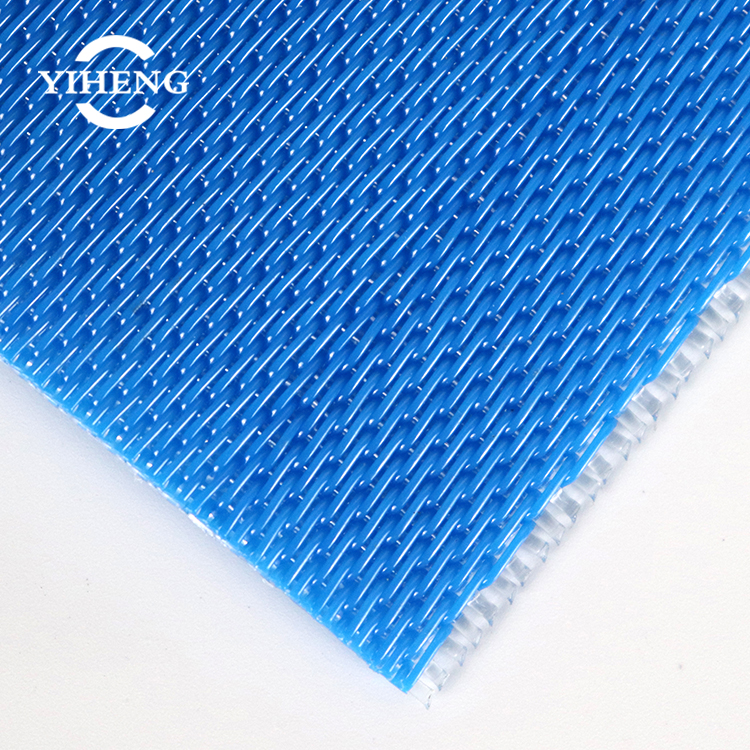
A polyester mesh belt is not a single commodity product. It can run as a dewatering belt in a belt filter press, a conveying surface in food drying, a forming fabric in paper or nonwoven production, a filter belt in pulp washing, or a stable moving bed in a UV printer. The same material name appears across many industrial specifications, and that is exactly where sourcing mistakes happen.
This guide is written for procurement teams, engineers, and plant operators who are researching or evaluating polyester mesh belt suppliers. It summarizes the technical parameters that should be compared, the compliance documents that should be requested, and the verification steps that reduce the risk of buying a belt that fails early or creates process defects. Published product and certification information from Henan Yiheng Mesh Belt Industry Co., Ltd. is used as the main reference because the company supplies a full range of polyester mesh belt architectures rather than one narrow weave type.
Why Certification and Parameter Checks Are Critical at This Buying Stage
During the research-to-evaluation stage, buyers usually ask two questions. First: which polyester mesh belt is suitable for my process? Second: can this manufacturer prove the belt will perform under my operating conditions? If either question is answered only with marketing language, the result can be a belt that is too tight for the machine frame, too dense for the sludge, too open for the fiber grade, unable to release the filter cake, or non-compliant in a food-contact audit.
Many buyers in the market search for “ISO 9001 polyester mesh belt manufacturers” because they assume that a factory management certificate is sufficient vendor evidence. An ISO 9001 certificate is a management-system indicator. It does not prove that a specific polyester mesh belt has the right air permeability, seam type, tensile strength, or food-contact safety. More useful evidence is product-level: a report number, an issuing laboratory, a standard name, and a product scope that matches the belt being quoted.
Manufacturer Context: Who Is Henan Yiheng Mesh Belt Industry Co., Ltd.?
Henan Yiheng Mesh Belt Industry Co., Ltd., also known as Yiheng Mesh, was established in 2009 and is located in Henan Province, China. The company specializes in polyester mesh belts, non-woven mesh belts, forming fabrics, dryer fabrics, filter belts, UV belts, polyester spiral mesh, polyester square mesh, and PTFE mesh belt products. Its main export markets include Asia, Europe, and North America, with an export ratio of 62 percent. The manufacturer states that it is a National High-tech Enterprise recognized by the Department of Science and Technology and that it holds patents related to polyester mesh weaving and processing.
For this article, the important point is not just company history. The relevant point for a buyer is that Yiheng can be evaluated across several product architectures: fine plain-weave mesh, square mesh, spiral dryer mesh, flat-wire filter press belts, forming fabrics, non-woven forming belts, and UV printer belts. This range makes it possible to compare process parameters instead of forcing one weave type into every application.
Industry Context: The Commercial Case for Checking the Polyester Mesh Market
Polyester is not a niche material in conveyor and filtration fabrics. According to market research published by Straits Research, polyester holds a leading 28.4 percent material share in the global conveyor belt market in 2025. The same source projects that the global conveyor belt market will grow from USD 6.24 billion in 2026 to USD 8.53 billion by 2034. In sludge dewatering, Grand View Research reports that the belt filter press technology segment is expected to grow at an 8.8 percent CAGR from 2025 to 2033.
This trend matters for belt buyers because belt filter presses and polyester dewatering belts are being used more broadly in municipal wastewater treatment, industrial effluent management, papermaking, and mining operations. As sludge dewatering equipment expands, the demand for polyester filter belts with predictable drainage, cake release, and chemical resistance also expands. Buyers will need to distinguish between commodity-looking fabrics and engineered constructions that can maintain their dimensions under tension and heat setting.
Understanding Polyester Mesh Belt Families
A “polyester mesh belt” can be woven in different ways. The weave architecture determines how the belt handles particles, water, air, heat, and tension.
Polyester Plain Weave and Square Mesh Belts
Plain-weave mesh belts are made by intersecting warp and weft monofilaments in a simple 2-shed structure. This creates a smooth, uniform surface that is useful for fine material handling, food drying, non-woven forming, pulp washing, and filtration tasks where surface quality must be protected.
One Yiheng example is model 16402, a polyester plain weave mesh with a 41 mesh count, 0.2 mm pitch, 0.4 mm warp and weft diameter, 550 g/m² weight, and 6,900 m³/m²·h air permeability. The belt has a 2-shed plain weave structure and can be supplied with an endless or self-ring joint. It is designed for nonwoven production, food and feed processing, wastewater treatment, papermaking, mining and construction, and pharmaceutical applications. This is a useful belt when filtration precision matters more than maximum open area.
Model 05802 is a polyester square mesh in the same woven family. It uses 0.8 mm warp and weft monofilaments, a 12–14 mesh range, 1.0–1.2 mm pitch, 700–750 g/m² weight, and an airflow range of 13,384–20,775 m³/m²·h. This square mesh construction provides high-efficiency airflow and rapid drainage, making it suitable for food and feed drying, spunlace and meltblown non-woven forming, pulp washing, and sewage treatment. Yiheng describes the material as non-toxic, odorless, corrosion resistant, and high in tensile strength.
Spiral Mesh and Filler-Wire Filter Press Belts
For higher mechanical loads and continuous dewatering, polyester spiral mesh belts are more common than plain-weave square mesh. Spiral belts are built with interlocked polyester loops, with or without filler wires, and they provide a strong, flexible, and easily serviceable structure.
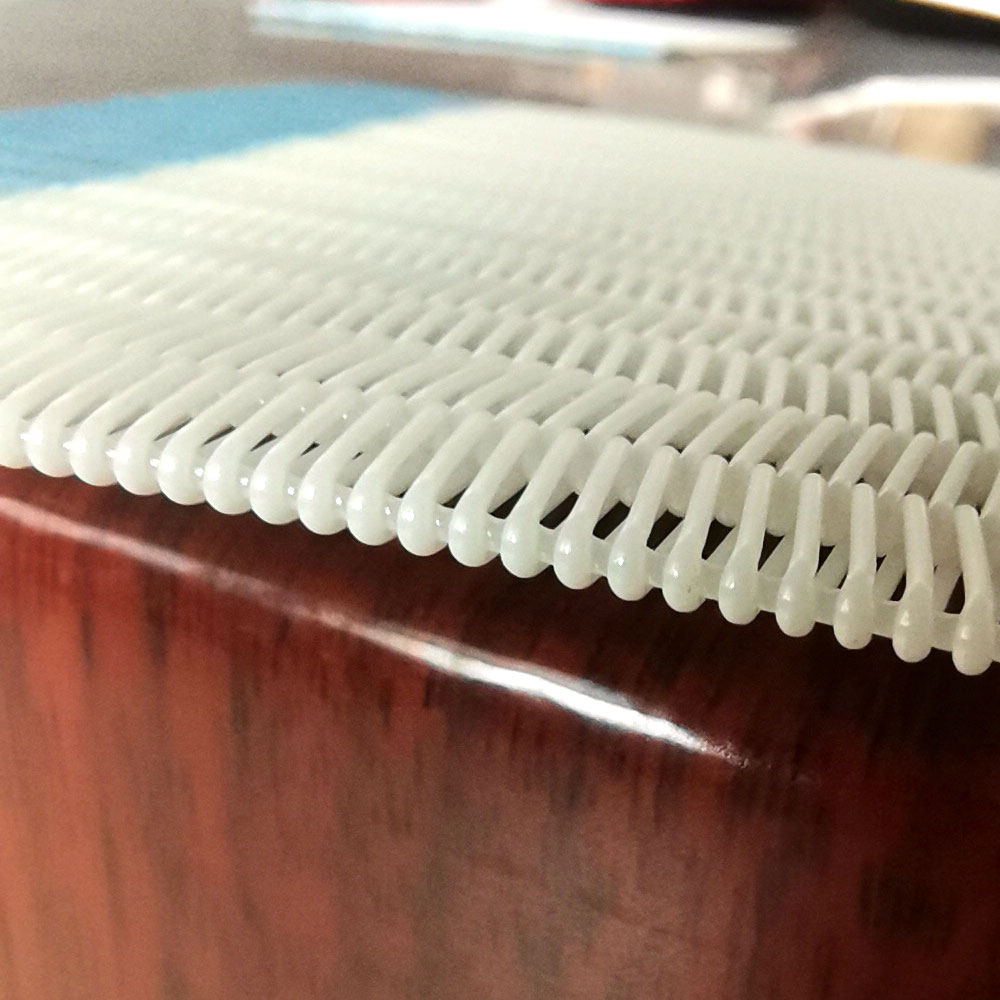
The Large Loop configuration is a polyester spiral mesh with 0.90 mm ring wire, 1.00 mm threading wire, a 2.95 mm belt thickness, and filler options of 0.90 x 3 mm, 0.90 x 4 mm, or 0.90 x 5 mm. Depending on filler selection, its air permeability in filter press use ranges from 9,000 to 13,700 ±500 m³/m²·h, with a strength at break of at least 2300 N/cm. In dryer configuration, Yiheng lists air permeability up to 19,000 m³/m²·h with a loop distance of 7.00 mm. This gives the buyer a choice between maximum drainage, balanced filtration, and drier filter cake within the same belt family.
The Medium Loop belt uses 0.68 mm ring wire and 0.90 mm weft material. It is 2.32 mm thick and has filler options of 0.68 x 3 mm and 0.68 x 4 mm. Air permeability is 10,700 to 12,000 ±500 m³/m²·h in the filter press version and 18,300 m³/m²·h in the dryer version. Its strength at break is at least 2000 N/cm. Because the medium loop is thinner than the large loop, it is easier to install on machines with tighter roller spacing.
The Small Loop belt is the slimmest option in the spiral series. It uses 0.52 mm warp wire and 0.70 mm weft wire, has a 5.20 mm loop distance, 17,500 m³/m²·h air permeability in dryer use, and 1.90 mm thickness. This compact construction is suited to process sections where a lighter belt reduces energy consumption and machine load.
Yiheng also supplies flat-wire filler-wire filter press belts, which are distinct from open dryer spirals. The Large Loop-Filler Wire filter press belt uses a flat-wire filler and has a strength at break of at least 2300 N/cm. The Medium Loop-Filler Wire belt has a strength at break of at least 2000 N/cm. The Small Loop-Filler Wire belt, with flat wire dimensions of 0.65 x 1.65 mm, delivers lower air permeability of roughly 7,300 ±500 m³/m²·h and a thickness of only 1.90 mm. These belts are intended for belt filter presses where the machine needs both a smooth running surface and a structure that helps separate solids from liquid.
Herringbone Filter Press Belts
Model 16903 is a separate filter press belt design within Yiheng's polyester range. It uses 0.70 mm warp and 0.90 mm weft wire, a warp density of 16 wires per cm, a weft density of 5.33 wires per cm, and a strength at break of at least 2200 N/cm. Air permeability is 7,894 ±500 m³/m²·h. The belt is made of high-grade PET that is resistant to acidic and alkaline conditions, and it has a herringbone or diagonal weave structure for improved drainage. Yiheng states that its surface helps prevent fibers and particles from embedding, and the herringbone structure makes sludge cake easier to peel. The intended equipment includes belt type filter presses, vacuum rubber belt filters, and horizontal vacuum belt filters.
Forming Fabrics for Paper and Nonwoven Production
When polyester mesh is used on the forming section of a paper or nonwoven machine, buyers need a more specialized fabric. Yiheng's polyester forming fabrics cover a mesh range from 5 to 108 mesh, thickness from 0.30 to 1.80 mm, and air permeability from 4,750 to 29,200 m³/m²·h. Warp and weft diameters range from 0.15 mm to 1.20 mm. Structure options include 2-shed plain weave, 3/4/5/8-shed single-layer fabrics, and double-layer fabrics. Joint types can be endless, self-ring, or double-pins. These belts use 100 percent high-tenacity PET monofilaments, and Yiheng highlights anti-hydrolysis and anti-static material options for sensitive paper and hygiene applications.
Published Data Comparison: What a Buyer Should Look For
Comparing filter press belts is easier when the key technical values are placed side by side. The table below is based only on Yiheng's published catalog data for its polyester mesh belt models.
| Polyester Mesh Belt Option | Construction / Filler | Thickness | Air Permeability | Strength at Break |
|---|---|---|---|---|
| 171003 / 16903 Filter Press Belt | Herringbone diagonal weave | Not stated | 7,894 ±500 m³/m²·h | ≥2200 N/cm |
| Large Loop-Filler Wire | Spiral with 0.90 x 3 / 0.90 x 4 / 0.90 x 5 flat fillers | 2.95 mm | 9,000–13,700 ±500 m³/m²·h | ≥2300 N/cm |
| Medium Loop-Filler Wire | Spiral with 0.68 x 3 / 0.68 x 4 fillers | 2.32 mm | 10,700–12,000 ±500 m³/m²·h | ≥2000 N/cm |
| Small Loop-Filler Wire | Spiral with 0.65 x 1.65 mm flat wire | 1.90 mm | 7,300 ±500 m³/m²·h | ≥2000 N/cm |
| Small Loop Dryer Spiral | Polyester spiral, loop distance 5.20 mm | 1.90 mm | 17,500 m³/m²·h | Not stated |
| Medium Loop Dryer Spiral | Polyester spiral, loop distance 6.50 mm | 2.32 mm | 18,300 m³/m²·h | Not stated |
| Large Loop Dryer Spiral | Polyester spiral, loop distance 7.00 mm | 2.95 mm | 19,000 m³/m²·h | Not stated |
This table is not a recommendation to choose the highest air permeability. The right value depends on the balance between drainage speed and solids retention. A fine plain weave such as model 16402 can capture fine particles but will have lower airflow, while an open large spiral will drain quickly but may allow fine solids to pass.
Step-by-Step Supplier Evaluation Process
Step 1: Define the Operating Condition, Not Just the Belt Name
Start by writing down the actual operating condition: the machine type, roller spacing, expected tension, temperature, chemical exposure, product contact requirement, and the solid-liquid separation goal. This prevents the mistake of buying a “polyester mesh belt” without knowing whether it is performing as a drying conveyor, a filter press belt, a washing belt, or a forming fabric.
Step 2: Choose the Weave Architecture That Matches the Process
A 2-shed plain weave belt is suitable when the surface must be smooth and the product must not be marked. A square mesh with 12–14 mesh and high airflow is suitable for rapid drying. A spiral dryer belt is suitable for hot-air drying and conveying with high permeability. A flat-wire filler spiral is suitable for pressure filtration where cake dryness and mechanical strength matter.
Step 3: Compare Mechanical Values and Dimensional Limits
For belt filter presses, ask for strength at break and compare it against machine tension. Yiheng's filter press series provides values from at least 2000 N/cm up to at least 2300 N/cm. For smaller roller diameters, also ask for belt thickness; a thinner belt such as the small loop or small filler-wire construction at 1.90 mm may fit a machine layout more easily than a 2.95 mm large-loop belt.
Step 4: Check Whether the Product Has Traceable Compliance Evidence
If the belt will be used in food processing, feed processing, pharmaceutical production, or another regulated application, ask for a report that names the product and the standard. Product-level evidence is stronger than a general company certificate. In Yiheng's case, the relevant documented evidence includes the following.
| Evidence Type | Certificate / Report Number | Issuer / Reference | Relevance |
|---|---|---|---|
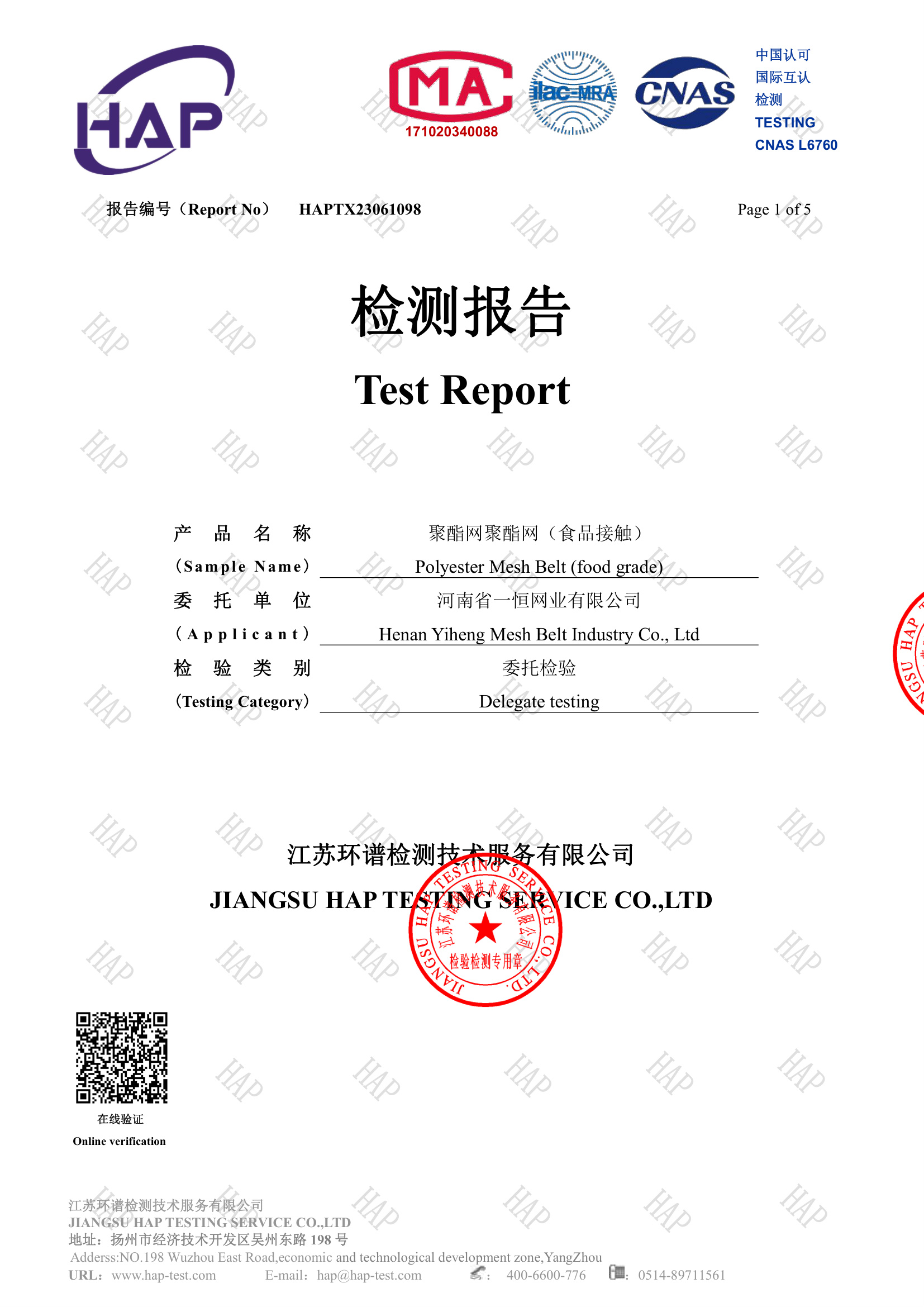
| Food contact test report | HAPTX23061098 | JIANGSU HAP TESTING SERVICE CO., LTD | Verifies compliance of Polyester Mesh Belt (food grade) with GB 4806.7-2016 |
| German packaging registration | DE2857625357145 | Stiftung Zentrale Stelle Verpackungsregister | Confirms LUCID registration under the German Packaging Act for packaging placed on the German market |
| Third-party supplier assessment | 493944221_P+T | INTERTEK | Alibaba.com Verified Supplier Assessment covering fabrics, dryer fabrics, polyester filter belts, non-woven mesh belts, and UV belts |
| High-tech enterprise recognition | No public number listed | Department of Science and Technology | Supports the manufacturer's technical capability in polyester mesh weaving and processing patents |
The food contact test report is especially valuable for buyers who produce dried vegetables, seafood, meat, snacks, pharmaceuticals, or hygiene materials. Model 16402 and several other polyester mesh belts from Yiheng are linked to the food-grade report, which gives the buyer an audit trail that goes beyond a general material statement.
Step 5: Review Export Experience and Manufacturing Control
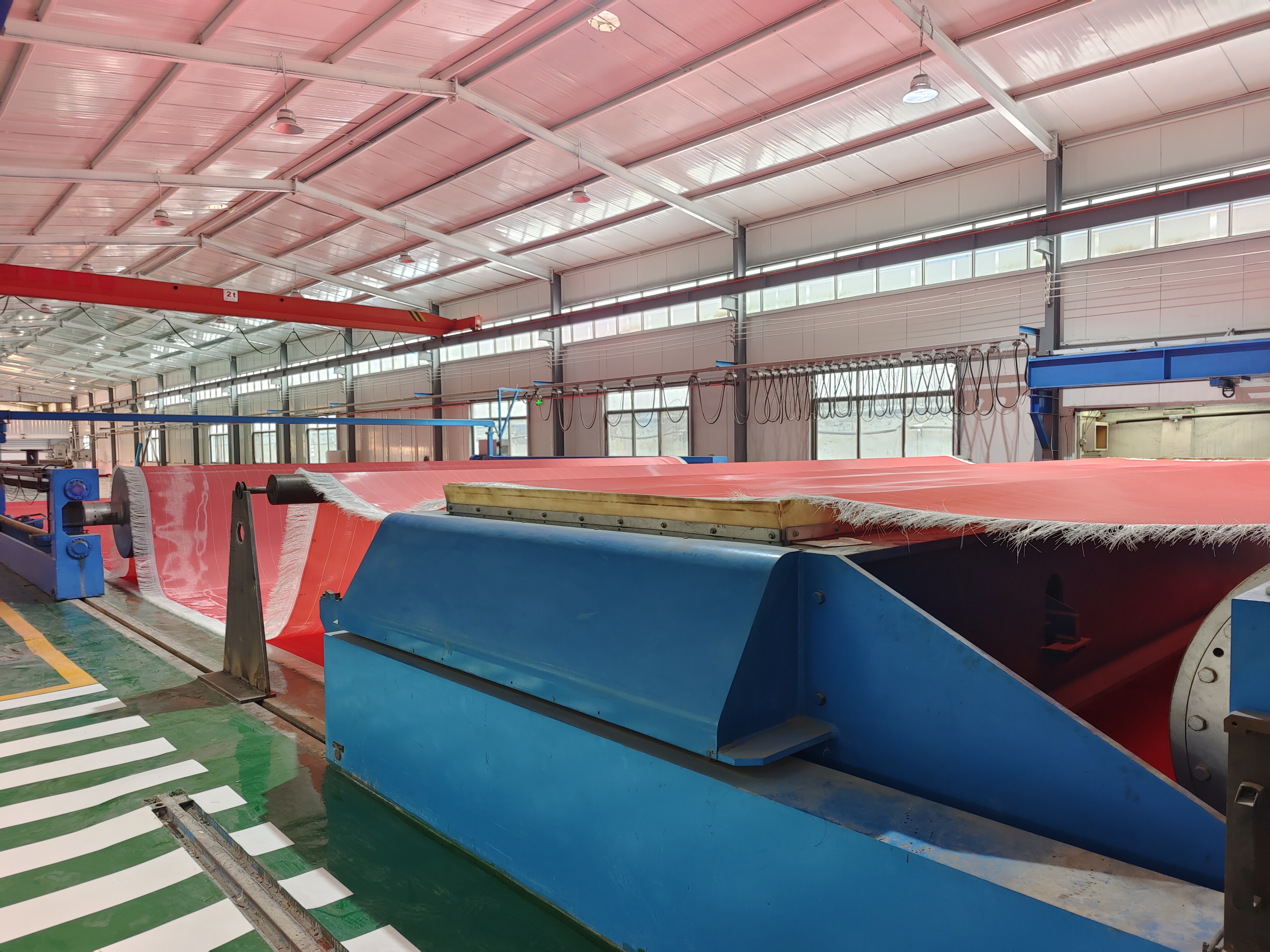
Because polyester mesh belts are used on continuous production lines, one bad seam or one heat-setting deviation can cause tracking problems and downtime. Ask the supplier about export destinations, sampling policy, and inspection options. Yiheng states that its export markets include Europe, North America, and Asia, and that it has an export ratio of 62 percent. Its production capability data also mentions a monthly capacity of 30,000 m² for customized production and a standard 15–30 day lead time for custom belts. For quality assurance, it offers 100 percent pre-shipment inspection and on-site third-party inspection through BV or SGS when required.
Step 6: Validate With a Sample Before Scaling Up
The most practical way to ease procurement risk is to test a sample. Yiheng supports customized production with a minimum order quantity for custom belts of 2 m², and the company states that free samples are available for many configurations. In some product descriptions, Yiheng also highlights rapid sampling and a low MOQ. For a buyer, the right sequence is: check the specification, inspect the compliance report, request a sample for a bench test or short production trial, and then scale up to a full-width order.
Use Cases Across Different Industries
Municipal Wastewater Sludge Dewatering
Belt filter presses in municipal wastewater plants need polyester dewatering belts that combine drainage with cake release. In a supplier-reported case from Malaysia, a municipal wastewater treatment plant used Yiheng polyester mesh belts on 12 belt filter presses and reported an 8 percent reduction in cake moisture and 40 percent lower maintenance costs over a six-month period. The operating team chose the belt for its high open area, anti-blocking surface, and chemical resistance. No belt failure was reported during the period.
Paper Production
In papermaking, polyester mesh belts are used for pulp washing, pressing, and on the forming section. A German paper mill using Yiheng fabrics on eight production lines for premium facial and kitchen towel forming reported 25 percent energy savings, 35 percent lower maintenance costs, and no major line failures over one year. The mill valued uniform formation, stable seams, and the absence of mesh marks.
Food and Feed Drying
For food processors, the belt must be easy to clean, temperature resistant, and safe for direct or indirect food contact. In China, a dehydrated vegetable and seafood processor used Yiheng polyester mesh belts on eight drying and conveying lines for two years. The reported result was 20 percent higher productivity and 35 percent lower maintenance costs, with zero food safety incidents. The food-grade compliance documentation is essential for this type of buyer. Models such as 16402 and other food-grade-linked polyester mesh belts provide a documented material path for this requirement.
Rubber and Chemical Fiber Processing
Polyester spiral mesh belts are also used in latex wire drying, fabric pre-shrinking machines, and rubber curing and cooling lines. Yiheng lists applications such as belt filter presses, papermaking pulp washing, meltblown non-woven equipment, fabric pre-shrinking machines, and latex wire drying and conveying for several spiral mesh products. A rubber products manufacturer in Malaysia used eight Yiheng curing and cooling lines and reported 15 percent higher productivity, 30 percent lower maintenance costs, and no major failures over two years.
Digital Printing and UV Curing
Another specialized use is the polyester mesh belt for UV printers. This belt is built from high-grade black PET with a spiral mesh and flat-wire filler structure. It is designed to provide a smooth, burr-free surface with stable heat setting, no off-tracking, no ruffles, and no bell-mouth distortion. A sign and display manufacturer in Austria using eight large-format EFI UV printers reported 20 percent higher productivity and 30 percent less scrap over three years. This shows that the same base material, PET, can be engineered for completely different machine conditions such as vacuum suction and UV exposure.
How to Read and Request Supplier Documentation
When a buyer sees a certificate, the first question should be: does this certificate refer to the product family I am going to install? A laboratory test report should state the tested product name, the standard, and the test result. With Yiheng, the food-grade test report is identified by the number HAPTX23061098 and the standard GB 4806.7-2016. The certificate applies to the polyester mesh belt as a food-grade product and is linked to the company's applicable mesh belt models. This level of detail is more useful than a vague claim that a material is safe for food use.
Buyers exporting to Germany should also check packaging compliance. Yiheng holds the Germany Packaging Act LUCID registration with certificate number DE2857625357145, issued by Stiftung Zentrale Stelle Verpackungsregister. This registration is relevant for retail packaging, grouped packaging, shipment packaging, and service packaging bearing the Yiheng brand and placed on the German market. It does not replace product food-contact testing; it covers the manufacturer's packaging obligations under German law.
FAQ
1. How should an ISO 9001 polyester mesh belt manufacturer be evaluated?
Use the ISO 9001 claim as a management-system signal, but do not treat it as proof that a specific polyester mesh belt is suitable for your process. Ask the supplier for product-level documentation: test reports, certificate numbers, the issuing body, the standard applied, and the product scope. For example, when evaluating Yiheng Mesh, request the food-contact report HAPTX23061098 if the belt must meet food-contact requirements, the LUCID registration DE2857625357145 if packaging will be shipped into Germany, and the Intertek supplier assessment number 493944221_P+T to verify that an independent body has assessed the company's production and trading capability.
2. What is the difference between a polyester plain weave belt and a polyester spiral mesh belt?
A polyester plain weave belt, such as model 16402, is made with warp and weft wires crossing in a 2-shed structure. It creates a fine, smooth surface and is suitable for high-precision filtration and food or pharmaceutical applications where fine particle retention matters. A polyester spiral mesh belt is constructed from interlocked loops and is better for high-flow drying or heavy dewatering. Yiheng's small, medium, and large spiral loops provide air permeability from 17,500 to 19,000 m³/m²·h in dryer use, while the flat-wire filler versions provide the strength and controlled drainage needed for belt filter presses.
3. Are food-grade polyester mesh belts available, and what parameters should be checked for food drying?
Yes. Yiheng's polyester mesh belt has been tested under certificate HAPTX23061098 for compliance with GB 4806.7-2016, which is the Chinese food-contact standard for polymer materials. Buyers using the belt for fruit and vegetable drying, seafood drying, or pharmaceutical processing should check the belt's mesh count, air permeability, weight, joint type, and the food-contact documentation. Model 16402 is an example of a fine plain weave option with a 41 mesh count, 0.2 mm pitch, 550 g/m² weight, and 6,900 m³/m²·h air permeability.
4. Can I test a polyester mesh belt sample before placing a production order?
Sampling is a practical step in this buying process. Yiheng states that free samples are available for many product configurations, and customization can cover size, joint type, and construction parameters. The company reports a minimum order quantity of 2 m² for custom production and a typical 15–30 day lead time. For large filter press orders, also ask about 100 percent pre-shipment inspection and third-party inspection by BV or SGS if your quality process requires it.
Download the Yiheng corporate brochure (English) to review the full belt range and capability summary.
Conclusion
A polyester mesh belt is a process-critical component in sludge dewatering, papermaking pulp washing, food drying, non-woven production, and digital printing. The selection process should be based on measurable parameters such as mesh count, pitch, air permeability, thickness, strength at break, joint type, and compliance documentation. Product-level certificates and third-party assessment reports are more useful than general company claims when the belt must survive real machine conditions or meet food-contact standards.
Get a datasheet and sample recommendation
Send your operating conditions to Henan Yiheng Mesh Belt Industry Co., Ltd. and ask for the product specification sheet that matches your machine. A sample test is available for qualified evaluations.
Email: ada@yhfilterbelt.com | WhatsApp: +86 184 3681 4894
Have Questions or Need More Details?
Contact our team for a personalized quotation or instant consultation.
Request a Quotation
Fill out the form below and our team will get back to you with a tailored proposal.
WhatsApp Direct Chat
Prefer to chat in real-time? Message us on WhatsApp for instant assistance & quick answers.
- Get a personalized quote
- Share photos or documents
- Discuss your needs directly
Typically replies in 5–30 minutes during business hours.