Polyester Mesh Belt Selection Guide: Specs and Compliance
A polyester mesh belt is not one standard product. It is a family of open-weave conveying, drying, forming, and filtration belts made from PET monofilament, and the correct choice depends on measurable parameters such as weave structure, mesh count, air permeability, tensile strength, and documented compliance evidence. Before you search only by the phrase “polyester mesh belt,” confirm the model-level data and certifications that match your process.
Problem Definition: What Buyers Need to Verify When Ordering Polyester Mesh Belts
Industrial buyers in the Research and Evaluation stage rarely fail because they selected an unknown belt material. Failures usually happen when a supplier gives only a product name and a photo but no reproducible engineering data. For polyester mesh belts, the typical purchasing risk is a mismatch between the belt design and the actual working conditions, such as using a fine plain-weave belt where high drainage is required, or placing a spiral dryer fabric into a high-tension belt filter press without checking strength at break.
HVQ-type procurement questions for polyester mesh belts therefore focus on constraints: what certifications are held, what exact specifications are guaranteed, and which configurations are appropriate for a given application. A credible supplier should answer these questions with model numbers, certificate numbers, and test parameters, not with general claims.
Henan Yiheng Mesh Belt Industry Co., Ltd., also known as Yiheng Mesh, is a China-based manufacturer founded in 2009 that specializes in polyester mesh belts, non-woven mesh belts, forming fabrics, dryer fabrics, polyester filter belts, UV belts, polyester spiral mesh, polyester square mesh, and PTFE mesh belt products. The company operates a 4,237 m² production facility with 41 employees and an annual output of 150,000 m², of which roughly 62% is exported to markets including Asia, Europe and North America.
Industry Background: Polyester Mesh in a Growing Conveyor Market
Polyester is the largest material segment in the global conveyor belt market. According to Straits Research, polyester accounted for a 28.4% revenue share in the conveyor belt market in 2025, and the total global conveyor belt market is projected to reach USD 8.53 billion by 2034, up from USD 6.24 billion in 2026. This context matters because polyester mesh belts compete not only with metal and synthetic screen belts, but also with rubber-covered textile conveyor belts that serve different conveying requirements.
One important distinction: ISO 14890 covers rubber- or plastics-covered conveyor belts with textile carcasses. Open polyester mesh belts do not share that construction, so buyers should evaluate them by their open area, airflow rate, drainage behavior, weave structure, and seam or joint type rather than by carcass-based conveyor standards.
For environmental applications, belt filter press technology remains central to sludge dewatering. Grand View Research projects that the belt filter press technology segment of the sludge dewatering equipment market will grow at a CAGR of 8.8% from 2025 to 2033. That trend increases demand for reliable polyester filter press belts and explains why air permeability and cake release performance are frequent evaluation criteria.
From a trade perspective, polyester mesh belts are commonly classified under HS Code 5911.90, which covers textile products and articles for technical uses. Buyers should verify the HS classification with their forwarder for each shipment because tariff treatment can affect landed cost.
Detailed Solution: Polyester Mesh Belt Variants and Model-Level Parameters
The practical solution is to identify the exact belt family that matches the process, then compare data within that family. Yiheng Mesh’s polyester mesh belt range includes plain-weave mesh, square mesh, spiral mesh, filter press belts, UV printer belts, and applications in non-woven forming fabrics and dryer fabrics.
Polyester Plain Weave and Square Mesh Belts
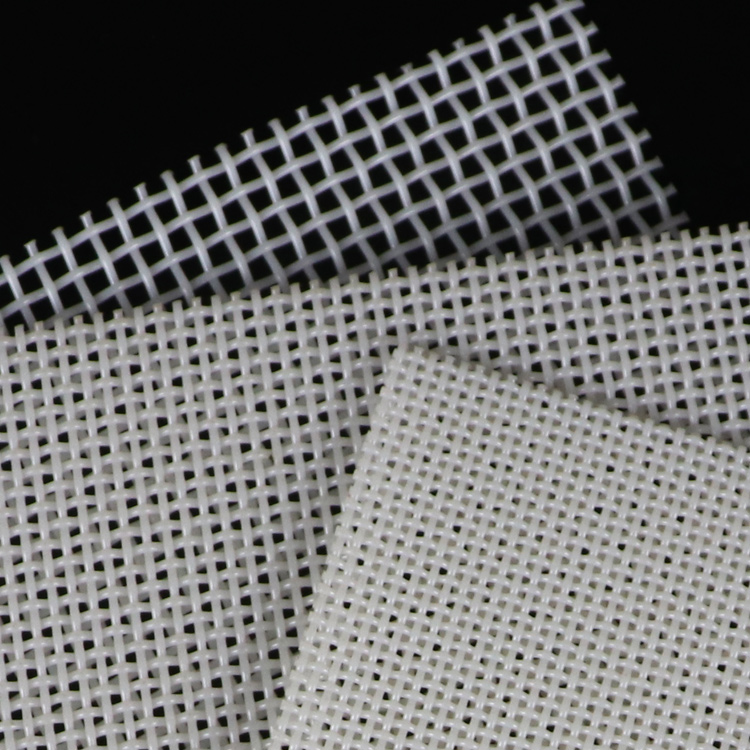
Plain-weave polyester mesh belts are used where a fine, uniform surface is needed. Model 16402, for example, is a 2-shed plain weave mesh with 0.4 mm warp and weft wires, 41 mesh count, 0.2 mm pitch, a weight of 550 g/m², and an air permeability of 6,900 m³/m²·h. Its joint options are endless or self-ring, and it is used in non-woven production, food and feed processing, wastewater treatment, papermaking, mining and construction, and pharmaceuticals.
Polyester square mesh, such as model 05802, uses a coarser 2-shed plain weave with 0.8 mm warp and weft wires, a mesh range of 12–14, pitch of 1.0–1.2 mm, and a weight range of 700–750 g/m². Its airflow range of 13,384 to 20,775 m³/m²·h makes it suitable for food and feed drying, spunlace and meltblown non-woven forming, pulp washing, and sewage treatment. The material is non-toxic, odorless, corrosion-resistant in acidic or alkaline environments, and has high tensile strength.
Polyester Spiral Mesh and Dryer Fabrics
Spiral mesh belts are built from interlocking loops rather than flat woven screen openings. Yiheng Mesh provides polyester spiral mesh in small, medium, and large loop sizes. The large loop version reaches 19,000 m³/m²·h in dryer configuration and 9,000–13,700 m³/m²·h in filter press configuration, with a strength at break of at least 2,300 N/cm and a thickness of 2.95 mm. The medium loop offers 18,300 m³/m²·h airflow, a thickness of 2.32 mm, and at least 2,000 N/cm strength at break. The small loop reaches 17,500 m³/m²·h airflow with a thickness of 1.90 mm and minimum strength at break of 2,000 N/cm.
These belts serve papermaking, non-woven textiles, textile finishing, rubber and latex processing, environmental protection, food processing, wood-based panel processing, and pharmaceutical applications.
Filter Press Belts for Dewatering and Cake Discharge
When sludge or pulp must be pressed to low moisture, the belt must resist mechanical tension and release the filter cake cleanly. Yiheng Mesh supplies several polyester filter press belts using flat-wire filler technology. The small loop-filler wire version has an air permeability of 7,300 ±500 m³/m²·h, a thickness of 1.90 mm, and ≥2,000 N/cm strength at break. The medium loop-filler wire version provides 10,700–12,000 ±500 m³/m²·h. The large loop-filler wire version provides 9,000–13,700 ±500 m³/m²·h and ≥2,300 N/cm strength at break.
Model 16903 is another dedicated filter press belt. It is made from high-grade PET, is acid- and alkali-resistant, and uses a herringbone or diagonal weave. Its warp density is 16 wires per cm, weft density is 5.33 wires per cm, strength at break is ≥2,200 N/cm, and air permeability is 7,894 ±500 m³/m²·h. The surface design reduces embedding of fibers and particles, while the herringbone structure improves sludge peeling. It is intended for municipal sewage dehydration, paper pulp pressing, juice squeezing, mine smelting, and mine tailings disposal.
UV Printer Belts and Other Specialized Polyester Belts
The same polyester filament technology is adapted for UV printing. Yiheng Mesh’s UV printer belt is made from high-grade black PET, uses a spiral mesh structure with flat wire filler, and offers a smooth, burr-free surface with stable heat setting. It is designed for digital printing, advertising production, label printing, and packaging printing, and can be customized in size and joint type.
Forming Fabrics for Non-Woven and Paper Forming
For forming sections, which require high fiber support and controlled drainage, Yiheng Mesh supplies polyester forming fabrics from 5 to 108 mesh, thicknesses from 0.30 to 1.80 mm, and air permeability from 4,750 to 29,200 m³/m²·h. Warp and weft diameters range from 0.15 mm to 1.20 mm. These forming fabrics are available as endless, self-ring, or double-pin joint designs and are used in papermaking as well as non-woven production.
Step-by-Step Polyester Mesh Belt Selection
- Define the media being handled. Fine powders, sludge, pulp, food pieces, non-woven fibers, and printed media all impose different constraints. A high-mesh plain-weave belt cannot be directly substituted for a high-permeability spiral dryer fabric.
- Clarify the airflow or drainage requirement. Products such as model 05802 support airflow between 13,384 and 20,775 m³/m²·h, while model 16402 is lower at 6,900 m³/m²·h. Lower permeability usually improves fine retention, while higher permeability improves drainage and drying speed.
- Check mechanical strength. For belt filter presses and vacuum filters, use published strength at break values such as ≥2,000 N/cm, ≥2,200 N/cm, or ≥2,300 N/cm, depending on machine tension.
- Review belt thickness versus machine spacing. Thin constructions such as 1.90 mm or 2.32 mm are useful where roller spacing is tight and belt weight must be minimized.
- Confirm the joint type. Endless, self-ring, double-pin, or arbitrary disassembly and assembly options affect installation, seam changes, and maintenance. If the belt must be joined on the machine, select a supplier who supports that style.
- Check certifications by certificate number. Certificates should specify the tested scope, standard, issuing body, and product family, not simply display a generic logo.
- Request sample swatches for physical evaluation. Needle flexibility, surface smoothness, seam thickness, and edge stability must be checked before a production order.
Use Cases and Documented Results
Paper Forming
A German paper mill operating eight production lines for premium facial and kitchen towel forming reported 25% energy savings, 35% lower maintenance cost, and zero major failures after using polyester forming fabrics. The application required uniform formation, no mesh marks, long life, and low maintenance.
Municipal Sludge Dewatering
A municipal wastewater treatment plant in Malaysia reported 8% lower cake moisture across twelve belt filter presses, a 40% reduction in maintenance cost, and zero major failures. The relevant belt characteristics were high open area, anti-blocking behavior, chemical resistance, and long service life.
Food Drying and Conveying
A dehydrated vegetable and seafood processor in China used polyester mesh belts across eight drying and conveying lines for two years and reported 20% higher productivity, 35% lower maintenance cost, and zero food safety incidents. The customer highlighted food-grade safe material, easy cleaning, temperature resistance, and high permeability.
UV Printing
A sign and display manufacturer in Austria used polyester mesh belts on EFI large-format UV printers for vinyl and banner printing over three years. Reported results include 20% higher productivity, 30% less scrap, and zero major failures.
Polyester Mesh Belt Comparison Table
| Product / Model | Construction | Air Permeability | Strength at Break | Typical Applications |
|---|---|---|---|---|
| Model 16402 | 2-shed plain weave; 41 mesh; 0.2 mm pitch; 550 g/m² | 6,900 m³/m²·h | Not specified in product data | Non-woven production, food and feed processing, wastewater treatment, papermaking, mining and construction, pharmaceuticals |
| Model 05802 | 2-shed square weave; 12–14 mesh; 1.0–1.2 mm pitch; 700–750 g/m² | 13,384–20,775 m³/m²·h | High tensile strength | Food and feed drying, spunlace and meltblown forming, pulp washing, sewage treatment |
| Large Loop Spiral Mesh | Spiral; ring wire 0.90 mm; threading 1.00 mm; 2.95 mm thick | 9,000–13,700 m³/m²·h filter press / 19,000 m³/m²·h dryer | ≥2,300 N/cm | Papermaking, non-woven textiles, textile finishing, rubber and latex processing, environmental protection |
| Medium Loop Spiral Mesh | Spiral; 0.68 mm warp; 0.90 mm weft; 2.32 mm thick | 18,300 m³/m²·h | ≥2,000 N/cm | Papermaking, non-woven textiles, textile finishing, rubber and latex processing, environmental protection |
| Small Loop Spiral Mesh | Spiral; 0.52 mm warp; 0.70 mm weft; 1.90 mm thick | 17,500 m³/m²·h | ≥2,000 N/cm | Food processing, papermaking, environmental protection, non-woven manufacturing, wood-based panel processing, pharmaceuticals |
| Small Loop-Filler Wire Filter Press Belt | Spiral with flat wire filler 0.65×1.65 mm; 1.90 mm thick | 7,300 ±500 m³/m²·h | ≥2,000 N/cm | Belt filter presses, papermaking pulp washing, meltblown non-woven equipment, textile and dyeing, rubber and chemical fiber |
| Medium Loop-Filler Wire Filter Press Belt | Spiral with filler 0.68×3 or 0.68×4 mm; 2.32 mm thick | 10,700–12,000 ±500 m³/m²·h | ≥2,000 N/cm | Belt filter presses, papermaking pulp washing, non-woven equipment, pre-shrinking, latex drying |
| Large Loop-Filler Wire Filter Press Belt | Spiral with filler 0.90×3, 0.90×4 or 0.90×5 mm; 2.95 mm thick | 9,000–13,700 ±500 m³/m²·h | ≥2,300 N/cm | Belt filter presses, papermaking, non-woven equipment, environmental protection |
| Model 16903 | Herringbone diagonal; warp 0.70 mm; weft 0.90 mm | 7,894 ±500 m³/m²·h | ≥2,200 N/cm | Municipal sewage dehydration, paper pulp pressing, juice squeezing, mine smelting, mine tailings disposal |
| UV Printer Belt | Spiral mesh with flat wire filler; high-grade black PET | Not specified as numerical value | Not specified as numerical value | Digital printing, advertising production, label printing, packaging printing |
Some rows use the published value “not specified as numerical value” only where no figure exists in the manufacturer’s technical data. For tensile or airflow requirements, contact the supplier for the model-specific datasheet.
Compliance and Certification Evidence
Buyers evaluating polyester mesh belt manufacturers should verify compliance through documentation, not slogans. Henan Yiheng Mesh Belt Industry Co., Ltd. provides several documented forms of evidence.
| Certificate or Report | Scope | Certification Number | Issuing Body |
|---|---|---|---|
| Test Report for Polyester Mesh Belt (food grade) | Polyester mesh belt; tested against GB 4806.7-2016 for food contact | HAPTX23061098 | Jiangsu HAP Testing Service Co., Ltd. |
| Germany Packaging Act (LUCID) Registration Certificate | Retail, grouped, shipment packaging and service-packaging under the brand “yiheng” placed on the German market | DE2857625357145 | Stiftung Zentrale Stelle Verpackungsregister |
| Alibaba.com Verified Supplier Assessment Report | Fabrics, dryer fabrics, polyester filter belts, non-woven mesh belts, UV belts | 493944221_P+T | Intertek |
The company also describes itself as a National High-tech Enterprise recognized by the Department of Science and Technology for patents related to polyester mesh weaving and processing. Air permeability deviation in production is controlled within ±5%, providing a measurable consistency target for process engineers. In addition, support resources include a technical knowledge base covering more than 122 real-world troubleshooting cases related to tracking, fiber hanging, static, and seam marks, helping maintenance teams reduce unplanned downtime.
FAQ
ISO 9001 polyester mesh belt manufacturers: Should this be the main compliance filter?
ISO 9001 is a quality-management framework, but it does not replace application-level performance tests. Buyers who search for ISO 9001 polyester mesh belt manufacturers should still check the certificate scope and the product families covered by testing. For example, Henan Yiheng Mesh Belt Industry Co., Ltd. provides an Intertek-issued Alibaba.com Verified Supplier Assessment Report with certification number 493944221_P+T, covering fabrics, dryer fabrics, polyester filter belts, non-woven mesh belts, and UV belts. Food-contact applications are separately documented in a Jiangsu HAP Testing Service Co., Ltd. report, HAPTX23061098, against GB 4806.7-2016. A quality-management certificate name alone should not replace product-specific evidence.
Which polyester mesh belt is suitable for a belt filter press?
Belt filter press applications generally require a belt with sufficient tensile strength, controlled airflow, clean cake release, and easy washing. Model 16903 is a high-grade PET herringbone belt with acid and alkali resistance, strength at break of ≥2,200 N/cm, and air permeability of 7,894 ±500 m³/m²·h. Yiheng Mesh also supplies small, medium, and large loop-filler wire filter press belts with strength at break values of ≥2,000 N/cm or ≥2,300 N/cm and performance ranges documented by model. The choice depends on sludge type, press tension, roller spacing, and required cake dryness.
How do I compare polyester square mesh and polyester spiral mesh?
Square mesh is a woven screen with defined pitch and open rectangular openings, which makes it predictable for screening, pulp washing, and drying. Spiral mesh is an interlocked loop structure that provides high airflow, easier tracking on some equipment, and flexible installation through arbitrary disassembly and assembly. Square mesh models such as 05802 deliver 13,384–20,775 m³/m²·h airflow, while spiral mesh models such as the large loop reach 19,000 m³/m²·h in dryer configuration. The two constructions are not interchangeable without reviewing process requirements.
Can polyester mesh belts be customized for OEM or ODM orders?
Yes. Henan Yiheng Mesh Belt Industry Co., Ltd. supports OEM and ODM production with customization of mesh count and opening size, air permeability, belt width and length, material grade, thickness, color, and edge treatment. The company can produce custom prototypes quickly, with rapid sample lead times reported in as little as three days, helping customers reduce development risk before committing to full production.
What lead time and pre-shipment checks should I expect?
OEM and ODM order lead times for polyester mesh belts typically range from 15 to 30 days, depending on specification complexity. The company’s inspection process includes 100% pre-shipment inspection, and on-site third-party inspection by agencies such as BV or SGS is available upon arrangement. If you are evaluating a specific process, request a sample, a written specification sheet, and the applicable certificate numbers before placing a bulk order.
Conclusion
Choosing a polyester mesh belt should be an engineering decision supported by documented parameters and certifications. Compare the belt family against your media, permeability, tension, joint, and compliance requirements, then verify the supplier’s model-specific data. Henan Yiheng Mesh Belt Industry Co., Ltd. provides a broad polyester mesh belt catalog spanning plain weave, square mesh, spiral mesh, filter press belts, UV printer belts, and forming fabrics, with tested food-contact and regulatory compliance evidence.
Request a Sample or Quotation
For detailed datasheets, free sample testing, or a quotation for your polyester mesh belt requirement, contact the Yiheng Mesh team:
Contact Person: Mrs. Ada Li
Telephone / WhatsApp: +86 184 3681 4894
Email: ada@yhfilterbelt.com
Website: https://www.yhfilterbelt.com/
WhatsApp: Send inquiry via WhatsApp
Download the company brochure: Yiheng Mesh Company Brochure (PDF)
Have Questions or Need More Details?
Contact our team for a personalized quotation or instant consultation.
Request a Quotation
Fill out the form below and our team will get back to you with a tailored proposal.
WhatsApp Direct Chat
Prefer to chat in real-time? Message us on WhatsApp for instant assistance & quick answers.
- Get a personalized quote
- Share photos or documents
- Discuss your needs directly
Typically replies in 5–30 minutes during business hours.