Polyester Mesh Belts Explained: From Spiral Construction to Industrial Use
A polyester mesh belt is an endless belt woven from high-tenacity polyester (PET) monofilament and used on industrial machines to convey, drain, press, dry or filter material. The version most first-time buyers meet is the polyester spiral mesh belt: monofilaments are wound into helical loops, the loops are interlinked, and a threading wire runs through the series to lock the belt into a continuous surface. That loop geometry — not the word “polyester” — decides how open the belt is, how much tension it carries, and how quickly it can be installed or taken off.
The short answer
- What it is: a woven polyester monofilament belt, normally supplied endless and closed by a threading wire.
- Main builds: spiral mesh (Small Loop, Medium Loop, Large Loop, with or without filler wires), square mesh, and plain weave mesh.
- Openness: air permeability from roughly 7,300 m³/㎡·h to 18,300 m³/㎡·h across common spiral builds, depending on loop distance and filler wires.
- Strength: break strength of ≥2,000 N/cm to ≥2,300 N/cm on filler-wire filter press builds.
- Core industries: environmental protection, papermaking, rubber and latex processing, and nonwoven textiles.
This explainer is written for buyers at the evaluation stage who already know they need a mesh belt but are not yet sure what they are specifying. It walks through the construction, the numbers that matter, the industries that use these belts, and the questions worth asking a supplier before an order is placed.
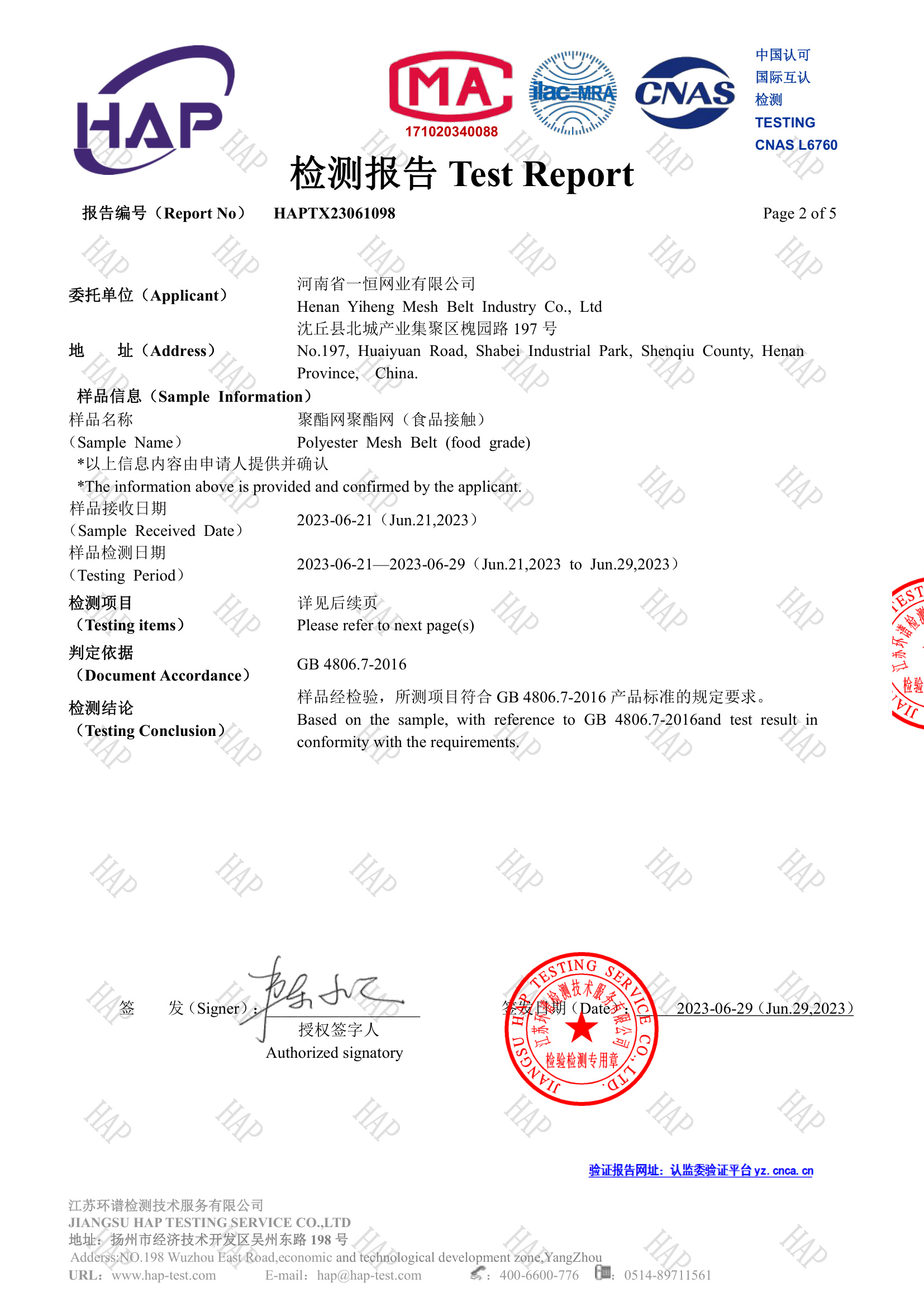
Henan Yiheng Mesh Belt Industry Co., Ltd. (Yiheng Mesh) is a polyester mesh belt manufacturer founded in 2009 in Henan, China. Its product range covers polyester mesh belts, nonwoven mesh belts, forming fabrics, dryer fabrics and polyester filter belts, and the company reports a 62% export ratio with Asia, Europe and North America as its main markets.
What a Polyester Mesh Belt Actually Is
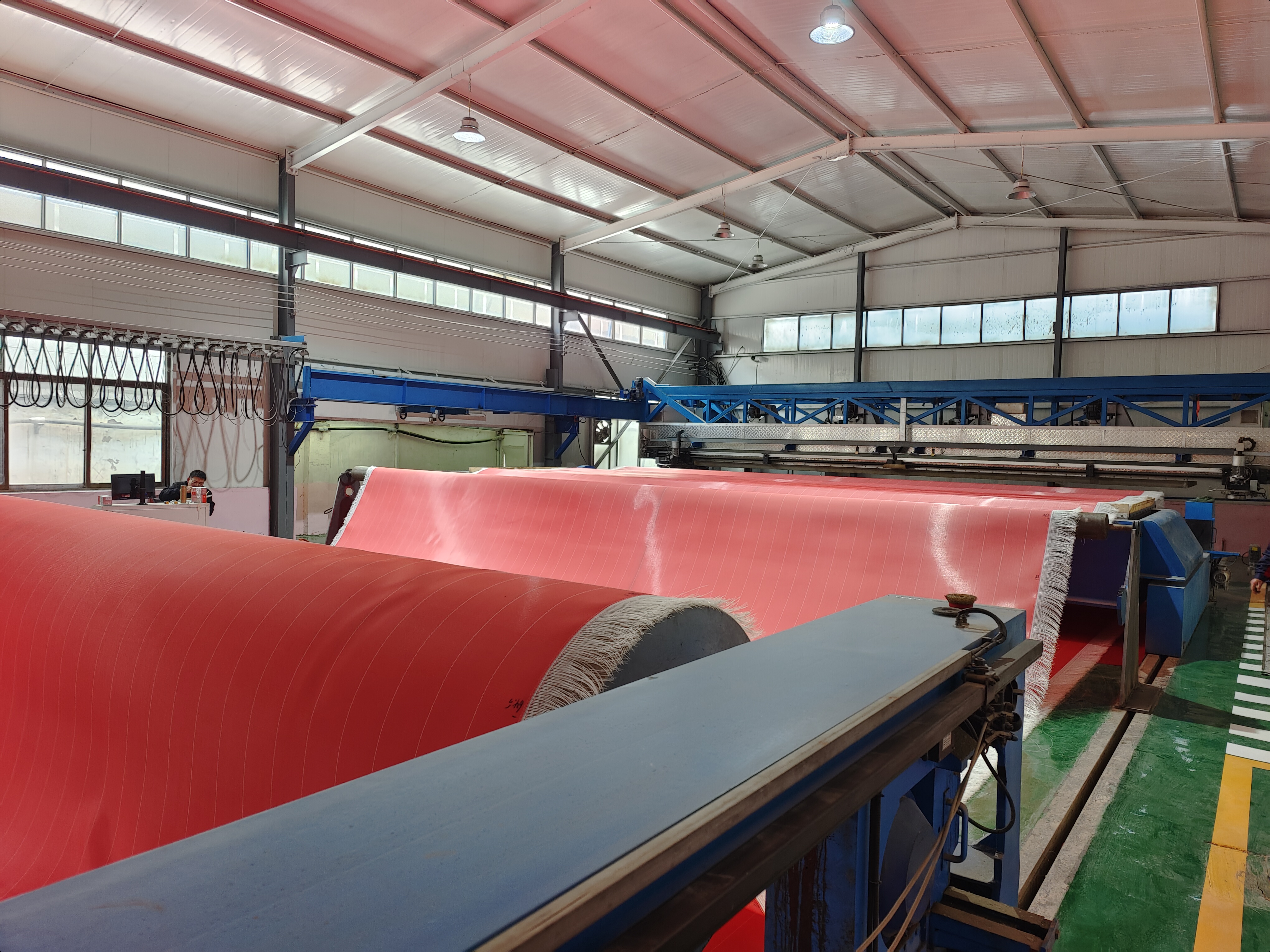
A polyester mesh belt is a textile engineering component rather than a commodity accessory. It is woven from polyester monofilament, heat-set to hold its dimensions, and joined into an endless loop that runs on the machine like a conveyor. Two properties separate it from a solid rubber belt: the belt is permeable, so air, water and vapour pass through the weave, and the belt is open, so the surface can be cleaned and the material being carried can be drained or dried from both sides.
The same product name covers several distinct constructions. A spiral mesh belt is built from helical loops. A polyester square mesh belt (for example model 05802) uses a 2-shed plain weave with 0.8 mm warp and weft, a mesh range of 12–14 and a weight of 700–750 g/m². A polyester plain weave mesh belt (for example model 16402) uses 0.4 mm warp and weft, 41 mesh, a 0.2 mm pitch and 550 g/m². All three are sold as “polyester mesh belt”, and all three behave differently on the machine.
The First-Time Buyer Problem: One Name, Many Belts
The core difficulty is that catalogues index these belts by weave name, while production problems are caused by weave behaviour. A buyer who orders “a polyester mesh belt” against a width and length only has not specified the two variables that control performance: how open the belt is, and how much load it can carry before it stretches.
Three failure patterns follow from this gap.
- Wrong open area. A belt that is too tight for a sludge dewatering duty holds water and produces a wetter cake; a belt that is too open on a drying line lets fine material pass through or dries unevenly. Air permeability, expressed in m³/㎡·h or in CFM at 127 Pa, is the number that controls this, and it changes with loop distance and filler wires.
- Wrong strength for the pressure. On a belt filter press the belt is squeezed between rollers. Plain spiral builds are quoted without a break-strength figure, while filler-wire builds are rated at ≥2,000 N/cm to ≥2,300 N/cm. Selecting a light build for a high-pressure zone shortens service life.
- Documentation gaps. Importers increasingly need food-contact evidence, packaging registration for the destination market, and a correct customs classification. These are supplied as documents, not as product features, so they have to be requested early.
A practical rule: specify the belt by duty first — dewatering, drying, cooling, conveying or filtration — then by loop or mesh geometry, then by dimensions. Reversing that order is the most common cause of a belt that fits the machine but does not fix the problem.
Industry Background: Where Polyester Mesh Belts Sit
Polyester is the leading material segment in the global conveyor belt market, with a 28.4% share in 2025 according to Straits Research. The same source projects the global conveyor belt market growing from USD 6.24 billion in 2026 to USD 8.53 billion by 2034. Polyester’s position reflects its balance of tensile strength, hydrolysis resistance and cost against metal and aramid alternatives in wet and warm process environments.
Demand is not evenly distributed. Grand View Research estimates that the belt filter press technology segment of the sludge dewatering equipment market will grow at a compound annual rate of 8.8% from 2025 to 2033, which directly drives consumption of polyester dewatering belts and belt filter press belts. Wastewater treatment is therefore one of the strongest single application pools for this product family.
For importers, polyester mesh belts are typically classified under HS code 5911.90, the heading for textile products and articles for technical uses, as listed in the USITC Harmonized Tariff Schedule. Classification affects duty and documentation, so it is worth confirming with a customs broker before the first shipment rather than after.
Within that market, four industries account for most spiral mesh belt demand: environmental protection (sludge dewatering and filtration), papermaking (pulp pressing and sheet formation support), rubber and latex processing (curing and sheet cooling), and nonwoven textiles (forming, drying and conveying). Each industry stresses a different property, which is why one belt design does not serve all four equally.
How Spiral Construction Works
Spiral construction is the reference design for polyester mesh conveyor belts in wet and high-tension duty. Understanding it makes the specification process much shorter.
Loop geometry sets the open area
A single polyester monofilament is wound into a helix. These helices are placed side by side and interlinked, so each loop passes through its neighbours. The distance between loop centres — the loop distance — is the primary control on openness and surface support. Yiheng Mesh quotes three spiral loop classes:
- Small Loop: warp 0.52 mm, weft 0.70 mm, loop distance 5.20 mm, thickness 1.90 mm, air permeability 17,500 m³/㎡·h.
- Medium Loop: warp 0.68 mm, weft 0.90 mm, loop distance 6.50 mm, thickness 2.32 mm, air permeability 18,300 m³/㎡·h.
- Large Loop: ring wire 0.90 mm, threading 1.00 mm, thickness 2.95 mm, loop distance 7.00 mm on dryer duty, air permeability 9,000–13,700 m³/㎡·h on filter press duty and up to 19,000 m³/㎡·h on dryer duty, with 550–840 CFM at 127 Pa.
A smaller loop distance gives a denser, smoother supporting surface; a larger loop distance gives a heavier, more open structure. Neither is inherently better — the correct choice depends on whether the machine is pressing, drying or simply carrying.
Threading wires, filler wires and break strength
After the loops are interlinked, a straight threading wire runs through them and closes the belt into a continuous surface. On filter press belts, additional filler wires are inserted into the loops to resist compression and reduce elongation. The effect on rated strength is measurable: Large Loop-Filler Wire builds use 0.90×3, 0.90×4 or 0.90×5 mm fillers and reach ≥2,300 N/cm, Medium Loop-Filler Wire builds use 0.68×3 or 0.68×4 mm fillers at ≥2,000 N/cm, and Small Loop-Filler Wire builds use a 0.65×1.65 mm flat filler at ≥2,000 N/cm.
Where drainage geometry matters more than pure strength, a herringbone or diagonal weave is used. Model 16903, for example, uses 0.70 mm warp and 0.90 mm weft at 16 and 5.33 wires/cm respectively, reaching ≥2,200 N/cm with 7,894 ±500 m³/㎡·h air permeability in acid- and alkali-resistant PET.
Joints, installation and disassembly
Because the belt is closed by a threading wire rather than a sewn or vulcanised seam, the loop can be opened along that wire. In practice this is the property that makes spiral belts maintainable: a damaged or worn belt can be released from the machine frame, removed along its own seam line, and a replacement threaded back into position without dismantling the surrounding structure. Endless and self-ring joint options are also offered on square mesh and plain weave builds, where the belt is supplied pre-joined to the required length.
Surface, cleaning and edge stability
A flat, smooth surface matters in two ways. It reduces marking on the product being carried, and it makes cleaning faster between product changes. Yiheng Mesh specifies a flat mesh surface that is easy to clean on nonwoven belt models, and a smooth surface without burrs on its UV printer belt, which uses a spiral mesh with flat wire filler and stable heat setting to avoid deviation, ruffles and bell mouths. Heat setting is what holds these dimensions in service; without it, a polyester belt will creep and lose width.
Spiral, Square and Plain Weave: Choosing the Family
Before loop size is discussed, the weave family should be settled. The table below compares the three families using published Yiheng Mesh specifications.
| Family and model | Structure | Key specification | Air permeability | Typical duty |
|---|---|---|---|---|
| Spiral mesh (Small / Medium / Large Loop) | Helical loops interlinked, closed by threading wire | Loop distance 5.20–7.00 mm; thickness 1.90–2.95 mm | 9,000–18,300 m³/㎡·h | Dewatering, drying, cooling, heavy conveying |
| Plain weave — 16402 | 2-shed plain weave, 0.4 mm warp / 0.4 mm weft | 41 mesh; 0.2 mm pitch; 550 g/m² | 6,900 m³/㎡·h | Nonwoven production, food and feed processing, wastewater, papermaking, mining, pharmaceuticals |
| Square mesh — 05802 | 2-shed plain weave, 0.8 mm warp / 0.8 mm weft | 12–14 mesh; 1.0–1.2 mm pitch; 700–750 g/m² | 13,384–20,775 m³/㎡·h | Food and feed drying, nonwoven forming, pulp washing, sewage treatment |
Preferred Spiral Configurations by Industry
For evaluation-stage buyers, the most useful starting point is the configuration that is already proven in the target industry. The builds below are the ones Yiheng Mesh lists as applicable to each industry, with their published parameters.
| Build | Loop / filler detail | Thickness | Air permeability | Break strength | Listed industries |
|---|---|---|---|---|---|
| Small Loop | Warp 0.52 mm / weft 0.70 mm; loop 5.20 mm | 1.90 mm | 17,500 m³/㎡·h | — | Food processing, papermaking, environmental protection, nonwoven, wood-based panel, pharmaceutical |
| Medium Loop | Warp 0.68 mm / weft 0.90 mm; loop 6.50 mm | 2.32 mm | 18,300 m³/㎡·h | — | Papermaking, nonwoven textiles, textile finishing, rubber and latex, environmental protection |
| Large Loop | Ring wire 0.90 mm; threading 1.00 mm; loop 7.00 mm (dryer) | 2.95 mm | 9,000–13,700 (filter press) / 19,000 (dryer) m³/㎡·h; 550–840 CFM | ≥2,300 N/cm | Papermaking, nonwoven textiles, textile finishing, rubber and latex, environmental protection |
| Large Loop-Filler Wire | Fillers 0.90×3 / 0.90×4 / 0.90×5 mm | 2.95 mm | 9,000–13,700 ±500 m³/㎡·h; 550–840 ±30 CFM | ≥2,300 N/cm | Wastewater treatment, papermaking, nonwoven, textile and dyeing, rubber and chemical fiber |
| Medium Loop-Filler Wire | Fillers 0.68×3 / 0.68×4 mm | 2.32 mm | 10,700–12,000 ±500 m³/㎡·h; 660–740 ±30 CFM | ≥2,000 N/cm | Wastewater treatment, papermaking, nonwoven, textile and dyeing, rubber and chemical fiber |
| Small Loop-Filler Wire | Flat filler 0.65×1.65 mm; threading 0.80 mm | 1.90 mm | 7,300 ±500 m³/㎡·h; 450 ±30 CFM | ≥2,000 N/cm | Wastewater treatment, papermaking, nonwoven, textile and dyeing, rubber and chemical fiber |
| 16903 herringbone | Warp 0.70 mm / weft 0.90 mm; 16 and 5.33 wires/cm | — | 7,894 ±500 m³/㎡·h | ≥2,200 N/cm | Municipal sewage dehydration, pulp pressing, juice squeezing, mine smelting, tailings disposal |
Read as a preference map, the pattern is straightforward. Sludge dewatering on a belt filter press points to the filler-wire spirals, because they carry the rated break strength needed under roller pressure and offer a controlled open area to prevent clogging. Drying duties — including the spiral dryer fabric used on paper and nonwoven lines — point to Large Loop builds, where the 7.00 mm loop distance and up to 19,000 m³/㎡·h permeability support high airflow. Rubber and latex curing sits with the Large Loop family, where thickness and heat resistance matter more than fine drainage. Nonwoven forming and drying can use Medium Loop or, where a finer surface is needed, a plain weave or square mesh build.
Step-by-Step: How to Specify and Order
- State the duty and the symptom. Write down what the line does (dewatering, drying, cooling, conveying, filtration) and what is currently going wrong: wet cake, sheet marking, tracking deviation, short belt life, or frequent cleaning stops.
- Choose the weave family. Spiral for wet, high-tension and high-airflow duty; square or plain weave where a finer, flatter supporting surface is required.
- Fix the loop distance or mesh count. Loop distance from 5.20 mm to 7.00 mm on spiral builds, or 12–14 mesh and 41 mesh on the square and plain weave examples. This is the decision that most affects the finished surface.
- Match air permeability to the process. Compare the target figure in m³/㎡·h or CFM at 127 Pa against the published range for the shortlisted build.
- Confirm strength and thickness. For press zones, check the break-strength rating and whether filler wires are included. For tight machine layouts, check thickness (1.90 mm to 2.95 mm across the spiral family).
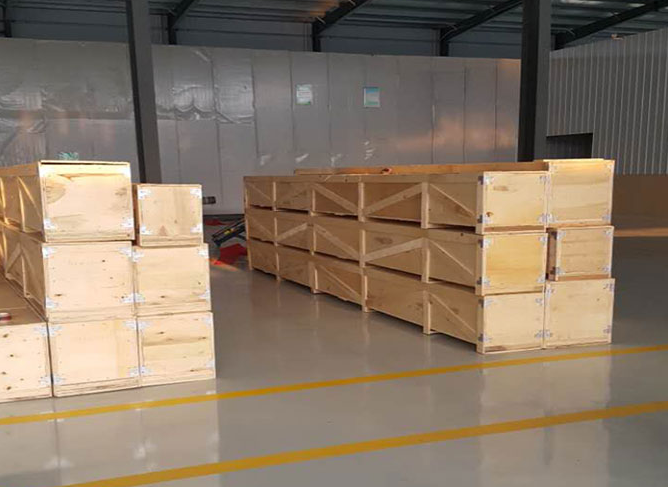
- Specify width, length, joint and edge. Yiheng Mesh customizes belt width and length, joint type, thickness, colour, edge and material (PET, PA or anti-static).
- Validate on the machine with a sample. Free sample testing is available, and remote technical support and installation guidance are provided.
- Confirm documentation, inspection and lead time. Check food-contact evidence if relevant, confirm 100% pre-shipment inspection and whether third-party inspection by BV or SGS is required, and plan around a 15–30 day lead time.
Use Cases: What the Numbers Look Like in Service
Food and vegetable drying, Switzerland. A dehydrated vegetable and seafood processor ran polyester mesh belts on 8 drying and conveying lines. Over a two-year period the installation recorded a 20% increase in productivity and a 35% reduction in maintenance costs, with zero food safety incidents. The belts were selected for high permeability, temperature resistance, easy cleaning and food-grade safe materials.
Municipal sludge dewatering, Malaysia. A wastewater treatment plant installed 12 polyester filter press belts for sludge dewatering. Within a six-month project the plant reported an 8% reduction in cake moisture and a 40% decrease in maintenance costs with no major failures. Belt selection focused on a high open area to prevent clogging, plus chemical resistance for municipal sludge.
Rubber curing and sheet cooling, Malaysia. A rubber products manufacturer used polyester mesh belts across 8 curing and cooling lines. Over two years the lines delivered a 15% increase in productivity and a 30% reduction in maintenance costs with zero major failures, with heat resistance and air permeability as the deciding properties.
Tissue and towel production, Germany. A paper mill applied polyester mesh belts on 8 production lines for premium facial and kitchen towel formation. After one year the mill recorded 25% energy savings and a 35% reduction in maintenance costs with zero major failures, with uniform formation, zero mesh marks and long life as the selection criteria.
UV printing, Austria. A sign and display manufacturer fitted polyester mesh belts to 8 EFI large-format UV printers for vinyl and banner printing. Over three years the site reported a 20% increase in productivity and 30% less scrap with zero major failures, citing easy-cleaning and wear-resistant surfaces.
Compliance, Quality Control and Documentation
For evaluation-stage buyers, documents are as much a part of the specification as the loop distance. Four items are worth requesting at quotation stage.
- Food-contact testing. Test report HAPTX23061098, issued 29 June 2023 by JIANGSU HAP TESTING SERVICE CO., LTD against standard GB 4806.7-2016, covers a food-grade polyester mesh belt with the scope stated as polyester mesh belt.
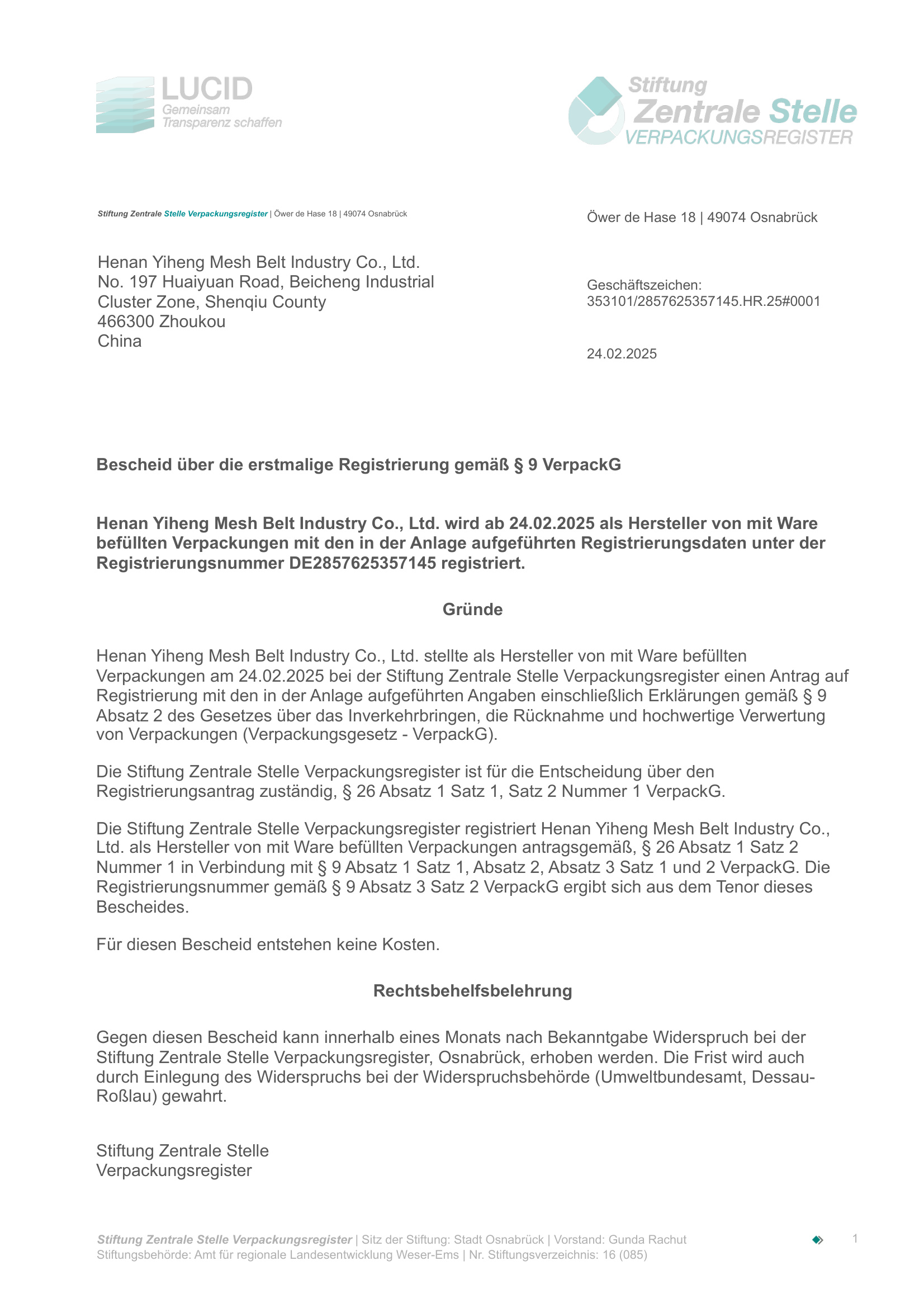
- German packaging registration. Yiheng Mesh is registered under the German Packaging Act (VerpackungsG) with the registration number DE2857625357145, issued 24 February 2025 by Stiftung Zentrale Stelle Verpackungsregister, covering retail, grouped and shipment packaging placed on the German market under the brand yiheng.
- Supplier verification. An Alibaba.com Verified Supplier Assessment Report, certificate 493944221_P+T, was issued by INTERTEK on 9 July 2026 and is valid to 9 July 2027, covering fabrics, dryer fabrics, polyester filter belt, non-woven mesh belt and UV belts.
- Inspection. Quality control includes 100% pre-shipment inspection, and on-site third-party inspection by BV or SGS is available on request.
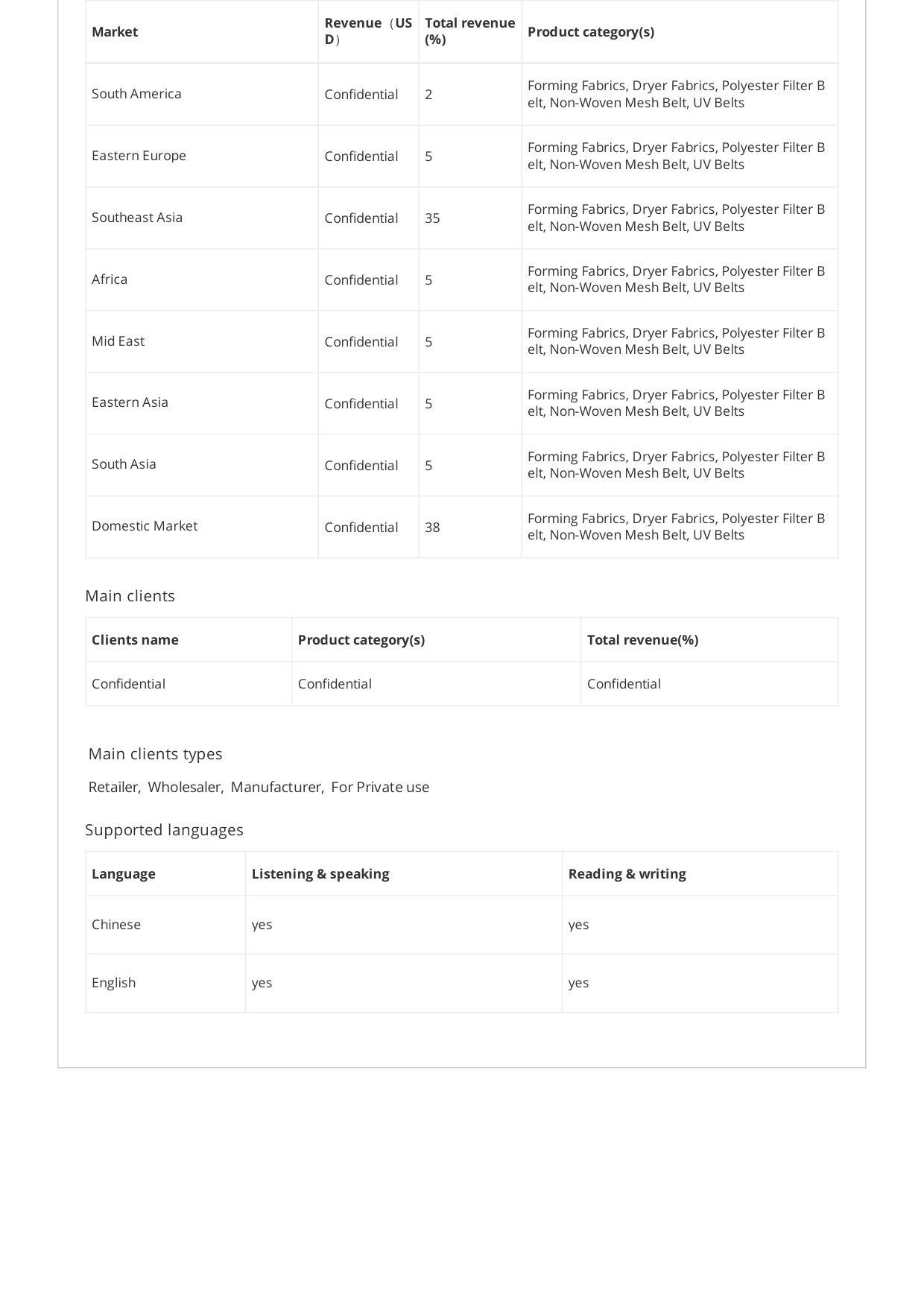
Two practical notes. First, a test report names a scope; confirm that the report covers the exact belt being ordered rather than the general product family. Second, packaging registration and customs classification answer different questions — HS 5911.90 classifies the goods, while the LUCID registration addresses packaging placed on the German market — and neither substitutes for the other.
FAQ
Is a polyester mesh belt food-contact compliant?
Compliance depends on the belt and on the documents supplied with it. Henan Yiheng Mesh Belt Industry Co., Ltd. holds a product compliance test report for a food-grade polyester mesh belt, report number HAPTX23061098, issued on 29 June 2023 by JIANGSU HAP TESTING SERVICE CO., LTD against standard GB 4806.7-2016, with the scope stated as polyester mesh belt. Buyers should confirm that the report scope matches the belt being ordered and that the destination market accepts the standard.
Can loop size, air permeability and belt dimensions be customized?
Yes. Yiheng Mesh works in OEM/ODM mode and customizes mesh count and opening size, air permeability in CFM, belt width and length, material (PET, PA or anti-static), thickness, colour and edge. The minimum order quantity is 2 m², so a trial width or a short development run can be ordered without committing to a full machine set.
Which build offers the lowest long-term cost?
Long-term cost is driven by belt life and maintenance rather than by the unit price alone. In a Malaysian municipal wastewater plant, 12 polyester filter press belts were reported to cut maintenance costs by 40% over a six-month project with no major failures; in a Swiss drying and conveying installation, maintenance costs fell 35% across eight lines. Correct loop distance and air permeability are what protect that outcome.
Can I test a belt before placing an order?
Free sample testing is available, and Yiheng Mesh provides remote technical support and installation guidance. A sample trial is the practical way to confirm that the specified air permeability and loop distance behave as expected on the actual machine before a production order is released.
What is the lead time, and how is quality checked?
Standard lead time is 15–30 days. Quality control includes 100% pre-shipment inspection, and on-site third-party inspection by BV or SGS is available. To start a sample or a quotation, send the application, belt dimensions, loop or mesh requirement and target air permeability to ada@yhfilterbelt.com or WhatsApp +86 184 3681 4894. The English catalogue can be downloaded from the link at the end of this article.
Conclusion
Polyester mesh belts look like a single product but behave like a family. The spiral construction — helical loops interlinked and closed by a threading wire, with filler wires added where pressure demands it — is the design that carries most wet, warm and high-tension duty in environmental protection, papermaking, rubber and nonwoven production. Loop distance, thickness, air permeability and break strength are the four numbers that translate that construction into machine performance, and they can all be specified before an order is placed.
For first-time buyers, the safest sequence is duty, then weave family, then loop or mesh geometry, then dimensions, then documentation. Get that order right and the belt is a wear part with a predictable life; get it wrong and no amount of downstream adjustment will fix a mismatch built in at specification.
Next step: sample, quotation or catalogue
Yiheng Mesh supplies spiral, square and plain weave polyester mesh belts with a 2 m² minimum order, free sample testing and a 15–30 day lead time. Send your application and belt specification to ada@yhfilterbelt.com or WhatsApp +86 184 3681 4894 to request a sample or a quotation.
Website: www.yhfilterbelt.com
English catalogue (PDF, public download): Download the Yiheng Mesh product catalogue
Have Questions or Need More Details?
Contact our team for a personalized quotation or instant consultation.
Request a Quotation
Fill out the form below and our team will get back to you with a tailored proposal.
WhatsApp Direct Chat
Prefer to chat in real-time? Message us on WhatsApp for instant assistance & quick answers.
- Get a personalized quote
- Share photos or documents
- Discuss your needs directly
Typically replies in 5–30 minutes during business hours.