Same 2.32 mm, Different Airflow: Medium Loop vs. Medium Loop-Filler Wire Polyester Mesh Belt
Two polyester mesh belts leave the same medium-loop family at the same 2.32 mm thickness, with the same 0.68 mm ring wire and 0.90 mm threading. One moves 18,300 m³/㎡·h of air. The other moves 10,700 to 12,000 ±500 m³/㎡·h. The only structural difference is a flat wire filler — and that filler decides whether a line drains fast or filters fine.
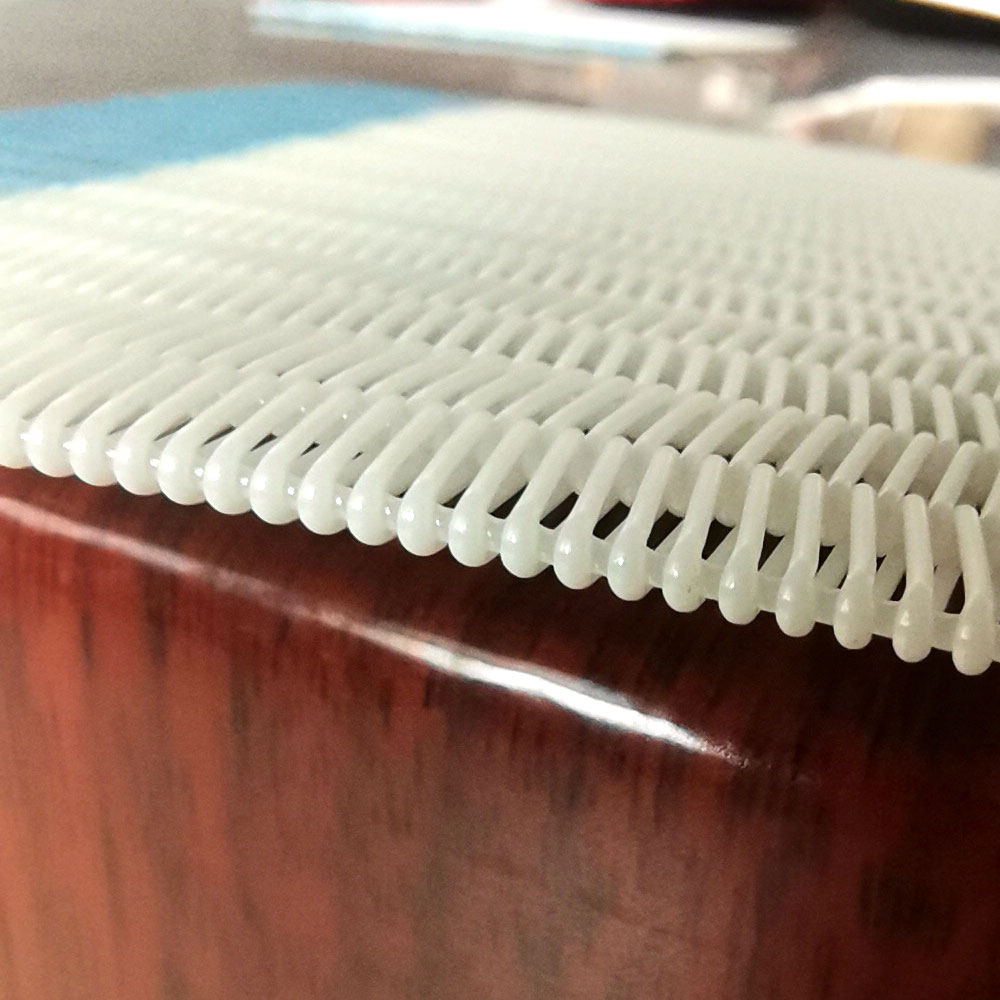
This head-to-head is written for the buyer who already knows the belt will be a medium loop and now has to decide between an open spiral and a flat-wire filled spiral. Both options are real, both are quoted under the same thickness, and both will physically fit the same machine. That is exactly why the choice has to be made on process behaviour rather than on the dimension drawing.
The short answer
Choose Medium Loop (18,300 m³/㎡·h) when the belt's main job is to carry and expose material to air or heat — drying sections, latex wire drying and conveying, hot-air nonwoven lines — or when the dewatering stage is already free-draining and the machine has drainage capacity to spare.
Choose Medium Loop-Filler Wire (10,700–12,000 m³/㎡·h) when the belt's main job is to hold solids back and release a drier cake — belt filter press sludge dewatering, pulp washing where fibre retention matters, and any stage where filtrate clarity is a measured outcome.
| Decision question | Medium Loop | Medium Loop-Filler Wire |
|---|---|---|
| What the loop contains | Open spiral, no filler wire | Flat wire fillers, 0.68×3 or 0.68×4 mm |
| Air permeability | 18,300 m³/㎡·h | 10,700–12,000 ±500 m³/㎡·h |
| Primary effect on the line | Maximum airflow and drainage speed | Denser mesh, finer filtration, drier cake |
| Best-fit stage | Drying, conveying, high-throughput dewatering | Press dewatering, pulp washing, controlled filtration |
Problem definition: why "medium loop, 2.32 mm" is not a specification
A requisition that reads "medium loop, 2.32 mm" describes geometry, not performance. Within that geometry sit at least two commercially available constructions, and they behave differently on the same machine. The purchaser who orders by geometry alone usually discovers the difference afterwards, in one of two ways.
The first is a belt that is too open for the duty. Air permeability of 18,300 m³/㎡·h is excellent for moving vapour and heat, but a mesh that passes that much air also has the open area to pass fine solids. On a press dewatering stage where the feed contains fine particles, that shows up as solids carry-over and a wetter cake than the line was designed for.
The second is a belt that is tighter than the duty needs. A filled construction retains more solids, but it also resists airflow. On a dryer section or a high-throughput dewatering stage that already has enough vacuum and enough residence time, the tighter belt can become the limiting item — the machine is capable of more than the belt allows through.
The technical answer is that air permeability, not thickness, is the number that separates these two products. Thickness sets whether the belt fits; permeability sets what the belt does once it is running.
Industry background: where the airflow-versus-retention trade-off comes from
Polyester is not a niche material in this category. Straits Research reports that polyester was the leading material segment in the global conveyor belt market in 2025, with a 28.4% share of revenue. That position comes from the same properties that make spiral polyester mesh viable in wet and hot processes: dimensional stability, chemical resistance and predictable weaving behaviour.
Demand for the filtration side of the category is also moving. Grand View Research projects that belt filter press technology within the sludge dewatering equipment market will grow at a compound annual rate of 8.8% between 2025 and 2033. Belt filter presses are a primary application for both belts in this comparison, which is why the choice between open and filled spiral constructions keeps coming up in procurement conversations.
At the same time, paper machine dryer sections, latex wire drying lines and meltblown nonwoven equipment all use polyester spiral belts for conveying and heat transfer rather than for solids retention. Those duties pull the specification in the opposite direction — toward maximum open area. A single supplier catalogue therefore has to offer both, and a single buyer has to know which one the line actually needs.
Detailed solution: what actually separates the two belts
1. The shared platform is genuinely shared
Medium Loop and Medium Loop-Filler Wire are both polyester spiral mesh belts built on a 0.68 mm ring wire with 0.90 mm threading, both 2.32 mm thick, and both rated at a breaking strength of at least 2,000 N/cm. Because the thickness and wire diameters match, roller spacing, guide settings, seam type and installation procedure carry over unchanged. Moving from one to the other is a belt substitution, not a machine modification — which is precisely why the decision can be revisited cheaply if the first choice underperforms.
2. The flat wire filler is the only real variable
On the Medium Loop, the spiral loops stay open and the belt is defined by a 6.50 mm loop distance. On the Medium Loop-Filler Wire, flat wire fillers of 0.68×3 mm or 0.68×4 mm are inserted into the loops. The fillers close part of the open area, and the resulting mesh is denser and finer — the mechanism behind the filtration claims attached to this construction.
3. The airflow gap is measurable, not marketing
The published figures allow a direct calculation. Measured against the 18,300 m³/㎡·h open belt, the filled version at 12,000 m³/㎡·h is roughly 34% lower in air permeability; at 10,700 m³/㎡·h it is roughly 42% lower. That is not a marginal difference — it is a different operating regime. On the filled version, the same datasheet also gives 660–740 ±30 CFM at 127 Pa, a second, independently measured expression of the same restriction.
4. The two filler options are a tuning range, not a marketing option
Within the Medium Loop-Filler Wire family, the filler size sets where the belt lands inside the 10,700–12,000 band. The 0.68×3 mm configuration is specified at the higher end (12,000 m³/㎡·h) for maximum drainage within the filled family; the 0.68×4 mm configuration is specified at 10,700 m³/㎡·h for finer filtration and a drier cake. Buyers who need to fine-tune an existing press without changing belt thickness can do so with the filler choice alone.
5. The tolerance is part of the specification
The filled belt is quoted at ±500 m³/㎡·h, and the CFM value at ±30. Tolerance should be written into the order rather than assumed, because a belt at the top of the band and a belt at the bottom of the band will not behave identically on a press that is already tuned to a narrow drainage window. Stating the target value and the acceptable band, then confirming it on receipt, is the difference between a repeatable process and a trial-and-error one.

Step-by-step breakdown: choosing between them on a live project
- Name the stage's single job. Convey and expose to air or heat → the open Medium Loop is the default. Retain solids and release cake → the filled Medium Loop-Filler Wire is the default. Mixed duties should be split by stage, not averaged into one compromise belt.
- Read the machine's drainage capacity. If the press or dryer already runs with vacuum capacity to spare, extra permeability buys speed. If the machine is already working at its drainage limit, extra permeability buys very little and costs retention.
- Check the symptoms of the current belt. Cloudy filtrate, solids escaping the press and a wet cake point toward a denser construction. A visibly over-dry or over-ventilated stage, or a line that will not reach its drying rate, points toward a more open one.
- Lock the mechanical envelope. Confirm 2.32 mm thickness, 6.50 mm loop distance, width, length, edge style and joint type against the machine drawing before discussing permeability. Both belts meet the same envelope, so this step should not change the answer.
- Confirm the tension margin. Both belts are rated at ≥2,000 N/cm. Where the application runs at higher tension or with heavier sludge loads, the larger loop filler-wire family is rated at ≥2,300 N/cm and should be considered rather than over-tensioning a medium loop.
- Validate with a trial length. Because both belts share thickness and wire diameters, a short run on one construction and then the other is a controlled comparison, not a re-engineering project.
Use cases: mapping each belt to a scenario
Belt filter press and sludge dewatering
This is the application where the decision carries the most commercial weight. Press dewatering runs under high mechanical pressure and tension, in chemically active and abrasive conditions, with cake release and anti-clogging behaviour determining throughput. The filled Medium Loop-Filler Wire is the better-matched construction here: the flat wire fillers create the denser structure that captures finer particles and supports a drier cake, and the belt is specified for belt filter presses and sludge dewatering equipment. The open Medium Loop remains valid where the feed is coarse and free-draining and the press has surplus drainage capacity.
A municipal wastewater treatment plant in Malaysia running 12 belt filter presses recorded an 8% reduction in cake moisture and a 40% reduction in maintenance costs over a six-month period, with no major failures reported. The belts used in that installation were specified with high open area to resist clogging and with chemical resistance for the sludge environment — a reminder that on press duty, retention and cleanability have to be solved together.
Papermaking: pulp washing and press sections
Pulp washing rewards fibre retention. Where wash water passes through the belt and fibre loss is a cost, the filled construction's denser surface is the appropriate starting point. The open Medium Loop is the more economical choice where the stock is already well formed and the priority is water removal speed rather than capture.
Paper machine dryer section
Dryer sections run hot, humid and under continuous tension, and the belt's contribution is heat transfer and vapour removal while keeping the sheet stable. That is an airflow duty, and the open Medium Loop at 18,300 m³/㎡·h is the natural fit. Filled constructions are used on the dryer side where sheet support and marking avoidance dominate, but the open spiral is the default when drying rate is the constraint.
Meltblown and other nonwoven lines
Nonwoven forming and hot-air bonding depend on uniform through-flow. The open Medium Loop suits hot-air and drying positions; where the belt also acts as a filtration layer in the process air stream, the filled version's finer structure is the better match. Both are used with meltblown nonwoven equipment.
Latex wire drying and conveying
Latex wire lines need consistent air movement across the full width plus a surface that does not mark the product. The open Medium Loop at 18,300 m³/㎡·h gives the highest through-flow in this family and is specified for latex wire drying and conveying. The filled version is used where the line also needs a tighter, more supportive surface.
Textile finishing and fabric pre-shrinking
Both constructions are specified for fabric pre-shrinking machines. The open belt is preferred where drying rate governs line speed; the filled belt where surface uniformity and controlled airflow matter more than raw volume.
Shared maintenance behaviour: smooth surface and arbitrary disassembly
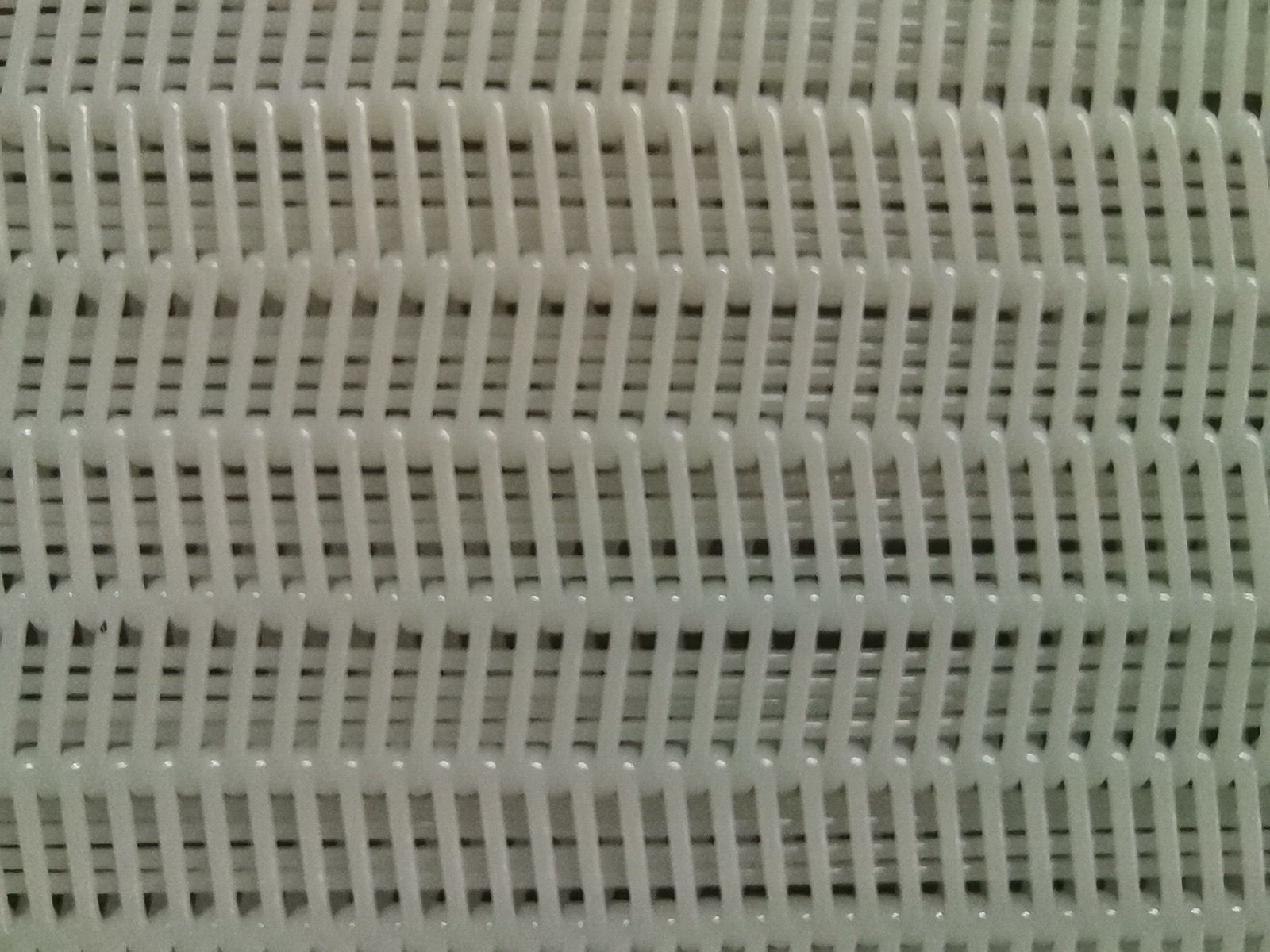
Both belts are supplied with a smooth mesh surface and support arbitrary disassembly and assembly. In practice that means installation, seam changes and routine maintenance can be carried out by the maintenance team on site rather than by removing the belt for factory work, and the smooth surface reduces material build-up that would otherwise need to be cleaned off during a shutdown. Because the two constructions are identical in thickness and wire diameter, a maintenance team that has learned one has effectively learned the other — spares strategy can be simplified accordingly, and a substitution decision does not trigger retraining or new tooling.
Comparison table: Medium Loop vs. Medium Loop-Filler Wire
| Parameter | Medium Loop | Medium Loop-Filler Wire |
|---|---|---|
| Product type | Polyester spiral mesh | Filter press belt, spiral mesh with flat wire filler |
| Ring wire | 0.68 mm | 0.68 mm |
| Threading | 0.90 mm | 0.90 mm |
| Filler | None (open loops) | 0.68×3 mm or 0.68×4 mm flat wire |
| Loop distance | 6.50 mm | Defined by the filler configuration |
| Thickness | 2.32 mm | 2.32 mm |
| Air permeability | 18,300 m³/㎡·h | 10,700–12,000 ±500 m³/㎡·h |
| CFM at 127 Pa | Not published on the open construction datasheet | 660–740 ±30 |
| Strength at break | ≥2,000 N/cm | ≥2,000 N/cm |
| Material | Polyester | Polyester |
| Surface and assembly | Smooth surface, arbitrary disassembly and assembly | Smooth surface, arbitrary disassembly and assembly |
| Typical duties | Drying, conveying, high-throughput dewatering, latex wire drying, fabric pre-shrinking | Belt filter presses, pulp washing, meltblown nonwoven, controlled filtration |
Figures as published on the respective product data sheets; the ± tolerances form part of the delivered specification.
Purchasing terms that apply to both belts
Commercial terms are identical across the two constructions, which keeps the technical decision clean. The minimum order quantity is 2 m². Payment terms are 30% deposit with the 70% balance before shipment. Delivery can be arranged on FOB, CIF, DAP or DDP terms. Third-party inspection by BV or SGS is available on request, on top of 100% pre-shipment inspection. Standard lead time is 15–30 days.
Both products sit under HS code 5911.90, the classification for textile products and articles for technical uses, as listed by the USITC Harmonized Tariff Schedule. Buyers should note one boundary condition: ISO 14890, the international standard for rubber- or plastics-covered conveyor belts with textile carcasses, does not describe open polyester spiral mesh. Where a project specification cites a standard, confirm that the cited document actually covers the belt type being purchased rather than assuming it does.
The belts are supplied by Henan Yiheng Mesh Belt Industry Co., Ltd. (Yiheng Mesh), a polyester mesh belt manufacturer founded in 2009, with 41 employees, a 3-engineer R&D team, annual output of 150,000 m² and an export ratio of 62% across Asia, Europe and North America. Customisation covers mesh count and opening size, air permeability, belt width and length, material, thickness, colour and edge; monthly capacity is 30,000 m².
FAQ
Which specifications must be confirmed in writing before ordering either belt?
Confirm thickness (2.32 mm on both), air permeability with its tolerance (18,300 m³/㎡·h for Medium Loop; 10,700–12,000 ±500 m³/㎡·h for Medium Loop-Filler Wire), breaking strength (≥2,000 N/cm on both), loop distance, width, length, edge style and joint type. Also confirm which standard, if any, applies to the project: ISO 14890 addresses rubber- or plastics-covered belts with textile carcasses and does not define open polyester spiral mesh, while the tariff classification for these technical textile articles is HS 5911.90.
How should a polyester mesh belt manufacturer be evaluated for sludge dewatering projects?
Ask for published air permeability and thickness values rather than a general product description, and confirm the supplier can hold those values within a stated tolerance. Verify that 100% pre-shipment inspection is standard and that third-party inspection by BV or SGS can be arranged. Check that width, length, edge and joint can be matched to the existing press, and that the supplier's production capacity supports repeat orders. Yiheng Mesh quotes a 2 m² minimum order, 30,000 m² monthly capacity and a 15–30 day lead time for these belts.
What are the MOQ, payment and delivery terms?
The minimum order quantity is 2 m² for both constructions. Payment is 30% deposit with 70% balance before shipment. Delivery can be quoted on FOB, CIF, DAP or DDP terms, and BV or SGS inspection is available. Lead time is typically 15–30 days depending on width, length, joint type and filler configuration.
Can a sample be tested before committing to a full order?
Yes. Free sample testing is available, and remote technical support and installation guidance are provided with the order. Because both belts share the same thickness and wire diameters, a trial on one construction followed by the other isolates airflow effects without any machine change — the cleanest way to settle an open-versus-filled decision on a live line.
What is the lead time, and how is quality verified before shipment?
Standard lead time is 15–30 days. Every order passes 100% pre-shipment inspection, and buyers can additionally appoint BV or SGS for independent verification. The practical check on arrival is air permeability against the ordered band and thickness against 2.32 mm, since those two values determine whether the belt will behave as specified in the press or dryer.
Ready to settle open versus filled on your own line?
Request a 2 m² trial length, a specification sheet, or a quote for Medium Loop or Medium Loop-Filler Wire polyester mesh belt. Samples and technical support are available before you commit to a full order. Download the full product catalogue for dimensions, tolerances and configuration options.
Download the Yiheng Mesh product catalogue (PDF) | Email: ada@yhfilterbelt.com | Tel / WhatsApp: +86 184 3681 4894 | www.yhfilterbelt.com
Conclusion
Medium Loop and Medium Loop-Filler Wire are not competing philosophies — they are two settings of the same 2.32 mm polyester spiral platform. The open construction delivers 18,300 m³/㎡·h of air permeability and belongs wherever airflow is the constraint: drying sections, latex wire lines, hot-air nonwoven positions and free-draining dewatering stages. The filled construction, at 10,700–12,000 ±500 m³/㎡·h with 0.68×3 or 0.68×4 flat wire fillers, suits the duties where retention and cake dryness decide the cost per tonne of sludge or pulp.
The decision rule is short: if the belt must move air, choose the open loop; if the belt must hold solids, choose the filler wire. Since both share thickness, wire diameters and a ≥2,000 N/cm strength rating, the wrong first choice costs a belt change, not a machine rebuild — and a 2 m² trial settles it faster than any calculation.
Have Questions or Need More Details?
Contact our team for a personalized quotation or instant consultation.
Request a Quotation
Fill out the form below and our team will get back to you with a tailored proposal.
WhatsApp Direct Chat
Prefer to chat in real-time? Message us on WhatsApp for instant assistance & quick answers.
- Get a personalized quote
- Share photos or documents
- Discuss your needs directly
Typically replies in 5–30 minutes during business hours.