Spiral vs. High-Low Loop Seams: A Decision Guide for Nonwoven Mesh Belts
Seam choice is a constraint decision, not a cosmetic one. A nonwoven forming belt runs as a closed loop, 24/7, through forming, drying and conveying positions, so the joint crosses every roller, suction box and pre-pressing nip once per revolution. That narrow strip of belt decides whether the loop runs quietly or pulses, whether the fabric carries transverse marks, and how long a belt change keeps the line down.
This guide compares the two joint constructions buyers ask about most — the conventional spiral seam and the high-low loop seam — against the conditions that actually separate them: joint thickness against body thickness, line speed, fabric weight, threading discipline, and the documents that have to travel with the order.
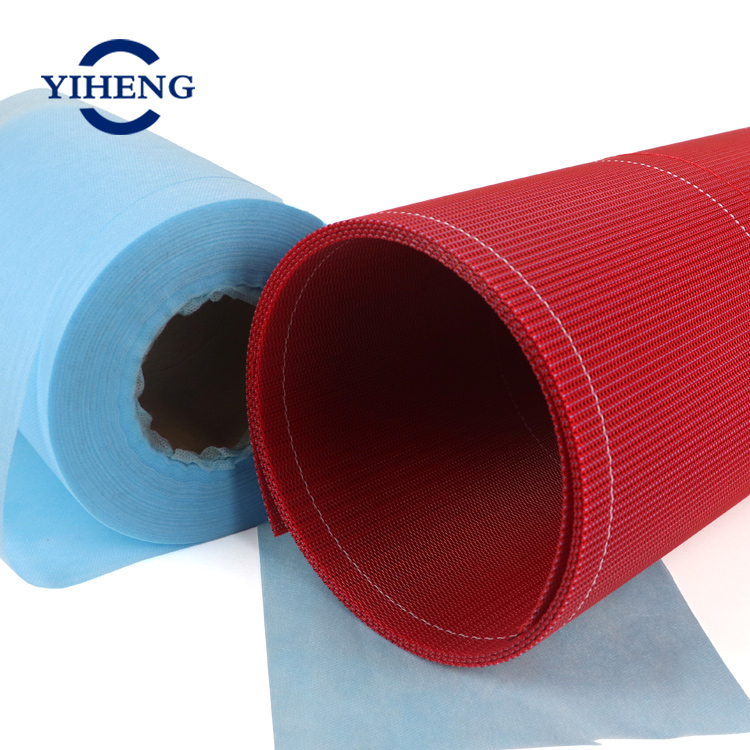
Short answer. Specify a high-low loop seam when the line runs fast or the fabric is thin and low-GSM. The construction lets the seam loops interlock without adding thickness, which is the documented reason a joint can pass a precision nip without generating a pulse. A spiral seam — ends aligned, loops interlocked, closed with an inserted wire — remains the practical joint where the belt does not cross a precision nip at high speed.
Why the joint, not the belt body, carries the risk
A forming belt has to hold several properties at once: dimensional stability under tension, uniform air permeability for even fibre laydown, heat resistance through the dryer, and enough surface release to transfer the web without marking. Yiheng controls air permeability within a ±5% band through heat-setting, and the documented requirement set for nonwoven web formation covers tensile strength, low elongation, hydrolysis resistance, abrasion resistance, anti-static performance and long service life.
None of that survives a badly matched joint. The body is continuous and heat-set; the joint is a manufactured discontinuity, and it is the only point on the loop whose thickness and permeability are set by a secondary operation. Problems therefore surface first as vibration, transverse marks or fibre snagging, not as a tensile break.
It also helps to separate three faults that get blamed on the joint. Fabric that floats, folds or flies off the mesh at the release point before the pre-pressing roller is usually a static or air-balance problem: the documented causes are static build-up in dry seasons, cooling air volume exceeding suction, and a pre-pressing roller running too cold. Longitudinal streaks with visible fibre clusters are fibre hanging, traced to excessive lower suction, a CFM that is too high for fine denier fibre, or polymer lumps and burrs on the surface. Only a repeating mark that appears once per belt revolution is a genuine seam signature.
Why a 0.2 mm step becomes expensive above 600 m/min
High-performance nonwoven forming belts are documented to operate at line speeds up to 1,000 m/min and at temperatures up to 180°C. Spunlaid technology, which covers spunbond and meltblown, held 48.4% of the global nonwoven technology market in 2023, and spunbond and spunmelt lines are exactly where belts spend their working life at the top of that speed range.
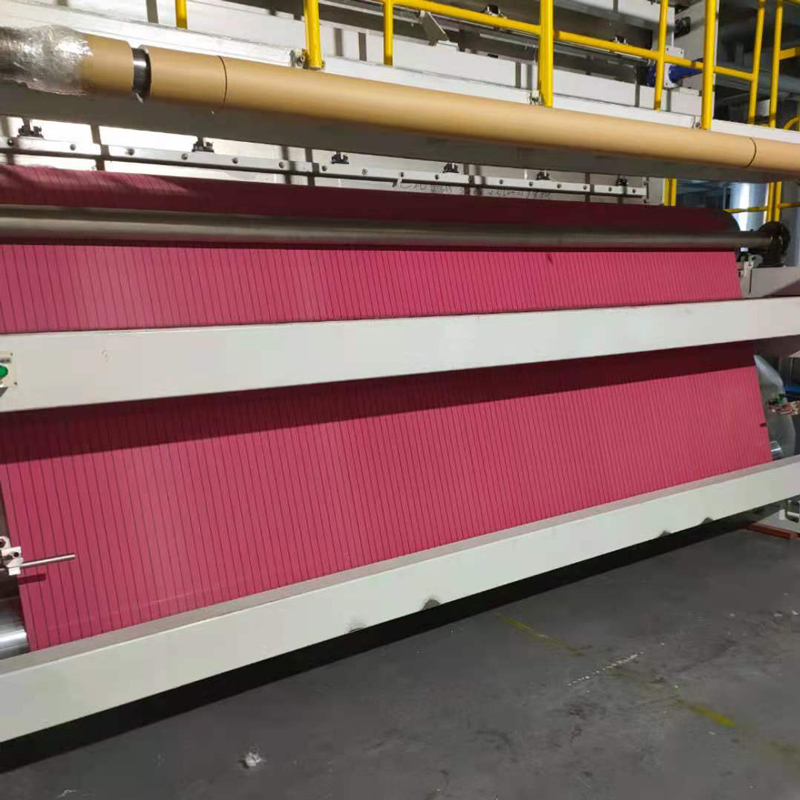
The mechanical rule is direct: at speeds above 600 m/min, a 0.2 mm thickness increase at the seam generates impulsive forces of thousands of Newtons as the joint passes the pre-pressing rollers. The periodic impact loads precision bearings and creates momentary pressure fluctuations, which print as transverse marks on the fabric. A joint standing 0.2 mm proud of the body is therefore not a cosmetic defect at speed; it is a repeating mechanical event, once per revolution, for the life of the belt.
Speed also raises the static problem. In high-velocity operation, friction between web and belt builds charge that can make thin fabric float or flip at the release point, which is why anti-static construction is a specification rather than an option: 10⁶ Ω on the SK604 high-speed series, 10⁵–10⁶ Ω on HY408S, and the higher-conductivity 10³–10⁴ Ω band on KJD700 for two-component and spunlace equipment where static build-up is the limiting issue.
Spiral seam vs high-low loop seam: how each joint behaves
Spiral seam: loop-and-wire closure
A spiral seam closes the belt by aligning both ends until the loops interlock, then inserting a wire through the aligned loops and hiding the wire ends inside the mesh body. Everything that decides whether that joint runs clean happens at installation: loop alignment, the finish on the wire tip, insertion speed, and whether the wire ends are fully buried. Yiheng threading guidance is specific — grind the steel wire tip into a smooth cone with sandpaper or a file, insert the wire at a steady speed with lubricant if needed, then bend and hide the excess wire back into the mesh body, wearing protective gloves throughout.
Its limitation is geometric. Where the closed joint sits above the belt body, the loop passes the pre-pressing rollers as a step, and the consequences at speed are the ones described above. A spiral seam is a sound fit where the joint does not run against a precision nip at high velocity; it is a risk where it does.
High-low loop seam: zero-step thickness matching
The high-low loop seam is designed around a single objective — matching joint thickness to body thickness. Special weaving lets the seam loops interlock without increasing total thickness: a zero-step design. Because there is no step, there is no pulse source, and dynamic balance is preserved as the joint passes the rollers.
Yiheng selection guidance applies this to speed directly. For a line running above 500 m/min where no speed reduction and no seam marks are acceptable, the recommendation is the SK604 high-speed series with a high-low loop seam — a double-pins joint on a 1.85 mm, 1030 g/m² belt, 700±30 CFM at 127 Pa/20 cm², with 10⁶ Ω conductivity and anti-hydrolysis filaments. The same flat, body-matched joint logic runs through the wider range: HY408S (1.85 mm, three-filament hybrid weave, 10⁵–10⁶ Ω), HY4106 (1.65 mm, 680±30 CFM), HB4106 (1.8 mm flat-filament, 580±30 CFM) and K6012 (2.8 mm, 2.5 layers, 750±30 CFM) are all documented with a flat seam matched to body thickness to prevent fibre snagging and roller jumping.
Spiral mesh is a belt construction, not only a joint
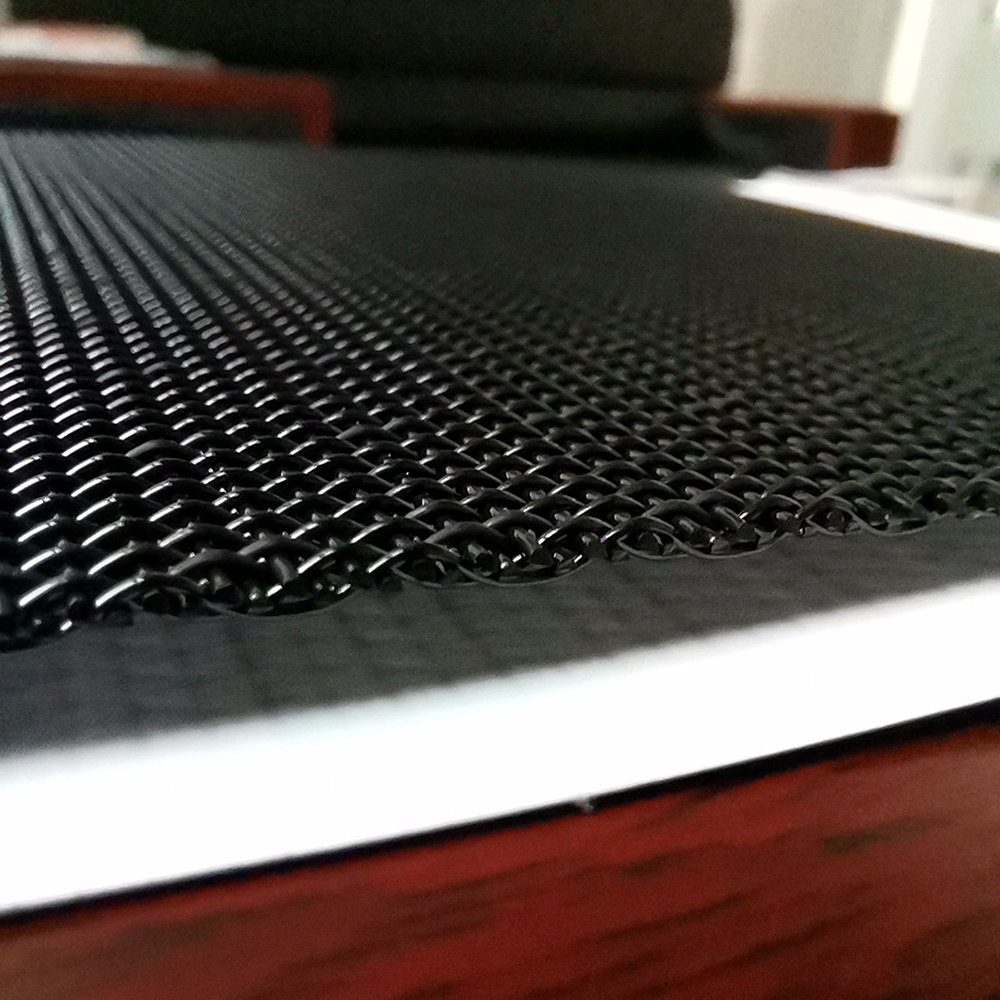
Spiral mesh also describes how a belt body is built. The polyester spiral mesh range is assembled from ring wire, threading wire and filler wire: Large Loop (ring wire 0.90 mm, loop distance 7.00 mm, thickness 2.95 mm, air permeability 9,000–13,700 m³/㎡/h in filter press duty), Medium Loop (loop distance 6.50 mm, thickness 2.32 mm, 18,300 m³/㎡/h) and Small Loop (loop distance 5.20 mm, thickness 1.90 mm, 17,500 m³/㎡/h). Those figures describe the body. The seam question in this guide is about how a woven forming belt is closed into a loop.
The third option: endless and self-ring joints
Not every belt needs a threaded joint. The airlaid series — 07502, 05602, 06702 and 09502 — and the spunlace series — 41203, 27254, 29254 and 60188 — are specified with endless or self-ring joints. Endless removes the joint alignment step entirely; self-ring keeps a serviceable joint. Where the belt can be fitted as a closed loop and the process cannot tolerate any joint geometry, endless is the constraint-clean answer. Where the belt must be installed on an assembled machine, the joint type is the constraint, and the decision returns to spiral versus high-low loop.
Threading the joint: seven steps that decide downtime
Installation is where a seam either becomes invisible or becomes a maintenance item. The sequence below is the documented procedure; each step maps to a failure mode that shows up later at line speed.
- Verify the replacement against the original specification. If the new belt length differs, do not reuse the old tension baseline — the belt may break.
- Align both ends so the loops interlock correctly. Misalignment is what turns into snagging later in the run.
- Grind the wire tip into a smooth cone with sandpaper or a file. A blunt tip catches loops and forces the wire.
- Insert the wire at a steady speed, using lubricant if needed.
- Bend and hide the excess wire ends back into the mesh body. Exposed ends snag during operation.
- Set tension to the marked baseline and run empty for about five minutes, make minor adjustments, then resume production. Marking a physical baseline on the tension rod while the original belt is still stable is what makes this fast.
- Without an automatic corrector, balance both sides deliberately. Confirm equal bolt exposure, run empty for 10–20 minutes, tighten the bolt on the side the belt runs toward, then mark the balance point permanently. Never over-tighten one side: that creates shear force at the seam and raises the risk of bursting or cracking.
Two habits pay for themselves. Wear protective gloves during threading to avoid wire-tip punctures, and clean polymer residue with heat softening plus vacuuming — a heat gun at 150°C, moved constantly 5–10 cm away — instead of focusing heat on one spot, which can shrink or melt the mesh.
Matching the joint to your line configuration
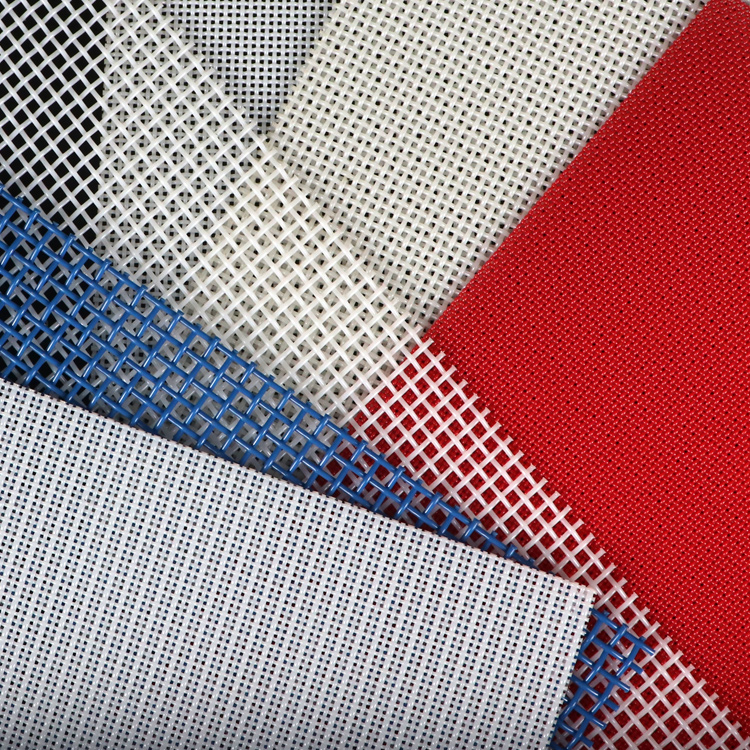
The decision is driven by four inputs: line speed, fabric weight and denier, static sensitivity, and whether the belt can be fitted as a closed loop. The table maps documented configurations to a specification starting point.
| Line condition | Joint and belt starting point | Documented basis |
|---|---|---|
| Speed above 500 m/min; no seam marks and no speed reduction acceptable | SK604 high-speed series with high-low loop seam; double-pins joint, 1.85 mm, 1030 g/m², 700±30 CFM, 10⁶ Ω | Selection guidance for high-speed lines; SK604 data sheet |
| Static-driven flipping on ultra-thin web; two-component or spunlace equipment | KJD700; above-4 below-8 weave, 2.34 mm, 600±30 CFM, 10³–10⁴ Ω, double-pins joint | KJD700 data sheet and conductivity specification |
| Frequent product changes; surface cleanliness is the bottleneck | HB4106 flat filament, 1.8 mm, 580±30 CFM; self-ring, millet-ring or double-pins options | HB4106 data sheet (flat filament, easy cleaning) |
| Fabric below 1.2 denier; fibre hanging and streaks | Encrypted weave: HY4106 (680±30 CFM, 1.65 mm) or SK604 | Selection guidance for fine denier anti-hanging |
| Hot-air and airlaid duty; high temperature; bulky web | 07502 (18 mesh, 420 g/m², 19,176 m³/㎡/h), 05602 (14 mesh, 1.2 mm pitch, 19,676 m³/㎡/h), 06702 (16 mesh, 1000 g/m²), 09502 (23 mesh, 650 g/m²); endless or self-ring | Airlaid model data sheets |
| Spunlace with a fine surface finish requirement | 27254 (70 mesh, 8,000 m³/㎡/h), 29254 (80 mesh, 7,800 m³/㎡/h), 41203 (103 mesh, 0.3 mm), 60188 (108 mesh, 4,750 m³/㎡/h); endless or self-ring | Spunlace model data sheets |
| Joint geometry cannot be tolerated at all; belt can be fitted as a closed loop | Endless construction | Airlaid and spunlace joint options |
Comparison table: spiral seam against high-low loop seam
Use this as a constraint checklist rather than a ranking. Both joints appear on production lines; the difference is what each one costs at a given speed.
| Criterion | Spiral seam | High-low loop seam |
|---|---|---|
| How the ends close | Ends aligned, loops interlocked, wire inserted, wire ends hidden back into the mesh body | Loops interlock through special weaving without increasing total thickness — zero-step design |
| Thickness against the body | The closed joint can sit above body thickness; 0.2 mm is the figure documented as significant | 1:1 thickness match with the mesh body |
| Behaviour at speed | Above 600 m/min, a 0.2 mm increase at the seam generates impulsive forces of thousands of Newtons at the pre-pressing rollers | Removes the pulse source; documented as eliminating roller jumping on high-speed lines |
| Effect on fabric surface | Momentary pressure fluctuation prints as transverse marks | Documented as zero mesh marks and no fibre snagging on flat-seam models |
| Machine load | Periodic impact can damage precision bearings | Dynamic balance maintained by removing the thickness differential |
| Installation sensitivity | Wire tip finish, loop alignment, insertion speed and hidden wire ends decide success | Joint flatness is set at manufacture; the same threading discipline applies to the pin and wire closing |
| Documented example | The baseline joint that high-low loop performance is compared against in selection guidance | SK604 high-speed series: double-pins joint, 1.85 mm, 700±30 CFM, 10⁶ Ω |
| Best fit | Lines where the joint does not cross a precision nip at high speed | High-speed lines producing thin, low-GSM, mark-sensitive fabric |
Use cases: where joint behaviour showed up in results
Documented customer results help separate the seam question from the belt question, because the reported gains combine joint flatness, weave and static control.
| Customer type and market | Scope | Application | Documented result |
|---|---|---|---|
| Wet wipe and medical dressing supplier, Germany | 12 spunlace lines, 1 year | Wet wipes and facial mask substrate | 15% higher productivity, 4% higher first-grade yield, 30% lower maintenance cost; high water permeability, zero mesh marks, hydrolysis resistant |
| Nonwoven fabric manufacturer, Switzerland | 8 Reicofil RF4 high-speed lines, 1 year | Baby diaper and sanitary napkin material | 10% higher capacity, 5% higher first-grade yield, 30% lower maintenance cost; wear resistance, dimensional stability, cost-effective |
| Nonwoven fabric manufacturer, United States | 200 m², Reifenhauser line, 6 months | High-speed spunbond web formation | Uniform web formation, zero mesh marks, easy release, USD 2,000 saved annually |
Documents to attach to the purchase order
Seam specification and compliance documents are separate packages, and buyers should request both. For nonwoven mesh belts the compliance set on file covers three areas:
- Food contact: test report HAPTX23061098, issued 29 June 2023 by JIANGSU HAP TESTING SERVICE CO., LTD, tested to GB 4806.7-2016 for polyester mesh belt (food grade).
- German packaging: LUCID registration DE2857625357145 with Stiftung Zentrale Stelle Verpackungsregister, issued 24 February 2025, covering retail, grouped, shipment and service packaging placed on the German market under the yiheng brand.
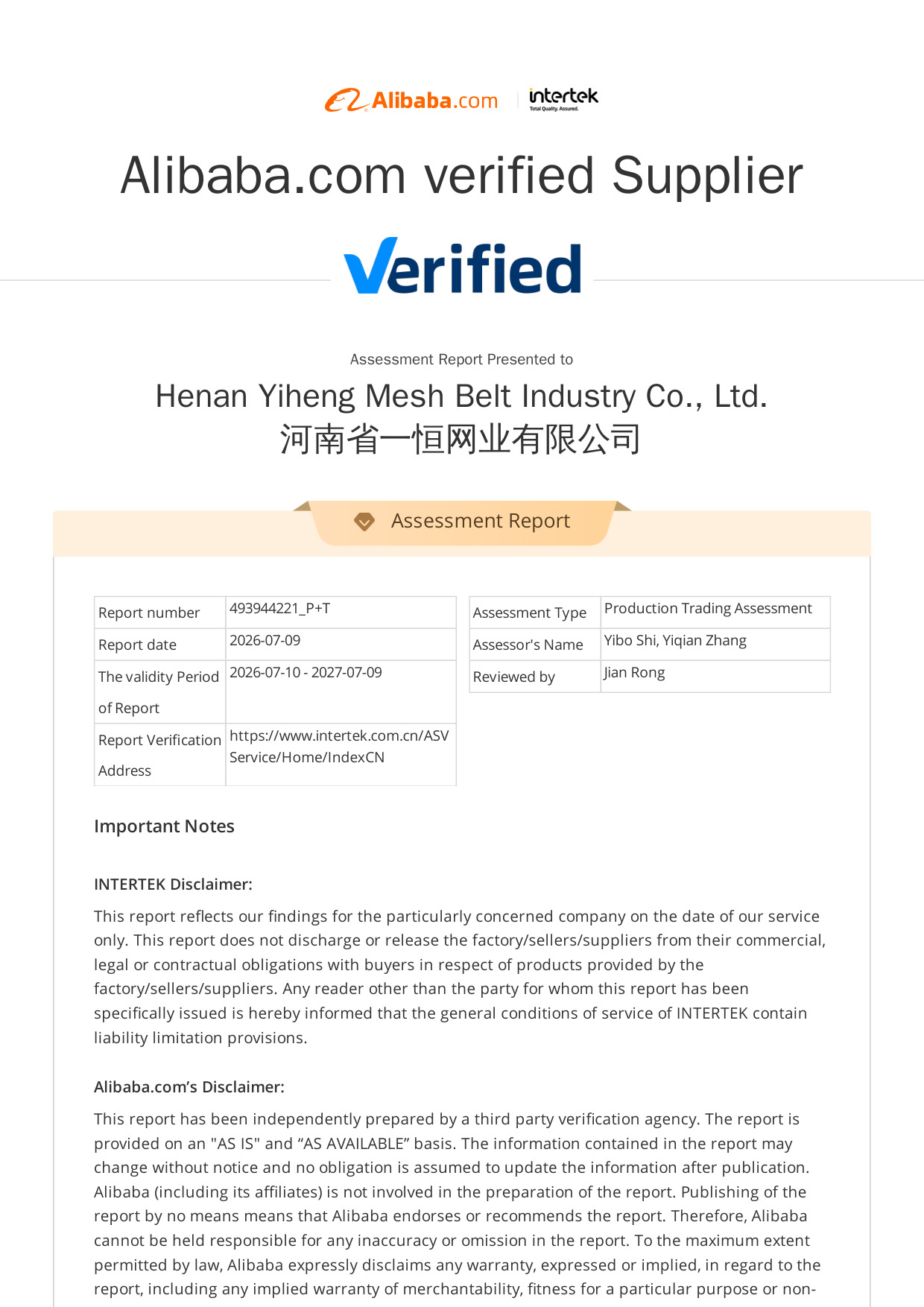
- Supplier assessment: INTERTEK Alibaba.com Verified Supplier Assessment report 493944221_P+T, issued 9 July 2026 and valid to 9 July 2027, with a scope that includes non-woven mesh belt, dryer fabrics, polyester filter belt and UV belts.
None of these documents certifies seam performance. They cover product contact, packaging compliance and supplier assessment; the seam itself is specified by joint type, thickness match and the threading procedure recorded on the purchase drawing.
Frequently asked questions
Do these belts ship with EU and German compliance documents?
Yes. The compliance set covers three areas: a food contact test report (HAPTX23061098, issued 29 June 2023 by JIANGSU HAP TESTING SERVICE CO., LTD to GB 4806.7-2016 for food-grade polyester mesh belt), a German Packaging Act LUCID registration (DE2857625357145, Stiftung Zentrale Stelle Verpackungsregister, issued 24 February 2025) for packaging placed on the German market under the yiheng brand, and an INTERTEK Alibaba.com Verified Supplier Assessment (493944221_P+T, valid to 9 July 2027). Request the certificate pack with the quotation so documents and belt reference stay in one file.
Can a high-low loop seam be matched to our machine, including Chaolong or Hongda lines?
Yiheng supplies users running Reicofil, Chaolong, Hongda and Aolong equipment and provides tuning data for those configurations. For lines above 500 m/min the high-speed recommendation is the SK604 series with a high-low loop seam; for fabric below 1.2 denier where fibre hanging drives downtime, the documented suggestion is the encrypted HY4106 or SK604 weave. Customization covers mesh count and opening size, air permeability, belt width and length, material, thickness, colour and edge treatment.
What does the seam choice cost over the belt service life?
Under standard operating conditions Yiheng mesh belts typically run 3–6 months. Two documented cases report 30% lower maintenance cost after moving to belts with matched, flat seams: a German wet-wipe and medical dressing supplier on 12 spunlace lines and a Swiss nonwoven manufacturer on 8 Reicofil RF4 high-speed lines. Energy sits in the same calculation — K6012 is documented with air permeability up to 12,000 m³/㎡/h as an energy-saving characteristic, and the 420 g/m² 07502 airlaid belt reduces machine load. Compare quotes on belt life plus maintenance hours, not on belt price alone.
Can we test a joint before committing to a full belt?
Yes. Free sample testing is available, and rapid sampling can deliver custom prototypes in as little as three days. For a seam evaluation, ask for the same model, joint type and thickness as the production belt, so the trial measures the joint rather than a different construction. Endless and self-ring options can be quoted on the airlaid and spunlace models alongside the threaded joints.
What is the lead time, and what support comes after delivery?
Standard lead time is 15–30 days. Quality control is 100% pre-shipment inspection, with on-site third-party inspection by BV or SGS available on request. After delivery, support includes remote technical support and installation guidance, which is where most seam problems are prevented. To start a specification, send the line model, belt dimensions, fabric weight and target speed — or request a quote and sample through ada@yhfilterbelt.com or WhatsApp +86 184 3681 4894.
Conclusion: pick the constraint, then the joint
The seam decision reduces to one question: does the joint cross a precision nip at high speed? If it does, thickness matching is the constraint, and a high-low loop seam specified on the SK604 high-speed series is the documented answer, with flat body-matched seams across HY408S, HY4106, HB4106 and K6012. If it does not, a spiral seam closed with a properly ground and properly hidden wire is a workable joint, provided the threading discipline above is followed and the tension baseline is re-marked.
Two practical rules close the loop. Judge a seam by its geometry rather than its label — 0.2 mm is the number that matters, because that is where impulsive forces reach thousands of Newtons above 600 m/min. And put the joint in writing on the drawing, next to CFM, thickness and joint type, so the belt that arrives matches the belt that was evaluated.
Next step. Send your line model, belt dimensions and target speed to receive a joint recommendation, a sample for threading trials, or a quotation. The full product catalogue and company brochure can be downloaded here: Yiheng Mesh brochure (PDF).
Henan Yiheng Mesh Belt Industry Co., Ltd. (Yiheng Mesh) — founded 2009, 4,237 m² facility in Henan, China, 41 employees, exporting 62% of output to Asia, Europe and North America. Contact: Mrs. Ada Li, +86 184 3681 4894, ada@yhfilterbelt.com, www.yhfilterbelt.com. Office: No. 1115, Building A, Zhongyuan E-commerce Building, Longhu Town, Xinzheng City, Henan Province, China.
Have Questions or Need More Details?
Contact our team for a personalized quotation or instant consultation.
Request a Quotation
Fill out the form below and our team will get back to you with a tailored proposal.
WhatsApp Direct Chat
Prefer to chat in real-time? Message us on WhatsApp for instant assistance & quick answers.
- Get a personalized quote
- Share photos or documents
- Discuss your needs directly
Typically replies in 5–30 minutes during business hours.