What Is a Polyester Spiral Mesh Belt? Loop and Wire Basics
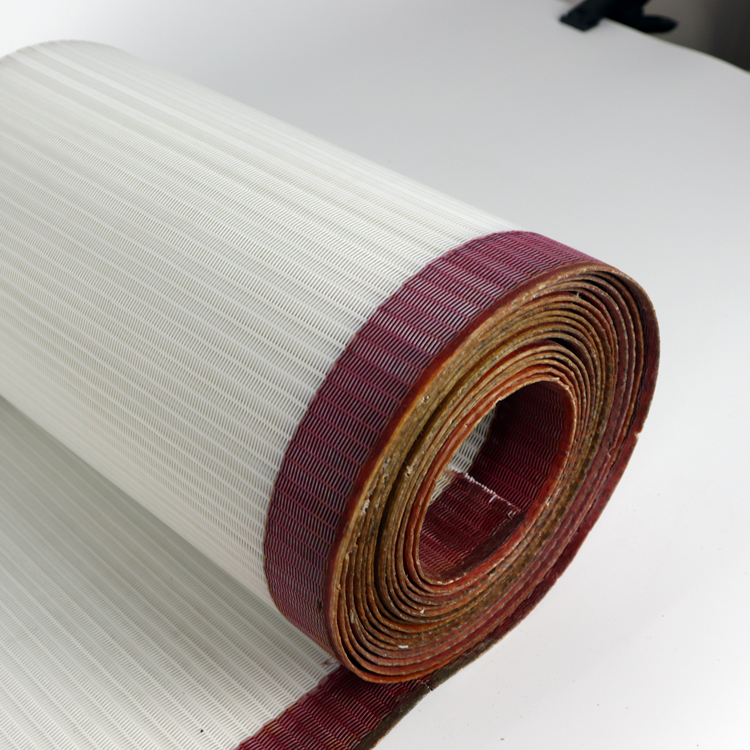
A polyester spiral mesh belt is an industrial belt built from linked spiral loops, polyester strands and, on some builds, flat filler wire. The loop is the repeating spiral unit. The wire is the polyester strand named on the data sheet. The filler wire is a flat insert that closes part of the opening. In the Small Loop build, the specified warp and weft diameters are 0.52 mm and 0.70 mm, loop distance is 5.20 mm, thickness is 1.90 mm, and air permeability is 17,500 m³/㎡/h. The Small Loop-Filler Wire version uses a 0.65 × 1.65 mm flat filler and lists 7,300 ±500 m³/㎡/h. That difference is the clearest first lesson in what ‘denser mesh’ means.
The term can look technical because a single datasheet mixes textile language with filtration language. Loop distance, warp diameter, weft diameter, thickness, filler wire, strength at break and air permeability all describe the same belt from different angles. Once the reader separates geometry from airflow, the product becomes easier to place: a polyester spiral mesh belt is a serviceable conveying and filtration medium, not a generic sheet of polyester mesh.
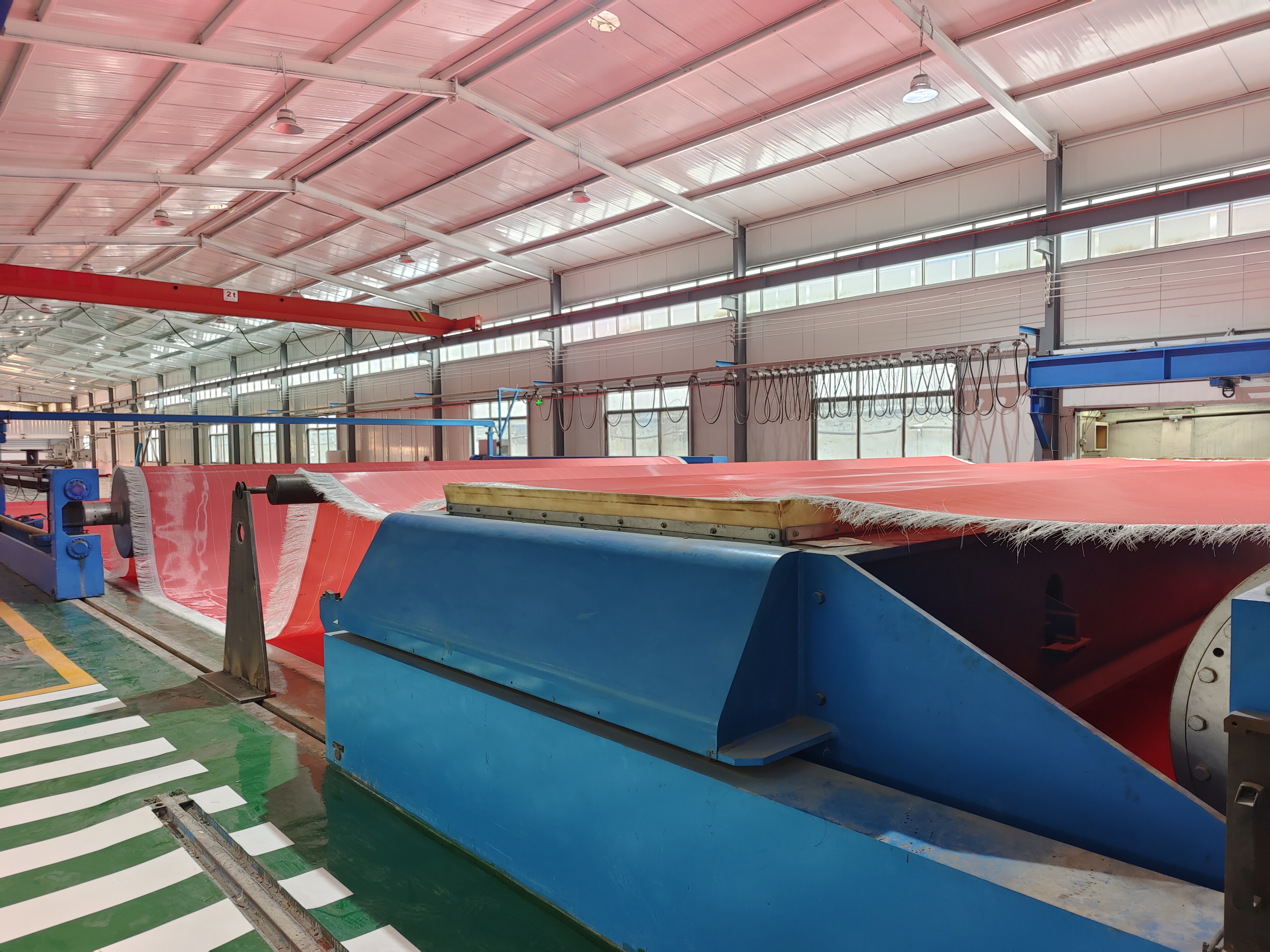
Henan Yiheng Mesh Belt Industry Co., Ltd. is a National High-tech Enterprise established in 2009 that specializes in the research, customization and manufacturing of high-precision non-woven forming belts and industrial filter belts. Its product range includes Polyester Spiral Mesh, Polyester Square Mesh, forming fabrics, dryer fabrics and filter belts. That range matters here because spiral mesh is one construction within a wider family of polyester mesh belts, and the vocabulary should not be confused with square-mesh or forming-fabric terminology.
What 'spiral mesh’ means in a polyester belt
Spiral mesh describes a belt body formed from loops rather than a simple flat woven grid. The loop gives the belt its repeating structure. Cross threads join the loop sections, and the belt surface is described as smooth. This is different from Polyester Square Mesh, where the product data specifies a 2-shed plain weave structure. Both are polyester mesh products, but they are not the same construction.
The word 'spiral’ should therefore be read as a construction term. It tells the buyer that the belt has loop geometry and that loop spacing, strand diameter and optional filler wire will shape the open area. It also explains why some product descriptions emphasise ‘arbitrary disassembly and assembly’: the belt is built in a way that allows installation, seam changes and routine maintenance to be handled at the belt level.
For a first-time buyer, the practical question is not simply ‘is this spiral mesh?’ but ‘which spiral build?’ A Small Loop and a Medium Loop are both polyester spiral mesh belts, yet their specified loop distances are 5.20 mm and 6.50 mm, their thicknesses are 1.90 mm and 2.32 mm, and their air permeability values are 17,500 and 18,300 m³/㎡/h. Those are different starting points for machine fit and process duty.
The problem: one datasheet, three kinds of ‘wire’
The main confusion comes from vocabulary. In everyday use, ‘wire’ suggests metal. In these polyester products, the warp and weft ‘wire’ values refer to polyester strand diameters. The data sheet may also list ‘ring wire’ and ‘threading’, and it may list a flat ‘filler wire’. These are different features. Reading them as one item makes a specification harder to compare.
A second confusion is airflow. A higher air permeability figure is not automatically a better belt. It means the structure is more open under the stated conditions. That can suit drainage or drying, but it may be less suitable when the process needs finer solids retention. The Small Loop-Filler Wire build, for example, lists 7,300 ±500 m³/㎡/h, while the unfilled Small Loop lists 17,500 m³/㎡/h. The lower figure is not a defect; it is the signature of a denser structure.
A third confusion is maintenance. ‘Arbitrary disassembly and assembly’ is sometimes read as a minor product note. In practice, it is a serviceability statement. Spiral product descriptions connect it with easier installation, seam changes and routine maintenance. That is relevant before the belt reaches the machine, not only after a failure.
Industry background: why polyester spiral mesh exists
Polyester spiral mesh sits within the industrial fabric and conveyor-belt field, but it serves a narrower job than a general conveyor belt. It is selected where a continuous belt must combine polyester durability with a controlled open structure. Yiheng’s product data cites wear resistance and durability as reasons for using polyester in these belts, and the same product family is listed for filtration, papermaking, nonwovens, textile finishing and latex processing.
The broader material context is large. Straits Research estimated that polyester represented 28.4% of global conveyor belt market revenue in 2025. That figure covers conveyor belts broadly, not polyester spiral mesh specifically, so it should not be used as a spiral-mesh market share. Its useful signal is narrower: polyester is an established belt material, and buyers are not dealing with an experimental polymer category.
For a discovery-stage reader, the more important background is functional. A spiral mesh belt has to match a machine, a process medium and a maintenance method. A papermaking pulp-washing line, a belt filter press and a latex wire drying line do not place the same demands on the belt. The datasheet values exist to make those differences visible.
How a polyester spiral mesh belt is built
The build can be read in four layers: material, loop, cross thread and filler. The material is polyester. The loop is the spiral element that gives the belt its body. The cross thread, described in the data as threading, links the loop structure. The filler is an optional flat wire inserted into the loop structure to reduce openness and create a denser mesh.
In the Small Loop-Filler Wire build, the threading is 0.80 mm and the filler is 0.65 × 1.65 mm flat wire. In the Medium Loop-Filler Wire build, the ring wire is 0.68 mm, the threading is 0.90 mm, and the filler options are 0.68 × 3 mm and 0.68 × 4 mm. In the Large Loop-Filler Wire build, the ring wire is 0.90 mm, the threading is 1.00 mm, and the filler options are 0.90 × 3 mm, 0.90 × 4 mm and 0.90 × 5 mm. These are not interchangeable details; they belong to specific builds.
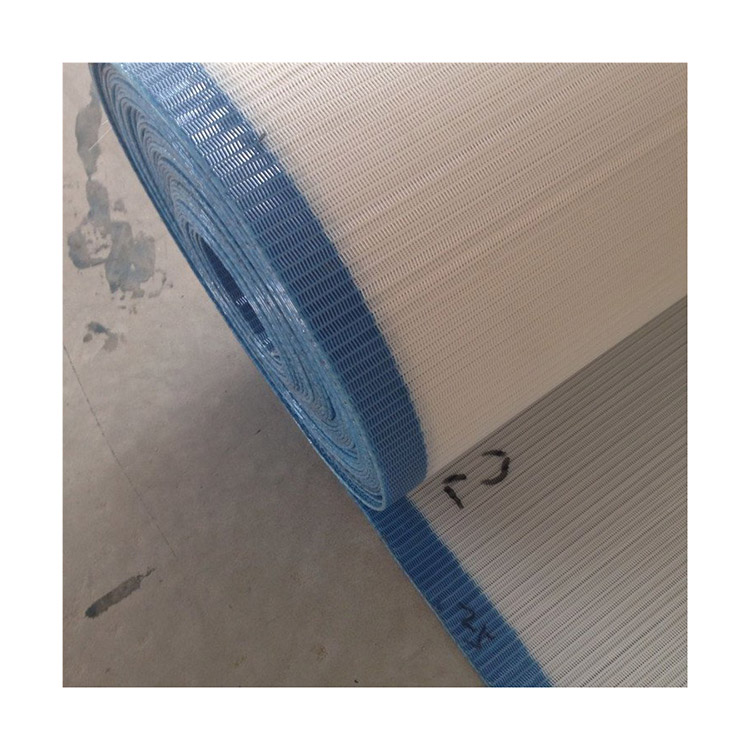
The flat filler is the feature that changes the mesh most visibly. Yiheng’s product description states that the flat wire filler creates a denser, finer mesh structure that captures smaller particles and is intended to deliver finer filtration and a drier filter cake compared with round-wire belts. That is a product-positioning statement, not an independent laboratory result. The measurable sign on the datasheet is the lower air permeability of the filler-wire build.
The smooth surface belongs to the same construction story. A spiral belt with a smooth mesh surface is easier to handle during installation and seam work than a belt with a more interrupted surface. The product data links the smooth surface with arbitrary disassembly and assembly, and then with easier installation, seam changes and routine maintenance.
Reading the spec sheet: loop distance, wire diameter, thickness and air permeability
The fastest way to understand a polyester spiral mesh belt is to read the numbers in a fixed order. Start with the construction and model, then read loop distance, strand diameters, thickness and air permeability. Do not compare one number without the others. A low airflow value may come from a filler wire, a tighter loop, a thicker build or a different test basis.
Loop distance
Loop distance is the spacing value attached to the repeating loop. In the Small Loop build it is 5.20 mm; in the Medium Loop build it is 6.50 mm. It is a geometry value, not a filtration rating. Two belts can share a material and still differ in loop distance, which is why the model name should travel with the specification.
Warp and weft wire diameter
The Small Loop build lists a warp diameter of 0.52 mm and a weft diameter of 0.70 mm. The Medium Loop build lists 0.68 mm and 0.90 mm. These are polyester strand dimensions, even though the data sheet uses the word ‘wire’. They describe the strand, not a metal component and not the flat filler.
Thickness
Thickness is the belt’s specified profile. The Small Loop and Small Loop-Filler Wire builds are 1.90 mm; the Medium Loop and Medium Loop-Filler Wire builds are 2.32 mm; the Large Loop-Filler Wire build is 2.95 mm. Thickness matters where roller spacing is tight and where belt weight affects handling. Yiheng’s product data positions the 1.90 mm build as the slimmest in the spiral series and suitable for machines with tight roller spacing.
Air permeability
Air permeability is an airflow value expressed per unit area per hour. It describes how open the structure is under the stated conditions. In the builds discussed here, the specified range runs from 7,300 ±500 m³/㎡/h for the Small Loop-Filler Wire to 18,300 m³/㎡/h for the Medium Loop. The Small Loop lists 17,500 m³/㎡/h, the Medium Loop-Filler Wire lists 10,700–12,000 ±500 m³/㎡/h, and the Large Loop-Filler Wire lists 9,000–13,700 ±500 m³/㎡/h.
Air permeability is not a micron rating. It does not by itself state the largest particle that will pass or be retained. Buyers should compare values only when the test method and conditions are comparable, and they should keep the process duty in view. A dryer application may value a more open structure; a fine dewatering application may value the denser structure created by a filler wire.
Strength at break
The Small Loop, Small Loop-Filler Wire and Medium Loop-Filler Wire data list strength at break at ≥2000 N/cm. The Large Loop-Filler Wire data list ≥2300 N/cm. Strength is a separate check from airflow. A belt can have the right openness and still be wrong for a machine if its tensile requirements do not match the application.
| Build | Specified strand or filler data | Loop distance | Thickness | Specified air permeability |
|---|---|---|---|---|
| Small Loop | Warp 0.52 mm; weft 0.70 mm | 5.20 mm | 1.90 mm | 17,500 m³/㎡/h |
| Small Loop-Filler Wire | Threading 0.80 mm; flat filler 0.65 × 1.65 mm | Not stated in supplied data | 1.90 mm | 7,300 ±500 m³/㎡/h |
| Medium Loop | Warp 0.68 mm; weft 0.90 mm | 6.50 mm | 2.32 mm | 18,300 m³/㎡/h |
| Medium Loop-Filler Wire | Ring wire 0.68 mm; threading 0.90 mm; fillers 0.68 × 3 or 0.68 × 4 mm | Not stated in supplied data | 2.32 mm | 10,700–12,000 ±500 m³/㎡/h |
Table note: values are as stated in the product data for the named builds. ‘Not stated in supplied data’ means the value was not provided; it does not mean the build cannot be specified.
Filler wire: how a denser mesh changes filtration
A filler wire is the clearest example of how a spiral mesh belt can be tuned without changing its basic family. The Small Loop and Small Loop-Filler Wire share a 1.90 mm thickness, but the specified air permeability falls from 17,500 to 7,300 ±500 m³/㎡/h when the flat filler is added. The Medium Loop and Medium Loop-Filler Wire share a 2.32 mm thickness, while the specified airflow moves from 18,300 to 10,700–12,000 ±500 m³/㎡/h.
That shift is the trade-off in plain terms. A more open build gives the process more airflow and drainage capacity under the stated conditions. A filler-wire build gives a denser structure, which is intended for finer retention and a drier cake. The right choice depends on what the line is trying to do. If the limiting problem is water removal speed, a more open build may be the logical starting point. If the limiting problem is solids passing through or the cake being too wet, the filler-wire build is the more relevant direction.
The flat shape matters because the product description explicitly contrasts it with round-wire belts. Yiheng states that the flat wire filler creates a denser, finer mesh structure and is intended to capture smaller particles. That statement should be read with its application scope: it describes the intended filtration effect of the flat-wire design, not a guarantee that every process will produce a drier cake. The buyer still needs to match the belt to the slurry, the machine and the operating conditions.
This is why the phrase ‘from 7,300 up to 18,300 m³/㎡/h’ is useful but incomplete on its own. The low end and the high end describe different builds with different jobs. The number should be read together with the model, the filler configuration and the thickness.
Why ‘arbitrary disassembly and assembly’ matters
Spiral product descriptions state a smooth mesh surface with arbitrary disassembly and assembly, and link that feature to easier installation, seam changes and routine maintenance. For a maintenance team, this changes the belt from a single sealed item into a serviceable component. The practical value is not that the belt is fragile or temporary; it is that installation and seam work can be approached at the belt level.
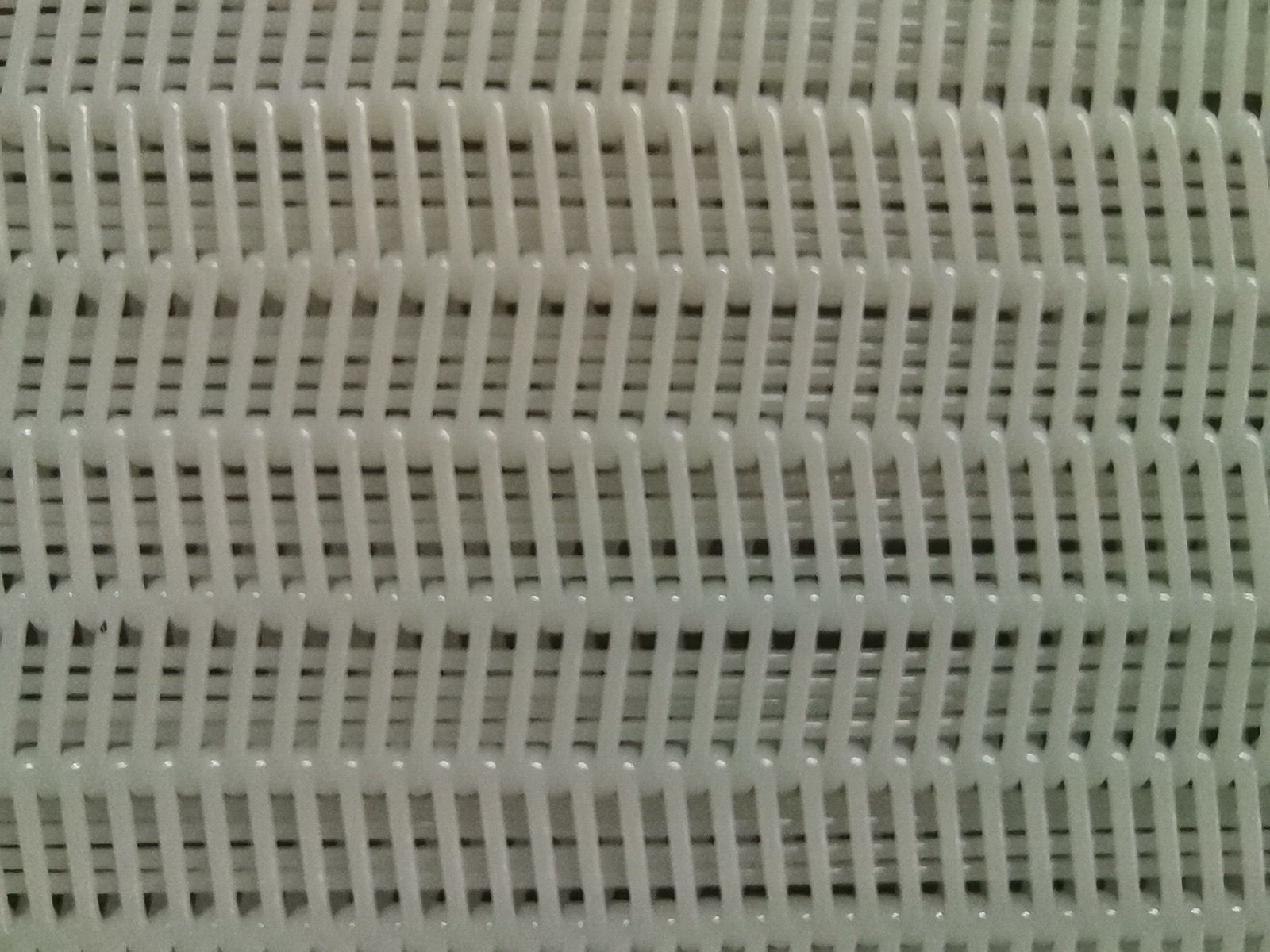
This feature also affects how a buyer should ask questions. Instead of asking only for the belt dimensions, ask how the joint is made, how the belt is assembled on the machine, and what is involved in a seam change. The answer should be consistent with the model data. A smooth surface and a serviceable loop structure are especially relevant on long belts where installation access is limited.
Maintenance value should not be confused with filtration value. A belt can be easy to install and still be wrong for the process. The correct reading is: disassembly and assembly are serviceability features; air permeability, thickness and loop geometry are performance-related features. Both belong in the evaluation.
Where polyester spiral mesh belts are used
The product data names five application areas that make the category easier to understand. Each uses the same basic belt family for a different process reason.
- Belt filter presses. Spiral mesh belts are used in filter press belts for dewatering. The filler-wire builds are the denser option, with the Small Loop-Filler Wire at 7,300 ±500 m³/㎡/h and the Medium Loop-Filler Wire at 10,700–12,000 ±500 m³/㎡/h. These are the builds to examine when finer retention is the priority.
- Papermaking pulp washing. The spiral range is listed for papermaking pulp washing and pressing. Here the belt has to handle a continuous wet process, so the combination of polyester durability, loop geometry and airflow is more relevant than a single headline number.
- Meltblown non-woven equipment. The spiral belt data lists meltblown non-woven equipment as an application. In this setting the belt is part of a continuous forming or conveying line, and the smooth surface and specified airflow support the process role described in the product data.
- Fabric pre-shrinking. The range is also listed for fabric pre-shrinking machines in textile finishing. The belt’s smooth surface and serviceable construction are relevant where the material must pass over the belt in a continuous operation.
- Latex wire drying and conveying. Spiral mesh belts are listed for latex wire drying and conveying in rubber and latex processing. The Medium Loop build combines a 2.32 mm thickness with 18,300 m³/㎡/h air permeability, while filler-wire versions provide a denser alternative when the process calls for it.
These applications also explain the secondary vocabulary. A buyer may see the same family described as a polyester filter belt, polyester dewatering belt, belt filter press belt, polyester dryer belt, spiral dryer fabric or drying conveyor belt. The names shift with the duty, but the underlying questions remain: what loop geometry, what strand diameter, what thickness, what airflow and what filler configuration?
How to read a spiral mesh data sheet in six steps
- Start with the process duty. Decide whether the belt is primarily for dewatering, pulp washing, nonwoven support, textile finishing or latex drying. The same spiral family can appear in several duties, but the priority changes.
- Confirm the construction. Check whether the model is a Small Loop, Medium Loop or Large Loop build, and whether it is unfilled or filler-wire. Do not compare a filler-wire airflow value with an unfilled value as if they were the same product.
- Read loop distance and strand diameter together. The Small Loop data gives 5.20 mm loop distance, 0.52 mm warp and 0.70 mm weft. The Medium Loop gives 6.50 mm, 0.68 mm and 0.90 mm. These values describe the geometry behind the model name.
- Check thickness against the machine. A 1.90 mm Small Loop build and a 2.32 mm Medium Loop build are not interchangeable where roller spacing is tight. The 2.95 mm Large Loop-Filler Wire build is another step in profile.
- Compare air permeability like for like. Use the stated units and conditions. A value of 7,300 m³/㎡/h is not ‘worse’ than 18,300 m³/㎡/h; it indicates a denser structure intended for a different filtration job.
- Confirm strength, joint and maintenance. Check the strength at break, the joint arrangement and what arbitrary disassembly and assembly means for the actual machine. A belt that is difficult to install has a cost beyond its purchase price.
Buyer checks before specifying a polyester spiral mesh belt
Before requesting a sample or quotation, reduce the requirement to a short specification: model family, filled or unfilled construction, loop distance where stated, warp and weft diameter, thickness, air permeability with test basis, strength at break, joint type and application. Ask the supplier to state which values belong to the exact build being offered. A general catalogue range is not a substitute for the model-level data.
It also helps to separate ‘open’ from ‘fine’. If the line is limited by drainage, the more open build deserves attention. If the line is limited by solids carry-over or cake dryness, the filler-wire build deserves attention. If the line is limited by installation access, the smooth surface and disassembly feature may matter as much as the airflow number. That is the practical value of learning the vocabulary: it turns a long datasheet into a set of decisions.
Frequently asked questions
What is the difference between a polyester spiral mesh belt and a polyester square mesh belt?
A polyester spiral mesh belt is built around loop geometry, while Polyester Square Mesh uses a woven structure. Yiheng’s square mesh model 05802 is specified as a 2-shed plain weave with a 12–14 mesh range, 1.0–1.2 mm pitch and 0.8 mm warp and weft diameter. Spiral mesh terminology instead centres on loop distance, threading and optional filler wire. The products can both be polyester mesh belts, but the construction language is different.
What does loop distance mean on a spiral mesh datasheet?
Loop distance is the spacing value for the repeating loop. In the Small Loop build it is 5.20 mm, and in the Medium Loop build it is 6.50 mm. It is a geometry value, not an airflow or filtration rating. It should be read with the strand diameters and the model name, because loop distance alone does not define the belt’s performance.
Why does filler wire lower air permeability?
Filler wire occupies part of the open area in the loop structure. The Small Loop lists 17,500 m³/㎡/h, while the Small Loop-Filler Wire build lists 7,300 ±500 m³/㎡/h. The Medium Loop lists 18,300 m³/㎡/h, while the Medium Loop-Filler Wire build lists 10,700–12,000 ±500 m³/㎡/h. The lower figures reflect a denser mesh intended for finer filtration, not a loss of quality.
Is higher air permeability always better?
No. Higher air permeability means a more open structure under the stated conditions. That can be useful for drainage or drying, but it may be less suitable when the process needs finer solids retention. The right value depends on the slurry, the machine and the target cake condition. Compare values only when the test basis is comparable.
Polyester mesh belt manufacturers: what should buyers check?
Ask for the exact model and build, not just a category range. Confirm loop distance where stated, warp and weft diameter, thickness, air permeability with test basis, strength at break, joint type and the intended application. Check whether the quote is for an unfilled or filler-wire build. Yiheng Mesh’s published profile lists rapid sampling and a 1 m² MOQ, and the company brochure can be downloaded here: Yiheng Mesh company brochure. A useful sample request should state the machine, belt dimensions, process duty and target airflow so the supplier can match the model rather than guess.
Conclusion
A polyester spiral mesh belt is best understood as a loop-based polyester belt with a tunable open structure. The loop, the polyester wire and the flat filler wire are the three terms that unlock the datasheet. Loop distance and strand diameter describe the geometry. Thickness describes the machine fit. Air permeability describes openness. Filler wire explains why a denser build such as the Small Loop-Filler Wire lists 7,300 ±500 m³/㎡/h while the unfilled Small Loop lists 17,500 m³/㎡/h.
The same vocabulary carries into application. Belt filter presses, papermaking pulp washing, meltblown non-woven equipment, fabric pre-shrinking and latex wire drying all use the spiral family for different process reasons. The buyer who can separate geometry, airflow, strength and serviceability will read a specification more accurately than one who compares a single number. That is the practical starting point for a discovery-stage evaluation.
For a specific spiral mesh evaluation, prepare the model, loop and strand data, thickness, air permeability basis, joint requirement and application. The Henan Yiheng Mesh Belt Industry Co., Ltd. website is the starting point for product and company information.
Have Questions or Need More Details?
Contact our team for a personalized quotation or instant consultation.
Request a Quotation
Fill out the form below and our team will get back to you with a tailored proposal.
WhatsApp Direct Chat
Prefer to chat in real-time? Message us on WhatsApp for instant assistance & quick answers.
- Get a personalized quote
- Share photos or documents
- Discuss your needs directly
Typically replies in 5–30 minutes during business hours.