
Dry vs Wet Ball Mill Grinding: A Comparison Guide for Ore, Cement, and Ceramic Applications
A ball mill can be built to run dry or wet, and that single configuration choice reshapes more of the plant than most buyers expect. It determines how the mill discharges, whether the circuit needs an air classifier or a hydrocyclone, how dust is controlled, and whether the product leaves the process as a powder or a slurry. For ore, cement, and ceramic applications, the answer is driven by three hard constraints: target product size, feed material behavior, and required throughput. This guide works through those constraints using published model ranges and specifications, so the comparison stays on parameters rather than habit.
Why the Dry vs Wet Decision Is Not a Minor Detail
Dry and wet grinding are not two interchangeable operating modes on the same machine. The choice propagates through the discharge design, the classification stage, the dust-collection scope, and the material-handling equipment downstream. A grinding circuit specified for dry operation typically pairs the mill with air classification and integrated dust collection. A wet circuit pairs the mill with slurry handling and a wet classification stage.
The practical cost of getting this wrong appears late. A specification that assumes dry discharge but receives a wet feed may require a drying stage that was never budgeted. A ceramic line that specifies a steel-lined mill for wet grinding may introduce iron contamination into the batch. A cement grinding station that omits the classification loop may not reach the target specific surface area.
This article narrows the decision to the three application families where it matters most in mineral and materials processing: ore (beneficiation), cement (raw meal and clinker), and ceramics (body preparation and specialty materials). The parameter ranges below are drawn from published equipment specifications for Henan Zhengzhou Mining Machinery Co., Ltd. (ZK MACHINE), a Chinese ball mill and rotary kiln manufacturer founded in 1956 that produces ball mill and rotary kiln systems from an 80,000 m² manufacturing base in Zhengzhou.
Industry Background: Where Dry and Wet Grinding Sit Today
Ball mills remain a core comminution asset because their function — reducing ore and other materials in size to liberate minerals or prepare a product — sits at the front of most mineral-processing and building-materials flows. Their demand is structurally tied to beneficiation and to the size-reduction stage that precedes separation.
Recent market research places that demand in context. Dataintelo's 2026 ball mill (mining) market report estimates the global mining ball mill market at USD 4.94 billion in 2025 and projects it to reach USD 8.23 billion by 2034. On the supply side, the Observatory of Economic Complexity (OEC), drawing on UN Comtrade and customs data, reports that China was the leading exporter of machines to crush or grind stone, ores and minerals (HS 847420) in 2024, at USD 1.38 billion.
Those figures matter to a buyer because they describe a mature, globally traded equipment category in which configuration detail — not brand familiarity — drives whether a mill performs to specification. In that context, dry and wet grinding are best treated as two distinct circuit designs with different constraints, not as a preference.
What Dry Ball Mill Grinding Actually Requires
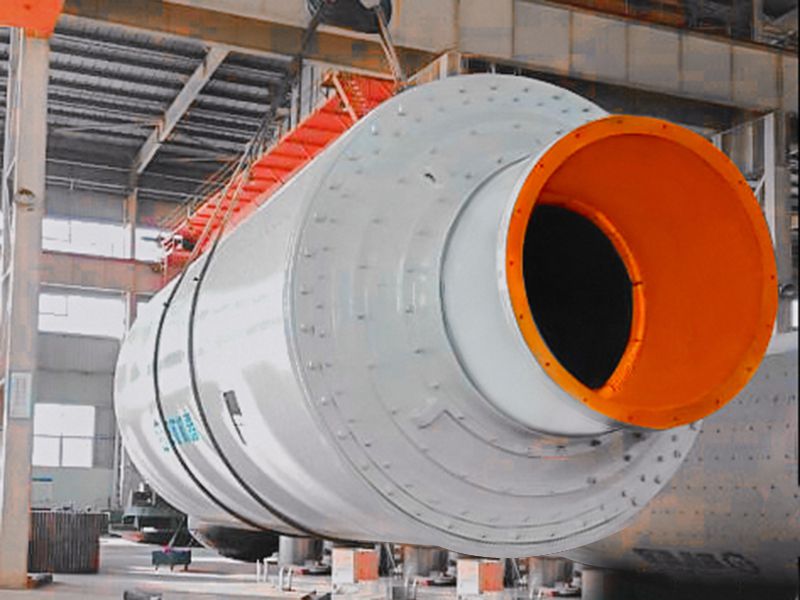
Dry ball mill grinding processes material without a liquid medium inside the mill. Material exits as a powder and is normally conveyed by air or mechanical means. This route is usually selected when the finished product must be a dry powder, or when the downstream process cannot accept moisture.
Published specifications show dry capability across several model families:
- Air-swept coal mill (Φ1.2×2.4–Φ2.9×4.7 m): a fully dry system that integrates grinding and drying in one circuit. Capacity range 1.4–16 t/h, motor power 45–570 kW, typical coal fineness 85%+ passing 200 mesh, and coal moisture below 2% under the stated operating conditions.
- Ore ball mill (1.2*2.0–6*12 m): supports dry grinding alongside wet grinding, with capacity 0.5–930 t/h and product size approximately 0.074–0.4 mm.
- General ball mill (Φ1.2x4.5–Φ4.6x10+3.5): supports dry or wet grinding, with capacity approximately 0.8–230 t/h, feed size ≤25 mm, and adjustable product size of approximately 0.07–0.4 mm.
- Rod mill (Φ0.9×1.8–Φ3.6×5.4 m): supports dry or wet grinding with overflow discharge, capacity 0.62–250 t/h, and main motor power 22–1600 kW.
The coal mill example is instructive. When a material carries moisture, dry grinding and drying are often combined in a single unit rather than handled as separate process steps. That is a circuit-design decision, not just a mill-type decision, and it changes the auxiliary equipment scope.
What Wet Ball Mill Grinding Actually Requires
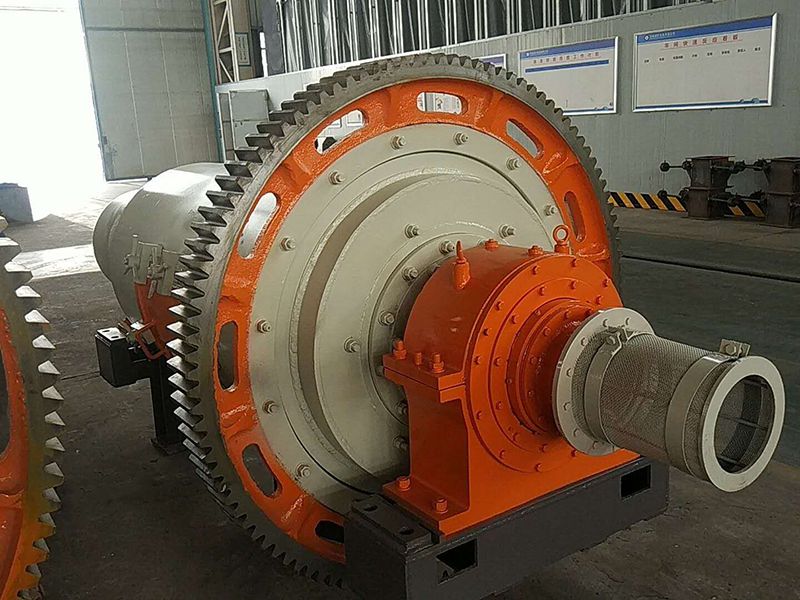
Wet ball mill grinding uses a liquid medium so that solids are transported and discharged as a slurry. This is the natural choice when the downstream process is already wet — for example, wet beneficiation stages or ceramic slip preparation.
Among the published configurations, two families illustrate wet operation most clearly:
Ceramic ball mills
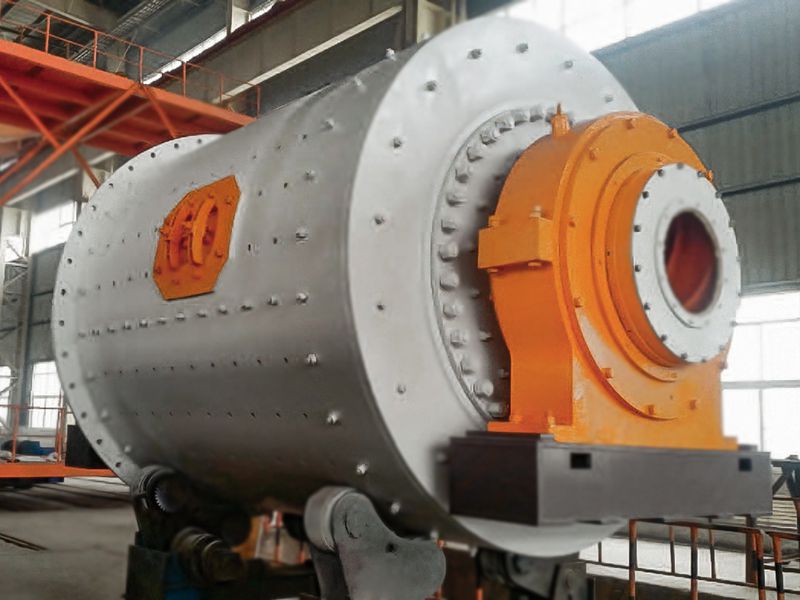
Ceramic ball mills are classified as wet grinding designs. The model range is 600×700–3200×4600 mm, covering cylinder diameters from 600 mm to 3200 mm and lengths from 700 mm to 4600 mm. Published parameters include:
- Loading capacity: 0.05–15 t per batch
- Rotational speed: 13–50 rpm
- Reference motor power: 2.2–75 kW
- Batch / intermittent operation
- Dry or wet grinding supported
- Mill shell: carbon steel or alloy steel
- Lining: alumina ceramic, silica, or other wear-resistant ceramic materials
- Grinding media: alumina balls, zirconia balls, or other ceramic media
The ceramic lining is the defining element in this family. It is specified to reduce the risk of contamination from the grinding system — a constraint that appears whenever the processed material must remain free of metal pickup.
Ore and rod mills in wet mode
Ore ball mills (1.2*2.0–6*12 m) support both dry and wet grinding, with capacity 0.5–930 t/h, product size approximately 0.074–0.4 mm, and a choice of overflow or grate discharge. Applicable materials include iron ore, copper ore, gold ore, lead-zinc ore, fluorite, quartz, and non-metallic minerals. Rod mills (Φ0.9×1.8–Φ3.6×5.4 m) also support dry or wet grinding with overflow discharge, at 0.62–250 t/h.
How Product Size Target, Feed Material, and Throughput Shape the Choice
Ore: product size and discharge configuration set the mode
In ore beneficiation, the target product size often decides the mode before anything else is considered. Ore ball mills are specified to produce approximately 0.074–0.4 mm. Where the downstream separation stage is wet — as is common in mineral processing — wet grinding is the consistent choice because the slurry can move directly into classification and separation without an intermediate drying step.
Discharge configuration is a second constraint. Ore ball mills offer either grate discharge or overflow discharge. These are not cosmetic differences; they change how material leaves the mill and therefore how the circuit is controlled. The correct option depends on the required product size distribution and the classification equipment that follows.
Cement: continuous operation with open or closed circuit
Cement grinding runs continuously rather than in batches. The cement ball mill (Φ1.2×4.5–Φ4.6×10) is specified with a throughput of approximately 1.4–87 t/h and a diameter range of 1.2–4.2 m. Its structural shell is Q235B/Q345B or equivalent structural steel. Two configuration paths are published:
- Open-circuit grinding — material passes through the mill once.
- Closed-circuit grinding — the mill is combined with a separator so that coarse particles return for further grinding.
The mill can also be combined with a roller press and separator as a grinding system. This matters for buyers comparing cement grinding proposals: the mill specification alone does not describe the circuit, and the classification equipment is part of the performance envelope.
The raw mill stage follows the same logic. Raw mills (Φ1.2×4.5–Φ3.5×10 m, with customized large-scale models available above that range) run at 1.7–73 t/h with a grinding media load of 5–118 t and adjustable product fineness. The published configuration is a ball mill-based raw grinding system, and the raw meal fineness produced is specified as uniform.
Ceramics: batch operation and contamination control
Ceramic grinding is the clearest case where wet grinding dominates, and where the reason is material-related rather than throughput-related. Ceramic ball mills operate in batch or intermittent mode at 0.05–15 t per batch. Because the lining and the grinding media are ceramic — alumina, silica, or zirconia — the batch can be processed without the iron pickup that a steel-lined mill would introduce.
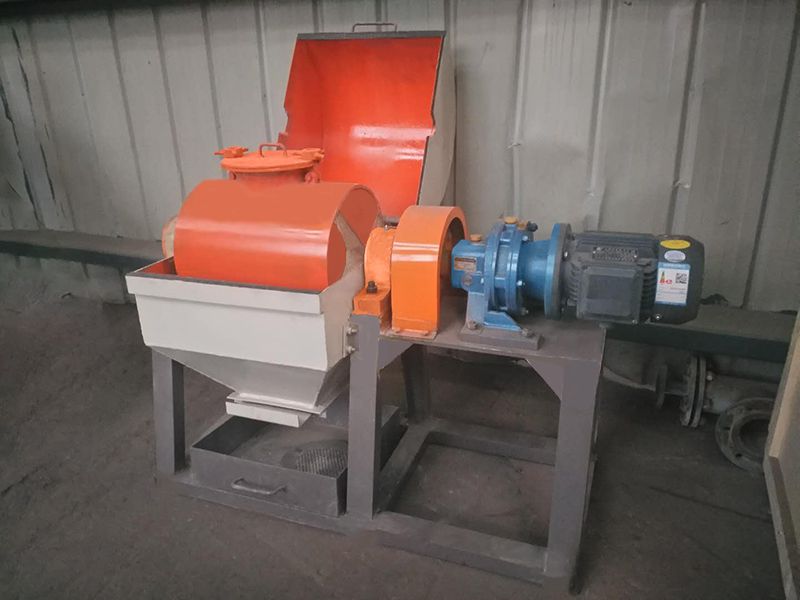
Where a project requires validation before committing to a full production mill, laboratory ball mills (Φ0.6×0.7–Φ1.8×2.1 m) provide a smaller-scale equivalent. These support both dry and wet grinding, with loading capacity 0.2–1.5 t per batch, motor power 2.2–11 kW, and rotational speed 23–35 rpm.
Published Model Ranges at a Glance
The table below consolidates the model ranges, capacities, and grinding modes described in the published specifications. It is arranged so that a buyer can compare dry and wet capability across product families rather than within a single mill type.
| Product | Model Range | Capacity | Grinding Mode | Discharge |
|---|---|---|---|---|
| Ball Mill | Φ1.2x4.5 – Φ4.6x10+3.5 | Approx. 0.8–230 t/h | Dry or wet | Grate or overflow |
| Ore Ball Mill | 1.2*2.0 – 6*12 m | 0.5–930 t/h | Dry or wet | Grate or overflow |
| Cement Ball Mill | Φ1.2×4.5 – Φ4.6×10 | Approx. 1.4–87 t/h | Continuous; open or closed circuit | Not specified in source |
| Raw Mill | Φ1.2×4.5 – Φ3.5×10 m | 1.7–73 t/h | Ball mill-based raw grinding system | Not specified in source |
| Rod Mill | Φ0.9×1.8 – Φ3.6×5.4 m | 0.62–250 t/h | Dry or wet | Overflow |
| Air-Swept Coal Mill | Φ1.2×2.4 – Φ2.9×4.7 m | 1.4–16 t/h | Dry, integrated grinding and drying | Not specified in source |
| Ceramic Ball Mill | 600×700 – 3200×4600 mm | 0.05–15 t/batch | Wet grinding design; dry or wet support | Batch / intermittent |
| Laboratory Ball Mill | Φ0.6×0.7 – Φ1.8×2.1 m | 0.2–1.5 t/batch | Dry or wet | Batch |
Model ranges, capacities, and grinding modes as published in product specifications.
A Step-by-Step Decision Framework
The following sequence reflects the order in which the constraints actually bind. Working through it in this order avoids re-specifying the circuit later.
- Fix the target product size first. Ore ball mills are specified at approximately 0.074–0.4 mm, and general ball mills at approximately 0.07–0.4 mm, both adjustable according to process requirements. If the required product size falls outside the range the mill family can deliver, the mill type changes before the grinding mode does.
- Check the feed behavior. Feed size ≤25 mm is the published limit for the general ball mill; larger feed may require a crushing or pre-grinding stage. Moisture content matters too — the air-swept coal mill is specified for coal moisture below 2% under stated operating conditions, and it dries as it grinds.
- Confirm whether the downstream process is wet or dry. If separation, classification, or forming is already wet, wet grinding avoids an unnecessary drying step. If the product must ship or feed a dry process, dry grinding avoids adding moisture control.
- Select the discharge configuration. Grate and overflow discharge are both available on the general ball mill and the ore ball mill. The choice follows the product size distribution target and the classification system.
- Decide batch or continuous. Cement and large-scale ore grinding run continuously. Ceramic body preparation and laboratory validation typically run batch or intermittent — ceramic ball mills at 0.05–15 t/batch and laboratory ball mills at 0.2–1.5 t/batch.
- Confirm contamination constraints. Where metal pickup is unacceptable, a ceramic-lined mill with ceramic media is the relevant configuration. This is a material-selection decision that sits alongside the dry/wet choice.
- Specify the supporting equipment. Dry circuits pair with dust collection and air classification; wet circuits pair with slurry handling. Ball mill liners are selected according to the processed material and operating conditions, with options including high-manganese steel, alloy steel, cast iron, rubber, and ceramic.
Note on configuration scope: ZK MACHINE supplies ball mills under an OBM production model. Ball mills and rotary kilns are not standard products in this category — each project requires customized engineering based on material properties, process requirements, production capacity, environmental regulations, and site conditions. Monthly capacity is 10 units, minimum order quantity is 1 unit, and standard lead time is approximately 3 months.
Use Cases: Dry and Wet Grinding in Practice
Dry grinding in ore and manganese oxide processing
A 10 t/h dry grinding ball mill project supplies stable, continuous production of high-quality manganese oxide powder. The circuit is described as fully enclosed dry grinding with integrated dust collection and air classification, a wear-resistant mill design, and smart electrical control. The project has been running for more than 20 years.
Wet grinding in ceramic and construction material production
A Φ2.3×2.7 m batch wet ceramic ball mill is used to grind mortar, sand, and other construction materials. The installation is characterized by a wet grinding process, wear-resistant ceramic materials, enhanced grinding fineness, and extended equipment service life. It has been in operation for more than 15 years.
Continuous cement grinding with closed-circuit classification
A 70 t/h cement grinding station combines clinker pre-crushing, cement grinding, high-efficiency classification, cement storage, discharge screening, weighing, and multi-point dust collection. A Φ4.2 m large ball mill provides the 70 t/h capacity, and the mill operates in closed circuit with an O-Sepa high-efficiency classifier — fine powder is separated as finished cement while coarse particles return to the mill. Product fineness is adjustable within 280–650 m²/kg. The station has been operating for more than 20 years.
Adjustable fineness in mineral grinding
A feldspar grinding production line is configured around a simple process flow and a compact equipment layout, with adjustable product fineness and increased mill throughput. The reported outcome is higher production capacity and product quality alongside lower energy consumption per tonne of powder and lower operating costs.
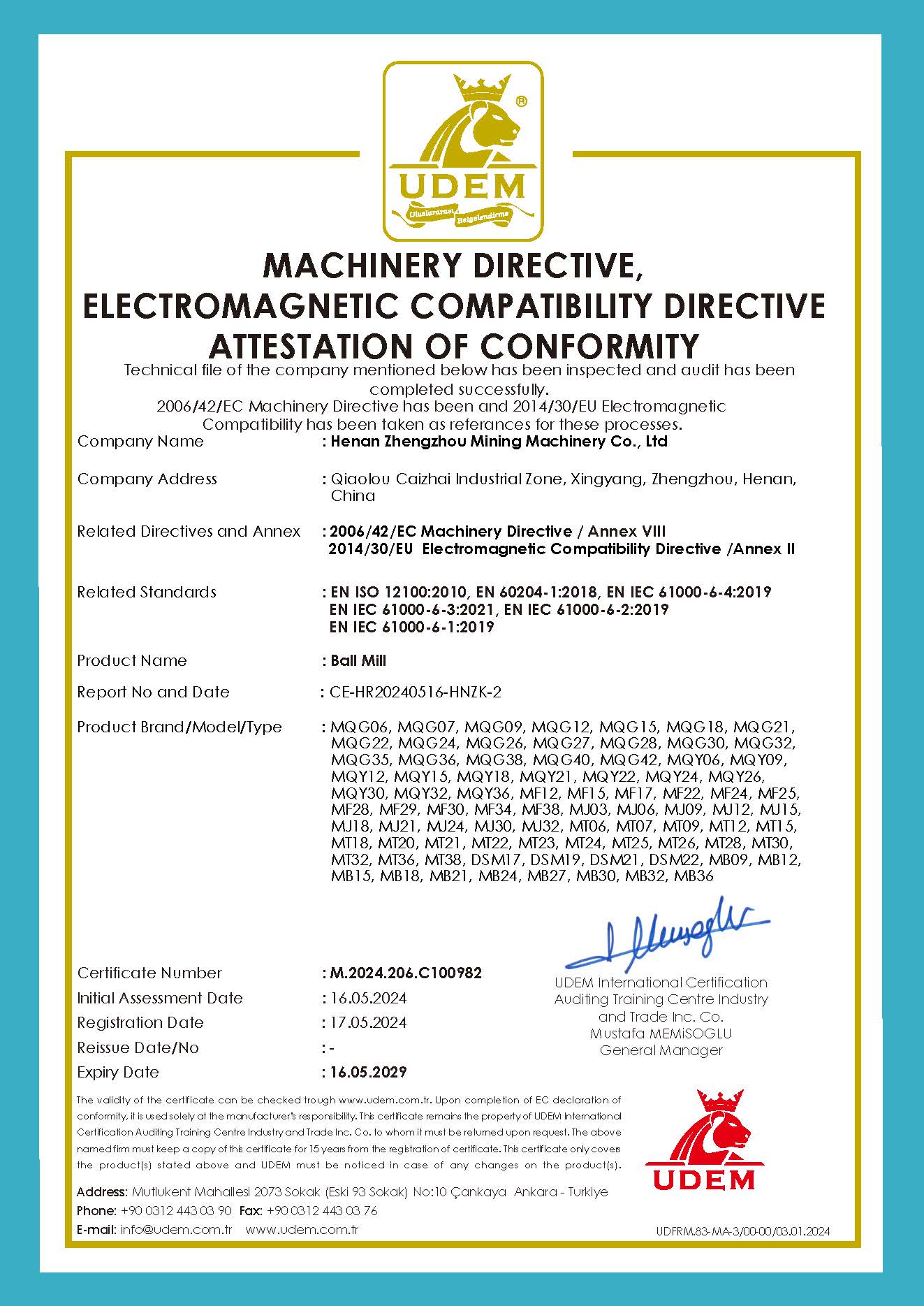
Compliance and Certification Facts for Ball Mill Buyers
For projects destined for the European Union, compliance documentation should be confirmed at the technical specification stage rather than after the order. The published certification facts for this equipment range are:
- Certification: CE
- Certificate number: M.2024.206.C100982
- Issuing authority: UDEM INTERNATIONAL CERTIFICATION AUDITING TRAINING Centre Industry and Trade Inc. Co.
- Market: EU
- Scope: Machinery, Electromagnetic Compatibility
- Standards cited: EN ISO 12100:2010, EN 60204-1:2018, EN IEC 61000-6-4:2019, EN IEC 61000-6-3:2021, EN IEC 61000-6-2:2019, EN IEC 61000-6-1:2019
- Issue date: 2024-05-16
- Expiry date: 2029-05-16
The CE certification covers Ball Mill, Cement Ball Mill, Ceramic Ball Mill, Laboratory Ball Mill, Ore Ball Mill, Rod Mill, Air-Swept Coal Mill, and Raw Mill products. For a complete grinding line, the applicable conformity scope may extend beyond the mill itself to electrical and control systems, conveying equipment, and dust collection equipment — buyers should define whether the requirement applies to the individual machine or the full production line.
Frequently Asked Questions
Is CE certification available for dry and wet ball mill configurations destined for the EU market?
CE certification applies to the Ball Mill range with certificate number M.2024.206.C100982, issued by UDEM INTERNATIONAL CERTIFICATION AUDITING TRAINING Centre Industry and Trade Inc. Co. The certification scope covers Machinery and Electromagnetic Compatibility and applies to the EU market, with an issue date of 2024-05-16 and an expiry date of 2029-05-16. Coverage extends to Ball Mill, Cement Ball Mill, Ceramic Ball Mill, Laboratory Ball Mill, Ore Ball Mill, Rod Mill, Air-Swept Coal Mill, and Raw Mill products. Because the applicable conformity requirements depend on the final equipment and system configuration, the certification scope should be confirmed against the specific project rather than assumed from the mill type alone.
What capacity and motor power ranges are available across dry and wet ball mill models?
Capacity and power vary by model family. The general Ball Mill (Φ1.2x4.5–Φ4.6x10+3.5) covers approximately 0.8–230 t/h with feed size ≤25 mm and product size approximately 0.07–0.4 mm. The Ore Ball Mill (1.2*2.0–6*12 m) covers 0.5–930 t/h with product size approximately 0.074–0.4 mm. The Cement Ball Mill (Φ1.2×4.5–Φ4.6×10) covers approximately 1.4–87 t/h with a diameter range of 1.2–4.2 m. The Raw Mill (Φ1.2×4.5–Φ3.5×10 m) covers 1.7–73 t/h with a grinding media load of 5–118 t. For motor power, the Rod Mill (Φ0.9×1.8–Φ3.6×5.4 m) is specified at 22–1600 kW, the Air-Swept Coal Mill at 45–570 kW, the Ceramic Ball Mill at a reference 2.2–75 kW, and the Laboratory Ball Mill at 2.2–11 kW.
What are the cost considerations when comparing dry and wet grinding configurations?
Published cost data for this equipment category is limited, and buyers should treat any figure as a starting point rather than a quotation. A secondary industry source cited in 2026 buyer's guide material places a small production mill at 5–12 t/h output in the range of USD 50,000–120,000, though this is a medium-confidence estimate rather than a manufacturer-published price. Beyond the initial capital figure, the more durable cost drivers are energy consumption during comminution and the wear life of liners and grinding media. A tumbling mill converts electrical energy into mechanical energy to generate fracture events, which makes power draw an inherent operating-cost factor — and it is one reason energy-saving ball mill designs are specified for continuous circuits. Because ball mills are customized rather than standard products, project-specific pricing depends on material characteristics, capacity, environmental requirements, and site conditions.
How can dry or wet grinding performance be validated before ordering a production mill?
Laboratory-scale validation is the practical route. The Laboratory Ball Mill (Φ0.6×0.7–Φ1.8×2.1 m) supports both dry and wet grinding at a loading capacity of 0.2–1.5 t per batch, with motor power 2.2–11 kW and rotational speed 23–35 rpm. It is a ceramic-lined ball mill and is applicable to ores, limestone, calcite, kaolin, bentonite, talc, mica, magnesite, ceramic materials, and other laboratory-scale materials. A batch trial on a laboratory mill allows the grindability of a specific feed to be observed before committing to a full production configuration. For buyers who want a deeper review, the company's full product catalogue is available for download: ZK MACHINE 2025 product catalogue.
What is the typical lead time and minimum order quantity for a customized ball mill?
Because ball mills are engineered to project conditions rather than selected from a standard catalogue, minimum order quantity is 1 unit and standard lead time is approximately 3 months, with a monthly production capacity of 10 units. Quality control is applied at 100% test before shipment. Export markets serve the Middle East, Southeast Asia, Africa, Russia, and CIS countries among others. To move from evaluation to a configuration review, the fastest route is to provide the project country, required capacity, feed material and size, target product fineness, and whether the circuit will run dry or wet — these inputs determine the model range and the supporting equipment scope.
Next Step: Sample Testing and Configuration Review
If you are comparing dry and wet grinding options for an ore, cement, or ceramic application, the most useful next step is a configuration review against your actual feed material and target product size. ZK MACHINE can recommend a mill model, grinding media, and liner configuration based on project conditions, and can support batch-scale validation through laboratory ball mill testing.
Contact: Joy | Email: vip@zkcorp.com | Tel / WhatsApp: +86 182-0361-6061 | Web: www.zkcomp.com
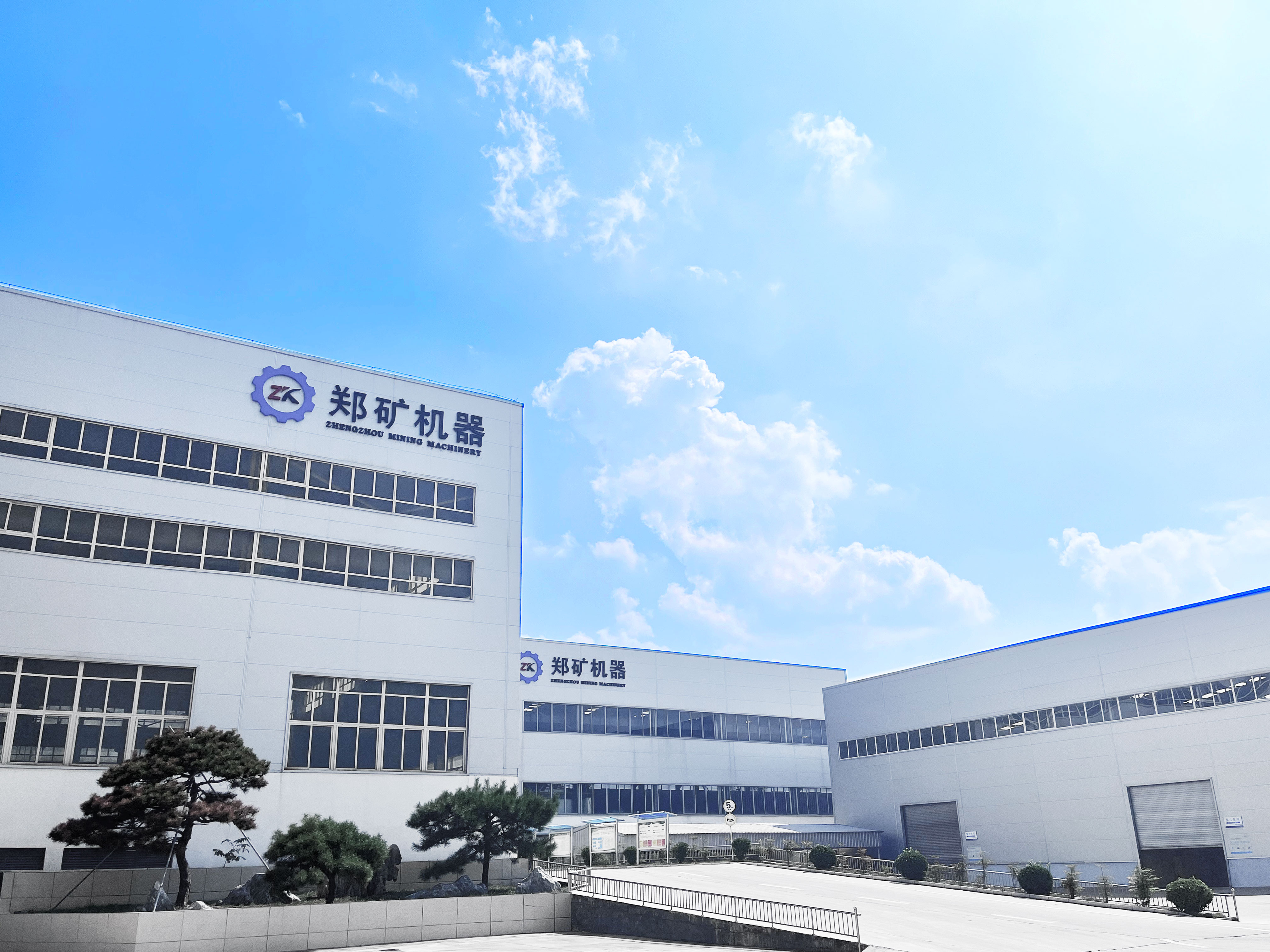
Offices: 15th Fl, Bldg No.13, National University Science Park (East), No.279, West 3rd Ring Rd, Zhengzhou, China | Factory: Qiaolou Caizhai Industrial Estate, Xingyang, Zhengzhou, China
Conclusion
Dry and wet ball mill grinding are two distinct circuit designs, and the choice between them is set by constraints rather than preference. Ore ball mills support both modes across a 0.5–930 t/h capacity range and produce approximately 0.074–0.4 mm, with grate or overflow discharge determining how the mill is integrated with classification. Cement grinding runs continuously in open or closed circuit, with the mill frequently combined with a roller press and separator. Ceramic ball mills are wet grinding designs with ceramic lining and ceramic media, operated in batch mode at 0.05–15 t/batch to control contamination.
For a buyer in the research and evaluation stage, the productive sequence is to fix the product size target, verify feed behavior and moisture, confirm whether the downstream process is wet or dry, and only then select the discharge configuration and mode. Model ranges, capacities, and CE certification details are verifiable, and they should be confirmed against the specific project rather than carried over from a similar application.
Have Questions or Need More Details?
Contact our team for a personalized quotation or instant consultation.
Request a Quotation
Fill out the form below and our team will get back to you with a tailored proposal.
WhatsApp Direct Chat
Prefer to chat in real-time? Message us on WhatsApp for instant assistance & quick answers.
- Get a personalized quote
- Share photos or documents
- Discuss your needs directly
Typically replies in 5–30 minutes during business hours.