What Is an EC Fan? A Discovery Guide to EC Fan Types and HVAC Applications
What Is an EC Fan? A Discovery Guide to EC Fan Types and HVAC Applications
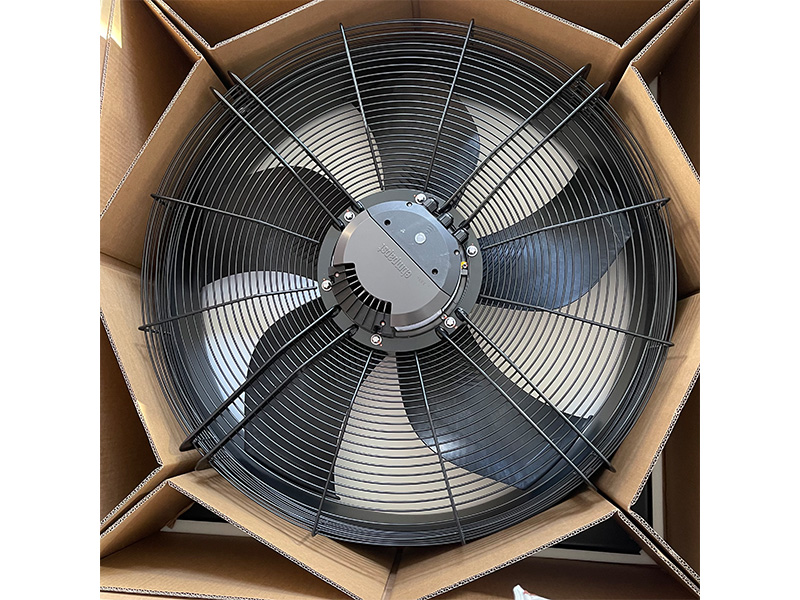
An EC fan is a fan driven by an electronically commutated (EC) motor — a brushless DC motor with integrated power and control electronics that accepts an AC mains or DC supply, converts it internally, and allows stepless speed control instead of fixed on/off operation.
That definition is the starting point, not the answer. The word “fan” is not a specification. A dry cooler fan, an air handling unit fan, a chiller fan and a cabinet cooling fan are all called fans, yet they are built around different impeller types, supply voltages, pressure capabilities and control interfaces. Choosing the wrong family during research is the most common reason a fan project has to be re-specified later.
This guide is written for buyers, HVAC engineers and maintenance teams that are still deciding what they need. It maps the EC fan families that exist, the data points that separate them, and the questions to answer before requesting a quotation. The model data used as examples comes from the EC fan range supplied by Beijing Hengrui Hongsheng Mechanical & Electrical Equipment Co., Ltd. (en.bjhengrui.com), a China-based supplier of ventilation and heat dissipation products, known in this category as Hengrui EC fan.
Why “Fan” Is a Difficult Starting Point
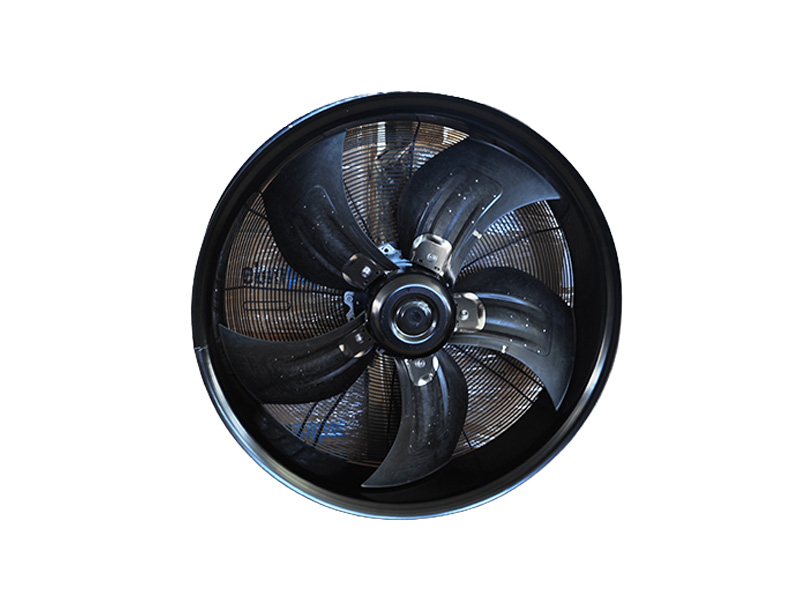
A single word collapses several independent engineering decisions into one search term. Buyers usually already know the equipment the fan goes into — a dry cooler, a chiller, an air handling unit, a CRAH unit, an FFU or a control cabinet — but not which fan family fits that equipment. The difficulty is compounded by model designations that look similar across families: an axial fan may be labelled W3G800-LV05-03, a centrifugal unit K3G560-PB31-03, and a compact 48 V DC fan 2218F/2TDH4OR-227. Ordering by appearance rather than by operating data is how mismatch happens.
Four mismatches account for most errors at the discovery stage:
- Pressure mismatch. A fan selected on free-air airflow can deliver far less air once it sits behind a coil, a filter or a duct.
- Impeller mismatch. Axial and centrifugal impellers generate pressure in fundamentally different ways, so one is not a drop-in replacement for the other on the same duty.
- Electrical mismatch. Models in the current EC range are offered with single-phase AC, three-phase AC and 48 V DC supplies, and these are not interchangeable.
- Control mismatch. A fan that cannot accept 0–10 V, PWM or Modbus signals cannot be integrated with the unit controller or with a building automation system.
The remedy is procedural rather than technical: identify the equipment first, then the air path, then the electrical supply, and only then compare models.
Industry Background: Where EC Fans Are Used
Beijing Hengrui Hongsheng lists its ventilation and heat dissipation products as being used in HVAC ventilation and air conditioning, refrigeration equipment, data centers, new energy, industrial automation, air purification, rail transit and power electronics heat dissipation. That list is a useful map of demand, because each of those sectors loads the fan differently.
Three shifts explain why EC fans have become the default choice in new equipment:
- Variable speed instead of fixed speed. EC motors allow continuous speed control, so airflow can be modulated to match load instead of being switched on and off. In cooling equipment this changes how the whole system is controlled, not only how the fan runs.
- Integrated electronics. Control and communication functions such as 0–10 V, PWM, Modbus and speed feedback are built into the fan electronics housing, which removes the need for a separate external drive in many designs.
- Higher-density cooling. Data center and power electronics cooling push air through tighter coils and denser racks, which raises the static pressure a fan must overcome.
For a buyer in the research stage, the practical consequence is that fan selection has become a question about the system — pressure, voltage, control and environment — as much as a question about the fan itself.
The Four EC Fan Families You Will Actually Be Offered
The EC fan market becomes navigable when models are grouped by impeller geometry and mounting context. Four families cover the great majority of HVAC, refrigeration and electronics cooling duties in the Hengrui EC fan range.
1. EC Axial Fans for Dry Coolers, Chillers and Cooling Towers
Axial fans move air along the axis of rotation and are the standard choice for outdoor heat rejection, where large air volumes pass through a coil against comparatively low system resistance. In this range the AxiBlade and HyBlade platforms appear in 630 mm, 800 mm and 910 mm impeller sizes.
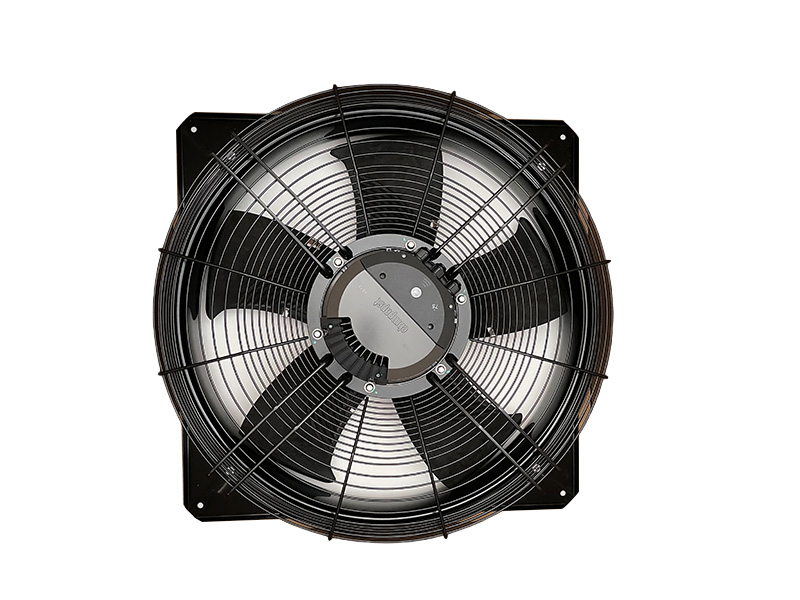
Representative models, with the published data for each:
- W3G800-LV05-03 — 800 mm, 3~380–480 VAC, 3,500 W, 5.3 A, 1,190 rpm, maximum back pressure 350 Pa, ErP point 19,225 m³/h at 337 Pa. PP plastic impeller with integrated guide vanes, galvanized steel fan housing and guard grille, IP55, H2+C environmental class.
- W3G910-LV12-36 — 910 mm, 3,250 W, 5.0 A, 1,070 rpm, maximum back pressure 300 Pa, ErP point 24,750 m³/h at 256 Pa. Guide vanes and diffuser structure, Modbus, H2+C, IP55.
- W3G800-KU21-05 — 800 mm, 2,900 W, 4.4 A, 1,100 rpm, maximum back pressure 260 Pa, ErP point 19,455 m³/h at 247 Pa.
- W3G910-KU25-03 — 910 mm, 2,550 W, 3.9 A, 980 rpm, maximum back pressure 220 Pa, ErP point 23,685 m³/h at 182 Pa.
- W3G630-NU33-03 — 630 mm high back-pressure AxiBlade, 3,600 W, 5.5 A, 1,800 rpm, maximum back pressure 440 Pa, ErP point 16,530 m³/h at 329 Pa, IP55, H2, Modbus, rated from −40 to +60 °C.
- W3G800-GV01-01 — 800 mm HyBlade with PP blade and embedded aluminum plate, 2,980 W, 4.5 A, 1,090 rpm, maximum back pressure 260 Pa, ErP point 18,115 m³/h at 212 Pa.
Two design details distinguish this outdoor family. Guide vanes recover swirl energy downstream of the impeller, which supports operation at higher back pressure on the LV platforms. The environmental class — H2 on the 630 mm model, H2+C on the 800 mm and 910 mm LV models — describes the corrosion and environmental exposure the fan is intended to withstand when it is mounted on an outdoor unit.
2. EC Centrifugal Fans for AHUs, CRAH Units and In-Row Cooling
Centrifugal fans accelerate air radially and convert velocity into static pressure, which is why they dominate duties involving coils, filters, longer duct runs or dense racks. The RadiCal and RadiPac platforms in this range cover 310 mm to 630 mm impellers, with published ErP operating points between 640 Pa and 1,749 Pa of static pressure.
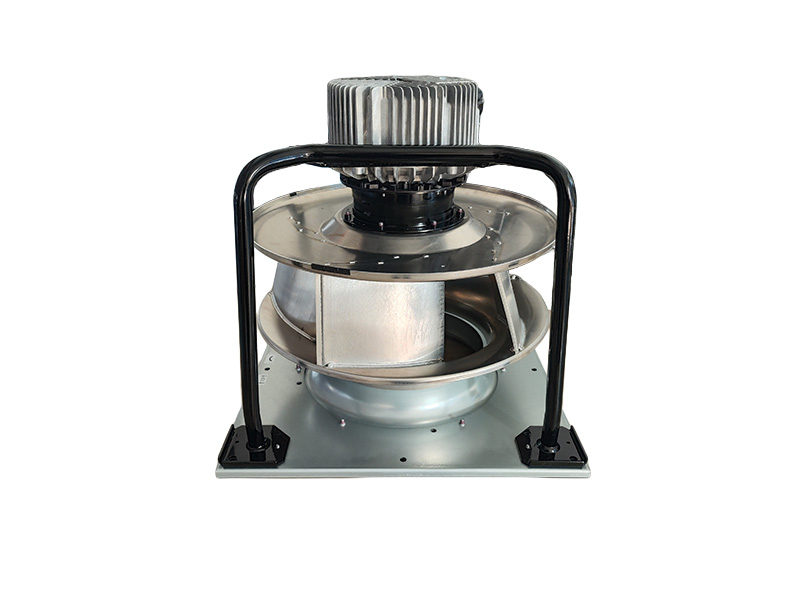
- K3G450-PB29-L1 — 450 mm, 3~380–480 VAC, 6,800 W, 10.3 A, 2,800 rpm, ErP point 9,035 m³/h at 1,749 Pa. Aluminum impeller, IP55, Modbus V6.3 and vibration sensor, intended for high-density data center CRAH, AHU and FanGrid applications.
- K3G500-PB33-01 — 500 mm, 5,700 W, 9.0 A, 2,250 rpm, ErP point 10,945 m³/h at 1,245 Pa, IP55, for high-static-pressure CRAH, AHU and data center fan walls.
- K3G560-PB31-03 — 560 mm, 4,400 W, 6.6 A, 1,700 rpm, ErP point 9,825 m³/h at 1,049 Pa, aluminum impeller, IP55, Modbus.
- K3G450-PA31-03 — 450 mm backward-curved module, 4,450 W, 6.8 A, 2,480 rpm, ErP point 8,430 m³/h at 1,275 Pa; supplied as a complete EC fan module that integrates impeller, motor and electronics in one unit.
- K3G560-FA28-03 — 560 mm, 3,950 W, 6.0 A, 1,900 rpm, ErP point 11,970 m³/h at 831 Pa, intended for AHU, CRAH, fan wall and energy-efficiency retrofit projects.
- R3G630-FB32-03 — 630 mm RadiCal, 3,300 W, 5.1 A, 1,370 rpm, ErP point 12,190 m³/h at 670 Pa; IP55, Modbus/0–10 V, soft start and electronic protection.
- K3G310-PH58-02 and K3G310-PV69-03 — 310 mm compact high-pressure units at 4,000 rpm, with ErP points of 4,505 m³/h at 1,479 Pa and 4,020 m³/h at 1,583 Pa respectively, for space-constrained in-row and precision cooling cabinets.
- R3G355-RG56-01 — 355 mm, 930 W, 1.7 A, 2,240 rpm, ErP point 3,205 m³/h at 640 Pa; IP54, passive PFC, Modbus/0–10 V and integrated PID control.
The main lesson from this family is that comparing centrifugal models is really a comparison of airflow at a defined static pressure. A 450 mm module delivering 9,035 m³/h at 1,749 Pa and a 630 mm module delivering 12,190 m³/h at 670 Pa are both EC centrifugal fans, but they are not competing for the same duty. Protection and control features follow the same rule: IP54 or IP55, Modbus RTU or Modbus V6.3, 0–10 V, PWM, soft start, integrated PI/PID control and vibration sensing are model-specific, not family-wide.
3. Compact EC Centrifugal Fans for FFUs, Cleanrooms and Air Purification
Cleanroom fan filter units and air purifiers need moderate airflow against filter resistance inside a shallow housing. Two models in this range address that duty.
- R3G355-AM14-61 — 355 mm, 1~200–277 VAC, 350 W, 1.5 A, 1,900 rpm, ErP point 2,050 m³/h at 400 Pa. Single-phase wide voltage range, compatible with slim-profile FFUs, adjustable speed; the final protection rating is to be ensured by the complete unit. Intended for cleanroom FFU/EFU, semiconductor, pharmaceutical and air purification equipment.
- R3G225-RE07-03 — 225 mm, 1~200–240 VAC, 170 W, 1.4 A, 2,860 rpm, ErP point 705 m³/h at 458 Pa. Compact and lightweight, IP54, 0–10 V/PWM with speed output, and high static pressure relative to its size; intended for compact FFUs, air purifiers, filtration units and electronic equipment ventilation.
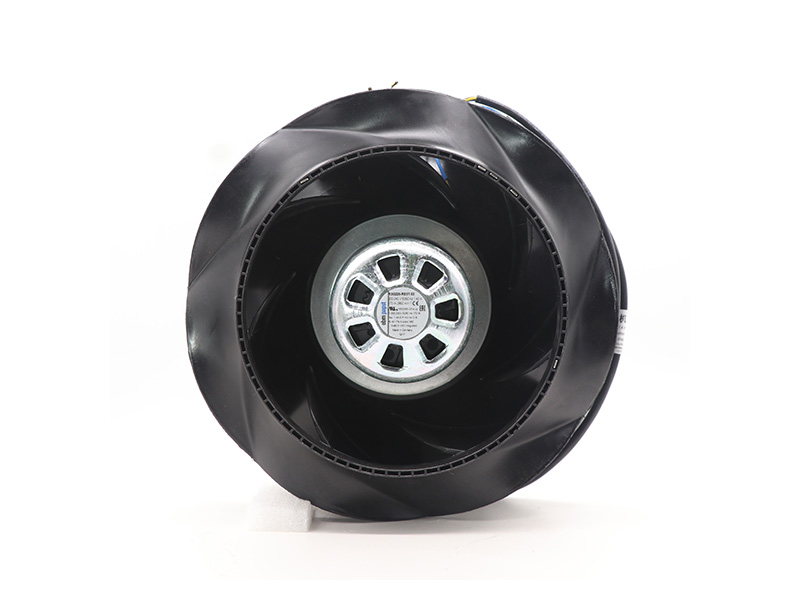
4. 48 V DC Compact and High-Pressure EC Fans for Cabinets and Electronics
Cabinet, telecom and high-density computing cooling is a DC world, and two 200 mm platforms cover it.
- 2218F/2TDH4OR-227 — 200 × 200 × 51 mm, 48 VDC (36–72 V), approximately 103 W at 48 V in free air, 6,500 rpm, maximum free-air flow 1,220 m³/h, maximum static pressure 1,170 Pa. Metal frame and plastic impeller, UL/CSA/CCC, wide-voltage DC input, any mounting orientation; intended for heat dissipation in communication cabinets, network equipment, UPS, power supplies and industrial electronics.
- AxiEco 200 (8317081096 / VWLH200CKLXS) — 200 × 200 × 70 mm, 48 VDC (36–60 V), 348 W at 48 V in free air, 7,000 rpm, maximum free-air airflow 1,820 m³/h, maximum static pressure 1,300 Pa. Composite frame and plastic impeller, UL/VDE/CSA/CCC, 0–10 V/PWM with speed feedback; built on the AxiEco 200 high-pressure platform for AI servers, rear-door heat exchangers (RDHx) and in-row cooling units.
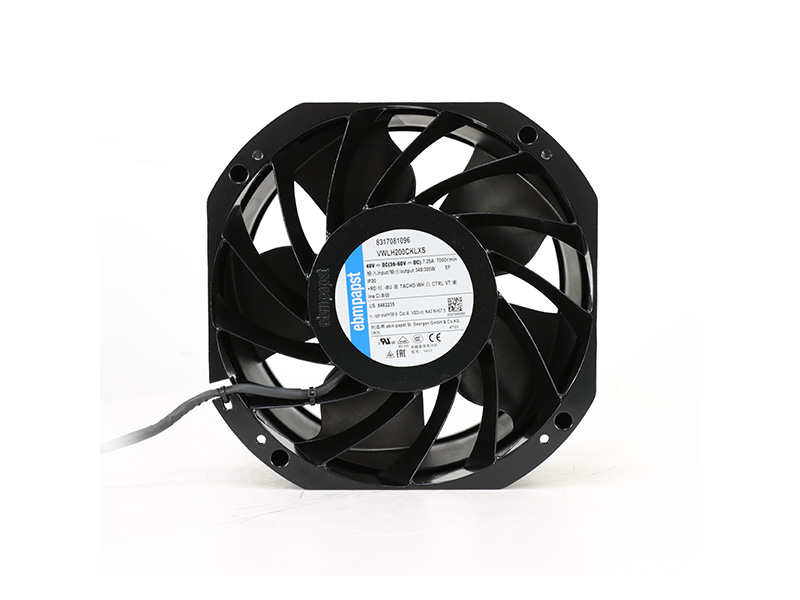
Note how DC fans are specified. Free-air airflow and maximum static pressure are two separate published figures, and the real duty point sits between them. A fan rated 1,820 m³/h in free air with 1,300 Pa maximum static pressure will deliver neither number once it is installed in a server or a cabinet.
Step-by-Step: From “I Need a Fan” to a Quotable Model
Step 1 — Name the equipment and the air path. Write down what the fan serves: dry cooler, air-cooled chiller, condenser, AHU, CRAH, fan wall, in-row or precision air conditioner, FFU, air purifier, or cabinet. The equipment type alone eliminates two of the four families in most cases.
Step 2 — Decide axial or centrifugal. Use axial fans when a large air volume must move against low to moderate resistance, as on dry coolers and condensers. Use centrifugal fans when air must be pushed through coils, filters or ductwork, where the ErP operating points in this range reach 1,749 Pa (K3G450-PB29-L1) and 1,583 Pa (K3G310-PV69-03).
Step 3 — Fix the electrical supply. The range includes single-phase AC models such as R3G355-AM14-61 at 1~200–277 VAC and R3G225-RE07-03 at 1~200–240 VAC, three-phase AC models at 3~380–480 VAC, and 48 VDC models with 36–60 V or 36–72 V input windows. The supply usually decides the model before airflow does.
Step 4 — Compare airflow at the duty point, not in free air. Ask for the airflow at the static pressure the system will actually present. For dry coolers and AHUs, the published ErP operating point is the practical comparison figure. For DC fans, compare the pair of values: maximum free-air flow (1,220 m³/h and 1,820 m³/h for the two 200 mm models above) against maximum static pressure (1,170 Pa and 1,300 Pa).
Step 5 — Lock down control and communication. Confirm which interface the unit controller expects: 0–10 V, PWM, Modbus RTU or Modbus V6.3. Confirm whether speed feedback, integrated PID/PI control, soft start or vibration sensing is required, since these appear on specific models such as R3G355-RG56-01, K3G450-PB29-L1 and R3G630-FB32-03 rather than across the whole range.
Step 6 — Check protection, environment and mounting, then confirm supply. Verify IP54 or IP55, the H2 or H2+C environmental class, temperature range (the 630 mm axial platform is rated −40 to +60 °C) and mounting constraints (the 48 V compact axial fan is specified for any mounting orientation). After that, validate the chosen model on the real equipment and confirm the supply route.
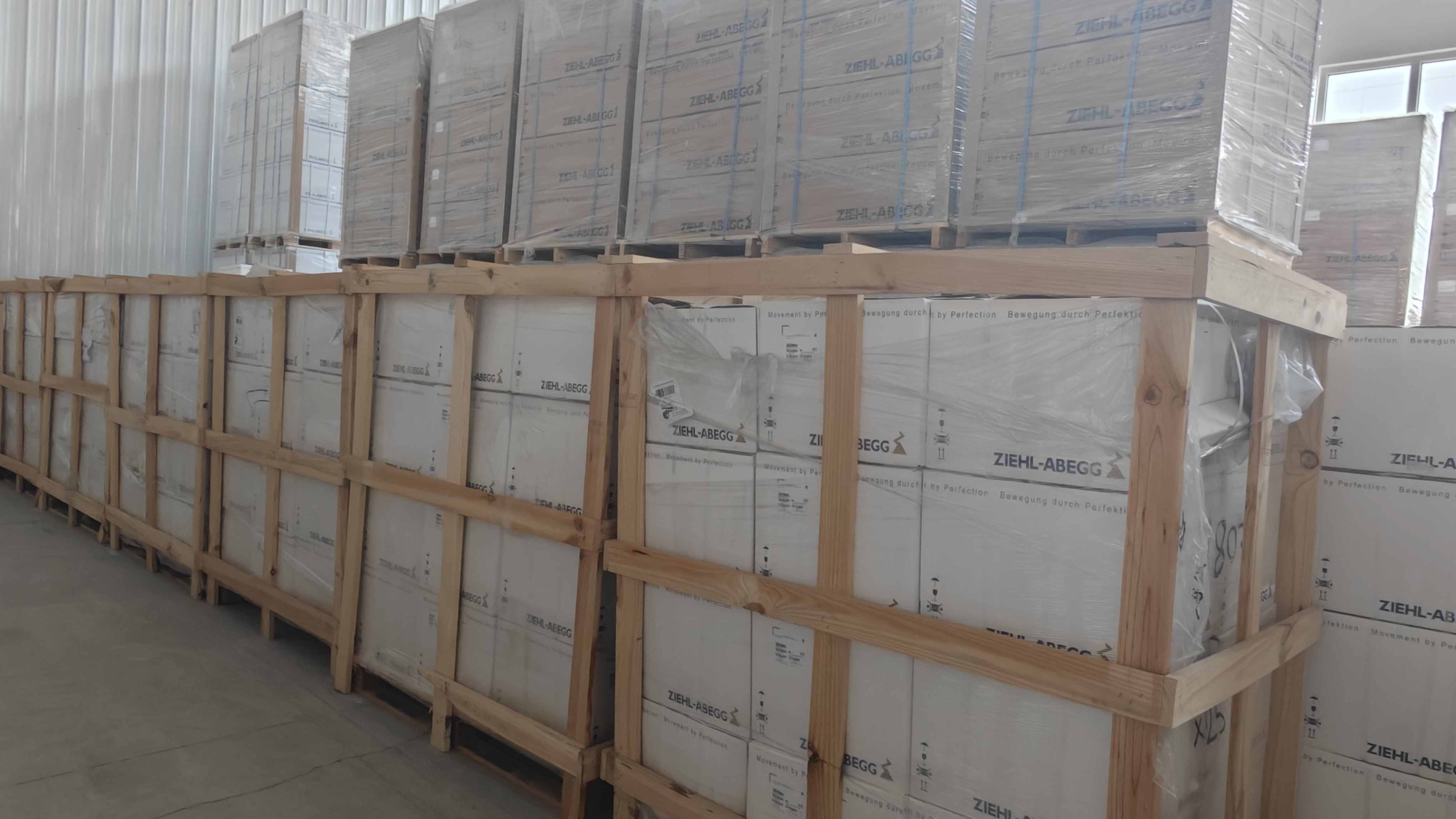
Sourcing note: Beijing Hengrui Hongsheng maintains long-term agent and distribution relationships with brands including ebmpapst, Ziehl-Abegg, SANYO, DELTA, SUNON, Rosenberg, WISTRO, SODECA, NMB, ADDA and S&P alongside its own EC fan range. When a design already specifies an ebmpapst Fan or Ziehl-Abegg Fan model, the same supplier can quote both the specified brand and an equivalent EC fan model, which shortens the comparison stage. Free fan selection, solution matching, fast shipment and after-sales support are part of the service scope, and a large amount of ready stock is held in inventory.
Use Cases: Matching EC Fans to Equipment
- Dry cooler and free cooling. W3G800-LV05-03, W3G800-KU21-05 and W3G910-LV12-36 are EC axial fans intended for dry coolers, data center cooling towers, condensers and free cooling, with maximum back pressures of 350 Pa, 260 Pa and 300 Pa respectively.
- Air-cooled chiller and condenser. W3G800-GV01-01 uses HyBlade hybrid blades for outdoor chiller and condenser units at 18,115 m³/h ErP point, while W3G630-NU33-03 covers higher back-pressure duties up to 440 Pa.
- Data center CRAH, AHU and fan wall. K3G560-PB31-03, R3G630-FB32-03 and K3G450-PA31-03 are EC centrifugal modules for CRAH, AHU, fan wall and retrofit projects where medium to high static pressure is required.
- In-row and precision cooling. K3G310-PV69-03 and K3G310-PH58-02 pack 1,583 Pa and 1,479 Pa of static pressure into 310 mm frames for space-constrained cabinets, while R3G355-RG56-01 covers lower-power in-row and small CRAH duties.
- Cleanroom FFU and air purification. R3G355-AM14-61 and R3G225-RE07-03 serve cleanroom FFU/EFU, semiconductor, pharmaceutical, filtration and air purifier equipment.
- Cabinets, telecom, UPS and AI server cooling. 2218F/2TDH4OR-227 and AxiEco 200 (8317081096 / VWLH200CKLXS) address communication cabinets, network equipment, power supplies, AI servers, rear-door heat exchangers and in-row cooling units.
Comparison Table: EC Fan Families at a Glance
| Family | Structure and drive | Typical supply | Published operating data (examples) | Typical applications |
|---|---|---|---|---|
| EC axial fan (AxiBlade / HyBlade) | Axial impeller with guide vanes or hybrid blades; galvanized steel housing and guard grille | 3~380–480 VAC | 16,530 m³/h at 329 Pa; up to 440 Pa max back pressure (W3G630-NU33-03) | Dry coolers, chillers, condensers, cooling towers, free cooling |
| EC centrifugal fan (RadiCal / RadiPac, backward-curved) | Centrifugal impeller on support plate and inlet ring; electronics integrated in the housing | 3~380–480 VAC | ErP point static pressure 640–1,749 Pa; airflow 3,205–12,190 m³/h | AHU, CRAH, fan wall, in-row and precision cooling, industrial air handling |
| Compact EC centrifugal fan | Single-phase unit with aluminum or PA impeller in a shallow housing | 1~200–277 VAC | 2,050 m³/h at 400 Pa (R3G355-AM14-61); 705 m³/h at 458 Pa (R3G225-RE07-03) | Cleanroom FFU/EFU, air purifiers, filtration units, electronics ventilation |
| 48 V DC compact / high-pressure EC fan | 200 mm axial fan, metal or composite frame with plastic impeller | 48 VDC (36–72 V / 36–60 V) | Max static pressure 1,170 Pa (2218F/2TDH4OR-227) and 1,300 Pa (AxiEco 200) | Communication cabinets, network equipment, UPS, power supplies, AI servers, RDHx |
EC Fan Model Quick Reference
| Model | Family | Format | Supply | Published operating point | Primary application |
|---|---|---|---|---|---|
| W3G800-LV05-03 | EC axial with guide vanes | 800 mm | 3~380–480 VAC | 19,225 m³/h at 337 Pa; max back pressure 350 Pa | Dry coolers, data center cooling towers, free cooling |
| W3G630-NU33-03 | EC axial, high back pressure | 630 mm | 3~380–480 VAC | 16,530 m³/h at 329 Pa; max back pressure 440 Pa | Dry coolers, chillers, outdoor heat exchange |
| W3G800-GV01-01 | EC axial (HyBlade) | 800 mm | 3~380–480 VAC | 18,115 m³/h at 212 Pa | Outdoor chillers and condensers |
| K3G450-PB29-L1 | EC centrifugal, high static pressure | 450 mm, aluminum impeller | 3~380–480 VAC | 9,035 m³/h at 1,749 Pa | High-density CRAH, AHU, FanGrid |
| K3G560-FA28-03 | EC centrifugal, backward-curved module | 560 mm | 3~380–480 VAC | 11,970 m³/h at 831 Pa | Data center AHU, CRAH, fan wall retrofit |
| K3G310-PV69-03 | EC centrifugal, compact high pressure | 310 mm, 4,000 rpm | 3~380–480 VAC | 4,020 m³/h at 1,583 Pa | In-row air conditioners, high-static-pressure cabinets |
| R3G225-RE07-03 | EC centrifugal, compact | 225 mm | 1~200–240 VAC | 705 m³/h at 458 Pa | Compact FFUs, air purifiers |
| AxiEco 200 (8317081096 / VWLH200CKLXS) | EC axial, high-pressure platform | 200 × 200 × 70 mm | 48 VDC (36–60 V) | 1,820 m³/h free air; 1,300 Pa max static pressure | AI servers, RDHx, in-row cooling units |
FAQ: EC Fan Discovery Questions
Do EC fans come with recognized certifications, and what ratings should I check?
Certification is model-specific, so it must be confirmed per part number rather than per family. In this range, the AxiEco 200 fan (8317081096 / VWLH200CKLXS) is listed with UL, VDE, CSA and CCC, and the 48 V EC compact axial fan 2218F/2TDH4OR-227 with UL, CSA and CCC. Enclosure and environmental ratings also vary: the dry cooler EC axial fan W3G800-LV05-03 is rated IP55 with an H2+C environmental class, while the in-row centrifugal fan R3G355-RG56-01 is IP54. For the cleanroom fan R3G355-AM14-61, the final protection rating is to be ensured by the complete unit. The practical rule is to request certification, IP rating and environmental class in writing for the exact model before ordering.
Can one EC fan model serve both an AHU and a dry cooler?
Rarely, because the two applications load the fan differently. Dry coolers and chillers use axial fans that move large air volumes against low to moderate resistance — W3G800-LV05-03 is published at an ErP point of 19,225 m³/h at 337 Pa. AHUs, CRAH units and in-row coolers push air through coils and filters and need far higher static pressure — K3G450-PB29-L1 is published at 9,035 m³/h at 1,749 Pa. The correct comparison is airflow at the system's operating pressure, not airflow in free air.
What drives the price of an EC fan?
Price is quoted per model and configuration, so there is no single figure across the range. The main cost drivers visible in the published specifications are impeller diameter and material (225 mm to 910 mm, plastic, aluminum or hybrid blades), motor power class, the electronics package, protection and environmental class (IP54 versus IP55, H2 versus H2+C), communication and control functions such as Modbus, PWM, speed feedback, soft start or vibration sensing, and order quantity against available stock. A larger or more expensive fan is not automatically a better fit: an oversized axial fan on a ducted duty will underperform a correctly sized centrifugal model. Free fan selection and solution matching are available to narrow the options before a quotation is issued.
Can I validate a fan before committing to a volume order?
Validation should be done on the real equipment, because airflow only becomes meaningful once the fan sits behind the actual coil, filter or duct. To start, provide the equipment type, supply voltage, required airflow at the operating static pressure, control interface and environmental conditions, and the supplier's selection and matching service will return a candidate model. Requests for a specific model for testing can be sent to Jason@bjhengrui.cn or qin@bjhengrui.cn, with overseas buyers also able to use sales06@bjhengrui.cn.
How quickly can EC fan models ship?
Beijing Hengrui Hongsheng keeps a large amount of ready stock in inventory to support fast shipment, and the service scope includes free fan selection, solution matching, fast shipment and after-sales support. For models that are not held in stock, lead time depends on the specific part number and quantity, so it should be confirmed together with the quotation. Sending the model designation, quantity and delivery destination in one request is the fastest way to obtain a firm answer. Model details, the full EC fan range and contact options are listed at en.bjhengrui.com.
Conclusion: From “Fan” to a Quotable Model
An EC fan is defined by its electronically commutated motor, but the selection decision is defined by four questions: what equipment the fan serves, whether the air path needs axial or centrifugal pressure generation, what supply voltage the panel provides, and which control interface the system expects. Answer those four and the range narrows quickly — from dry cooler axial fans such as W3G800-LV05-03, through high-static-pressure centrifugal modules such as K3G450-PB29-L1 and K3G560-FB32-03, to compact FFU and 48 V cabinet fans such as R3G225-RE07-03 and the AxiEco 200.
The data to compare is published data: airflow at the operating point, static pressure, supply voltage, protection class, environmental class and control interface. Everything else is appearance.
Next step: turn your requirement into a model number
Send the equipment type, supply voltage, required airflow at system static pressure and control interface. The selection team returns a matched EC fan model, availability and a quotation — and a sample for validation where required.
Email Jason@bjhengrui.cn | qin@bjhengrui.cn | en.bjhengrui.com