
What Is an EC Fan? A Practical Guide to EC Fans for HVAC
What Is an EC Fan? A Practical Guide to EC Fans for HVAC Cooling Systems
An EC fan is a fan built around an electronically commutated (EC) motor — a brushless motor whose control electronics are integrated into the fan assembly. Because the electronics sit inside the fan, an EC fan can be speed-controlled directly by a 0–10 V signal, a PWM signal or a Modbus command, without adding an external controller or inverter. That single design difference is why EC fans are now standard equipment in air handling units, dry coolers, chillers, in-row cooling units and cabinet cooling systems.
This article is written for the early stage of that research. Engineers, procurement staff and distributors usually begin with a broad term such as fan, and the results that come back mix EC fans, AC axial fans, DC axial flow fans, blower fans, centrifugal exhaust fans, HVAC cooling fans and cabinet cooling fans into one list. The components behind those words are not interchangeable, and the difference is decided by duty point, voltage, control interface and mechanical fit — not by vocabulary.
The guide covers the definition of an EC fan, the practical difference between EC axial and EC centrifugal designs, how to read an EC fan datasheet, a step-by-step selection sequence, typical applications, and the model families that carry this technology. Product data quoted below comes from the published specifications of Beijing Hengrui Hongsheng Mechanical & Electrical Equipment Co., Ltd., a China-based EC fan supplier located in Beijing that provides fan selection and system matching services for ventilation and heat dissipation equipment.
Problem Definition: Why "Fan" Is an Easy Search Term and a Hard Buying Decision
Finding a fan takes seconds. Selecting one takes longer, because the same word covers several product categories that behave differently in service.
- EC fan / EC axial fan — brushless motor with integrated electronics; speed set by an analogue signal, PWM or a bus command.
- AC axial fan — AC induction motor; when the application needs variable speed, a separate controller or drive is normally added.
- DC axial flow fan — low-voltage fan, often 12 V, 24 V or 48 V DC, widely used in cabinets and electronic equipment.
- EC centrifugal fan / EC centrifugal blower — an impeller inside a housing, chosen when the system needs pressure rather than free air.
- Backward-curved EC fan — a centrifugal impeller with backward-curved blades, frequently supplied as a complete module for AHU and fan wall duty.
- Blower fan / centrifugal exhaust fan — broad trade terms that usually point to centrifugal units in exhaust, filtration or conveying service.
- Dry cooler fan, AHU fan, chiller fan, HVAC cooling fan, cabinet cooling fan — application names rather than separate technologies; each one still resolves to an axial or centrifugal EC fan with a specific duty point.
A second, more expensive problem appears after the equipment is in service. A part number specified years earlier — a model such as 9GV0624P1G031, or an item selected from an ebmpapst fan or Ziehl-Abegg fan catalogue — has to be replaced, and the replacement has to match airflow at static pressure, supply voltage, control signal and mounting geometry. Buying on the part number alone is how a project ends up with a fan that fits the opening but not the duty.
When selection is based on the wrong criteria, the symptoms are predictable: a cabinet that runs hotter than designed, noise complaints from a fan running at fixed full speed, a filter that loads up and chokes the airflow, a retrofit that needs new cabling, or a cooling system that never reaches the part-load savings the project assumed.
Industry Background: Why EC Fans Became Standard in HVAC and Cooling
Ventilation systems rarely run at full output all year. A chiller condenser fan, a data center air handler or an AHU serving a commercial building spends most of its operating hours somewhere below design speed, following ambient temperature, occupancy or heat load. AC induction motors hold their efficiency well at the design point but lose efficiency when they are slowed with simple voltage control, which is why large fixed-speed fan banks with periodic on/off staging were once the norm.
EC motors changed that equation by moving commutation into electronics. Speed becomes a control parameter rather than a mechanical constraint, and the fan can follow the load continuously. In parallel, ecodesign requirements for fans in major markets — commonly referenced through ErP — pushed part-load efficiency into the specification, and data center operators adopted EC fan walls to reduce cooling energy in both new builds and retrofits.
That shift is visible in how fan data is published today. Modern EC fan datasheets declare an ErP operating point: an airflow figure at a defined static pressure, rather than a single maximum airflow number. For example, the EC centrifugal fan model K3G560-PB31-03 is declared at 9,825 m³/h at 1,049 Pa, and the 630 mm EC axial fan model W3G630-NU33-03 at 16,530 m³/h at 329 Pa with a maximum back pressure of 440 Pa. For a buyer, this is the number to compare against a system curve — not the headline free-air airflow.
The second background trend is thermal density. Air-cooled chillers, dry coolers and free-cooling systems remain the workhorses of heat rejection, while AI servers, rear-door heat exchangers and in-row cooling units have pushed cabinet-level cooling duty upward. Both ends of that spectrum use EC fans, but they use very different impellers and pressure capabilities.
What an EC Fan Contains, and What Each Part Means for a Buyer
An EC fan is a complete assembly rather than an air-moving component with a motor attached. The parts a buyer should be able to identify on a datasheet are the motor and electronics, the impeller, the housing and guard, the control interface, the electrical supply, and the environmental ratings.
- Motor and electronics: brushless EC motor with commutation and control electronics integrated in the fan hub or housing. Depending on model, this includes soft start, electronic protection, passive PFC or PID control built into the unit.
- Control interface: 0–10 V analogue, PWM or Modbus RTU on the models listed below, with speed feedback or speed output available on several types.
- Impeller and materials: PP plastic, PA plastic or aluminium impellers, with galvanized steel support plates, fan housings and guard grilles on outdoor models.
- Supply voltage: single-phase 1~200–277 VAC, three-phase 3~380–480 VAC, or 48 VDC on low-voltage equipment fans.
- Protection and environment: IP54 or IP55 on the industrial ranges, and environmental ratings such as H2 or H2+C on outdoor axial models.
Those six items decide whether a fan can be installed in an existing enclosure. The impeller type decides what it can do once it is there.
EC axial fans for dry coolers, chillers, condensers and cooling towers
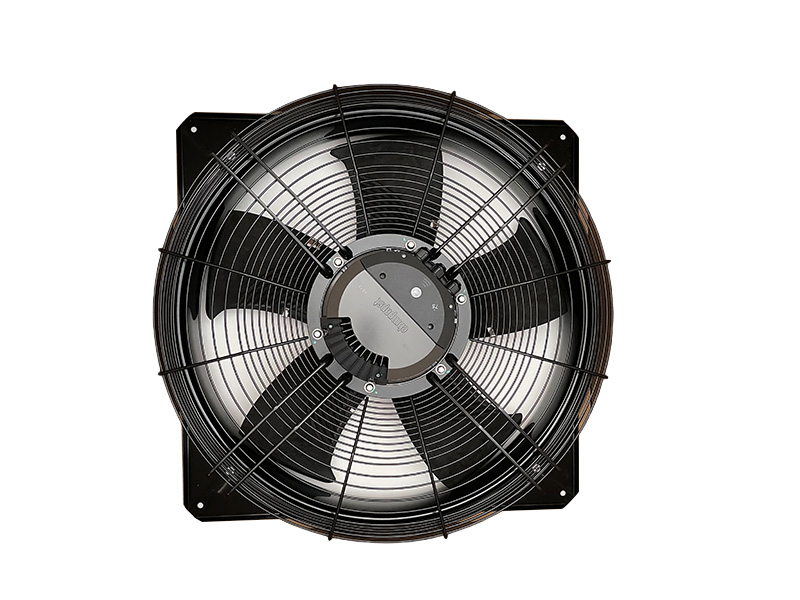
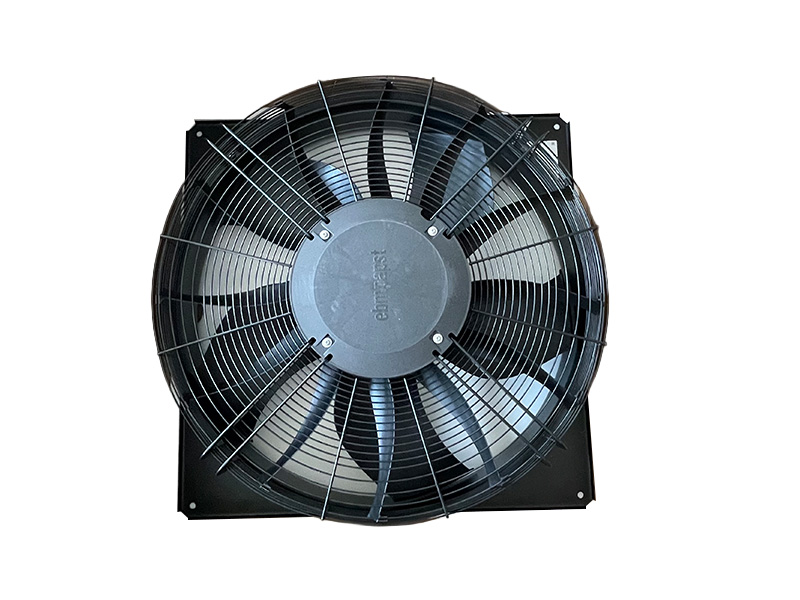
Axial EC fans move large volumes of air against relatively low pressure. That is exactly the duty of an outdoor heat exchanger, where the coil creates a modest pressure drop and the priority is airflow across a large face area. The 800 mm model W3G800-LV05-03 is a representative case: an EC axial flow fan with integrated guide vanes, declared at 19,225 m³/h at 337 Pa with a maximum back pressure of 350 Pa, rated IP55 with an H2+C environmental rating, and built with a PP plastic impeller and galvanized steel housing. Its intended applications are dry coolers, data center cooling towers, condensers and free cooling systems.
The same platform scales in two directions. Model W3G910-LV12-36 increases impeller diameter to 910 mm and reaches 24,750 m³/h at 256 Pa with a maximum back pressure of 300 Pa, again using guide vanes, IP55 and an H2+C rating, which suits data center cooling towers and large dry coolers. Model W3G630-NU33-03 goes the other way: 630 mm, 16,530 m³/h at 329 Pa, and a higher back pressure capability of 440 Pa, which is useful when a coil or a close-coupled installation adds resistance. It carries IP55, an H2 rating and Modbus communication, and is specified for operation between −40 °C and +60 °C.
Two further variants matter in chiller and condenser work. Model W3G800-GV01-01 uses a hybrid blade construction — a PP blade with an embedded aluminium plate — and delivers 18,115 m³/h at 212 Pa with EC stepless speed control for outdoor units. Model W3G800-KU21-05 and model W3G910-KU25-03 are the lower-power members of the family, declared at 19,455 m³/h at 247 Pa and 23,685 m³/h at 182 Pa respectively, for dry coolers, condensers and industrial refrigeration where the pressure requirement is modest.
EC centrifugal and backward-curved centrifugal fans for AHU, CRAH and precision cooling
When a system includes ducts, filters, coils or a high-density heat load, pressure replaces airflow as the limiting factor. Centrifugal designs are used here because they generate higher static pressure, and backward-curved impellers keep that pressure available at reasonable efficiency.
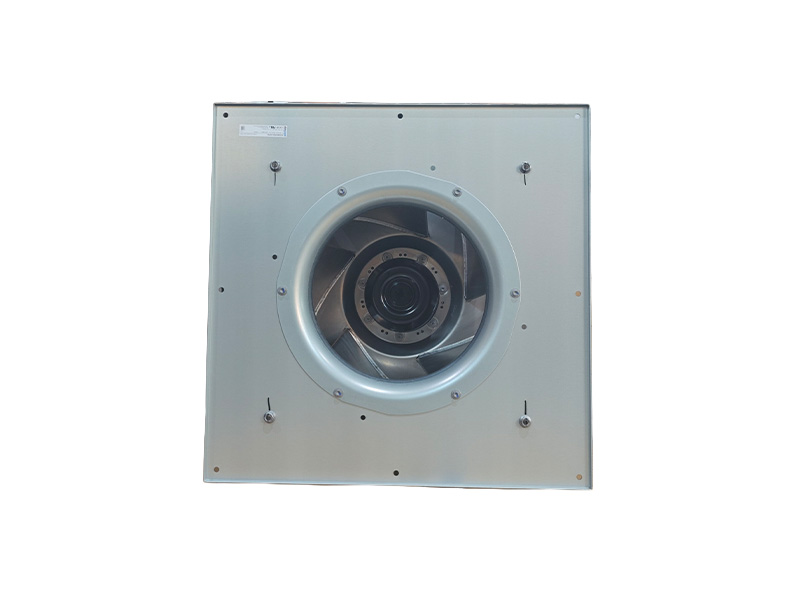
The published data shows the range clearly. Model K3G560-PB31-03, a 560 mm high static pressure EC centrifugal fan for data center CRAH and AHU units, is declared at 9,825 m³/h at 1,049 Pa, supplied as a complete module with an aluminium impeller, IP55 protection and Modbus communication. Model K3G500-PB33-01 raises the pressure further, reaching 10,945 m³/h at 1,245 Pa for high-static-pressure CRAH, AHU and data center fan walls.
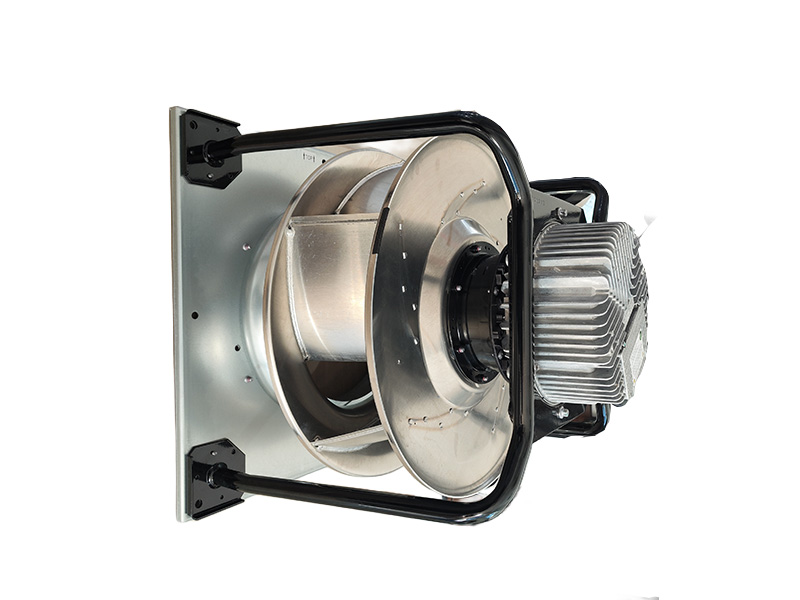
Where airflow and pressure both matter, model K3G450-PB29-L1 combines a 450 mm aluminium impeller with a declared point of 9,035 m³/h at 1,749 Pa, a Modbus V6.3 interface and a vibration sensor, and is positioned for high-density data centers, CRAH units, AHU units and FanGrid arrays. Model K3G450-PA31-03 is the backward-curved centrifugal module for the same family of duties, declared at 8,430 m³/h at 1,275 Pa and supplied as a complete EC fan module that integrates impeller, motor and electronics in a single unit — a format that simplifies CRAH, AHU, fan wall and computer room air conditioning retrofits.
Compact installations have their own options. Model K3G310-PV69-03 is a 310 mm EC centrifugal fan for in-row air conditioners and high-static-pressure cabinets, declared at 4,020 m³/h at 1,583 Pa with IP55 protection and Modbus or 0–10 V control — a high pressure in a small frame, which is the point of the design. Model R3G355-RG56-01 covers in-row and precision air conditioning at 3,205 m³/h at 640 Pa with a low power draw of 930 W at 2,240 rpm, IP54 protection, passive PFC and integrated PID control.
For larger air handling and fan wall duty, the RadiCal EC centrifugal fans include model R3G500-FA28-03 at 8,715 m³/h at 794 Pa with Modbus RTU and partial-load speed control, model R3G630-FB32-03 at 12,190 m³/h at 670 Pa with soft start and electronic protection, and model K3G560-FA28-03 at 11,970 m³/h at 831 Pa for AHU, CRAH and energy-efficiency retrofit projects.
Compact EC fans for cabinets, FFU and air purification
Not every EC fan sits on a roof or in a plant room. Communications cabinets, UPS systems, power supplies and industrial electronics need small fans with wide voltage tolerance and high pressure capability, while cleanroom FFUs and air purifiers need quiet, controllable airflow in a slim profile.
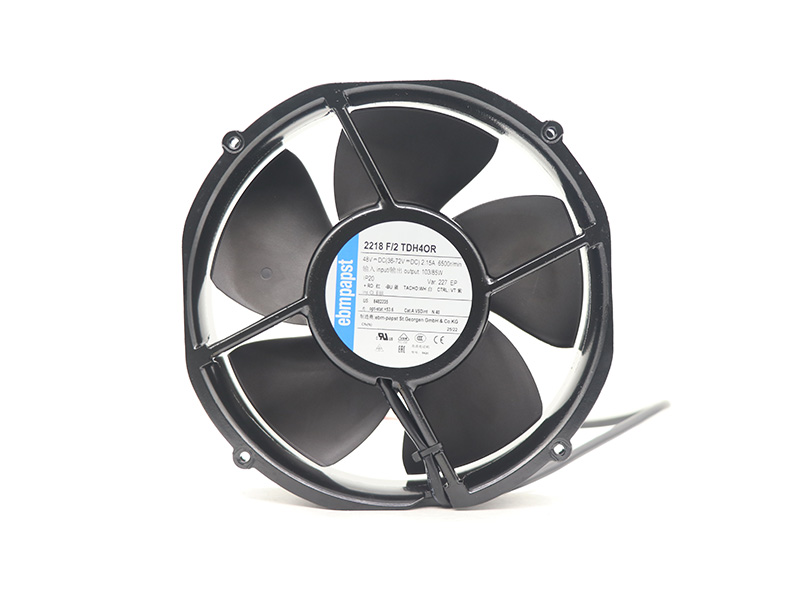
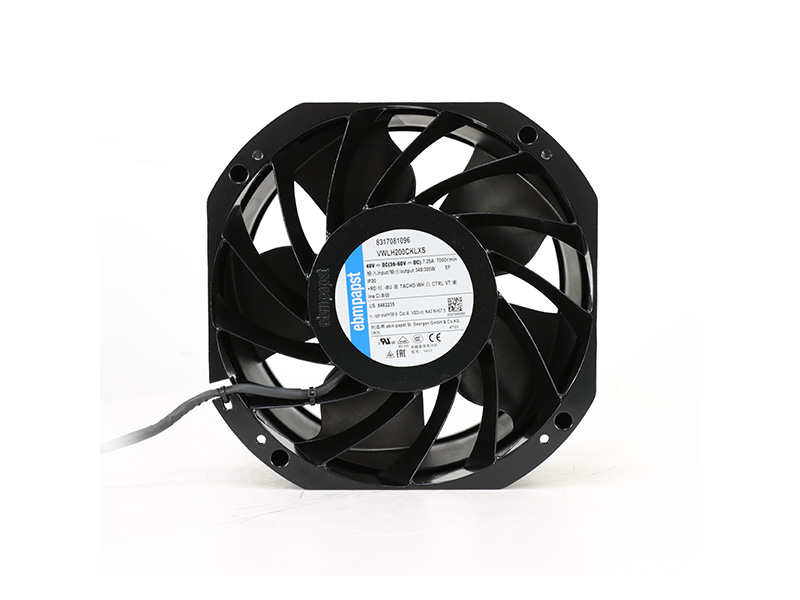
The 48 V EC compact axial fan model 2218F/2TDH4OR-227 measures 200 × 200 × 51 mm and runs from 36–72 VDC, drawing approximately 103 W at 48 V in free air. It reaches a maximum free-air flow of 1,220 m³/h and a maximum static pressure of 1,170 Pa, supports 0–10 V or PWM control with speed feedback, can be mounted in any orientation, and carries UL, CSA and CCC listings. The AxiEco 200 fan, model 8317081096 / VWLH200CKLXS, is the higher-pressure alternative at 200 × 200 × 70 mm: 36–60 VDC, 348 W at 48 V in free air, maximum free-air airflow 1,820 m³/h and maximum static pressure 1,300 Pa, with UL, VDE, CSA and CCC listings. It is designed for AI servers, rear-door heat exchangers and in-row cooling units.
On the air treatment side, model R3G225-RE07-03 is a 225 mm RadiCal EC centrifugal fan for small FFUs and air purifiers, declared at 705 m³/h at 458 Pa from a single-phase 200–240 VAC supply with IP54 protection and 0–10 V or PWM control. Model R3G355-AM14-61 is a 355 mm cleanroom FFU and air purification fan running on a wide single-phase 200–277 VAC range, declared at 2,050 m³/h at 400 Pa and compatible with slim-profile FFU construction.
Step-by-Step: How to Select an EC Fan for a Specific Duty
Selection is a sequence, and skipping a step usually shows up later as noise, rework or under-performance.
- Define the duty point. Establish the required airflow at the required static pressure, including worst-case conditions such as a loaded filter, high ambient temperature or a fouled coil. A single maximum airflow figure is not a duty point.
- Choose the fan type. Use an axial EC fan for high airflow against low pressure, such as dry coolers and condensers. Use an EC centrifugal or backward-curved centrifugal fan where ducts, filters or coils create resistance, such as AHU, CRAH and in-row cooling units.
- Match the supply and control interface. Confirm whether the site provides three-phase 380–480 VAC, single-phase 200–277 VAC or 48 VDC, and whether the controller sends 0–10 V, PWM or Modbus.
- Check the environment. Verify the IP rating and environmental class (IP54, IP55, H2, H2+C), the ambient temperature range, and whether the fan operates indoors, outdoors, in humid air or in a cleanroom.
- Verify mechanical fit. Compare impeller diameter, overall frame dimensions, mounting orientation and the space available for the housing or guard grille. A correct duty point in the wrong frame is still a failed selection.
- Compare declared performance points. Use the ErP operating point or declared duty point on the datasheet so that two candidates are compared at the same pressure, not at their respective free-air maxima.
- Confirm supply and support. Check stock, shipping route and whether the supplier can support selection and after-sales service. Beijing Hengrui Hongsheng provides free fan selection and solution matching, keeps a large amount of ready stock in inventory to support fast shipment, and provides full-category product supply and after-sales support.
Use Cases: Where EC Fans Are Applied
EC fans appear across ventilation, cooling and heat dissipation because the same motor platform can be built into very different impeller and housing combinations.
- Data centers: CRAH and AHU units, fan walls and retrofits use high static pressure EC centrifugal modules such as K3G560-PB31-03, K3G450-PB29-L1 and K3G450-PA31-03.
- Dry coolers, chillers and condensers: outdoor heat rejection uses EC axial fans with guide vanes or hybrid blades, including W3G800-LV05-03, W3G910-LV12-36, W3G630-NU33-03 and W3G800-GV01-01.
- AI servers, RDHx and in-row cooling: high-density electronics cooling uses compact high-pressure fans such as the AxiEco 200 and the 310 mm in-row EC centrifugal models.
- Telecom cabinets, UPS and power supplies: 48 VDC EC axial fans such as the 200 × 200 × 51 mm model 2218F/2TDH4OR-227 provide wide-voltage cabinet cooling.
- Cleanrooms, FFU and air purification: single-phase EC centrifugal fans such as R3G355-AM14-61 and R3G225-RE07-03 serve FFU, EFU, semiconductor, pharmaceutical and air purification equipment.
- Commercial HVAC: AHU supply, return and exhaust duty, VAV systems, ductwork pressurization and chiller applications use air handling unit fans and chiller fans from the EC fan HVAC and EC axial fan ranges.
- Industrial refrigeration and automation: condenser and refrigeration equipment, power electronics heat dissipation, rail transit and general industrial cooling are served by the same model families.
Comparison Table: EC Fan Types and Representative Models
The table below compares representative published models by fan type, application, declared duty point and control or rating. All figures are declared values from the manufacturer's published specifications and should be matched against the actual system curve before ordering.
| Fan type | Typical application | Representative model | Declared duty point | Control / rating |
|---|---|---|---|---|
| EC axial with guide vanes | Dry cooler, cooling tower | W3G800-LV05-03 | 19,225 m³/h @ 337 Pa; max. back pressure 350 Pa | IP55; H2+C; 3~380–480 VAC |
| EC axial with guide vanes | Data center cooling tower, dry cooler | W3G910-LV12-36 | 24,750 m³/h @ 256 Pa; max. back pressure 300 Pa | IP55; H2+C; Modbus |
| EC axial (AxiBlade) | Dry cooler, chiller, condenser | W3G630-NU33-03 | 16,530 m³/h @ 329 Pa; max. back pressure 440 Pa | IP55; H2; Modbus; −40 to +60 °C |
| EC axial (HyBlade) | Outdoor chiller, condenser | W3G800-GV01-01 | 18,115 m³/h @ 212 Pa | IP55; EC stepless speed control |
| EC centrifugal (RadiPac module) | Data center CRAH, AHU | K3G560-PB31-03 | 9,825 m³/h @ 1,049 Pa | IP55; Modbus; aluminium impeller |
| EC centrifugal, high pressure | CRAH, AHU, FanGrid | K3G450-PB29-L1 | 9,035 m³/h @ 1,749 Pa | IP55; Modbus V6.3; vibration sensor |
| EC backward-curved centrifugal module | AHU, CRAH, retrofit | K3G450-PA31-03 | 8,430 m³/h @ 1,275 Pa | IP55; integrated fan module |
| EC centrifugal (RadiCal) | CRAC, AHU, server room | R3G500-FA28-03 | 8,715 m³/h @ 794 Pa | IP55; Modbus RTU; partial-load control |
| EC centrifugal, compact high pressure | In-row cooling, precision cooling | K3G310-PV69-03 | 4,020 m³/h @ 1,583 Pa | IP55; Modbus / 0–10 V |
| 48 VDC EC compact axial | Telecom cabinet, UPS, power supply | 2218F/2TDH4OR-227 | 1,220 m³/h free air; max. static pressure 1,170 Pa | UL / CSA / CCC; 48 VDC (36–72 V) |
| 48 VDC EC compact axial (AxiEco 200) | AI server, RDHx, in-row cooling | 8317081096 / VWLH200CKLXS | 1,820 m³/h free air; max. static pressure 1,300 Pa | UL / VDE / CSA / CCC; 48 VDC (36–60 V) |
| EC centrifugal (RadiCal) | FFU, air purifier, filtration | R3G225-RE07-03 | 705 m³/h @ 458 Pa | IP54; 0–10 V / PWM; 1~200–240 VAC |
A second comparison is useful at the start of a retrofit, when the question is whether to replace an existing AC axial fan with an EC equivalent.
| Aspect | AC axial fan | EC axial fan |
|---|---|---|
| Motor and commutation | AC induction motor without integrated electronics | Brushless motor with electronic commutation integrated in the fan |
| Speed control | Usually external — voltage regulation, a separate controller or a frequency inverter | Directly by 0–10 V, PWM or Modbus signals |
| Components in the control panel | A separate speed control device is commonly required | Often not required, because control is integrated in the fan |
| Part-load behaviour | Efficiency typically falls when the fan is slowed by simple voltage control | Speed follows system load, so operation tracks demand continuously |
| Feedback and monitoring | Limited unless external devices are added | Speed feedback, speed output and bus communication are built in on many models |
| Typical applications | Constant-speed ventilation, older equipment | AHU, CRAH, dry cooler, chiller, cabinet and FFU cooling |
Limits and trade-offs: EC fans are not automatically the right answer for every position. A retrofit only works when the duty point, supply voltage, control signal and mechanical interface all match. Certification and the final protection rating of an assembly — for example a slim FFU built around an EC centrifugal fan — are established by the complete unit, so the fan's own rating should be confirmed against the enclosure it is installed in.
FAQ: EC Fan Questions Buyers Ask Before Specifying
Are EC fans compliant with efficiency requirements, and which certifications apply?
EC fan performance is normally declared at an ErP operating point, which is the airflow the fan delivers at a defined static pressure rather than a free-air maximum — for example 9,825 m³/h at 1,049 Pa for model K3G560-PB31-03 and 4,020 m³/h at 1,583 Pa for model K3G310-PV69-03. Certification listings vary by model: the 48 V EC compact axial fan 2218F/2TDH4OR-227 and the AxiEco 200 fan 8317081096 / VWLH200CKLXS are listed with UL, CSA and CCC, and the AxiEco 200 also carries VDE. For a specific project, the declared ErP point and the certificate for the exact model and voltage variant should be confirmed with the supplier before the order is placed, because compliance is assessed at the level of the installed equipment.
Can an EC fan replace an existing AC axial fan in a cabinet or an AHU?
Often yes, provided four conditions are met: duty point, supply voltage, control signal and mechanical interface. The 48 V EC compact axial fan model 2218F/2TDH4OR-227, for instance, measures 200 × 200 × 51 mm, accepts 36–72 VDC, supports 0–10 V or PWM control with speed feedback, and can be mounted in any orientation — characteristics that make substitution practical in cabinet and rack applications. Matching frame size alone is not sufficient: the replacement must deliver the required airflow at the pressure the system actually presents, including filter loading. Suppliers that offer fan selection services can model the duty point before a replacement is specified.
How should cost be evaluated when comparing EC and AC fans?
Compare installed cost rather than purchase price. An EC fan integrates the motor, its electronics and speed control in one assembly, which removes the separate controller or drive and its wiring in many designs. In systems that run below full speed for much of the year — dry coolers in free-cooling mode, chillers following condensing pressure, data center CRAH units following IT load — part-load energy consumption dominates the total cost of ownership. Efficiency-related requirements such as ErP operating points also affect which fans can be specified at all, so a lower purchase price on a fan that cannot meet the efficiency or control requirement is not a saving.
How can a selection be validated before placing an order?
Validate on data first: match the required airflow at the system's static pressure against the fan's declared ErP point, not against its free-air maximum. For an existing installation, collect the current part number — for example a specified model such as 9GV0624P1G031 — together with the mounting dimensions, supply voltage, control signal and the measured or calculated duty point. Beijing Hengrui Hongsheng provides free fan selection and solution matching so that the model, voltage variant and control interface are checked against those inputs before shipment, and its technical team can support system matching for AHU, chiller, dry cooler and data center applications.
What supply and lead-time support is available for EC fan orders?
Supply depends on the model, the voltage variant and the quantity, so current availability should be confirmed per project. The structural support behind it is stable: Beijing Hengrui Hongsheng keeps a large amount of ready stock in inventory to support fast shipment, reports an annual production capacity of 50,000,000 units and a factory area of 100,000 m², and employs approximately 700 staff including an R&D team of 80 engineers and technicians. The company operates offices in Chengdu, Wuxi, Tianjin, Shenzhen and Hong Kong, states an export ratio of 70% with the USA as a main market, and maintains long-term agency and distribution relationships with brands including ebmpapst, Ziehl-Abegg, SANYO, DELTA, SUNON, Rosenberg, WISTRO, SODECA, NMB, ADDA and S&P. For a quotation or a selection request, contact the team at Jason@bjhengrui.cn or qin@bjhengrui.cn, or send a WhatsApp message to +86 18701526587.
Conclusion: Start From the Duty Point, Not the Part Number
An EC fan is defined by more than its motor: it is a brushless, electronically commutated unit whose control electronics are integrated into the assembly, which allows direct speed control through 0–10 V, PWM or Modbus signals. From that starting point, the practical question is always the same — axial or centrifugal, which pressure and airflow, which voltage and control interface, which protection rating, and which frame size.
Answering those questions in order is what separates a fan that works from a fan that merely fits. Axial EC fans such as W3G800-LV05-03 and W3G910-LV12-36 handle outdoor heat rejection at high airflow; EC centrifugal and backward-curved modules such as K3G560-PB31-03, K3G450-PB29-L1 and K3G450-PA31-03 carry high static pressure in AHU, CRAH and in-row cooling; and compact 48 V and single-phase models cover cabinets, FFU and air purification duty.
Next Step: Send Your Duty Point
If you are at the research stage, the fastest way to narrow the options is to send the airflow, static pressure, supply voltage, control signal and mounting dimensions you are working with. Beijing Hengrui Hongsheng Mechanical & Electrical Equipment Co., Ltd. provides free fan selection, solution matching, fast shipment and after-sales support for EC fans, EC centrifugal fans, EC centrifugal blowers, dry cooler fans, air handling unit fans and chiller fans.
Website: en.bjhengrui.com — Email: Jason@bjhengrui.cn / qin@bjhengrui.cn / sales06@bjhengrui.cn — WhatsApp: +86 18701526587 / +86 13102080631 / +60 11 59376901.