
What Is an EC Fan? Fan Types, Uses and Selection Basics
What Is an EC Fan? Fan Types, Uses and Selection Basics
An EC fan is a fan driven by an electronically commutated (EC) motor - a brushless motor with its control electronics built into the fan assembly. Because the electronics are integrated, an EC fan accepts a speed command directly through a PWM signal, a 0-10 V analogue signal or Modbus communication, without a separate variable frequency drive being added to the equipment.
That definition is a starting point rather than an answer. Most buyers who begin with the single word “fan” are looking for a machine that will hold a specific airflow against a specific resistance, at a specific voltage, inside a specific enclosure. This guide covers the fan categories used in HVAC ventilation, refrigeration, data center and cabinet cooling, shows where each category fits, and explains what to confirm before a fan is specified, quoted or ordered.
Why a Simple “Fan” Search Rarely Lands on the Right Part
“Fan” describes a function - moving air - not a specification. Under that one word sit axial and centrifugal impellers, AC-driven and DC-driven machines, 48 V cabinet coolers and 910 mm outdoor impellers. Two products that are both correctly called a fan can differ by more than four times in static pressure at comparable airflow, and by a similar margin in supply voltage and control interface.
Three failures account for most mis-selected fans:
- Category confusion. An axial impeller pushes air along its axis and is efficient at moving large volumes against low resistance. A centrifugal impeller - including a backward curved EC fan or a centrifugal blower - throws air outward and can hold its flow against filters, coils and long duct runs. Choosing between them by appearance rather than by pressure requirement is the most common error.
- Operating-point confusion. A free-air airflow figure describes a fan with nothing in front of it. Real equipment always has something in front of it: a coil, a filter, a grille, a duct bend. The useful figure is airflow at a stated static pressure, which is why data sheets in this range publish a defined operating point such as 9,825 m³/h at 1,049 Pa rather than a single headline number.
- Interface confusion. Three-phase 380-480 VAC, single-phase 200-277 VAC and 48 VDC all appear in the ranges described below, alongside PWM, 0-10 V, Modbus RTU and speed feedback. A fan that matches on airflow and mismatches on interface is still the wrong fan.
There is also a label problem. Buyers often search for the exact string printed on the fan they are replacing - a query such as “9GV0624P1G031 fan” - instead of searching for a category. That approach works when the original datasheet is at hand, because a full model string carries the frame size, supply and platform generation of a specific fan. When the datasheet is missing, the more reliable route is to measure the duty (airflow, static pressure, supply, control signal, mounting) and then match a current model to that measurement.
Industry Background: Why EC Drives Became the Default in Cooling Equipment
Cooling equipment rarely runs at constant full load. Dry coolers reject heat with ambient air and only need maximum fan output on the hottest days; AHU systems vary supply, return and exhaust volumes with occupancy, filtration load and outside conditions; chiller condensers are controlled against condensing pressure. Equipment that has to follow a varying load needs a fan whose speed can be commanded continuously rather than switched on and off.
The EC fan answers that requirement by putting the drive inside the motor. In the ranges described here, EC motors are direct-drive and the fan carries a built-in control board that accepts PWM, 0-10 V or Modbus input; several models also return a speed signal to the controller. Equivalent AC configurations in the same applications are described as EC/AC motor direct drive or belt drive with variable frequency speed control - that is, the drive stays outside the fan.
Performance publishing follows the same logic. Instead of quoting a single airflow, the data sheets state an operating point together with its pressure condition, for example 16,530 m³/h at 329 Pa for the W3G630-NU33-03 or 9,035 m³/h at 1,749 Pa for the K3G450-PB29-L1. Because flow and pressure always appear together, fans from different families can be compared on the same basis.
Application demand shapes the catalogue. Products in this category are used in HVAC ventilation and air conditioning, refrigeration equipment, data centers, new energy, industrial automation, air purification, rail transit and power electronics heat dissipation - which is why the same range contains a 225 mm fan for air purifiers and a 910 mm fan for a cooling tower.
The supply side of the market is split between manufacturers and the distributors and technical service providers who handle model selection and matching. Beijing Hengrui Hongsheng Mechanical & Electrical Equipment Co., Ltd. is a China-based supplier of EC fans and ventilation and heat dissipation products, established in 2011, with more than 10 years of experience in the ventilation and heat dissipation industry; its website is https://en.bjhengrui.com. The company maintains long-term agent and distribution relations with brands such as ebmpapst, Ziehl-Abegg, SANYO, DELTA, SUNON, Rosenberg, WISTRO, SODECA, NMB, ADDA and S&P, and states that it holds exclusive authorization for WISTRO and SODECA in China. Its product range covers EC fans, EC centrifugal fans, blower fans, DC axial flow fans, EC centrifugal blowers, dry cooler fans, air handling unit fans and chiller fans.
For a buyer in the discovery stage, the practical consequence is that “who sells this fan” and “who can select this fan” are two different questions. High-volume catalogue items can often be bought from stock; a replacement for an existing unit usually needs duty matching before it is ordered.
The EC Fan Family: Four Categories Worth Knowing
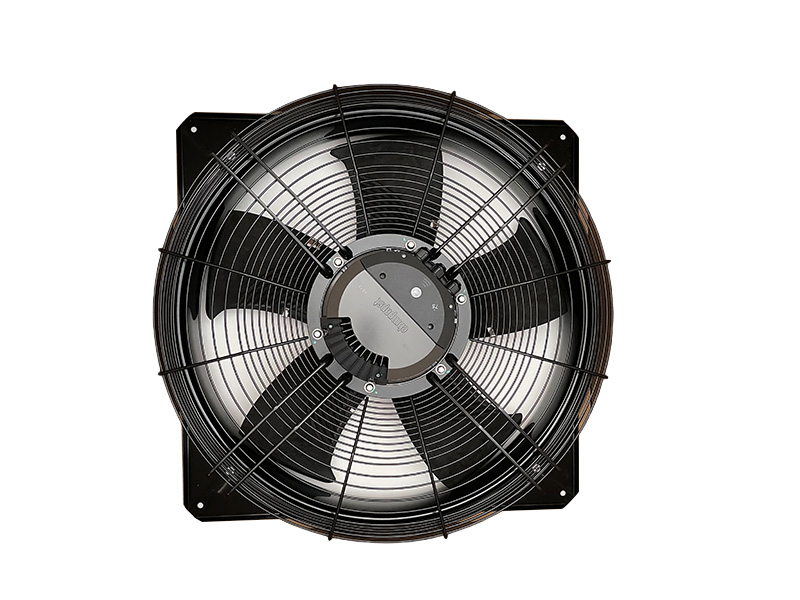
1. EC axial fans - dry cooler, chiller and cooling tower duty
Axial models are identified by impeller diameter and housing shape. In this range the three-phase axial platforms are 630 mm, 800 mm and 910 mm:
- W3G630-NU33-03 - 630 mm AxiBlade; 3~380-480 VAC; 3,600 W; 5.5 A; 1,800 rpm; maximum back pressure 440 Pa; operating point 16,530 m³/h at 329 Pa; PP plastic impeller with galvanized steel housing and guard grille; IP55; H2; Modbus; rated for -40 to +60 °C.
- W3G800-GV01-01 - 800 mm HyBlade with PP blades and an embedded aluminum plate; 3~380-480 VAC; 2,980 W; 4.5 A; 1,090 rpm; maximum back pressure 260 Pa; operating point 18,115 m³/h at 212 Pa; IP55.
- W3G800-KU21-05 - 800 mm; 3~380-480 VAC; 2,900 W; 4.4 A; 1,100 rpm; maximum back pressure 260 Pa; operating point 19,455 m³/h at 247 Pa.
- W3G800-LV05-03 - 800 mm; 3~380-480 VAC; 3,500 W; 5.3 A; 1,190 rpm; maximum back pressure 350 Pa; operating point 19,225 m³/h at 337 Pa; PP impeller with guide vanes for swirl recovery; IP55; H2+C.
- W3G910-KU25-03 - 910 mm; 3~380-480 VAC; 2,550 W; 3.9 A; 980 rpm; maximum back pressure 220 Pa; operating point 23,685 m³/h at 182 Pa.
- W3G910-LV12-36 - 910 mm; 3~380-480 VAC; 3,250 W; 5.0 A; 1,070 rpm; maximum back pressure 300 Pa; operating point 24,750 m³/h at 256 Pa; guide vanes and diffuser structure; IP55; H2+C; Modbus.
These fans serve dry coolers, chillers, condensers, data center cooling towers and free cooling systems - duties where airflow is high and system resistance is comparatively low.
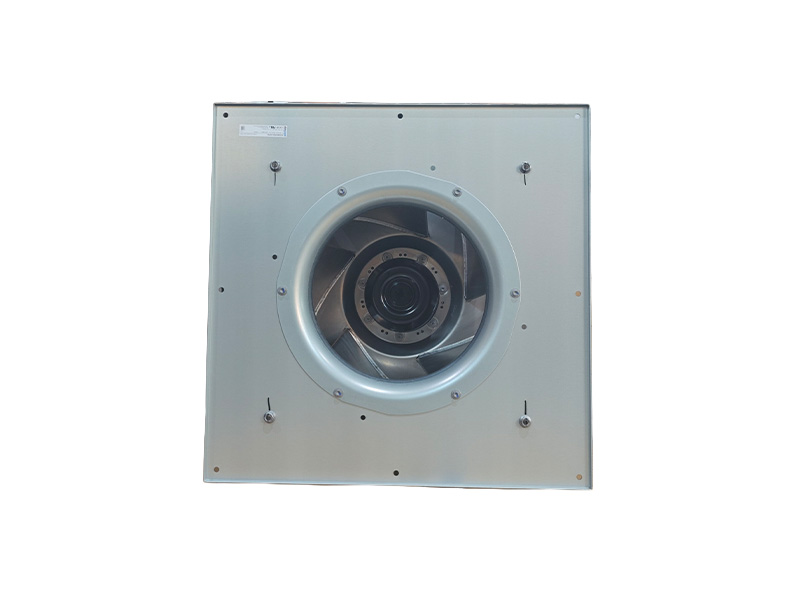
2. EC centrifugal fans and centrifugal blowers - pressure duty
When air has to pass through a cooling coil, a filter bank or a long duct, the impeller must generate far more pressure. Centrifugal modules in this range span 225 mm to 630 mm, in both RadiPac and RadiCal variants, and several are supplied as complete EC fan modules that integrate impeller, motor and electronics in a single unit:
- K3G450-PB29-L1 - 450 mm high static pressure; 3~380-480 VAC; 6,800 W; 10.3 A; 2,800 rpm; operating point 9,035 m³/h at 1,749 Pa; aluminum impeller; IP55; Modbus V6.3; vibration sensor.
- K3G450-PA31-03 - 450 mm backward-curved; 3~380-480 VAC; 4,450 W; 6.8 A; 2,480 rpm; operating point 8,430 m³/h at 1,275 Pa; IP55; Modbus RTU; 0-10 V/PWM; integrated PI control.
- K3G500-PB33-01 - 500 mm RadiPac; 3~380-480 VAC; 5,700 W; 9.0 A; 2,250 rpm; operating point 10,945 m³/h at 1,245 Pa; aluminum impeller; IP55.
- K3G560-PB31-03 - 560 mm RadiPac; 3~380-480 VAC; 4,400 W; 6.6 A; 1,700 rpm; operating point 9,825 m³/h at 1,049 Pa; IP55; Modbus.
- K3G560-FA28-03 - 560 mm backward-curved module; 3~380-480 VAC; 3,950 W; 6.0 A; 1,900 rpm; operating point 11,970 m³/h at 831 Pa; PP impeller; IP55; Modbus.
- R3G630-FB32-03 - 630 mm RadiCal; 3~380-480 VAC; 3,300 W; 5.1 A; 1,370 rpm; operating point 12,190 m³/h at 670 Pa; IP55; Modbus/0-10 V; soft start.
- K3G310-PV69-03 - 310 mm; 3~380-480 VAC; 3,050 W; 4.7 A; 4,000 rpm; operating point 4,020 m³/h at 1,583 Pa; IP55; Modbus/0-10 V.
- K3G310-PH58-02 - 310 mm; 3~380-480 VAC; 2,950 W; 4.6 A; 4,000 rpm; operating point 4,505 m³/h at 1,479 Pa; IP54; TOP thermal protection.
- R3G355-RG56-01 - 355 mm RadiCal; 3~380-480 VAC; 930 W; 1.7 A; 2,240 rpm; operating point 3,205 m³/h at 640 Pa; IP54; passive PFC; Modbus/0-10 V; integrated PID control.
- R3G355-AM14-61 - 355 mm; 1~200-277 VAC; 350 W; 1.5 A; 1,900 rpm; operating point 2,050 m³/h at 400 Pa; single-phase wide voltage; designed for slim-profile FFUs, with the final protection rating ensured by the complete unit.
- R3G225-RE07-03 - 225 mm RadiCal; 1~200-240 VAC; 170 W; 1.4 A; 2,860 rpm; operating point 705 m³/h at 458 Pa; IP54; compact and lightweight.
The pattern to notice is the trade-off. Smaller impellers running faster reach high pressure, while larger centrifugal impellers reach higher volume: a 310 mm module holds 4,505 m³/h at 1,479 Pa, whereas a 630 mm module moves roughly three times that volume at under half the pressure.
3. DC axial flow fans - cabinet, telecom and electronics cooling
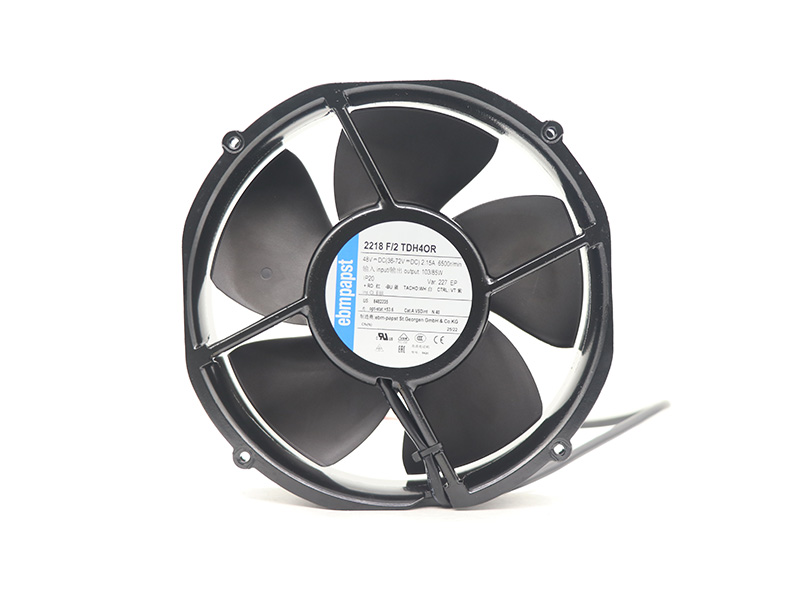
Low-voltage fans serve a different part of the market: the inside of an enclosure. Two examples from this range show how much pressure a compact DC axial flow fan can still generate:
- 2218F/2TDH4OR-227 - 200 × 200 × 51 mm compact axial; 48 VDC (36-72 V); approximately 103 W at 48 V in free air; 6,500 rpm; maximum free-air flow 1,220 m³/h; maximum static pressure 1,170 Pa; metal frame with plastic impeller; any mounting orientation; UL/CSA/CCC.
- AxiEco 200, 8317081096 / VWLH200CKLXS - 200 × 200 × 70 mm; 48 VDC (36-60 V); 348 W at 48 V in free air; 7,000 rpm; maximum free-air airflow 1,820 m³/h; maximum static pressure 1,300 Pa; composite frame; 0-10 V/PWM; speed feedback; UL/VDE/CSA/CCC.
Typical duties are cabinet cooling for communication equipment, network equipment, UPS systems and power supplies, industrial electronics, and the newer high-density cases: AI servers, rear-door heat exchangers (RDHx) and in-row cooling units.
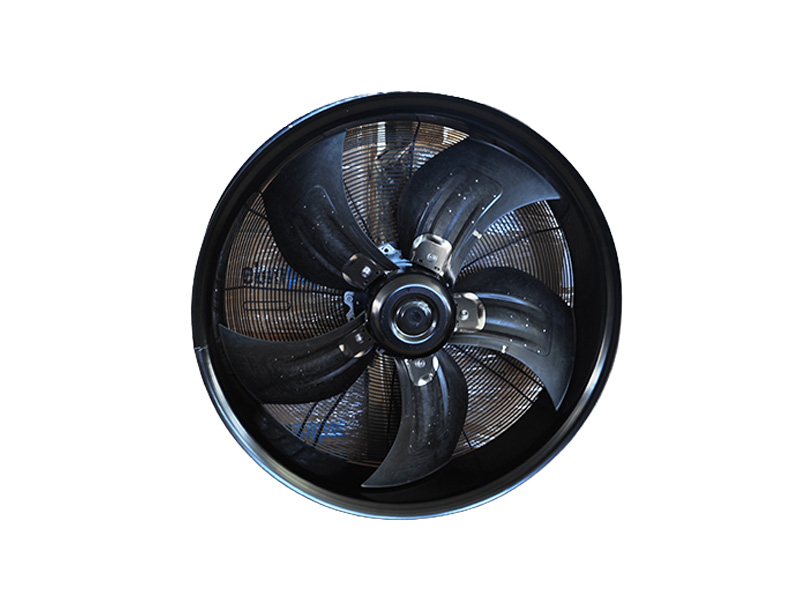
4. AC axial fans and AC-driven centrifugal fans - where they still fit
EC fans did not remove AC fans from the market. Where the equipment already provides a variable frequency drive, or where a fan runs continuously at one duty, an AC axial fan or an AC-driven centrifugal fan remains a valid choice. In this range such configurations are described as EC/AC axial impellers with variable-speed operation based on ambient temperature, or as EC/AC motor direct drive or belt drive with variable frequency speed control. The trade-off is scope: with AC, the drive and the control logic stay outside the fan, the cabinet has to accommodate them, and the fan itself does not accept a digital speed command or report its speed. That difference is why AC axial fan replacement and EC retrofit are frequently the same project.
Step-by-Step: From “Fan” to a Specified Model
- Write the duty down as a pair of numbers. Airflow alone is not a duty; airflow at a static pressure is. If the existing data sheet only gives a free-air figure, treat it as an upper bound and estimate or measure the system resistance separately.
- Choose the impeller family from the pressure requirement. Low resistance (open coil, condenser, wall opening) points to axial; filters, coils and duct runs point to centrifugal. The numbers make the difference concrete: a 910 mm axial impeller reaches 24,750 m³/h at 256 Pa, while a 450 mm centrifugal impeller reaches 9,035 m³/h at 1,749 Pa.
- Match the supply and the control signal. Confirm whether the panel provides 380-480 VAC three-phase, 200-277 VAC single-phase or 48 VDC, and whether the controller uses PWM, 0-10 V or Modbus. If the controller needs speed feedback, check that the fan provides it.
- Check environment and mechanics. Protection ratings in this range include IP54 and IP55; environmental classifications include H2 and H2+C; the W3G630-NU33-03 is specified from -40 to +60 °C. Impeller material matters too - PP, PA, aluminum or galvanized steel - as does the mounting orientation, which for the 2218F/2TDH4OR-227 is described as any orientation.
- Confirm the scope of supply. Some models ship as complete EC modules with impeller, motor and electronics in one unit; others include guide vanes, guard grilles or support plates. On some fan-only products, such as the R3G355-AM14-61, the final protection rating is ensured by the complete unit rather than by the fan alone.
- Validate the commercial path. Availability, selection support and after-sales decide whether the correct fan can actually be installed on schedule. A model that matches every technical requirement but cannot be sourced in time is still a project risk.
Where These Fans Are Used
Mapping the categories above to real equipment gives a short route from duty to model family:
- Dry coolers and free cooling - W3G800-LV05-03, W3G800-KU21-05, W3G910-LV12-36; the guide vane versions are intended to recover swirl at the discharge.
- Chillers and condensers - W3G630-NU33-03, W3G800-GV01-01, W3G910-KU25-03.
- Data center CRAH, AHU and fan walls - K3G560-PB31-03, K3G450-PB29-L1, K3G450-PA31-03, K3G560-FA28-03, K3G500-PB33-01, R3G630-FB32-03.
- In-row and precision cooling - K3G310-PV69-03, K3G310-PH58-02, R3G355-RG56-01.
- AI server, RDHx and high-density electronics - AxiEco 200 (8317081096 / VWLH200CKLXS).
- Telecom cabinets, UPS and power electronics - 2218F/2TDH4OR-227.
- Cleanroom FFU, air purification and compact filtration - R3G355-AM14-61, R3G225-RE07-03.
In every case the fan is not chosen as a component in isolation. It is chosen against the pressure that the coil, filter, duct or enclosure will impose on it - which is why an hvac cooling fan specified by airflow alone is a frequent source of undersized installations.
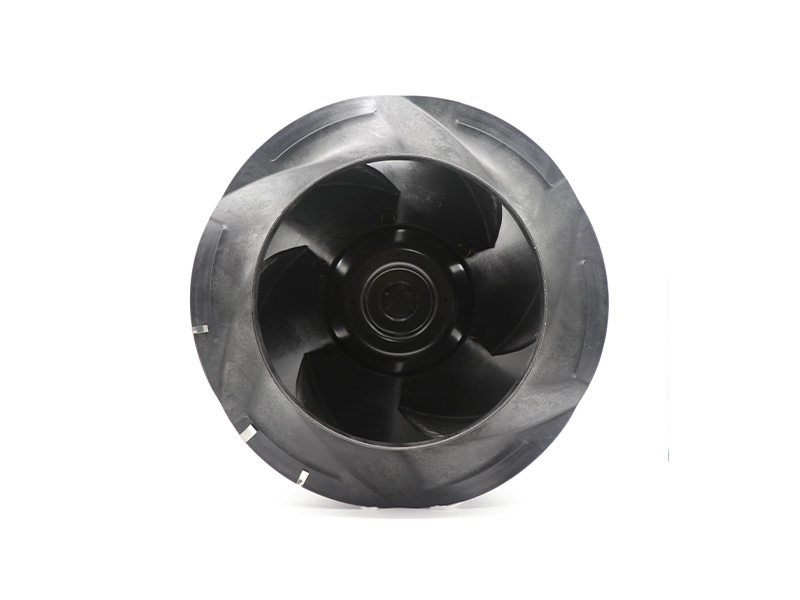
Fan Type Comparison at a Glance
The table below compares representative models from this range using published figures only. Every column comes from the model data sheet, so the comparison can be repeated with the same definitions.
| Fan category | Example model | Size | Supply and power | Speed | Published operating data | Typical duty |
|---|---|---|---|---|---|---|
| EC axial, dry cooler / chiller | W3G630-NU33-03 | 630 mm | 3~380-480 VAC, 3,600 W, 5.5 A | 1,800 rpm | ErP point 16,530 m³/h @ 329 Pa; max back pressure 440 Pa | Dry coolers, chillers, condensers, data center outdoor heat exchange |
| EC axial with guide vanes | W3G800-LV05-03 | 800 mm | 3~380-480 VAC, 3,500 W, 5.3 A | 1,190 rpm | ErP point 19,225 m³/h @ 337 Pa; max back pressure 350 Pa | Dry coolers, data center cooling towers, condensers, free cooling |
| EC axial, high airflow | W3G910-LV12-36 | 910 mm | 3~380-480 VAC, 3,250 W, 5.0 A | 1,070 rpm | ErP point 24,750 m³/h @ 256 Pa; max back pressure 300 Pa | Data center cooling towers, dry coolers, outdoor heat exchangers |
| EC centrifugal, very high pressure | K3G450-PB29-L1 | 450 mm | 3~380-480 VAC, 6,800 W, 10.3 A | 2,800 rpm | ErP point 9,035 m³/h @ 1,749 Pa | High-density data center CRAH, AHU, fan wall |
| EC backward-curved centrifugal module | K3G450-PA31-03 | 450 mm | 3~380-480 VAC, 4,450 W, 6.8 A | 2,480 rpm | ErP point 8,430 m³/h @ 1,275 Pa | CRAH, AHU, EC fan wall, data center retrofit |
| EC centrifugal, large volume | R3G630-FB32-03 | 630 mm | 3~380-480 VAC, 3,300 W, 5.1 A | 1,370 rpm | ErP point 12,190 m³/h @ 670 Pa | Large CRAH, AHU, data center fan walls, ventilation retrofit |
| EC centrifugal, compact in-row | K3G310-PV69-03 | 310 mm | 3~380-480 VAC, 3,050 W, 4.7 A | 4,000 rpm | ErP point 4,020 m³/h @ 1,583 Pa | In-row air conditioners, precision cooling, compact CRAC |
| EC centrifugal, compact FFU | R3G225-RE07-03 | 225 mm | 1~200-240 VAC, 170 W, 1.4 A | 2,860 rpm | ErP point 705 m³/h @ 458 Pa | Compact FFUs, air purifiers, filtration units |
| DC axial, cabinet cooling | 2218F/2TDH4OR-227 | 200 × 200 × 51 mm | 48 VDC (36-72 V), approx. 103 W at 48 V | 6,500 rpm | Max free-air flow 1,220 m³/h; max static pressure 1,170 Pa | Communication cabinets, network equipment, UPS, industrial electronics |
| DC axial, high pressure | 8317081096 / VWLH200CKLXS | 200 × 200 × 70 mm | 48 VDC (36-60 V), 348 W at 48 V | 7,000 rpm | Max free-air airflow 1,820 m³/h; max static pressure 1,300 Pa | AI servers, RDHx, in-row cooling units |
Note on reading the table: for the three-phase EC models, the published operating data is an operating point expressed as airflow at a stated static pressure. For the 48 VDC models, maximum free-air flow and maximum static pressure are separate published values and should not be combined into one operating point.
Frequently Asked Questions
What does the operating point on an EC fan data sheet actually tell you?
It gives airflow together with the static pressure at which that airflow is produced - for example 9,825 m³/h at 1,049 Pa for the K3G560-PB31-03, or 16,530 m³/h at 329 Pa for the W3G630-NU33-03. The pairing matters because a fan that delivers a given volume against low resistance will deliver much less of it once a coil, filter or duct is in the air path. When comparing two fans, compare them at the pressure your equipment will actually create, not at their maximum free-air figures. The 48 VDC models in this range publish maximum free-air flow and maximum static pressure as two separate values; those numbers should not be treated as a single operating point.
What is the difference between an EC axial fan and an EC centrifugal fan?
The difference is impeller geometry and the pressure the fan can hold. An EC axial fan moves air parallel to the shaft and is strongest at high volume with low resistance: the 910 mm W3G910-LV12-36 reaches 24,750 m³/h at 256 Pa. An EC centrifugal fan accelerates air outward and converts that into pressure, so it holds its flow against filters, coils and ductwork: the 450 mm K3G450-PB29-L1 reaches 9,035 m³/h at 1,749 Pa. Backward-curved centrifugal impellers such as those in the K3G450-PA31-03 and the K3G560-FA28-03 are the common choice for CRAH and AHU fan sections, while axial fans dominate dry cooler, condenser and cooling tower duty.
Can an EC fan replace an AC axial fan in existing equipment?
Often it can, but four checks decide the answer. First, supply: EC models in this range operate on 3~380-480 VAC, 1~200-277 VAC or 48 VDC, so the available supply must match. Second, control: EC fans accept PWM, 0-10 V or Modbus and several report speed back, so the controller must be able to send and receive in that format. Third, mechanics: frame size, mounting orientation and the geometry of guide vanes or guard grilles must fit the existing aperture. Fourth, scope of protection: some products are supplied as complete modules with the electronics integrated, while on others the final protection rating is ensured by the complete unit rather than by the fan alone. AC configurations in the same applications typically rely on variable frequency control or belt drive, so an EC retrofit usually removes the external drive instead of adding one.
What drives the cost of an EC fan?
The main cost drivers are impeller family and diameter, motor power, control capability and construction. A 225 mm single-phase RadiCal module such as the R3G225-RE07-03 (170 W) and a 450 mm three-phase high-static-pressure module such as the K3G450-PB29-L1 (6,800 W) are not comparable purchases, even though both are EC centrifugal fans. Within one size, the protection rating (IP54 or IP55), the environmental classification (H2 or H2+C), integrated functions such as Modbus, passive PFC or vibration sensing, and add-ons such as guide vanes and guard grilles all change the specification and therefore the price. Because these vary per project, pricing is normally confirmed against a defined model, quantity and configuration rather than from a generic list; fan selection and solution matching are provided free of charge, so the specification can be fixed before a quotation is issued.
How can a buyer validate a fan and confirm availability before ordering?
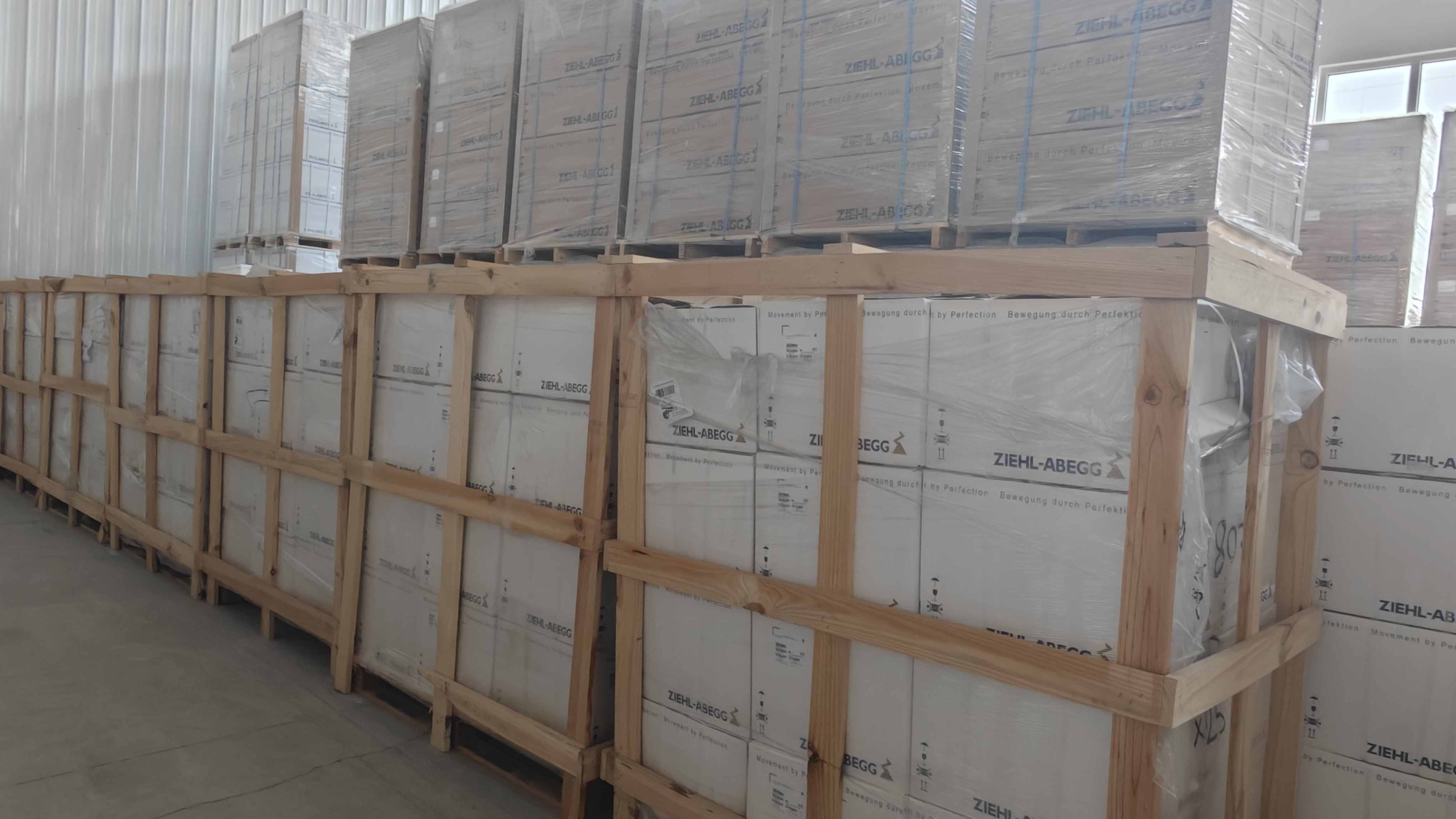
Validation normally runs in three steps: confirm the duty (airflow at the static pressure your equipment creates), confirm the interface (supply voltage, control signal, mounting), and confirm the model that satisfies both - including whether it ships as a fan or as a complete module. Supplier selection and system matching exist for exactly this step. Availability then depends on the model and quantity. Beijing Hengrui Hongsheng states that it keeps a large amount of ready stock to support fast shipment and that its annual production capacity reaches 50,000,000 units, which supports both one-off replacement orders and recurring supply programmes. To start a check, send the model number or the duty point together with the quantity to Jason@bjhengrui.cn or qin@bjhengrui.cn, or message WhatsApp +86 153 1188 3615.
Next Step: Match the Fan to the Duty, Not to the Category
EC fan selection starts with two numbers - the airflow the equipment must move and the static pressure it must overcome - and ends with a model whose supply, control, protection rating and mounting also fit. The categories covered here account for most of the duties that appear in HVAC ventilation, refrigeration, data center and cabinet cooling; the model data sheets carry the figures needed to compare them.
Beijing Hengrui Hongsheng supplies EC fans, EC centrifugal fans, blower fans, DC axial flow fans, EC centrifugal blowers, dry cooler fans, air handling unit fans and chiller fans, and provides fan selection, system matching and full-category product supply as part of a one-stop ventilation, heat dissipation and industrial control service. The company is based in Beijing, China, exports approximately 70% of its products with the USA as its main market, and operates about 100,000 m² of factory space with approximately 700 employees, including 80 engineers and technicians.
If you are working from a model number, a replacement requirement or a duty point, send it for a selection check and a quotation:
- Email: Jason@bjhengrui.cn | WhatsApp: +86 18701526587
- Email: qin@bjhengrui.cn | WhatsApp: +86 13102080631
- Overseas sales: sales06@bjhengrui.cn | WhatsApp: +60 11 59376901
- WhatsApp: +86 153 1188 3615
- Website: https://en.bjhengrui.com