
What Is an Industrial Fan? EC Fan Types & Selection Guide
What Is an Industrial Fan? EC Fan Types & Selection Guide
An industrial fan is a machine that moves air by converting motor power into airflow and static pressure. In HVAC, refrigeration and electronics cooling it is the component that decides how much heat leaves a coil, a duct or a server rack — and how much electricity that movement costs.
This guide is written for people at the beginning of the buying process: engineers, importers, distributors and equipment builders who know they need "a fan" and want to understand the categories before they start comparing suppliers. It explains what the main fan families do, where each one normally runs, and how to turn a rough requirement into a defined duty point.
Beijing Hengrui Hongsheng Mechanical & Electrical Equipment Co., Ltd. is a service provider integrating the sales, model selection and matching, and technical services of ventilation and heat dissipation products, including EC fans, EC centrifugal fans, blower fans and DC axial flow fans. Its published product information and specifications are used throughout this guide as concrete reference points for the categories described.

Problem Definition: Why "I Need a Fan" Is Not Yet a Requirement
The word "fan" hides at least four different purchase decisions. Mixing them up is the most common reason a fan order goes wrong — the wrong voltage, the wrong pressure, or the right fan attached to the wrong system.
- A replacement decision. An existing fan fails. What matters is matching the original model number, voltage range, control signal and mounting, not choosing the most efficient product on the market.
- A design decision. A new AHU, chiller, dry cooler or cabinet needs a fan selected from a performance curve against a calculated duty point.
- A category decision. The buyer knows the airflow they need but has not yet decided between an axial fan, a centrifugal fan or a blower, which are not interchangeable.
- A supply decision. The technical requirement is settled, and the question becomes which supplier can repeat the delivery consistently, with the right documentation and support.
When the pressure side of the requirement is ignored, airflow collapses as soon as the fan is installed behind a coil, a filter or a long duct. When the fan is oversized, the system pays for it in noise, energy consumption and mechanical stress on the equipment. Both failures come from the same root cause: treating airflow as a single number instead of a point on a curve.
The minimum data set before contacting any supplier is therefore small but specific: required airflow in m³/h, the static pressure in Pa at which that airflow must be delivered, supply voltage and frequency or DC range, the control interface, the ambient and ingress conditions, and the mechanical mounting situation. Everything else — impeller material, protection class, communication protocol — is a consequence of those inputs.
Industry Background: Why EC Fans Became the Standard Choice in HVAC
Electronically commutated (EC) motors changed how air movement is specified in modern HVAC and cooling equipment. In a conventional AC fan, speed is tied to the supply frequency and external speed control requires a separate variable-frequency drive. In an EC fan, the commutation electronics are integrated with the motor, so stepless speed control, protection functions and — in many models — communication interfaces such as Modbus come as part of the product rather than as extra components.
Two consequences follow for buyers. First, part-load efficiency becomes a genuine selection criterion, because the fan can be slowed down instead of cycled on and off. Second, the fan becomes a component with a data interface that can be integrated into a building management or equipment control system, which is why EC fan models now regularly quote a control signal, a speed feedback output and an ingress protection rating alongside airflow and pressure.
Refrigeration and data center cooling have pushed the other trend: higher static pressure. Dense coils, deep filters and long duct runs create resistance that a low-pressure axial fan cannot overcome, which is why high static pressure centrifugal modules and fan-wall configurations have become common in air handling units, computer room air handlers and precision cooling units.
A third shift concerns sourcing. Because EC fan platforms are used across hundreds of equipment designs, buyers increasingly work with suppliers who can offer selection support across several brand platforms rather than a single product line — particularly when a legacy model must be replaced without redesigning the equipment.
Detailed Solution: The Main Fan Families and What Each One Does
Four product families cover the majority of HVAC, refrigeration and electronics cooling requirements. They are distinguished by how they move air, how much pressure they can generate, and what they are normally installed into.
EC axial fans: high airflow against moderate system resistance
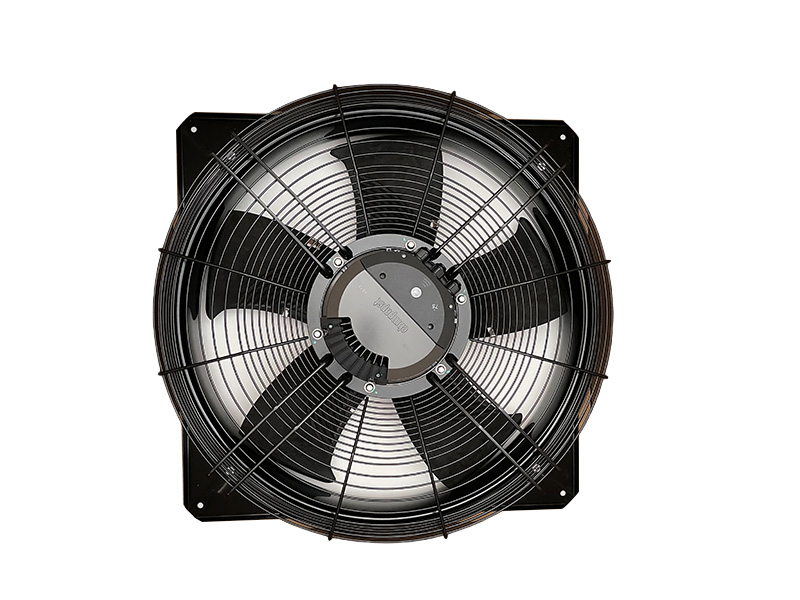
An EC axial fan moves air parallel to the motor shaft using a propeller-type impeller. Its strength is volume: at low to moderate system resistance it delivers large airflow in a compact depth, which makes it the default choice for outdoor heat exchange equipment where air passes across a coil with limited ducting.
Concrete examples from a published EC fan range illustrate how the family scales. The model W3G910-LV12-36 is a 910 mm EC axial fan rated 3,250 W at 3~380–480 VAC, delivering an ErP point of 24,750 m³/h at 256 Pa with a maximum back pressure of 300 Pa; it uses PP plastic impeller and guide vanes with a galvanized steel housing, carries an IP55 rating and an H2+C environmental rating, and is intended for data center cooling towers, dry coolers and free cooling. At 800 mm, the W3G800-LV05-03 is rated 3,500 W and reaches an ErP point of 19,225 m³/h at 337 Pa with a maximum back pressure of 350 Pa. The W3G800-GV01-01 is a HyBlade model rated 2,980 W for outdoor chiller and condenser units, with an ErP point of 18,115 m³/h at 212 Pa.
A feature worth understanding is the guide vane. On models such as the W3G800-LV05-03 the impeller is paired with guide vanes that recover swirl energy downstream of the blades, which raises efficiency and, in models such as the W3G910-LV12-36, is combined with a diffuser structure to improve airflow and noise behaviour.
EC centrifugal fans and backward-curved modules: the high static pressure family
A centrifugal fan draws air in along the motor axis and discharges it at 90 degrees, using a rotating impeller inside a housing. Because the impeller adds energy to the air through centrifugal force rather than lift, this family can generate far higher static pressure than an axial fan of similar diameter — which is exactly what a deep cooling coil, a high-efficiency filter or a compact cabinet requires.
The published range shows how the pressure capability scales with duty. The K3G450-PB29-L1 is a high static pressure EC centrifugal fan for data center CRAH and AHU units and FanGrid applications, rated 6,800 W at 3~380–480 VAC and quoted at an ErP point of 9,035 m³/h at 1,749 Pa; it includes Modbus V6.3 communication and a vibration sensor. The K3G560-PB31-03, a RadiPac EC centrifugal fan module for CRAH and AHU units, is rated 4,400 W with an ErP point of 9,825 m³/h at 1,049 Pa. Both use an aluminium impeller with a galvanized steel support plate and inlet ring, an IP55 rating and Modbus communication.
Where space is constrained, the same family is built smaller and faster. The K3G310-PV69-03 is a 310 mm EC centrifugal fan for in-row air conditioners and high-static-pressure cabinets, rated 3,050 W at 4,000 rpm with an ErP point of 4,020 m³/h at 1,583 Pa. Its sibling model K3G310-PH58-02 is rated 2,950 W with an ErP point of 4,505 m³/h at 1,479 Pa, uses an aluminium impeller and includes TOP thermal protection.
Backward-curved centrifugal modules and complete fan units form a related sub-category. The K3G450-PA31-03 is an EC backward-curved centrifugal fan supplied as a complete module that integrates the impeller, motor and electronics in a single unit, intended for CRAH, AHU, EC fan wall and computer room air conditioning configurations in data centers and for AHU fan sections. The K3G560-FA28-03 is a 560 mm backward-curved module rated 3,950 W with an ErP point of 11,970 m³/h at 831 Pa, positioned for AHU, CRAH, fan wall and energy-efficiency retrofitting work.
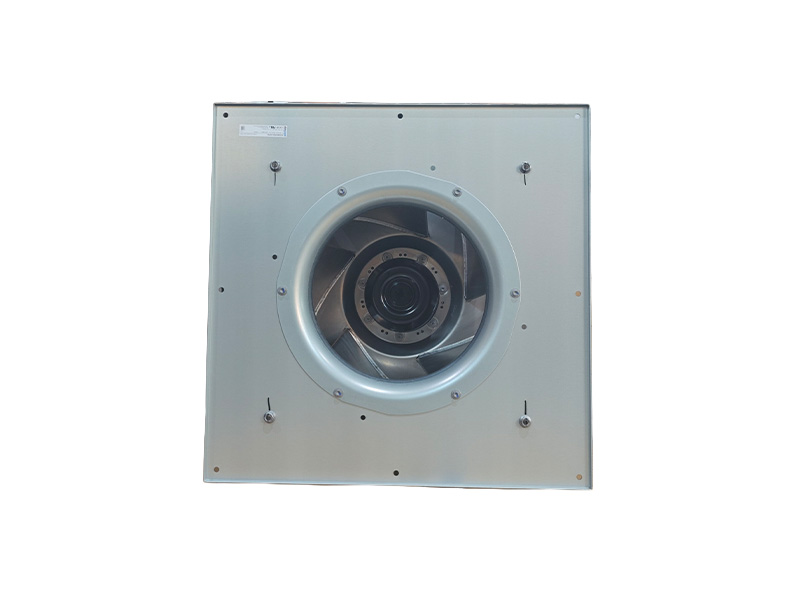
Precision cooling and in-row units use the same principle in a smaller envelope. The R3G355-RG56-01 is a 355 mm RadiCal EC centrifugal fan rated 930 W with an ErP point of 3,205 m³/h at 640 Pa; it is rated IP54, includes passive PFC and offers Modbus or 0–10 V control with integrated PID regulation. The R3G500-FA28-03 is a 500 mm RadiCal fan for CRAC and AHU units rated 2,850 W at an ErP point of 8,715 m³/h at 794 Pa, and the larger R3G630-FB32-03 covers 630 mm with an ErP point of 12,190 m³/h at 670 Pa, including soft start and electronic protection.
Blower fans and EC centrifugal blowers
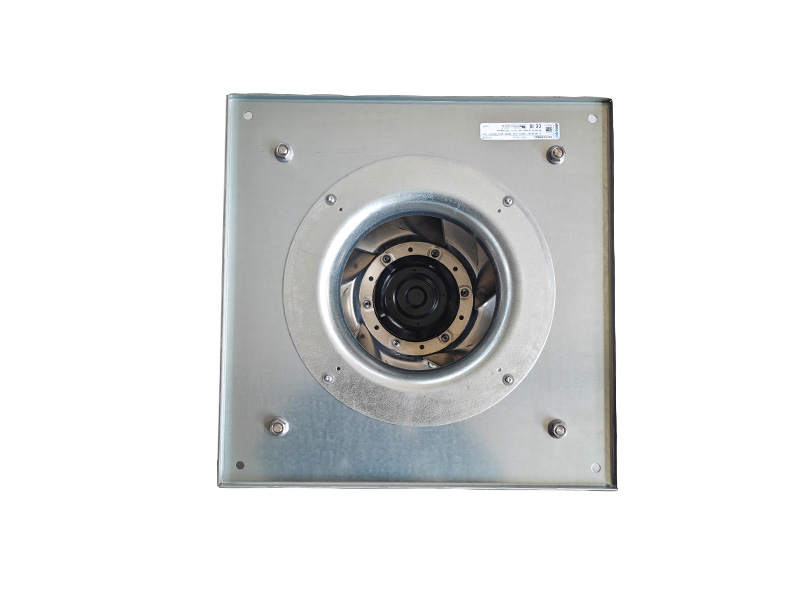
Blower fans and EC centrifugal blowers are the same physical family described in different market language: an impeller inside a housing that produces pressurised air for ducted or forced delivery. They appear in the product range as EC centrifugal blowers and blower fans, and they are typically specified where air must be pushed through a resistance rather than simply circulated — filtration units, duct systems and equipment ventilation.
Compact air purification duties sit at the small end of this family. The R3G225-RE07-03 is a 225 mm RadiCal EC centrifugal fan designed for compact FFUs and air purifiers, rated 170 W on a single-phase 1~200–240 VAC supply with an ErP point of 705 m³/h at 458 Pa. At 355 mm, the R3G355-AM14-61 is rated 350 W on 1~200–277 VAC with an ErP point of 2,050 m³/h at 400 Pa; it is intended for cleanroom FFU, semiconductor, pharmaceutical and air purification equipment, and its wide voltage range makes it compatible with slim-profile FFU designs.
DC axial flow fans and 48 V cabinet fans
Not every fan runs on mains voltage. Cabinets, telecom equipment and high-density electronics use DC axial flow fans operating from a low-voltage bus, where the priorities shift to pressure density, wide input tolerance and monitoring capability.
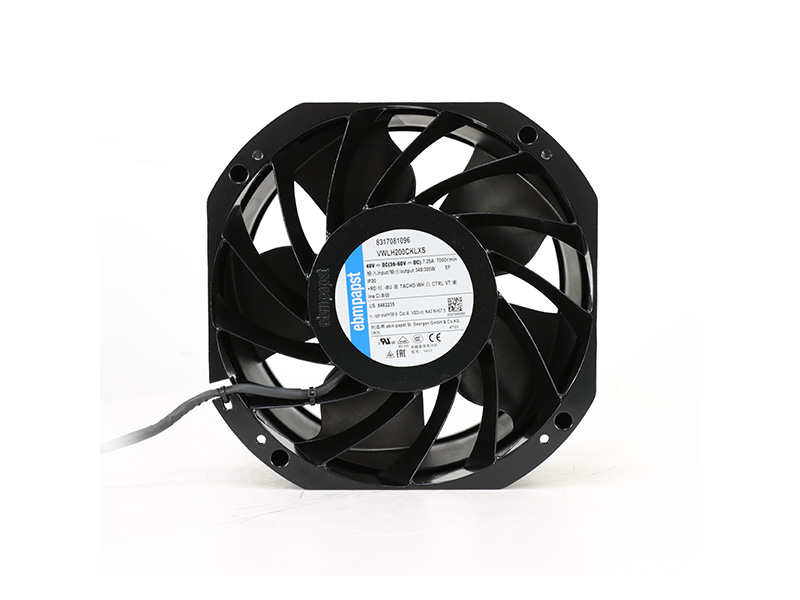
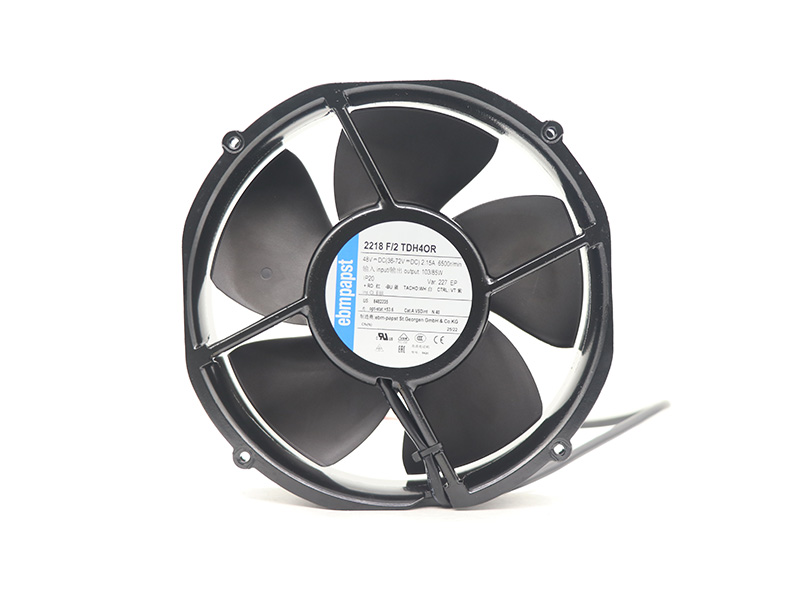
Two examples make the difference clear. The 2218F/2TDH4OR-227 is a 48 V EC compact axial fan measuring 200 × 200 × 51 mm, operating from 36–72 VDC, drawing approximately 103 W at 48 V in free air, running at 6,500 rpm and delivering a maximum free-air flow of 1,220 m³/h and a maximum static pressure of 1,170 Pa; it is intended for communication cabinets, network equipment, UPS systems, power supplies and industrial electronics, and is listed with UL, CSA and CCC approvals. The AxiEco 200, model 8317081096 / VWLH200CKLXS, is a 200 × 200 × 70 mm fan built on a high-pressure platform for AI servers, in-row air conditioners and rear-door heat exchangers (RDHx); it operates from 36–60 VDC, draws 348 W at 48 V in free air, runs at up to 7,000 rpm and reaches a maximum free-air flow of 1,820 m³/h against a maximum static pressure of 1,300 Pa, with 0–10 V and PWM control, speed feedback and UL, VDE, CSA and CCC approvals.
Step-by-Step Breakdown: How to Select a Fan in Seven Steps
- Define the duty point, not the airflow. State airflow and static pressure together — for example, an ErP operating point of 9,035 m³/h at 1,749 Pa describes a very different fan from one quoted at 19,225 m³/h at 337 Pa, even though both are EC fans. The duty point is the input that all other decisions follow from.
- Confirm the electrical supply and control interface. Mains-powered models in this range operate on 3~380–480 VAC or on single-phase 1~200–277 VAC, while DC models run from a 48 V bus across a stated range such as 36–60 V or 36–72 V. Then confirm how the fan will be commanded: PWM, 0–10 V, Modbus RTU or Modbus V6.3, and whether speed feedback is required.
- Match the fan family to system resistance. Axial fans suit air-cooled coils, dry coolers, condensers and cooling towers where resistance is moderate. Centrifugal fans and backward-curved modules suit deep coils, filters, ducted AHU sections and compact cabinets where static pressure reaches several hundred to well over a thousand pascals.
- Check the environment and protection rating. Ingress protection is stated per model — IP54 for the R3G355-RG56-01 and the K3G310-PH58-02, IP55 for the K3G560-PB31-03 and the W3G910-KU25-03. Outdoor dry cooler and chiller duties may also call for an environmental class such as H2 or H2+C, and for a stated ambient range, as with the W3G630-NU33-03 at −40 to +60 °C.
- Verify the mechanical fit and mounting position. Diameter, frame size, housing type and mounting orientation all constrain the choice. The 48 V EC compact axial fan for cabinets is specified for any mounting orientation; large axial fans such as the 800 mm and 910 mm models use a galvanized steel housing and guard grille suited to outdoor units.
- Evaluate part-load behaviour, not just the design point. Because EC models support stepless speed control, the useful comparison is performance across the speed range. Models with integrated PI or PID control, soft start and electronic protection, such as the R3G630-FB32-03 and the R3G355-RG56-01, reduce the amount of control work the equipment builder has to add.
- Confirm supply, stock and after-sales support. A technically correct fan is only useful if it arrives on schedule for every build. Ask about available stock, shipment speed, warranty handling and who provides selection support when the duty point changes.
Use Cases: Where These Fans Actually Run
- Dry coolers and free cooling. Large axial EC fans move ambient air across the coil. Models such as the W3G800-KU21-05 (19,455 m³/h at 247 Pa) and the W3G800-LV05-03 with guide vanes cover this duty.
- Chillers and condensers. Outdoor units use axial EC fans with hybrid blades and sealed housings, as in the W3G800-GV01-01 for outdoor chiller and condenser units.
- Data center CRAH, AHU and fan walls. High static pressure centrifugal modules such as the K3G450-PB29-L1 and the K3G450-PA31-03 handle dense coils and deep filter sections; fan-wall layouts use multiple modules controlled in parallel.
- In-row and rack-level precision cooling. Compact 310 mm and 355 mm centrifugal fans fit the narrow envelope of in-row air conditioners and small CRAH units while still producing over 1,400 Pa at the operating point.
- AI servers and rear-door heat exchangers. The AxiEco 200 platform addresses high-density electronic cooling, where 1,300 Pa of static pressure is needed in a 200 mm frame.
- Telecom cabinets, UPS and power electronics. 48 V EC compact axial fans provide wide-voltage operation and monitoring for communication cabinets and industrial electronics.
- Cleanroom FFU, air purification and filtration. Single-phase centrifugal fans such as the R3G355-AM14-61 and the R3G225-RE07-03 serve cleanroom, pharmaceutical and air purification equipment.
Across all of these, the company's products are stated to be used in HVAC ventilation and air conditioning, refrigeration equipment, data centers, new energy, industrial automation, air purification, rail transit and power electronics heat dissipation.
Comparison Table: Representative EC Fan Models by Duty
The table below compares published models from a single EC fan range. It is organized by duty point, not by size, because that is the order in which the specification should be read.
| Model | Fan family | Typical application | Published operating point | Supply and features |
|---|---|---|---|---|
| W3G910-LV12-36 | EC axial, AxiBlade with guide vanes | Data center cooling towers, dry coolers, free cooling | 24,750 m³/h @ 256 Pa (max. back pressure 300 Pa) | 3~380–480 VAC; IP55; H2+C; Modbus |
| W3G800-KU21-05 | 800 mm EC axial, AxiBlade | Dry coolers, condensers, free cooling | 19,455 m³/h @ 247 Pa (max. back pressure 260 Pa) | 3~380–480 VAC; IP55; H2+C |
| W3G800-LV05-03 | 800 mm EC axial with guide vanes | Dry coolers, cooling towers, condensers | 19,225 m³/h @ 337 Pa (max. back pressure 350 Pa) | 3~380–480 VAC; IP55; H2+C |
| W3G630-NU33-03 | 630 mm EC axial, AxiBlade, high back pressure | Dry coolers, chillers, data center outdoor heat exchange | 16,530 m³/h @ 329 Pa (max. back pressure 440 Pa) | 3~380–480 VAC; IP55; H2; Modbus; −40 to +60 °C |
| R3G630-FB32-03 | EC centrifugal, RadiCal | Large CRAH, AHU, fan wall, ventilation retrofit | 12,190 m³/h @ 670 Pa | 3~380–480 VAC; IP55; Modbus / 0–10 V; soft start |
| K3G560-PB31-03 | EC centrifugal, RadiPac module | Data center CRAH, AHU, fan wall, industrial air handling | 9,825 m³/h @ 1,049 Pa | 3~380–480 VAC; IP55; Modbus |
| K3G450-PB29-L1 | High static pressure EC centrifugal | High-density data center CRAH, AHU, FanGrid | 9,035 m³/h @ 1,749 Pa | 3~380–480 VAC; IP55; Modbus V6.3; vibration sensor |
| R3G355-RG56-01 | 355 mm EC centrifugal, RadiCal | In-row and precision air conditioners, small CRAH | 3,205 m³/h @ 640 Pa | 3~380–480 VAC; IP54; Modbus / 0–10 V; integrated PID |
| 8317081096 / VWLH200CKLXS (AxiEco 200) | 200 × 200 × 70 mm DC axial | AI servers, RDHx, in-row cooling units | Max. free-air flow 1,820 m³/h; max. static pressure 1,300 Pa | 48 VDC (36–60 V); 0–10 V / PWM; speed feedback; UL/VDE/CSA/CCC |
| 2218F/2TDH4OR-227 | 200 × 200 × 51 mm 48 V EC compact axial | Communication cabinets, network equipment, UPS, power supplies | Max. free-air flow 1,220 m³/h; max. static pressure 1,170 Pa | 48 VDC (36–72 V); 0–10 V / PWM; speed feedback; UL/CSA/CCC |
Two patterns are visible in the table. Moving from the axial rows to the centrifugal rows, airflow falls while static pressure rises by roughly three to seven times, which is why the families are not substitutes for one another. And within the axial family, impeller diameter drives airflow more than motor power does — the 910 mm model produces more airflow at 2,550 W to 3,250 W than the 630 mm model does at 3,600 W.
FAQ
What certifications and protection ratings should I check on an EC fan?
Check three layers: electrical safety approvals, ingress protection, and any environmental class stated for outdoor use. In the range described here, the AxiEco 200 fan for AI servers and RDHx is listed with UL, VDE, CSA and CCC approvals, and the 48 V EC compact axial fan for communication cabinets is listed with UL, CSA and CCC. Ingress protection is stated per model: IP54 for the R3G355-RG56-01 in-row fan and the K3G310-PH58-02, and IP55 for models such as the K3G560-PB31-03 CRAH/AHU module and the W3G910-KU25-03 dry cooler fan. Outdoor dry cooler models such as the W3G630-NU33-03 additionally carry an H2 environmental class and a stated operating range of −40 to +60 °C. One boundary worth noting: for FFU and air purification fans, the fan-level figure is not the final system rating — for the R3G355-AM14-61 the final protection rating has to be ensured by the complete unit.
Can a supplier match an EC fan to my airflow and static pressure instead of only selling catalog items?
Yes, and for first-time buyers this is usually where the most value is created. Beijing Hengrui Hongsheng provides free fan selection and solution matching alongside product supply, and it maintains long-term agent and distribution relations with brands including ebmpapst, Ziehl-Abegg, SANYO, DELTA, SUNON, Rosenberg, WISTRO, SODECA, NMB, ADDA and S&P, together with cooperative relationships with a number of manufacturers in the fan and industrial control industry. Its R&D team consists of 80 engineers and technicians. In practice this means a buyer can send a duty point plus voltage and control requirements and ask for two or three model options with their ErP operating points, rather than being limited to whatever a single catalog lists. It also matters for replacement work: when a specific part number such as 9GV0624P1G031 is involved, the useful first step is a selection check that identifies which current platforms meet the same mechanical and electrical envelope.
What drives the cost of an EC fan?
Four variables dominate, and none of them is the purchase price alone. The first is impeller size and material — a 225 mm single-phase RadiCal fan rated 170 W and a 450 mm three-phase high static pressure module rated 6,800 W sit at completely different points, and the stated impeller materials (PA plastic, PP plastic, aluminium sheet or aluminium) follow the duty. The second is motor power and speed class. The third is the electronics package: models such as the K3G450-PA31-03 include integrated PI control, Modbus RTU and 0–10 V/PWM input, while simpler fans may offer speed control only. The fourth is whether the item is supplied as a complete module — the RadiPac and RadiCal units such as the K3G560-PB31-03 and the K3G450-PA31-03 integrate impeller, motor and electronics in a single unit, which reduces assembly work for the equipment builder but changes the unit basis compared with buying components separately. The correct comparison is therefore cost per duty point including part-load energy, not list price per fan.
How can I validate a fan before placing a volume order?
Validation normally happens in two stages. The first is a selection check, in which the supplier matches candidate models to your duty point and confirms the operating point; the ErP point published for each model, such as 4,505 m³/h at 1,479 Pa for the K3G310-PH58-02 or 3,205 m³/h at 640 Pa for the R3G355-RG56-01, is a practical benchmark for comparing candidates on equal terms. The second stage is a physical test on your own coil, duct, AHU section or cabinet, because system effects such as inlet obstruction, cabinet leakage and coil fouling change real airflow. Control behaviour should be verified in the same test: confirm that the 0–10 V or PWM signal, the Modbus interface and the speed feedback output behave as expected in your own controller. Buyers who keep ready stock and support fast shipment shorten this evaluation cycle considerably, and free fan selection plus solution matching is normally the entry point.
What supports supply continuity for a recurring fan program?
Three things matter: manufacturing capacity, inventory, and a service network. Beijing Hengrui Hongsheng produces about 50,000,000 units per year, which supports recurring supply programs, and keeps a large amount of ready stock in inventory to support fast shipment. The company was established in 2011, operates a 100,000 m² facility with approximately 700 staff, and has offices in Chengdu, Wuxi, Tianjin, Shenzhen and Hong Kong, which shortens response distance for both domestic and export orders. Approximately 70% of products are exported, with the USA as the main market, and the company states it has served more than 20,000 corporate customers. For a long-term program, the practical step is to fix the specific model, voltage variant and control interface in writing at the beginning, so that repeat orders can be placed without repeating the selection work — you can start that process by requesting a selection check through en.bjhengrui.com.
Conclusion
Choosing a fan becomes a manageable task once the categories are separated. Axial EC fans deliver high airflow against moderate resistance and belong on dry coolers, condensers and cooling towers. Centrifugal and backward-curved EC fans deliver high static pressure and belong in CRAH and AHU units, fan walls, in-row cooling and ducted filtration systems. Blower fans and EC centrifugal blowers cover pressurised delivery duties, and DC axial flow fans serve cabinets and high-density electronics where the supply is a low-voltage DC bus.
The discipline that connects them is the same in every case: define the duty point as airflow and static pressure together, confirm the electrical and control interface, check the protection rating and environmental class against the installation, then verify part-load behaviour and supply continuity. A fan that matches its system at part load costs less to run and lasts longer than one chosen on airflow alone.
Beijing Hengrui Hongsheng supplies EC fans, EC centrifugal fans, blower fans, DC axial flow fans, EC centrifugal blowers, dry cooler fans, air handling unit fans and chiller fans, and provides professional fan selection, system matching solutions and full-category product supply services. Its stated goal is to operate as a one-stop platform for ventilation, heat dissipation and industrial control products, with the product range used across HVAC ventilation and air conditioning, refrigeration equipment, data centers, new energy, industrial automation, air purification, rail transit and power electronics heat dissipation.

Next step: send your duty point, get matched models
If you have an airflow and static pressure requirement, a failing model number, or a new equipment design that needs a fan selected, the fastest route is a free selection and matching check. Share the duty point, supply voltage, control interface and installation constraints, and you will receive candidate models with their published operating points.
Website: https://en.bjhengrui.com
Email: Jason@bjhengrui.cn | Tel / WhatsApp: +86 18701526587
Email: qin@bjhengrui.cn | Tel / WhatsApp: +86 13102080631
Overseas sales: sales06@bjhengrui.cn | Tel / WhatsApp: +60 11 59376901
WhatsApp: Chat with the selection team