
Air Filter Efficiency Classes FAQ for Smart Manufacturing: MERV, F-Grades, HEPA H13, ULPA U14/U15
Air filter efficiency classes are labels produced by different standards families, and they are not interchangeable. In the Henkaes air filter range used for smart manufacturing projects, G1–G4 describes panel filter grades, F5–F9 describes bag filter grades, MERV 8–16 describes furnace and box filter grades under ASHRAE 52.2, H13 describes high-efficiency filters such as the V-Bank Filter, the HEPA Air Filter and the B737/B757 Electronic Cabin Air Filter under EN 1822, and U14/U15 describes cleanroom filters for data centers and microelectronics. This FAQ explains what each class actually specifies, where it belongs in a filter chain, and how procurement and engineering teams should verify it before ordering.
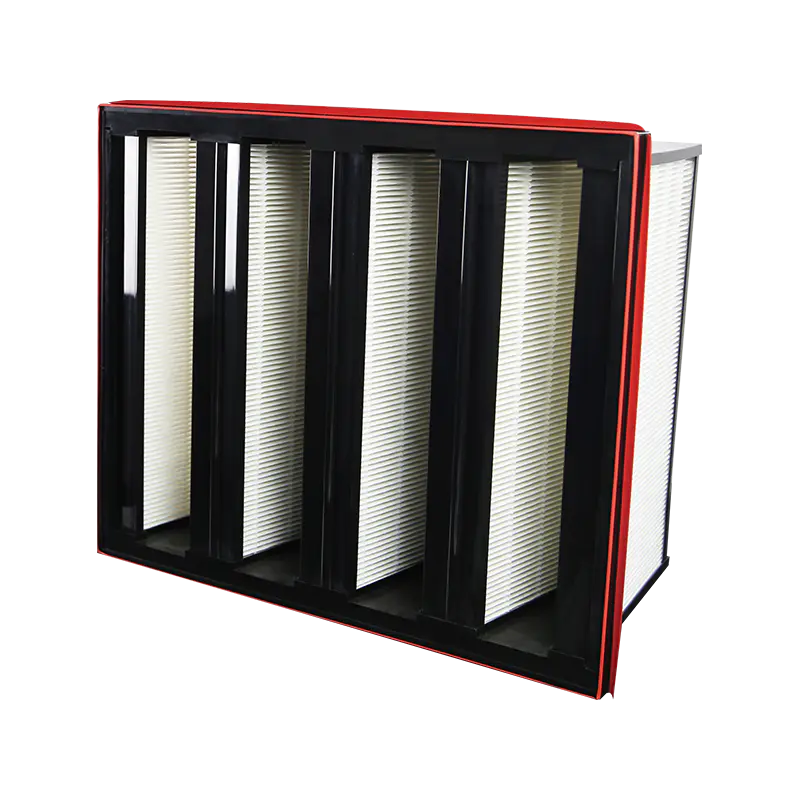
V-Bank Filter – efficiency grade H13, fiberglass and polypropylene media, specified for commercial and public buildings such as airports, hotels, museums and restaurants.
Problem Definition: Why Class Confusion Slows Down a Filter Procurement
The practical difficulty in a smart manufacturing project is not choosing a high grade. It is choosing a grade that means the same thing to the design engineer, the maintenance contractor and the supplier who quotes it. Three recurring failures cause most of the friction.
First, mixed classification families on one bill of quantities. A single equipment schedule often lists a G4 pre-filter, an F8 intermediate stage, a MERV 13 final stage and an H13 terminal filter in the same column heading. These four entries come from different frameworks, and each is verified by a different test logic. When the column is simply titled “efficiency”, the quotation comparison becomes meaningless because suppliers are answering different questions.
Second, treating H13 as a generic word for high efficiency. H13 is a defined class inside the EN 1822 framework used in Europe to classify EPA, HEPA and ULPA filters by filtration efficiency and zero leakage. In the Henkaes range, H13 appears on the V-Bank Filter, on the HEPA Air Filter, and on the B737/B757 Electronic Cabin Air Filter — three products with different media, different housings and different applications. The grade alone does not describe the product; it only describes one performance attribute.
Third, legacy grade references that nobody re-mapped. Many project documents still cite F-grades from the EN 779 family. Since mid-2018, EN 779 has been completely replaced by ISO 16890 in Europe, while ASHRAE 52.2 remains a classification framework behind MERV values. A specification that has not been updated creates a mismatch between what the document says and what a European buyer is now expected to certify against.
Industry Background: Four Classification Families Behind One Specification
Understanding the class ladder starts with understanding that four separate frameworks are in normal commercial use.
ASHRAE Standard 52.2 classifies general ventilation filters with MERV ratings from 1 to 16. MERV is derived from performance efficiency calculated from synthetic-dust loading tests, which is why MERV describes fractional particle capture behaviour over a loading cycle rather than a single laboratory snapshot. This is the framework used for the furnace and box filter families in the Henkaes range, and it is also the test standard applied in the company's own filter testing.
EN 779 and its replacement, ISO 16890. The F5–F9 band belongs to the EN 779 family of general ventilation classes. Since mid-2018, EN 779 has been replaced in Europe by ISO 16890. F-grades have not disappeared from industry practice — they still appear on drawings, in tender documents and on existing equipment labels — but a buyer specifying F5–F9 today should state clearly whether acceptance is against the historical EN 779 grade or a current ISO 16890 class.
EN 1822. In Europe, EN 1822 is the framework used to classify EPA, HEPA and ULPA filters by filtration efficiency and zero leakage. This is the framework that sits behind the H13 and U14/U15 grades discussed throughout this article.
Market context. Air filtration demand is being pulled upward by both building systems and consumer devices. The global smart air purifier market was valued at USD 2.5 billion in 2023 and is projected to grow at a CAGR of 14.1% from 2024 to 2030, with Asia Pacific holding a 41.4% revenue share in 2023 (Grand View Research). The HEPA filter segment alone reached USD 5.77 billion in 2025 (Market Research Future). For manufacturers and procurement teams, that growth translates into more grade variants on the same production line, not fewer.
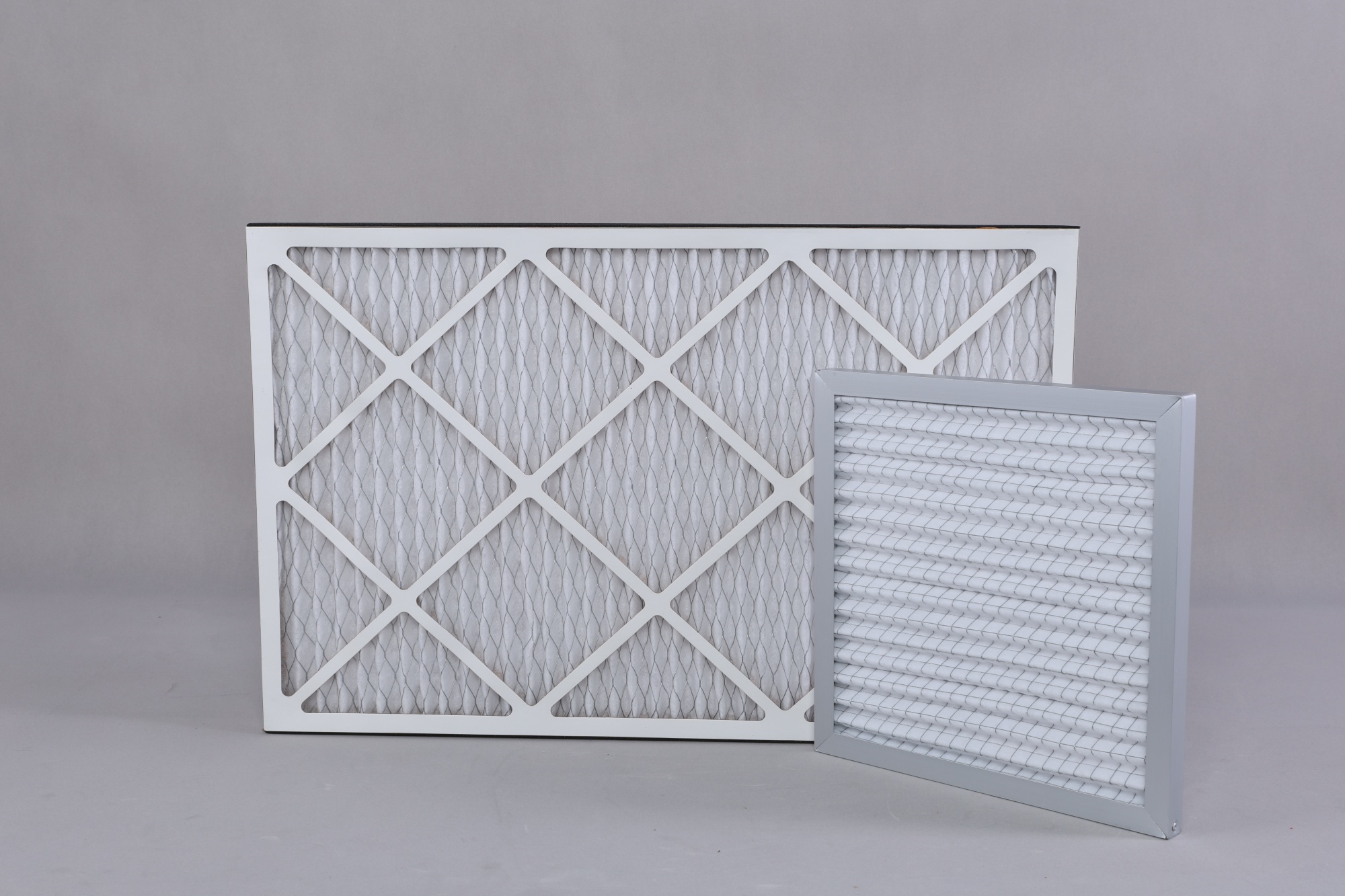
Furnace Air Filter – supplied in MERV 8, MERV 11 and MERV 13 grades, polypropylene media, for commercial and public buildings.
Detailed Solution: What Each Class Actually Specifies
The clearest way to answer the class question is to walk the ladder from the lowest grade in the range to the highest, and to state for each step which product carries the grade and which application the grade is specified for.
What do G1–G4 panel filter grades cover?
G1–G4 is the coarse band of the range, carried by the Panel Filter with fiberglass or polypropylene media. The specified application is commercial and public buildings such as airports, hotels, museums and restaurants. In a filter chain, this band is the workhorse first stage: it removes the bulk of coarse airborne dust before air reaches more expensive media downstream. The design value of a G-grade is not its capture ceiling but its cost per unit of dust held and its role in protecting the stages behind it.
What does F5–F9 mean on a bag filter?
The Bag Filter carries F5, F6, F8 and F9 grades with microfine fiberglass media, again specified for commercial and public buildings including airports, hotels, museums and restaurants. The bag construction holds a large media area inside the same face dimension, which is why this band is commonly used as the intermediate stage between a panel pre-filter and a high-efficiency final filter. Within the band, F5 to F9 gives a buyer four steps to tune against the dust load of a specific building rather than jumping straight to a high-efficiency filter.
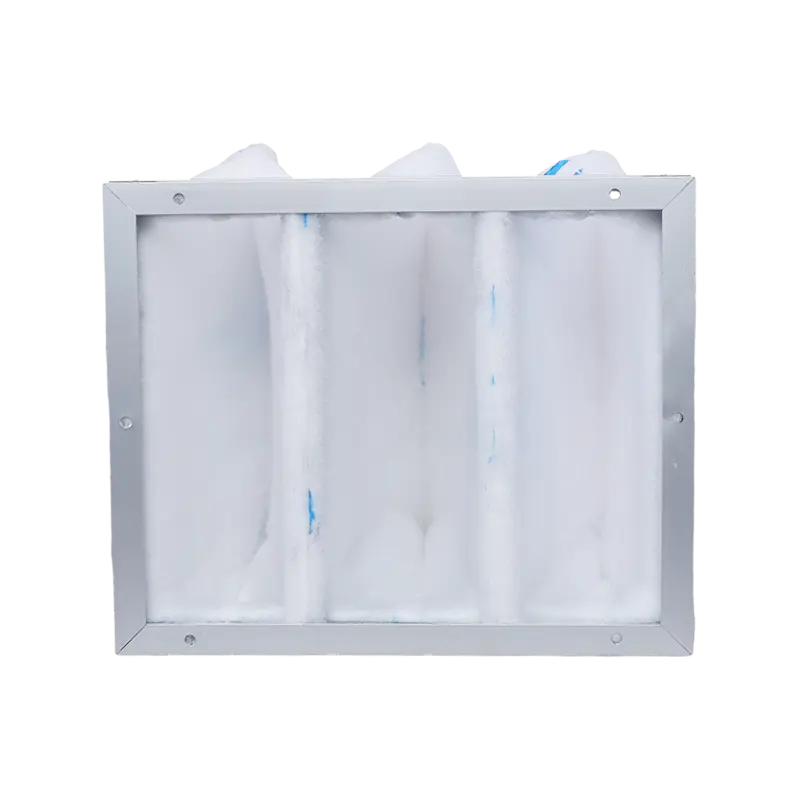
Bag Filter – F5, F6, F8 and F9 grades, microfine fiberglass media, used as an intermediate HVAC filtration stage.
What do MERV 8, 11 and 13 mean on a furnace filter?
The Furnace Air Filter is supplied in MERV 8, MERV 11 and MERV 13 with polypropylene media, for commercial and public buildings such as airports, hotels, museums and restaurants. The practical advantage of this product family is that three MERV steps exist inside one product type: an engineer can raise the final stage of a general ventilation system without changing the filter format, the housing or the maintenance access route. That matters in retrofit work, where the equipment is fixed and only the consumable can move.
When does a MERV 15/16 box filter replace a MERV 13 stage?
The Box Filter carries MERV 15 and MERV 16 with microfiberglass media, and is specified for pharmaceutical plants, hospitals and food and beverage production sites. MERV 15/16 is the highest MERV band in this range, and the application list is the decision signal: where the process is regulated by contamination risk rather than comfort, the specification moves from the furnace filter band to the box filter band. Hospital and pharmaceutical projects commonly require that step change, and food and beverage production sites appear on the same list.
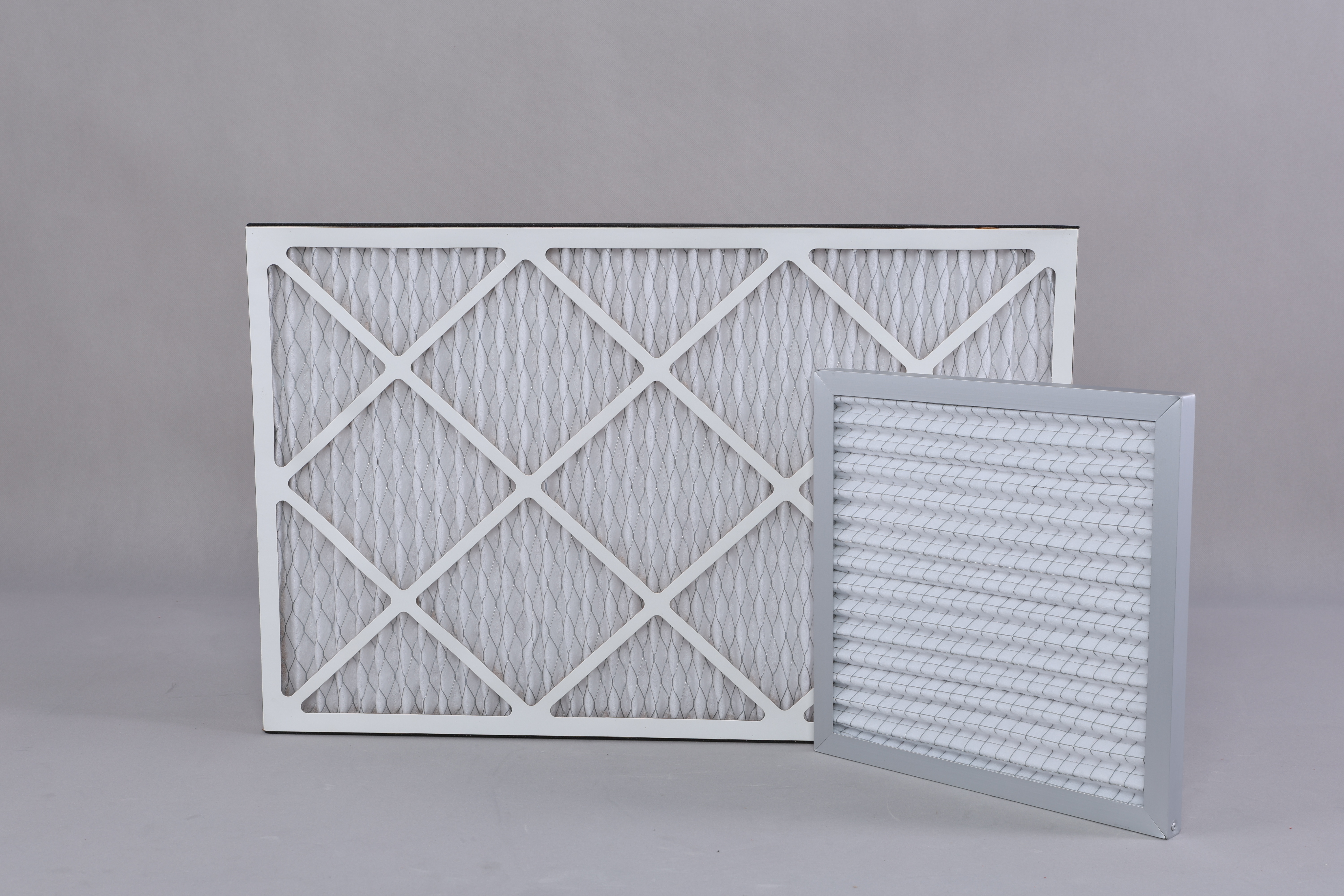
Box Filter – MERV 15 and MERV 16 grades, microfiberglass media, specified for pharmaceutical plants, hospitals and food and beverage production sites.
What does H13 mean, and which products carry it?
H13 is a high-efficiency class within EN 1822. In the Henkaes range it appears on three distinct products, and buyers should treat them as separate specifications rather than as one grade:
- V-Bank Filter, H13 – fiberglass and polypropylene media, specified for commercial and public buildings such as airports, hotels, museums and restaurants. This is the H13 option for building HVAC systems that need a high-efficiency final stage.
- HEPA Air Filter, H13 – fiberglass and polypropylene media, specified for household appliances such as air purifiers and air cleaners. The True HEPA Air Filter in the same family is rated at ≥99.97%.
- B737/B757 Electronic Cabin Air Filter, H13 – microfiberglass media, specified for aerospace and aviation cabin air filtration.
The lesson for a specification writer is that “H13” on a drawing defines a performance class, not a part number. The housing depth, media type, gasket and frame all still need to be stated separately.
What separates U14/U15 cleanroom filters from H13?
The Cleanroom Air Filter carries U14 and U15 grades with microfiberglass and PTFE media, and is specified for cleanrooms such as data centers and microelectronics manufacturing. This is the top of the ladder in the range, and it exists for a different decision than H13: not “can this building's air be improved” but “can this process environment be held at a defined contamination level”. The available media options — microfiberglass and PTFE — give the specifier a material choice inside the same grade band, which is a normal consideration where the filter must perform consistently over a long service interval.
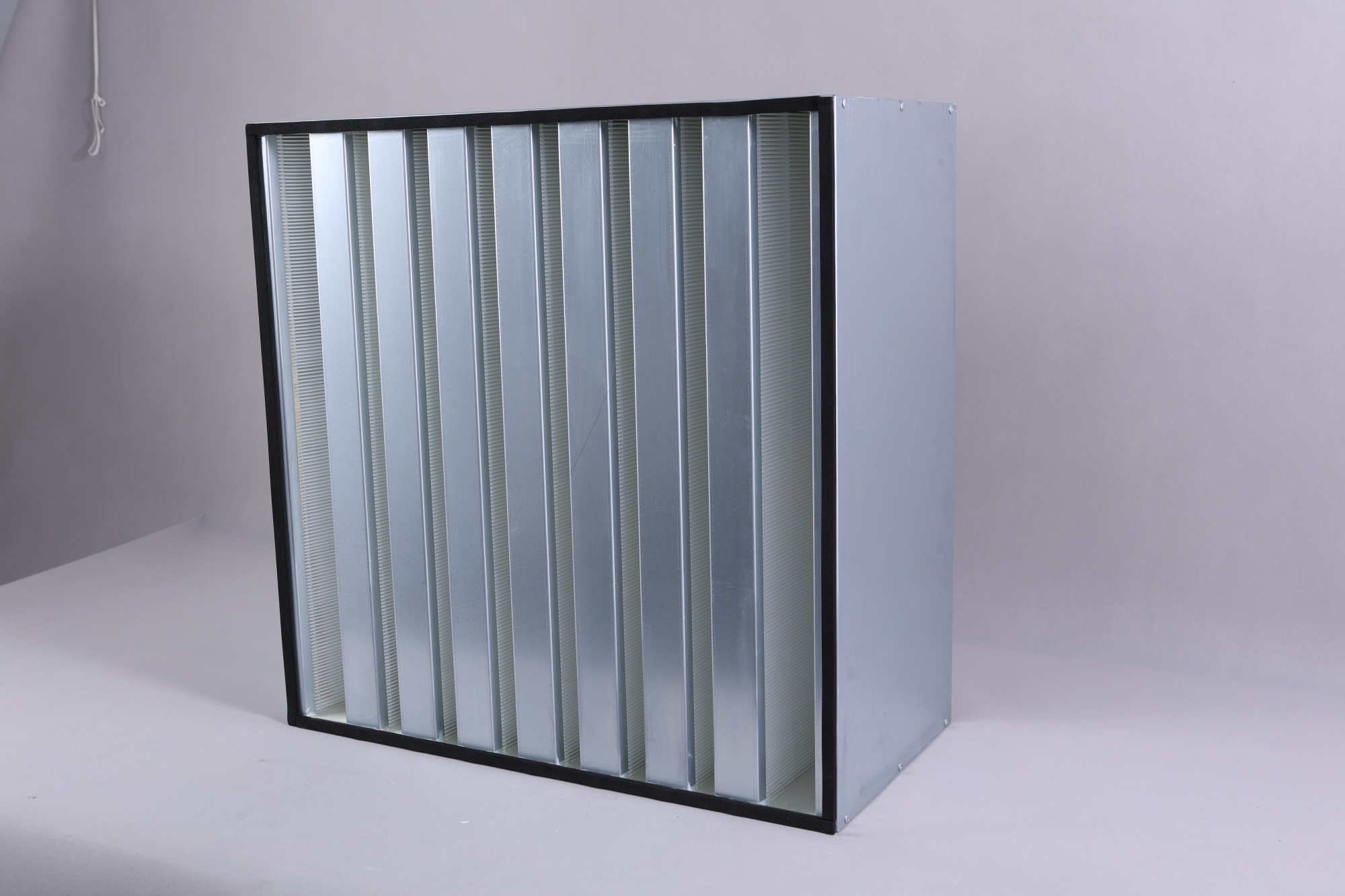
Cleanroom Air Filter – U14 and U15 grades, microfiberglass and PTFE media, for cleanroom applications such as data centers and microelectronics.
Where does H13 sit in aircraft cabin ventilation?
The B737/B757 Electronic Cabin Air Filter is rated H13 with microfiberglass media and is documented for Boeing B737/B757 filter replacement work, operating under aircraft working conditions and matched to the fresh air system of the cabin. The scenario requires customized dimensions, and the documented application market for this project type is China. Aircraft cabin filtration is a useful reminder that an efficiency class travels across industries but the qualification route does not: a filter qualified for a building HVAC duct is not automatically qualified for a cabin air system.
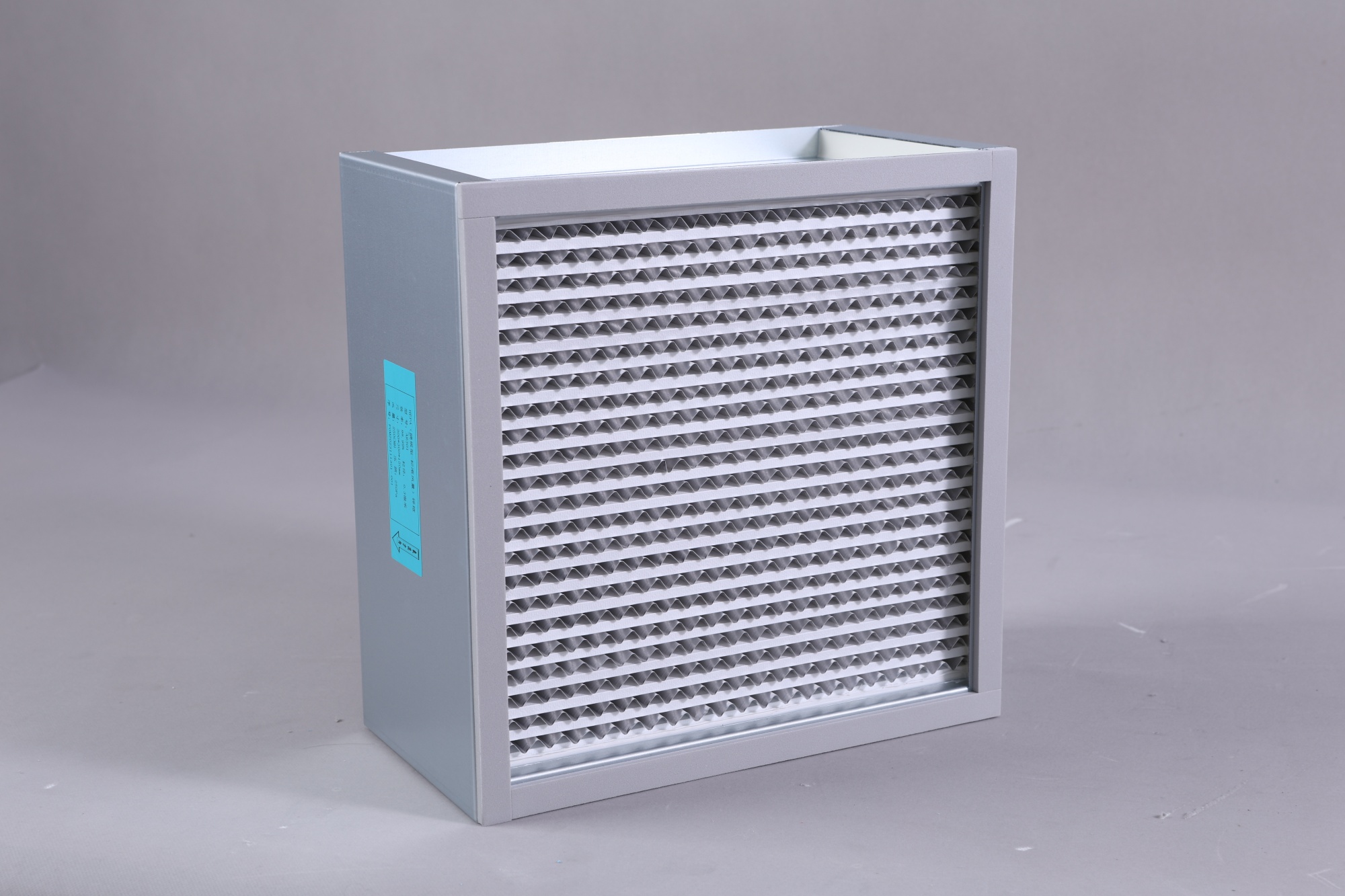
B737/B757 Electronic Cabin Air Filter – H13 grade, microfiberglass media, for aircraft cabin fresh air systems with customized dimensions.
Step-by-Step: Matching a Grade to a Project
The following sequence keeps a filter specification traceable from design intent to purchase order. It works for a single air handling unit and for a multi-building programme.
Step 1 — Fix the governing standard before the grade. Write “MERV 13 to ASHRAE 52.2” or “H13 to EN 1822” rather than “MERV 13” or “H13” alone. If a legacy F-grade must stay in the document, state whether acceptance follows the historical EN 779 reference or a current ISO 16890 class.
Step 2 — Draw the filter chain, not the filter list. Assign each stage a role: coarse protection, intermediate duty, final stage, terminal stage. A typical building chain in this range steps from Panel Filter G1–G4, to Bag Filter F5–F9, to Furnace Air Filter MERV 8/11/13, with V-Bank Filter H13 as the high-efficiency final option. Hospital and pharmaceutical chains shift the last stage to Box Filter MERV 15/16, and cleanroom chains end at Cleanroom Air Filter U14/U15.
Step 3 — Match media and construction to the class. The grade and the media are a pair. In this range, polypropylene appears on the Furnace Air Filter, fiberglass and polypropylene on the Panel Filter and V-Bank Filter, microfine fiberglass on the Bag Filter, microfiberglass on the Box Filter and the aircraft cabin filter, and microfiberglass with PTFE on the Cleanroom Air Filter. A quotation that changes the media while keeping the grade label is a different product.
Step 4 — Confirm dimensions and housing constraints. Customized dimensions appear as a special requirement across the documented scenarios in this range, including pharmaceutical plant projects, cleanroom design projects, hospital and HVAC system projects, food and beverage workshops, and the aircraft cabin replacement case. Dimensions belong in the enquiry from the first message, not at sample stage.
Step 5 — Validate the class against test evidence and a physical sample. Ask which test system produced the data and request the sample that matches the production intent. Henkaes operates efficiency and air resistance test systems for filter media, a noise test lab, a 30 cubic meter test room for formaldehyde and VOC removal efficiency, and a CADR test room for air purifiers, and uses ASHRAE 52.2 in testing air filters.
Step 6 — Lock the commercial terms that protect the schedule. For a customized order the stated minimum order quantity is 500 PCS, the standard lead time is 30 days, and monthly capacity is 200,000 PCS against an annual output of 2,000,000 pcs.
Use Cases: Where Each Class Belongs
Commercial and public buildings. Airports, hotels, museums and restaurants are the documented application for the Panel Filter G1–G4, the Bag Filter F5–F9, the Furnace Air Filter MERV 8/11/13 and the V-Bank Filter H13. The chain logic is straightforward: coarse protection first, graded intermediate stages in the middle, and a high-efficiency final stage where the space or the system demands it.
Hospitals and pharmaceutical plants. The Box Filter at MERV 15/16 with microfiberglass media is the specified product for pharmaceutical plants, hospitals and food and beverage production sites. Pharmaceutical plant building projects in this range are documented for the United States and the Netherlands, operate in automatic mode under normal indoor environment conditions, and capture dust and fine particles with customized dimensions as a special requirement.
Food and beverage plants. Workshop renovation projects in food and beverage plants use the same MERV 15/16 box filter logic, under normal indoor environment conditions, with customized dimensions.
Cleanrooms: data centers and microelectronics. Cleanroom design projects use the Cleanroom Air Filter at U14/U15 with microfiberglass and PTFE media, operating automatically to capture dust and fine particles under normal indoor environment conditions. This is the only band in the range positioned for cleanroom process environments.
Aerospace and aviation. B737/B757 cabin filter replacement uses the H13 Electronic Cabin Air Filter with microfiberglass media and customized dimensions, matched to the fresh air system.
Household air purifiers and cleaners. The HEPA Air Filter at H13 and the True HEPA Air Filter at ≥99.97% serve air purifier and air cleaner applications under normal indoor environment conditions, capturing dust, fine particles and pollen. Where gas-phase removal is also required, the Activated Carbon Filter is offered in CTC70, CTC80, CTC90 and CTC100 grades, and the VOC Air Filter uses activated carbon with a special catalyst for specific VOC removal.
Comparison Table: Efficiency Classes in the Henkaes Range
| Product | Efficiency class | Media | Documented application | Typical position in the filter chain |
|---|---|---|---|---|
| Panel Filter | G1–G4 | Fiberglass, polypropylene | Commercial and public buildings: airports, hotels, museums, restaurants | Coarse first stage |
| Bag Filter | F5, F6, F8, F9 | Microfine fiberglass | Commercial and public buildings: airports, hotels, museums, restaurants | Intermediate stage |
| Furnace Air Filter | MERV 8, MERV 11, MERV 13 | Polypropylene | Commercial and public buildings: airports, hotels, museums, restaurants | Graded general ventilation stage |
| Box Filter | MERV 15, MERV 16 | Microfiberglass | Pharmaceutical plants, hospitals, food and beverage production sites | High-load stage before HEPA/ULPA |
| V-Bank Filter | H13 | Fiberglass, polypropylene | Commercial and public buildings: airports, hotels, museums, restaurants | High-efficiency HVAC final stage |
| HEPA Air Filter | H13 | Fiberglass, polypropylene | Household appliances: air purifiers, air cleaners | Final stage in purifier or cleaner |
| True HEPA Air Filter | ≥99.97% | Fiberglass, polypropylene | Household appliances: air purifiers, air cleaners | Final stage in purifier or cleaner |
| Cleanroom Air Filter | U14, U15 | Microfiberglass, PTFE | Cleanrooms: data centers, microelectronics | Terminal cleanroom stage |
| B737/B757 Electronic Cabin Air Filter | H13 | Microfiberglass | Aerospace and aviation cabin air systems | Terminal cabin air stage |
FAQ: Air Filter Efficiency Classes in Project Procurement
Which standard should be written into the specification — MERV, an F-grade, or an EN 1822 class?
Name the standard and the class together, plus the test method. ASHRAE Standard 52.2 classifies general ventilation filters with MERV ratings from 1 to 16, and MERV is based on performance efficiency calculated from synthetic-dust loading tests. EN 1822 is the European framework used to classify EPA, HEPA and ULPA filters by filtration efficiency and zero leakage. F-grades belong to the EN 779 family, which has been replaced in Europe by ISO 16890 since mid-2018. A line such as “MERV 13 to ASHRAE 52.2” or “H13 to EN 1822” removes the ambiguity that otherwise resurfaces as a sample dispute.
Can one supplier cover G1–G4 through U14/U15 for a single project?
The Henkaes range runs from Panel Filter G1–G4, through Bag Filter F5/F6/F8/F9 and Furnace Air Filter MERV 8/11/13, to Box Filter MERV 15/16, V-Bank Filter H13, HEPA Air Filter H13, True HEPA Air Filter at ≥99.97%, Cleanroom Air Filter U14/U15 and the B737/B757 Electronic Cabin Air Filter H13. Production support includes OEM and ODM cooperation with size and logo customization, monthly capacity of 200,000 PCS and 100% inspection. Nantong Henka Environment Solutions Co., Ltd (Henkaes) was founded in 2004, operates a 30,000 m² facility with 63 employees and 11 engineers, and exports 69% of output to the EU and US.
What drives the commercial difference between a MERV 11 filter and an F9 or H13 filter?
Media and construction drive the difference more than the class label itself, because each step up the ladder changes the material and the production control required. In this range, the Furnace Air Filter at MERV 8/11/13 uses polypropylene media, the Bag Filter at F5–F9 uses microfine fiberglass, the Box Filter at MERV 15/16 uses microfiberglass, and the Cleanroom Air Filter at U14/U15 uses microfiberglass and PTFE. A grade label on its own is not a price list. For customized orders the stated minimum order quantity is 500 PCS and the standard lead time is 30 days, so the commercially efficient approach is to fix the class, media and dimensions in one enquiry rather than comparing quotations built on three different assumptions.
How can a buyer validate a custom-dimension efficiency class before mass production?
Validate through a physical sample backed by test evidence. Henkaes provides design, sample making, production and testing as part of its air purification solutions, and operates efficiency and air resistance test systems for filter media, a noise test lab, a 30 cubic meter test room for formaldehyde and VOC removal efficiency, and a CADR test room for air purifiers, with ASHRAE 52.2 used in filter testing. Documented ODM and OEM projects illustrate the validation pattern: a 50,000 PCS ODM programme for formaldehyde removal in the US reported two years of stable performance, a 50,000 PCS ODM programme for VOC removal reported one year stable, and a 20,000 PCS OEM programme reported one year stable with high efficiency.
What lead time and capacity should the project plan assume?
Plan around a 30-day standard lead time and a monthly capacity of 200,000 PCS, against annual output of 2,000,000 pcs. Customized orders start at an MOQ of 500 PCS, and quality control is stated as 100% inspection. Because 69% of output is exported to the EU and US markets, mixed-class orders should be scheduled with the full filter chain visible in one enquiry rather than released stage by stage. To move from class selection to a confirmed specification, request a sample and a quotation with the required grades, media and dimensions, and download the Air Filter E-Catalogue for the full product list.
Conclusion: A Class Is a Decision, Not a Label
The class ladder in this range is coherent once it is read as a sequence of decisions. G1–G4 protects the system, F5–F9 and MERV 8/11/13 grade the working stages of general ventilation, MERV 15/16 raises the ceiling for hospital, pharmaceutical and food production environments, H13 delivers high efficiency in building HVAC, purifier and aircraft cabin formats, and U14/U15 defines the terminal stage for cleanroom processes such as data centers and microelectronics.
For a smart manufacturing project, the reliable method is to name the standard alongside the class, draw the chain before choosing a grade, keep media and construction attached to the grade, and validate with test evidence and a sample before committing volume. Henkaes, operated by Nantong Henka Environment Solutions Co., Ltd, has manufactured air filters since 2004 from a 30,000 m² facility in Haimen, Jiangsu, holds ISO 14001:2015, ISO 9001:2015 and ISO 45101:2018 certifications, and supplies HEPA, HVAC, cleanroom and cabin air filters as well as OEM and ODM programmes for air purifier and air cleaner brands.
Next Step: Confirm the Class for Your Project
Send the required efficiency classes, media preference and dimensions, and the Henkaes team will respond with a sample proposal and a quotation against a 30-day standard lead time and a 500 PCS customized MOQ.
Website: www.airfilterodm.com | Email: peter@airfilter-china.com | Tel: +86 138-1376-6750 | WhatsApp: +86 138-1376-6750
Product catalogue: Download the Air Filter E-Catalogue (PDF)

Henkaes air filter manufacturing facility, Nantong Henka Environment Solutions Co., Ltd, Haimen, Jiangsu — ISO 14001:2015, ISO 9001:2015 and ISO 45001:2018 certified.
Efficiency classes referenced in this article follow ASHRAE 52.2 (MERV), EN 779 / ISO 16890 (general ventilation grade context) and EN 1822 (EPA, HEPA and ULPA classification). Product grades and applications are stated as documented in the Henkaes product and application data.
Have Questions or Need More Details?
Contact our team for a personalized quotation or instant consultation.
Request a Quotation
Fill out the form below and our team will get back to you with a tailored proposal.
WhatsApp Direct Chat
Prefer to chat in real-time? Message us on WhatsApp for instant assistance & quick answers.
- Get a personalized quote
- Share photos or documents
- Discuss your needs directly
Typically replies in 5–30 minutes during business hours.