
Cleanroom Air Filter Selection for Microelectronics & Data Centers
Cleanroom Air Filter Selection for Microelectronics & Data Centers
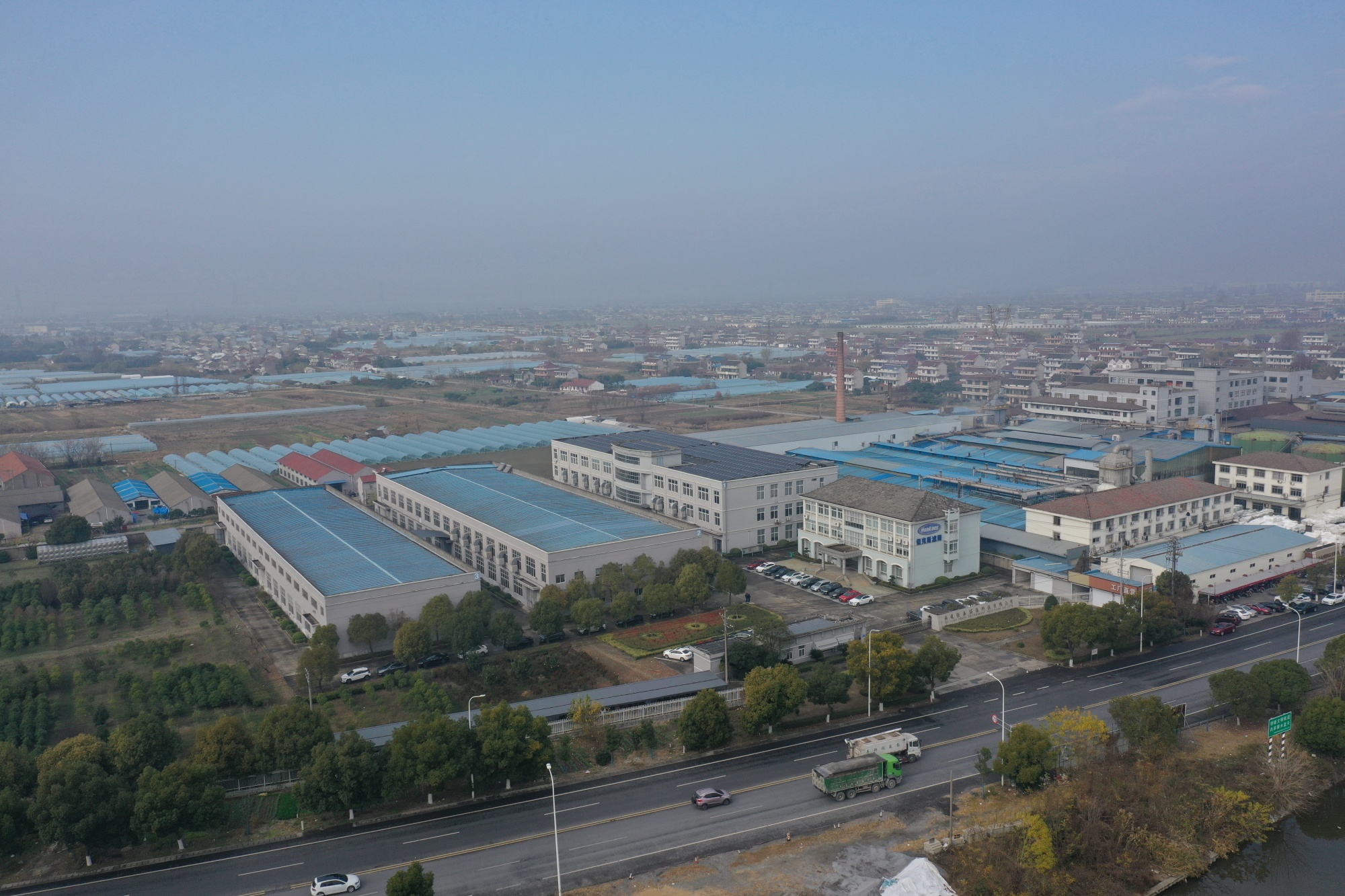
Cleanroom-grade filter production at Nantong Henka Environment Solutions Co., Ltd. (Henkaes).
Cleanroom air filter selection for microelectronics and data centers turns on three decisions: the efficiency grade the process actually needs, the medium that can hold that grade in continuous operation, and whether the supplier can repeat the same specification shipment after shipment. In most cleanroom final-stage applications, the workable answer is a filter rated U14/U15 and built with microfiberglass or PTFE media — the configuration Henkaes supplies as its Cleanroom Air Filter.
This guide is written for engineers, facility managers and procurement teams that have already shortlisted filter types and are now evaluating or executing a purchase. It explains what U14/U15 means within the EN 1822 framework, how the microfiberglass and PTFE options should be treated during specification, the eight steps of a defensible selection process, and the evidence a supplier should be able to produce before a purchase order is released.
Problem Definition: Why Standard HVAC Filters Stop Short
Microelectronics production and data centers share one filtration characteristic that ordinary HVAC filters are not engineered to handle: the filter sits at the end of the air path, and the cost of contamination is measured in yield or uptime rather than in occupant comfort. Semiconductor and microelectronics spaces are widely recognized as among the most particle-sensitive production environments in manufacturing, while data halls move high air volumes continuously with heat loads that never switch off.
Four practical problems follow from that.
Grade selection drifts upward. Once the filter becomes the last barrier between the air handling unit and the critical space, the specification moves into the ULPA band. Henkaes rates its Cleanroom Air Filter at efficiency grade U14/U15, above the H13 filters it builds for household HEPA units, V-Bank HVAC units and aircraft cabins.
Media becomes a real decision. The Cleanroom Air Filter is offered with microfiberglass or PTFE media. These are not interchangeable defaults; the medium has to be named in the specification and confirmed before production.
Standards get mixed up. Buyers frequently carry MERV figures from an HVAC schedule straight into a cleanroom final-stage specification. The two frameworks measure different things and cannot be substituted for one another.
Continuity is under-planned. A cleanroom filter that is correct in the first delivery but different in the fourth is a supply risk. Capacity, inspection practice and lead time belong in the evaluation, not in the post-order conversation.
Industry Background: The Demand Behind U14/U15 Filtration
The global air filters market was valued at USD 17.08 billion in 2025 and is projected to reach USD 34.66 billion by 2034, according to Fortune Business Insights. The high-efficiency end of that market is tied to semiconductor fabrication, pharmaceutical production and mission-critical IT infrastructure — environments where air quality is an operating parameter rather than a comfort target.
Grade language in this segment comes mainly from two standards, and confusing them is one of the most common specification errors.
| Standard | What it classifies | Basis of classification |
|---|---|---|
| EN 1822 | HEPA and ULPA filters | Efficiency at the Most Penetrating Particle Size (MPPS); within this framework H14 requires 99.995% efficiency. |
| ASHRAE 52.2 | HVAC filters | Ability to capture particles between 0.3 and 10 micrometers, expressed as MERV 1–16. |
The practical reading for a project is straightforward. EN 1822 governs the final-stage filter in a microelectronics cleanroom or a data hall; MERV ratings describe the upstream HVAC stages that protect it. A specification that says "MERV 15 or equivalent cleanroom grade" without naming an EN 1822 class invites a filter that passes the wrong test.
The second background factor is media supply. ULPA-grade filters are built from fine media under tight process control, and how consistently that medium is pleated, sealed and inspected determines how the finished filter behaves in service. Cleanroom buyers therefore tend to evaluate a manufacturing base, not a catalogue code.
The Cleanroom Air Filter: U14/U15 Efficiency with Microfiberglass or PTFE Media
Efficiency grade: U14/U15
Henkaes specifies its Cleanroom Air Filter at efficiency grade U14/U15 and lists the applicable industry as cleanroom environments, including data centers and microelectronics. Within the current range, this is the highest filtration grade offered, sitting above the H13 items and well above the HVAC models rated MERV 8–16 or F5–F9. In a selection process, U14/U15 is the grade to consider when the filter is the final barrier between the air handling unit and the production or equipment space.
Media: microfiberglass and PTFE
Two media are specified for this model: microfiberglass and PTFE. Microfiberglass also appears in two other high-grade Henkaes products — the Box Filter (MERV 15 and MERV 16, used in pharmaceutical plants, hospitals and food and beverage production sites) and the B737/B757 Electronic Cabin Air Filter (H13, aerospace and aviation). Within the current range, PTFE is specified for the Cleanroom Air Filter.
Which medium a project should order cannot be decided from the grade alone. It depends on the conditions the filter will operate under and on the qualification protocol the buyer has to satisfy, so the medium should be stated in the RFQ, checked against the engineering sample, and locked before mass production.
Manufacturing, testing and certification behind the specification
Nantong Henka Environment Solutions Co., Ltd. (Henkaes) has manufactured air filters since 2004 at a 30,000 m² facility in Haimen District, Nantong City, Jiangsu Province, China, roughly 120 km from Shanghai. The company employs 63 people, including a research and development team of 11 engineers, produces 2,000,000 pcs annually, and exports 69% of its output, mainly to the EU and USA.
Its quality system is certified to ISO9001:2015 (certificate 04523Q30502R4M) and ISO14001:2015 (certificate 04523E30387R2M), both issued by Beijing Dalu Hangxing Quality Certification Center Co., Ltd., with scope covering the design and production of air filter, air purifier and fresh air machine.
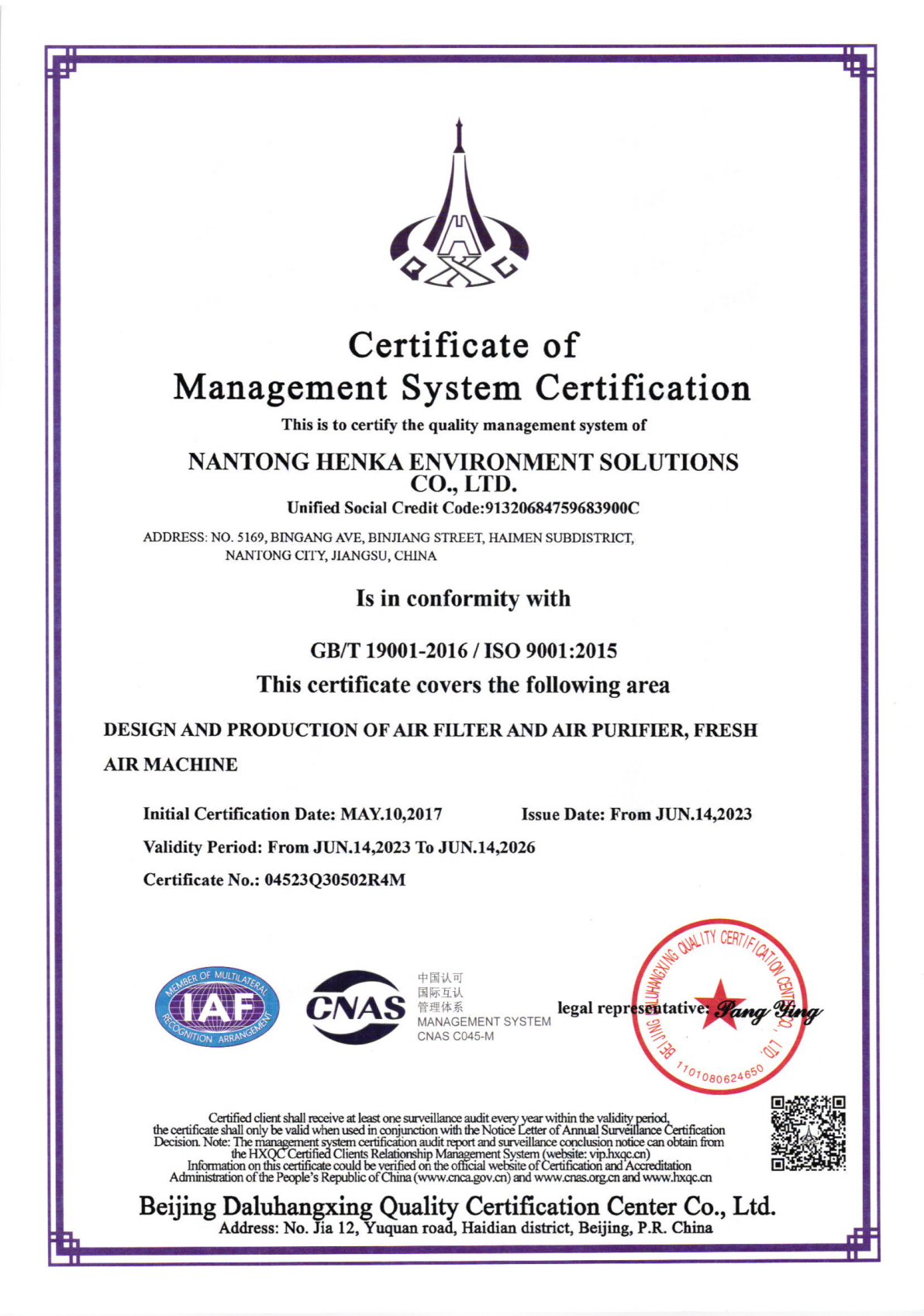
ISO9001:2015 and ISO14001:2015 certification covering filter design and production.
Test equipment relevant to a cleanroom qualification includes an efficiency and air resistance test system for filter media, a noise test lab, a 30-cubic-meter test room for formaldehyde and VOC removal efficiency, and a CADR test room for air purifiers. ASHRAE 52.2 is the standard used in testing air filters.
On the engineering side, the company works with more than 20 years of experience alongside a US engineering team and can design from customer specifications, drawings, samples or concepts. Complete engineering design services are offered, covering filter design, engineering sample production, production and testing, solid modeling and rapid prototyping.
Step-by-Step: Selecting a Cleanroom Air Filter for a Fab or Data Hall
Step 1 — Locate the filter stage before choosing a grade. Identify which positions in the air path are served by upstream HVAC filters and which position is the final barrier. Only the final-barrier position should be evaluated against the U14/U15 cleanroom specification; upstream stages are handled by HVAC models such as the Bag Filter (F5, F6, F8, F9) or the Panel Filter (G1–G4).
Step 2 — Write the specification in EN 1822 language. State the efficiency grade as U14/U15 and name the medium explicitly. This removes the ambiguity that appears when a MERV figure is carried over from an HVAC schedule into a cleanroom schedule.
Step 3 — Resolve the media decision early. Choose between microfiberglass and PTFE with the supplier on the table, based on the operating conditions and the buyer's own qualification protocol. Changing media after the sample stage invalidates the validation work.
Step 4 — Fix the dimensional and customization scope. Henkaes provides OEM and ODM production services globally, with size and logo customization. Dimensions and mounting interfaces should be agreed before tooling or pleating specifications are issued.
Step 5 — Define the acceptance test. The purchasing terms specify pre-shipment test as the acceptance criterion, and 100% inspection is performed on all products. Agree which internal test system applies — for example the filter media efficiency and air resistance test system — and record it in the purchase order.
Step 6 — Validate with an engineering sample. Engineering sample production is part of the supplier's design service. Treat the sample as the reference standard for the whole order: once it is approved, the approved sample governs production.
Step 7 — Lock commercial terms and capacity. Henkaes quotes a MOQ of 500 PCS, delivery terms of FOB/EXW/DDP, payment terms of TT 50%/50%, and a lead time of 30 days. Monthly capacity is 200,000 pcs, which is the number to check against the project's replacement cycle, not only against the first order.
Step 8 — Plan the replacement path. After-sales support is provided remotely. For cleanroom and data hall operation, replacement intervals should be driven by the buyer's own monitoring of the installed filters, with the supplier's lead time factored into the reorder point.
Use Cases: Where This Configuration Belongs
Microelectronics cleanroom final stage. The Cleanroom Air Filter is specified for cleanroom environments including microelectronics. It is the appropriate choice where wafer, package or assembly processes require the highest filtration grade in the range and where the filter is the last component before air enters the critical space.
Data center air handling. Data centers are listed among the cleanroom environments this model serves. The selection logic differs from a fab in emphasis rather than in grade: the filter has to hold U14/U15 performance across continuous high-volume airflow, which makes media consistency and repeatable pleating quality the deciding evaluation criteria.
Adjacent environments where a different model fits better. Over-specifying every filter in a building is a common and avoidable cost. The Box Filter (MERV 15 and MERV 16) is designed for pharmaceutical plants, hospitals and food and beverage production sites; the V-Bank Filter (H13) and Bag Filter (F5–F9) serve commercial and public buildings such as airports, hotels, museums and restaurants. Matching grade to environment is part of the selection decision.
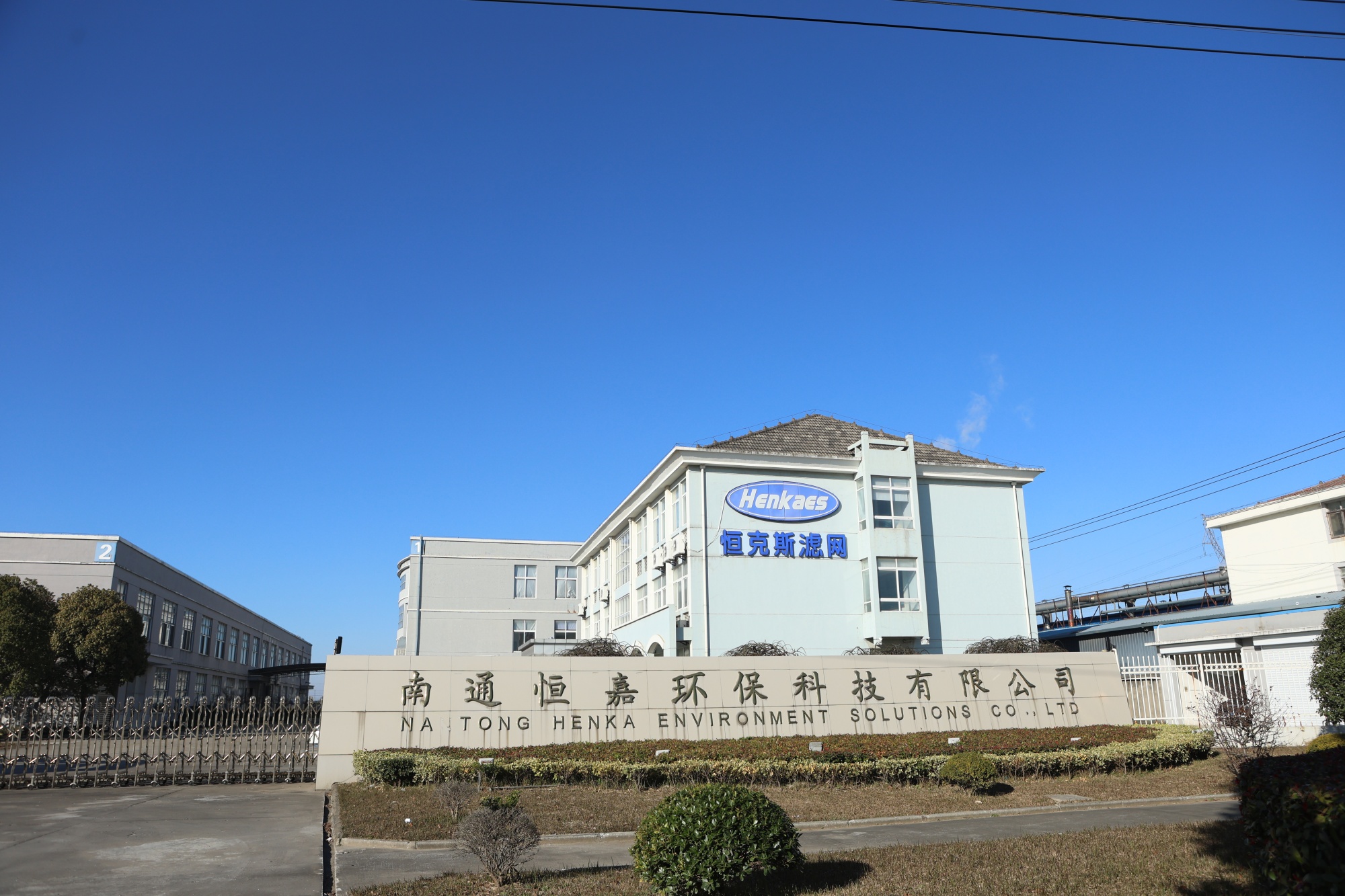
Henkaes supplies cleanroom and HVAC air filters under OEM and ODM programmes.
Volume and multi-year stability evidence. Three reference projects in the United States document how the manufacturer performs at production scale: a 20,000 pcs air filter supply project for an OEM client for indoor air purification, completed within one year with one year of stable operation and high efficiency; a 50,000 pcs project for an ODM client for indoor air purification, with a one-year implementation period and one year of stable operation, including good performance in removing volatile organic compounds; and a 50,000 pcs air filter project for an ODM client for formaldehyde removal, with a two-year duration and stable performance over two years.
These are indoor air purification programmes rather than cleanroom installations, but they answer the execution-stage question cleanroom buyers ask most often: can the supplier hold a specification across tens of thousands of pieces and across multiple years? The same quality system — 100% inspection, pre-shipment test, and documented media testing — applies to cleanroom orders.
Comparison Table: Where the Cleanroom Air Filter Sits in the Range
The following table positions the cleanroom model against the other filter types Henkaes produces. It is a positioning aid, not a ranking: grades taken from different standards are not interchangeable, and the correct model is the one that matches the environment.
| Filter model | Efficiency grade | Media | Intended environment |
|---|---|---|---|
| Cleanroom Air Filter | U14/U15 | Microfiberglass, PTFE | Cleanroom environments, including data centers and microelectronics |
| Box Filter | MERV 15, MERV 16 | Microfiberglass | Pharmaceutical plants, hospitals, food and beverage production sites |
| V-Bank Filter | H13 | Fiberglass, Polypropylene (PP) | Commercial and public buildings: airports, hotels, museums, restaurants |
| Bag Filter | F5, F6, F8, F9 | Microfine fiberglass | Commercial and public buildings |
| Panel Filter | G1–G4 | Fiberglass, Polypropylene (PP) | Commercial and public buildings |
| Furnace Air Filter | MERV 8, MERV 11, MERV 13 | Polypropylene (PP) | Commercial and public buildings |
| B737/B757 Electronic Cabin Air Filter | H13 | Microfiberglass | Aerospace and aviation |
| HEPA Air Filter | H13 | Fiberglass, Polypropylene (PP) | Household appliances such as air purifiers and air cleaners |
| True HEPA Air Filter | ≥99.97% | Fiberglass, Polypropylene (PP) | Household appliances such as air purifiers and air cleaners |
FAQ
Which efficiency grade and standards apply to a cleanroom air filter for microelectronics and data centers?
Henkaes specifies its Cleanroom Air Filter at efficiency grade U14/U15, with the applicable industry listed as cleanroom environments including data centers and microelectronics. In the EN 1822 framework, HEPA and ULPA filters are classified by their efficiency at the Most Penetrating Particle Size (MPPS), and within that framework H14 requires 99.995% efficiency. ASHRAE 52.2 is a separate classification: it grades HVAC filters from MERV 1 to MERV 16 based on their ability to capture particles between 0.3 and 10 micrometers, and it governs upstream HVAC stages rather than the cleanroom final stage. On the manufacturing side, the supplier's quality system can be verified directly — Henkaes holds ISO9001:2015 (04523Q30502R4M) and ISO14001:2015 (04523E30387R2M), issued by Beijing Dalu Hangxing Quality Certification Center Co., Ltd. for the design and production of air filter, air purifier and fresh air machine.
Can the Cleanroom Air Filter be customized for a specific cleanroom layout or data hall?
Yes. The manufacturer provides OEM and ODM production services globally, and the customization services available include size and logo customization. Design work can start from customer specifications, drawings, samples or concepts, supported by a research and development team of 11 engineers and by complete engineering design services that cover filter design, engineering sample production, production and testing, solid modeling and rapid prototyping. Production capacity for planning purposes is 2,000,000 pcs annual output and 200,000 pcs monthly capacity, with 100% inspection performed on all products.
What drives the cost of a U14/U15 cleanroom air filter, and what are the purchasing terms?
Pricing is quoted against a defined specification rather than a catalogue code, so the cost drivers are the specification elements themselves: the efficiency grade, the selected medium (microfiberglass or PTFE), the degree of size customization, the order quantity, and the test and acceptance requirements attached to the order. The standard purchasing terms published by Henkaes are a MOQ of 500 PCS, delivery terms of FOB/EXW/DDP, acceptance criteria of pre-shipment test, and payment terms of TT 50%/50%. Because delivery term selection changes the landed cost structure, buyers should fix the Incoterm at the quotation stage.
How can a buyer validate a cleanroom filter before mass production?
Validation runs through three checkpoints. First, engineering samples: sample production is part of the supplier's engineering design services, so a project-specific sample can be produced and approved before volume manufacturing. Second, test evidence: the manufacturer maintains an efficiency and air resistance test system for filter media, a noise test lab, a 30-cubic-meter test room for formaldehyde and VOC removal efficiency, and a CADR test room for air purifiers, with ASHRAE 52.2 used in testing air filters. Third, production discipline: 100% inspection is performed on all products, and pre-shipment test is the stated acceptance criterion. Reference projects in the United States — including a 20,000 pcs OEM supply project and a 50,000 pcs ODM project, both with stable operation over one year, and a further 50,000 pcs project stable over two years — show how that discipline performs at volume.
What is the lead time and delivery setup for a cleanroom air filter order?
The stated lead time is 30 days, with a MOQ of 500 PCS and a monthly capacity of 200,000 pcs. Delivery terms available are FOB, EXW and DDP, acceptance is based on pre-shipment test, and payment terms are TT 50%/50%. After-sales support is provided remotely. Buyers running continuous cleanroom or data hall operations should set the reorder point against the 30-day lead time and confirm monthly capacity against their replacement schedule, not only against the launch order. To move from evaluation to execution, you can request a specification-matched quotation, a sample, or the full product catalogue at peter@airfilter-china.com or +86 138-1376-6750. The Henkaes air filter catalogue is available for download here: E-Catalogue for Air Filter.
Conclusion
Cleanroom air filter selection for microelectronics and data centers is decided by grade, media and supplier repeatability — not by price alone. The U14/U15 cleanroom specification sits at the top of the Henkaes range, is available with microfiberglass or PTFE media, and is listed for cleanroom environments that include data centers and microelectronics. Around that specification, the supporting facts that make a purchase order defensible are the certified quality system (ISO9001:2015 and ISO14001:2015), the in-house media efficiency and air resistance testing, the 100% inspection regime, the 30-day lead time, and the 200,000 pcs monthly capacity behind it.
For buyers evaluating or executing a cleanroom filter purchase, the working sequence is: fix the EN 1822 grade, resolve the media choice, define the acceptance test, approve an engineering sample, then lock commercial terms and a replenishment plan against real capacity. Nantong Henka Environment Solutions Co., Ltd. (Henkaes) publishes its full range and contact details at www.airfilterodm.com.
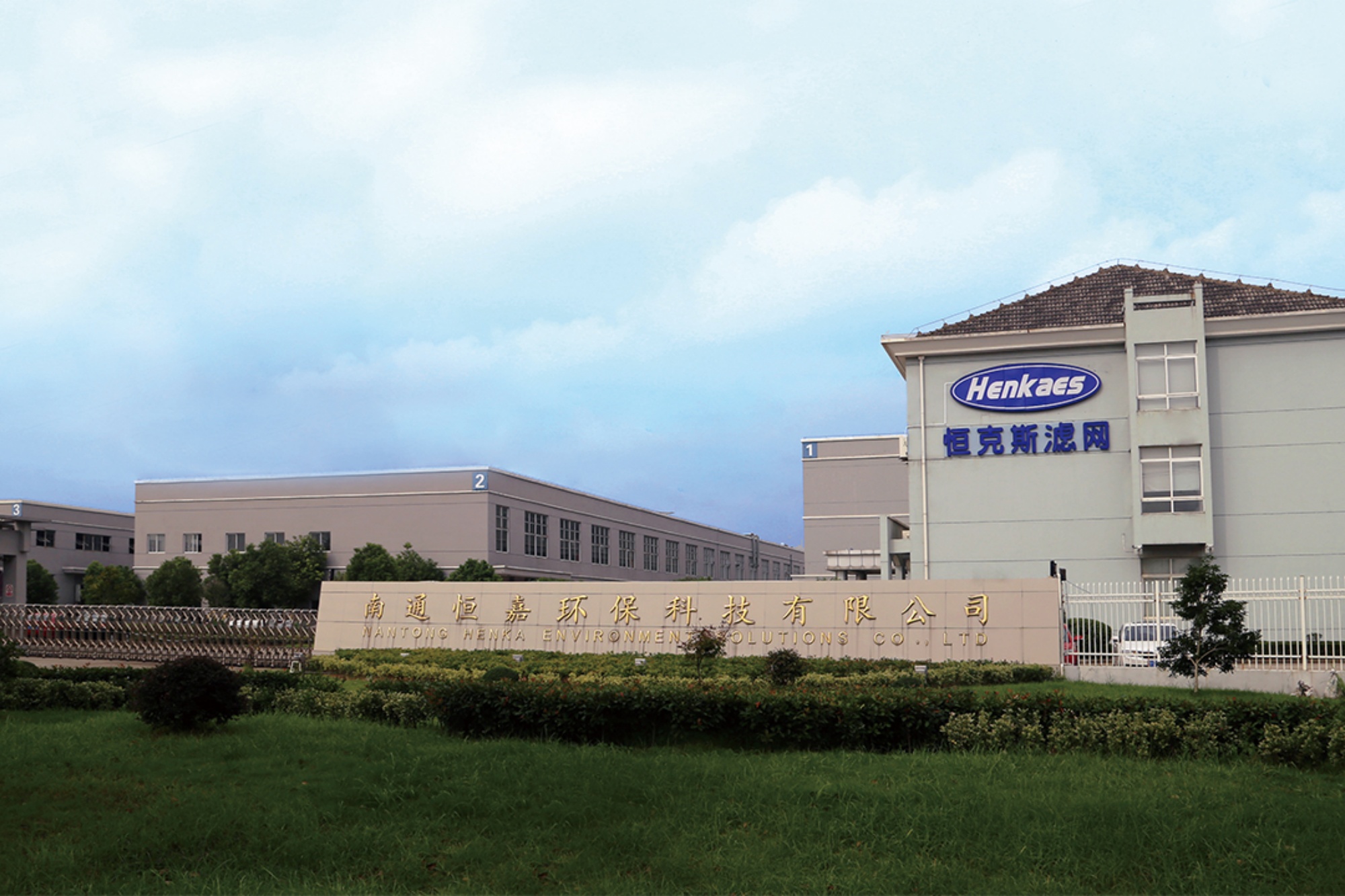
Next step: Request a U14/U15 cleanroom air filter sample or a specification-matched quotation. Contact Peter Zhou at peter@airfilter-china.com, call +86 138-1376-6750, or message on WhatsApp. Download the Air Filter E-Catalogue.