
PVC Wall Panel Compliance and Specification Guide for Importers and Specifiers
A PVC wall panel order is decided by three constraints that have nothing to do with how the panel looks in a catalogue photo: the profile standard the panel is certified against, the substance screening behind the material it is made from, and the documented commercial position — minimum order quantity, monthly capacity and lead time — of the factory behind the quotation.
Most sourcing problems on decorative wall panels appear after the sample has been approved, not before it. A sample confirms colour and groove depth. It does not confirm which models an attestation actually covers, whether a fire-related claim belongs to the same construction, or how many containers a factory can ship in a month.
This guide is written for importers, distributors, specifiers and procurement teams that have finished discovery and are now evaluating suppliers. It sets out the standards that apply to PVC and WPC wall panels in the European market, explains precisely what the third-party documentation held by Zhejiang Highsea New Material Co., Ltd. — trading as Hisea-Decorative Film & Decorative Panels — covers, and gives a six-step verification sequence that can be applied to any China-based wall panel manufacturer.
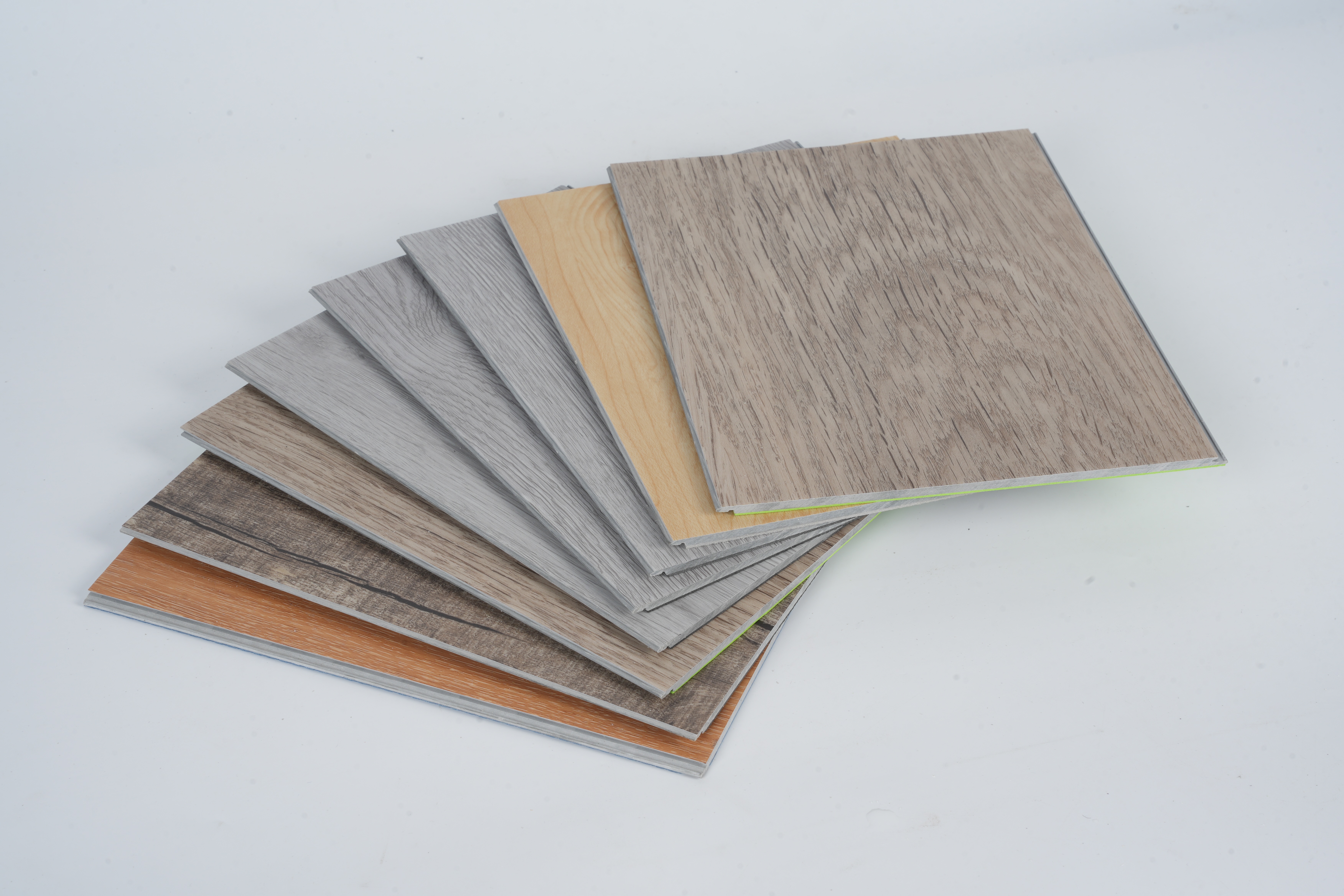
PVC wall panel, Hisea-Decorative Film & Decorative Panels — the panel family that carries the CE Technical Inspection Attestation of Conformity under EN 17104:2021.
Problem definition: why wall panel sourcing breaks down at the evaluation stage
Compliance documentation and commercial documentation fail in different ways, and both failures are avoidable. The panel itself is rarely the problem. The problem is the distance between a product claim and a product document.
Failure one: document scope mismatch. A test report issued for a decorative film is a valid and useful document for that film, but it is not a conformity attestation for the finished panel. When a supplier presents a film test report and a panel attestation side by side without labelling the difference, the buyer inherits the risk instead of reducing it. In the file held by Zhejiang Highsea New Material Co., Ltd., the SGS SVHC test report refers to PVC FILM (Style No.: HS71001), while the UDEM attestations refer to the PVC Panel and WPC Panel products. These are three different documents covering three different items.
Failure two: framework mismatch. Fire performance in decorative panels is tested and classified under different systems depending on the destination market. Commercial procurement guidance associates EN 13501-1 with Europe and the UK, ASTM E84 with the USA and Canada, and GB 8624 with China. These systems use different test methods, so their classifications are not interchangeable and should never be converted from one to another without a formal equivalence basis.
Failure three: specification drift between quote and drawing. A price quoted against one sheet thickness, a UV-coated face quoted as a plain face, or a fluted profile quoted as a flat panel. In Hisea’s range alone, WPC wall panels are produced at 160*22 mm, 160*24 mm, 150*10 mm, 150*15 mm and 195*12 mm, and PVC wall panels at 300*8 mm and 300*8.5 mm. A quotation that does not name the profile is not a quotation.
Failure four: commercial terms surfacing late. A lead time quoted for stock rather than for a made-to-order run, or an MOQ that appears for the first time on the proforma invoice. Both are decision-stage risks, which is why they belong in the evaluation checklist rather than in the negotiation.
Industry background: market context and the regulatory layer
Demand-side data explains why compliance has become a purchasing criterion rather than a formality. According to a Dataintelo market report published in 2026, the global PVC panels market was valued at USD 14.8 billion in 2025, with wall panels holding the largest product-type share at 42.5%. In the adjacent wood-plastic composite category, Grand View Research estimated the global market at USD 8.9 billion in 2025 and projected USD 21.5 billion by 2033, a CAGR of 11.7%.
Two consequences follow for buyers. First, volume is concentrated in wall panels, which means suppliers compete on specification rather than on availability: thickness, coating, profile depth and surface treatment are the differentiators. Second, the WPC segment is expanding faster than the PVC segment in forecast terms, so a supplier that covers both material families lets a buyer hedge a specification decision without changing vendor.
On the regulatory side, the European market applies a defined standard layer to PVC profiles for wall and ceiling finishes. EN 13245-2:2008, published by the European Committee for Standardization (CEN), specifies the health and safety requirements for unplasticized poly(vinyl chloride) PVC-U profiles and cellular PVC-UE profiles for interior and exterior wall and ceiling finishes. Separately, EN 17104:2021 is the standard cited in the Technical Inspection Attestations of Conformity held for PVC Panel and WPC Panel in the Hisea file. Fire classification, by contrast, is not a single European default: it depends on the testing framework the destination market or project specification uses.
Substance restrictions form a third layer. Regulation (EC) No 1907/2006 concerning REACH underpins SVHC screening in the EU market, and the Hisea PVC film (Style No.: HS71001) is covered by an SGS SVHC test report issued under that regulation.
Finally, customs classification is often underestimated at the evaluation stage. Commercial sources place rigid PVC wall and ceiling coverings primarily under HS heading 391810, while also identifying 391890, 392049, 392190, 392590 and 392690 as possible related headings depending on product construction and form. That classification is indicative rather than an official ruling, and it matters because landed-cost modelling built on the wrong heading is quietly wrong.
Detailed solution: what each panel family actually commits to
The practical way to evaluate a wall panel supplier is to separate the material commitment from the document commitment. The material commitment determines where the panel can be used; the document commitment determines where it can be sold.
PVC wall panel — the wet-area family
PVC wall panels are extruded from polyvinyl chloride and form a continuous non-porous surface that does not absorb water or hold odours. That single material property drives most of the specification logic: the panel is chosen for kitchens, bathrooms, washrooms and other wet service areas where a washable wall surface is the requirement and where a porous substrate would eventually fail. Standard sizes in the Hisea range are 300*8 mm and 300*8.5 mm.
The document commitment on this family is a CE Technical Inspection Attestation of Conformity issued by UDEM Uluslararasi Belgelendirme Denetim Egitim Merkezi San. ve Tic. A.S. The certificate number is M.2026.206.C145889, the applicable standard is EN 17104:2021, the issue date is 2026-08-10, the expiry date is 2031-08-09, and the certification applies to the EU market. The listed scope covers PVC Panel models including 300*8*2900MM and 1220*3000*3MM.
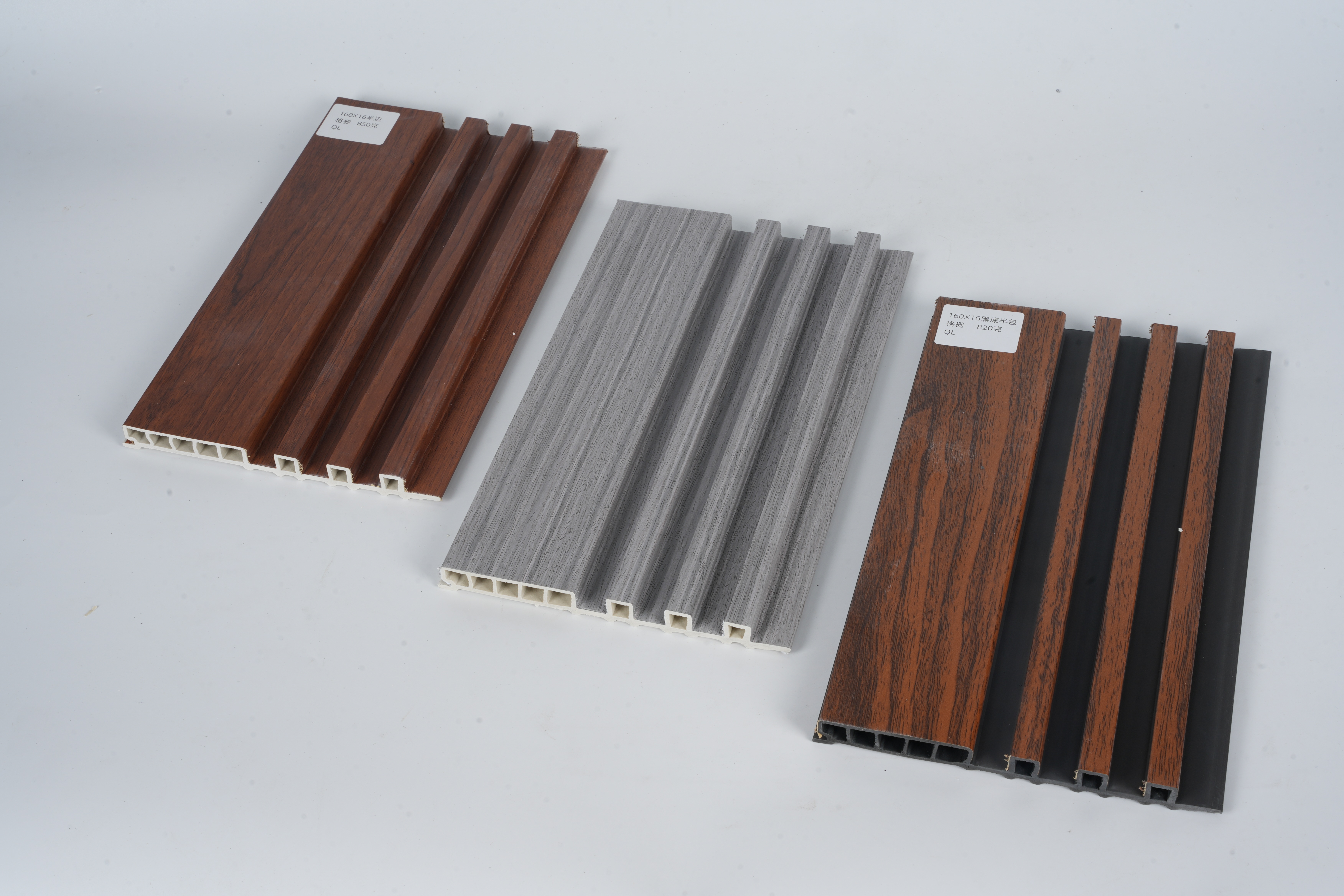
WPC wall panel with fluted profile — moisture and rot resistance, covered by UDEM attestation No. M.2026.06.C1.45891 under EN 17104:2021.
WPC wall panel — the indoor and outdoor family
WPC wall panels offer moisture and rot resistance because the wood fibre is blended with thermoplastic resin rather than left exposed. The practical consequence is that the same material family can be specified for interior feature walls, hotel corridors, retail fronts and covered outdoor walls, which reduces the number of different wall products a project has to stock. The range covers fluted, slatted and flat profile directions across wood grain and solid colour faces.
Stated standard sizes are 160*22 mm, 160*24 mm, 150*10 mm, 150*15 mm and 195*12 mm. The document commitment is a Technical Inspection Attestation of Conformity issued by UDEM under EN 17104:2021, certificate number M.2026.06.C1.45891, valid from 2026-08-07 to 2031-08-09, for the EU market, covering WPC Panel models including 160*24MM, 160*22MM, 150*10MM and 150*15MM.
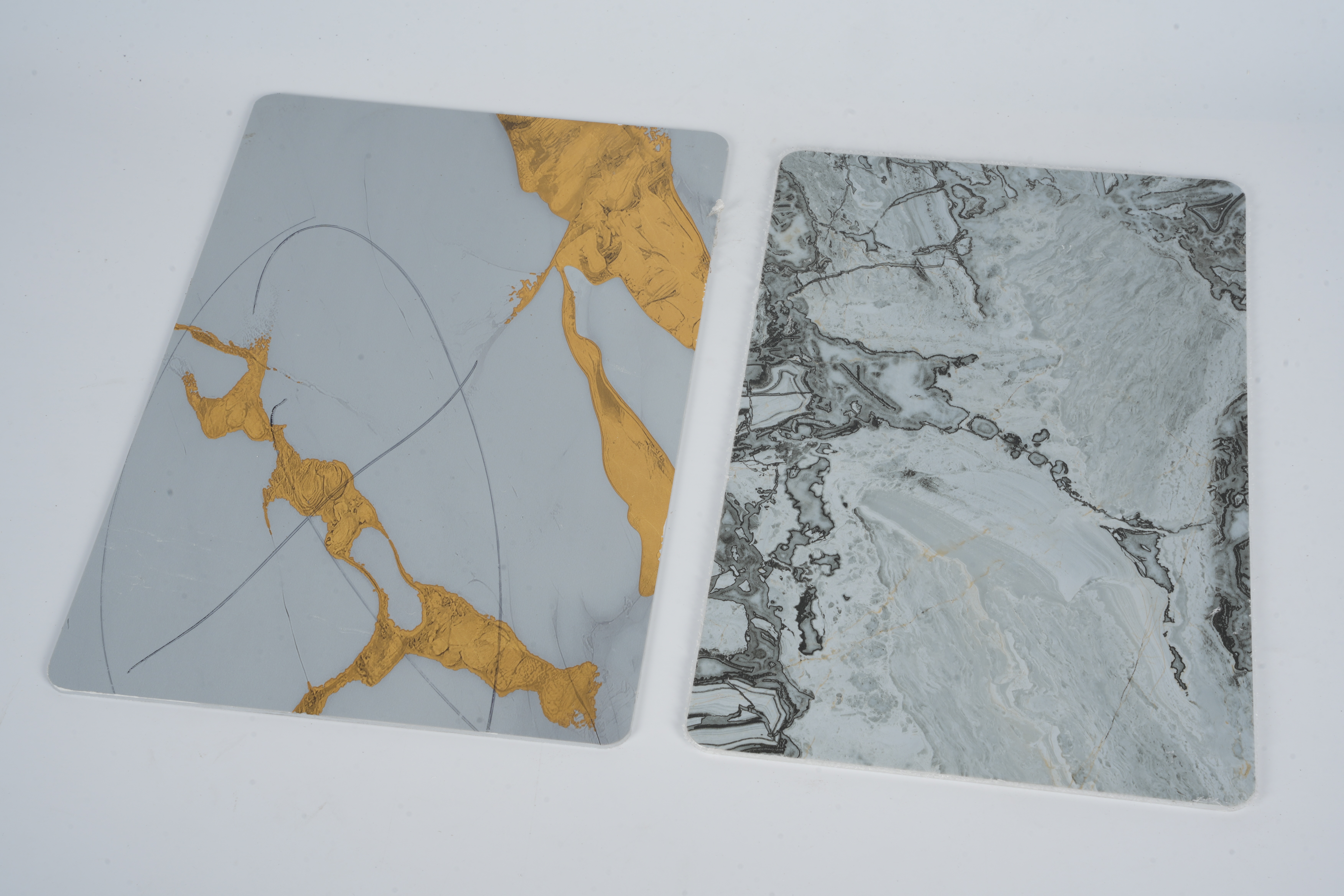
UV board — a UV cured coating that forms a dense sealed film, supplied at 1220*2440*2.5 mm and 1220*2440*3 mm.
UV board — the high-contact surface family
UV boards carry a UV cured coating that forms a dense sealed film over the base sheet. The practical meaning is durability against daily contact: the cured film takes water rings, grease spots and light scratches, which keeps printed marble and stone patterns readable on cabinet fronts, wardrobe faces and retail fixtures over long service. Sizes are 1220*2440*3 mm and 1220*2440*2.5 mm.
Bamboo charcoal board — the large-format decorative family
Bamboo charcoal boards are supplied at 1220*2440*5 mm and 1220*2440*8 mm for interior decorative use where a large-format panel reduces joint count on a wall run.
The substance layer: SGS SVHC screening and what it actually covers
The substance file is where precision pays. The PVC FILM (Style No.: HS71001) supplied by ZHEJIANG HIGHSEA NEW MATERIAL CO., LTD. is covered by an SVHC test report issued by SGS under Regulation (EC) No 1907/2006 concerning REACH. The certification number is SHAHL26023493001, the report was issued on 2026-08-10, and it applies to the EU market. The screening covers 253 substances in the Candidate List and 1 potential SVHC in the submitted PVC FILM sample, with results of ≤ 0.1% (w/w) for 253 Candidate List substances and 1 potential SVHC in the submitted sample.
Read the scope before you file it. The SVHC report applies to the PVC film used as a decorative surface layer, not to a finished wall panel. Filing it as a panel certificate creates a compliance gap that surfaces later, usually at customs or at a project handover.
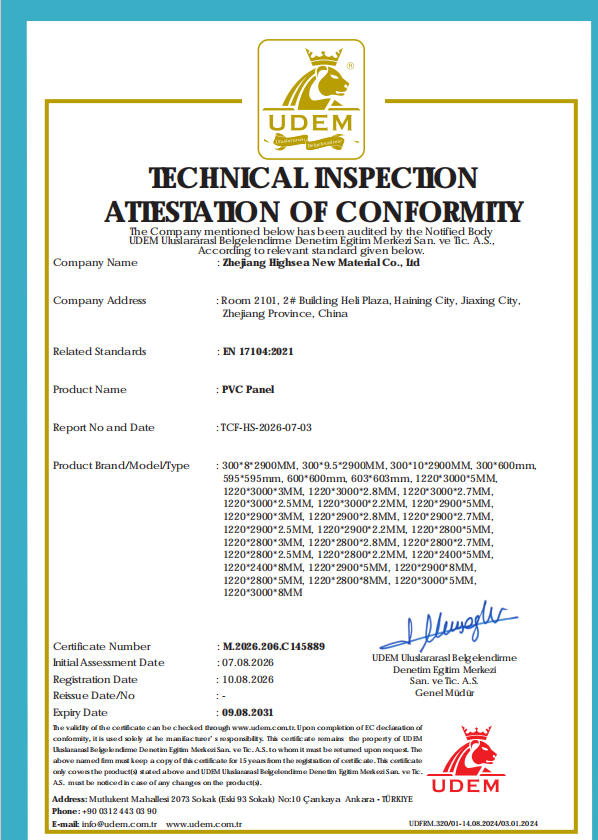
CE Technical Inspection Attestation of Conformity for PVC Panel, certificate No. M.2026.206.C145889, EN 17104:2021, issued 2026-08-10, expiring 2031-08-09.
Step-by-step: a six-step verification sequence for evaluation-stage buyers
- Step 1 — Fix the destination market before reading any document. A certificate valid for one market is not evidence for another. The EU route runs through the profile standard layer and REACH substance screening; fire classification follows the framework your market or project uses.
- Step 2 — Match the document to the exact model, thickness and construction. An attestation that lists models is only useful if your model is in the list. Confirm the model number, then confirm the profile and surface finish match the drawing.
- Step 3 — Check issue and expiry dates, and record them. The Hisea PVC Panel attestation runs from 2026-08-10 to 2031-08-09, and the WPC Panel attestation is valid from 2026-08-07 to 2031-08-09. An expired or soon-to-expire document should be a re-quote trigger, not a footnote.
- Step 4 — Build the substance file separately from the product file. Keep the film-level SVHC report apart from the panel-level attestation. For humid indoor and outdoor decorative projects, low formaldehyde and easy-clean requirements should be written into the specification rather than assumed.
- Step 5 — Convert the commercial position into a delivery plan. Confirm MOQ, capacity and lead time against your own programme. Hisea’s stated position is an MOQ of 300 pieces, a lead time of 20–30 days, a monthly capacity of 20 × 40ft high-cube containers, and OEM support for customized patterns, packaging, colours and sizes.
- Step 6 — Verify quality control and after-sales before loading. Quality control runs across three stages: incoming raw materials inspected batch by batch for formulation and process consistency; in-process control points monitoring thickness, density, colour difference, surface flatness and texture consistency; and outgoing inspection of every batch before loading is arranged. After-sales support is provided remotely.
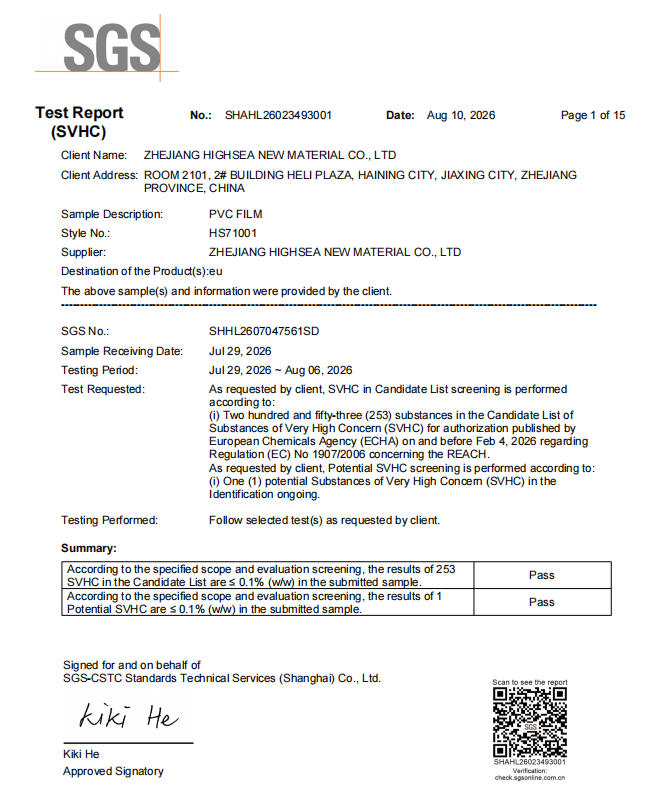
SGS SVHC test report No. SHAHL26023493001, issued 2026-08-10 under Regulation (EC) No 1907/2006, covering PVC FILM Style No. HS71001.
Use cases: where each constraint decides the specification
Bathrooms, washrooms and food-preparation areas. The non-porous PVC surface is the decisive property: splashes and grease stay on the surface rather than soaking in, so routine cleaning is a wipe rather than a scrub. These are the interiors where a non-porous declaration matters more than the decorative face.
Hotel corridors, lobbies, restaurants and retail fronts. WPC fluted and slatted profiles carry the design load here, and moisture and rot resistance supports the specification in humid or intermittently wet conditions. The same range covers both interior feature walls and covered exterior zones, which simplifies procurement on mixed-use projects.
Cabinets, wardrobe fronts, TV backgrounds and retail fixtures. The UV cured coating is the constraint that decides durability, because these surfaces take frequent wiping and handling.
Interior and exterior wall decoration projects in humid environments. Hisea positions its wall panel range for indoor and outdoor wall decoration in humid conditions, with waterproofing, termite resistance, low formaldehyde and easy cleaning as the stated special requirements, and static installation with no power consumption at the point of use.
A documented personalised-customisation order. One Hisea case covers a personalised-customisation buyer that ordered a 40-foot high-cube container of wall panels for resale and for personal use in decorating indoor and outdoor areas. The reported outcome was an excellent installation result, correct sizing, no colour difference and repeat ordering. Read that case for what it demonstrates: that a mixed, customised container can be produced to a consistent colour standard and then re-ordered.
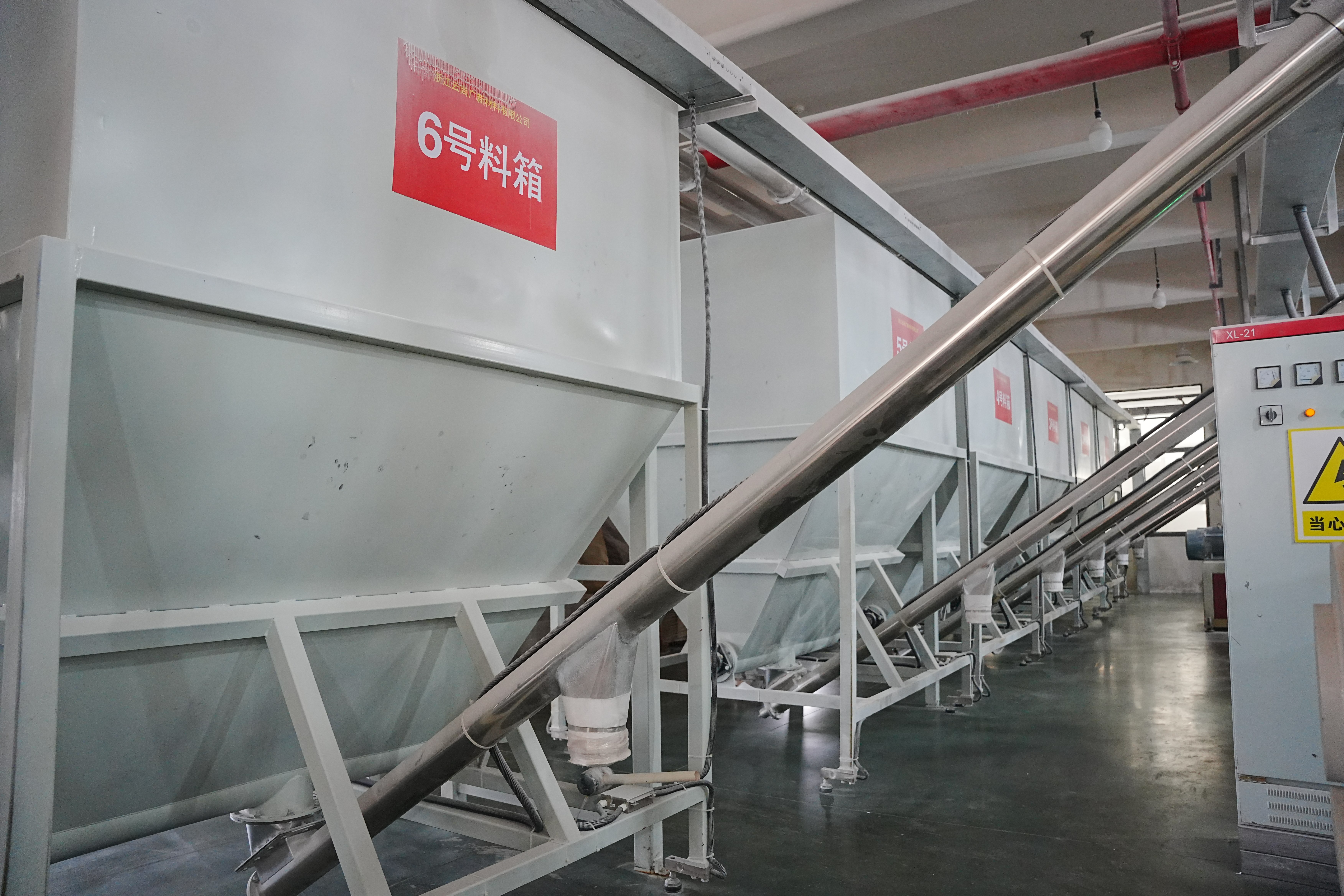
Production at Zhejiang Highsea New Material Co., Ltd. — a closed loop from formulation through extrusion and calendering, surface treatment, cutting and packaging.
Comparison table: panel families, sizes and documents on file
The table below compares only the facts documented in this file. It is a document map, not a performance ranking.
| Panel family | Base material | Stated sizes | Moisture behaviour | Third-party document on file |
|---|---|---|---|---|
| PVC wall panel | PVC | 300*8 mm; 300*8.5 mm | Non-porous surface that does not absorb water or hold odours | CE Technical Inspection Attestation of Conformity, EN 17104:2021, No. M.2026.206.C145889, issued 2026-08-10, expires 2031-08-09 (EU) |
| WPC wall panel | Wood fibre blended with thermoplastic resin | 160*22 mm; 160*24 mm; 150*10 mm; 150*15 mm; 195*12 mm | Moisture and rot resistance | Technical Inspection Attestation of Conformity, EN 17104:2021, No. M.2026.06.C1.45891, valid 2026-08-07 to 2031-08-09 (EU) |
| UV board | Board with UV cured coating | 1220*2440*3 mm; 1220*2440*2.5 mm | Dense sealed film over the base sheet | No separate certificate referenced in this file |
| Bamboo charcoal board | Bamboo charcoal composite board | 1220*2440*5 mm; 1220*2440*8 mm | Not stated in this file | No separate certificate referenced in this file |
| PVC film (surface layer, Style No. HS71001) | PVC film | Style No. HS71001 | Not applicable | SGS SVHC test report No. SHAHL26023493001, Regulation (EC) No 1907/2006 (REACH), issued 2026-08-10 (EU) |
Frequently asked questions
How do I verify fire-test reports when sourcing PVC wall panels from China?
Fire performance is a project-specific requirement, not a default attribute of a decorative panel, and the framework depends on the destination market. Commercial procurement guidance associates EN 13501-1 with Europe and the UK, ASTM E84 with the USA and Canada, and GB 8624 with China; because these systems use different test methods, their classes are not equivalent and should not be converted. Before accepting a fire-related claim, check five things: that the report names the exact product, thickness, construction and surface finish; that it cites the current edition of the standard; that the laboratory’s accreditation scope covers the test method; that the report is issued, dated and still current; and that the classification belongs to the framework your market applies. Zhejiang Highsea New Material Co., Ltd. holds EN 17104:2021 Attestations of Conformity for PVC Panel and WPC Panel from UDEM, plus an SGS SVHC test report for PVC film. Where a project requires a specific fire classification, request the product-specific fire test report for the exact panel construction you intend to buy.
What does EN 17104:2021 cover, and which Hisea models are certified under it?
EN 17104:2021 is the standard cited in the two Technical Inspection Attestations of Conformity held by Zhejiang Highsea New Material Co., Ltd. For PVC Panel, the certificate number is M.2026.206.C145889, issued by UDEM on 2026-08-10 and expiring 2031-08-09 for the EU market, with a scope listing models including 300*8*2900MM and 1220*3000*3MM. For WPC Panel, the certificate number is M.2026.06.C1.45891, issued by UDEM and valid from 2026-08-07 to 2031-08-09, covering models including 160*24MM, 160*22MM, 150*10MM and 150*15MM. Separately, the PVC film used as a decorative surface layer (Style No.: HS71001) is covered by SGS SVHC test report No. SHAHL26023493001, issued 2026-08-10 under Regulation (EC) No 1907/2006, screening 253 Candidate List substances and 1 potential SVHC with results of ≤ 0.1% (w/w) in the submitted sample. The film report and the panel attestations are different documents covering different items, and they should be filed separately.
Can sizes, colours and patterns be customised, and what capacity stands behind it?
Yes. Zhejiang Highsea New Material Co., Ltd. operates OEM production with customised patterns, customised packaging, customised colours and customised sizes. The stated monthly capacity is 20 × 40ft high-cube containers, which supports container-level and multi-container procurement. Production runs as a closed loop from formulation through extrusion and calendering, surface treatment, then cutting and packaging, and quality control covers incoming materials, in-process checkpoints and outgoing inspection. Trial orders start from 300 pieces and can be mixed by colour and size.
What price band should I budget for 3 mm PVC marble wall panels?
A commercial market source reported 2024 FOB China pricing for standard 3 mm PVC marble sheets at USD 3.00–3.60 per m², described as gradually stabilising after a period of volatility. Treat that figure as a market benchmark for one specification, not as a quotation: it does not carry a currency date, Incoterm, packaging basis or freight assumption, and it should not be applied to other thicknesses, UV-coated faces or customised patterns. Use it to sanity-check a landed-cost model, then request a specification-matched quotation that states the currency, Incoterm, MOQ, packaging basis and quotation date. Hisea quotation requests can be sent to Tommy@zjhisea.com.
What is the MOQ and lead time for a Hisea wall panel order?
Minimum order quantity starts at 300 PCS, and trial orders can be mixed by colour and size. Production lead time is typically 20–30 days, with a 40HQ container order commonly running 20–25 days after deposit. Monthly capacity is 20 × 40ft high-cube containers, which supports repeat and multi-container programmes, and batches are inspected before loading is arranged. For a first order, match your sample and specification sheet to the certificate scope before the proforma invoice is issued, so that the model you approve is the model that is covered. Sample and quotation requests can be made through www.zjhisea.com or by contacting the sales team directly.
Conclusion: compliance is a purchasing decision, not paperwork
The wall panel market rewards buyers who read documents as carefully as they read colour cards. Global PVC panel demand was valued at USD 14.8 billion in 2025 with wall panels taking the largest share, and the WPC segment is forecast to grow at 11.7% annually to 2033 — which means supplier competition will keep shifting towards specification quality, documented conformity and delivery reliability rather than towards price alone.
Three checks carry most of the weight. First, confirm the standard layer that applies to your destination market and match it to the exact model you are buying, remembering that a film-level SVHC report and a panel-level attestation are different documents. Second, confirm the fire framework your project applies and never convert a classification between EN 13501-1, ASTM E84 and GB 8624. Third, confirm the commercial position — MOQ, capacity, lead time and inspection routine — before the sample is approved, not after.
Zhejiang Highsea New Material Co., Ltd., operating as Hisea-Decorative Film & Decorative Panels, covers PVC wall panel, WPC wall panel, UV board and bamboo charcoal board in one portfolio, with CE Technical Inspection Attestations of Conformity under EN 17104:2021 for PVC Panel and WPC Panel, an SGS SVHC test report under REACH for PVC film Style No. HS71001, an MOQ from 300 pieces, a 20–30 day lead time, and monthly capacity of 20 × 40ft high-cube containers.
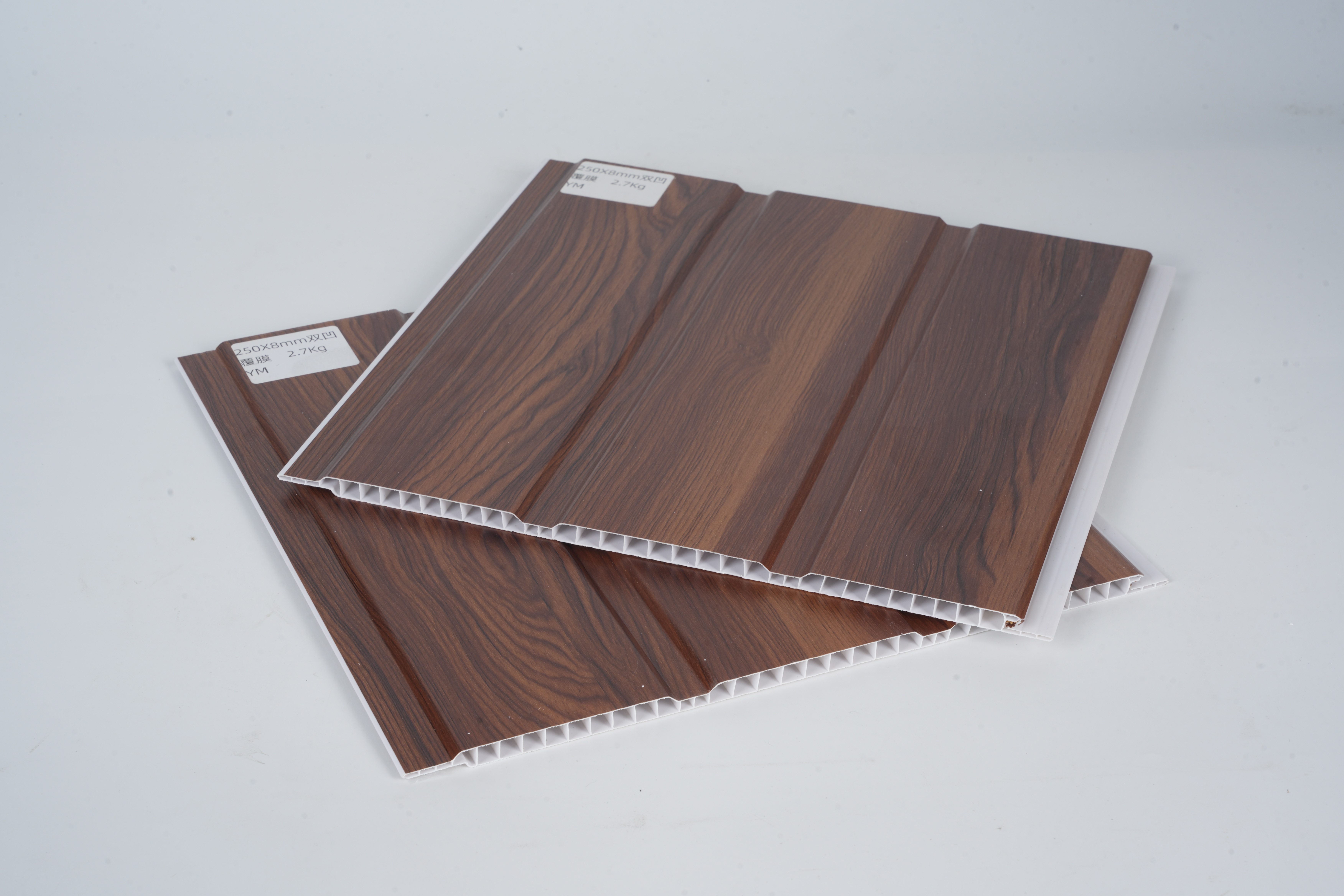
PVC wall panel range — request a sample and a specification-matched quotation before finalising the order.
Next step: sample, specification and quotation
Request a physical sample and a specification-matched quotation, or download the product catalogue to review sizes, profiles and finishes before your next supplier comparison.