
SPC Wall Panel Compliance: A Buyer's Verification Checklist
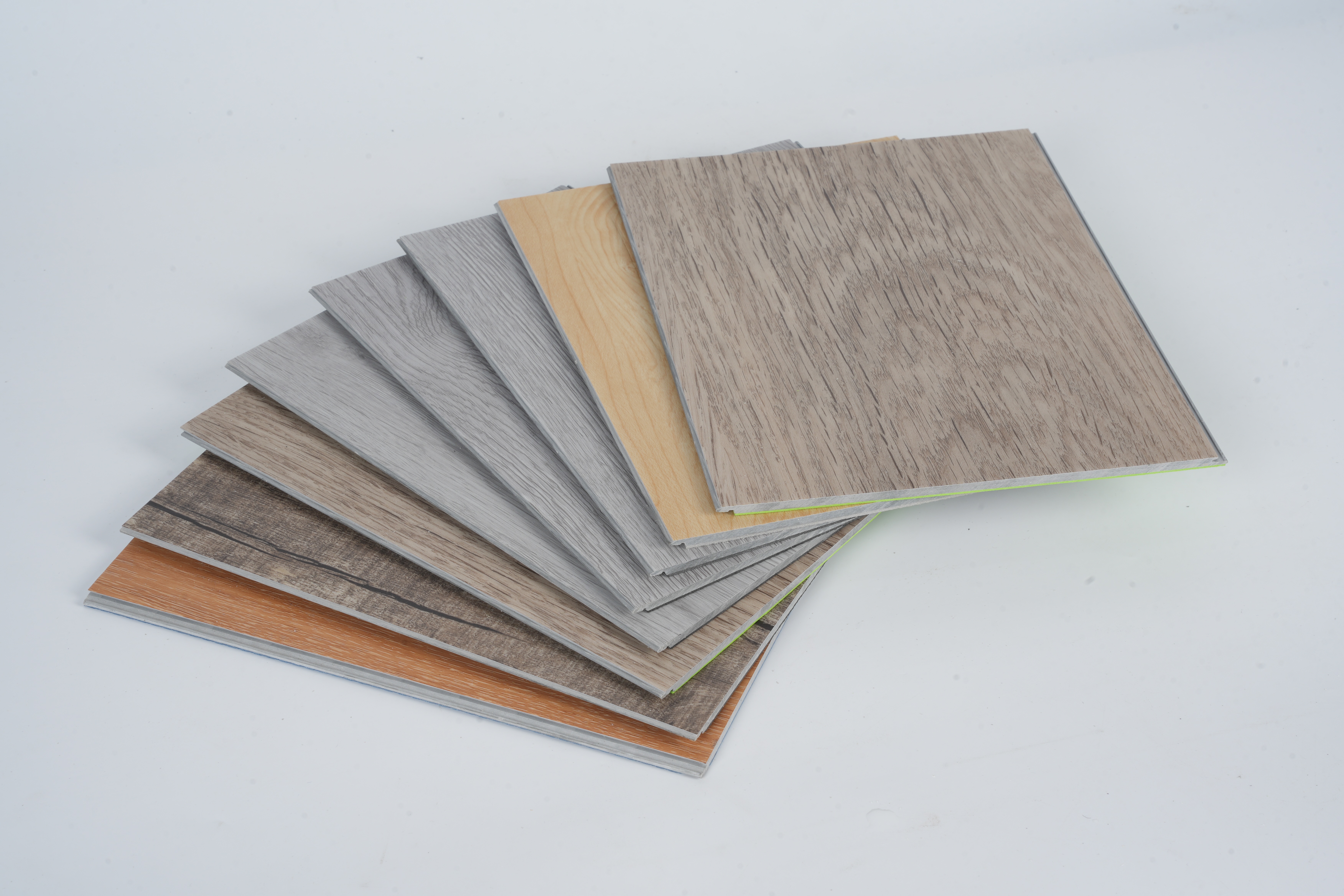
SPC wall panel orders rarely fail on appearance. They fail on paperwork that does not name the exact product, thickness, construction, surface finish and destination market. A certificate can be genuine, current and issued by a recognised body and still be irrelevant to the panel actually being shipped, because it was issued for a different product family, a different model, or a different market framework.
The short answer for buyers: match every document to the exact SKU on the purchase order, confirm which framework applies to your destination market, verify the issuer and its accreditation scope, check the validity window, and confirm which quality-control stages will apply to the batch being loaded.
This checklist sets out what a sourcing team should verify before confirming an SPC wall panel order, in what order to check it, and where the common gaps sit. It also uses the published certification records of Zhejiang Highsea New Material Co., Ltd., which trades as Hisea-Decorative Film & Decorative Panels, as a worked example of what a document pack looks like when each certificate is matched to a named model list.
Why SPC Wall Panel Buyers Get Blocked by Compliance, Not Design
SPC wall panel, PVC wall panel and WPC wall panel are separate product families with different compositions and different performance characteristics. A certificate issued for one family does not transfer to another, and within the same family it does not automatically transfer across thicknesses, profiles or surface finishes. This single misunderstanding causes most of the friction in wall panel procurement.
Commercial procurement guidance in this category is consistent on one point: the document has to match the product. The verification fields that matter are the exact product name, the thickness, the panel construction, the surface finish, the current edition of the referenced standard, and whether the testing laboratory's accreditation scope actually covers the test method used. A supplier statement that is not tied to those fields is a claim, not evidence.
Market rules add a second layer. In the European Union, EN 13245-2:2008 specifies the health and safety requirements for unplasticized poly(vinyl chloride) (PVC-U) profiles and cellular unplasticized poly(vinyl chloride) (PVC-UE) profiles for interior and exterior wall and ceiling finishes. It is the harmonised reference point for this profile category in EU market-access discussions, and it is worth checking whether a supplier's documentation cites it or a different standard for the product being quoted.
Fire-performance documentation is market-dependent. Commercial compliance guidance associates EN 13501-1 with European markets and the UK, ASTM E84 with the USA and Canada, and GB 8624 with China. These frameworks use different test methods and different classification systems, so a class obtained under one framework should not be presented or accepted as equivalent to a class under another.
Scope note: SPC, PVC and WPC wall panels are separate families, and each certificate has to be matched to the exact family, model, thickness and finish on the order. Hisea's published certificate set covers its PVC Panel and WPC Panel lines; those documents are used below to show what a properly matched record looks like, not as a substitute for product-specific documents on an SPC order.
Customs classification adds a third layer. Commercial market sources identify HS 391810 as the primary heading for rigid PVC wall and ceiling coverings, and list 391890, 392049, 392190, 392590 and 392690 as possible related headings depending on panel construction and product form. Because classification is product-dependent, buyers estimating landed cost should ask for the supplier's previous export declarations and product descriptions rather than assuming one code covers a mixed order.
What the Wall Panel Market Looks Like in 2026
Category demand for wall panels keeps expanding, and that is exactly why supplier-level evidence now matters more than category-level optimism.
Dataintelo's PVC panels market report (March 2026) valued the global PVC panels market at USD 14.8 billion in 2025, with wall panels holding the largest product-type share at 42.5%. Grand View Research (September 2026) estimated the global wood plastic composites market at USD 8.9 billion in 2025 and projected USD 21.5 billion by 2033, a CAGR of 11.7%.
Two implications follow. First, growth of this scale attracts new suppliers and new traders, so the volume of certificate images circulating inside quotation packs grows faster than the underlying testing behind them. Second, publicly available quantitative data for the SPC sub-segment specifically is thinner than for the wider PVC and WPC categories, which means the strongest evidence a buyer can hold is a supplier-level document that names a model, not a category forecast.
The supplier whose records are used as the worked example here, Zhejiang Highsea New Material Co., Ltd. (Hisea-Decorative Film & Decorative Panels), has operated since 2002 from a 20,000 m² facility with around 300 employees, exports roughly 70% of output to South America, Africa, Asia and the Middle East, and runs at a monthly output of 20 × 40 ft high-cube containers. Its documented product families are WPC wall panel, PVC wall panel, UV board and bamboo charcoal board, with CE and RoHS certification listed in its company profile.
Seven Verification Points for an SPC Wall Panel Order
1. Product match
Every document should name the product family, the model, the thickness and the surface finish of what is being ordered. Where a certificate covers a list of models, that list should be checked line by line against the purchase order. As an example of a document that names its scope explicitly, the UDEM Technical Inspection Attestation of Conformity M.2026.06.C1.45891 covers WPC Panel models including 160*24MM, 160*22MM, 160*20MM, 150*10MM, 150*15MM, 140*18MM, 140*13MM, 150*13MM, 194*10MM, 180*20MM, 200*11MM, 200*20MM, 50*50MM, 50*10MM, 50*150MM, 50*90MM, 1220*3000*5MM, 1220*3000*3MM and 1220*3000*2.8MM. A model outside that list is not covered by that attestation.
2. Standard and edition
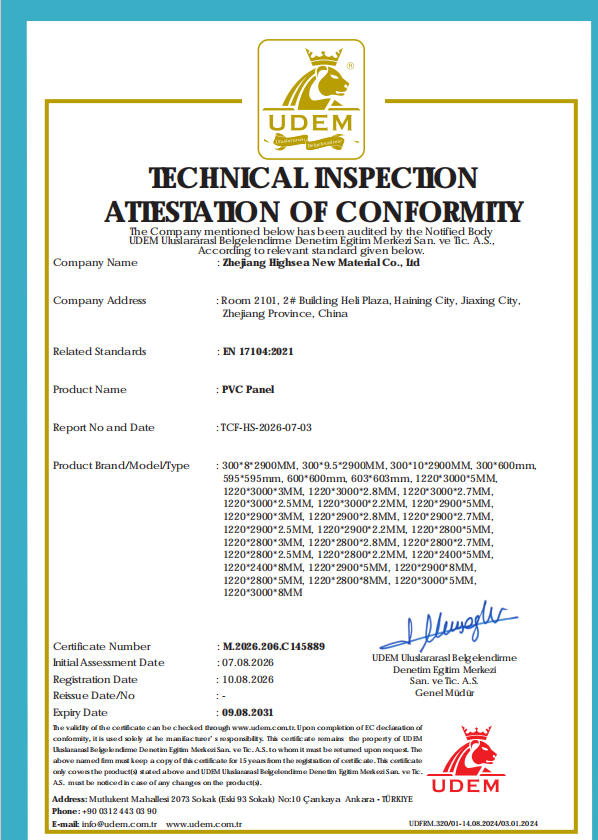
Confirm which standard the document cites and whether it is the current edition. EN 17104:2021 is the standard cited in both of Hisea's UDEM attestations, one covering PVC Panel (certificate M.2026.206.C145889) and one covering WPC Panel (certificate M.2026.06.C1.45891). For EU wall and ceiling profile finishes, EN 13245-2:2008 remains the harmonised reference for PVC-U and PVC-UE profiles.
3. Issuer and accreditation scope
Verify the issuing organisation and whether its scope covers the method used. Hisea's records show two issuer types: UDEM (UDEM Uluslararası Belgelendirme Denetim Eğitim Merkezi San. ve Tic. A.Ş.), an independent third-party certification body, and SGS. Commercial guidance recommends checking that a laboratory's accreditation covers the specific test method, with the ISO/IEC 17025 scope as the usual reference point, because an accredited organisation can still issue a report outside the method you actually need.
4. Validity window
Record issue and expiry dates before you file anything. The attestation for PVC Panel was issued on 2026-08-10 and expires on 2031-08-09. The attestation for WPC Panel is valid from 2026-08-07 to 2031-08-09. A document with no expiry date, or one whose date has passed, should be treated as supporting information rather than market-access evidence.
5. Substance restriction evidence
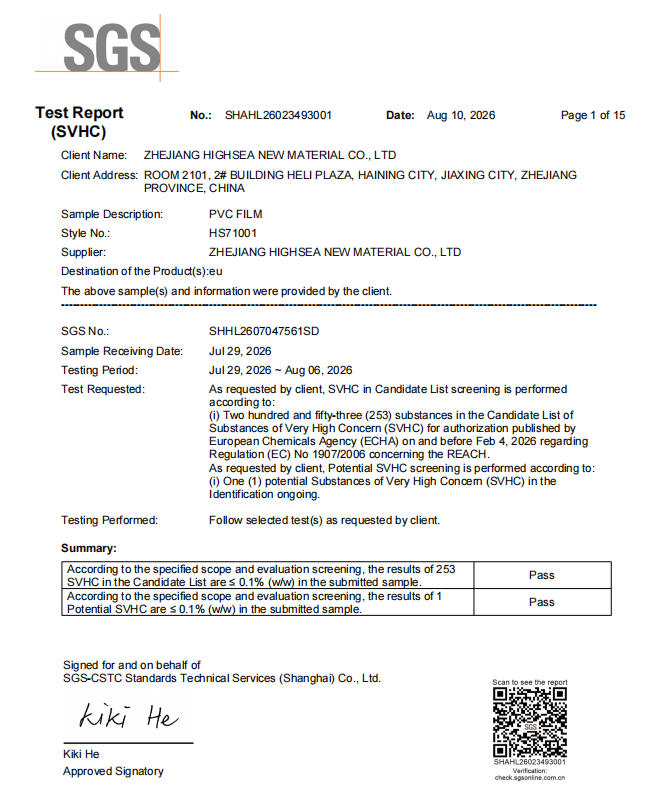
For EU-bound orders, substance restriction evidence is usually requested alongside the performance attestation. Hisea holds an SGS SVHC test report, certificate number SHAHL26023493001, issued on 2026-08-10 under Regulation (EC) No 1907/2006 concerning REACH. The screening covered 253 substances on the Candidate List plus 1 potential SVHC in the submitted PVC FILM sample (Style No.: HS71001), with results of ≤ 0.1% (w/w). Note the scope carefully: this report names a film product, not a finished panel, so it is evidence for that material and should be requested again for the panel construction actually being ordered.
6. Fire-performance documentation
Ask for fire documentation separately for each panel construction and finish, and confirm the framework matches the destination market. Because EN 13501-1, ASTM E84 and GB 8624 use different methods and classifications, a European buyer should not accept an ASTM E84 result as a substitute, and a North American buyer should not accept a European class as equivalent. Where fire evidence is not supplied for the exact model being ordered, treat that gap as an open item rather than assuming that category-level performance carries over.
7. Production-stage quality control
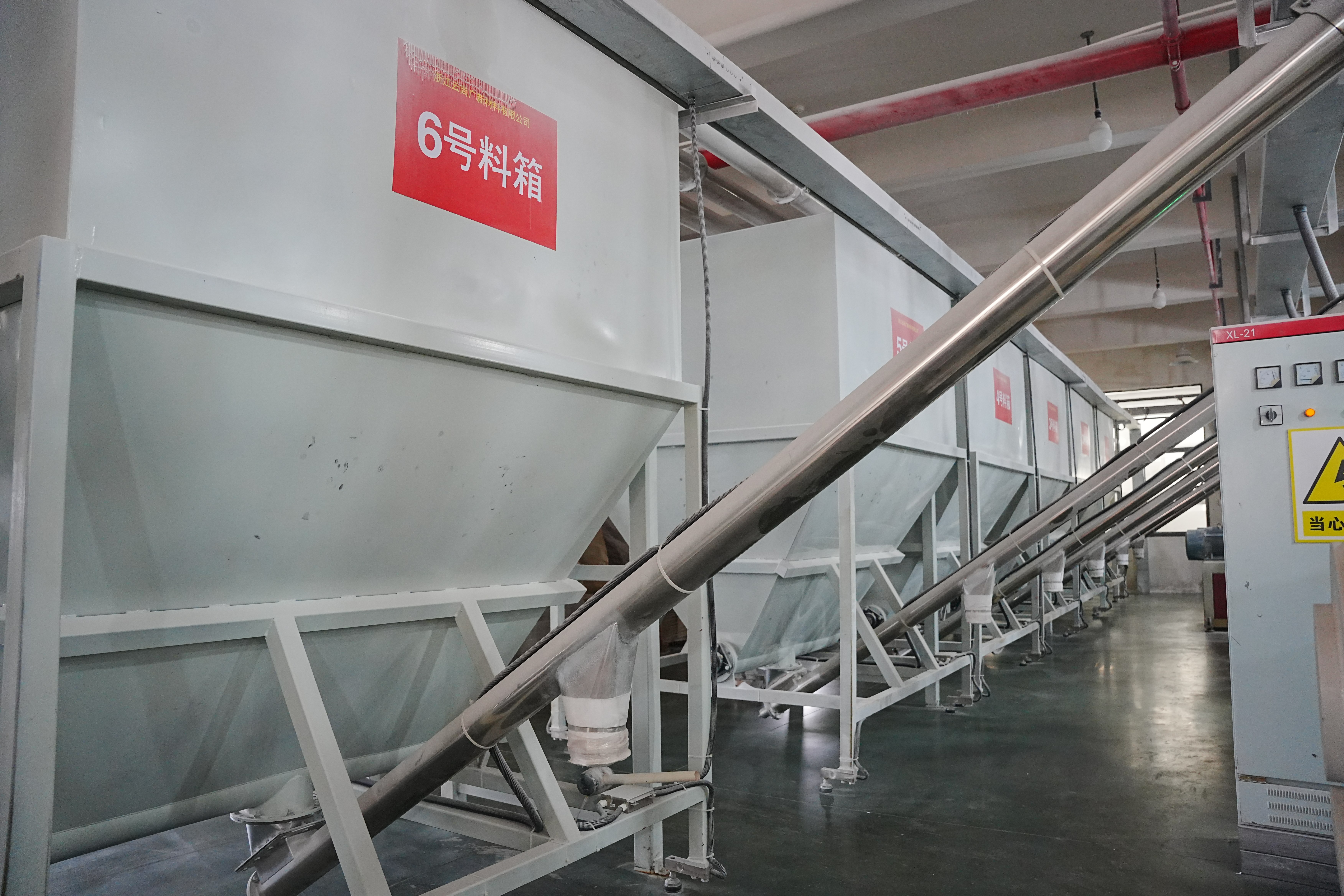
Documentation describes capability; the batch is what ships. Hisea organises production as a continuous loop from raw material to finished product, covering formulation, extrusion/calendering, surface treatment, and cutting and packaging. Quality control runs at three stages: incoming materials are inspected batch by batch to confirm formulation and process consistency; in-process control points monitor thickness, density, colour difference, surface flatness and texture consistency; and every outgoing batch is inspected before loading is arranged.
Step-by-Step: Running the Check from RFQ to Loading
- Freeze the specification sheet before you contact suppliers. Define panel family, thickness, length, width, surface finish, colour reference and whether the application is interior, exterior or wet-area. A vague specification produces unmatched documents.
- Name the destination market and the framework you will accept. For EU profile-based wall and ceiling products that means EN 17104:2021 and EN 13245-2:2008, plus the fire framework that applies in that market.
- Request the full document pack, not a certificate image. Ask for document type, certificate number, issuing body, standard and edition, issue date, expiry date, and the model list covered.
- Match the model list to your purchase order line by line. Anything not named in the document is not covered by it, regardless of how similar the panel looks.
- Verify the issuer and the accreditation scope that applies to the test method. Check that the issuing organisation's scope covers the method used for your product, not just the category.
- Cross-check substance restriction coverage against the actual material and construction. Confirm which material the report names and whether that material is used in the panel you are buying.
- Confirm the QC regime for the batch. Incoming material inspection, in-process control points on thickness, density, colour difference, surface flatness and texture, and final batch inspection before loading.
- Confirm capacity and lead time against the project schedule. Then agree packaging, labelling and the documents that must travel with the shipment.
Where Wall Panel Constraints Bite by Application
Bathrooms, kitchens and other wet service areas. The binding constraint is water behaviour, not appearance. A PVC wall panel has a non-porous surface that does not absorb water or hold odours, which is why it is specified for kitchens, bathrooms and other wet service areas. WPC wall panel is specified where moisture and rot resistance are required, including bathrooms, laundry areas and covered outdoor walls.
Hotel corridors, lobbies and commercial interiors. Here the constraint is batch consistency, because colour and texture must hold across a full container and across repeat orders. Hisea's documented case record describes a 40-foot high cube container supplied for resale and for personal use in decorating indoor and outdoor areas, with the customer reporting correct sizes, no colour difference and repeat ordering over a five-year relationship. That kind of continuity only holds if in-process colour-difference control is maintained on every run.
Exterior and covered outdoor walls. The constraint is moisture and rot resistance, and termite resistance is commonly listed as a special requirement for indoor/outdoor decorative panel projects in humid environments, along with waterproofing, low formaldehyde and easy cleaning.
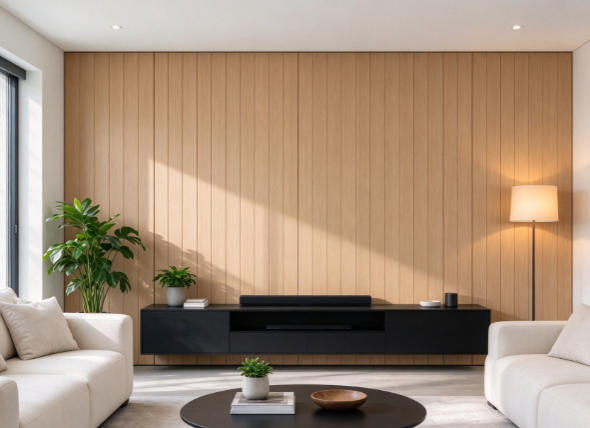
Feature walls, TV backgrounds and ceilings. The constraint is profile and coating rather than substrate. Fluted, slatted, louver and flat profiles with wood-grain or solid-colour faces let a wall run change character by swapping groove depth and coating instead of changing the base material, which keeps the specification stable while the design changes.
Retail interiors and showroom fixtures. The constraint is surface durability under daily handling. A UV-cured coating forms a dense sealed film over the base sheet, so the decorative face keeps its sheen through contact, wiping and handling, and printed patterns stay readable over long service.
Panel Specifications and Documented Certification at a Glance
The tables below summarise the verified product parameters and the documented certificates that a buyer can actually check against a purchase order.
| Product family | Model reference | Standard sizes | Material | Typical application |
|---|---|---|---|---|
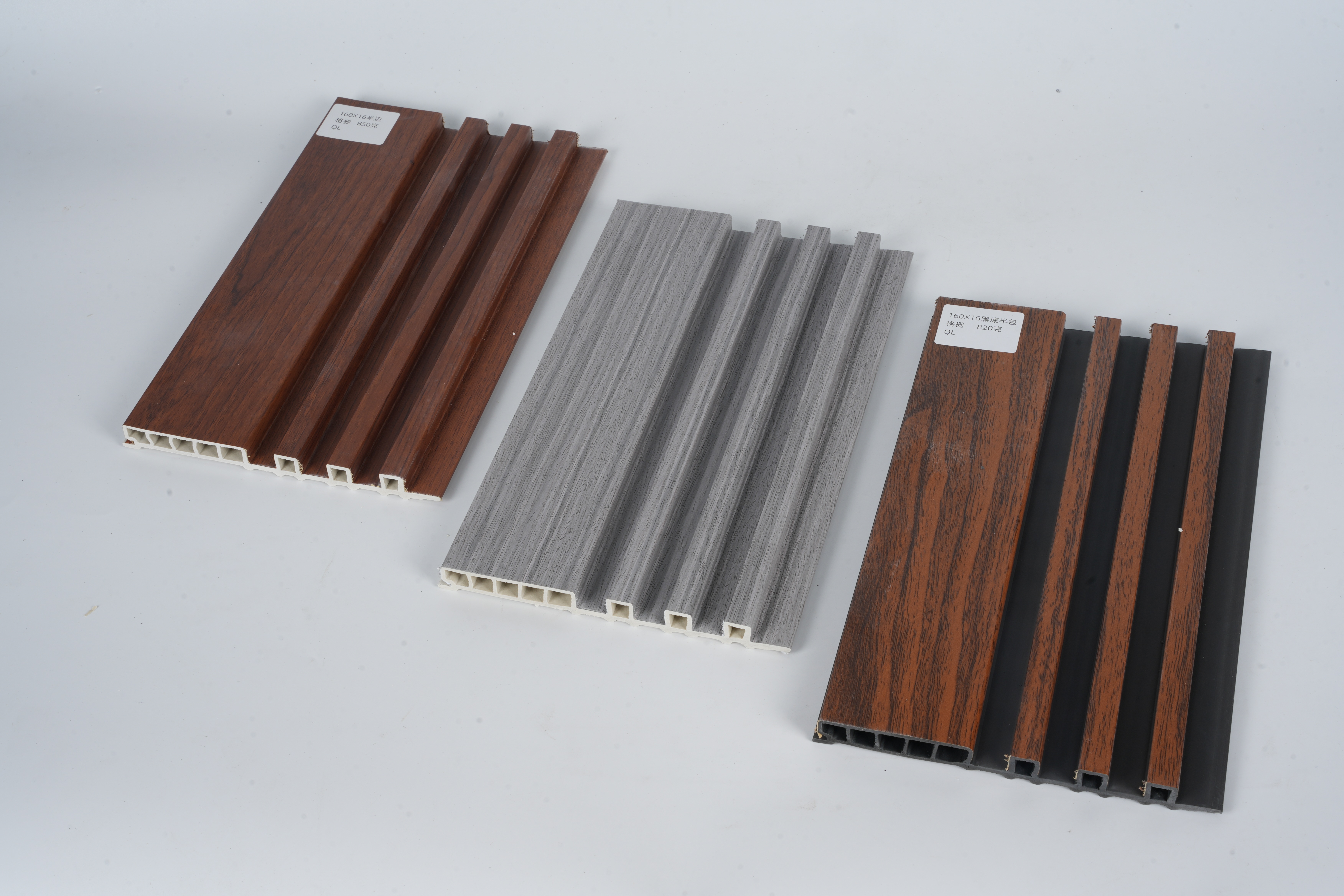
| WPC wall panel | HS-WPC WALL PANEL | 160×22 mm, 160×24 mm, 150×10 mm, 150×15 mm, 195×12 mm | WPC | Feature walls, TV backgrounds, hotel corridors, retail fronts, balcony and patio cladding |
| PVC wall panel | HS-PVC WALL PANEL | 300×8 mm, 300×8.5 mm | PVC | Kitchens, bathrooms, clinics, food preparation rooms, laboratories, public washrooms |
| UV board | HS-UV BOARD | 1220×2440×3 mm, 1220×2440×2.5 mm | Surface-coated board | Kitchen and bathroom cabinets, TV background walls, hotel room furniture, retail fixtures |
| Bamboo charcoal board | Within the decorative panel range | 1220×2440×5 mm, 1220×2440×8 mm | Panel board | Interior wall decoration |
| Document | Issuer | Number | Standard / regulation | Scope covered | Validity | Market |
|---|---|---|---|---|---|---|
| Test Report (SVHC) | SGS | SHAHL26023493001 | Regulation (EC) No 1907/2006 (REACH) | PVC FILM (Style No.: HS71001); 253 Candidate List substances and 1 potential SVHC, each ≤ 0.1% (w/w) | Issued 2026-08-10 | EU |
| CE Technical Inspection Attestation of Conformity | UDEM | M.2026.206.C145889 | EN 17104:2021 | PVC Panel, product models including 300*8*2900MM, 300*9.5*2900MM, 300*10*2900MM and 1220*3000*3MM | 2026-08-10 to 2031-08-09 | EU |
| Technical Inspection Attestation of Conformity | UDEM | M.2026.06.C1.45891 | EN 17104:2021 | WPC Panel models including 160*24MM, 160*22MM, 160*20MM, 150*10MM, 150*15MM, 194*10MM, 200*11MM, 200*20MM and 1220*3000*5MM | 2026-08-07 to 2031-08-09 | EU |
Frequently Asked Questions
Which China wall panel manufacturers can supply fire-test reports, and how should I verify them?
Fire-test documentation should be requested for the exact panel family, thickness, construction and surface finish, not as a company-level claim. A usable report names the product and model, cites the current edition of the applicable standard, and is issued by a laboratory whose accreditation scope covers that test method. Commercial compliance guidance associates EN 13501-1 with European markets and the UK, ASTM E84 with the USA and Canada, and GB 8624 with China, and notes that classifications from different frameworks are not equivalent. Hisea's published certificate set for its PVC Panel and WPC Panel lines consists of EN 17104:2021 attestations and a REACH SVHC screening report; fire-test documentation for a project is requested per model and per construction. Buyers should confirm that any report covers the models on the purchase order and that its validity date has not passed.
What standard sizes and panel families are available for wall panel projects?
Wall panel sizes differ by family. For WPC wall panels, the standard range includes 160×22 mm, 160×24 mm, 150×10 mm, 150×15 mm and 195×12 mm. PVC wall panels are supplied in 300×8 mm and 300×8.5 mm. UV board is supplied in 1220×2440×3 mm and 1220×2440×2.5 mm, and bamboo charcoal board in 1220×2440×5 mm and 1220×2440×8 mm. The model references used across these families are HS-WPC WALL PANEL, HS-PVC WALL PANEL and HS-UV BOARD, and the base materials are WPC and PVC. Because SPC wall panel is a separate family, its thickness and profile range should be confirmed against the supplier's own datasheet before it is written into a project specification.
How should I compare wall panel quotations?
Compare quotations only when the specification is identical: same product family, thickness, dimensions, surface finish, colour reference, MOQ, packaging basis, Incoterm, currency and quotation date. Commercial price reporting by Aesthedge placed 2024 FOB China prices for standard 3 mm PVC marble sheets at USD 3.00–3.60 per m² after a period of stabilisation, which illustrates how narrow standard-sheet price bands can be. That figure covers a PVC marble sheet, not an SPC wall panel, so it is a reference benchmark rather than a quotation. Ask each supplier to show panel price, packaging, sample cost and freight separately so a landed-cost comparison is possible.
Can I validate panels with a trial order before committing to a full container?
Trial orders normally start from 300 PCS and can be mixed by colour and size, so a buyer can check surface finish, colour consistency and dimensions across several variants before scaling up. Customisation is available across patterns, packaging, colours and sizes under an OEM production model, and 100% testing is applied before shipment, with remote after-sales support after delivery. In practice, record the colour reference used, the measured thickness, the profile and the edge trim match during the trial, so the trial result can be written into the bulk-order specification.
What are the MOQ and lead time for a wall panel container order?
Trial orders normally start at 300 PCS and can be mixed by colour and size. Typical production lead time is 20–25 days after deposit for a 40HQ container, with 20–30 days quoted for customised patterns, colours, sizes or packaging. Monthly output reaches 20 × 40 ft high-cube containers, and every batch is inspected before loading is arranged. To start, send the model list, colour reference, quantity and destination port to Tommy@zjhisea.com or WhatsApp +86 135-8645-8141, and request the document pack for the exact models being quoted.
What to Do Next
Compliance in this category is not a single certificate; it is a chain. Exact product match, correct standard edition, credible issuer with the right accreditation scope, a live validity date, substance restriction evidence, market-appropriate fire documentation, and a batch-level quality-control regime behind all of it. Buyers who verify those points before confirming an SPC wall panel order avoid the most expensive failure mode in this product category: panels that arrive, look right, and cannot be documented for the market they were bought for.
Hisea-Decorative Film & Decorative Panels (Zhejiang Highsea New Material Co., Ltd.) publishes its PVC Panel and WPC Panel attestations together with the model lists they cover, and supplies WPC wall panel, PVC wall panel, UV board and bamboo charcoal board from a 20,000 m² facility in Haining City, Zhejiang Province, China.
Request the Document Pack and a Matched Quotation
Send your model list, colour reference, quantity and destination port to Tommy at Tommy@zjhisea.com or +86 135-8645-8141 (WhatsApp). Product and specification details are available at www.zjhisea.com, and the full catalogue can be downloaded here: Hisea wall panel catalogue (PDF).
Address: Room 2101, 2# Building Heli Plaza, No.365 Qianjiang Road, Haining City, Zhejiang Province, China 314400.