
WPC Wall Panel Technical Guide: Composition, Extrusion Parameters and Selection Criteria
A WPC wall panel is a decorative cladding profile made by blending wood-derived fibre with a thermoplastic binder, extruding the compound into a shaped section, then treating, cutting and packaging it. Two panels can look identical in a photograph and still differ in thickness tolerance, density, colour difference, surface flatness and moisture behaviour — which is why the specification, not the picture, decides the outcome of a project order.
What a WPC wall panel is
A WPC (wood-plastic composite) wall panel is a rigid decorative profile in which a wood-derived fraction is dispersed in a thermoplastic matrix and formed by extrusion. The wood fraction contributes stiffness, a matte surface and a wood-like appearance; the thermoplastic fraction binds the fibre, allows the compound to be melted and shaped, and gives the finished profile its resistance to moisture and insects when the formulation is correctly controlled.
Within the broader Wall Panel category, WPC sits alongside several other decorative panel families that buyers usually evaluate together: PVC wall panel, SPC wall panel, PVC marble sheet, bamboo charcoal wall panel, UV board and PVC ceiling panel. Each family has a different production route and therefore different tolerance behaviour. The WPC route is the one covered in this guide.
The buyer problem: identical photographs, non-identical panels
The practical difficulty in WPC procurement is that appearance is a poor proxy for performance. A fluted profile photographed at 45 degrees reveals almost nothing about density, wall thickness tolerance, colour difference between batches, or how the surface will behave when a corridor is cleaned daily. Buyers therefore tend to compare quotations on price and lead time alone — the two numbers that are easiest to read and hardest to verify.
The result is a specification gap. Importers, distributors and project specifiers receive samples that pass a visual check, then discover during installation that panels from different batches sit at slightly different depths, that joints require more trimming than planned, or that a colour that matched under showroom lighting reads differently under corridor lighting. None of these problems is visible in a product photo, and none of them can be resolved by asking for a lower price.
The remedy is to convert appearance-based questions into process-based questions: what is the panel made of, how was it formed, which control points were monitored during production, and which documents describe the exact profile being quoted. This guide follows that sequence.
Industry background: where WPC sits in the wall panel market
Decorative wall panels are a large and still-expanding category. Dataintelo's PVC panels market report places the global PVC panels market at USD 14.8 billion in 2025, with wall panels holding the largest product-type share at 42.5%. That figure describes the PVC-centred part of the market; the wood-plastic composite side has its own growth path. Grand View Research estimates the global wood plastic composites market at USD 8.9 billion in 2025, projected to reach USD 21.5 billion by 2033, a CAGR of 11.7%.
Two consequences matter for buyers. First, WPC is no longer a niche substitute — it is a mainstream decorative option for interior feature walls, hotel corridors and humid interiors, and supply is broad enough that quality dispersion between suppliers is wide. Second, the compliance environment has tightened. EN 17104:2021, the European standard for thermoplastics rigid protective wallcovering panels for internal use in buildings, sets out performance characteristics for this product class, and EN 13245-2:2008 specifies health and safety requirements for unplasticized PVC profiles used in wall and ceiling finishes in the EU market. Fire performance is assessed through different frameworks depending on jurisdiction — EN 13501-1 in Europe and the UK, ASTM E84 in the USA and Canada, GB 8624 in China — and these systems are not interchangeable. A report issued under one framework cannot be read as evidence under another.
Composition: what goes into the compound
The finished properties of a WPC panel are largely decided before extrusion begins. The compound typically contains four functional groups:
- Wood-derived fibre. The fibre fraction gives the profile its stiffness, its matte surface and its wood-like character. Fibre grading and moisture content at the incoming stage influence how evenly the compound melts and how consistent the extruded surface appears.
- Thermoplastic binder. The binder holds the fibre together and makes the profile formable. Binder level relative to fibre is one of the main determinants of density, impact behaviour and moisture resistance.
- Processing additives. These support flow through the die, release from hot surfaces, and dimensional stability during cooling. Their balance affects surface quality more than any single additive level.
- Colourants and stabilisers. These determine the base colour and its resistance to change over time, and they are the main lever for colour difference between production batches.
Because formulation is the first variable, batch-by-batch incoming material inspection is a quality control step rather than a purchasing formality: raw materials are inspected batch by batch to ensure consistency of formulation and process parameters. Without that check, downstream control points cannot hold.
Production sequence: formulation, extrusion, surface treatment, cutting and packaging
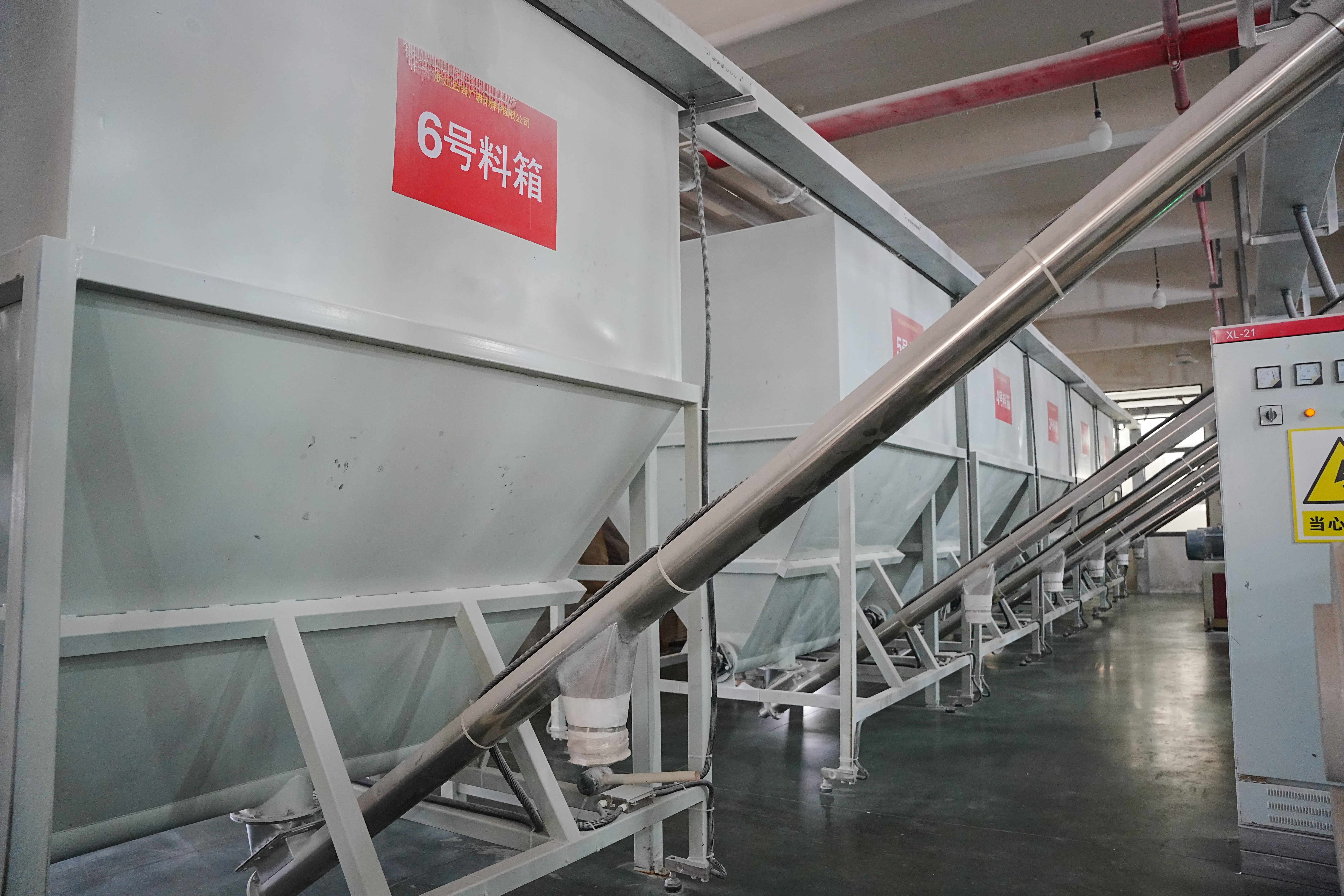
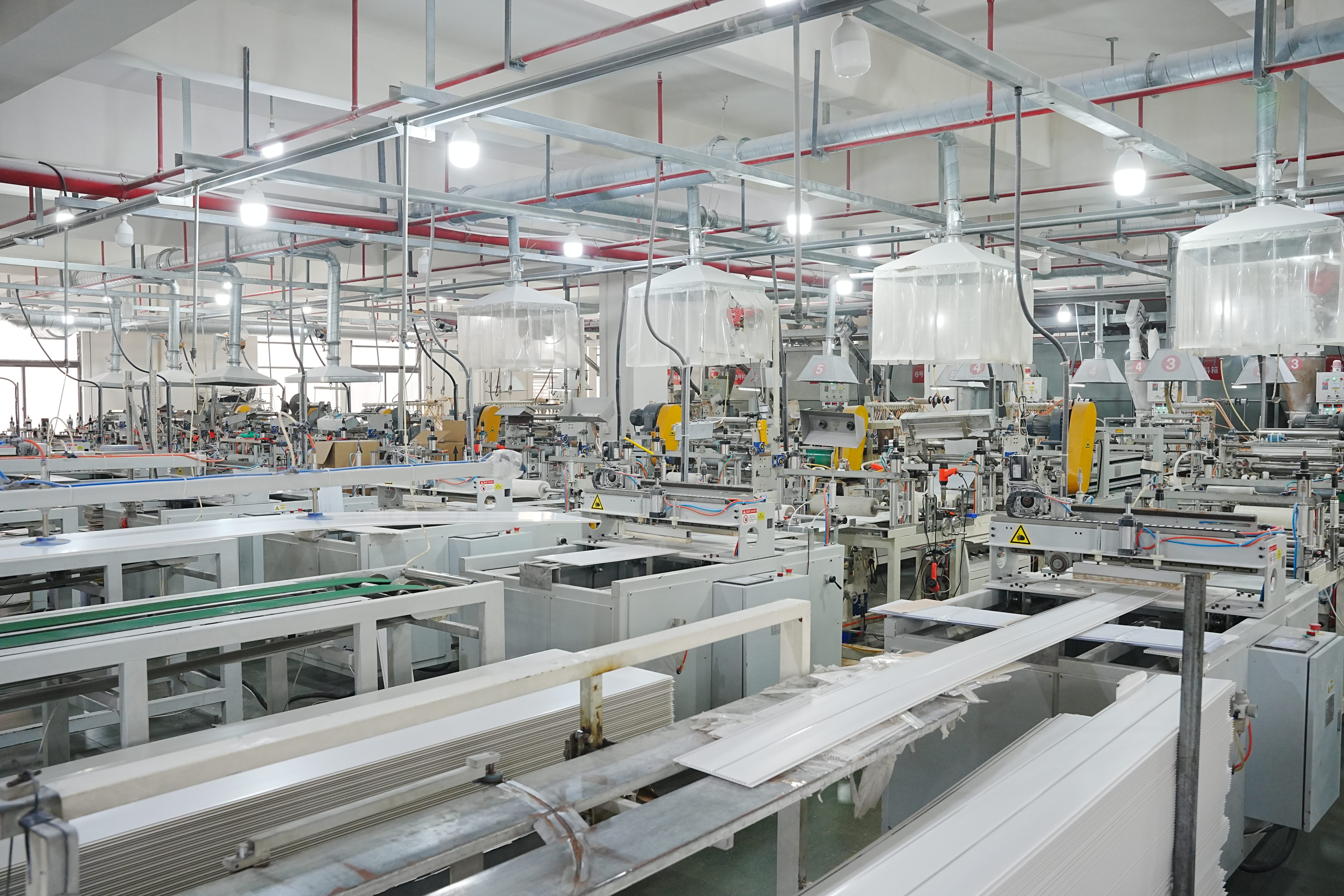
Zhejiang Highsea New Material Co., Ltd. organises panel production as a continuous closed loop from raw material to finished product: formulation — extrusion/calendering — surface treatment — cutting and packaging. The company is a Chinese manufacturer of decorative films and surfacing materials, founded in 2002, operating a 20,000 m² facility with 300 employees and exporting approximately 70% of its output to South America, Africa, Asia and the Middle East under the brand Hisea-Decorative Film & Decorative Panels. Its panel range includes WPC wall panel, PVC wall panel, UV board, outdoor wall panel and decking.
Stage 1 — Formulation
Fibre, binder, additives and colourant are combined into a consistent compound. This stage fixes the material basis of the order: two suppliers quoting the same profile size at different prices are frequently quoting different binder-to-fibre ratios, which will show up later as a difference in weight, stiffness and surface behaviour rather than as a visible defect.
Stage 2 — Extrusion and calendering
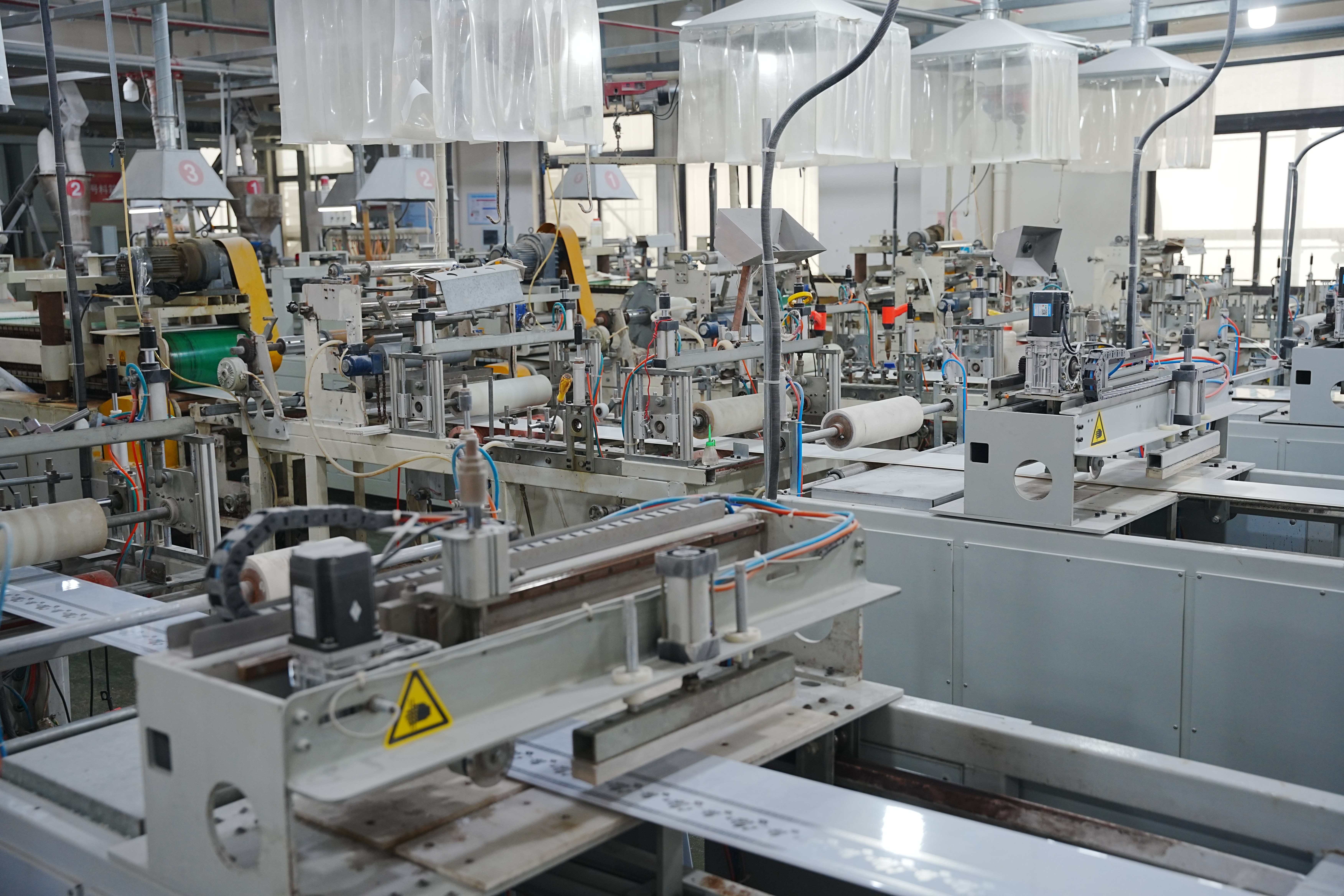
The compound is melted and forced through a die to form the profile section, then calibrated and cooled. This stage converts a material recipe into a dimensional product. Thickness, density and surface flatness are effectively created here, and errors introduced at this point cannot be corrected by later finishing.
Stage 3 — Surface treatment
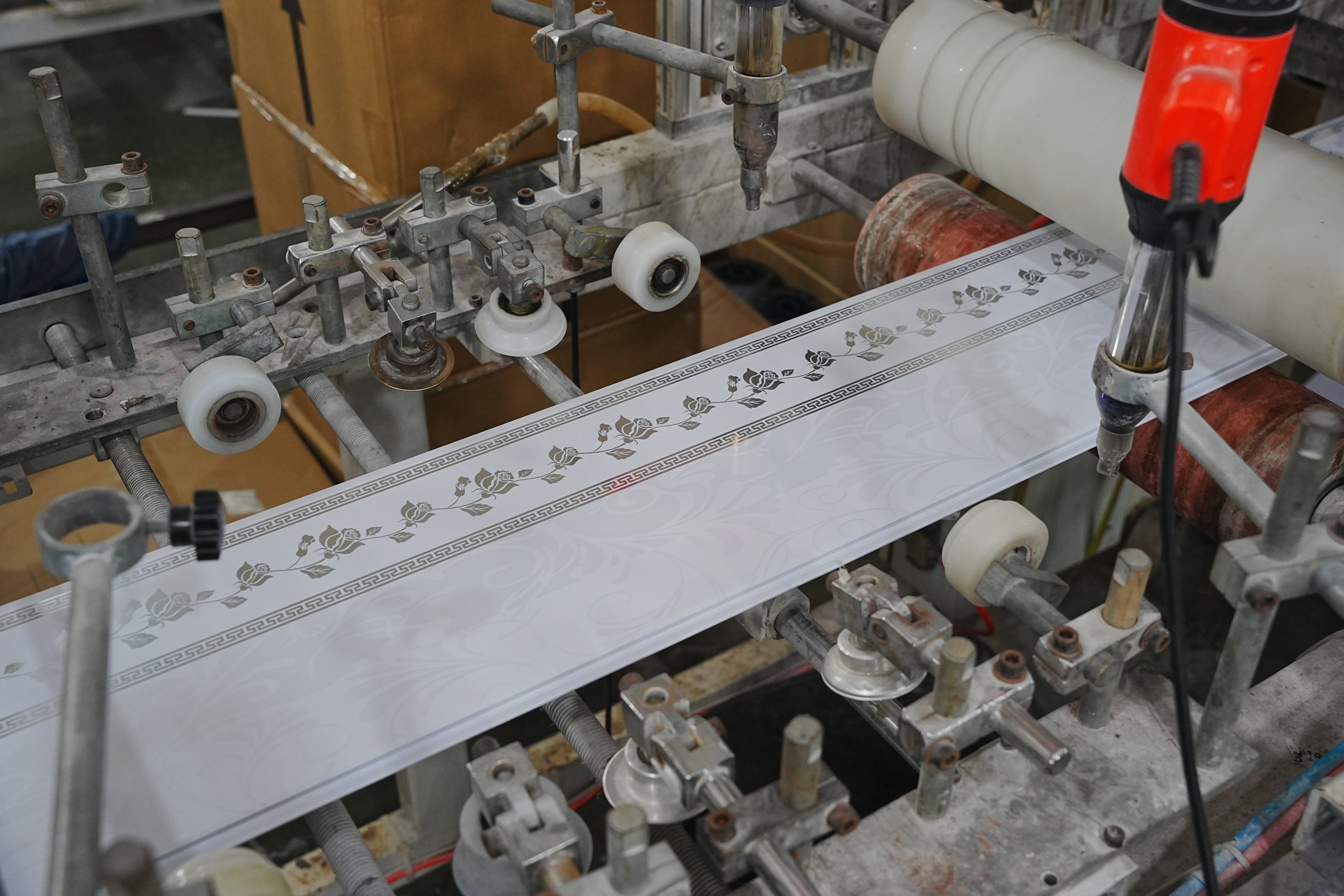
The extruded profile receives its decorative surface — a wood grain, a solid colour, a film-laminated face or a coating, depending on the product. Surface treatment determines the visual result, the tactile texture and the panel's resistance to scratching and cleaning in service.
Stage 4 — Cutting and packaging
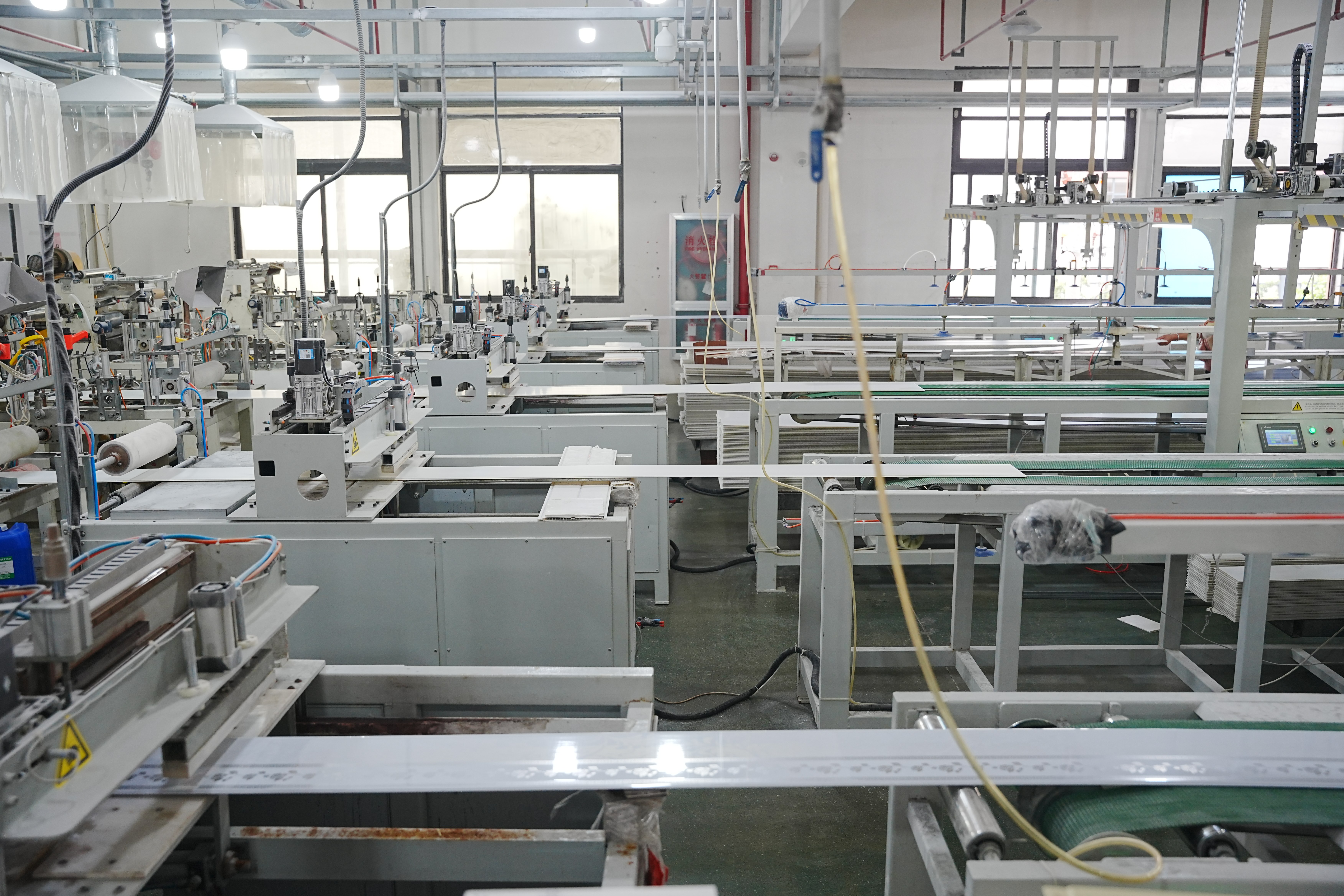
Profiles are cut to length, checked and packed. Packaging protects not only against transit damage but against moisture uptake and edge deformation during container transport, which matters for humid destination markets.
Extrusion parameters that decide final properties
Extrusion is where the specification is physically created, and its variables are interdependent rather than independent. The parameters that govern the outcome are the barrel temperature profile along the screw, the screw speed and the resulting shear on the compound, the die and calibrator geometry, the cooling regime after the die, and the haul-off speed that sets the final section.
The interdependence is the part buyers most often underestimate. A change in melt temperature alters flow through the die, which changes surface finish; the same change alters how the profile cools, which changes internal stress and therefore flatness and dimensional stability after cutting. A supplier that adjusts one parameter to fix a surface defect can create a thickness drift elsewhere. This is why process control has to be monitored on outputs rather than asserted on inputs, and why a supplier's in-process records are more informative than a description of its equipment.
Buyers do not need numeric setpoints, and it would be misleading to quote them as if they were universal — they depend on the specific compound, die and line. What buyers should ask for is evidence that the outputs of these parameters are monitored and recorded: thickness, density, colour difference, surface flatness and texture consistency, checked at defined stages rather than only at the end of the run.
In-process control points at Zhejiang Highsea New Material Co., Ltd.
Quality control at the company runs through three stages, and the middle stage is the one that most directly addresses the buyer problem described earlier.
- Incoming materials. Raw materials are inspected batch by batch to ensure consistency of formulation and process parameters. This protects the recipe before any profile is formed.
- In-process. Control points are set at key stages to monitor thickness, density, colour difference, surface flatness and texture consistency. These five outputs map directly onto the failure modes that appear on site: thickness tolerance governs joint alignment, density governs stiffness and weight, colour difference governs batch-to-batch matching, flatness governs whether panels sit flush against the substrate, and texture consistency governs how the finished wall reads under raking light.
- Outgoing goods. Every batch is inspected before shipment, and loading is arranged only after the batch passes inspection.
Capacity context is relevant to long-term supply planning rather than to product quality: monthly output reaches 20 × 40ft high-cube containers, which allows the company to serve container-level and multi-container procurement while providing a relatively stable delivery expectation for large orders. The company's products have obtained CE and RoHS certification, meeting market-access requirements for electrical safety and restriction of hazardous substances in the relevant markets.
Selection criteria buyers should confirm
Profile type and size
Profile geometry sets the visual rhythm of the wall and the installation method. Fluted and slatted profiles dominate interior feature walls; flat and large-format panels serve different design intents. Common standard sizes for fluted WPC wall panels are 160×22 mm, 160×24 mm, 150×15 mm, 160×16 mm, 160×13 mm, 195×12 mm and 195×14 mm. The WPC parameter list for the HS-WPC WALL PANEL model covers 160×22 mm, 160×24 mm, 150×10 mm, 150×15 mm and 195×12 mm. Buyers should confirm the size designation against the actual section drawing rather than a photograph, because identical nominal sizes from different dies do not always produce identical joint profiles.
Thickness
Thickness drives stiffness, weight per unit area, and how forgiving the panel is on an uneven substrate. It is also the dimension most exposed to tolerance drift during extrusion. Confirm the nominal thickness, the acceptable tolerance band, and which control point measures it.
Moisture and rot resistance
Because the thermoplastic matrix encapsulates the fibre, a correctly formulated WPC panel is moisture-resistant, termite-resistant and easy to clean. These properties are the reason WPC is used in humid interiors and in bathroom wall panel applications where tiles or coatings would otherwise be specified. They are formulation and process outcomes, however — not automatic properties of anything sold as WPC. Confirm them against the technical data for the exact profile.
Indoor versus outdoor suitability
WPC wall panels are used across indoor and outdoor wall decoration projects, including humid environments at normal ambient temperature. Exterior use is a separate qualification: UV exposure, thermal cycling and rain contact place demands that interior profiles are not necessarily built for. The company's range separates WPC wall panel, outdoor wall panel and decking as distinct product families for this reason. A buyer specifying an Exterior Wall Panel application should confirm that the profile being quoted is the outdoor variant, not an interior profile recommended by default.
Surface finish, colour and texture consistency
Finish determines both appearance and durability. UV-coated and wood-grain PVC faces, film-laminated surfaces and solid colours each behave differently under cleaning, scratching and light. Two questions resolve most of the risk: what is the colour difference specification between batches, and how is texture consistency verified along a production run? Both are recorded as in-process control points rather than as final visual inspection.
Documentation: EN 17104:2021 attestation and the model list
For the WPC wall panel range, specification evidence is documented through an EN 17104:2021 attestation, together with the certified WPC model list covering the fluted profile sizes quoted in this guide. EN 17104:2021 addresses the performance characteristics of thermoplastics rigid protective wallcovering panels for internal use in buildings, which is the correct standard family for this product class in European-facing specifications.
Step-by-step: specifying and verifying a WPC wall panel order
- Define the application before the product. Establish whether the wall is interior or exterior, whether the environment is humid, and whether the space is residential, commercial or hospitality. Hotel lobbies and corridors, offices and meeting rooms, restaurants, retail stores and showrooms all place different demands on surface durability and cleaning.
- Fix the profile and size from a section drawing. Select from the confirmed size list and check the joint detail, not only the face width.
- State thickness with a tolerance band. A nominal figure without a tolerance cannot be inspected on arrival.
- Specify surface finish and colour reference. Define the finish type and the acceptable colour difference between batches, then agree how it will be checked.
- Collect the documentation set. Request the EN 17104:2021 attestation and model list, CE and RoHS documentation, and any project-specific fire test report naming the exact construction.
- Validate with a sample before committing volume. Check the sample against the same five in-process outputs: thickness, density, colour difference, surface flatness and texture consistency.
- Agree inspection and loading conditions. Confirm that every batch is inspected before shipment and that loading follows batch approval, then align that sequence with your own receiving inspection.
Use cases
WPC wall panels are used for interior feature walls, TV backgrounds, living rooms and bedrooms, hotel lobbies and corridors, offices and meeting rooms, restaurants, retail stores and showrooms, and ceilings. In each setting the reason for choosing WPC is slightly different:
- Hotel Decoration Wall Panel. Corridors and lobbies need consistent colour across large areas and repeated floors, which makes batch-to-batch colour difference the primary risk rather than the profile itself.
- Bathroom Wall Panel and humid interiors. Moisture-resistant, easy-clean panels replace tiling or coating systems in damp areas where joint hygiene matters.
- Commercial fit-out and retail. Quick Installation Wall Panel systems reduce on-site labour because panels are fixed on battens or directly onto a flat, dry substrate using clips, screws or adhesive, with matching corner and edge trims. Cutting is done with standard woodworking tools and no painting or finishing is required on site.
- Acoustic and feature walls. Fluted and slatted profiles provide visual depth; where acoustic performance is a project requirement, it should be specified and evidenced separately rather than assumed from profile shape.
- Exterior Wall Panel applications. Outdoor wall cladding requires the outdoor product family, not an interior profile.
Comparison: low-priced panel versus higher-grade panel
The table below records a supplier-level comparison between a low-priced board and a higher-grade board in the same decorative panel family. It is included because price differences of this size are usually explained by material content and service behaviour rather than by profile geometry — the same logic applies when comparing WPC quotations.
| Comparison dimension | Low-priced board | Higher-grade board |
|---|---|---|
| Cost | Baseline | 10% higher |
| Construction and weight | Lightweight construction with low weight per unit area | Higher PVC content |
| Flexibility | Cannot be folded into a circle; elasticity not particularly good | Capable of ensuring no tearing when folded in half; better elasticity |
| Surface behaviour | Lower tolerance to temperature fluctuation | Surface will not crack or peel under temperature fluctuation |
| Maintenance | Refurbishment may be required over the service life | No periodic surface refurbishment needed |
| Typical use | Lower-demand decorative areas | Indoors, outdoors, commercial areas, residential areas and construction sites |
The purchasing implication is straightforward. A 10% price gap is small relative to the cost of surface refurbishment or premature replacement in a commercial area, so the decision should be made on service behaviour and documented control points rather than on the quoted unit price alone.
Frequently asked questions
What documentation should confirm that a WPC wall panel complies with specification?
Request the EN 17104:2021 attestation for the WPC wall panel range together with the certified model list, and check that both name the exact profile, thickness and surface finish being quoted. Ask for CE and RoHS documentation, which the company's products have obtained, and for any project-specific fire test report. Confirm the standard edition is current and that the laboratory's scope covers the test method. In European specifications for PVC-U profiles used in wall and ceiling finishes, EN 13245-2:2008 sets health and safety requirements; for fire performance, EN 13501-1, ASTM E84 and GB 8624 apply in different markets and cannot be treated as equivalent.
How should buyers evaluate suppliers for long-term PVC and WPC wall panel supply on hotel projects?
Hotel projects reward supply continuity more than they reward a single low quotation, because colour consistency across floors and replacement availability after handover are usually the problems that surface. Evaluate three things. First, documented in-process control: at Zhejiang Highsea New Material Co., Ltd. this covers thickness, density, colour difference, surface flatness and texture consistency, with batch-by-batch incoming material inspection and pre-shipment inspection of every batch before loading. Second, delivery reliability at volume: monthly output reaches 20 × 40ft high-cube containers, which supports container-level and multi-container procurement. Third, evidence depth: an EN 17104:2021 attestation with a model list, CE and RoHS documentation, and a technical answer to the exact profile question rather than a generic brochure. The company exports approximately 70% of its output to South America, Africa, Asia and the Middle East, which indicates export-facing production and documentation routines.
Where does the price difference between low-priced and higher-grade panels come from?
It comes mainly from material content and the resulting service behaviour. In the recorded comparison, the higher-grade board carries approximately 10% higher cost, a higher PVC content, better elasticity — no tearing when folded in half, where the low-priced board cannot be folded into a circle — and a surface that will not crack or peel under temperature fluctuation, so no periodic surface refurbishment is needed. The low-priced board is lighter and suited to lower-demand decorative areas. For commercial and hotel use, the 10% gap is normally outweighed by the maintenance and replacement cost avoided.
How should a sample be validated before a production order?
Validate the sample against the same outputs that production controls, not against appearance alone. Check thickness against the agreed tolerance, compare density and weight per unit area against the specification, inspect colour difference against the approved reference under the lighting of the actual project, check surface flatness by laying the panel on a flat reference, and review texture consistency along the full length of the sample. Confirm the profile size against the section drawing — common fluted WPC sizes include 160×22 mm, 160×24 mm, 150×15 mm, 160×16 mm, 160×13 mm, 195×12 mm and 195×14 mm — and confirm that the attestation and model list cover that exact size.
What are typical order quantities and lead times?
Trial orders for PVC wall panels normally start from 300 PCS and can be mixed by colour and size; typical production lead time is 20–25 days after deposit for a 40HQ container. Published purchasing terms for the panel range list FOB, DDP and CIF delivery terms with TT payment. For multi-container programmes, monthly output capacity of 20 × 40ft high-cube containers is the relevant planning figure, and every batch is inspected before shipment with loading arranged only after the batch passes inspection.
Conclusion
WPC wall panel quality is decided in the compound and in the die, not in the photograph. Formulation sets the material basis, extrusion and calendering create thickness, density and flatness, surface treatment determines durability and appearance, and cutting and packaging protect the result through transport. A buyer who specifies profile, thickness, moisture behaviour, indoor or outdoor suitability, surface finish and documentation in that order is evaluating the same variables the factory controls — which is what makes a quotation comparable in the first place.
For the WPC wall panel range, the specification evidence to request is the EN 17104:2021 attestation with the certified model list, the CE and RoHS documentation, and confirmation of the five in-process control points: thickness, density, colour difference, surface flatness and texture consistency.
Next step — sample, quotation or full catalogue
Zhejiang Highsea New Material Co., Ltd. (Hisea-Decorative Film & Decorative Panels) supplies WPC wall panel, PVC wall panel, UV board, outdoor wall panel and decking. Contact: Tommy · Tel / WhatsApp +86 135-8645-8141 · Email Tommy@zjhisea.com · www.zjhisea.com · Address: Room 2101, 2# Building Heli Plaza, No.365 Qianjiang Road, Haining City, Zhejiang Province, China 314400.
Download the product catalogue: Hisea wall panel catalogue (PDF)
Have Questions or Need More Details?
Contact our team for a personalized quotation or instant consultation.
Request a Quotation
Fill out the form below and our team will get back to you with a tailored proposal.
WhatsApp Direct Chat
Prefer to chat in real-time? Message us on WhatsApp for instant assistance & quick answers.
- Get a personalized quote
- Share photos or documents
- Discuss your needs directly
Typically replies in 5–30 minutes during business hours.