
Concrete Pump Pipe Model Codes: 150L=3000, 150R400*90°, 150-125 L=1200
A concrete pump pipe model code is a compressed order line, not a product name. Read left to right, it states the nominal diameter first, then either a length (straight pipe) or a bend radius and angle (elbow), while a reducer carries both diameters. Three codes cover most of what a project engineer orders: 150L=3000 is a DN150 straight pipe 3,000 mm long; 150R400*90° is a DN150 elbow with a 400 mm bend radius and a 90° bend; 150-125 L=1200 is a reducer from DN150 to DN125, 1,200 mm long. The code answers shape and size. It does not answer wall thickness, wear tier, hardness, layer construction, end connection or conformity — and that is where most wrong orders start.
This guide decodes each segment of those three codes, adds two further formats from the same catalogue (the double-layer elbow coded 275*90° and the clamp coded 150A), then converts the reading into an ordering and acceptance routine for high-rise, tunnel, bridge and mining work. Product-specific values below are taken from the manufacturer's published specification blocks; external industry references are attributed where they appear.
What a Pump Pipe Code Controls — and What It Leaves Open
A model code fixes geometry. In the specification blocks used for this article, four attributes are encoded: nominal diameter, part form (straight, elbow, reducer, clamp), a length or a bend radius, and — for bending parts — an angle. Everything that determines how long the part survives, and whether it joins the line it is clamped into, sits outside the code.
The gap is measurable. A secondary trade summary describes ST52 delivery pipe at DN125 with 4.5–5 mm wall thickness as a common configuration for high-pressure applications. A supplier product page for a DN125 line-pump pipe lists a 4–12 mm thickness range and hardness up to 68 HRC, with pressure and weld values the page does not tie to a stated test method — a commercial claim, not independently verified test data. Neither figure exists inside a model code. A buyer who orders "150L=3000" and stops there has specified a bore and a length and nothing else.
That does not make codes unreliable; it makes them an address rather than a specification. Use the code to locate the part, then use the quotation, the test record and the goods-in inspection to fix the attributes the code cannot carry.
The Decoding Grammar: Four Segments, One Order
Codes in this product family follow a consistent reading order even when punctuation changes between products.
Segment 1 — diameter. The leading number is the nominal bore in millimetres: 150 for DN150, 125 for DN125, 100 for DN100. Codes normally print the number without the DN prefix; DN is the designation that appears on drawings and specifications.
Segment 2 — form indicator. "L=" followed by a number means a straight length. "R" followed by a number means a bend radius. A hyphen between two diameters (150-125) means a reducer. A diameter followed by a letter (150A) means a clamp or coupling.
Segment 3 — size value. Lengths and radii are in millimetres, so L=3000 is 3,000 mm (3 m), not 300 mm and not 3,000 cm. R400 is a 400 mm radius.
Segment 4 — angle. Bending parts carry the angle in degrees after a separator such as an asterisk. Straight pipes and reducers have no angle segment.
Three misreads account for most ordering errors:
- Unit drift. L=3000 is three metres. A requirement written as "L=300" or "L=3000 mm but 3 m in the drawing" triggers a re-quote, not a faster delivery.
- Segment confusion between formats. In 150R400*90° the leading 150 is the bore and R400 is the radius; in 275*90° the leading number is the radius and there is no bore at all. Reading a radius as a bore produces an elbow that cannot join the line.
- Direction reversal on reducers. 150-125 means DN150 to DN125 in that order. The two ends are not interchangeable, so flow direction belongs on the order.
| Model code | Part | Diameter | Geometry in the code | Left out of the code |
|---|---|---|---|---|
| 150L=3000 | Straight pipe | DN150 | L = 3,000 mm | Wall thickness, wear tier, hardness, layer structure, end finish |
| 150R400*90° | Elbow | DN150 | R = 400 mm; 90° bend | Layer construction, material grade, inner-wall hardness |
| 275*90° | Double-layer elbow | Not stated — DN100 / DN125 / DN150 options | R = 275 mm; 90° bend | Which diameter is being bought |
| 150-125 L=1200 | Reducer | DN150 → DN125 | L = 1,200 mm | Connection type at each end, flow direction |
| 150A | Clamp | DN150 | Letter suffix | Meaning of the suffix; matching pipe-end type |
Worked Example 1: 150L=3000, a DN150 Straight Pipe 3,000 mm Long
150L=3000 reads as a DN150 straight pipe, 3,000 mm long. It is the simplest format in the set and the one most often treated as complete. The product block for this item catalogues a wear-resistant straight pipe with a single-layer structure; the material line lists 20# steel or quality alloy structural steel, and the material field records quenched alloy steel at HRC 55–62.
The same block documents three design-life levels under this one code: 7,000–8,000 m³, 25,000–40,000 m³ and 40,000–50,000 m³, with cost-performance indices of 1, 1.6 and 3.0 in the same order. Three different products therefore share one code, and the code never says which one is being quoted. For context, a secondary commercial source places single-layer pipe in the region of 15,000–25,000 m³ and twin-wall pipe at 50,000–100,000 m³; those figures come from a different measurement scope and a commercial source, so treat them as a framing reference rather than a ranking of suppliers.
The buyer consequence is direct. A quotation request or purchase order should pair the code with the wear tier, the material and the hardness range, and the supplier should confirm all three in writing on the same document. A service-life multiplier — Hongchang, for example, states that its straight and curved pipes are 2–3 times the service life of ordinary products — only becomes checkable once it is attached to a tier and a hardness value alongside the code.
Length is the attribute the code fixes cleanly, and it is also where customization enters. Custom lengths are part of the standard customization offer, so a riser that needs a 2,850 mm closing piece can be ordered as a variant instead of being cut on site. On horizontal runs fed by a trailer (tow) pump, the 3,000 mm module reduces the number of joints; on a vertical riser in high-rise work — continuous pumping of 8–12 hours per day, integrated with a pump truck, with high pressure and wear resistance as the stated requirements — joint count and wear tier matter more than nominal length.
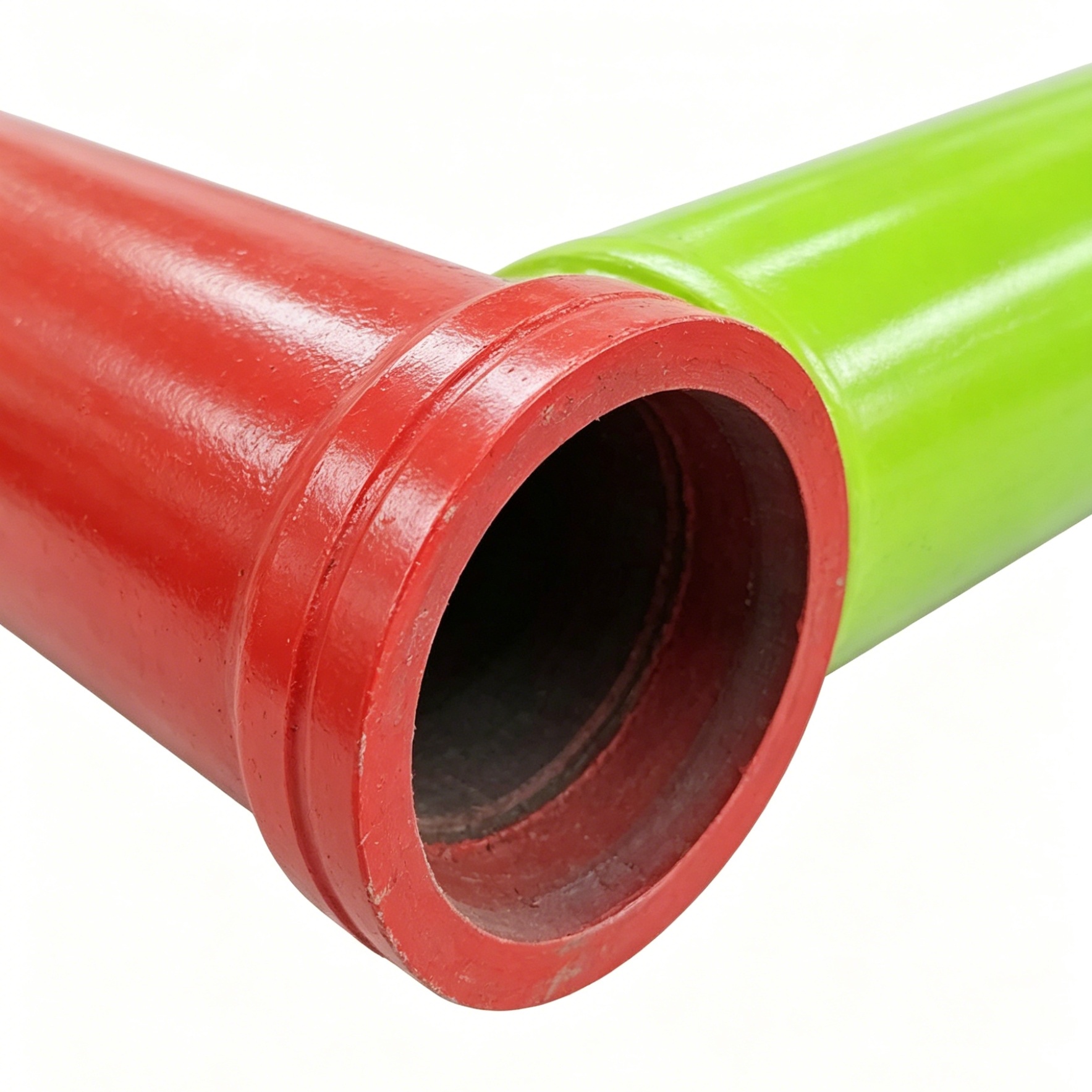
Wear-resistant straight pipe: the code 150L=3000 fixes the DN150 bore and the 3,000 mm length, but not the wear tier behind them.
Worked Example 2: 150R400*90°, a DN150 Elbow at R400 and 90°
150R400*90° reads as a DN150 elbow with a 400 mm bend radius and a 90° bend. The part is catalogued as a double-layer elbow in wear-resistant cast steel or high-strength carbon steel, formed by integral casting or welded forming, then heat-treated with the inner wall quenched. Standard angle options are 90°, 45°, 30° and 15°, all listed as customizable; the radius options in the same block are R180, R190.5 and R275, also customizable. This item's own scope is recorded as DN150 with R=400.
That pair of statements is the most useful lesson in the article. The radius family in a spec block (R180, R190.5, R275) is a menu, not a ceiling, and the radius printed in a model code (R400) is one selection from — or an extension of — that menu. Radius is therefore the least safe segment to assume. Confirm the exact R value on the drawing and in the quotation, and never inherit a radius from a code used on an earlier project.
Radius also has the clearest mechanical consequence. A tighter bend concentrates abrasive wear on the outer wall and adds resistance to the flow of the mix; a longer radius spreads wear across more surface and eases the change of direction, at the cost of occupying more space in a boom, a riser shaft or a tunnel invert. That is why radius and angle are specified as a pair: a 90° elbow at R400 and a 90° elbow at R275 are not interchangeable in wear life or in physical fit, even though both read as "90°".
Angle does a separate job. Right-angle turns in a vertical riser are built from 90° elbows, while gradual direction changes — approaching a placement point, easing around an obstruction — can be spread across 45°, 30° and 15° bends, which is why one elbow family carries four angle options. In tunnel work, where the line must achieve direction changes of 90° to 180° under heavy-duty operation with abrasion resistance as the stated requirement, the angle set and the double-layer construction function together rather than as separate upgrades.
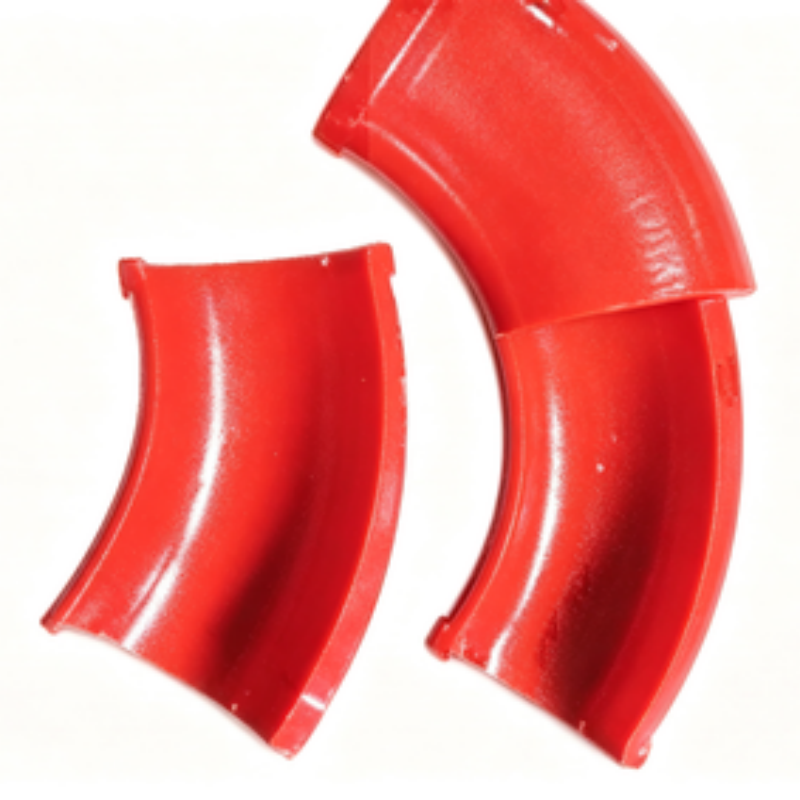
Cast steel elbow: the R segment is a variable, not a house constant — confirm the radius on the drawing before ordering.
Worked Example 3: 150-125 L=1200, a DN150 to DN125 Reducer
150-125 L=1200 reads as a reducer from DN150 to DN125 with an overall length of 1,200 mm. The larger diameter is written first. When the code moves onto a purchase order, state which end connects to the pump side so the part cannot be installed in reverse.
The product block records wear-resistant alloy steel or high-carbon steel pipe; three connection options — thickened pipe end, flange, or pipe clamp connection; customized length with 1 m, 1.5 m and 2 m as common values; and a surface sequence of shot blasting, anti-rust primer and topcoat. Connection method is not part of the code, and it is the attribute most likely to stop an installation: a reducer quoted with a flanged end will not join a line assembled from 150A clamps.
The documented application for this diameter-transition function is bridge construction and infrastructure work: medium-pressure operation, precision fit, connection to matching fittings. That combination explains the 1,200 mm length — a transition section long enough to be handled and clamped as a discrete part rather than a short adaptor at the joint. Precision fit is listed as the special requirement for this application, which makes dimensional verification at goods-in more than a formality.
The Code With No Diameter: 275*90°
275*90° reads as a double-layer elbow with a 275 mm bend radius and a 90° bend — but the diameter is missing. The same product block offers nominal diameters of DN100, DN125 and DN150, angles of 90°, 45°, 30° and 15°, radii of R180, R190.5 and R275, a quenched inner wall, and an anti-rust primer plus topcoat finish. In this catalogue the leading number tracks the R275 radius option rather than a bore — the opposite of the convention used in 150R400*90°, where the leading number is the diameter.
Two rules follow. First, a leading number is not automatically a diameter; check whether an R, an L or a hyphen segment is present before interpreting it. Second, a code that omits the diameter must be completed at the point of order: "275*90°, DN125" is orderable, "275*90°" alone is not. Naming the diameter also lets the supplier match the elbow to the clamps and straight pipes around it, because a DN125 elbow in a DN150 line is a conversion, not a repair.
150A: The Clamp Code and the Joint Layer
150A reads as a clamp for a DN150 joint. The clamp block records high-quality cast iron or cast steel, integral casting with precision machining, shot blasting and anti-rust spraying, and compatibility with DN100, DN125 and DN150 as customizable diameters.
The letter suffix is not standardised in the published block, so treat it as a supplier-side identifier and confirm it against the drawing instead of decoding it from first principles. What matters commercially are the two facts the code does carry: the compatible diameter, and the fact that the clamp is a separate line item. Straight pipes, elbows and reducers do not arrive with their clamps, which is why a clamp-jointed line should be ordered with the clamp count included — typically one clamp per joint — and why the reducer block lists clamp connection as only one of three end options.
Clamp joints also move the inspection point. In a clamp-connected line the joint decides pressure retention and alignment, so a pressure test and a dimensional check at the joint belong in acceptance, not only on the pipe body.
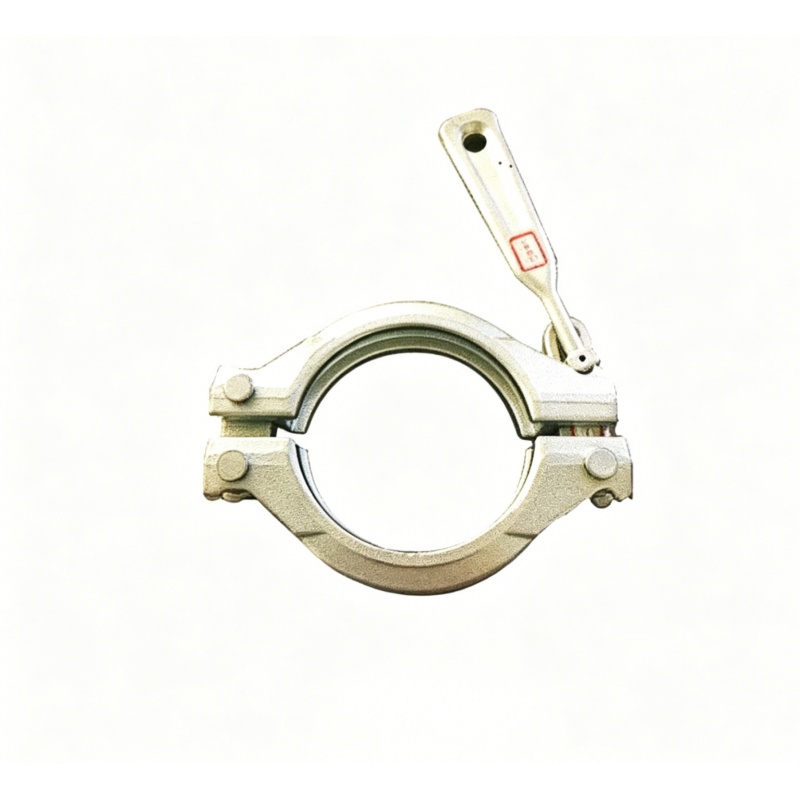
Wedge type clamp: joint components carry their own codes and must be counted per joint, not assumed with the pipe.
Matching the Codes to High-Rise, Tunnel, Bridge and Mining Work
Once the code is decoded, the project decides which of the open attributes must be fixed. The four documented application settings below differ mainly in pressure, duty cycle and wear mechanism.
High-rise building pumping. Continuous operation of 8–12 hours per day with pump truck integration, under high pressure, with wear resistance stated as the requirement. Codes in this setting need the straight-pipe wear tier and hardness written down, and the vertical run needs double-layer elbows at every change of direction, because the elbow absorbs the concentrated wear at each turn.
Tunnel construction. Direction changes of 90° to 180° under heavy-duty operation, with abrasion resistance as the stated requirement — a duty that consumes elbows faster than straights and makes the angle set and double-layer construction the decisive specification. A line that stacks bends to reach 180° concentrates wear at each individual bend, so the radius of each bend should be confirmed rather than inherited.
Bridge and infrastructure work. Medium-pressure operation focused on pipe diameter transition and precision fit. The reducer code does most of the work here, and "150-125 L=1200" plus the connection method fully describes the part.
Mining and slurry transport. 24/7 operation combining corrosion and wear resistance — the harshest duty in the set, and the one where the highest documented tier and the quenched hardness range earn their cost premium. In a mine line, a wear-tier downgrade hidden behind an unchanged code is the most expensive mistake available.
| Application | Documented operating condition | Code attributes to fix before ordering |
|---|---|---|
| High-rise building | Continuous 8–12 h/day, pump truck integration, high pressure, wear resistance | Straight-pipe wear tier and hardness; elbow layer construction and radius |
| Tunnel | Heavy-duty operation, direction change of 90–180°, abrasion resistance | Angle set, radius per bend, double-layer elbows |
| Bridge / infrastructure | Medium pressure, diameter transition, precision fit | Reducer diameter pair, overall length, connection method |
| Mining / slurry | 24/7 operation, corrosion and wear resistance | Highest wear tier, quenched hardness, clamp specification |
Writing an Order Line That Cannot Be Misread
A code plus its open attributes is a complete order line, and in that form it survives quotation, production and goods-in without reinterpretation.
- Straight pipe: model code, nominal diameter, length, wear tier, material, hardness range, end finish, quantity.
- Elbow: model code, nominal diameter, radius, angle, layer construction, inner-wall treatment, quantity.
- Reducer: model code, both diameters in flow order, overall length, connection method at each end, quantity.
- Clamp: model code, compatible diameter, quantity per joint, and the pipe-end type it must match.
Customization sits on top of that structure rather than replacing it. OEM/ODM work covers custom specifications, custom lengths, logo printing and brand packaging; minimum order quantity starts at one piece for a sample order, and lead time runs 15–30 days. Monthly capacity is stated as 50,000 meters of straight pipe plus 15,000 pieces of curved pipe, which is the relevant figure when one coded order has to be repeated across several project phases.
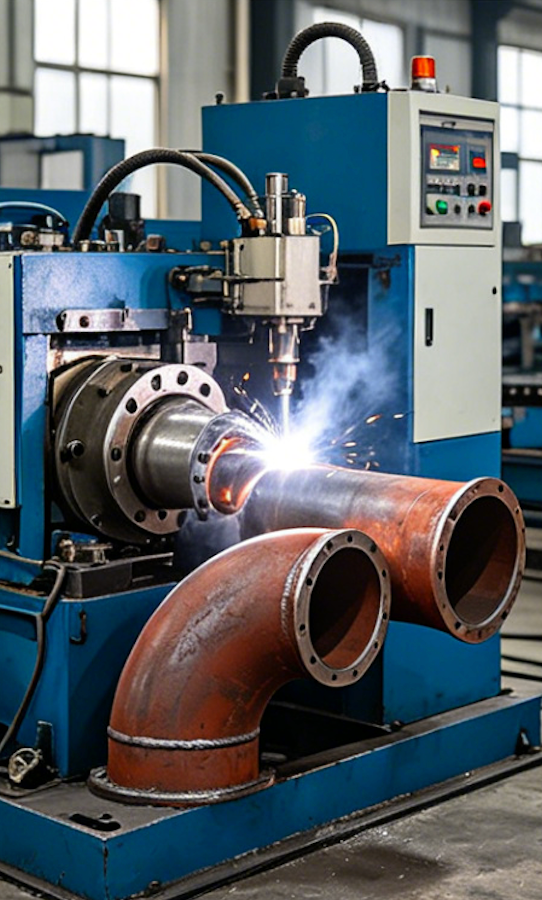
Custom radius and custom length are production options, not code variations — both must be stated in the order line.
Acceptance Checks for Coded Parts
Acceptance is where a code stops being a text string and becomes a measurement. The checks below map to the documented quality-control steps: 100% inspection, pressure testing, hardness testing (HRC) and dimensional check.
Dimensional check against the code. Verify bore, overall length, radius and angle, plus both diameters on a reducer. Radius is the value most often assumed rather than measured.
Hardness verification. Quenched product is documented at HRC 55–62, and one documented high-rise case reports operation at HRC 58–62 inside that range. Ask for the reading rather than the adjective, and check where the test was taken, because an inner-wall quench and a through-wall hardness number describe different things.
Pressure test and joint check. Confirm that the test was performed and record the result for joints as well as bodies, especially on clamp-connected lines.
Certificate scope. A model code never carries conformity information. The scope statement of ISO 21573-1:2024 concerns commercial specifications for concrete pumps used on building sites; it does not certify a pipe product and should not be presented as if it did. For any CE or ISO 9001 claim, request the certificate number, the issuing body and the product scope the certificate actually covers.
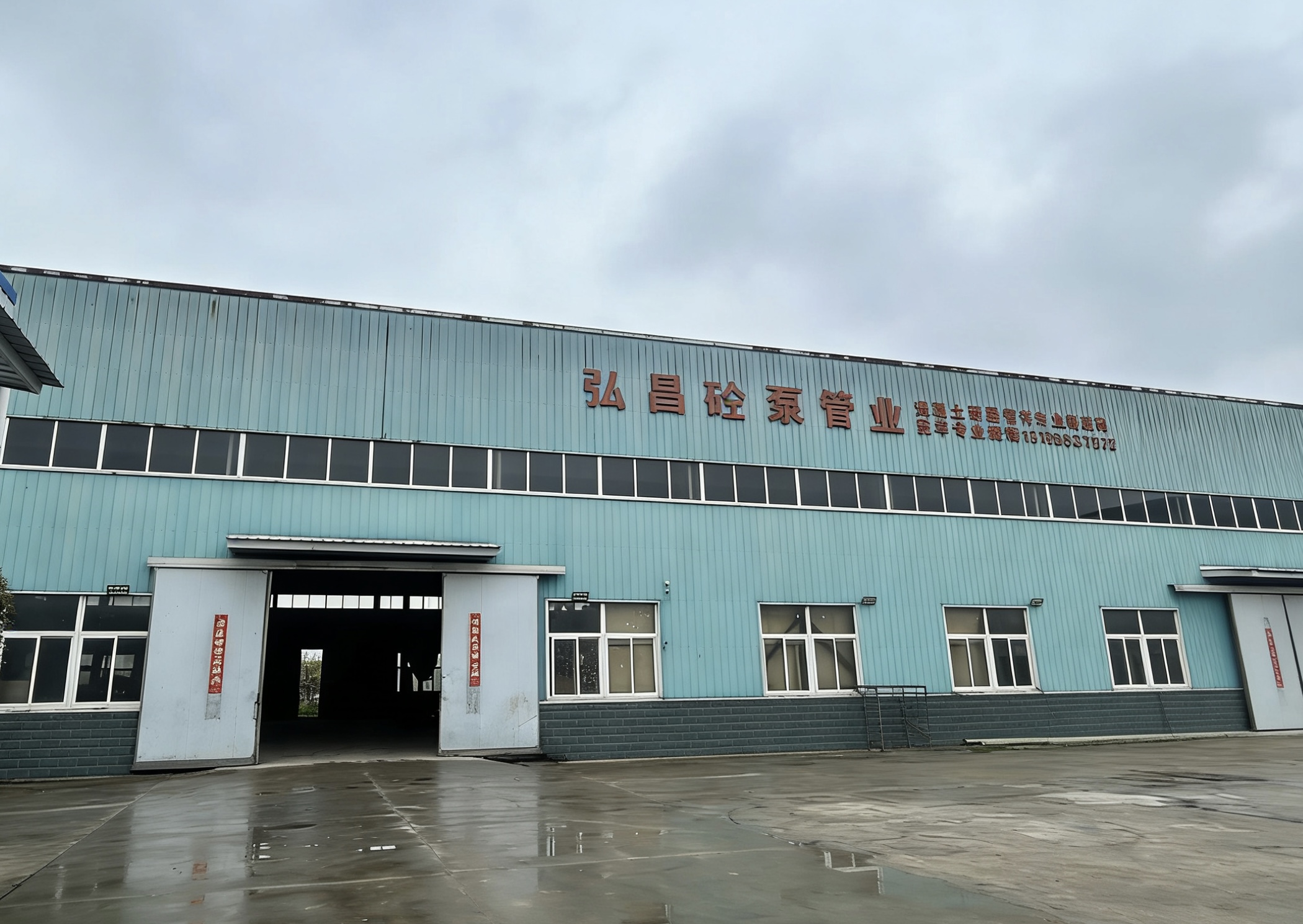
Hongchang Machinery Technology Co., Ltd. is a concrete pump pipe manufacturer based in Ma'anshan City, Anhui Province, China, producing straight pipes, elbows, clamps and reducers. The company reports annual output of 50,000 meters of straight pipe and 15,000 curved pipes from a 2,600 m² facility, a 50% export ratio, and states that it is a designated supporting manufacturer for Xingma Automobile, with pipes matched to pump trucks and tow pumps from Sany Heavy Industry and Zhonglian Heavy Industry. Those are company statements, so the specification details behind any coded order should be confirmed against its documentation at hongchangpumpipe.com.
Frequently Asked Questions
Does a concrete pump pipe model code confirm CE or ISO 9001 compliance?
No. A code describes geometry — diameter, length, radius, angle — and carries no conformity information. Compliance is verified separately by requesting the certificate number, the issuing body and the exact product scope. Note also that ISO 21573-1:2024 sets out commercial specification content for concrete pumps used on building sites; it is a pump-level standard, not a pipe certification. A CE mark or an ISO 9001 certificate covering one product line should not be read as covering every coded item in a catalogue.
What does the 150 in 150L=3000 or 150R400*90° actually mean?
It is the nominal bore: 150 means DN150. The code prints the number without the DN prefix, and DN is the designation used on drawings and specifications. DN100, DN125 and DN150 form the working range in this product family, and a reducer writes both diameters in one code, as in 150-125.
What does the R in 150R400*90° control, and can the radius be customized?
R is the bend radius in millimetres, so R400 is a 400 mm radius, and 90° is the bend angle. Radius affects both fit and wear concentration: a tighter bend concentrates abrasive wear on the outer wall and adds resistance to flow, while a longer radius spreads wear but takes more space. Radius options are listed as customizable — the elbow family documents R180, R190.5 and R275 as options while this item's scope is recorded as R=400 — so confirm the exact radius on the drawing and quotation instead of inferring it from the code format.
Why does the double-layer elbow code 275*90° have no diameter?
Because the leading number in that catalogue refers to the R275 bend radius rather than to a bore, the opposite of the 150R400*90° convention. The same product block offers DN100, DN125 and DN150, so the diameter must be added when ordering: "275*90°, DN125" is a complete requirement, whereas "275*90°" alone leaves the bore open and cannot be matched to the surrounding line.
Why can two pipes coded 150L=3000 have very different service life?
Because the code fixes diameter and length only. One documented straight-pipe specification carries three design-life levels under a single code — 7,000–8,000 m³, 25,000–40,000 m³ and 40,000–50,000 m³, with cost-performance indices of 1, 1.6 and 3.0 — alongside material options that include 20# steel, quality alloy structural steel and quenched alloy steel at HRC 55–62. Buying "150L=3000" without the tier and hardness means buying an unspecified wear part at a specified size.
How do I check that a coded part matches my line before a bulk order?
Order a sample: minimum order quantity is one piece, which makes physical verification practical. Check bore, overall length, radius, angle and end connection; on a reducer, confirm both diameters in flow order; confirm the hardness reading sits inside the stated range; and confirm the clamp diameter matches the pipe ends, since clamps are separate items and the suffix letter is supplier-specific. A part that fails one of those checks will fail the same way in a bulk shipment.
What lead time and customization apply to coded pipe orders?
Lead time is documented at 15–30 days, with monthly capacity of 50,000 meters plus 15,000 pieces. Customization covers custom specifications, custom lengths, logo printing and brand packaging, so a code can be adapted to a project module rather than the reverse. To move from decoding to a quotation, send the full order line — code, diameter, length or radius and angle, wear tier, material, hardness range, connection and quantity — and request a one-piece sample plus pricing against that line by email at chenzhen@hongchangpumpipe.com or WhatsApp +86-13301770177.
Conclusion: Read the Code, Then Complete It
Model codes are efficient once their limits are clear. 150L=3000 fixes a DN150 bore and a 3,000 mm length; 150R400*90° fixes a DN150 bore, a 400 mm radius and a 90° bend; 150-125 L=1200 fixes a DN150-to-DN125 transition 1,200 mm long; 275*90° fixes a radius and an angle but leaves the bore to the buyer; 150A fixes a DN150 clamp joint. Every one of those codes leaves material, wear tier, hardness, layer construction and connection open — and those are the attributes that decide how many cubic metres a part delivers before it is replaced.
The working habit is short: decode the geometry, write the open attributes into the same order line, and verify both at goods-in. Applied to a high-rise riser, a tunnel bend sequence or a bridge transition, that habit is what turns a model code from a label into a specification.
Need a sample against a decoded code?
Send the model code with its wear tier, material, hardness range and connection type, and the technical team can quote against that full line and supply a one-piece sample for fit and hardness verification before a bulk order.
Have Questions or Need More Details?
Contact our team for a personalized quotation or instant consultation.
Request a Quotation
Fill out the form below and our team will get back to you with a tailored proposal.
WhatsApp Direct Chat
Prefer to chat in real-time? Message us on WhatsApp for instant assistance & quick answers.
- Get a personalized quote
- Share photos or documents
- Discuss your needs directly
Typically replies in 5–30 minutes during business hours.