High-Rise Concrete Pump Pipe Elbow Wear: A Double-Layer Fix
A high-rise delivery line typically runs 8–12 hours a day and turns through 90°–180° between the pump truck and the placing point. Wear does not spread evenly across that line — it concentrates at the bends. Matching each bend with the right double-layer elbow, in the right diameter, radius, angle, and inner-wall material, is what keeps a vertical line productive.
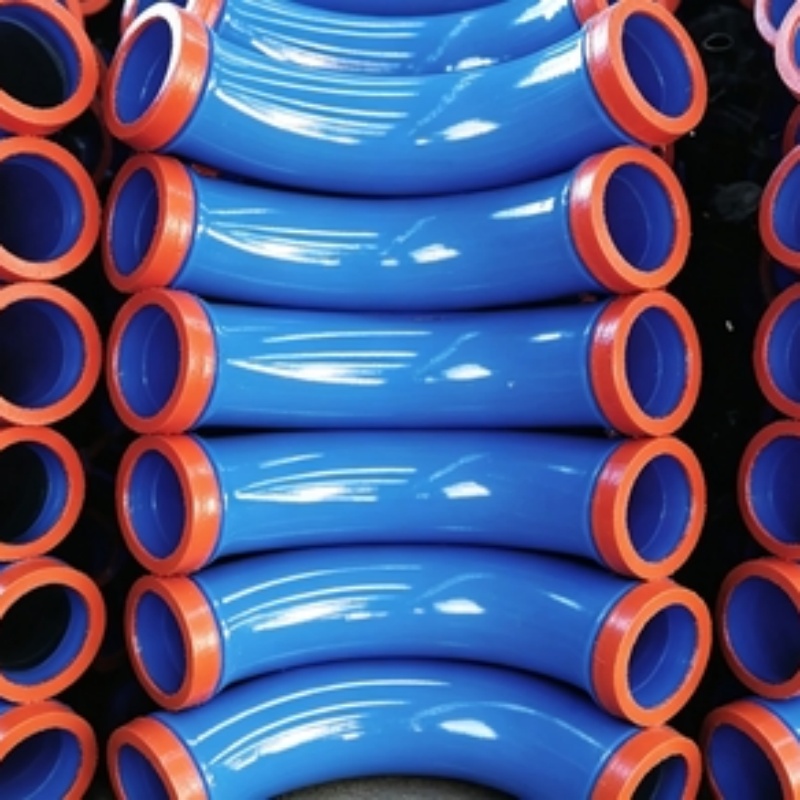
Cast steel double-layer elbow, DN150 R=400 — the high-pressure bend of a high-rise delivery line. Image: Hongchang Machinery Technology Co., Ltd.
High-rise concrete pumping asks a delivery line to do something a ground pour does not: hold pressure while climbing, and keep doing it for most of a working day. Between the pump outlet at street level and the placing boom on the structure, the concrete changes direction by 90° to 180°, and every degree of that change is absorbed by an elbow. The bends are where the line is loaded hardest and where a forced stoppage costs the most.
This article treats elbows as specified components rather than generic fittings. It covers what happens at the bends of a high-rise line, how a double-layer elbow is built, and how diameter, radius, angle, and material are matched to a real project — using the specification data of two Hongchang double-layer elbow models as the working example.
The Problem: High-Rise Lines Do Not Wear Evenly
In a concrete delivery line, the straight runs and the bends do not age at the same rate. The bend is the wear point, and on a high-rise site four conditions combine to make it the failure point as well.
- Direction change concentrates abrasive contact. On a straight run, concrete moves in one direction and the abrasive fraction of the mix — sand and coarse aggregate — travels largely parallel to the pipe wall. At a bend, that flow is forced to change direction, and particles strike the outer wall of the elbow at an angle instead of sliding past it.
- The vertical lift adds pressure to the same location. Lifting concrete up a structure requires pressure, and the outer wall of each bend carries that pressure while it is already absorbing abrasion.
- The duty cycle removes recovery time. High-rise pumping commonly runs continuously for 8–12 hours a day, integrated with a pump truck, with high pressure and wear resistance as the stated requirements for the pipe system.
- Access is worst where failure is most likely. Once the line is climbing a structure, a bend is often the least accessible item on it. Replacing one mid-pour is a stoppage, not a maintenance task.
The practical result: a project that buys elbows as a single line item tends to replace the same bend repeatedly while the straight pipe behind it is still serviceable. The alternative is to specify elbows by position in the line, which is what the rest of this article sets out.
Industry Background: More Concrete, Delivered Under More Pressure
Two industry trends push the delivery line — not only the pump — toward a higher specification.
The first is volume. The global concrete pump market was valued at approximately USD 6.05 billion in 2024, with expectations to grow at a CAGR of 5.13% through 2032, according to Credence Research. Asia Pacific dominated that market in 2025 with an estimated 42% revenue share, driven primarily by infrastructure projects in China and India, based on GMInsights industry analysis. More pumped concrete means more metres of delivery line in service, and more elbows consuming their wear allowance.
The second is equipment mix. Truck-mounted concrete pumps held a dominant 48% market share in 2025 because of their mobility and efficiency in urban construction environments, according to Technavio. Truck-mounted units are the standard choice for high-rise work, and they are served by delivery lines built from pipe, elbow, reducer, and clamp components.
On the delivery side, the technical response to higher pressure has been the double-layer pipe. High-pressure concrete delivery systems frequently use twin pipes — a double-layer construction — to handle pressures up to 85 bar and to minimise abrasive wear from large aggregates, as described by Esser Twin Pipes. The same logic applies to bends: the elbow is where pressure and abrasion meet, so it is the component where a two-layer construction has the most work to do.
For projects in, or selling into, the European Union, EN 12001:2012 is the relevant reference. It specifies safety requirements for conveying, spraying, and placing machines for concrete and mortar and applies to concrete pump delivery systems. It is a system-level standard rather than an elbow specification, which is why buyers usually ask suppliers for documentation on how the delivery system addresses it.
The Double-Layer Elbow: Construction and Specification
A double-layer elbow separates two jobs that a single-wall bend has to perform at the same time. The inner wall carries abrasion: it is the surface the concrete actually touches, and it is hardened to resist it. The outer layer carries the structural load: it holds pressure and keeps the geometry of the bend stable. Splitting those functions is what allows the inner surface to be hardened without compromising the pressure performance of the fitting.
Hongchang Machinery Technology Co., Ltd. produces elbows on this principle. The process route is integral casting or welded forming, followed by heat treatment and inner-wall quenching. The same production line quotes inner-wall hardness of HRC 55–62 after quenching for its wear-resistant pipe range.
Model 150R400*90°: the DN150 bend for the main high-rise line
The 150R400*90° is a double-layer elbow applied at DN150 with a bend radius of R=400, which places it on the main vertical run of a high-rise line rather than on a branch. It is made from wear-resistant cast steel or high-strength carbon steel and is produced either by integral casting or by welded forming, in both cases followed by heat treatment and inner-wall quenching. The angle is available in 90°, 45°, 30°, and 15°, and the bend radius can be supplied in R180, R190.5, or R275, all customizable.
Model 275*90°: the quenched-inner-wall bend for DN100–DN150
The 275*90° is a double-wall elbow built around a quenched inner wall. It is available in nominal diameters DN100, DN125, and DN150, with a catalogue scope of DN180–DN275 across various angles, and it shares the same angle and radius options as the DN150 model: 90°, 45°, 30°, and 15°, with R180, R190.5, and R275 bend radii, all customizable. The finished part is protected with an anti-rust primer and a topcoat spray.
Radius and angle: the two numbers that decide how a bend behaves
Bend radius and bend angle describe different things, and buyers sometimes treat them as interchangeable. They are not.
The angle states how much the flow direction changes at that fitting — 90° for a full turn, 45°, 30°, or 15° for part of a turn. The radius states how much distance the concrete is given to make that change. A longer radius gives the flow more arc to turn through, which spreads abrasive contact over a greater length of wall. A shorter radius fits a confined shaft or tight boom geometry, but it concentrates the same load into a shorter arc.
This produces a practical trade-off. Building a 90° turn from one 90° elbow takes one fitting and one joint. Building the same turn from two 45° elbows, or from three 30° elbows, uses more fittings and more clamps and takes longer to assemble — but each individual bend is shallower and does less work per unit of wall. Which of those matters more depends on the space the line has, not on a general rule, and that is why both radius and angle are offered as customizable values rather than fixed catalogue sizes.
Selection note. There is no single correct elbow for a high-rise line. The workable approach is to decide the turn geometry first — how much direction change happens at that position, and how much room the structure leaves for it — and then to pick the radius and angle that fit, keeping the diameter consistent with the main line and using a reducer only where the diameter genuinely has to change.
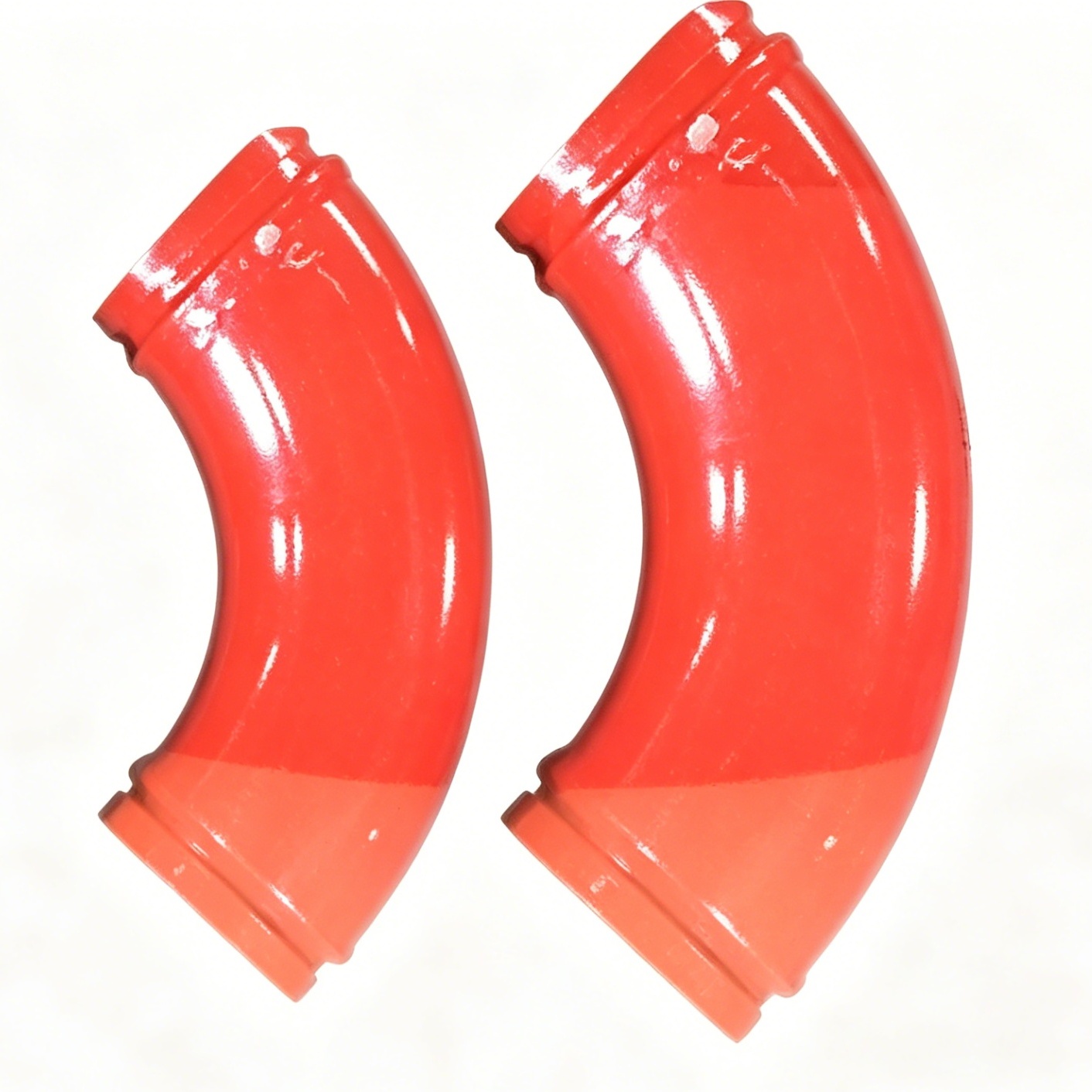
The 275*90° double-wall elbow, DN100–DN150, quenched inner wall, with 90°/45°/30°/15° angle options. Image: Hongchang.
Step-by-Step: Matching Elbows to a High-Rise Line
The sequence below turns the specification options above into a line schedule. It follows the order in which the decisions actually constrain each other: geometry first, then diameter, then the fitting details.
- Map every turn in the line. Walk the route from the pump truck outlet to the placing point and record each direction change and its angle. On a high-rise line, the total change between the pump and the boom is commonly between 90° and 180°, and each change is a bend that has to be specified rather than an incidental.
- Fix the main diameter. DN150 is the working diameter of the high-rise delivery line, and the 150R400*90° elbow is applied at DN150 with R=400. Where the line has to step down, the transition should be handled by a dedicated reducer rather than by forcing a mismatch. Hongchang's reducer is built for the DN150-to-DN125 transition at L=1200 mm, with thickened pipe end, flange, or pipe clamp connection, custom lengths (commonly 1 m, 1.5 m, or 2 m), and a shot-blasted, primed, topcoated finish.
- Set the angle at each position. Use a 90° elbow where the line makes the whole turn at one point — typically close to the pump outlet or where the line leaves the boom. Where the structure allows a longer transition, break the turn into 45°, 30°, or 15° segments so that no single fitting carries the entire direction change.
- Choose the radius for that position. R=400 is the applied radius on the DN150 model; R180, R190.5, and R275 are the catalogue radius options, and all are customizable. The radius should follow the space the structure provides at that bend.
- Confirm material, process, and the joint. Specify wear-resistant cast steel or high-strength carbon steel for the 150R400*90° model, or the quenched inner wall for the 275*90° model. Then make sure the joint matches: the 150A clamp is an integral-cast, precision-machined fitting compatible with DN100, DN125, and DN150, shot-blasted and anti-rust sprayed, so the elbow, reducer, straight pipe, and clamp are specified as one system rather than four separate purchases.
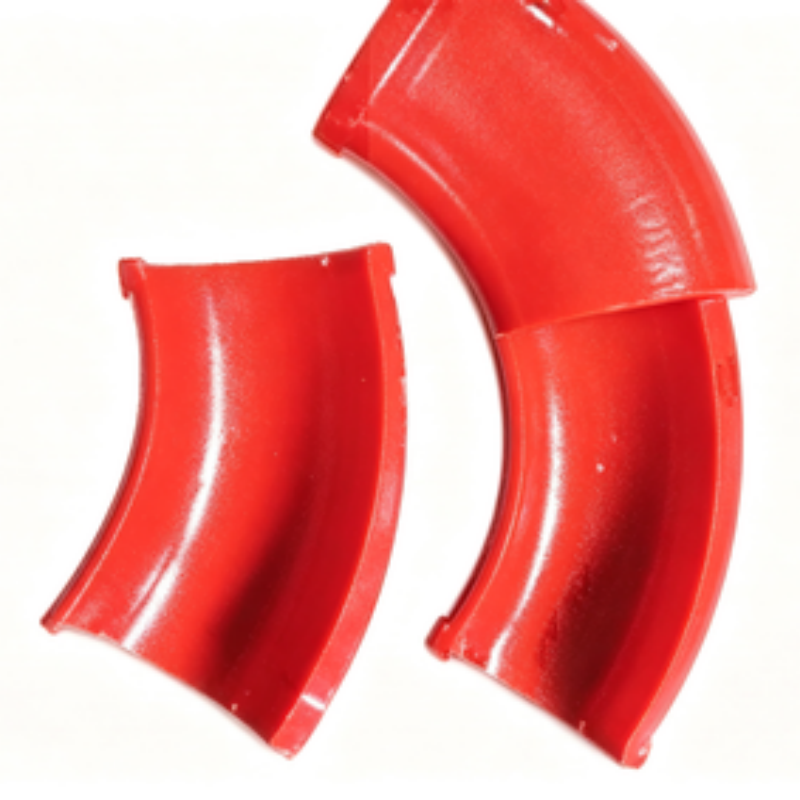
Cast steel elbow after heat treatment — the outer layer holds pressure while the quenched inner wall takes abrasion. Image: Hongchang.
Use Cases: Where This Specification Logic Applies
High-rise work is the scenario this article is built around, but the same matching logic — diameter, radius, angle, material — applies wherever a delivery line is loaded at its bends.
- High-rise building concrete pumping. Continuous operation of 8–12 hours per day, integrated with a pump truck, under high pressure with wear resistance as the defining requirement. Both elbow models above are applied here.
- Tunnel construction. Direction change of 90–180° under heavy-duty operation, with abrasion resistance as the special requirement. A tunnel line often packs more bends into a shorter distance than a vertical shaft, which raises the number of positions where radius and angle have to be chosen deliberately.
- Bridge construction. Pipe diameter transition is the primary function, operating at medium pressure with precision fit as the requirement — which puts the reducer and the clamp, not only the elbow, at the centre of the specification.
- Mining. Mine concrete injection and slurry transportation running 24/7, with corrosion and wear resistance required and a slurry pump system as the matched equipment.
Three reported outcomes from Hongchang's own project records illustrate what a matched specification looks like in service:
- A construction company took 50 units for a high-rise building project. Over a three-year period, the reported result was stable operation with a 30% longer lifespan, with the supplied items highlighted for high wear resistance at HRC 58–62.
- An equipment OEM integrated 200 pieces into pump truck manufacturing over a two-year programme, with custom specifications and quality consistency as the outcome of the integration.
- A mining company ordered 100 metres for underground mining. Over four years in heavy-duty service, reported maintenance was reduced by 40%.
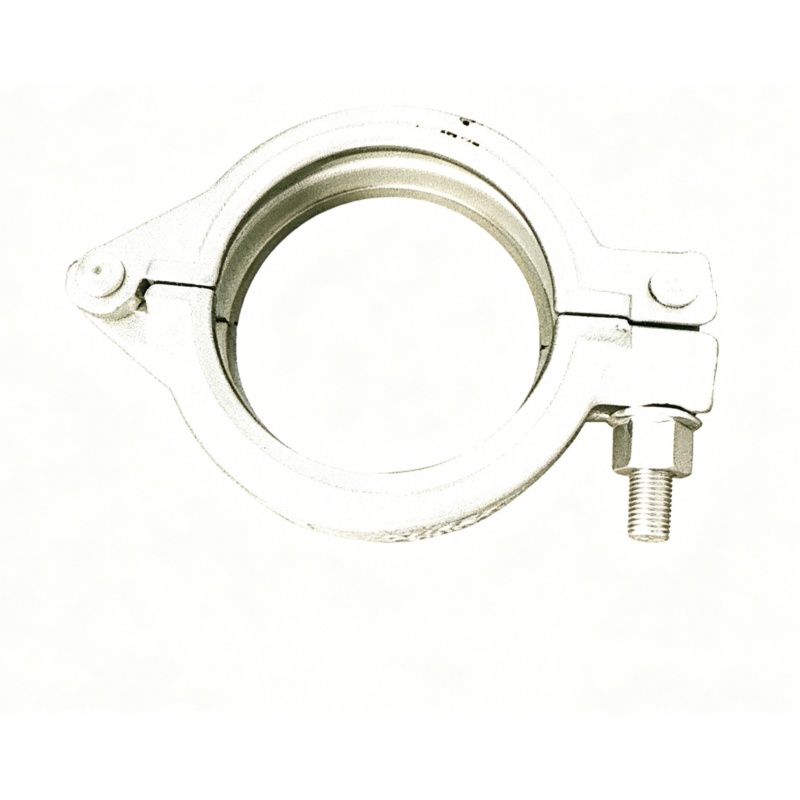
The 150A clamp joins elbow, reducer, and straight pipe into one delivery system. Image: Hongchang.
Double-Layer Elbow Specification Comparison
The table below compares the two double-layer elbow models on the parameters a buyer has to confirm before ordering. Values are the catalogue specifications for each model.
| Parameter | 150R400*90° | 275*90° |
|---|---|---|
| Type | Double-layer elbow | Double-wall elbow |
| Material | Wear-resistant cast steel / high-strength carbon steel | Quenched inner wall |
| Process | Integral casting / welded forming + heat treatment + inner-wall quenching | Double-wall construction with quenched inner wall |
| Nominal diameter | DN150 | DN100 / DN125 / DN150 |
| Applied / catalogue size | DN150, R=400 | DN180–DN275 across various angles |
| Bend radius | R180 / R190.5 / R275 (customizable) | R180 / R190.5 / R275 (customizable) |
| Angle | 90° / 45° / 30° / 15° (customizable) | 90° / 45° / 30° / 15° (customizable) |
| Surface treatment | Not specified in catalogue | Anti-rust primer + topcoat spraying |
| Certification | ISO 9001:2015, certificate ISO-2024-HC | ISO 9001:2015, certificate ISO-2024-HC |
Two rows are worth reading carefully. The process row is the difference that is hardest to see after delivery: a heat-treated, quenched elbow and a plain bend can look similar from the outside. The diameter row is the one that decides where each model belongs — DN150 with R=400 on the main line, and the DN100–DN150 range of the 275*90° model where the line is smaller or where a stepped turn is being built.
Compliance and Verification Before You Order
For high-rise and infrastructure buyers, the specification is only half of the procurement file; the other half is what can be verified. Three points are checkable before an order is placed.
- ISO 9001:2015 certification. The Double-layer Elbow product is certified to ISO 9001:2015 for the global market, issued by Certification Body under certificate number ISO-2024-HC. The certificate was issued on 13 November 2025, expires on 12 November 2028, and covers manufacturing quality.
- System-level standard for EU-facing projects. EN 12001:2012 specifies safety requirements for conveying, spraying, and placing machines for concrete and mortar. It applies to the delivery system as a whole, so it is worth asking a supplier how their delivery components are addressed within that framework rather than treating it as an elbow certificate.
- Production quality control. Hongchang's inspection regime covers 100% inspection, pressure testing, hardness testing (HRC), and dimensional checks, applied to a monthly capacity of 50,000 metres of straight pipe plus 15,000 curved pipe pieces.
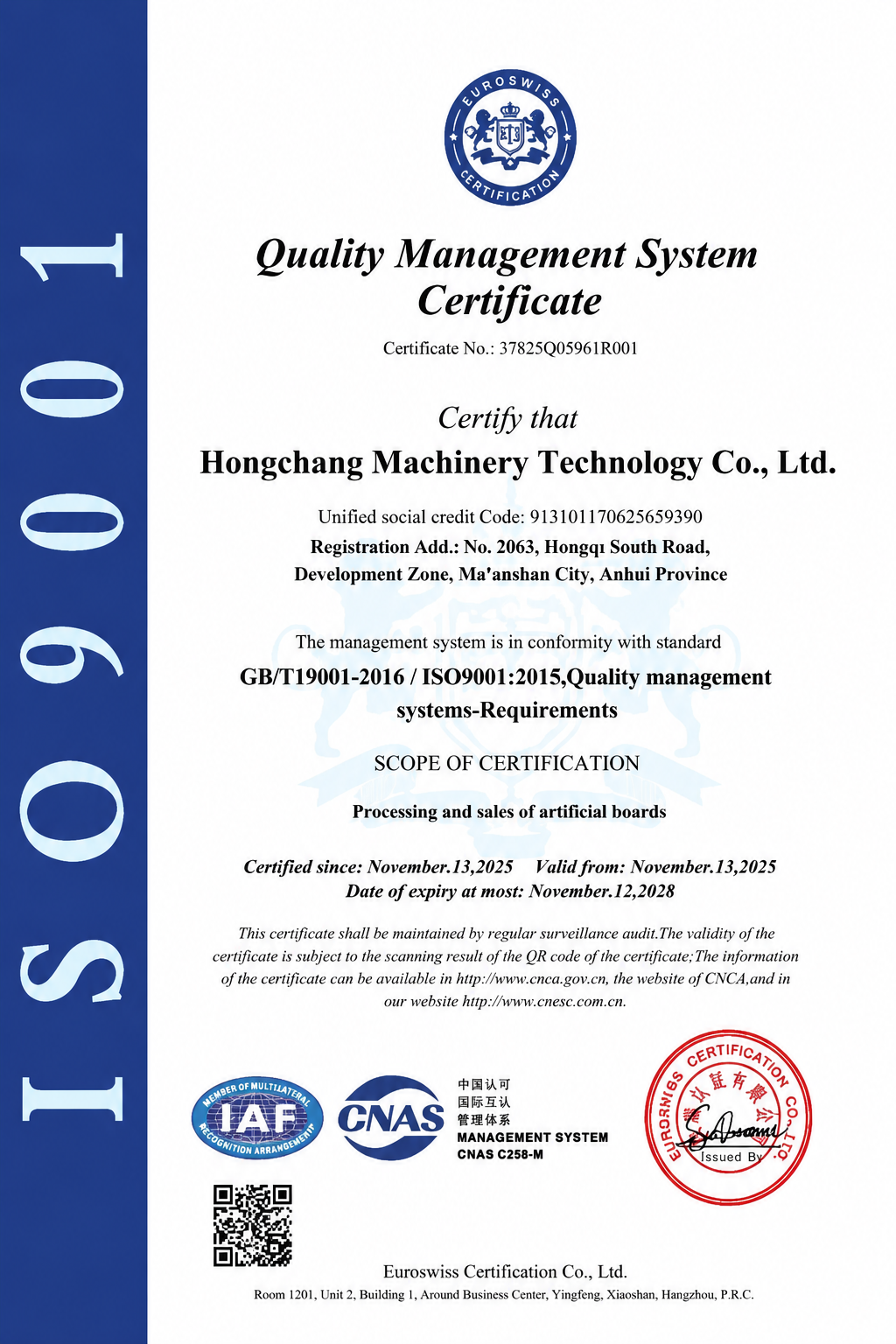
ISO 9001:2015 certification, certificate number ISO-2024-HC, covering manufacturing quality for the global market. Image: Hongchang.
FAQ: Double-Layer Elbows for High-Rise Concrete Pumping
Is the Hongchang double-layer elbow certified for international projects?
Yes. The Double-layer Elbow product is certified to ISO 9001:2015. The certification is issued by Certification Body under certificate number ISO-2024-HC, applies to the global market, and covers manufacturing quality. It was issued on 13 November 2025 and expires on 12 November 2028. For EU-facing projects, EN 12001:2012 is the relevant system-level standard — it specifies safety requirements for conveying, spraying, and placing machines for concrete and mortar — and buyers usually ask how the delivery system as a whole addresses it.
Can the elbow be supplied in a specific diameter, radius, and angle?
Yes. The 150R400*90° double-layer elbow is applied at DN150 with R=400 and is made from wear-resistant cast steel or high-strength carbon steel through integral casting or welded forming, heat treatment, and inner-wall quenching. The 275*90° double-wall elbow uses a quenched inner wall and is available in DN100, DN125, and DN150, with a catalogue scope of DN180–DN275 across various angles. Both models offer 90°, 45°, 30°, and 15° angles and R180, R190.5, and R275 bend radii, all customizable. Custom specifications, logo printing, brand packaging, and custom lengths are available under OEM/ODM.
What drives the cost of a double-layer elbow?
The material and the process route are the first cost variables: wear-resistant cast steel versus high-strength carbon steel, and integral casting versus welded forming, in both cases with heat treatment and inner-wall quenching. Diameter is the second, and the amount of non-standard customization in radius, angle, or length is the third. A useful reference for how material grade scales cost within the same product family is Hongchang's single-layer straight pipe, which is listed in three design-life tiers — 7,000–8,000 m³, 25,000–40,000 m³, and 40,000–50,000 m³ — at cost-performance ratios of 1, 1.6, and 3.0. The same logic applies to bends: the lowest unit price does not automatically produce the lowest line cost.
Can I validate the elbow with a sample before committing to a full order?
Yes. Sample orders start at 1 piece, and OEM/ODM customization — custom specifications, logo printing, brand packaging, and custom lengths — is available for buyers who need a trial fit or a branded build. Production orders are covered by 100% inspection, pressure testing, hardness testing (HRC), and dimensional checks. To request a sample, send the line drawing or the required diameter, radius, and angle through hongchangpumpipe.com and the team will confirm the closest catalogue match.
What is the lead time and the monthly supply capacity?
Standard lead time is 15–30 days, supported by a monthly capacity of 50,000 metres of straight pipe plus 15,000 curved pipe pieces. Elbows with custom radius, angle, or length are produced within the same window according to the customization involved. Hongchang's main export markets are Southeast Asia, the Middle East, Europe, and the Americas, and after-sales support covers technical support, spare parts supply, installation guidance, and remote troubleshooting.
Conclusion: Specify the Bends, Not Just the Pipe
On a high-rise pour, the delivery line is under load for most of a working day and changes direction by 90° to 180° on the way up. The straight runs handle their share of that duty, but the bends are where abrasion, pressure, and limited access meet — which is why an elbow specified by position, rather than bought as a generic fitting, changes how the line performs across a project.
The specification itself is not complicated. It is a diameter that matches the main line, a radius and angle that fit the turn the structure actually makes, and a two-layer construction in which the quenched inner wall takes the abrasion while the outer layer holds the pressure. For the DN150 main line, that means the 150R400*90° cast steel heat-treated double-layer elbow at R=400; for DN100 to DN150 positions and stepped turns, the 275*90° double-wall elbow with quenched inner wall and R180, R190.5, or R275 radius. Reducer and clamp selection completes the system.
Next Step: Sample, Specification Quote, or Catalogue
Hongchang Machinery Technology Co., Ltd. is a concrete pump pipe and elbow manufacturer based in Ma'anshan City, Anhui Province, China, exporting to Southeast Asia, the Middle East, Europe, and the Americas, with sample orders starting at 1 piece.
Send your line drawing, required diameter, radius, and angle, and the team will confirm the model match, certification documents, lead time, and pricing.
Website: www.hongchangpumpipe.com | Email: chenzhen@hongchangpumpipe.com | Tel / WhatsApp: +86-13301770177
Address: No. 2063, Hongqi South Road, Development Zone, Ma'anshan City, Anhui Province, China
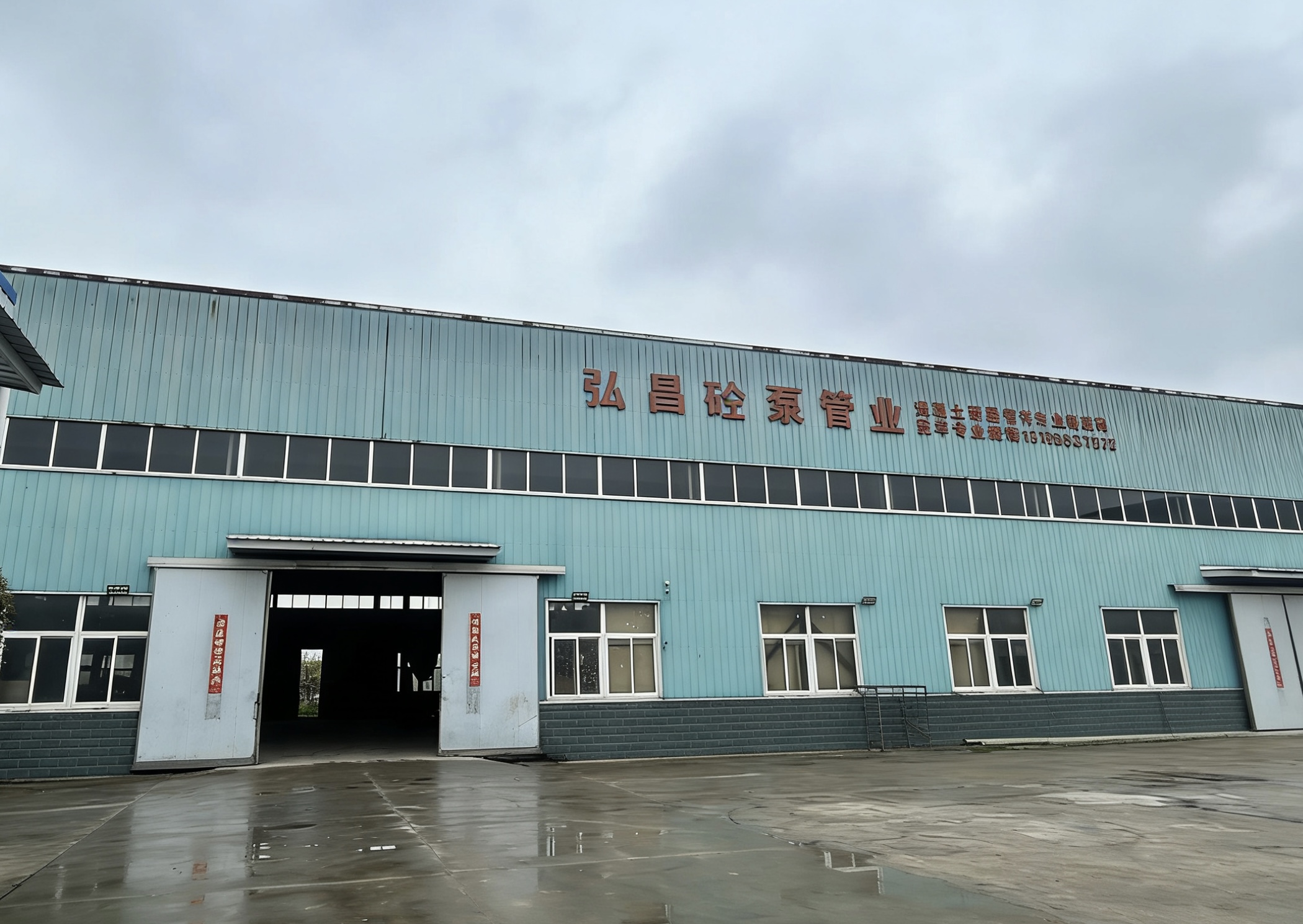
Hongchang Machinery Technology Co., Ltd., Ma'anshan City, Anhui Province — 50,000 m of straight pipe and 15,000 curved pipe pieces per year. Image: Hongchang.
Have Questions or Need More Details?
Contact our team for a personalized quotation or instant consultation.
Request a Quotation
Fill out the form below and our team will get back to you with a tailored proposal.
WhatsApp Direct Chat
Prefer to chat in real-time? Message us on WhatsApp for instant assistance & quick answers.
- Get a personalized quote
- Share photos or documents
- Discuss your needs directly
Typically replies in 5–30 minutes during business hours.