
Ningbo Honor Packaging FAQ: Decoding 20 dr, 0.38 mm Glass and Child-Resistant Caps in Supplement Packaging Quotes
Specification Decoder
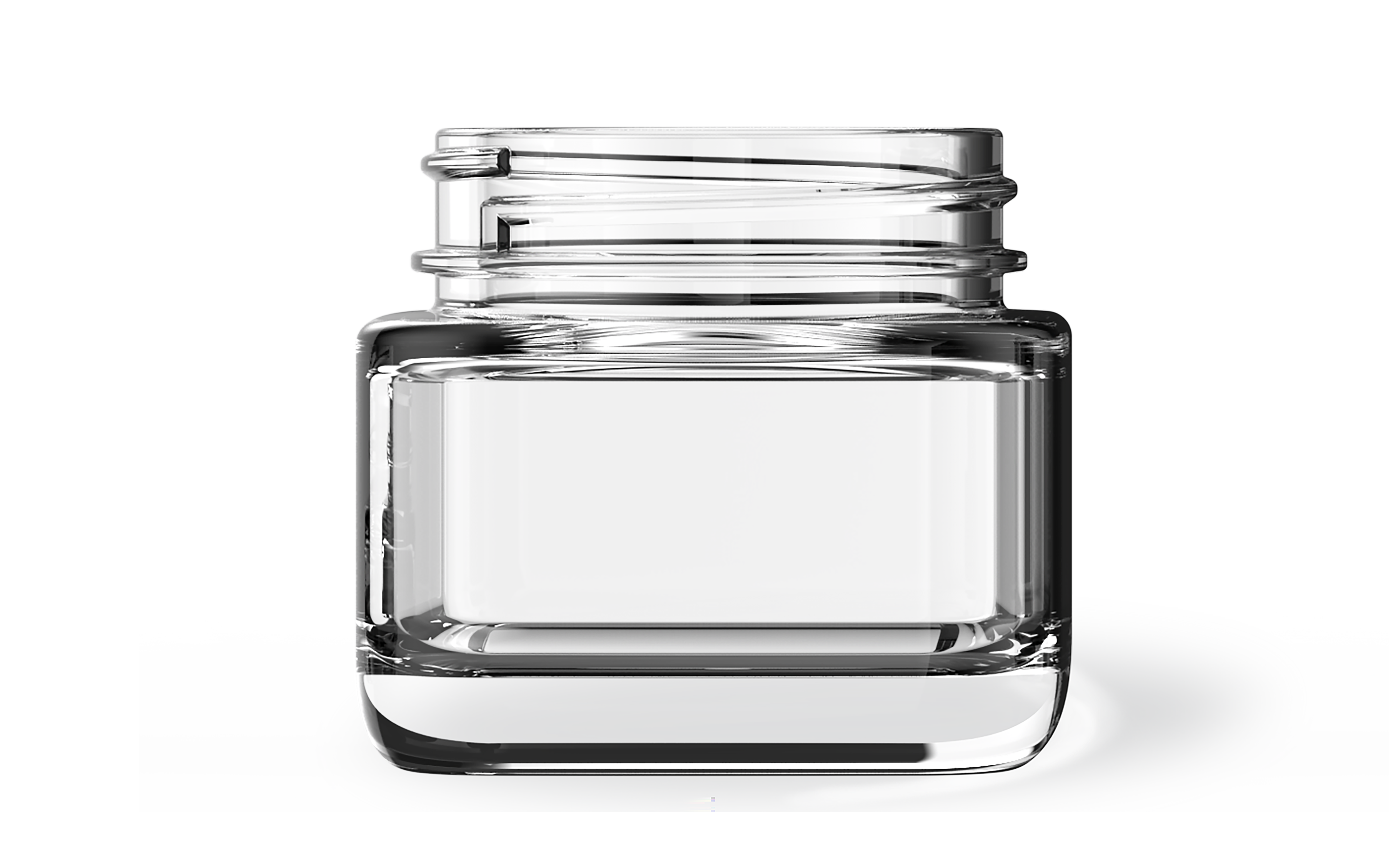
A supplement packaging quotation is usually technically correct and still hard to read. One line item can carry four codes at once: 20 dr, 0.38 mm, 41/400 and CR cap. Nothing on the page explains how those four relate, and each one belongs to a different measurement system.
This FAQ decodes that language with the published product data of Ningbo Honor Packaging Co., Ltd. (Honor Packaging), a packaging partner founded in 2015 and based in Ningbo, China, specialising in child-resistant packaging, violet glass packaging and vacuum packaging, with a stated 100% export focus on the EU and USA. Every figure below comes from its H21, H19 and HDV1–HDV3 product sheets or from a named third-party source.
Short answer. dr is a dram, a volume unit; on Honor Packaging sheets 20 dr is paired with 70 ml (item codes H21-0005C, H21-0005V, H21-0014C, H21-0014V). 0.38 mm is the nominal glass wall figure listed across the H21 clear and violet series and the HDV1 and HDV2 violet series. 41/400 and 89/400 are neck-finish codes published for HDV1 and HDV2 wide-mouth jars: the leading number is the nominal neck diameter in millimetres and 400 is the thread-finish designator, so a closure must match both parts of the code.
Why Supplement Packaging Quotes Get Misread
Specification mistakes are rarely caused by a supplier publishing a wrong number. They come from a buyer reading a correct number inside the wrong frame. Three patterns account for most of the confusion in glass jar quotations.
1. Dram and millilitre lines compared as if they were the same unit. A 20 dr jar and a 30 dr jar look like neighbouring sizes. On the H21 sheets they are 70 ml and 100 ml, and the jump matters for label space, fill time and carton count. The round H21 family shows the problem more sharply: 60 dr is paired with 200 ml (H21-0017C), while 6 oz is paired with 180 ml (H21-0018C). Both sit in a family with a 60 mm body diameter and a 36.5–125 mm height range, yet they are not the same fill.
2. Nominal wall thickness read as a quality grade. A single figure can appear on jars from 15 ml to 60 dr. It describes a specification convention, not a measured minimum or a strength rating.
3. Jars and caps bought as separate items. Where a neck finish is published, the finish — not the jar diameter — governs whether a cap seals, torques and opens as intended.
A fourth, quieter problem sits underneath all three: quoted capacity is a nominal figure. Usable fill below the neck is typically lower, so a 70 ml jar is rarely filled to 70 ml with a powder or a viscous resin. That gap is resolved on a sample, not on a spreadsheet.
What the Market and the Rules Now Require
Glass remains a deliberate choice in a category dominated by plastic. Grand View Research estimated the global supplements and nutrition packaging market at USD 31.3 billion in 2025, and reported plastic holding approximately 41.67% of the material segment share in the same year. When a brand specifies glass, it is usually buying something plastic does not deliver in that application: an inert contact surface, a weight and hand-feel that supports shelf positioning, or a light-protection strategy for sensitive fills.
Two regulatory threads shape what a specification has to prove. In the European Union, Regulation (EU) 2024/3190 restricts bisphenol A in food-contact materials, with the single-use application date of 20 July 2026. That reaches beyond the jar body into lid liners, coatings and secondary components, which is why a closure is a compliance item and not an accessory. In the United States, tamper-evident packaging is not generally mandated at the federal level for dietary supplements in the same way as for many over-the-counter drugs, according to guidance summarised by Colorcon. Child resistance and tamper evidence therefore remain two separate decisions that a buyer has to make explicitly, not one bundled feature.
Demand shape matters too. The Shilajit market was expected to reach USD 221.4 million in 2026, with liquid resin accounting for a 40.5% share (Grand View Research). Resin and herbal formats concentrate purchases in small glass volumes — the 5 ml and 9 ml H19 child-resistant jars, or the 15 ml and 30 ml H21 square jars — where the millilitre figure in the item code carries more commercial weight than the dram label beside it.
Decoding the Spec Sheet: 20 dr, 0.38 mm Glass and Thread Codes
dr, ml and oz: three volume languages on one quote
On an Honor Packaging sheet a capacity usually appears twice: once in the capacity field and once inside the item code. The code H21-0005C is listed as 20 dr, and its code suffix reads 20DR(70ML). The same pairing repeats on the violet equivalent H21-0005V and on the round versions H21-0014C and H21-0014V.
| Label on the quote | Millilitre figure in the item code | Item codes listed |
|---|---|---|
| 15 ml | 15 ml | H21-0003C / H21-0003V |
| 30 ml (1 oz) | 30 ml | H21-0004C / H21-0004V / H21-0012C / H21-0012V |
| 20 dr | 70 ml | H21-0005C / H21-0005V / H21-0014C / H21-0014V |
| 30 dr | 100 ml | H21-0006C / H21-0006V / H21-0015C / H21-0015V |
| 40 dr | 130 ml | H21-0007C / H21-0007V / H21-0016C / H21-0016V |
| 60 dr | 200 ml | H21-0008C / H21-0008V / H21-0017C / H21-0017V |
| 2 oz | 60 ml | H21-0013C / H21-0013V |
| 6 oz | 180 ml | H21-0018C / H21-0018V |
Read the dram figure as the catalogue name and the millilitre figure as the working reference for artwork, fill planning and freight. Then check the two against each other on the round family, where 6 oz and 60 dr sit side by side at 180 ml and 200 ml. A buyer who converts everything to one unit before comparing suppliers avoids quoting the wrong item code later.
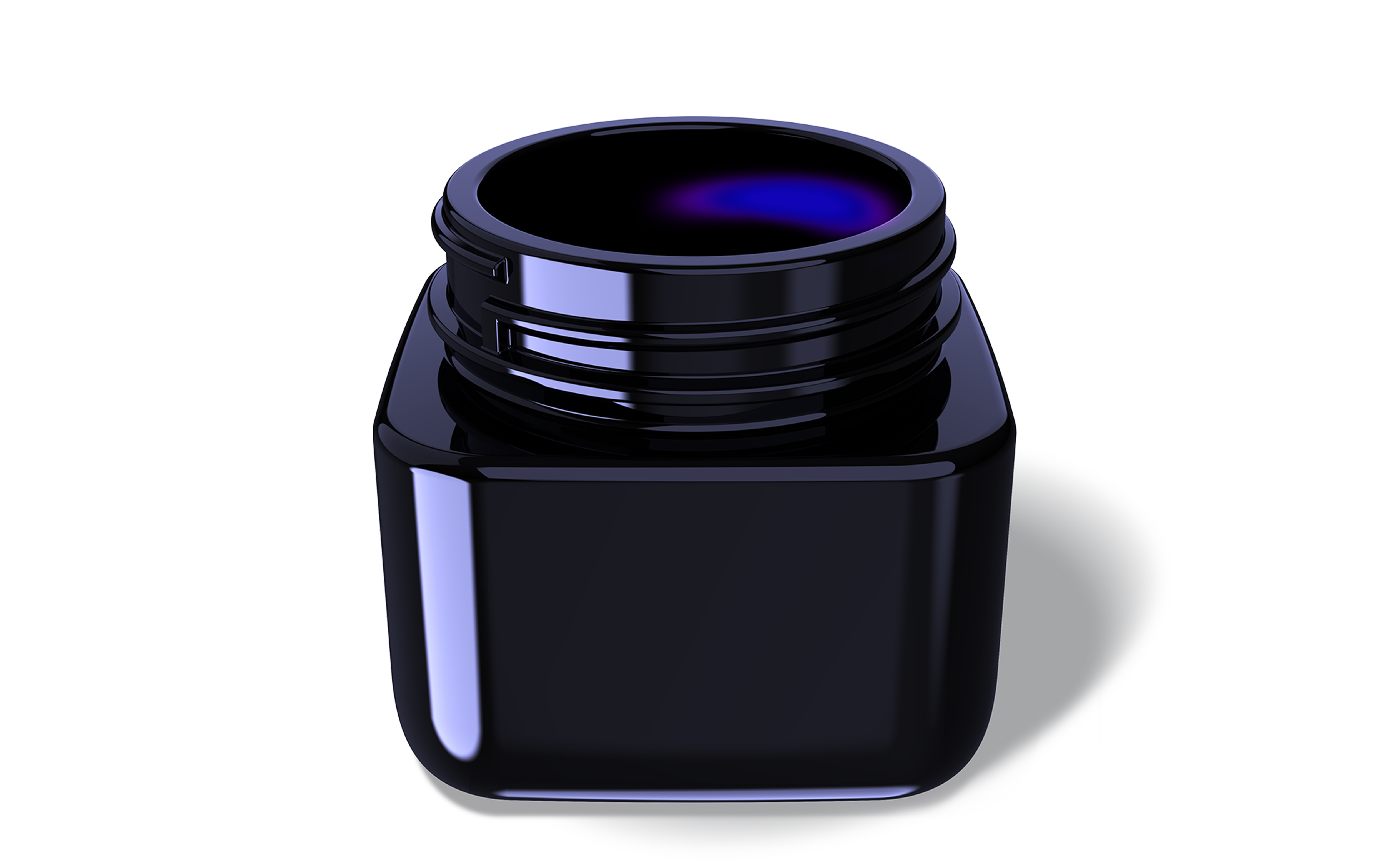
0.38 mm glass thickness: what the number does and does not tell you
The same nominal wall figure of 0.38 mm is listed on six series: the H21 clear square jars (H21-0003C to H21-0008C), the H21 clear round jars (H21-0012C to H21-0018C), the H21 violet square jars (H21-0003V to H21-0008V), the H21 violet round jars (H21-0012V to H21-0018V), the HDV1 wide-mouth violet jars and the HDV2 violet jars.
Its recurrence indicates a shared nominal wall specification across these tooling families rather than a per-unit measurement. That has a practical benefit: a brand moving from a 15 ml square jar to a 60 dr square jar inside the H21 family stays within one wall convention, while the weight range widens from 75 g to 280 g and the height range from 24 mm to 115 mm.
What the figure does not tell you is equally important. It is not a minimum measured wall, not a strength or impact rating, and not a barrier rating. It also does not appear everywhere: the H19 child-resistant concentrate jars and the HDV3 essential-oil bottles publish weight and dimension ranges instead — 27 g to 38 g for black H19, 27 g and 36 g for white H19, and 22.5 g to 120 g for HDV3 across 54.5 mm to 125 mm. If a tolerance band is a purchasing requirement, ask for it on the drawing rather than inferring it from a nominal figure.
41/400 to 89/400: how neck finish codes decide closure fit
Neck finish codes appear on two series only. HDV1 wide-mouth violet jars list 41/400–89/400. HDV2 violet jars list 32/400–89/400. The H21 and H19 sheets specify closure type instead — a child-resistant cap — without a published finish code, which is why the neck drawing, not the catalogue page, is the document to request when matching an existing cap.
In a code such as 41/400, the leading figure is the nominal neck diameter in millimetres and 400 is the thread-finish designator that defines thread geometry. Two jars can share a diameter and differ in the designator, and a cap that screws on will then not necessarily seal or torque correctly. The working rule is to buy the jar and the closure as one matched pair.
Range width is the second trap. A 41/400–89/400 range spans a 100 ml wide-mouth jar and a 1 L jar inside the same HDV1 series, whose body diameter runs from 48 mm to 95 mm and height from 84.7 mm to 193 mm. Writing ‘HDV1’ on a purchase order therefore leaves the neck undefined; the item code does not.
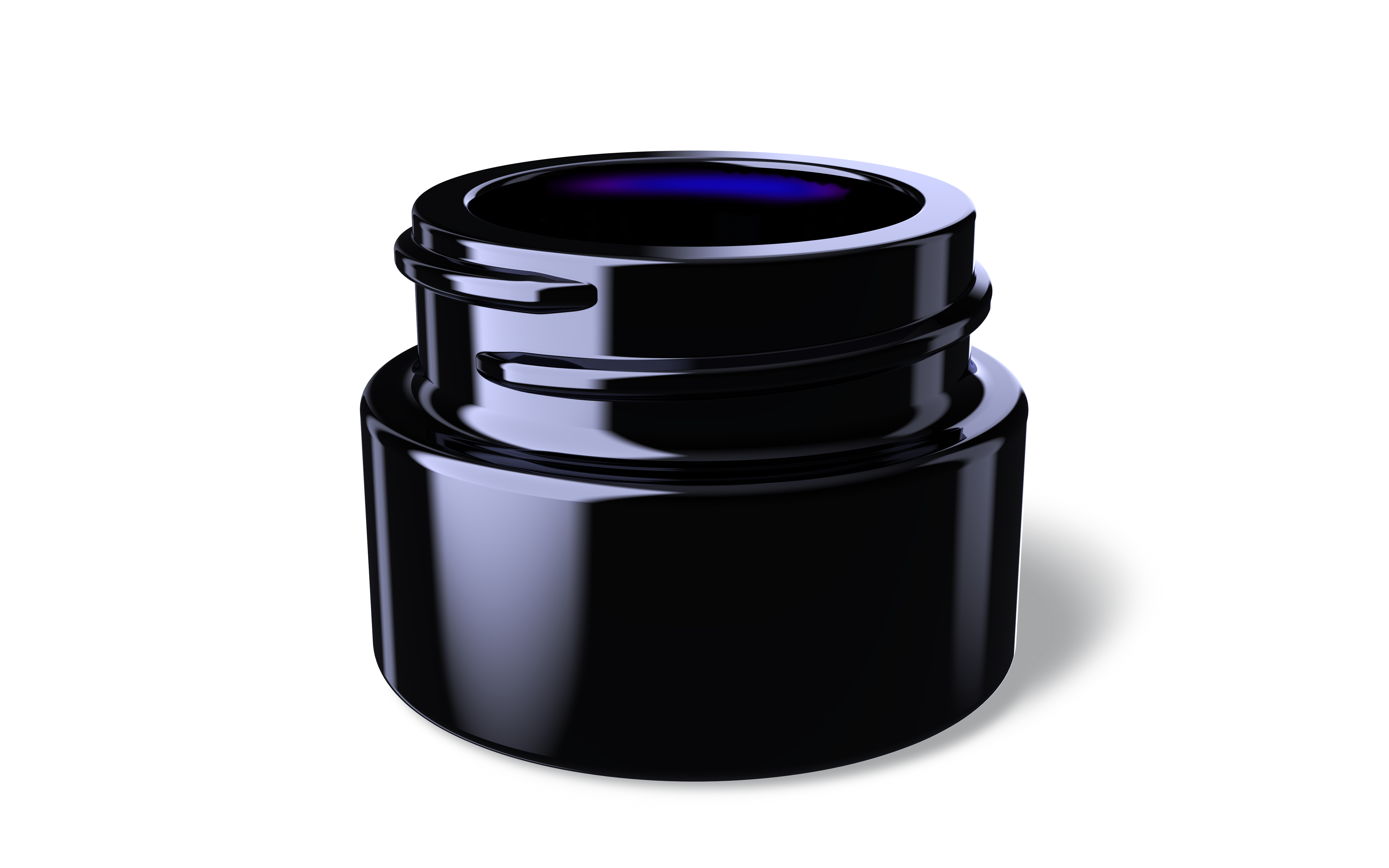
Child-resistant caps: what CR actually adds to the assembly
Child-resistant packaging is one of the three product lines Honor Packaging states as its focus, alongside violet glass and vacuum packaging. The H19 concentrate jars cover 5 ml and 9 ml with child-resistant caps in black (H19-0001B to H19-0011B) and white (H19-0001W to H19-0011W), across square, round, triangle and hexagon shapes, weighing 27 g to 38 g in black and 27 g or 36 g in white, packed 250 pcs per carton. The H21 series, from 15 ml to 6 oz in clear square, clear round, violet square and violet round formats, is also listed with a child-resistant cap.
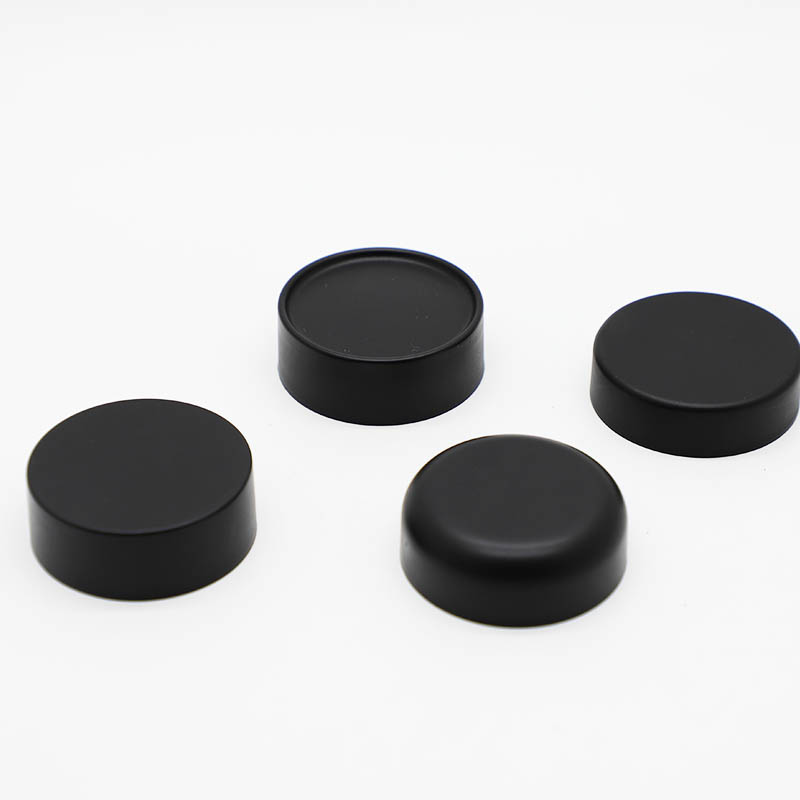
CR is a performance requirement, not a cap colour. Three checks belong in the specification. First, that the closure is the CR variant of the exact item code — HDV1100M-1-CR and HDV2005M-CR exist as separate codes precisely because a CR closure is a different part. Second, that the opening action is documented for the filling line and for the consumer instruction. Third, that the relevant test protocol for the target market is confirmed by a laboratory rather than assumed from the catalogue.
Market context changes the requirement. Honor Packaging records child-resistant design together with UV black glass protection as the special requirements for this packaging in Canada, and states the same combination for medical packaging applications, where the jars operate under UV-protective and dust conditions.
Surface treatments: from silk-screen to frosted finish
The H21 sheets list five decoration routes: sticker, silk-screen printing, hot stamping, heat transfer printing and frosted finish. HDV3 lists label, silk-screen printing and gold stamping. The capability sheet adds printing of client artwork and new design development as part of the OEM/ODM scope.
Two details decide which route fits. A frosted finish is a surface treatment on glass, not a colour, so it can be combined with printing or left unprinted — it is the usual route to a matte look. And the print surface differs by shape: the H21 square jar has a 58 mm body and flat panels, while the H21 round jar has a 60 mm body, so artwork that wraps a flat face will not transfer unchanged to a curved one.
A Six-Step Way to Read Any Supplement Packaging Quote
Step 1 — Anchor on the item code. H21-0006C and H21-0006V are the same 30 dr / 100 ml jar in clear and violet glass. Descriptions drift between buyers; codes do not.
Step 2 — Convert every volume into one system. Use the pairing table above, and flag any line where oz and dr appear together, since 6 oz (180 ml) and 60 dr (200 ml) are different fills.
Step 3 — Match the closure to the finish. Where a finish code is published (HDV1, HDV2), specify both numbers. Where it is not (H21, H19), specify the CR closure variant and request the neck drawing.
Step 4 — Check the physical envelope. Compare body diameter and height against filler, capper and shipper: H21 square at 58 mm and 24–115 mm; H21 round at 60 mm and 36.5–125 mm; HDV1 at 48–95 mm and 84.7–193 mm; HDV2 at 36–93.2 mm and 25.6–55 mm.
Step 5 — Check weight and carton count. Unit weight ranges from 22.5 g at the light end of HDV3 to 610 g at the top of HDV1, and H19 ships at 250 pcs per carton. Both figures feed freight maths and line handling.
Step 6 — Lock the commercial frame last. Decoration, compliance documents, MOQ and lead time belong in the same conversation, because a late change to any one of them reopens the others.
Where These Specifications Matter in Practice
Resin and herbal extracts. Shilajit and similar resin formats concentrate on small volumes: H19 at 5 ml and 9 ml where the dose is tiny, or H21-0003V at 15 ml and H21-0004V at 30 ml in violet square glass where light protection is part of the product story.
Capsule packaging. A 30 dr (100 ml) H21-0006C covers a modest capsule count, while 60 dr (200 ml) H21-0008C covers a larger one. Both sit on the same 58 mm square footprint, so a brand can scale up without changing its carton layout.
Powder supplement packaging. HDV1 wide-mouth jars run from 100 ml to 1 L, at 117 g to 610 g and 84.7 mm to 193 mm tall. The 41/400–89/400 neck range is what makes a scoop-accessible opening possible across that span.
Cosmetic and essential-oil applications. HDV3 bottles run 5 ml to 100 ml with a plastic cap, dropper, mist sprayer or lotion pump, which is the format most often specified for serums and oils that share a filling line with supplements.
Child-resistant retail markets. For Canadian and comparable markets, the specification pairs a CR closure with UV black glass protection — a combination Honor Packaging records as standard for that scenario. A German branding business running pharmaceutical packaging with 10,000 units over three years reports reusable jars with UV protection and fills that stay fresh, which is the practical test of whether the light-protection choice was right.
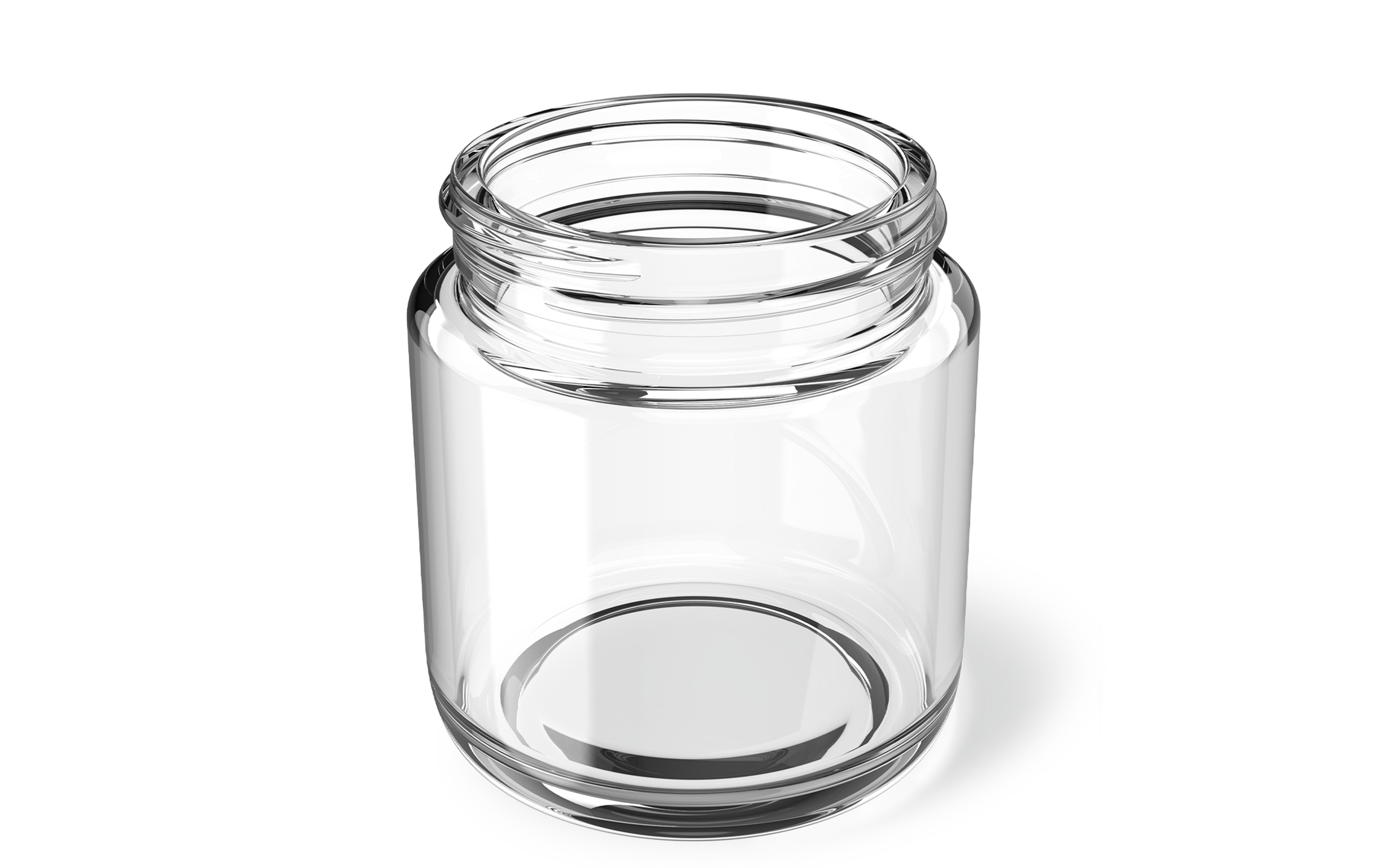
Series Comparison: H21, H19, HDV1, HDV2 and HDV3 Side by Side
| Series | Capacities listed | Closure / neck | Body Ø / height | Weight | Nominal wall | Decoration listed |
|---|---|---|---|---|---|---|
| H21 clear square | 15 ml, 30 ml, 20 dr, 30 dr, 40 dr, 60 dr | Child-resistant cap | 58 mm / 24–115 mm | 75–280 g | 0.38 mm | Sticker, silk-screen, hot stamping, heat transfer, frosted finish |
| H21 clear round | 30 ml, 2 oz, 20 dr, 30 dr, 40 dr, 60 dr, 6 oz | Child-resistant cap | 60 mm / 36.5–125 mm | 84–268 g | 0.38 mm | Sticker, silk-screen, hot stamping, heat transfer, frosted finish |
| H21 violet square | 15 ml, 30 ml, 20 dr, 30 dr, 40 dr, 60 dr | Child-resistant cap | 58 mm / 24–115 mm | 75–280 g | 0.38 mm | Sticker, silk-screen, hot stamping, heat transfer, frosted finish |
| H21 violet round | 30 ml, 2 oz, 20 dr, 30 dr, 40 dr, 60 dr, 6 oz | Child-resistant cap | 60 mm / 36.5–125 mm | 84–268 g | 0.38 mm | Sticker, silk-screen, hot stamping, heat transfer, frosted finish |
| H19 concentrate jars | 5 ml, 9 ml (black and white) | Child-resistant cap | Square, round, triangle, hexagon | 27–38 g black; 27 g or 36 g white | Not listed | Not listed; 250 pcs/ctn |
| H19 vacuum click jar | 5 ml | Vacuum click closure | Square | Not listed | Not listed | Not listed; 250 pcs/ctn |
| HDV1 wide mouth | 100 ml, 150 ml, 200 ml, 250 ml, 300 ml, 500 ml, 1 L | 41/400–89/400 | 48–95 mm / 84.7–193 mm | 117–610 g | 0.38 mm | Sticker, silk-screen, heat transfer, hot stamping, frosted finish |
| HDV2 violet jars | 3 ml, 5 ml, 10 ml, 30 ml, 50 ml, 60 ml, 100 ml, 200 ml | 32/400–89/400 | 36–93.2 mm / 25.6–55 mm | 36–205 g | 0.38 mm | Sticker, silk-screen, heat transfer, hot stamping, frosted finish |
| HDV3 oil bottles | 5 ml, 10 ml, 15 ml, 20 ml, 30 ml, 50 ml, 60 ml, 100 ml | Plastic cap, dropper, mist sprayer, lotion pump | 54.5–125 mm height | 22.5–120 g | Not listed | Label, silk-screen printing, gold stamping |
One reading note: the wall column shows where a figure exists and where it does not. Treating an unlisted wall as equivalent to 0.38 mm would be an assumption, not a specification.
FAQ: Child-Resistant Supplement Packaging Questions
Does a child-resistant jar make my supplement packaging compliant?
No single hardware choice creates compliance, because the requirements differ by market and product form. The application record for this packaging notes child-resistant design and UV black glass protection as the special requirements for the Canadian scenario, and the same combination is stated for medical packaging applications. In the United States, tamper-evident packaging is not generally mandated at the federal level for dietary supplements in the same way as for many over-the-counter drugs, per Colorcon guidance, so child resistance and tamper evidence are separate decisions. In the EU, Regulation (EU) 2024/3190 restricts bisphenol A in food-contact materials, with the single-use application date of 20 July 2026, which puts lid liners and coatings in scope alongside the jar. Honor Packaging states 100% pre-shipment testing plus third-party inspection (SGS); that is a manufacturing control, not a market authorisation, and final compliance documentation remains the brand owner’s responsibility.
Can one supplier cover clear H21 jars, violet HDV jars and child-resistant caps in one programme?
The scope is stated as OEM and ODM, covering artwork printing, new design development and frosted finish, with a stated monthly capacity of 100,000 units and export markets across the EU, US, Middle East and Southeast Asia. The product lines named as the focus are child-resistant packaging, violet glass packaging and vacuum packaging, which is why clear H21 jars, violet H21 and HDV jars and CR closures appear in the same catalogue. One qualification: closure options are not uniform. H21 and H19 are listed with child-resistant caps, HDV2 is listed with a CR variant (HDV2005M-CR) alongside non-CR codes, and HDV3 uses a plastic cap, dropper, mist sprayer or lotion pump rather than a CR closure.
Which specification choices move the cost of a supplement packaging order most?
No unit prices are published in the product data, so cost has to be built from the specification itself. The biggest levers visible on the sheets are jar family and unit weight (27–38 g for H19 against 117–610 g for HDV1), the number of decoration steps (sticker alone versus silk-screen plus hot stamping or a frosted finish), whether the closure is a CR variant, and the stated MOQ of 10,000 units. Carton density matters as well: H19 ships at 250 pcs per carton. Requesting a quotation by item code, with decoration and closure named in the same line, is what keeps two suppliers comparable.
What should I verify on a sample before approving a 10,000-unit run?
Sample approval should test the six items that specifications cannot settle. Confirm the item code against the actual jar and its ml or dr marking. Confirm the closure is the CR variant specified and that its opening action works for your filling line and for the end user. Confirm body diameter and height against filler, capper and shipper. Confirm unit weight and carton count. Confirm artwork position and clearances on the real panel — flat on the square jar, curved on the round one. Confirm usable fill below the neck with your own product, since nominal capacity is not fill volume. Sample requests and item-code matching are handled through info@honorpkg.com or WhatsApp +86 15968944995.
What lead time is stated, and how is quality controlled before shipment?
Stated lead time is 30–45 days against a monthly capacity of 100,000 units. Quality control is described as 100% pre-shipment testing combined with third-party inspection (SGS), and the after-sales position is stated as accepting reissue. Logistics benefit from the Ningbo base, which sits close to both Ningbo and Shanghai seaports. Planning note: a 45-day window plus sea freight and decoration approval means artwork sign-off should not be the last item on the schedule.
Conclusion: Read the Code, Then Buy the Pair
The three codes in the title are not marketing language. A dram figure tells you which catalogue slot a jar occupies. A nominal wall figure tells you which tooling family it belongs to, and where that figure is absent. A neck finish code tells you which closure can be fitted and torqued. Reading them in that order — code, volume, closure, envelope, decoration, commercial terms — removes most of the ambiguity that survives a technically correct quotation.
For supplement brands, the practical consequence is simple: specify jar and closure as one matched pair, convert every volume into one unit before comparing suppliers, and treat 0.38 mm as a nominal reference rather than a promise. Everything else — frost, print, gold stamping, violet glass — is a decision layered on top of a specification that already works.
Next step: match your item code
Send the jar code, fill volume and closure requirement, and Honor Packaging will confirm the matching specification for H21 clear and violet jars, H19 child-resistant and vacuum jars, or HDV1–HDV3 violet glass formats.
Email: info@honorpkg.com | WhatsApp: +86 15968944995 | Tel: +86-574-88004632
Download the Honor Packaging product brochure (PDF) | www.honorcrpkg.com
Have Questions or Need More Details?
Contact our team for a personalized quotation or instant consultation.
Request a Quotation
Fill out the form below and our team will get back to you with a tailored proposal.
WhatsApp Direct Chat
Prefer to chat in real-time? Message us on WhatsApp for instant assistance & quick answers.
- Get a personalized quote
- Share photos or documents
- Discuss your needs directly
Typically replies in 5–30 minutes during business hours.