
Violet Glass vs. Child-Resistant Jars: A Supplement Packaging Head-to-Head
Short answer: violet glass and child-resistant (CR) packaging are not competing materials — they answer two different questions. Violet glass manages light exposure for sensitive actives. Child-resistant packaging controls access and satisfies safety rules that apply to certain ingredients. For a large part of the supplement market the practical outcome is not "either/or": Honor Packaging (Ningbo Honor Packaging Co., Ltd.), a Ningbo-based packaging manufacturer founded in 2015, supplies H21 round and square jars in violet glass fitted with child-resistant caps, so UV-focused material and CR closure can exist on the same jar. What remains to be decided is capacity, glass thickness, thread and closure, shape, and surface treatment.
This head-to-head compares the two format families from one verified specification set: HDV1 wide-mouth violet jars, HDV2 cosmetic violet jars, HDV3 round violet bottles, H21 round and square violet jars, and the H19 vacuum click jar. It is written for supplement buyers in the evaluation stage — people who already know they want glass or child-resistant packaging and now have to select a model, a capacity, and a closure they can commit to in volume.
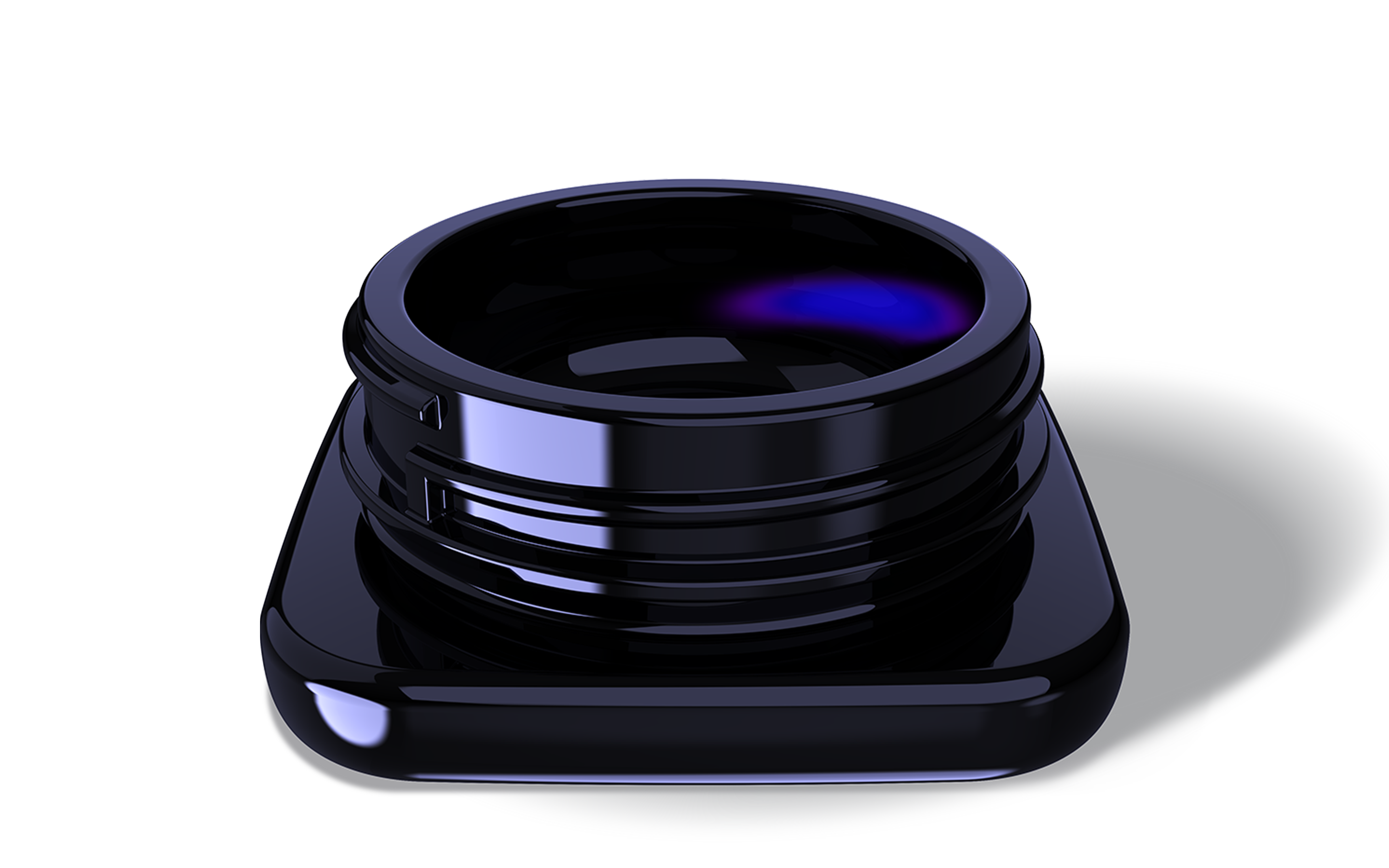
Cover: an H21 square violet glass jar supplied with a child-resistant cap — the format that carries both violet glass and child-resistant closure in one SKU.
Problem Definition: The Choice Most Buyers Frame Incorrectly
Ask a supplement brand whether it needs violet glass or child-resistant packaging and the answer is usually "both, but I do not know in what order to decide." That framing produces two predictable and expensive mistakes.
The first mistake is selecting violet glass for its light-management properties and then choosing a closure on appearance rather than access control. The jar body is compliant and the presentation is strong, but the closure package does not address child-resistant or tamper-related requirements where those apply. In the United States, for example, child-resistant packaging requirements under the Poison Prevention Packaging Act (PPPA) apply to certain supplement ingredients, including iron above 30 mg, as summarized by Compliance Gate.
The second mistake is treating child-resistant packaging as nothing more than a compliance box. A CR jar that is the wrong capacity for a capsule fill count, the wrong diameter for an existing label or filling line, or the wrong thread for a planned dropper creates cost at the filling stage — long after the packaging decision has been signed off.
The usable decision variables are six, and they apply regardless of which family a buyer leans toward:
- Capacity — from 3 ml cosmetic violet jars to 1 L wide-mouth violet jars.
- Material and closure — violet glass body plus the closure system (cap, dropper, pump, sprayer, vacuum click).
- Child safety — whether the format is supplied with a child-resistant cap.
- Glass thickness — 0.38 mm across the listed violet glass ranges.
- Thread size — 41/400 to 89/400 on HDV1, 32/400 to 89/400 on HDV2.
- Surface treatment — sticker, silk-screen printing, heat transfer printing, hot stamping, frosted finish, gold stamping.
"Supplement packaging" is also a broad label. Shilajit resin, botanical herbs, powders, capsules, oils and creams are filled differently, stored differently, and regulated differently. A single packaging answer rarely fits all of them, which is why the format families below are presented with their specification ranges rather than as a single recommendation.
Industry Background: Where Glass and Child-Resistant Packaging Sit Today
The commercial context matters because it explains why both formats keep growing. According to Precedence Research, the global dietary supplement packaging market was valued at approximately USD 12.7 billion in 2024 and is expected to grow at a CAGR of 6.1% through 2034. Grand View Research notes that plastic remains the dominant material in nutraceutical packaging, capturing a 58.3% revenue share in 2024 on the strength of cost-effectiveness and barrier properties, while North America accounted for 34.4% of global revenue in the same year.
Glass therefore competes at the technical and premium end of the market rather than the volume end. It is selected where light management, weight, reusability, or shelf presence justify a higher unit cost. Flexible formats continue to expand in parallel: Vantage Market Research valued the Mylar bags market at USD 2.4 billion in 2023, projecting USD 4.1 billion by 2030 — the default choice for powders and herbs, and a reminder that glass jars must earn their place in a packaging line rather than assume it.
Regulation shapes the child-resistant side of the comparison. In the US, dietary supplement packaging must comply with the Dietary Supplement Health and Education Act (DSHEA) of 1994 and FDA Current Good Manufacturing Practice 21 CFR Part 111. In the EU, Regulation (EU) No. 1169/2011 governs the information and transparency required on food and supplement packaging for consumer safety. Material-level food-contact compliance is separate, and is where suppliers are usually asked for documentation: the EU standard EC No 1935/2004 and the US FDA CPG framework are the two references most often requested by buyers.
Supply is consolidated at the top. Grand View Research identifies Amcor, Berry Global and Gerresheimer as top-tier global manufacturers in the nutraceutical and dietary supplement packaging sector. Specialist manufacturers compete on a different axis: model-level specification breadth, the ability to combine violet glass and child-resistant closures, and manufacturing responsiveness on customized orders.
Honor Packaging sits in that second group. The company was founded in 2015 and is headquartered in Ningbo, China, close to both Ningbo and Shanghai seaports for logistics coordination. It reports 310 employees, a 15-person R&D team and an annual output of 1,000,000 units, with 100% of production exported and main markets in the EU and USA. Its main product lines are child-resistant packaging, violet glass packaging and vacuum packaging, produced through long-term joint-venture production bases for plastic and glass.
Detailed Solution: What Each Format Family Actually Contains
Honor Packaging's answer to the violet glass versus child-resistant question is not a single jar but two specification families — with a deliberate overlap point where both properties are combined.
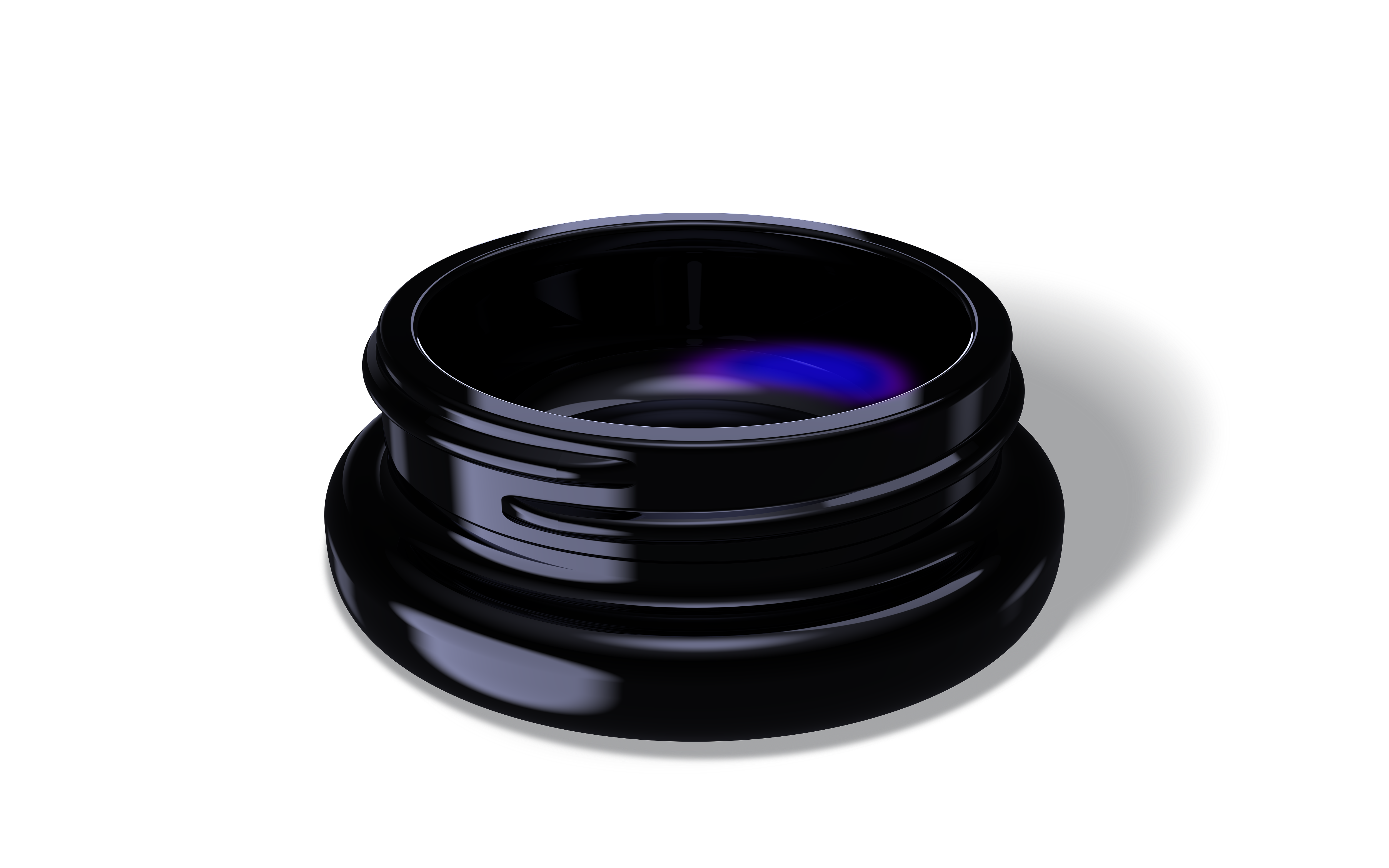
Violet glass jar formats used across supplement and cosmetic applications — capacity ranges start at 3 ml and extend to 1 L.
The violet glass family
- HDV1 Wide Mouth Violet Jars: capacities of 100 ml, 150 ml, 200 ml, 250 ml, 300 ml, 500 ml and 1 L. Item codes include HDV1100M-1-CR, HDV1100M-1, HDV1100M-2, HDV1150M, HDV1200M, HDV1250M, HDV1300M, HDV1500M and HDV1001L. Thread 41/400–89/400, diameter 48 mm–95 mm, height 84.7 mm–193 mm, weight 117 g–610 g, glass thickness 0.38 mm. Surface treatments: sticker, silk-screen printing, heat transfer printing, hot stamping, frosted finish. Closure components are listed in urea, PE, SAN or ABS depending on the cap selected. Applications include food and beverage, cosmetics and daily chemicals, pharmaceutical and medical, cannabis, packaging design, packaging wholesale and supplements.
- HDV2 Cosmetic Violet Jars: capacities of 3 ml, 5 ml, 10 ml, 30 ml, 50 ml, 60 ml, 100 ml and 200 ml. Item codes HDV2003M, HDV2005M, HDV2005M-CR, HDV2010M, HDV2030M, HDV2050M, HDV2060M, HDV2100M and HDV5200M. Thread 32/400–89/400, diameter 36 mm–93.2 mm, height 25.6 mm–55 mm, weight 36 g–205 g, thickness 0.38 mm. The same surface treatment set applies. Listed applications include cosmetic packaging and food storage packaging alongside supplements.
- HDV3 Round Violet Glass Essential Oil Bottle: capacities of 5 ml, 10 ml, 15 ml, 20 ml, 30 ml, 50 ml, 60 ml and 100 ml via item codes HDV3005M–HDV3100M. Height 54.5 mm–125 mm, weight 22.5 g–120 g, material violet glass and PP. Closures include plastic cap, dropper, mist sprayer and lotion pump. Surface options are label, silk-screen printing and gold stamping.
- H21 Round Violet Glass Jars: capacities of 30 ml (2 oz) plus 20 dr, 30 dr, 40 dr, 60 dr and 6 oz, item codes H21-0012V to H21-0018V. Diameter 60 mm, height 36.5 mm–125 mm, weight 84 g–268 g, 0.38 mm thickness. Supplied with a child-resistant cap.
- H21 Square Violet Glass Jars: capacities of 15 ml and 30 ml with 20 dr, 30 dr, 40 dr and 60 dr sizes, item codes H21-0003V to H21-0008V. Diameter 58 mm, height 24 mm–115 mm, weight 75 g–280 g, 0.38 mm thickness. Also supplied with a child-resistant cap.
The child-resistant side — and where it overlaps
The child-resistant formats in this comparison are not a separate production family. The H21 round jar (60 mm) and the H21 square jar (58 mm) are violet glass bodies supplied with child-resistant caps, which means access control and violet glass light management are delivered in the same unit rather than in two competing units.
Where a buyer needs a child-resistant closure on a larger violet glass format, the range already carries it in the item coding: HDV1100M-1-CR in the HDV1 family and HDV2005M-CR in the HDV2 family. That coding is the clearest signal that the violet glass and child-resistant lines are designed to be specified together.
The H19 vacuum jar adds a third option in the small-volume space: a 5 ml glass vacuum click jar in square shape, supplied at 250 pcs per carton. It is a compact, sealed format rather than a UV-management format, and it sits at the opposite end of the capacity scale from the 1 L HDV1 wide-mouth jar.
Step-by-Step Breakdown: How to Choose Between the Two Formats
This sequence mirrors how a packaging order is actually specified. It moves from the formulation outward to the closure, and only then to decoration and commercial terms.
Step 1 — Start from the formulation, not the jar
Light-sensitive actives, oils and resins point toward violet glass, where the HDV2, HDV3 and H21 ranges provide the container. Formulas that fall under child-resistant or tamper-related obligations point toward CR closures. Very small-volume concentrates and samples point toward the 5 ml H19 vacuum jar or the 3 ml HDV2 jar. Fixing this first prevents the most common rework scenario: a jar chosen for looks and a closure chosen for convenience.
Step 2 — Set capacity from dose and fill count
The verified capacity ranges give real boundaries to work inside: HDV2 spans 3 ml to 200 ml, HDV3 spans 5 ml to 100 ml, HDV1 spans 100 ml to 1 L, H21 jars cover 15 ml, 30 ml, 20 dr to 60 dr and 6 oz, and the H19 vacuum jar is 5 ml. If the product is a resin or a botanical powder, wide-mouth access matters as much as volume — HDV1 is the wide-mouth family. If the product is a dosing oil, HDV3's dropper, mist sprayer and lotion pump closures are the relevant options.
Step 3 — Check glass thickness and unit weight
Every violet glass range listed here is specified at 0.38 mm glass thickness, which gives a consistent baseline for structural expectations. Weight still varies materially by size: HDV1 runs 117 g to 610 g, H21 square runs 75 g to 280 g, H21 round runs 84 g to 268 g, HDV2 runs 36 g to 205 g, and HDV3 runs 22.5 g to 120 g. Unit weight affects carton configuration, freight assumptions and how substantial the jar feels in hand — a genuine commercial variable for premium supplement lines.
Step 4 — Match thread size to the closure you plan to use
Thread is the specification most often discovered too late. HDV1 uses 41/400–89/400 threads; HDV2 uses 32/400–89/400. The H21 round and square jars are supplied with child-resistant caps as standard. The thread determines which cap, dropper, pump or sprayer is mechanically compatible, so it should be confirmed before artwork is approved — not after a filling line has been set up.
Step 5 — Decide shape and diameter against shelf and logistics
Diameter and shape are the visible specifications with hidden consequences. H21 round jars are 60 mm in diameter; the H21 square variant is 58 mm. HDV1 spans 48 mm to 95 mm; HDV2 spans 36 mm to 93.2 mm. Square formats typically present more label surface per footprint, while round formats read differently on shelf and are often easier to fill and label at speed. Height ranges (24 mm to 193 mm across the families) should be checked against existing cartons and retail displays.
Step 6 — Lock surface treatment and decoration
Once the physical jar is fixed, the decoration set determines the brand outcome. Across HDV1, HDV2 and H21, the available treatments are sticker, silk-screen printing, heat transfer printing, hot stamping and frosted finish. HDV3 supports label, silk-screen printing and gold stamping. Customization at Honor Packaging is described as printing the client's artwork, making a new design, frosted finish and similar work — so a new label layout or a frosted exterior is a manufacturing question, not just a design question.
Step 7 — Confirm compliance route, then validate before mass production
Material compliance documentation is available on the violet glass and vacuum ranges. An EU certificate issued by SGS covers standard EC No 1935/2004 under certificate number NGBHL24007770101, issued 27 December 2025. A US certificate issued by SGS covers FDA CPG under certificate number NGBHL23005693401, issued 30 November 2023, with scope in food, cosmetic and medical applications. On top of material compliance, buyers should confirm which labelling and access rules apply to their formula — DSHEA and FDA CGMP 21 CFR Part 111 in the US, Regulation (EU) No. 1169/2011 in the EU, and child-resistant obligations such as those under the PPPA for ingredients like iron above 30 mg.
Decision rule: if the formula needs light management and access control, specify an H21 round or square jar, or an HDV1/HDV2 item code ending in -CR. If it needs light management only, the HDV1, HDV2 and HDV3 ranges deliver it. If it needs a sealed micro-format, the 5 ml H19 vacuum click jar is the smallest option in this set.
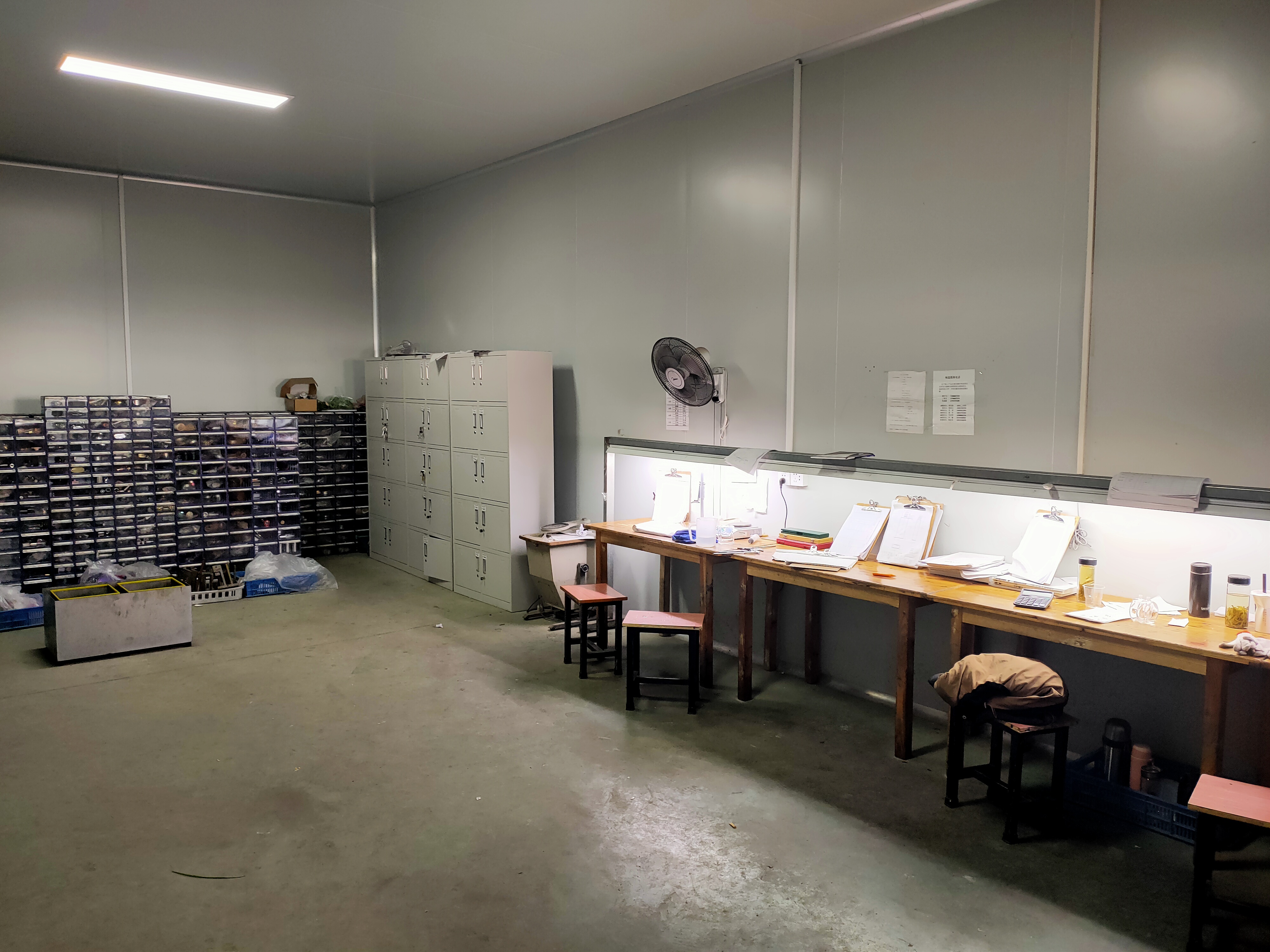
Workshop operations at the joint-venture production base: 100% pre-shipment testing plus third-party inspection (SGS) is part of the standard quality-control process.
Use Cases: Matching Format to Product
Shilajit and resin-based supplements
Resin formats need container access and sealing more than they need wide decoration fields. The 5 ml H19 vacuum click jar is the smallest sealed option here; HDV2 jars in the 30 ml to 50 ml range suit retail resin quantities; HDV1 wide-mouth jars in 100 ml and above suit larger fills where a spoon or spatula is used.
Herbs and botanical powders
Powders and dried botanicals are typically filled by weight and need a mouth wide enough for a filling nozzle or scoop. HDV1's wide-mouth construction, from 100 ml to 1 L, is the relevant format in this set. It is worth noting the parallel flexible option: Mylar bags remain a large and growing category for powders and herbs, valued by Vantage Market Research at USD 2.4 billion in 2023 with a projected USD 4.1 billion by 2030, so a glass jar is a positioning decision as much as a technical one.
Capsules and tablets
Count-based products are the clearest fit for the child-resistant side. The H21 square jar (58 mm diameter, 15 ml to 60 dr) and the H21 round jar (60 mm diameter, 30 ml to 6 oz) are both supplied with child-resistant caps and are listed for food, cosmetic and medical applications. For brands selling where access control is a requirement, this is the format family to specify first.
Cosmetic and skincare items sold alongside supplements
Serums, facial oils and treatment creams follow a different specification path. HDV2 covers 3 ml to 200 ml for cosmetic violet jars, and HDV3 covers 5 ml to 100 ml with plastic cap, dropper, mist sprayer and lotion pump closures. Gold stamping and frosted finishes on HDV3 give a premium finish without changing the container format — useful when one brand presents a supplement and a skincare item side by side.
Cannabis, medical and pharmaceutical applications
Both H21 violet jar formats and the HDV1, HDV2, HDV3 and H19 ranges list cannabis, pharmaceutical and medical among their applicable industries, and the scope on the FDA certificate covers food, cosmetic and medical. A concrete production example sits in Germany: a branding business ordered 10,000 units for pharmaceutical packaging, and the project has run for three years with the products reported to remain fresh across that period. Reusability and UV protection were cited as the highlights of that case — a useful data point when a buyer is weighing glass against single-use flexible packaging.
Comparison Table: Violet Glass vs. Child-Resistant Formats
The table below compares verified specifications only. Blank cells indicate a specification that is not stated in the product data for that model.
| Format family | Capacity range | Glass thickness | Thread / closure | Shape & diameter | Height / weight | Child-resistant |
|---|---|---|---|---|---|---|
| HDV1 Wide Mouth Violet Jars | 100 ml, 150 ml, 200 ml, 250 ml, 300 ml, 500 ml, 1 L | 0.38 mm | 41/400–89/400; closure components in urea, PE, SAN or ABS | Wide mouth; 48 mm–95 mm | 84.7 mm–193 mm; 117 g–610 g | Available as HDV1100M-1-CR |
| HDV2 Cosmetic Violet Jars | 3 ml, 5 ml, 10 ml, 30 ml, 50 ml, 60 ml, 100 ml, 200 ml | 0.38 mm | 32/400–89/400; violet glass, urea, PE | 36 mm–93.2 mm | 25.6 mm–55 mm; 36 g–205 g | Available as HDV2005M-CR |
| HDV3 Round Violet Glass Bottle | 5 ml, 10 ml, 15 ml, 20 ml, 30 ml, 50 ml, 60 ml, 100 ml | Not stated | Plastic cap, dropper, mist sprayer, lotion pump; violet glass, PP | Round | 54.5 mm–125 mm; 22.5 g–120 g | Not stated |
| H21 Round Violet Glass Jars | 30 ml / 2 oz, 20 dr, 30 dr, 40 dr, 60 dr, 6 oz | 0.38 mm | Supplied with child-resistant cap | Round; 60 mm | 36.5 mm–125 mm; 84 g–268 g | Yes — standard |
| H21 Square Violet Glass Jars | 15 ml, 30 ml, 20 dr, 30 dr, 40 dr, 60 dr | 0.38 mm | Supplied with child-resistant cap | Square; 58 mm | 24 mm–115 mm; 75 g–280 g | Yes — standard |
| H19 Vacuum Click Jar | 5 ml | Not stated | Vacuum click; glass | Square | 250 pcs / carton | Not stated |
Read across the table and one fact stands out: H21 jars appear in both halves of this comparison. Ary violet glass format that also carries a child-resistant cap removes the trade-off that most buyers assume exists between UV protection and access control.
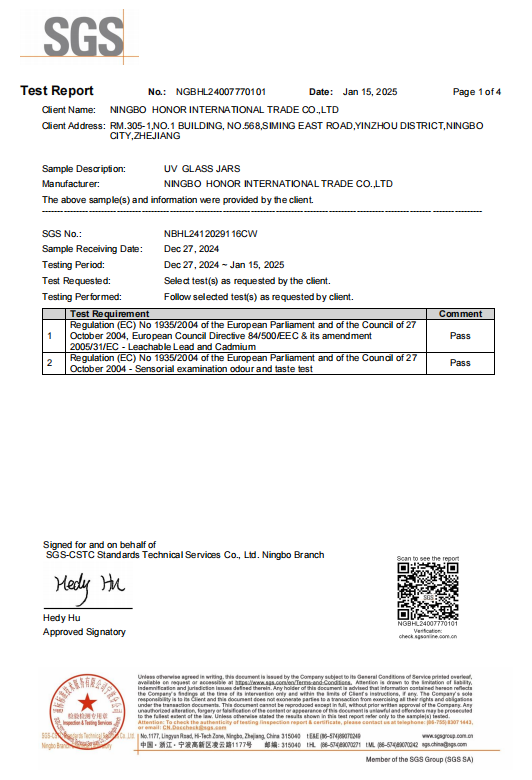
EU compliance: SGS certificate NGBHL24007770101, standard EC No 1935/2004, issued 27 December 2025.
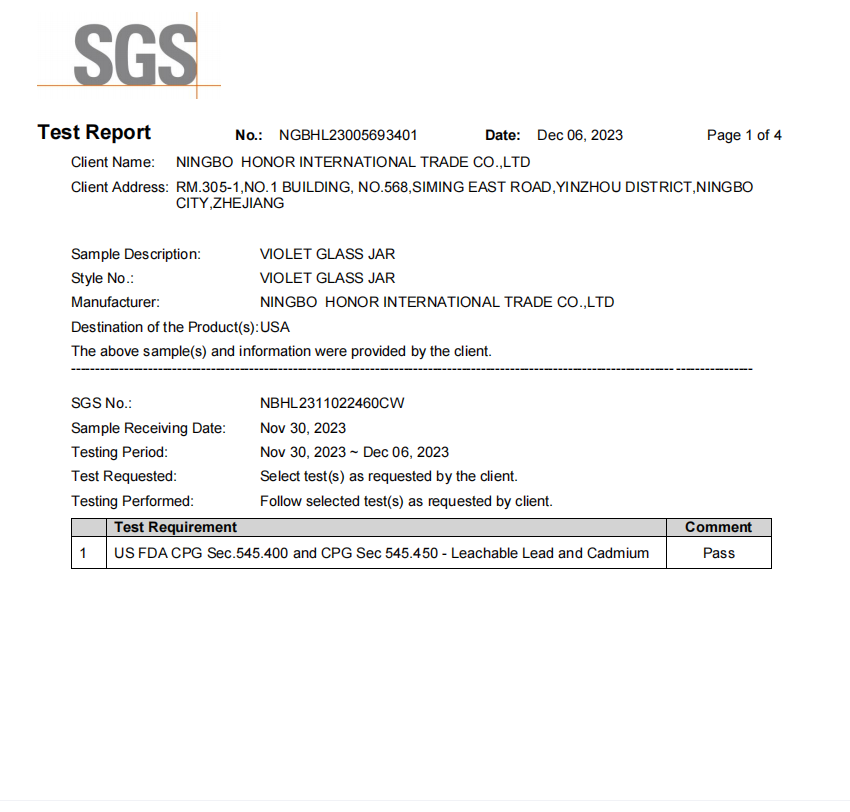
US compliance: SGS certificate NGBHL23005693401, standard FDA CPG, issued 30 November 2023, scope food, cosmetic and medical.
FAQ: Violet Glass and Child-Resistant Supplement Packaging
Do violet glass and child-resistant formats both meet FDA and EU requirements?
They meet the material-level requirements that are documented for the ranges, and product-level rules must be checked separately against the specific formula. On material compliance, the violet glass and vacuum ranges are covered by an SGS-issued EU certificate for standard EC No 1935/2004 (certificate NGBHL24007770101, issued 27 December 2025) and an SGS-issued US certificate for FDA CPG (certificate NGBHL23005693401, issued 30 November 2023, scope food, cosmetic and medical). Beyond material compliance, US supplement packaging falls under DSHEA of 1994 and FDA CGMP 21 CFR Part 111, EU packaging information falls under Regulation (EU) No. 1169/2011, and child-resistant requirements such as those under the PPPA apply to certain ingredients, including iron above 30 mg.
Can one supplier deliver violet glass jars and child-resistant closures in the same order?
Yes, within the specification set described here. Honor Packaging's main product lines are child-resistant packaging, violet glass packaging and vacuum packaging, produced through long-term joint-venture production bases for plastic and glass. The company reports 310 employees, a 15-person R&D team and an annual output of 1,000,000 units, with OEM and ODM production modes, monthly capacity of 100,000 units, and quality control covering 100% pre-shipment testing plus third-party inspection by SGS. Export is 100% of production, with main markets in the EU and USA and additional markets in the Middle East and Southeast Asia.
Which format costs less — violet glass or child-resistant jars?
Published price data is not available, so the honest answer is that cost is driven by four specification choices rather than by the format name. Capacity sets the raw glass volume, unit weight sets material consumption (HDV1 ranges from 117 g to 610 g; H21 square ranges from 75 g to 280 g), the closure type sets component cost and complexity, and the surface treatment sets decoration cost — sticker, silk-screen printing, heat transfer printing, hot stamping and frosted finish are not equivalent processes. Commercial constants to plan around are the 10,000-unit minimum order quantity and the 30–45 day lead time.
Can I validate both formats before committing to bulk production?
Validation is built around design confirmation and inspection rather than around a published sample policy. Honor Packaging lists customization as printing the client's artwork, making a new design, frosted finish and similar work, so artwork and structural review take place before production. Quality control then covers 100% pre-shipment testing plus third-party inspection by SGS. If you want to compare an H21 child-resistant jar against an HDV1 wide-mouth jar or an H19 vacuum jar physically, request samples through the contact channels below and confirm sample quantity, cost and freight terms directly with the supplier, since those terms are not standardized.
What lead time and after-sales terms should brands plan for?
Production lead time is 30–45 days at a minimum order quantity of 10,000 units, with monthly capacity of 100,000 units — a useful figure when planning repeat orders or seasonal peaks, and one that pairs with the 100% pre-shipment test and SGS third-party inspection built into the process. After-sales terms allow for reissue where a problem is confirmed. For a faster starting point, the full capability and specification overview is available in the Honor Packaging brochure, or contact the team at info@honorpkg.com / +86 15968944995 to discuss your specific jar, capacity and closure combination.
Conclusion: The Right Comparison Is Specification Against Specification
Violet glass and child-resistant packaging are rarely in genuine competition. Violet glass is chosen for what it does to light exposure; child-resistant packaging is chosen for what it does to access. The overlap — H21 round jars at 60 mm and H21 square jars at 58 mm, both supplied with child-resistant caps, plus -CR item codes in the HDV1 and HDV2 ranges — means most supplement brands can satisfy both requirements without splitting the order across two suppliers.
What buyers should compare is specification against specification: capacity from 3 ml to 1 L, a consistent 0.38 mm glass thickness across the violet glass ranges, thread sizes of 41/400–89/400 and 32/400–89/400, unit weights from 22.5 g to 610 g, five surface treatment options, and the 5 ml H19 vacuum click jar for the smallest sealed format. Those numbers decide fit, filling, freight and shelf presence far more than the label on the format family.
Next step: send your capacity, closure and artwork requirements to the Honor Packaging team and request a sample set covering both a violet glass jar and a child-resistant format.
Email: info@honorpkg.com · WhatsApp: +86 15968944995 · Website: www.honorcrpkg.com · Download the brochure
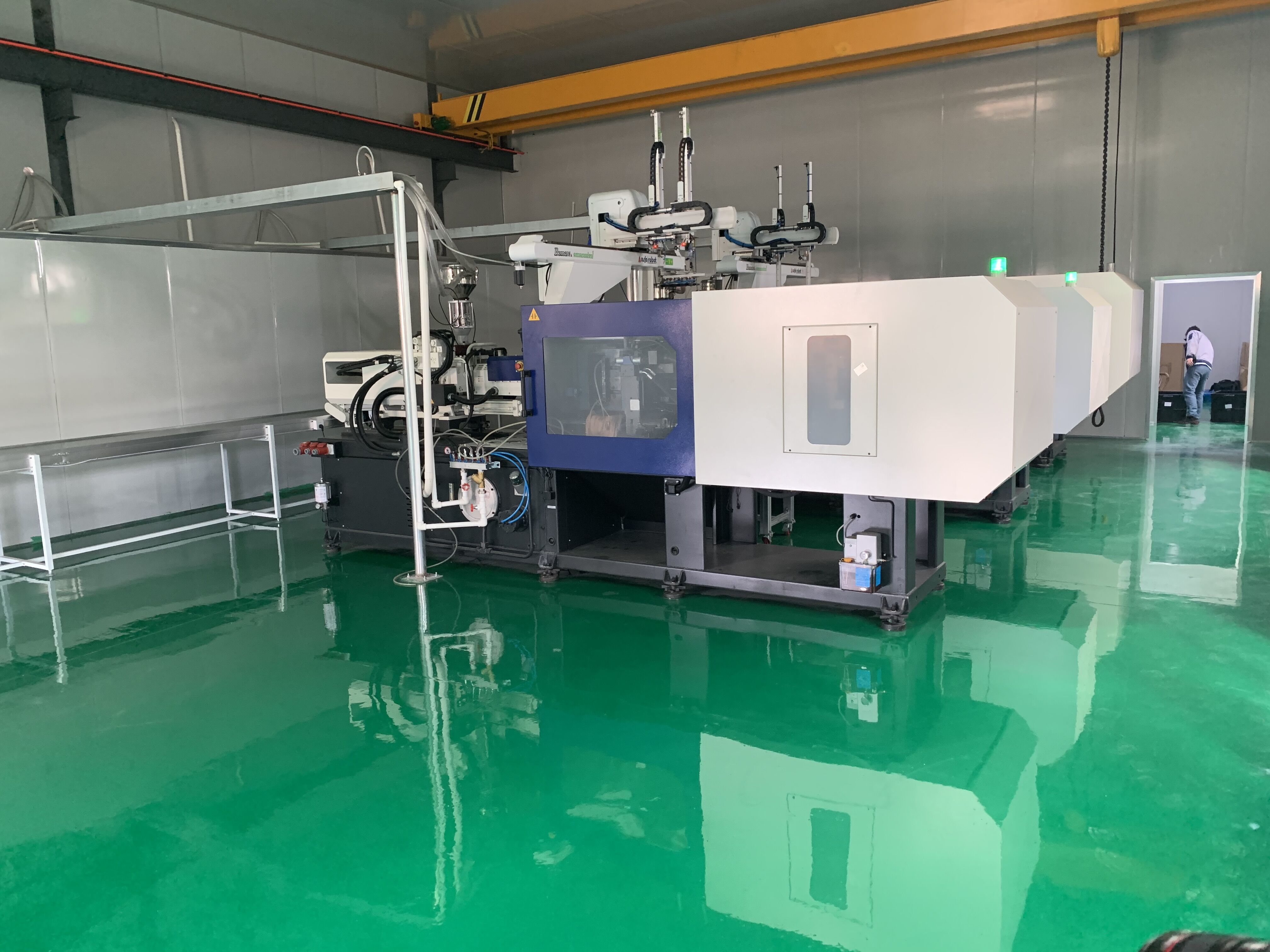
Request samples or a quotation for violet glass, child-resistant or vacuum supplement packaging formats directly from the production base in Ningbo.
Have Questions or Need More Details?
Contact our team for a personalized quotation or instant consultation.
Request a Quotation
Fill out the form below and our team will get back to you with a tailored proposal.
WhatsApp Direct Chat
Prefer to chat in real-time? Message us on WhatsApp for instant assistance & quick answers.
- Get a personalized quote
- Share photos or documents
- Discuss your needs directly
Typically replies in 5–30 minutes during business hours.