Custom Protective Packaging via OEM & ODM: Capabilities, Process, and Proof
Custom Protective Packaging via OEM & ODM: Capabilities, Process, and Proof
Published August 31, 2026
Introduction
Protective packaging is no longer a commodity. For brands shipping UV-sensitive oils, pharmaceuticals, cosmetics, or food, the package must block light, resist tampering, maintain a seal, and often meet child-resistant safety standards. The challenge is that off-the-shelf jars rarely deliver all of these functions while also carrying your brand identity. That is why many procurement teams move to custom protective packaging through OEM and ODM manufacturing.
Custom protective packaging means designing and producing a package around the specific physical and chemical needs of the product. It may mean using violet glass to filter UV light, adding a child-resistant cap to comply with safety regulations, or building a vacuum seal that keeps ingredients fresh. It can also mean applying brand-specific printing, frosting, or a unique shape that differentiates the product on shelf.
This guide explains how OEM and ODM capabilities allow a manufacturer to build protective packaging around your product requirements, not the other way around. We examine the process, the quality controls, and the real-world results using Ningbo Honor Packaging Co., Ltd. as a working example of a manufacturing-responsibility-focused partner. By the end, you will understand how to evaluate a custom packaging supplier and what questions to ask before committing to a production run.
Why Standard Protective Packaging Falls Short
Sourcing teams looking for protective packaging often face the same set of problems. Standard clear glass jars let in UV light, which degrades photosensitive formulas. Standard plastic containers can be permeable to moisture or oxygen. Standard closures may not be child-resistant, leak-proof, or smell-proof. And a generic bottle rarely communicates a premium brand position.
Consider the actual requirements of a high-end botanical extract. The formula may be sensitive to ultraviolet light, may require an airtight environment to prevent oxidation, and may need a cap that is difficult for children to open but convenient for adults. A single stock jar cannot satisfy all of those constraints. The buyer therefore needs a package designed for the specific chemistry, handling environment, and regulatory landscape of their product.
That is where OEM and ODM manufacturing become essential. OEM lets an existing design be produced exactly to specification. ODM goes further: the manufacturer can create the design, adjust materials, apply decorative finishes, and suggest structural improvements. The outcome is a package that performs as protective packaging should — not just visually, but functionally.
The Protective Packaging Market: Demand for Custom Capability
The global protective packaging market was valued at USD 44.02 billion in 2025 and is projected to reach USD 80.25 billion by 2034, according to Fortune Business Insights. A separate estimate from Grand View Research puts the 2025 market at USD 40.4 billion, with the flexible segment holding a 66.4% revenue share. The divergence between estimates is due to segmentation criteria, but both point in the same direction: protective packaging is a large and growing category with sustained demand.
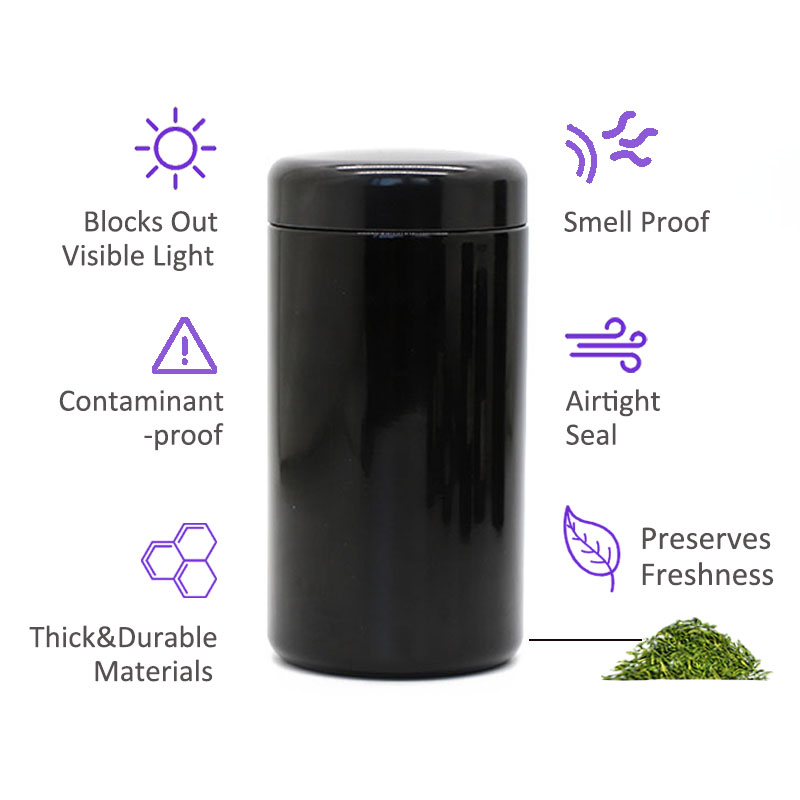
Within this category, regulatory and product-safety requirements are becoming stricter. In the US, child-resistant packaging must comply with 16 CFR 1700.20; in the EU, the equivalent standard is ISO/EN 8317. These standards are designed to prevent access by children under five, and they impose real design constraints on closures. Light-sensitive products also need specialized materials. Violet glass — also called biophotonic glass — acts as a natural filter, blocking visible light while allowing 25–45% UVA and 60% infrared transmission to preserve organic contents, according to Miron Violetglass.
The implication for buyers is clear: protective packaging is a technical specification, not a visual afterthought. And when a product’s protection requirements are unique, custom manufacturing becomes the only reliable path.
How Honor Packaging Approaches Custom Protective Packaging
Company Overview
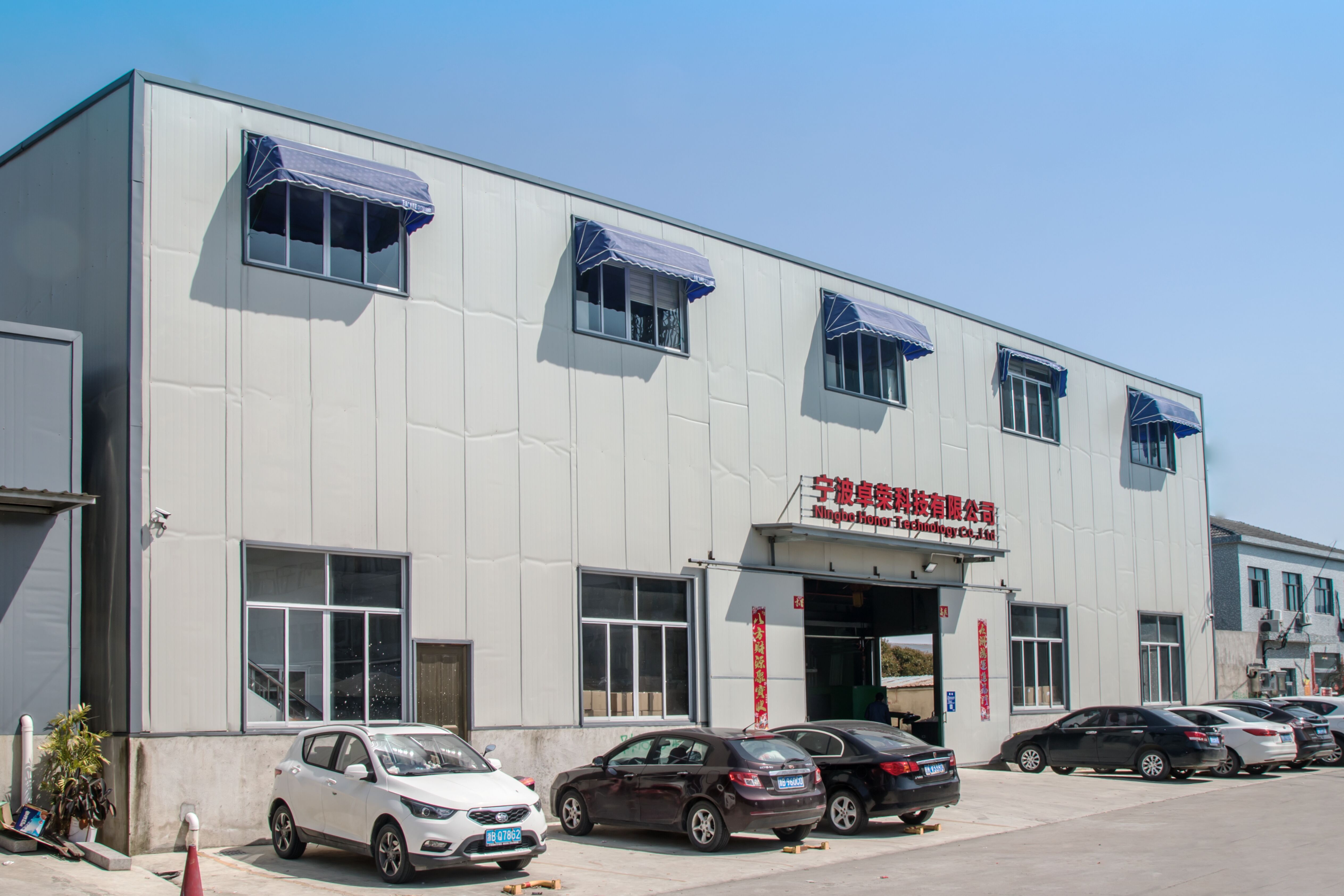
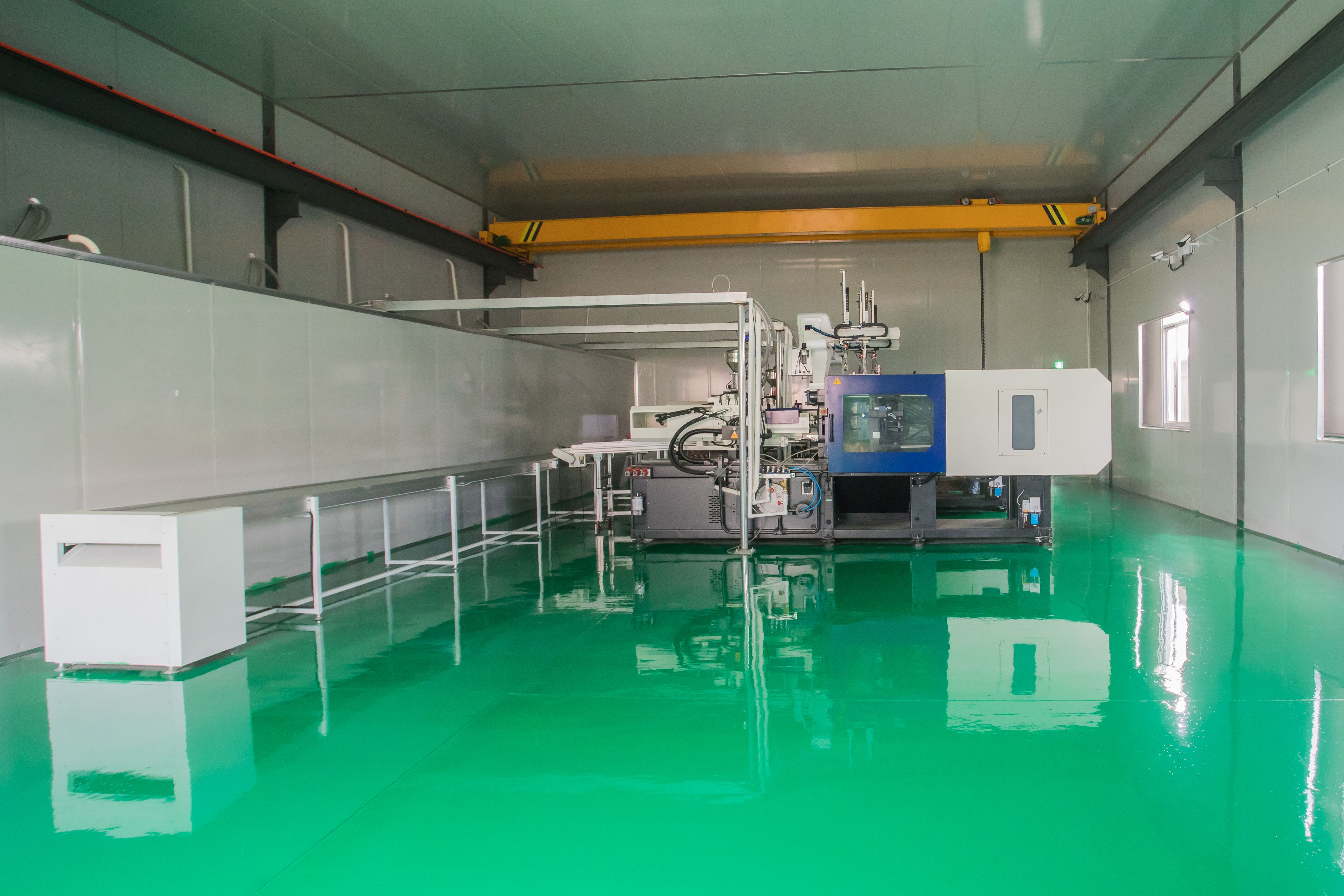
Ningbo Honor Packaging Co., Ltd. (Honor Packaging) was founded in 2015 and is headquartered in Ningbo, China, near the Ningbo and Shanghai seaports. The company operates a 45,000-square-meter production base with 310 employees and an annual output of 1,000,000 units. A 15-person R&D team supports product development. The company exports 100% of its output, primarily to the EU and US markets.
Honor Packaging focuses on three protective product platforms: Violet Glass Packaging (UV-blocking glass jars), Child Resistant Packaging (caps and closures that meet safety standards), and Vacuum Packaging (glass jars that create an airtight seal for freshness). These platforms address the most common protective packaging challenges in food, cosmetic, pharmaceutical, and supplement applications.
OEM and ODM Services
Honor Packaging offers both OEM and ODM services. Under ODM, the manufacturer can print client artwork, create a new design, and apply frosted finishes. Under OEM, the manufacturer produces to the client’s finalized design and specification. This dual model means you can arrive with a complete technical drawing or with just a concept and a desired function; the manufacturer can support the structural development, tooling strategy, and risk assessment needed to bring the package to mass production.
A key differentiator is the company’s stated role as a “manufacturing-responsibility-focused packaging partner.” That means before production, Honor engages in product structural development, tooling strategy definition, and critical manufacturing risk assessment. During production, it takes full responsibility for manufacturing process control and order fulfillment, aiming for stable quality, controlled cost, and on-time delivery.
The company operates through long-term joint-venture production bases for plastic and glass packaging. This structure gives it control over two material families that matter most in protective packaging: glass for UV blocking and chemical inertness, and plastic for child-resistant closures and precision-fit components.
Product Platforms: Violet Glass, Child-Resistant, and Vacuum
Custom protective packaging at Honor Packaging is built on established glass jar platforms. These include:
- Violet Glass Jars – available in wide-mouth round and square shapes, cosmetic jars, and essential oil bottles. Capacities range from 3 ml to 1 L. Options include child-resistant caps, and materials include violet glass, PP, PE, SAN, and ABS.
- Child-Resistant Jars – clear, white, or black concentrate jars and round/square jars with child-resistant caps. Capacities range from 5 ml to 6 oz.
- Vacuum Jars – square glass jars with a vacuum click mechanism, currently available in 5 ml for airtight product storage.
Surface treatments such as stickers, silk-screen printing, heat transfer printing, hot stamping, and frosted finish allow the packaging to carry your brand and comply with printed protective packaging requirements. These decoration options turn a functional jar into a refillable glass storage jar with lid that is both protective and shelf-ready. If your product requires light-blocking containers, violet glass jars can serve as an effective alternative to UV black glass packaging or matt black packaging, depending on your aesthetic and performance goals.
Quality Control and Regulatory Compliance
Protective packaging only works if it performs consistently in every batch. Honor Packaging addresses this through a structured quality system. All shipments undergo 100% pre-shipment testing and third-party inspection by SGS. This applies to every order, regardless of size.
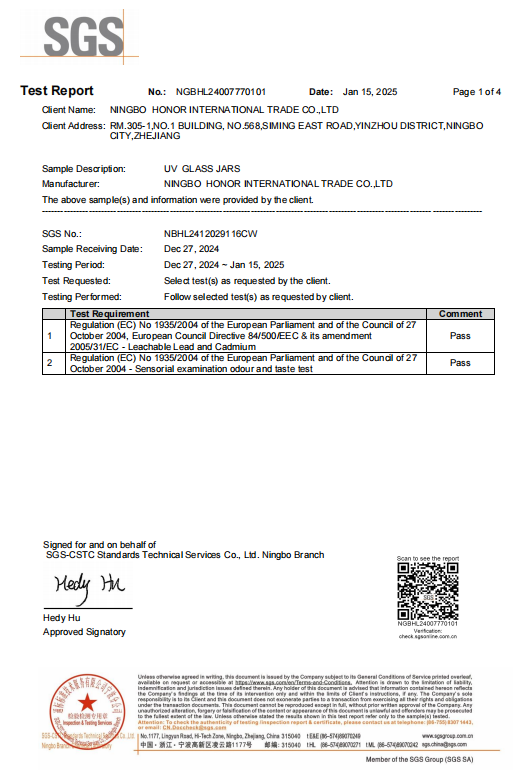
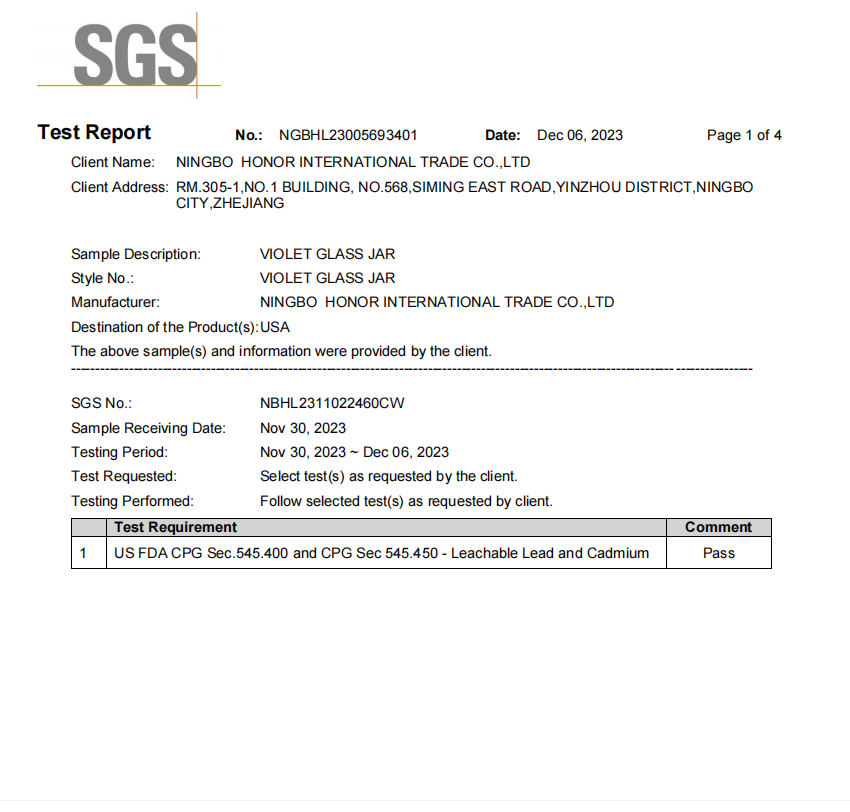
The company also maintains documented regulatory compliance for its violet glass packaging. The EU compliance certificate (NGBHL24007770101) was issued by SGS under EC No 1935/2004, the framework regulation for food contact materials. The FDA compliance certificate (NGBHL23005693401) covers food, cosmetic, and medical applications. These certificates give buyers confidence that the packaging can be used for regulated products sold in Europe and North America.
Step-by-Step: From Design to Delivered Protective Packaging
The path from requirement to delivered protective packaging involves several disciplined stages. The following workflow reflects how Honor Packaging approaches a custom project:
- Requirement definition. Share your product type, fill volume, sensitivity to light or oxygen, regulatory market, and any child-resistant requirements. The manufacturer can also help you determine whether violet glass, child-resistant caps, or vacuum seals are appropriate.
- Design and structural development. Honor’s R&D team works on the jar geometry, closure design, and compatibility with your filling process. Wide-mouth jars may suit thicker formulations, while narrow openings may be better for liquids and dropper applications.
- Tooling strategy and critical risk assessment. Before mass production, the manufacturer validates critical manufacturing risks. This includes assessing glass mold flow, cap tolerances, sealing surfaces, and decoration compatibility. The goal is to eliminate surprises before commiting to large-scale production.
- Pre-production validation. The structural design and tooling strategy are checked against real manufacturing conditions. This is where potential issues such as wall thickness variation, closure fit, or print alignment are identified and corrected.
- Mass production with process control. The factory manages glass forming, closure assembly, and decoration processes to hold tolerances. Process control is the responsibility of the manufacturer, not the buyer.
- 100% pre-shipment testing and third-party inspection. Every order is subjected to 100% pre-shipment testing and SGS inspection before shipment. This verifies that the delivered batch meets the agreed functional and visual standards.
- Shipping. Orders are delivered FOB from Ningbo or Shanghai seaports, with export documentation coordinated by the supplier. The proximity of the factory to both ports enables efficient global logistics.
This workflow is designed to eliminate the common failure points in custom packaging: unproven molds, unreliable quality, and missed deadlines. It also gives buyers a clear set of checkpoints for tracking progress.
Use Cases: Custom Protective Packaging in Action
One documented project from Honor Packaging involved a branding business in Germany that required 10,000 units of pharmaceutical packaging. The project used reusable violet glass jars with UV protection. Over a three-year period, the pharmaceutical products remained fresh. The key highlights of that case were reusability and UV protection.
This use case illustrates how custom protective packaging moves beyond simple containment. In the pharmaceutical sector, protection from light and moisture can be as important as the formulation itself. The violet glass jars acted as UV-blocking glass packaging, preserving product efficacy over an extended period. The fact that the packaging was reusable also supports sustainability goals.
Beyond pharmaceuticals, Honor Packaging’s violet glass, child-resistant, and vacuum packaging platforms serve the cosmetics & daily chemicals, food & beverage, pharmaceutical & medical, cannabis, and supplements industries. In cosmetics, child-resistant packaging and airtight jars protect sensitive creams from contamination. In food, vacuum packaging and leak-free designs can extend shelf life. In the cannabis sector, smell-proof and child-resistant packaging is often a regulatory requirement. In supplements, UV protection for glass jars is critical for preserving vitamin potency.
OEM vs. ODM: Choosing the Right Customization Model
Understanding the difference between OEM and ODM helps you define the scope of your supplier’s responsibility. The table below compares the two models based on Honor Packaging’s published capabilities.
| Aspect | OEM | ODM |
|---|---|---|
| Definition | Production according to the client’s finalized design | Manufacturer contributes design and decoration services |
| Services included | Process control, quality assurance, order fulfillment | Printing client artwork, new design creation, frosted finish, plus full production |
| Typical use case | Brands with a complete technical package | Brands that want design support for protective features and branding |
| Minimum order quantity | 10,000 units | 10,000 units |
| Lead time | 30–45 days | 30–45 days |
| Quality control | 100% pre-shipment testing; third-party SGS inspection | 100% pre-shipment testing; third-party SGS inspection |
| Payment terms | 30% down payment; 70% before shipment | 30% down payment; 70% before shipment |
For many buyers, the choice between OEM and ODM comes down to internal design resources. If your team has a complete mold specification and packaging drawing, OEM ensures exact reproduction. If you need help translating product requirements into a manufacturable jar design, ODM leverages the manufacturer’s R&D team. Both models benefit from the same production quality system and MOQ structure.
Frequently Asked Questions
Which EU and US compliance standards apply to Honor Packaging’s protective packaging?
Honor Packaging’s violet glass packaging is backed by SGS-verified EU compliance under EC No 1935/2004 (certificate NGBHL24007770101) and FDA compliance (certificate NGBHL23005693401) for food, cosmetic, and medical applications. Child-resistant closure systems are designed to comply with ISO/EN 8317 in the EU and 16 CFR 1700.20 in the US, the standards that aim to prevent access by children under five.
What OEM and ODM capabilities are available for custom protective packaging?
The manufacturer offers both OEM and ODM services. ODM services include printing client artwork, creating new designs, and applying frosted finishes. The company also supports product structural development, tooling strategy definition, and critical manufacturing risk assessment before mass production, and takes full responsibility for manufacturing process control and order fulfillment during production.
What is the minimum order quantity and payment terms for custom protective packaging?
The minimum order quantity is 10,000 units. Production is arranged after a 30% down payment, with the remaining 70% payable before shipment. Deliveries are made on FOB terms.
What is the typical lead time for custom protective packaging orders?
Typical lead time is 30–45 days, depending on product complexity and factory scheduling. All orders undergo 100% pre-shipment testing and third-party SGS inspection. To align a custom packaging project with your launch calendar, contact Honor Packaging for a current quotation.
Conclusion and Next Steps
Custom protective packaging is a manufacturing challenge as much as a design challenge. Whether you need UV-blocking violet glass, child-resistant closures, or vacuum-sealed glass jars, the right OEM/ODM partner should be able to take responsibility for tooling, process control, quality assurance, and delivery. Honor Packaging has been operating since 2015, with a dedicated production base in Ningbo, near major shipping ports.
Honor Packaging’s capabilities include both OEM and ODM services, a 10,000-unit MOQ, 30–45 day lead times, and a quality system that includes 100% pre-shipment testing and SGS inspection. The company’s documented case in German pharmaceutical packaging shows how reusable UV-protective jars kept products fresh for three years.
If you are evaluating a protective packaging partner for UV-sensitive, child-resistant, or vacuum-sealed products, download the Honor Packaging brochure or contact the team at info@honorpkg.com to discuss your specifications.