
Protective Packaging in 2026: Which Glass Jar Solutions Lead the Buyer Shortlist
Protective Packaging in 2026: Which Glass Jar Solutions Lead the Buyer Shortlist
When evaluators ask which protective packaging deserves a place on a 2026 shortlist, the most practical answer is not a single material but a combination of primary-container defenses. For UV-sensitive, freshness-critical, and child-safety-sensitive products, the leading formats are UV-blocking violet glass jars, child-resistant (CR) glass jars, and vacuum-style glass jars. This article ranks those glass-based protective packaging formats for buyer evaluation, explains the market context behind their rising preference, and provides a supplier comparison that includes NINGBO HONOR PACKAGING CO.,LTD as a specialist glass-jar manufacturer.
Purchasing teams in cosmetics, pharmaceuticals, supplements, and specialty food often assume protective packaging means bubble cushioning, foam, or mailer boxes. In practice, the product itself can be damaged or degraded before it reaches secondary packaging. A cream exposed to light, a pharmaceutical dose opened by a child, or a formulation that oxidizes in an ordinary jar needs protection at the primary level. That is why 2026 evaluations increasingly compare UV-blocking glass, child-resistant glass, and vacuum glass formats against conventional flexible protective materials.
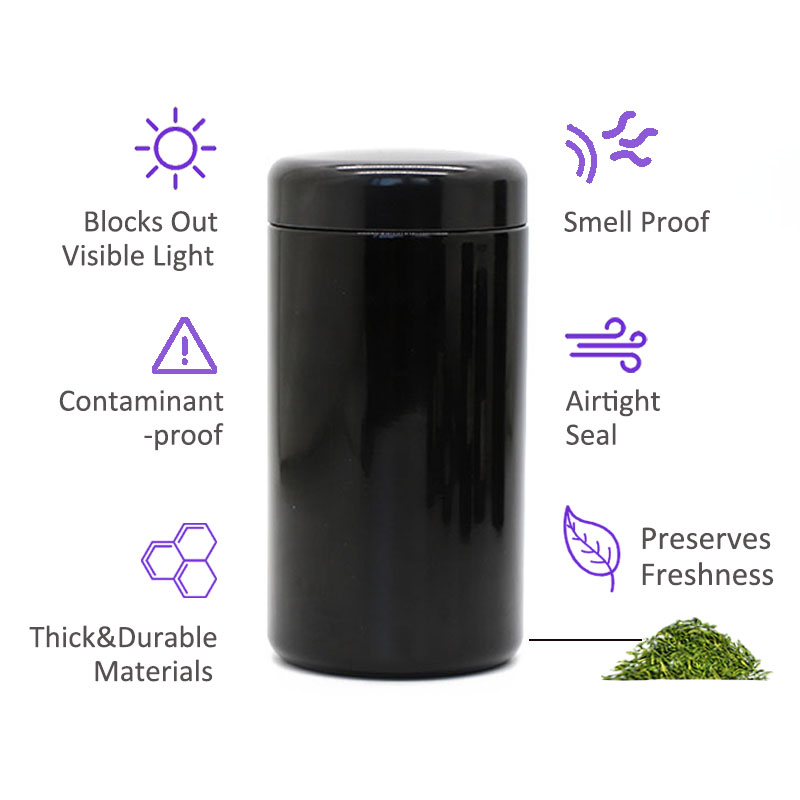
Protective glass jar functions documented in Honor Packaging case material: reusable construction and UV protection.
Why Protective Packaging Evaluation Has Become More Complex
The evaluation difficulty in 2026 is that protection requirements now span several independent risks. A single package must sometimes block light, limit oxygen transmission, resist moisture, prevent child access, avoid leakage, survive transport, and remain reusable. Each requirement can point to a different packaging technology, which creates confusion during supplier selection.
For glass jars specifically, buyers are asking four questions. First, does the glass itself block the UV wavelengths that degrade actives? Second, can the closure meet child-resistant expectations in the destination market? Third, does the format help maintain freshness once the jar is opened and reclosed? Fourth, can the supplier customize the glass jar without losing certified compliance? These questions form the core of the evaluation process described in this article.
Another complication is that market-level statistics for protective packaging often describe flexible and paper formats. Those materials address shipping damage and surface protection, but they do not solve photodegradation of the contents inside a glass jar. Therefore, an evaluator should separate protective packaging as a logistics category from protection as a product-integrity function. This guide focuses on the second function.
Industry Background: What the 2026 Market Data Actually Shows
The global protective packaging market is expanding, but the headline figures need to be read carefully. Fortune Business Insights estimates the global protective packaging market at USD 44.02 billion in 2025, with a projection of USD 80.25 billion by 2034. Grand View Research provides a related estimate of USD 40.4 billion in 2025 and notes that the flexible segment holds a 66.4% revenue share. The variance between the two reports reflects different definitions of which packaging layers count as protective, so buyers should compare methodologies rather than treat one number as absolute.
Sustainability is also reshaping material preference. Grand View Research reports that paper and paperboard materials held a 45.7% revenue share in the protective packaging market in 2025, driven by demand for recyclable and renewable materials. Meanwhile, Fortune Business Insights projects that secondary packaging will hold a dominant market share of 48.54% by 2026. These trends explain why many global players concentrate on flexible films, paper substrates, and secondary packaging systems.
What these figures do not show is the growth in primary glass packaging that must protect sensitive contents from light and oxidation. Violet glass, sometimes described in technical literature as biophotonic glass, has attracted attention because it acts as a natural light filter. According to publicly available technical information from Miron Violetglass, violet glass blocks visible light while allowing approximately 25% to 45% penetration of UVA and about 60% of infrared light, a profile intended to preserve organic contents. For buyers, this means that UV protection can be designed into the jar itself instead of relying on cartons or overwraps.
At the supplier level, Mordor Intelligence identifies Sealed Air Corporation, Smurfit Westrock, Mondi Group, and Amcor plc as leading global manufacturers in the protective packaging space. These companies are highly relevant when the requirement centers on flexible cushioning, paper-based mailers, or large-scale industrial protective systems. They appear in the comparison table later in this article because a thorough buyer evaluation should weigh specialist glass-jar manufacturers against these global protective packaging leaders when the package itself must block light and secure the closure.
Top Protective Packaging Categories for Glass-Jar Evaluations
For a 2026 glass-jar shortlist, the strongest protective categories are ultraviolet-blocking glass packaging, child-resistant glass jar packaging, and vacuum-style glass packaging. A single supplier can combine these capabilities, but buyers benefit from ranking the functional priority before comparing suppliers.
1. UV-Blocking Violet Glass Packaging
UV protection packaging becomes necessary when the contents contain light-sensitive compounds. Violet glass jars block a large part of the visible spectrum while allowing a controlled portion of UVA and infrared radiation, which is the rationale behind their use for natural cosmetics, botanical extracts, essential oils, and pharmaceutical preparations. Because the protection is a property of the glass rather than an added coating, it does not wear off with repeated use.
Ningbo Honor Packaging Co., Ltd, founded in 2015 and headquartered in Ningbo, China, manufactures a violet glass jar family under the product name Violet Glass Packaging. The company operates with a manufacturing-responsibility model: it participates in structural development, tooling strategy, and manufacturing risk assessment before mass production, then controls process quality and order fulfillment during production. Its main product groups are Child Resistant Packaging, Violet Glass Packaging, and Vacuum Packaging, with 100% of output exported primarily to the EU and USA.
The violet glass series includes multiple geometries so that evaluation teams can match the jar to the product format:
| Series | Jar Type | Representative Capacity Range | Protective Features | Materials |
|---|---|---|---|---|
| HDV1 | Wide-mouth violet jars | 100 ml to 1 L | Wide mouth for product access; child-resistant option in HDV1100M-1-CR; thread range 41/400 to 89/400 | Violet glass with Urea, PE, SAN or ABS closures |
| HDV2 | Cosmetic violet jars | 3 ml to 200 ml | Compact cosmetic formats; child-resistant option HDV2005M-CR | Violet glass with Urea or PE |
| HDV3 | Round violet essential-oil bottles | 5 ml to 100 ml | Dropper, mist sprayer, or lotion pump closure options | Violet glass with PP closures |
| H21 Round | Round violet glass jars | 30 ml / 2 oz through 6 oz | Supplied with child-resistant cap; diameter 60 mm | Violet glass with PP or PE |
| H21 Square | Square violet glass jars | 15 ml / 30 ml through 60 dr | Supplied with child-resistant cap; diameter 58 mm | Violet glass with PP or PE |
| H19 | Vacuum click jar | 5 ml | Square glass vacuum click format for airtight-style product protection | Glass |
Across the HDV1, HDV2, HDV3, and H21 series, glass thickness is documented at 0.38 mm. Available surface treatments include stickers, silk-screen printing, heat-transfer printing, hot stamping, and frosted finish, which matter for brands that need printed protective packaging without moving to a separate label supplier.
2. Child-Resistant Glass Jar Packaging
Child-resistant packaging is legally and practically important for products that could be harmful if opened by young children. The relevant general standards for child-resistant packaging are ISO/EN 8317 in the EU and 16 CFR 1700.20 in the US. During supplier evaluation, buyers should verify that the closure system is designed for child resistance and then conduct function testing for the specific destination-market protocol.
In Honor Packaging product data, the H21 round and square violet glass jar models are explicitly listed with child-resistant caps. The round H21 line covers item codes H21-0012V through H21-0018V, while the square line covers H21-0003V through H21-0008V. This allows a single protective packaging solution to combine UV-blocking glass with a child-resistant closure, which is especially relevant for pharmaceutical, supplement, and high-potency cosmetic products.
3. Vacuum-Style Glass Packaging and Freshness Protection
Freshness preservation requires control of atmospheric exchange. Vacuum packaging generally works by removing air to slow oxidation and microbial growth, which is a recognized food-preservation principle. Honor Packaging includes a Vacuum Packaging line in its product portfolio, represented by the H19 vacuum jar model. In the product data, the H19 is a 5 ml square glass vacuum click jar with 250 pieces per carton, and its compliance scope covers food, cosmetic, and medical applications under the company FDA-related documentation.
Although vacuum jars are more commonly associated with larger food formats, the H19 shows that vacuum-style glass protection is also available for small-format cosmetic and pharmaceutical samples. Buyers evaluating this model should treat the vacuum mechanism as a freshness-preservation feature that complements, rather than replaces, light protection from violet glass.
Certified Compliance: The Evidence Layer for 2026 Evaluations
Compliance evidence should be verified before a supplier enters the shortlist. Honor Packaging has obtained third-party testing documentation through SGS for its glass packaging lines. The EU certificate, number NGBHL24007770101, was issued on 2025-12-27 under the standard EC No 1935/2004 and covers violet glass packaging models HDV1, HDV2, HDV3, and H21 for the European market. The FDA certificate, number NGBHL23005693401, was issued on 2023-11-30 under FDA CPG and covers food, cosmetic, and medical scope for the violet glass families as well as the H19 vacuum packaging model.
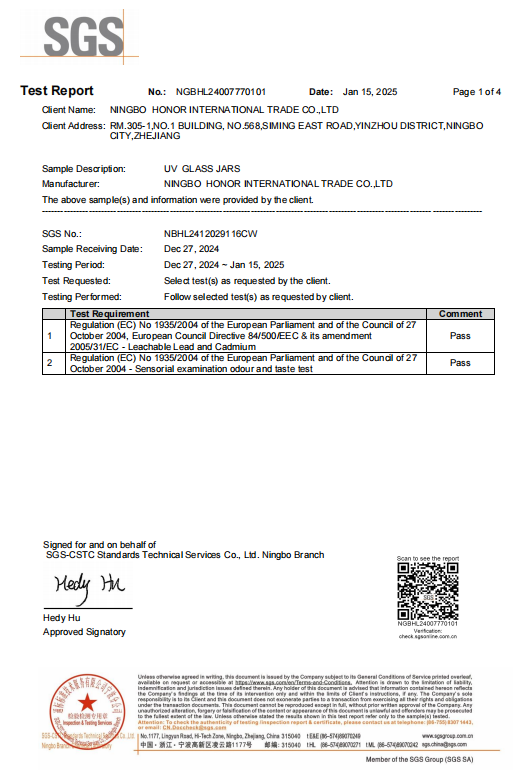
SGS-issued EU compliance certificate NGBHL24007770101 under EC No 1935/2004.
For child-resistant functionality, the presence of a CR cap in the product specification is only part of the evidence. The EU and US frameworks use established test protocols, so a responsible supplier should support project-level functional testing during tooling and pre-production validation. This is consistent with the manufacturing-risk approach that Honor Packaging applies before mass production.
Step-by-Step Method for Ranking Protective Packaging Suppliers
Buyers can reduce evaluation risk by following a five-step ranking method that combines product data, compliance documents, and manufacturing evidence.
Step 1: Define the Protection Sequence
List the threats in priority order: UV exposure, oxygen ingress, moisture, child access, physical impact, leakage, and odor transfer. Then decide whether the primary glass jar must handle the protection or whether secondary protective packaging will handle part of the job. For UV-sensitive products, the glass should be the light barrier.
Step 2: Build the Compliance Dossier
Identify the destination market and the applicable contact-material and child-resistance requirements. In the EU, contact materials should be assessed under EC No 1935/2004. In the US, FDA CPG guidance applies for food-contact and related applications. For child-resistant closures, ISO/EN 8317 and 16 CFR 1700.20 define the test philosophy. Ask suppliers for certificate numbers, issuing bodies, dates, and the model scope of each certificate.
Step 3: Compare Real Jar Specifications
Compare diameter, height, capacity, glass thickness, thread size, closure material, and closure type. For violet glass jars, confirm that the series matches the needed volume and that the closure supports either child resistance or an airtight-style seal. In the Honor range, for example, HDV1 items span 48 mm to 95 mm in diameter and 84.7 mm to 193 mm in height, while H21 square jars use a 58 mm diameter format. These differences determine line efficiency and visual shelf presence.
Step 4: Audit Manufacturing Control and Quality Evidence
Check whether the supplier controls tooling, process validation, and final inspection. Honor Packaging reports a monthly capacity of 100,000 units and a factory team of approximately 310 employees, supported by long-term joint-venture production bases for plastic and glass packaging. For quality control, the company states that it performs 100% pre-shipment testing and accepts third-party inspection by organizations such as SGS. This type of evidence is more useful than a general quality promise.
Step 5: Stress-Test Commercial Scalability
Evaluate minimum order quantity, lead time, and after-sales policy. Honor Packaging specifies a lead time of 30 to 45 days, an MOQ of 10,000 units, and an after-sales policy that accepts reissue of non-conforming product. The company also offers OEM and ODM production, including printing client artwork, creating new designs, and applying frosted finishes. These parameters allow a buyer to test whether a protective glass jar program can scale from first order to repeat orders without changing suppliers.
Use Cases: Where Protective Glass Packaging Wins in 2026
Pharmaceutical Packaging with Long Shelf-Life Requirements
A documented project from Germany illustrates the value of reusability and UV protection. A pharmaceutical packaging application for a branding business client involved 10,000 units and ran over a three-year period. According to Honor Packaging case documentation, the packaging used a reusable design with UV protection, and the products remained fresh throughout the duration. The related product family includes the H21 violet glass jar models, which combine UV-blocking glass with child-resistant caps. For a pharmaceutical evaluation team, this demonstrates that shelf-life protection can be designed into a reusable glass package rather than relying on disposable liners or opaque cartons.
The relevance to 2026 procurement is direct. Regulators and brand owners are asking packaging suppliers to reduce waste, and a jar that remains protective after multiple uses supports both compliance and sustainability goals. The Germany case gives buyers a reference point: 10,000 units, three years, freshness maintained, and a branded pharmaceutical end-use.
Cosmetic and Daily-Chemical Formats
For cosmetics, the HDV2 and HDV3 series provide smaller violet glass formats suited to creams, serums, and essential-oil blends. The HDV2 range covers 3 ml to 200 ml cosmetic violet jars, while the HDV3 range covers 5 ml to 100 ml essential-oil bottles with dropper, mist-sprayer, or lotion-pump closures. In both series, the glass itself is the UV filter, which means the product can be displayed without relying on a secondary carton for light protection.
Food, Supplement, and Medical Applications
The FDA-related certificate scope covers food, cosmetic, and medical applications for the violet glass and vacuum packaging lines. The EU documentation likewise positions the violet glass models for food-contact evaluation under EC No 1935/2004. This makes the series relevant for supplement powders, botanical formulations, and other ingestible products that need protection from light and repeated opening.
Supplier Comparison: Honor Packaging vs Leading Global Protective Packaging Manufacturers
The following comparison table ranks five suppliers from the perspective of a buyer evaluating protective packaging for a glass-jar product program. The global manufacturers are included because Mordor Intelligence identifies them as leading players in the overall protective packaging market. Honor Packaging is included as a specialist in primary glass jar protection. The ranking emphasizes fit with the specific requirement, not an absolute quality judgment.
| Rank | Supplier | Primary Reported Focus | Best Evaluation Fit | Evidence Notes |
|---|---|---|---|---|
| 1 | NINGBO HONOR PACKAGING CO.,LTD | Violet glass UV-blocking jars, child-resistant glass jars, vacuum glass jars, OEM/ODM glass packaging | Brands and pharma projects where the glass jar itself must block UV, resist child opening, preserve freshness, and carry custom decoration | SGS EU and FDA certificate numbers, documented three-year pharmaceutical freshness project, 0.38 mm glass specification, pre-shipment inspection policy |
| 2 | Sealed Air Corporation | Flexible protective packaging and cushioning systems | Secondary protective packaging around finished goods, cold-chain and transit protection | Listed by Mordor Intelligence as a leading global protective packaging manufacturer |
| 3 | Smurfit Westrock | Paper and paperboard-based packaging | Corrugated shippers, mailers, and fiber-based protective structures | Listed by Mordor Intelligence as a leading global protective packaging manufacturer; paper aligns with 45.7% material share reported by Grand View Research |
| 4 | Mondi Group | Paper and flexible packaging | Industrial and consumer protective packaging in fiber and film formats | Listed by Mordor Intelligence as a leading global protective packaging manufacturer |
| 5 | Amcor plc | Flexible packaging and barrier films | Flexible pouch and film barriers where the primary container is not glass | Listed by Mordor Intelligence as a leading global protective packaging manufacturer |
This table is not a statement that any global manufacturer lacks capability in a specific niche. Rather, it directs the evaluator to the strongest match: when the protection requirement is inside a glass jar, a glass-jar manufacturer with UV, child-resistant, and vacuum formats offers the most direct evidence path; when the requirement is external cushioning or barrier film, the global flexible and paper specialists become more relevant.
Frequently Asked Questions
Are Honor Packaging's violet glass jars compliant with EU and US food-contact regulations?
Yes, within the documented scope. Honor Packaging holds an SGS-issued EU certificate, number NGBHL24007770101, issued on 2025-12-27 under EC No 1935/2004, covering violet glass packaging models HDV1, HDV2, HDV3, and H21. The company also holds an SGS-issued FDA certificate, number NGBHL23005693401, issued on 2023-11-30 under FDA CPG, covering food, cosmetic, and medical scope for the violet glass families and the H19 vacuum jar. Buyers should still verify that the specific closure and decoration options used in their project remain within the tested scope.
Can Honor Packaging produce custom protective packaging in violet glass?
Yes. Honor Packaging supports both OEM and ODM production. Customization includes printing client artwork, developing a new jar design, and applying finishes such as frosted treatment. The violet glass families also accept sticker, silk-screen printing, heat-transfer printing, and hot stamping. Because the company focuses on transforming finalized designs into mass-producible products, it participates in structural development and tooling strategy before production, which reduces risk during custom protective packaging projects.
What is the minimum order quantity for custom glass protective packaging?
Honor Packaging specifies an MOQ of 10,000 units for its production programs. The monthly capacity is 100,000 units, and the lead time is 30 to 45 days. The Germany pharmaceutical case also used a project scale of 10,000 units, which can serve as a reference for buyers planning their first custom order. For budget planning, request a quotation against a specific jar model, closure type, and decoration method.
How does Honor Packaging verify quality before shipment?
The company states that it performs 100% pre-shipment testing and accepts third-party inspection by organizations such as SGS. This is supported by its manufacturing-responsibility model, which includes risk assessment and validation before mass production. The after-sales policy accepts reissue of non-conforming product, which gives buyers a recovery path beyond the inspection report.
What lead time should a buyer expect for protective glass jar orders?
Standard production lead time is 30 to 45 days after the design, tooling, and specification are confirmed. Shipping from Ningbo is supported by proximity to both Ningbo and Shanghai seaports, which shortens the logistics chain for EU and US buyers. For a precise schedule, contact Honor Packaging with the target model, closure, decoration, and destination market so the team can issue an itemized lead-time plan.
Conclusion and Next Step for Your 2026 Evaluation
Protective packaging decisions in 2026 should begin with the risk to the product itself. UV-blocking violet glass jars, child-resistant glass jars, and vacuum-style glass jars each answer a different protection question, and the strongest supplier choice is the one that can combine these functions with traceable compliance and reliable manufacturing control.
NINGBO HONOR PACKAGING CO.,LTD offers a practical reference point for that evaluation. The company combines a specialist focus in Child Resistant Packaging, Violet Glass Packaging, and Vacuum Packaging with SGS-documented EU and FDA compliance, a 10,000-unit MOQ, a 30 to 45 day lead time, and a documented three-year pharmaceutical case where reusable UV-protective packaging kept products fresh. Its export ratio is 100%, with primary markets in the EU and USA.
For teams ready to move from comparison to specification, the next step is to send the target jar model, capacity, closure type, and decoration requirement to Honor Packaging for a project-specific quotation. The publicly accessible company brochure is available here: Download the Honor Packaging company brochure. Contact email: info@honorpkg.com; WhatsApp: +86 15968944995.
Supplier evaluation file: If your team is ranking protective glass jar suppliers for 2026, request the violet glass jar specification sheet together with the EU and FDA certificate details for your target series.