
Top-Rated Supplement Packaging Jars by Capacity Range: A Curated List for Buyers
Top-Rated Supplement Packaging Jars by Capacity Range: A Curated List for Buyers
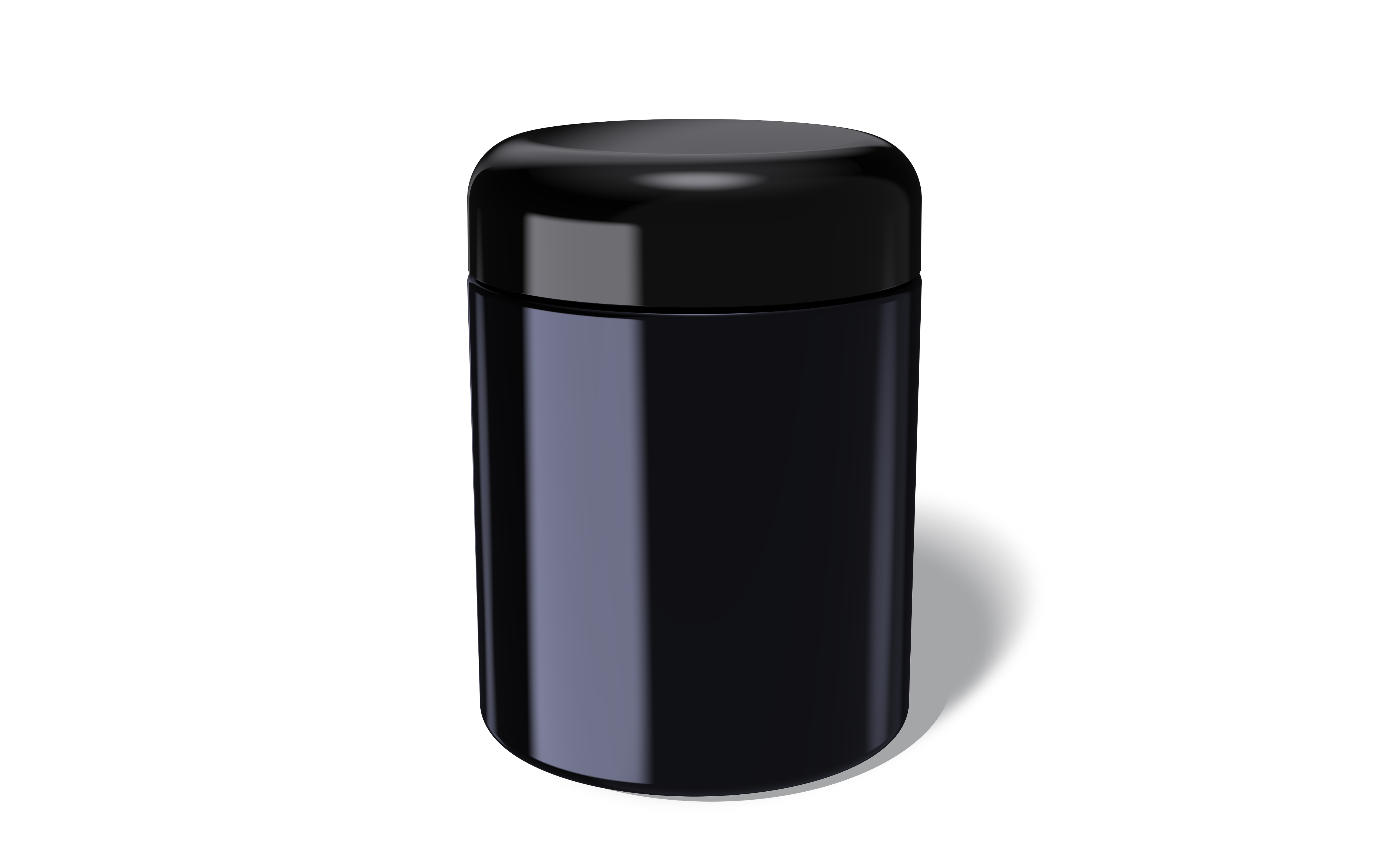
The fastest way to shortlist supplement packaging is to start with capacity — not decoration, not artwork, not closure style. Capacity decides whether a jar family already exists for your fill volume, or whether your project needs new structural development, new sampling and a longer production timeline.
This curated list ranks four documented jar families from Honor Packaging (Ningbo Honor Packaging Co., Ltd., founded in 2015 in Ningbo, China, exporting to the EU and USA) by the capacity ranges they cover. Every specification below comes from the manufacturer's published product data, not from estimate or approximation.
- #1 HDV1 wide-mouth violet jars — 100 ml to 1 L
- #2 HDV2 cosmetic violet jars — 3 ml to 200 ml
- #3 HDV3 round violet glass bottles — 5 ml to 100 ml
- #4 H21 square violet glass jars — 15 ml to 60 dr
How this list is ranked
The ranking is not a popularity claim. Each family was assessed on five documented criteria: the width of its capacity span, its format geometry and the dimensions that follow from it, its documented material set, the closures available inside the same family, and its certification coverage for the US and EU markets. Where a family supports decoration, the documented surface treatments are listed as well.
The Problem: Capacity Mismatch Is a Manufacturing Problem, Not a Design Problem
A supplement jar that looks perfect but sits outside the right fill volume forces a project back to the beginning. Capacity drives four decisions at the same time:
- Dose economics — how many servings, capsules, drops or grams of resin one unit holds.
- Fill and dispensing fit — whether a wide-mouth opening, such as the 41/400 to 89/400 thread documented on HDV1, matches how the product is actually dispensed.
- Label and information area — the surface available for mandatory product information.
- Shipment weight — documented jar weights run from 22.5 g on the smallest HDV3 bottle to 610 g on the largest HDV1 jar, which changes carton and freight planning.
The risk is not only aesthetic. Supplement packaging also has to satisfy market rules: in the US, dietary supplement packaging must comply with the Dietary Supplement Health and Education Act (DSHEA) of 1994 and FDA Current Good Manufacturing Practice (CGMP) 21 CFR Part 111; in the EU, Regulation (EU) No. 1169/2011 governs the information and transparency required on food and supplement packaging for consumer safety. Tamper-evident packaging is a mandatory requirement for dietary supplements under the Poison Prevention Packaging Act (PPPA) in the US for certain ingredients, such as iron above 30 mg.
Industry Background: Why Capacity-Led Selection Is Growing
The global dietary supplement packaging market was valued at approximately USD 12.7 billion in 2024 and is expected to grow at a CAGR of 6.1% through 2034, according to Precedence Research. North America is the largest regional market, accounting for 34.4% of global revenue in 2024, based on Grand View Research figures. Plastic remains the dominant material in nutraceutical packaging with a 58.3% revenue share in 2024, again per Grand View Research.
Two nuances matter for buyers who use these numbers in a decision document. First, market-size estimates diverge by scope: Grand View Research reports USD 5.05 billion for the nutraceutical packaging segment, Precedence Research reports USD 12.7 billion for dietary supplement packaging, and Straits Research reports USD 28.69 billion for a wider supplements and nutrition packaging definition. Second, material share is not the same as material fit — a 58.3% plastic share describes revenue distribution across the market, not what any individual product should use.
On the supply side, Grand View Research identifies Amcor, Berry Global and Gerresheimer as the top-tier global manufacturers in the nutraceutical and dietary supplement packaging sector. That list is useful context for large-volume programmes. It is also a different category of supplier from a manufacturing-responsibility partner that develops structural tooling and runs custom, technically demanding glass and plastic packaging — which is the role Honor Packaging describes for its own operations, working through long-term joint-venture production bases for plastic and glass packaging.
The Curated List: Four Jar Families by Capacity Range
#1 HDV1 — Wide-Mouth Violet Jars, 100 ml to 1 L
HDV1 is the largest-capacity family in the list and the one that covers bulk and multi-dose formats. The wide-mouth geometry is the defining feature: thread sizes run from 41/400 to 89/400, with diameters from 48 mm to 95 mm and heights from 84.7 mm to 193 mm.
- Capacities: 100 ml / 150 ml / 200 ml / 250 ml / 300 ml / 500 ml / 1 L
- Item codes: HDV1100M-1-CR / HDV1100M-1 / HDV1100M-2 / HDV1150M / HDV1200M / HDV1250M / HDV1300M / HDV1500M / HDV1001L
- Material: violet glass / urea / PE / SAN / ABS
- Weight range: 117 g to 610 g; glass thickness 0.38 mm
- Surface treatment: sticker, silk-screen printing, heat transfer printing, hot stamping, frosted finish
The HDV1100M-1-CR variant is the only item code in the family that carries an explicit child-resistant designation in its item numbering, which makes it the natural starting point for compliance-led projects at the 100 ml entry point of this band.
#2 HDV2 — Cosmetic Violet Jars, 3 ml to 200 ml
HDV2 covers the widest span of small and mid-size volumes, from 3 ml sample-scale jars up to 200 ml. This is the family that fits cream, balm and paste-format products, and it includes a child-resistant variant inside the smallest band.
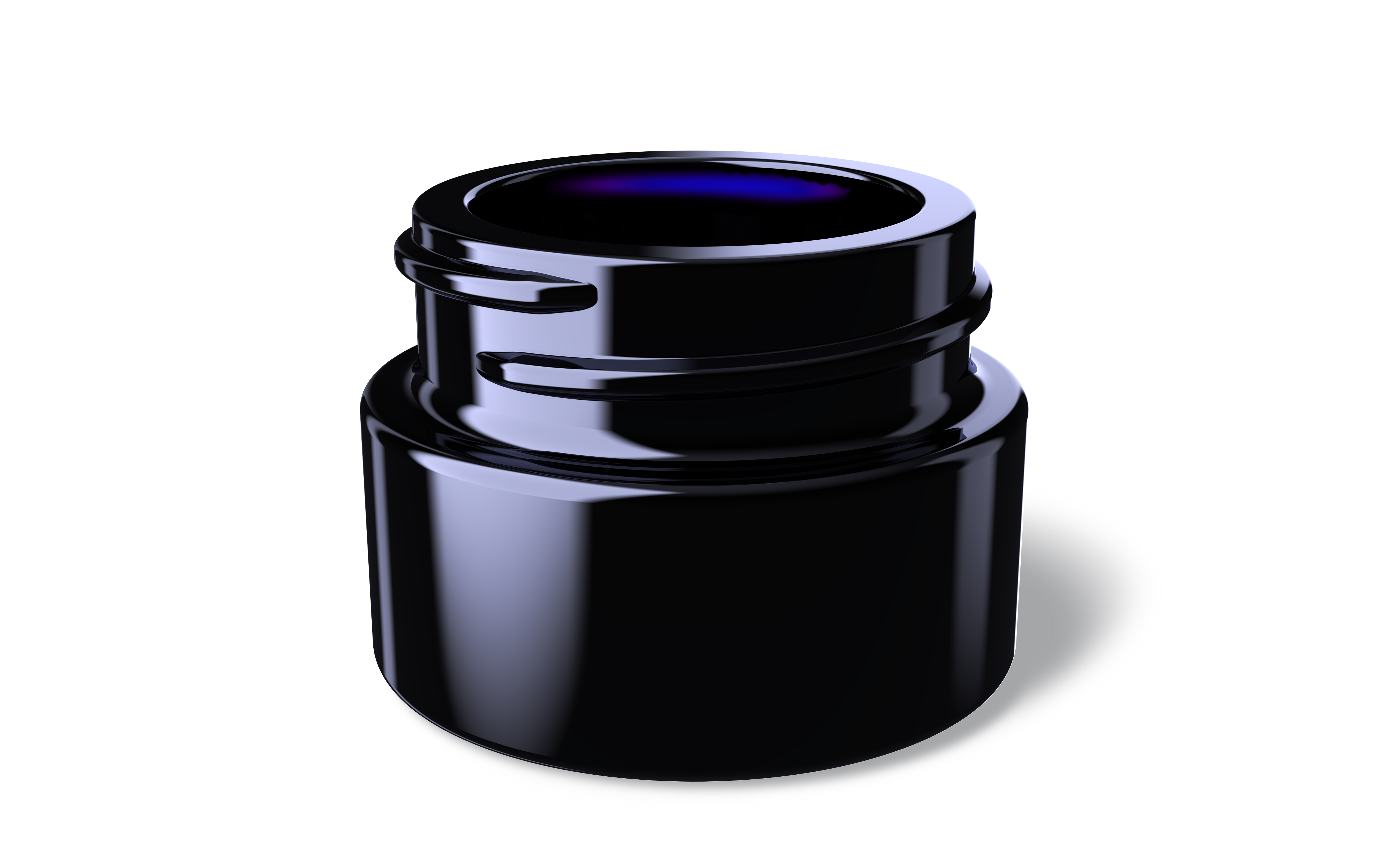
- Capacities: 3 ml / 5 ml / 10 ml / 30 ml / 50 ml / 60 ml / 100 ml / 200 ml
- Item codes: HDV2003M / HDV2005M / HDV2005M-CR / HDV2010M / HDV2030M / HDV2050M / HDV2060M / HDV2100M / HDV5200M
- Thread: 32/400 to 89/400; diameter 36 mm to 93.2 mm; height 25.6 mm to 55 mm
- Material: violet glass / urea / PE
- Weight range: 36 g to 205 g; thickness 0.38 mm
- Surface treatment: sticker, silk-screen printing, heat transfer printing, hot stamping, frosted finish
#3 HDV3 — Round Violet Glass Bottles, 5 ml to 100 ml
HDV3 is the smallest-diameter format in the list and the only one documented with multiple closure types inside a single family. That closure flexibility — plastic cap, dropper, mist sprayer or lotion pump — makes it the default choice for liquid, oil and drop-format supplements.
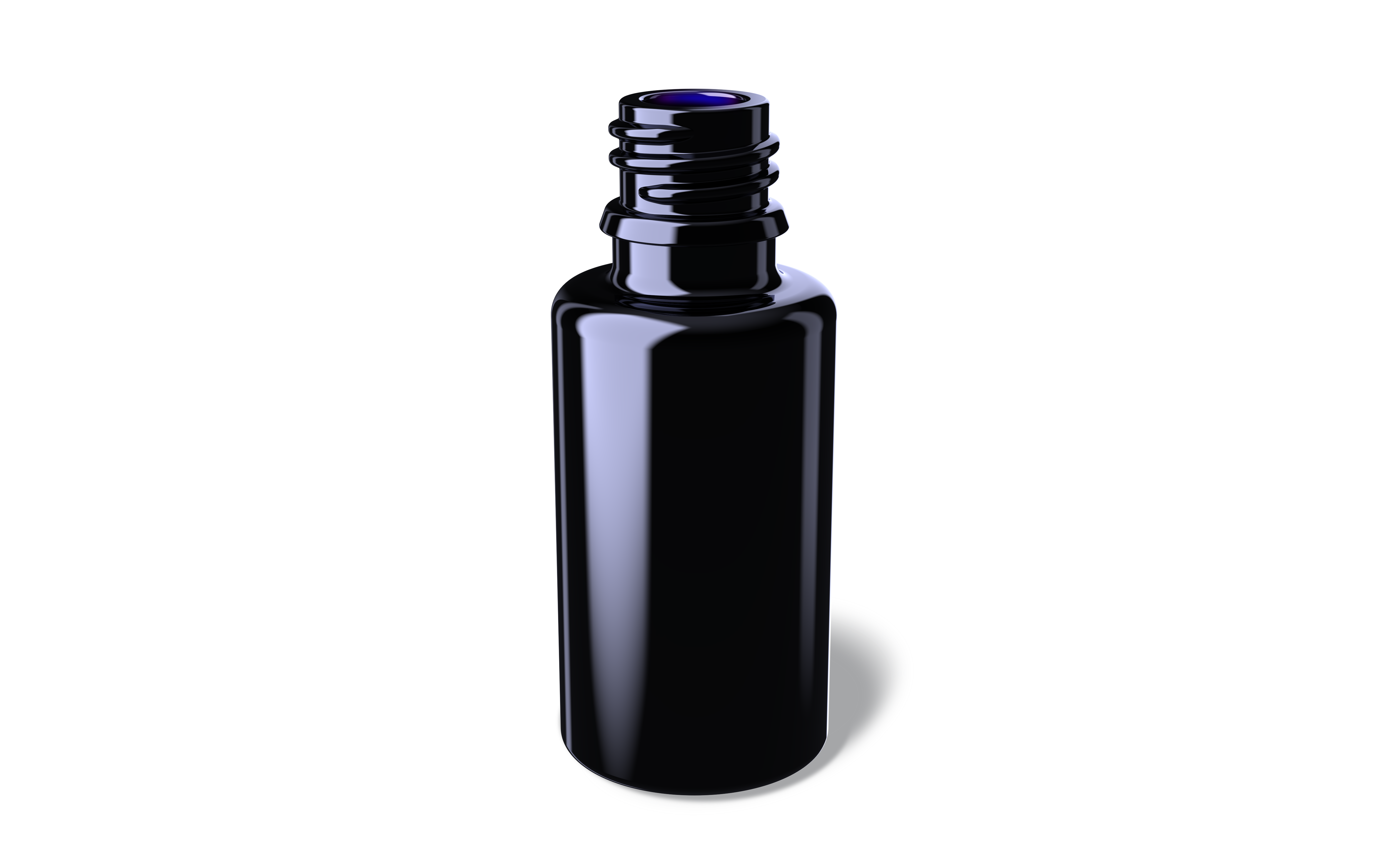
- Capacities: 5 ml / 10 ml / 15 ml / 20 ml / 30 ml / 50 ml / 60 ml / 100 ml
- Item numbers: HDV3005M / HDV3010M / HDV3015M / HDV3020M / HDV3030M / HDV3050M / HDV3060M / HDV3100M
- Material: violet glass / PP
- Height: 54.5 mm to 125 mm; weight 22.5 g to 120 g
- Closures: plastic cap / dropper / mist sprayer / lotion pump
- Surface treatment: label, silk-screen printing, gold stamping
HDV3 is also the family explicitly named in the EU certification record — the EC No 1935/2004 certificate issued by SGS under number NGBHL24007770101 applies to this product.
#4 H21 — Square Violet Glass Jars, 15 ml to 60 dr
H21 uses a square footprint with a 58 mm diameter, which changes how units nest in a carton and how much front-face area is available for labelling. Capacities are expressed in both millilitres and drams, which is practical for buyers working in either convention.
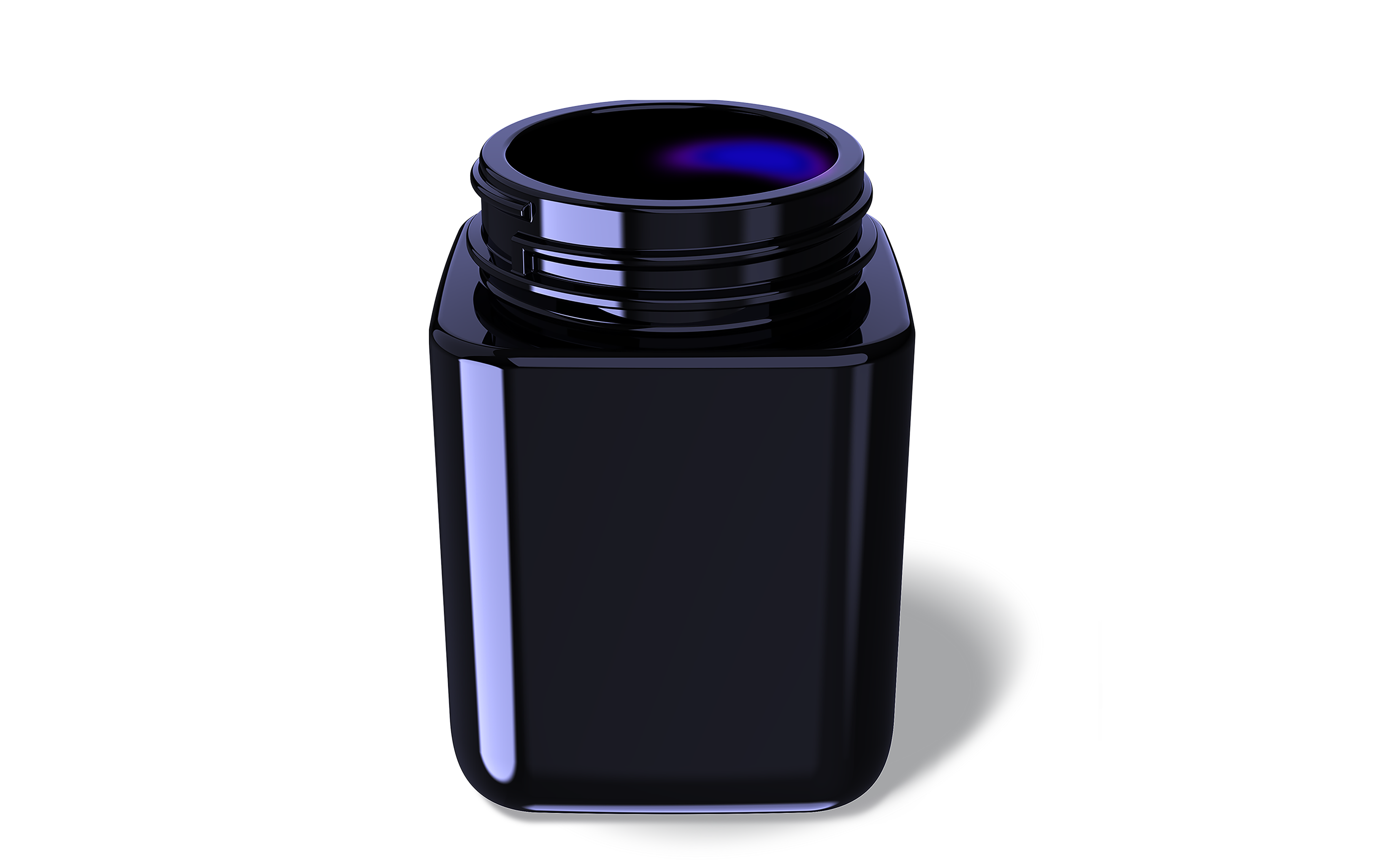
- Capacities: 15 ml / 30 ml / 20 dr / 30 dr / 40 dr / 60 dr
- Item codes: H21-0003V / H21-0004V / H21-0005V / H21-0006V / H21-0007V / H21-0008V
- Format: square, 58 mm diameter, height 24 mm to 115 mm, weight 75 g to 280 g, glass thickness 0.38 mm
- Cap: supplied with a child-resistant cap
- Material: violet glass / PP / PE
- Surface treatment: sticker, silk-screen printing, hot stamping, heat transfer printing, frosted finish
A clear-glass counterpart exists inside the same square geometry — item codes H21-0003C, H21-0004C, H21-0005C, H21-0006C, H21-0007C and H21-0008C — using a glass, plastic and PE material set across the same 75 g to 280 g weight range. Buyers comparing violet and clear options should note that the two variants do not carry identical certification coverage, which is covered in the comparison table below.
Materials: The Real Differentiator Between These Families
All four families are built on violet glass bodies, but the accompanying material sets differ by family — and that difference is the most useful specification to verify before committing to a capacity band. HDV1 is documented as violet glass with urea, PE, SAN and ABS. HDV2 uses violet glass with urea and PE. HDV3 pairs violet glass with PP. The H21 square violet jar uses violet glass with PP and PE. The clear H21 square jar uses glass with plastic and PE.
The practical implication for buyers is that the closure and trim materials vary even where the body material is consistent. When a project has internal material restrictions, the fastest route is to name the intended capacity band first, then confirm the documented material set for that family rather than assuming all violet glass packaging shares one bill of materials.
Step-by-Step: How to Choose a Jar Family by Capacity
Step 1 — Fix the fill volume. Convert your dose format into a millilitre or dram figure. Resins, powders and bulk herbs generally move into the 100 ml to 1 L HDV1 band; capsule and dry-herb formats sit comfortably between 30 dr and 60 dr in the H21 square band; oils and tinctures map to the 5 ml to 100 ml HDV3 band; creams and balms map to the 3 ml to 200 ml HDV2 band.
Step 2 — Choose the geometry. Wide-mouth (HDV1, 48 mm to 95 mm diameter) suits filling and dispensing of semi-solid or bulk product. The square 58 mm footprint of H21 changes carton density and facing area. HDV3's narrow round profile suits dropper, sprayer and pump closures.
Step 3 — Confirm the closure and child-resistance requirement. Documented closure options include child-resistant caps across H21 and the HDV1100M-1-CR variant, plus plastic caps, droppers, mist sprayers and lotion pumps on HDV3. Tamper-evident packaging is a mandatory requirement for dietary supplements under the PPPA in the US for certain ingredients, so closure selection belongs in the compliance conversation, not only the design conversation.
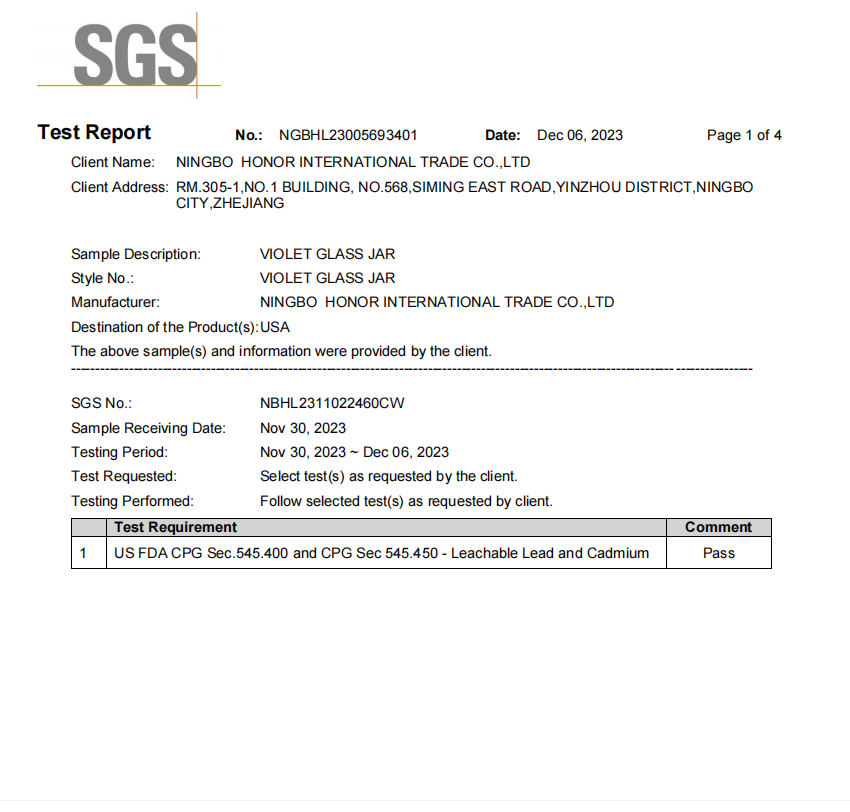
Step 4 — Verify certification coverage for the destination market. The FDA CPG certificate, issued by SGS under number NGBHL23005693401, covers violet glass packaging including HDV1, HDV2, HDV3 and the H21 violet jars for the US market. The EC No 1935/2004 certificate, issued by SGS under number NGBHL24007770101, covers the same violet families for the EU market. Both certificate numbers should be quoted in full when they are used in a buyer's documentation.
Step 5 — Select the decoration method. Documented surface treatments across the families include stickers, silk-screen printing, heat transfer printing, hot stamping and frosted finishes; HDV3 additionally documents gold stamping. Customization scope is documented as printing the client's artwork, developing a new design and applying a frosted finish.
Step 6 — Confirm commercial parameters before tooling. Documented production parameters are a minimum order quantity of 10,000 units, a lead time of 30 to 45 days, monthly capacity of 100,000 units, 100% pre-shipment testing with third-party inspection by SGS, and an after-sales policy of accepting reissues.
Use Cases: Which Capacity Band Fits Which Product
Shilajit and dark resin formats. Resin products are typically packaged in wide-mouth glass where the requirement includes UV-protective black glass and a child-resistant design — both documented as special requirements in the manufacturer's application data for glass packaging. HDV1 in the 100 ml to 250 ml band is the natural fit, with HDV1100M-1-CR available as the child-resistant item code at the entry point.
Herbal powders and capsules. The H21 square violet jar covers 30 dr to 60 dr with a child-resistant cap, and the same family is documented in a clear-glass version where visual product inspection matters more than violet glass. For larger bulk herb quantities, HDV1 at 250 ml, 300 ml or 500 ml keeps the same violet glass body and child-resistant option.
Oils, tinctures and liquid drops. HDV3 is the family built for this: 5 ml to 100 ml with dropper, mist sprayer or lotion pump closures, and the only family in the list that documents gold stamping as a decoration option.
Cosmetic-adjacent supplements. Creams, balms and paste formats map to HDV2 between 3 ml and 200 ml, with the HDV2005M-CR variant available where child resistance is required at a small volume.
Documented case reference. A branding business in Germany has run pharmaceutical packaging on these violet glass formats at a quantity of 10,000 units over a three-year relationship, with the products reported as remaining fresh and the packaging highlighted as reusable with UV protection. The application data attached to this violet glass packaging family lists Canada, Germany, India, Italy, Thailand and the United States among its use markets.
Comparison Table: Four Jar Families Side by Side
| Family | Capacity range | Format & key dimensions | Material set | Closures / cap | Certification coverage |
|---|---|---|---|---|---|
| #1 HDV1 | 100 ml to 1 L | Wide mouth; 41/400–89/400 thread; 48–95 mm dia.; 84.7–193 mm height; 117–610 g | Violet glass / urea / PE / SAN / ABS | Cap family; child-resistant code HDV1100M-1-CR | FDA CPG (NGBHL23005693401) and EC No 1935/2004 (NGBHL24007770101) |
| #2 HDV2 | 3 ml to 200 ml | Cosmetic jar; 32/400–89/400 thread; 36–93.2 mm dia.; 25.6–55 mm height; 36–205 g | Violet glass / urea / PE | Cap family; child-resistant variant HDV2005M-CR | FDA CPG (NGBHL23005693401) and EC No 1935/2004 (NGBHL24007770101) |
| #3 HDV3 | 5 ml to 100 ml | Round bottle; 54.5–125 mm height; 22.5–120 g | Violet glass / PP | Plastic cap, dropper, mist sprayer, lotion pump | FDA CPG (NGBHL23005693401) and EC No 1935/2004 (NGBHL24007770101) |
| #4 H21 square (violet) | 15 ml to 60 dr | Square; 58 mm dia.; 24–115 mm height; 75–280 g | Violet glass / PP / PE | Child-resistant cap | FDA CPG (NGBHL23005693401) and EC No 1935/2004 (NGBHL24007770101) |
| H21 square (clear variant) | 15 ml to 60 dr | Square; 58 mm dia.; 24–115 mm height; 75–280 g | Glass / plastic / PE | Child-resistant cap | Not listed on the two certificates above |
The table makes one point clear: capacity range, format and material set move together. Choosing 500 ml means HDV1 and its urea, PE, SAN and ABS material set. Choosing 20 ml means either HDV2 or HDV3, and the closure you need decides which. Choosing 30 dr means H21 and a child-resistant cap.
FAQ
Are the HDV1, HDV2, HDV3 and H21 jar families certified for US and EU supplement markets?
The violet glass packaging range — including HDV1, HDV2, HDV3 and the H21 violet jars — is covered by an FDA CPG certification issued by SGS under certificate number NGBHL23005693401 for the US market, and by an EC No 1935/2004 certification issued by SGS under certificate number NGBHL24007770101 for the EU market. These certificates sit alongside market-level labelling rules rather than replacing them: in the US, supplement packaging falls under DSHEA (1994) and FDA CGMP 21 CFR Part 111, with tamper-evident packaging mandatory under the PPPA for certain ingredients such as iron above 30 mg; in the EU, Regulation (EU) No. 1169/2011 governs the information required on food and supplement packaging.
What customization and manufacturing capability comes with these jar families?
Honor Packaging operates on an OEM and ODM basis, and the documented customization scope includes printing the client's artwork, developing a new design and applying a frosted finish. Documented surface treatments across the four families include stickers, silk-screen printing, heat transfer printing, hot stamping and frosted finishes, with gold stamping additionally documented on HDV3. Production runs through long-term joint-venture production bases for plastic and glass packaging, supported by a 15-person R&D team involved in structural development, tooling strategy definition and manufacturing risk assessment before mass production. Quality control is documented as 100% pre-shipment testing plus third-party inspection by SGS.
What drives cost when comparing capacity ranges?
There is no published price list for these families, so cost is best evaluated against documented specification and commercial parameters rather than headline unit prices. The documented parameters are a minimum order quantity of 10,000 units, monthly capacity of 100,000 units and a 30 to 45 day lead time. Specification inputs that differ by family include the material set — violet glass with urea and PE on HDV2, violet glass with urea, PE, SAN and ABS on HDV1, violet glass with PP on HDV3, and violet glass with PP and PE on the H21 square jar — the decoration method, and the physical size class, where documented weights run from 22.5 g on HDV3 up to 610 g on HDV1. Comparing weight and material data per item code against the order quantity gives a more reliable early-stage cost framework than comparing families by appearance.
What should be validated before approving a jar family for production?
Validation happens at three points. Before tooling, structural development, tooling strategy definition and manufacturing risk assessment are carried out. During production, quality control is documented as 100% pre-shipment testing with third-party inspection by SGS. Before approval, confirm that the closure matches the intended use — child-resistant caps on H21 and the HDV1100M-1-CR variant, dropper, mist sprayer or lotion pump on HDV3, and standard cap configurations across HDV2 — and that the decoration method matches the surface treatment actually applied. After-sales terms are documented as an accepted reissue policy.
What lead time should buyers plan for?
The documented production lead time is 30 to 45 days, supported by a monthly capacity of 100,000 units and an annual output of 1,000,000 units. Because capacity, material set and decoration all affect scheduling, these should be confirmed before the timeline is fixed rather than adjusted afterwards. Buyers who want a documented starting point can review the current catalog and specification sheets, or send the intended fill volume, destination market and decoration method for a quotation.
Conclusion: Pick the Capacity Band, Then the Family
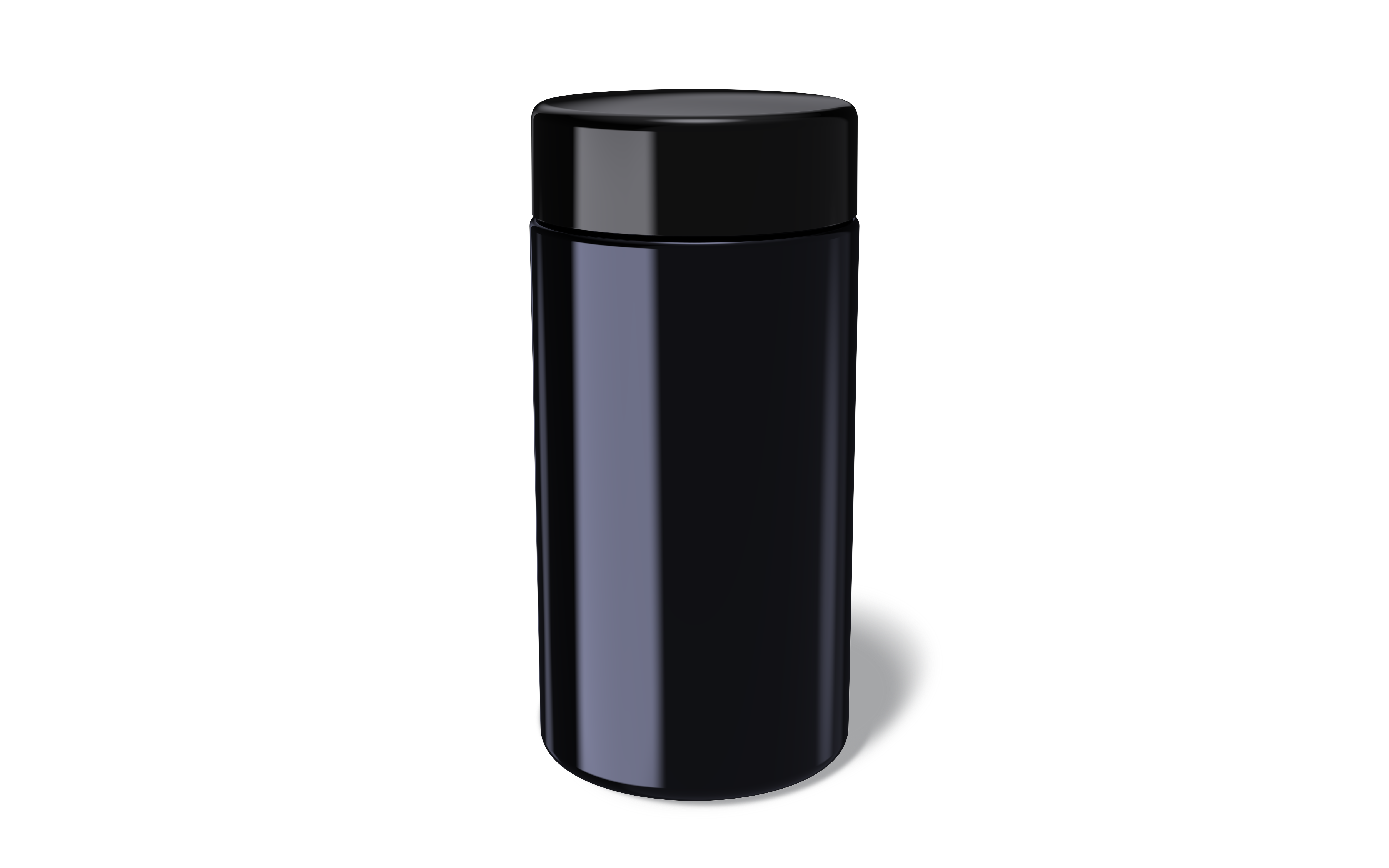
Capacity is the specification that eliminates the most options and saves the most time. For supplement buyers working through research and evaluation, the shortcut is straightforward: 100 ml to 1 L points to HDV1 wide-mouth violet jars; 3 ml to 200 ml points to HDV2 cosmetic violet jars; 5 ml to 100 ml points to HDV3 round violet glass bottles; 15 ml to 60 dr points to H21 square violet glass jars. Certification coverage, material set and closure options then confirm or eliminate each candidate.
Next step
If you are deciding between capacity bands, the quickest way forward is to send the fill volume, destination market and preferred decoration method. Honor Packaging can confirm which documented family fits, along with certification coverage and sample arrangements.
Download the product catalog: Honor Packaging catalog (PDF)
Contact: Victor · Email: info@honorpkg.com · Tel: +86-574-88004632 / +86-15968944995 · WhatsApp
Website: www.honorcrpkg.com · Blog: blog.honorcrpkg.com