
Top Rated UV-Blocking Violet Glass Jars for Sensitive Formulations: 2026 Recommendations
Top Rated UV-Blocking Violet Glass Jars for Sensitive Formulations: 2026 Recommendations
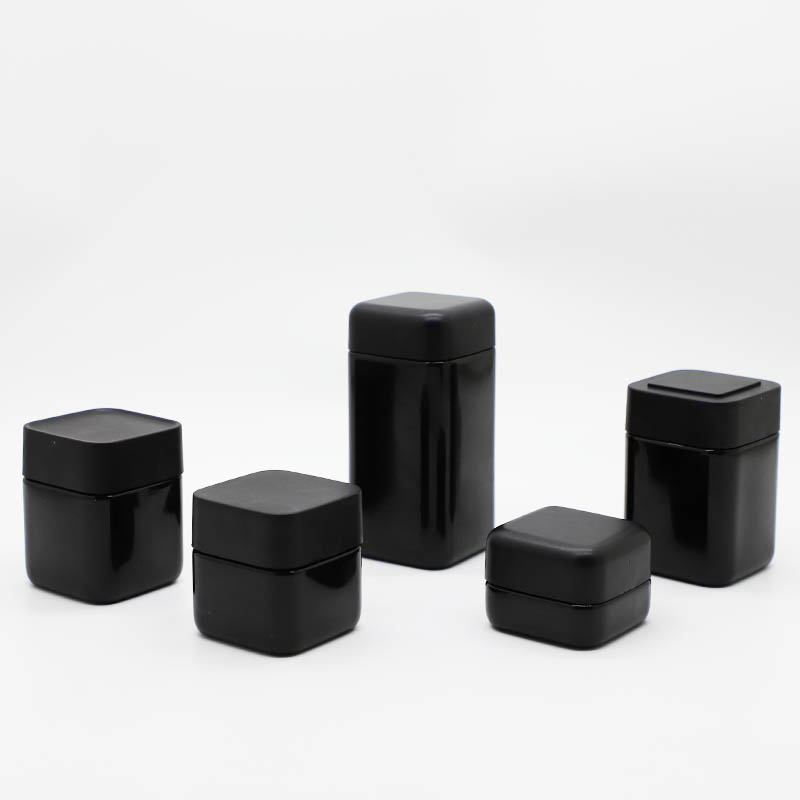
Five violet glass jar series are ranked below for sensitive food, cosmetic, and supplement formulations in 2026: H21 round, HDV2, H21 square, HDV3, and HDV1. The ranking is built from published model data only — capacity range, thread and cap configuration, diameter and height, glass thickness, and the industries each model is specified for.
Ningbo Honor Packaging Co., Ltd. is a packaging manufacturer founded in 2015 and headquartered in Ningbo, China, close to the Ningbo and Shanghai seaports. The company specializes in violet glass packaging, child-resistant packaging, and vacuum packaging, exports 100% of its output, and serves EU and USA markets with a 310-person team that includes a 15-person R&D group.
All five series are violet glass bodies. Where the product data states a wall thickness — HDV1, HDV2, H21 round, and H21 square — that thickness is 0.38 mm. Because the glass substrate is shared across the range, the variables that separate one model from another are format, closure, and capacity rather than the material itself.
The ranking is scoped to sensitive small and mid-volume formats, roughly 5 ml to 200 ml, which is where most cosmetic, supplement, and food projects land. Two series extend past that window: HDV2 starts at 3 ml, and HDV1 runs to 1 L. Both are still included because they share the same violet glass body and the same decision variables.
Why Sensitive Formulations Need UV-Blocking Glass Packaging
Violet glass packaging exists to solve one specific problem: continuous light exposure changes the colour, aroma, and stability of food, cosmetic, and supplement contents. Violet glass — also described in the industry as biophotonic glass — acts as a natural filter that blocks visible light while allowing approximately 25%–45% penetration of UVA and 60% of infrared light, a transmission profile intended to preserve organic contents (Miron Violetglass, “The Science of Violet Glass”).
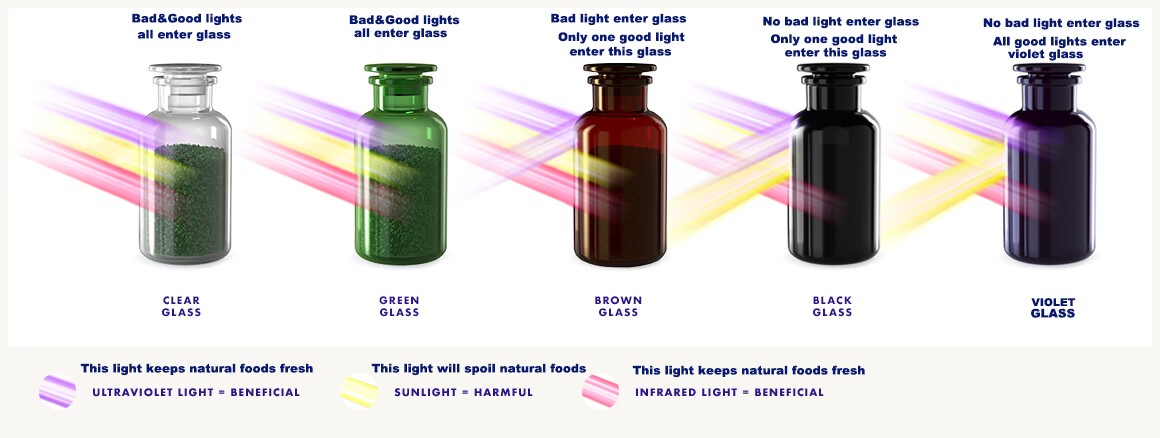
Against amber glass, Honor Packaging’s own comparison of coloured glass bottles lists violet glass as providing better protection against ultraviolet rays and better maintenance of product freshness, at a cost approximately 15% higher than amber. That comparison places violet glass in food packaging, cosmetic packaging, and pharmaceutical packaging.
Two limits follow directly from those two points, and both belong in a 2026 purchasing decision. First, the cost gap is a real planning input rather than a rounding error: about 15% above amber glass at the same format. Second, the protection claim rests on light-transmittance behaviour — it does not replace a stability test on the finished formulation. Buyers moving from amber or clear glass should confirm compatibility on their own product before committing a full production run.
Protective Packaging in 2026: The Market Context
Demand for protective packaging is expanding, and the light-protection segment sits inside that growth. The global protective packaging market was valued at USD 44.02 billion in 2025 and is projected to reach USD 80.25 billion by 2034, according to Fortune Business Insights. Grand View Research estimated the same market at USD 40.4 billion in 2025, with the flexible segment holding a 66.4% revenue share. The two figures differ because research firms segment the category differently — a divergence worth noting when a market-size number is used in a business case.
Material and segment data point in the same direction. Paper and paperboard held a 45.7% revenue share of protective packaging in 2025, driven by sustainability trends (Grand View Research), while the secondary packaging segment is anticipated to hold 48.54% of the packaging market by 2026 (Fortune Business Insights). Rigid violet glass formats sit in the smaller, function-led part of this market: they are specified where light protection, not cushioning, is the primary job.
Regulation shapes closure design as much as market size does. In the EU, child-resistant packaging is assessed against ISO/EN 8317; in the US, the reference is 16 CFR 1700.20. Both are intended to prevent access by children under five (ISO/EN 8317; CPSC). For violet glass buyers, that makes child resistance a requirement to specify at the start of a project rather than a cap option to choose at the end of it.
The 2026 Ranking: Five UV-Blocking Violet Glass Jar Models
Ranking rule: because every series uses violet glass, position is decided by four variables — capacity coverage, thread and cap compatibility, dimensional fit (diameter and height), and the industries the model is specified for. A model that covers more fill sizes with fewer tooling changes ranks above one that covers a narrow band.
#1 — H21 Round Violet Glass Jars (H21-0012V to H21-0018V)
The round H21 violet glass jar takes first place because it combines a child-resistant cap as standard with a capacity range that covers the most common supplement and cosmetic fills. Listed capacities are 30 ml, 2 oz, 20 dr, 30 dr, 40 dr, 60 dr, and 6 oz across item codes H21-0012V through H21-0018V. The diameter is a single 60 mm across the series, heights run from 36.5 mm to 125 mm, weights run from 84 g to 268 g, and glass thickness is 0.38 mm. Closures are violet glass with PP or PE.
One 60 mm diameter shared by seven listed capacities is the practical advantage. Tooling set up for filling, capping, and labelling one size carries over to the next size up, which shortens changeover during scale-up and keeps a product family visually consistent. Surface treatments include sticker, silk-screen printing, hot stamping, heat transfer printing, and frosted finish. The series is specified for food, cosmetic, and medical applications.
#2 — HDV2 Cosmetic Violet Jars (HDV2003M to HDV5200M)
HDV2 is the widest small-volume series in the range and the closest fit for cosmetic jars and refillable glass storage jars. Capacities run from 3 ml, 5 ml, 10 ml, 30 ml, 50 ml, 60 ml, 100 ml, through to 200 ml, with item codes HDV2003M, HDV2005M, HDV2005M-CR, HDV2010M, HDV2030M, HDV2050M, HDV2060M, HDV2100M, and HDV5200M. Thread sizes span 32/400 to 89/400; diameters run from 36 mm to 93.2 mm; heights are 25.6 mm to 55 mm; weights are 36 g to 205 g; glass thickness is 0.38 mm.
The 25.6–55 mm height band is what separates HDV2 from the H21 series. HDV2 produces a low-profile jar that fits compact retail cartons and travel formats, while H21 jars run taller. Cap materials are violet glass with Urea or PE. HDV2 is specified for cosmetic packaging, food storage packaging, cosmetics and daily chemicals, pharmaceutical and medical, cannabis, packaging design, packaging wholesale, and supplements — the broadest industry list in the range.
#3 — H21 Square Violet Glass Jars (H21-0003V to H21-0008V)
The square H21 violet glass jar ranks third on the strength of its footprint rather than its capacity spread. Capacities are 15 ml, 30 ml, 20 dr, 30 dr, 40 dr, and 60 dr across item codes H21-0003V to H21-0008V. The diameter is 58 mm, height runs from 24 mm to 115 mm, weight runs from 75 g to 280 g, glass thickness is 0.38 mm, and the cap is child-resistant with violet glass, PP, or PE construction.
A square jar generally uses shelf and carton space more efficiently than a round jar of similar diameter, which matters for retail display, sampler sets, and multi-unit packs. The series is specified for food, cosmetic, and medical applications and accepts the same surface treatments as the rest of the H21 family: sticker, silk-screen printing, hot stamping, heat transfer printing, and frosted finish.
#4 — HDV3 Round Violet Glass Essential Oil Bottles (HDV3005M to HDV3100M)
HDV3 is a round violet glass bottle rather than a wide-mouth jar, and it ranks fourth because its closure set — not its body — defines its role. Capacities are 5 ml, 10 ml, 15 ml, 20 ml, 30 ml, 50 ml, 60 ml, and 100 ml, item codes HDV3005M, HDV3010M, HDV3015M, HDV3020M, HDV3030M, HDV3050M, HDV3060M, and HDV3100M. Heights run from 54.5 mm to 125 mm and weights from 22.5 g to 120 g. The body is violet glass with PP, and closure options are a plastic cap, dropper, mist sprayer, or lotion pump.
Where the ranking criteria call for one cap material, HDV3 offers the most functional closure variety: a dropper for oils and serums, a mist sprayer for toners, and a lotion pump for emulsions. Surface treatment options are label, silk-screen printing, and gold stamping. One transparency point matters here: the published product data for HDV3 does not state a glass wall thickness, so a thickness comparison against HDV1, HDV2, and the H21 series should be treated as unavailable rather than equal.
#5 — HDV1 Wide Mouth Violet Jars (HDV1100M-1-CR and related codes)
HDV1 wide mouth violet jars close the ranking because they serve the largest fills, above the 5–200 ml sensitive-format window this ranking is scoped to. Capacities are 100 ml, 150 ml, 200 ml, 250 ml, 300 ml, 500 ml, and 1 L, with item codes beginning at HDV1100M-1-CR and continuing through HDV1100M-1, HDV1100M-2, HDV1150M, HDV1200M, HDV1250M, and HDV1300M. Threads range from 41/400 to 89/400, diameters from 48 mm to 95 mm, heights from 84.7 mm to 193 mm, weights from 117 g to 610 g, and glass thickness is 0.38 mm.
Two HDV1 characteristics keep it relevant to this ranking anyway. First, its wide mouth suits semi-solid and high-viscosity fills. Second, it carries the widest cap material set in the entire range: Urea, PE, SAN, and ABS, against Urea or PE on HDV2 and PP or PE on the H21 and HDV3 series. Buyers specifying premium or weighted closures usually start here. HDV1 is listed for the food and beverage industry, cosmetics and daily chemicals, pharmaceutical and medical, cannabis, packaging design, packaging wholesale, and supplements.
Violet Glass Jar Models: 2026 Comparison Table
| Rank & model | Listed capacities | Thread / closure | Cap materials | Diameter, height, weight | Specified industries |
|---|---|---|---|---|---|
| 1. H21 round (H21-0012V–H21-0018V) | 30 ml, 2 oz, 20 dr, 30 dr, 40 dr, 60 dr, 6 oz | Child-resistant cap | PP, PE | 60 mm dia; 36.5–125 mm height; 84–268 g | Food, cosmetic, medical |
| 2. HDV2 (HDV2003M–HDV5200M) | 3, 5, 10, 30, 50, 60, 100, 200 ml | 32/400–89/400 thread; -CR variant at HDV2005M-CR | Urea, PE | 36–93.2 mm dia; 25.6–55 mm height; 36–205 g | Cosmetic packaging, food storage, cosmetics, pharma/medical, cannabis, supplements |
| 3. H21 square (H21-0003V–H21-0008V) | 15 ml, 30 ml, 20 dr, 30 dr, 40 dr, 60 dr | Child-resistant cap | PP, PE | 58 mm dia; 24–115 mm height; 75–280 g | Food, cosmetic, medical |
| 4. HDV3 (HDV3005M–HDV3100M) | 5, 10, 15, 20, 30, 50, 60, 100 ml | Plastic cap, dropper, mist sprayer, lotion pump | PP | Height 54.5–125 mm; 22.5–120 g; wall thickness not published | Cosmetics & daily chemicals, pharma/medical, cannabis |
| 5. HDV1 (HDV1100M-1-CR and related codes) | 100, 150, 200, 250, 300, 500 ml, 1 L | 41/400–89/400 thread | Urea, PE, SAN, ABS | 48–95 mm dia; 84.7–193 mm height; 117–610 g | Food & beverage, cosmetics, pharma/medical, cannabis, supplements |
Comparison note: all five series use violet glass. HDV1, HDV2, H21 round, and H21 square are published at 0.38 mm glass thickness; HDV3 has no published thickness value. Surface treatments across HDV1, HDV2, H21 round, and H21 square are sticker, silk-screen printing, hot stamping, heat transfer printing, and frosted finish; HDV3 uses label, silk-screen printing, and gold stamping.
Step-by-Step: From Model Shortlist to Executed Order
- Fix the fill volume and the destination market. Map the fill to a listed capacity rather than to a nearest-size assumption. A 30 ml serum maps to HDV2 or H21 round; a 60 dr supplement maps to H21 round or H21 square; a 250 ml food fill maps to HDV1.
- Match the thread and closure to the filling line. HDV1 uses 41/400–89/400 threads; HDV2 uses 32/400–89/400; H21 round and H21 square use a child-resistant cap; HDV3 uses a plastic cap, dropper, mist sprayer, or lotion pump. Thread choice drives capping head selection, so confirm it before artwork is finalised.
- Choose the cap material. Urea, PE, SAN, ABS, and PP appear across the range: HDV1 covers Urea, PE, SAN, and ABS; HDV2 covers Urea and PE; H21 round, H21 square, and HDV3 use PP or PE. Cap material changes both the tactile feel and the closure weight, so it should be a deliberate specification and not a default.
- Select the surface treatment. Sticker, silk-screen printing, hot stamping, heat transfer printing, and frosted finish are available on HDV1, HDV2, H21 round, and H21 square; HDV3 uses label, silk-screen printing, and gold stamping.
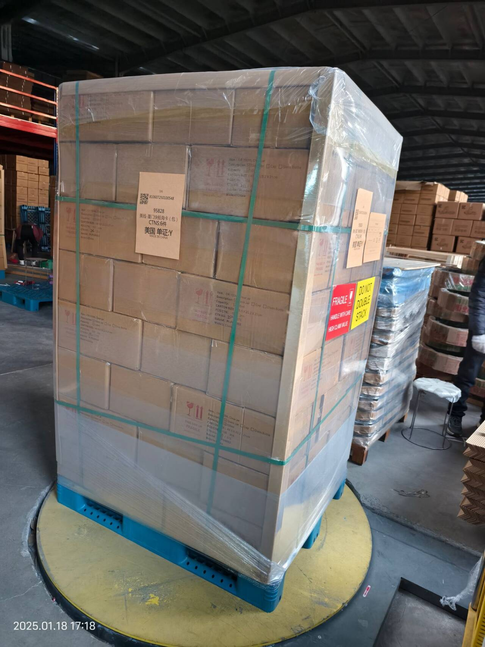
- Lock breakage control into the order, not the forwarder’s checklist. Fragile glass is wrapped in protective foam and loaded onto pallets under the manufacturer’s shockproof packaging and palletizing standards. For airtight, leak-free and light-blocking glass containers, this step decides how much of the shipment arrives intact.
- Confirm commercial terms. Minimum order quantity is 10,000 units, delivery is FOB, the acceptance method is a pre-shipment test, and payment is 30% on order with the remaining 70% before shipment.
- Reserve capacity and confirm lead time. Monthly production capacity is 100,000 units and typical lead time is 30–45 days, with supply experience across EU, US, Middle East, and Southeast Asia markets.
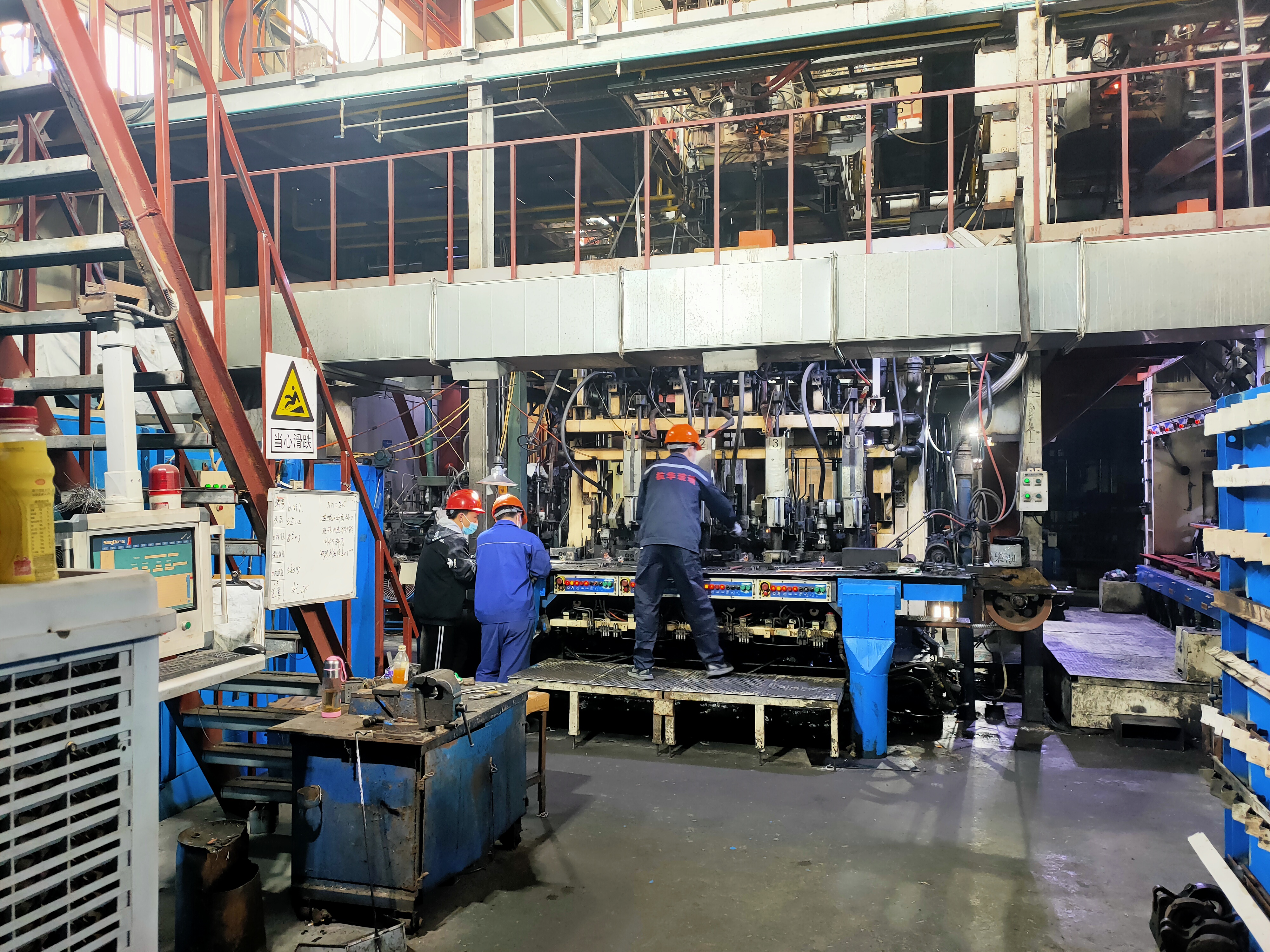
- Plan the repeat order as a series, not a one-off. Honor Packaging works through long-term joint-venture production bases for plastic and glass packaging, and takes responsibility for structural development, tooling strategy, and manufacturing risk assessment before mass production, then for process control and order fulfilment during it. For a buyer, that is the difference between a first batch that matches the sample and a reorder that matches the first batch.
Use Cases: Matching the Model to the Formulation
Model choice follows the fill, not the product category. The mappings below use only the capacities, threads, dimensions, and industries published for each series.
- Cosmetic serums and creams, 15–50 ml: HDV2 covers 30 ml and 50 ml with 32/400–89/400 threads and Urea or PE caps, at a 25.6–55 mm height that fits compact retail cartons. HDV2 is specified for cosmetic packaging and food storage packaging.
- Essential oils and oil-based actives, 5–100 ml: HDV3 offers 5 ml to 100 ml with a dropper, mist sprayer, lotion pump, or plastic cap, in PP. Its 54.5–125 mm height is built around glass dropper assemblies rather than wide-mouth filling.
- Supplements and capsules, 30 ml to 6 oz / 20–60 dr: H21 round carries the child-resistant cap as standard and is specified for food, cosmetic, and medical contents. A single 60 mm diameter across the seven listed capacities keeps capping and labelling consistent across an SKU family.
- Shelf-efficient retail and sampler formats, 15 ml to 60 dr: H21 square uses a 58 mm diameter and 24–115 mm heights, so more units fit per shelf or carton than a round jar of comparable diameter.
- Food, beverage and bulk supplement fills, 100 ml to 1 L: HDV1 wide mouth jars accept 41/400–89/400 threads and Urea, PE, SAN, or ABS caps — the broadest cap material set in the range — which suits semi-solid and high-viscosity fills.
One practical pattern is worth noting. Where a brand mixes H21 round and H21 square for the same product family, the violet glass body and cap style stay visually consistent even though the footprint changes — which is why the two H21 formats are frequently specified together rather than treated as competing options.
Frequently Asked Questions
Which violet glass jar series come with a child-resistant cap?
H21 round violet glass jars (item codes H21-0012V to H21-0018V) and H21 square violet glass jars (H21-0003V to H21-0008V) list a child-resistant cap as their cap specification. HDV2 and HDV1 include item codes with a “-CR” suffix — HDV2005M-CR and HDV1100M-1-CR — in their published code lists; because the published data for those two series lists closure materials rather than closure function, buyers who require child resistance on those formats should confirm the cap specification directly. Where child resistance is regulated, the EU reference standard is ISO/EN 8317 and the US reference is 16 CFR 1700.20, both designed to prevent access by children under five. Cap configuration is one input to that assessment, and the complete closure assembly should be confirmed for the destination market.
Can one model cover both a 30 ml cosmetic jar and a 60 dr supplement jar?
Partly. HDV2 covers 30 ml and extends to 200 ml with 32/400–89/400 threads and Urea or PE caps, at a 25.6–55 mm height. H21 round covers 30 ml, 30 dr, 40 dr, and 60 dr at a single 60 mm diameter with a child-resistant cap, at heights of 36.5–125 mm. A brand that needs both a low-profile cosmetic jar and a taller child-resistant supplement jar will usually specify two models; because both use violet glass, the visual identity of the family stays consistent across the two formats.
How much more does violet glass cost than amber glass?
Honor Packaging’s comparison of coloured glass bottles lists violet glass at approximately 15% higher cost than amber glass, with better protection against ultraviolet rays and better maintenance of product freshness for food, cosmetic, and pharmaceutical contents. The same comparison lists lower maintenance requirements for violet glass. Budget planning should treat that 15% as a format-level differential rather than a fixed line item, because the cap material — Urea, PE, SAN, ABS, or PP — moves the total as well.
What is the minimum order, and how is a first batch validated?
The minimum order quantity is 10,000 units. Delivery is FOB, the acceptance method is a pre-shipment test, and payment is 30% on order with the remaining 70% before shipment. For fragile glass, products are wrapped in protective foam and loaded onto pallets under the manufacturer’s shockproof packaging and palletizing standards, so the first batch is validated on the same handling rules that apply to repeat orders.
What lead time and monthly capacity should be planned for a violet glass jar programme?
Monthly production capacity is 100,000 units and typical lead time is 30–45 days, with supply experience across EU, US, Middle East, and Southeast Asia markets. A repeat-order plan should use both numbers together: capacity defines how much volume can be absorbed per month, while lead time defines the reorder cycle. Sample sets, quotations, and the full product catalogue can be requested by email at info@honorpkg.com, or through the catalogue download in the next section.
Conclusion
For sensitive formulations in 2026, the ranking resolves into a simple mapping. HDV2 for low-profile cosmetic and food-storage jars from 3 ml to 200 ml. H21 round for child-resistant supplement and food jars from 30 ml to 6 oz. H21 square where shelf or carton density matters, from 15 ml to 60 dr. HDV3 where a dropper, mist sprayer, or lotion pump is required, from 5 ml to 100 ml. HDV1 where the fill is larger, the mouth is wider, or the cap material must be Urea, PE, SAN, or ABS. All five are violet glass; the four series with published thickness are stated at 0.38 mm; and all five accept surface treatments that keep a product family visually consistent.
The decision variables are the same ones the ranking uses: capacity, thread and cap, diameter and height, and specified industry. Once those four are fixed, the remaining execution questions — MOQ, lead time, breakage control, and repeat-order consistency — follow the manufacturer’s published terms rather than the model choice.
Next Step: Samples, Quotation, and Catalogue
Honor Packaging supplies violet glass packaging, child-resistant packaging, and vacuum packaging to EU and USA markets from Ningbo, China. To move from model selection to a quotation, send the fill volume, the target market, and the required cap material.
- Catalogue download: Honor Packaging product brochure (PDF)
- Email: info@honorpkg.com
- Tel: +86-574-88004632 / +86-15968944995
- WhatsApp: +86 159 6894 4995
- Website: www.honorcrpkg.com