Construction Powder Coating Application Guide: Exterior, Interior and Hardware Scenarios

Cover: aluminium powder coating on architectural profiles — the exterior zone of a construction project.
A construction project rarely needs one powder coating. The exterior envelope is judged on colour retention and corrosion after years of sun, rain and thermal movement. An interior partition is judged on how it looks, how well it hides marks and how it cleans. A door handle, a filing cabinet or a wrench is judged on whether the coating chips the first time it is dropped. Those are three different coating problems, and they are solved by different powder families, different gloss levels and different film builds.
This guide maps the powder coating families used in construction and decoration projects to five project zones, and states the datasheet values a specifier can check before approving a finish: a cure window of 180–200 °C for 10–15 minutes, coverage of 8–10 m²/kg at 30–90 μm film thickness, and salt spray performance of 500 hours with unilateral cross-section corrosion ≤2 mm on the standard polyester and epoxy grades. Hsinda (Chengdu Hsinda Polymer Materials Co., Ltd) is a powder coating manufacturer established in 2015 in Chengdu, China, operating a 10,000 m² factory with eight production lines and three sample lines and an annual capacity of about 5,000 tons, according to company information. The product figures quoted in this guide are taken from that manufacturer's published technical sheets.
What follows is a selection aid for research and evaluation stages: zone, then chemistry, then surface effect, then test evidence. It is not a project guarantee. Final approval of a finish stays with the specifier, who must check the exact product, colour and test report against the project's exposure conditions.
Why exterior, interior and hardware zones fail differently
Coating selection starts with the question "what will attack this surface?", not "what colour is it?". On an exterior aluminium profile, the stress comes from ultraviolet light, moisture and repeated thermal movement; the visible failure is chalking, gloss loss or creeping corrosion at cut edges. On an interior partition or ceiling panel, ultraviolet load is small and the stresses are abrasion, cleaning chemicals and appearance — a glossy surface that shows every fingerprint is a worse choice than a textured one even if both resist corrosion equally. On handled hardware, the dominant load is mechanical: impact, chipping and abrasion, which is why texture and film toughness matter more than colour depth.
The product data in this range follows the same split. Pure epoxy and epoxy-polyester hybrid grades are classified as indoor powder coatings. The polyester grades carry the weathering evidence: an ISO 11341:2004 340-lamp result of 500 hours with no powdering and gloss retention above 50% for the textured polyester products, and 1,000 hours for the aluminium grade, which additionally records a one-year Florida natural exposure with gloss retention above 50%.
The practical consequence is that a colour card is not a selection document. Two products can carry the same RAL number and still separate at 500 hours of salt spray, or after two summers of ultraviolet exposure. The rest of this guide therefore works in a fixed order: zone, chemistry, surface effect, film build, cure schedule, then test evidence.
Where powder coating sits in the construction market
Powder coating is a recognised product segment of the construction paints and coatings market, listed alongside water-borne, solvent-borne and high-solids technologies in Verified Market Research's product segmentation. Within the powder category, Grand View Research reports that the polyester segment accounted for 48.2% of market share in 2025, attributing that position to weatherability and UV resistance — the same property that decides whether a coating belongs on an exterior profile.
For sourcing context, Fortune Business Insights valued the global powder coatings market at USD 16.12 billion in 2025 and placed Asia Pacific at 63.10% of that value. That share is relevant to lead-time and supplier planning, not to finish selection. The Associated General Contractors of America records more than 919,000 construction establishments in the United States in the first quarter of 2023 — a measure of downstream construction activity, not of coating consumption. Commercial research houses define the category differently, so these numbers are direction only.
The zone map: five construction scenarios and what each one stresses
- Zone 1 — Exterior envelope. Aluminium profiles, doors and windows, glass curtain walls, sunroom frames, exterior faces of architectural partitions, guardrails, bus shelters and light poles. Stress: UV, rain, salt spray, thermal cycling. Requirement: weathering data plus corrosion data on the exact grade.
- Zone 2 — Semi-exposed transition. Covered balconies, canopy soffits, entrance frames and the inner faces of sunroom sections that still receive daylight through glass. Stress: indirect UV plus condensation. Requirement: the same weathering family as Zone 1 where light reaches the surface, and an interior grade only where it genuinely does not.
- Zone 3 — Interior architectural. Interior partitions, railings, ceilings, cabinet bodies, lighting fixtures, radiators. Stress: abrasion, cleaning, appearance, low UV. Requirement: hardness, adhesion, gloss control and a surface that hides handling marks.
- Zone 4 — Furniture, fixtures and hardware. Steel and wood furniture, filing cabinets, lockers, shelving, security doors, safes, tools, bathroom and kitchen hardware. Stress: impact, chipping, repeated handling, occasional chemical contact. Requirement: texture, impact and abrasion behaviour on top of corrosion resistance.
- Zone 5 — Heavy-duty industrial anti-corrosion. Oil and gas pipelines, water supply systems, valves, steel reinforcement bars, electrical enclosures, machinery housings. Stress: continuous moisture, salts, general acids and oils. Requirement: barrier performance and chemical resistance, with indoor positioning where UV is absent.
Which powder family belongs in which zone
The table below uses only the values published on the individual product datasheets. All grades share a particle size of 32–42 μm on average, a specific gravity of 1.2–1.7, adhesion of grade 0 to ISO 2409:2020, hardness ≥H to ISO 15184:2020, a cure schedule of 180–200 °C for 10–15 minutes, and coverage of 8–10 m²/kg at 30–90 μm film thickness with a nominal 70 μm film.
| Finish family | Chemistry as listed | Typical construction zone | Gloss (ISO 2813) | Salt spray (ISO 7253) |
|---|---|---|---|---|
| Aluminium powder coating | Polyester | Profiles, doors and windows, curtain walls, sunrooms, partitions | 5–95% | 1,000 h, ≤2 mm |
| Sandy powder coating | Polyester | Exterior aluminium, security and high-end doors, kitchen and bathroom hardware | 5–95% | 500 h, ≤2 mm |
| Glossy powder coating | Polyester | Aluminium doors and windows, railings, outdoor furniture, light poles | 5–95% | 500 h, ≤2 mm |
| Wrinkle powder coating | Polyester | Interior furniture, cabinets, electrical cabinets, tools, railings | 5–95% | 500 h, ≤2 mm |
| Hammer tone powder coating | Polyester | Hand tools, security doors, safes, radiators, public facilities | 5–95% | 500 h, ≤2 mm |
| Matt powder coating | Not fixed across colours | Appliance and electronic housings, lighting, automotive interior | 5–30% | 500 h, ≤2 mm |
| Epoxy and anti-corrosion powder coating | Pure epoxy | Pipelines, valves, rebar, electrical insulation, machinery | 5–95% | 500 h, ≤2 mm |
| Epoxy-polyester hybrid | Epoxy-polyester | Indoor appliances, office furniture, MDF and low-temperature programmes | 5–95% | 500 h, ≤2 mm |
| TGIC-free powder coating | HAA polyester | Indoor appliances, office and residential furniture, instrumentation | 5–95% | 500 h, ≤2 mm |
Table values are transcribed from the individual product datasheets. Where a gloss range is wider than the surface effect normally implies, the datasheet range is reported as published; confirm the actual gloss target on the approval sample.
Seven steps to specify a construction powder coating
Step 1 — Fix the zone and the exposure. Write down what the surface will actually see: direct weather, covered transition, dry interior, repeated handling, or continuous chemical contact. This single decision removes most of the catalogue before colour is discussed.
Step 2 — Match chemistry to that exposure. Polyester grades cover surfaces exposed to daylight; the aluminium grade carries 1,000-hour ISO 11341:2004 340-lamp weathering plus one-year Florida natural exposure with gloss retention above 50%. Pure epoxy and anti-corrosion grades are positioned for corrosion duty and electrical insulation and are listed as indoor products. Epoxy-polyester hybrid grades are also listed as indoor, and are the ones named for MDF and low-temperature curing programmes.
Step 3 — Choose the surface effect for the zone. The range lists smooth, sandy (sandblasted), wrinkled, hammered, watermarked, cracked, stone-like, metallic and pearlescent, chameleon, photochromic, thermochromic, electroplating-effect, reflective and luminescent finishes. Gloss is measured to ISO 2813:2014 across 5–95%, with the common classification of high gloss above 80%, semi-gloss 40–79% and matt 5–39%. Texture is a hiding and handling decision — it must not replace the performance data the zone requires.
Step 4 — Set film build, then calculate quantity. The datasheets list a nominal 70 μm film and coverage of 8–10 m²/kg at 30–90 μm. As a calculation from those published values: 1,000 m² of aluminium profile surface corresponds to roughly 100–125 kg of powder before any transfer loss on the line. Treat that as a budgeting figure and confirm it with your applicator.
Step 5 — Lock the cure schedule to the oven. Every grade in this range lists 180–200 °C for 10–15 minutes. The same powder cannot compensate for an under-curing line, so the schedule has to be verified against the oven's actual performance with production loads before the finish is approved.
Step 6 — Confirm application method, colour and gloss control. All grades are listed for tribo or electrostatic spray guns, with custom RAL and Pantone colour matching. Put the colour standard and the gloss value, measured to ISO 2813, on the approval sheet — not just the colour name.
Step 7 — Verify with test reports and a physical sample. Ask for the ISO values on the exact product and colour: adhesion to ISO 2409 (grade 0), hardness to ISO 15184 (≥H), impact to ISO 6272-1, bending to ISO 1519, cupping to ISO 1520, salt spray to ISO 7253, humidity to GB/T 1740 (1,000 hours, slight gloss loss, ≤ level 1) and weathering to ISO 11341. Then hold a coated coupon in your hand before releasing the order.
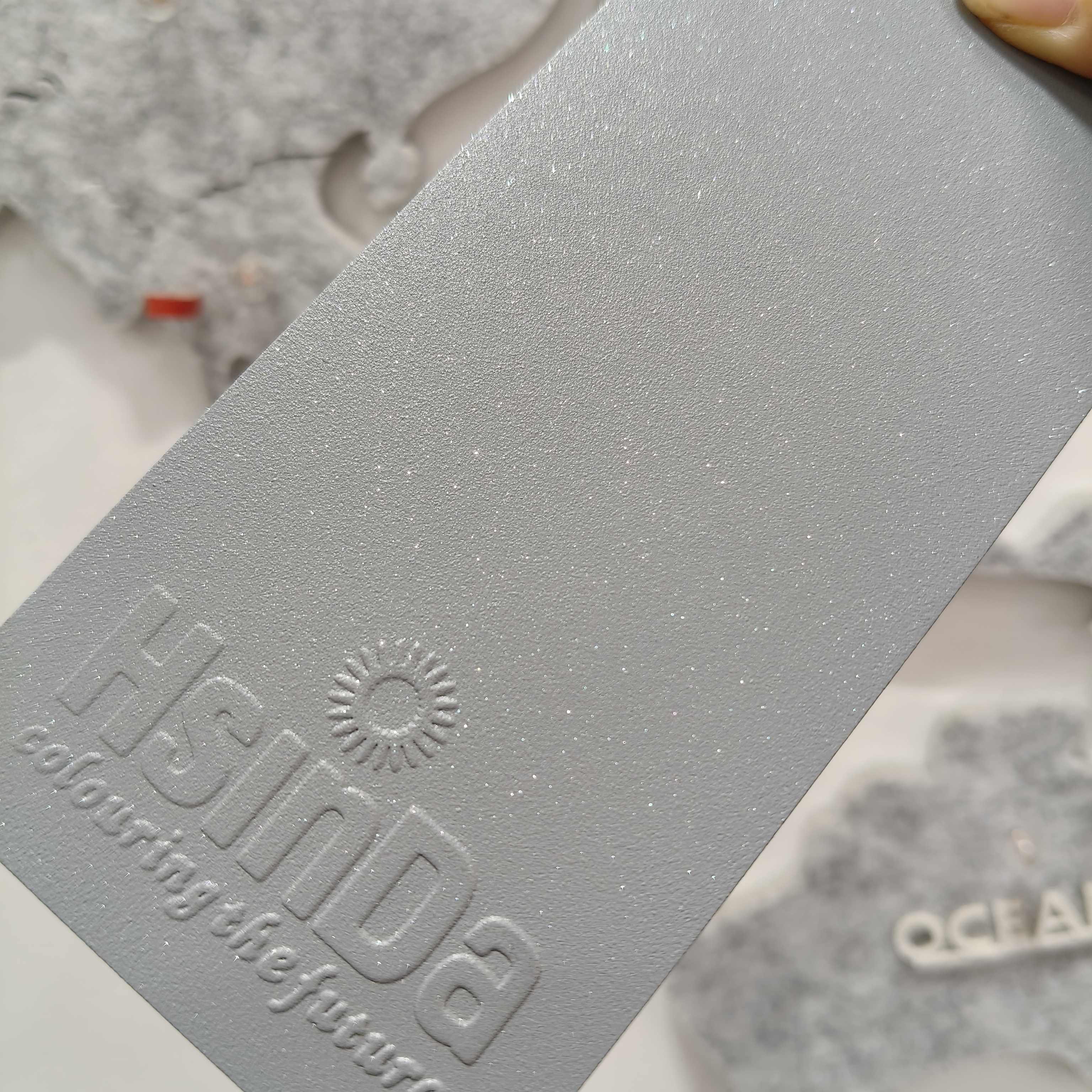
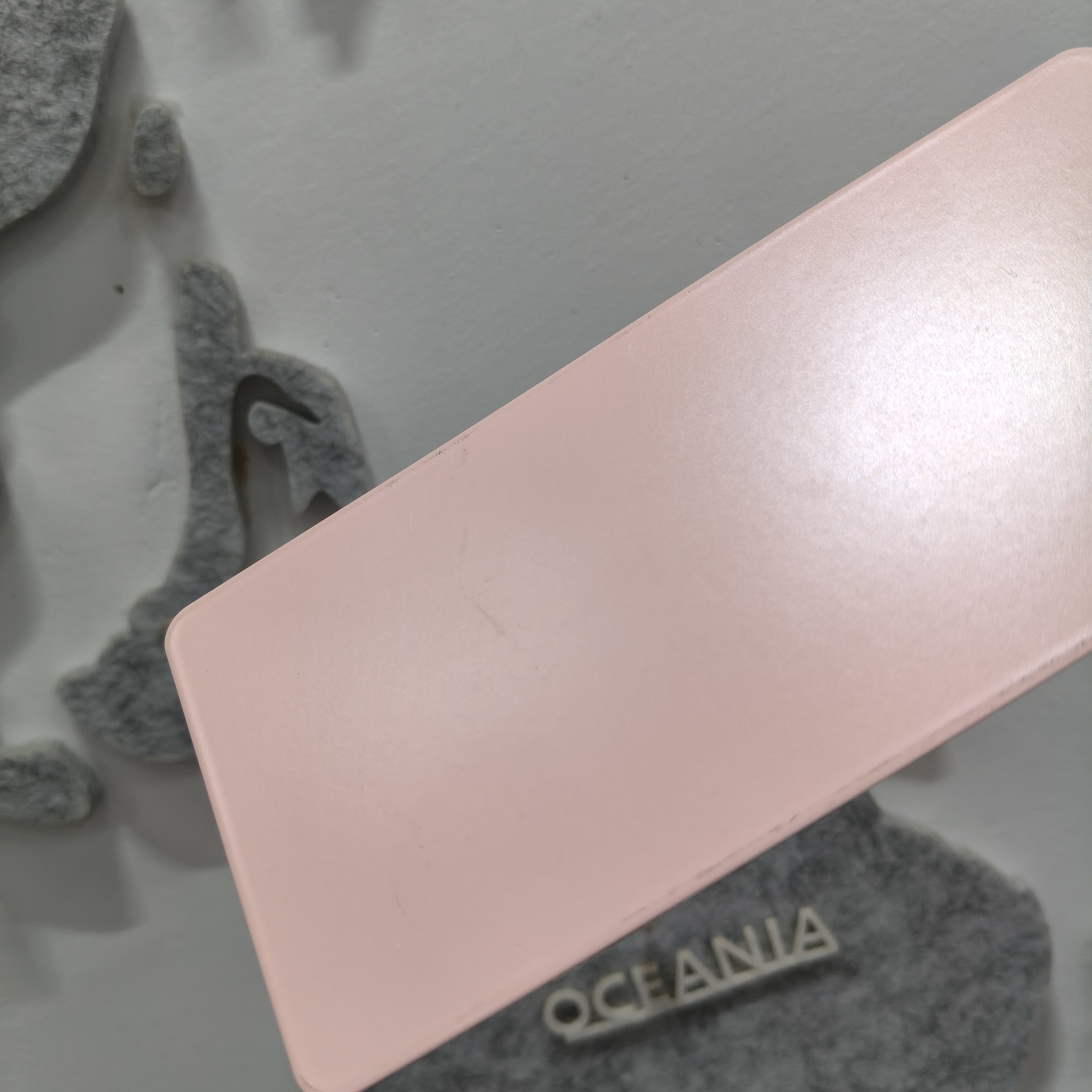
Sandy (sandblasted) powder coating — a textured polyester surface for exterior aluminium and high-end door and window systems.
Zone 1 in practice: exterior aluminium profiles, curtain walls, sunrooms and partitions
This is the zone with the longest evidence trail, because failure here is expensive and visible. The aluminium powder coating grade lists architectural applications directly — aluminium profiles, doors and windows, glass curtain walls, sunrooms and architectural partitions — together with transport and municipal items such as guardrails, bus stops and shelters, signs and vehicle parts. Its datasheet records adhesion grade 0, hardness ≥H, salt spray of 1,000 hours with ≤2 mm cross-section corrosion, and weathering of 1,000 hours on the 340-lamp test with gloss retention above 50%, supported by a one-year Florida natural exposure.
One datasheet difference deserves attention. The aluminium grade lists impact of 2.5 Nm, bending ≤5 mm and cupping ≥5 mm, while the standard polyester grades list 50 kg/cm impact, bending ≤2 mm and cupping ≥6 mm. Those are different test values published for different products; a specifier comparing them should confirm which number applies to the exact grade and colour being supplied rather than assuming they are interchangeable.
For textured exterior work, the sandy grade is the second option: it is described as a weather-resistant coating for aluminium profiles, doors and windows, curtain walls and guardrails, with a 500-hour 340-lamp weathering result and 500-hour salt spray to ≤2 mm. Where a brighter architectural appearance is required on railings, outdoor furniture or light poles, the glossy polyester grade covers the same exterior construction list. Whichever is chosen, the three numbers to write into the specification are 180–200 °C for 10–15 minutes, 8–10 m²/kg at 30–90 μm, and the salt spray result for that product.
Zone 2 and 3 in practice: interior architectural surfaces
Interior specification is decided by appearance and handling, not by sunlight. The aluminium grade's application list extends to interior partitions, railings, ceilings, cabinets and lighting fixtures, so the same product family can hold both faces of a project — but the reason for choosing it indoors is mechanical and cosmetic, not weathering.
Wrinkle powder coating is the workhorse for indoor structure and furniture: steel and wood furniture, filing cabinets, security doors, machine tools, motor housings, distribution boxes and electrical cabinets. Its documented benefit in these positions is coverage of casting defects plus corrosion protection, which matters on cast or welded components that will never be fully flat.
For appliance and electronic housings, lighting and automotive interior parts, the matt grade lists a gloss range of 5–30%, and its documented purpose is to reduce visible scratches and fingerprint marks. For indoor programmes that need a specific compliance position, the TGIC-free HAA polyester grade is the alternative, listed for appliance housings, office and residential furniture, shelving and lockers, instrumentation and automotive interior parts. Where a lower cure temperature or MDF substrate is involved, the epoxy-polyester hybrid grade is the one the datasheets name for those programmes.
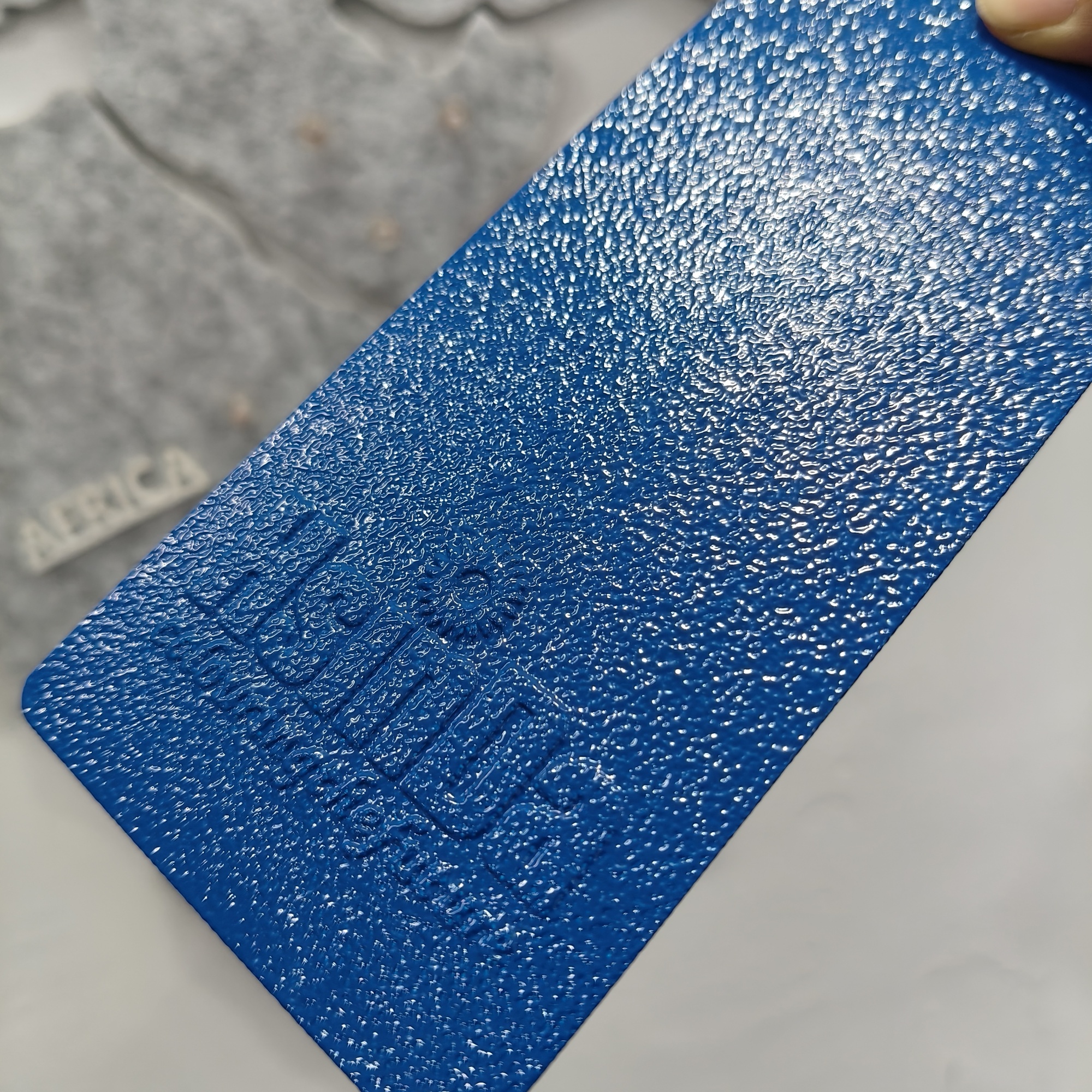
Wrinkle powder coating — a textured polyester finish for interior furniture, cabinets and electrical panels.
Zone 4 in practice: furniture, fixtures and handled hardware
Hardware is where texture earns its place. Wrinkle finishes are documented for hand and power tools, where the surface is expected to be anti-slip, wear-resistant and corrosion-resistant at the same time. Hammer tone is documented for bench vises, wrenches and saw-blade handles, and also for security doors, filing cabinets and safes, where a dense coating over an imperfect substrate provides protection without requiring a flat base. Sandy finishes appear in the same zone at the decorative end: kitchen cabinets, wardrobes, stainless-steel countertops, bathroom hardware and shelves.
All three textured polyester families carry the same published mechanical and corrosion baseline — adhesion grade 0, hardness ≥H, impact 50 kg/cm, salt spray 500 hours to ≤2 mm — so the choice between them is a decision about grip, hiding power and appearance rather than about corrosion performance. That is a useful simplification for a buyer: pick the texture for the way the part is used, then confirm the corrosion and cure values are unchanged for the specific colour.
Handled hardware also has a documented production record. A hardware tool manufacturer in Mexico and the United States has used this coating route for 1,000 tons over five years on wrenches, post-hole diggers, wheelbarrows and shovels, with rust resistance and abrasion resistance recorded as the outcome for steel blades used outdoors. The same file records the manufacturer's own framing of the process as an eco-friendly route — that is a supplier statement, not an independently measured result.
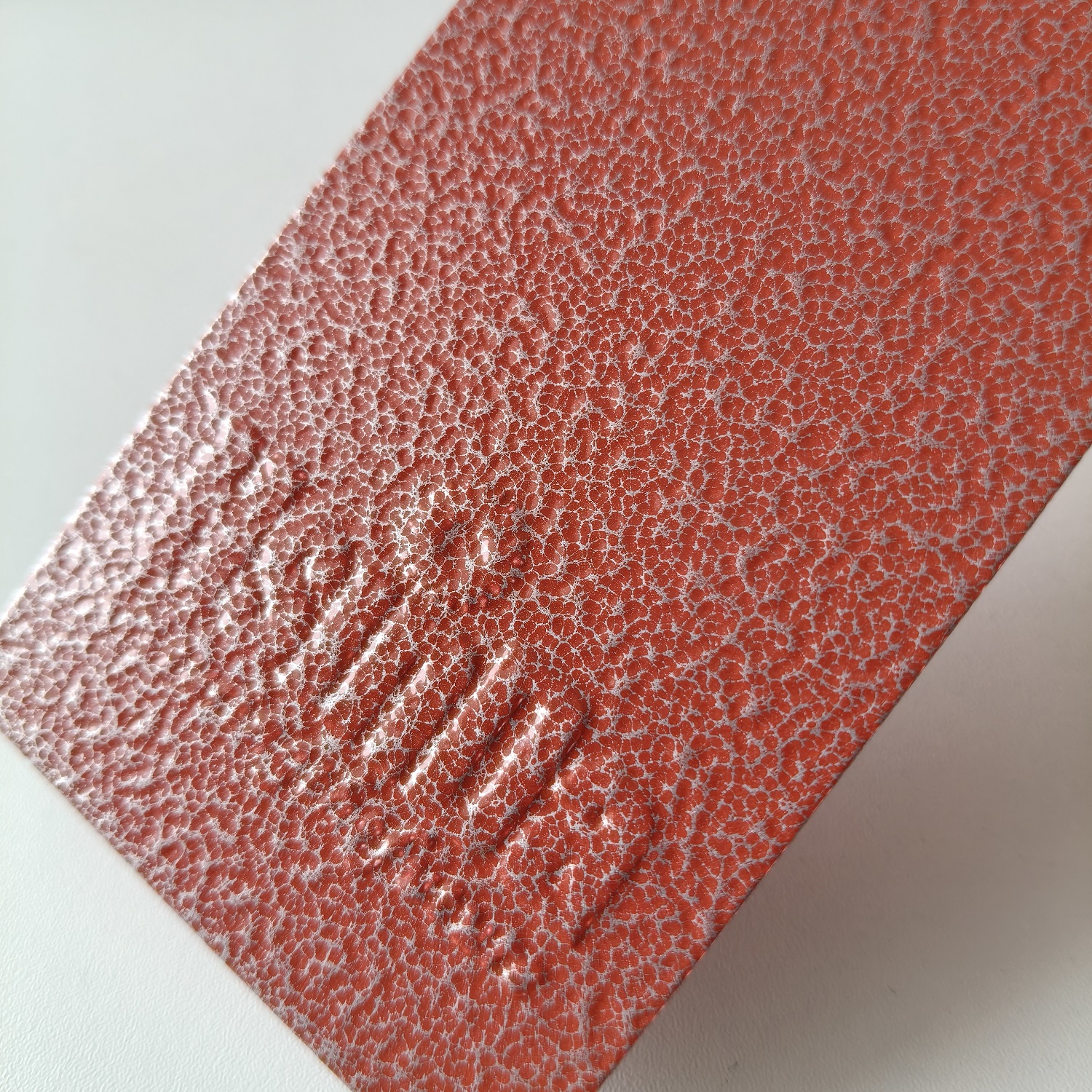
Hammer tone powder coating — used on tools, security doors and cast components where the substrate is not perfectly flat.
Zone 5 in practice: heavy-duty anti-corrosion epoxy
Where the surface is wet, salty or chemically exposed and never sees daylight, pure epoxy is the family the datasheets position for the job. The documented applications are specific: oil and gas pipelines, water supply systems, valves and steel reinforcement bars for corrosion duty; electric vehicle battery components, hairpin stators, busbars, motor copper bars, transformers, switchgear, capacitors and circuit boards for insulation; chassis, engine-bay components, pump bodies and gearboxes for heavy industry.
Its published performance is a 500-hour salt spray result to ISO 7253 with ≤2 mm cross-section corrosion, 1,000-hour humidity resistance to GB/T 1740 with slight gloss loss at ≤ level 1, adhesion grade 0 and hardness ≥H. Chemical resistance is stated as good against general acids and oils with average alkali resistance — a qualification worth keeping in the specification, because it tells a buyer that alkaline exposure needs separate evaluation rather than an assumption of equal performance.
Because these grades are listed as indoor products, they should not be moved onto an exposed façade on the strength of their corrosion numbers alone. The correct reading is: strong barrier performance in continuous moisture and salt, no published weathering evidence to support exterior UV service.
Anti-corrosion epoxy powder coating — barrier protection for pipelines, valves, rebar and electrical components.
Verification checklist before a finish is approved
- Confirm the product name and datasheet revision, not just the colour code.
- For exterior surfaces, require the ISO 11341:2004 340-lamp weathering result and the salt spray result on the exact grade.
- Check the mechanical set: adhesion ISO 2409 grade 0, hardness ISO 15184 ≥H, impact ISO 6272-1, bending ISO 1519, cupping ISO 1520.
- Write the gloss target to ISO 2813 and approve it on a physical sample, not on a screen render.
- Verify the cure window of 180–200 °C for 10–15 minutes against the actual oven, and keep the cure record with the batch.
- Recalculate quantity from 8–10 m²/kg at 30–90 μm and reconcile it with the line's real transfer efficiency.
- Ask how certificates and test reports can be independently checked; company information states ISO 9001 and ISO 14001 factory certification and RoHS, REACH, SGS and AAMA testing, and those claims should be confirmed against the issuing body for the specific product.
What the case record shows — and what it does not
Three documented applications illustrate the zone logic. Electrical enclosure work covering 40 tons over ten years across Mexico, Paraguay, Sri Lanka, Russia and China is recorded for corrosion resistance, insulating or static-conductive behaviour and appearance — a Zone 3 and Zone 5 mix. An industrial shelving and storage manufacturer in Colombia is recorded with 100 tons over ten years using an epoxy-polyester electrostatic process for shelving, mezzanines and display furniture, with colour range and gloss variation noted as a benefit. The hardware tool programme described earlier covers 1,000 tons over five years.
These records show which zones the materials have been supplied into and for how long. They do not predict performance on a different substrate, climate or pre-treatment line, and none of them should be read as a service-life guarantee for a new project.
Frequently asked questions
Powder coating manufacturer for aluminium applications: what should a specifier verify?
Verify four things on the exact product. First, weathering: the aluminium grade should show its ISO 11341:2004 340-lamp result, listed here as 1,000 hours without powdering and gloss retention above 50%, plus the one-year Florida natural exposure. Second, corrosion: the salt spray result to ISO 7253, listed at 1,000 hours with unilateral cross-section corrosion ≤2 mm for that grade. Third, the mechanical set: adhesion grade 0 to ISO 2409, hardness ≥H to ISO 15184, impact, bending and cupping. Fourth, colour and gloss control to ISO 2813 across a 5–95% range with RAL or Pantone matching. Ask for the datasheet revision and the test report, not a colour card.
Can the same powder coating be used indoors and outdoors?
Not on the strength of one datasheet. In this range, pure epoxy and epoxy-polyester hybrid grades are classified as indoor products, while the polyester grades carry the weathering data. A sunroom is the useful test case: the outer face needs the exterior polyester grade, and any inner face that still receives daylight through glass should be treated the same way rather than downgraded to an indoor product. Only genuinely unlit interior surfaces should move to an indoor grade.
What film thickness and powder quantity should a project budget for?
The datasheets list a nominal 70 μm film and coverage of 8–10 m²/kg at 30–90 μm film thickness. Calculated from those figures, 1,000 m² of surface corresponds to roughly 100–125 kg before transfer losses. That range is a planning figure derived from published coverage; the real consumption depends on part geometry, rack density and the line's transfer efficiency, so it should be reconciled with an applicator's trial before the order quantity is fixed.
Which texture suits hardware that is handled every day?
Choose on grip and hiding power, because the corrosion baseline is identical. Wrinkle is specified where an anti-slip, wear-resistant surface is wanted on tools, cabinets and electrical enclosures. Hammer tone is specified where the substrate is imperfect and the coating must cover casting defects while resisting abrasion — tools, security doors, safes, radiators. Sandy is the finer decorative option for kitchen and bathroom hardware, high-end doors and shelves. All three carry a 500-hour salt spray result to ≤2 mm, adhesion grade 0 and hardness ≥H in the published data.
How is a 500-hour salt spray claim verified before ordering?
Match three things: the test standard, the product, and the colour. The published claim is ISO 7253:1996, after 500 hours the coating film remains unchanged with unilateral cross-section corrosion ≤2 mm on the standard polyester and epoxy grades; the aluminium grade is listed at 1,000 hours on the same criterion. Ask for the report covering the exact grade and colour, and request a coated coupon so the finish can be inspected and, if needed, retested against the project's own acceptance criteria.
What are the minimum order and lead time for a custom colour?
The published capability data lists two routes. For custom colour development in the ODM route, the minimum is 300 kg with a 15–20 day lead time; for OEM programmes covering carton, sample card and logo branding, the listed minimum is 6 tons with a 20-day lead time. Monthly capacity is stated as 400 tons, with 100% testing and 24-hour online technical support. A practical next step is to request a custom colour sample card or a coated coupon against your zone, substrate and gloss target before committing to a production quantity; the full capability and product range is summarised in the Hsinda powder coating brochure.
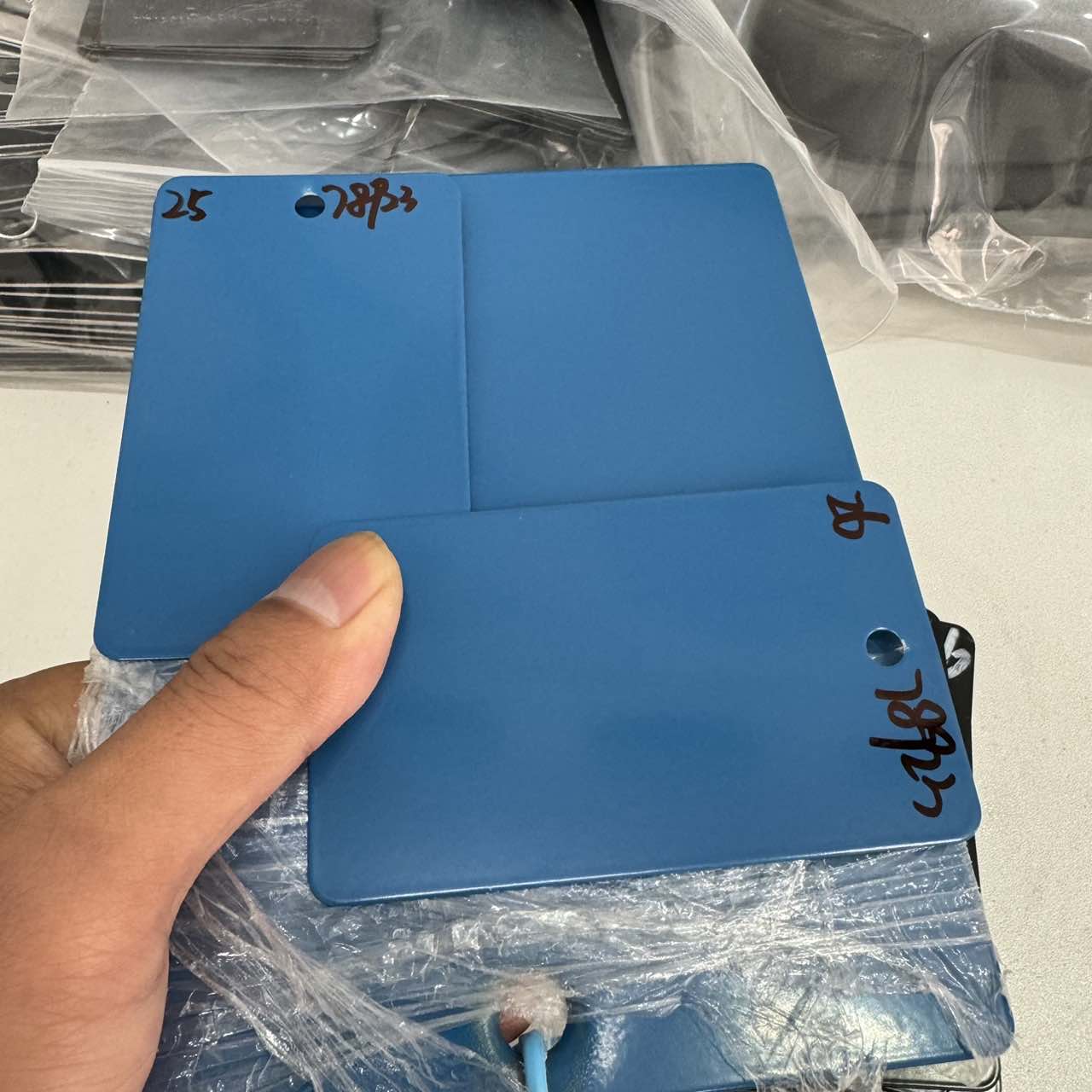
Custom colour sample preparation — approve the colour, gloss and texture on a physical card before production.
Conclusion: select by zone, approve by test value
Construction powder coating selection becomes manageable once the project is divided into zones. Exterior aluminium profiles, doors, windows, curtain walls, sunrooms and partitions belong to the polyester weathering grades, with the aluminium grade's 1,000-hour weathering and 1,000-hour salt spray data at the top of that group. Interior partitions, furniture and fixtures belong to the textured and matt polyester grades or to the indoor epoxy-polyester and TGIC-free options, where hardness, adhesion and appearance decide the result. Handled hardware belongs to wrinkle, hammer tone and sandy textures chosen for grip and hiding power. Continuous wet, salty or chemically exposed industrial steel belongs to pure epoxy, with its 500-hour salt spray and 1,000-hour humidity record and its stated average alkali resistance.
Three numbers travel across every zone and should appear in every specification: cure at 180–200 °C for 10–15 minutes, coverage of 8–10 m²/kg at 30–90 μm film thickness, and a salt spray result expressed as hours plus cross-section corrosion in millimetres. A finish approved against those values, on a physical sample, is a finish a project team can defend.
Have Questions or Need More Details?
Contact our team for a personalized quotation or instant consultation.
Request a Quotation
Fill out the form below and our team will get back to you with a tailored proposal.
WhatsApp Direct Chat
Prefer to chat in real-time? Message us on WhatsApp for instant assistance & quick answers.
- Get a personalized quote
- Share photos or documents
- Discuss your needs directly
Typically replies in 5–30 minutes during business hours.