Powder Coating Suppliers for Construction: Capability and Delivery Verification
The short answer: a powder coating supplier is only a safe choice for a construction project when three things are documented rather than promised — a resin and finish system that matches the substrate and its exposure class; a parameter set you or your applicator can actually test, covering curing window, particle size, film thickness, coverage, adhesion, hardness and salt-spray performance; and a delivery pattern that holds when the project schedule tightens, covering capacity, MOQ, lead time, packing and after-sales support.
This guide is written for construction and decoration buyers who have already moved past discovery and are comparing two or three suppliers at the shortlist stage. It uses the published specifications of Chengdu Hsinda Polymer Materials Co., Ltd. (Hsinda) — a thermoset powder coating manufacturer established in 2015 in Chengdu, Sichuan, China, operating 8 production lines and 3 sample lines — as a worked example of what verifiable capability documentation looks like, and where the gaps normally appear.
Why a clean data sheet still fails construction buyers
A data sheet describes a product. It does not describe whether that product fits your substrate, your exposure class, your curing oven or your delivery calendar. Most failures at the evaluation stage come from six specific mismatches, and each one is checkable before an order is placed.
- Chemistry-to-exposure mismatch. Pure epoxy powder coating is positioned for anti-corrosion and indoor duty — pipelines, valves, steel reinforcement bars and electrical insulation. Polyester systems carry the weather resistance. Epoxy-polyester hybrid systems are positioned as indoor powder coatings. Choosing by price rather than by exposure produces chalking, gloss loss or corrosion that only appears after installation.
- Finish mismatch. Gloss is classified by 60° gloss meter value into high gloss (above 80%), semi-gloss (40–79%) and matte (5–39%). A façade specified as matte that arrives at 45% gloss is a visible defect, and it is a specification error, not a coating defect.
- Curing window mismatch. Published cure data only holds when the applicator can hit it. If the specification states 180–200 °C for 10–15 minutes, an under-cured part will not deliver grade 0 adhesion to ISO 2409:2020 or ≥H hardness to ISO 15184:2020, no matter who supplied the powder.
- Coverage-versus-thickness mismatch. Consumption is normally quoted as 8–10 m²/kg at 30–90 μm film thickness. Budgeting on coverage without the film thickness assumption understates powder consumption on complex architectural profiles.
- Certificate scope mismatch. Certificates carry a scope — a resin family, a sample, a market. A certificate that covers one formulation does not automatically cover the item you are buying.
- Delivery mismatch. Capacity claims, minimum order quantity and lead time decide whether a compliant specification actually reaches site on schedule.
Industry background: a large, concentrated, chemistry-led category
Powder coating is not a marginal option in construction. It is classified as a defined product-type segment of the construction paints and coatings market, alongside water-borne, solvent-borne and high-solids technologies. That matters at the evaluation stage because it means the specification decision is usually a comparison between coating systems, not only between suppliers.
Published market sizing is directionally consistent but not identical. One commercial study values the global powder coatings market at USD 16.12 billion in 2025, while a second places the 2024 figure at USD 17.01 billion with a 2033 forecast of USD 33.78 billion. The gap reflects scope definitions — decorative versus industrial inclusion — so buyers should treat any single number as directional rather than absolute. On regional structure the picture is clearer: Asia Pacific accounted for 63.10% of global revenue in 2025, and polyester resin systems alone held 48.2% of the market in 2025, driven by weatherability and UV resistance.
Downstream demand is broad. The US construction sector alone counted more than 919,000 construction establishments in the first quarter of 2023 — a large base of architectural and industrial projects that consume coated aluminum, steel and metal components. For buyers, the practical implication is that supplier density is high, self-reported capability is common, and verification discipline is what separates suppliers in practice.
One technical standard is worth adding to the evaluation file. ISO 8130-8 establishes a method for estimating the storage stability of thermosetting coating powders — relevant because project powder frequently sits in a warehouse or on site for months between delivery and application.
The four-layer evaluation framework
Rather than scoring suppliers on adjectives, score them on four layers, each of which produces a document you can keep in the project file.
- Portfolio fit — does the supplier publish the resin chemistry, finish type and performance option your substrate and exposure class require?
- Parameter evidence — are curing window, particle size, film thickness, coverage, adhesion, hardness and salt-spray performance stated against named test standards?
- Compliance documentation — do certificates exist, are they in scope, and are they current?
- Delivery assurance — capacity, production lines, MOQ, lead time, packing model and after-sales support.
Step-by-step: how to verify a construction powder coating supplier
Step 1 — Fix the substrate and exposure class before you contact suppliers
Write down the substrate (aluminum profile, galvanized steel, mild steel, MDF), the exposure (interior, exterior, coastal, industrial atmosphere), the expected service life, and the finish appearance required. Everything downstream — resin, gloss, texture, test evidence — follows from this one paragraph. Suppliers that answer before you have defined it are answering a different question.
Step 2 — Match the resin system to the exposure
For exterior architectural work, polyester-based systems are the starting point. Their published application scope covers aluminum doors and windows, curtain walls, railings, outdoor furniture, highway guardrails and street light poles. Where full weather data is required, look for the aluminum-profile grade of the product: published salt spray and weather resistance extending to 1000 hours, and a one-year natural aging test in Florida with gloss retention above 50%.
For heavy-duty anti-corrosion, pure epoxy systems are the reference point — oil and gas pipelines, water supply systems, valves and steel reinforcement bars — and they also serve electrical insulation duties such as motor copper bars, transformers and switchgear. Because epoxy is positioned as an indoor-oriented system, any exterior use needs an explicit UV and weatherability discussion with the supplier rather than an assumption.
For indoor metal and furniture work, epoxy-polyester hybrid powder coating covers appliances, office and residential furniture, instrumentation and automotive interior components, and this family also includes low-temperature curing and MDF-capable variants. For markets where TGIC is restricted, a TGIC-free HAA polyester system is the relevant alternative, and the associated REACH SVHC test report should be requested for exactly that chemistry.
Step 3 — Match the finish and gloss level to the application
Appearance is a technical specification, not a preference. Gloss is defined by 60° gloss meter value, and surface texture is defined by effect type: smooth, sandblasted, wrinkled, hammered, watermarked, cracked, stone-like, metallic or pearlescent, chameleon, photochromic, thermochromic, electroplating effect, reflective and luminescent. Where the project also has functional requirements, performance variants include weather resistance (UV resistant, AAMA 2604, Qualicoat 2 and Qualicoat 1), corrosion resistance, antibacterial, anti-slip, anti-fingerprint, fireproof and explosion resistant, scratch resistant, and low-temperature curing.
Hammer tone, wrinkle and sandy finishes are frequently specified for enclosures, cabinets, shelving and hardware because they hide surface imperfections, while glossy and matt finishes dominate architectural profiles and visible metal furniture. Fix the finish name, the gloss band and the substrate in writing before samples are made.
Step 4 — Verify the parameter set, not the adjectives
This is the core of capability verification. Ask for the numbers and the standards behind them, then compare them against your applicator's capability. The table below shows what a complete parameter set looks like on a published thermoset powder coating specification.
| Parameter | Published specification | Test standard |
|---|---|---|
| Average particle size | 32–42 μm | Product data |
| Film thickness | 70 μm | Product data |
| Coverage | 8–10 m²/kg at 30–90 μm film thickness | Product data |
| Curing schedule | 180–200 °C, 10–15 minutes | Product data |
| Application method | Tribo gun or electrostatic spray gun | Product data |
| Gloss | 5–95% (matt range 5–30%) | ISO 2813:2014 |
| Impact | 50 kg/cm | ISO 6272-1:2017 |
| Bending | ≤2 mm | ISO 1519:2002 |
| Cupping | ≥6 mm | ISO 1520:2006 |
| Adhesion | Grade 0 | ISO 2409:2020 |
| Hardness | ≥H | ISO 15184:2020 |
| Salt spray resistance | 500 hours, film unchanged, unilateral corrosion at the cross section ≤2 mm | ISO 7253:1996 |
| Humidity and heat resistance | 1000 hours, slight gloss loss, ≤ level 1 | GB/T 1740-2007 |
| Weather resistance | 340 lamp tube 500 hours, no powdering, light retention >50% | ISO 11341:2004 |
Two verification lessons follow. First, parameters are product-specific, not company-wide: the aluminum-profile grade of the same portfolio publishes a different profile, including impact 2.5 Nm, bending ≤5 mm, cupping ≥5 mm, salt spray resistance of 1000 hours and weather resistance of 1000 hours. Second, generic claims such as "good corrosion resistance" cannot be tested. A statement such as "after 500 hours the coating film remains unchanged and the unilateral corrosion at the cross section is ≤2 mm" can be.
Step 5 — Verify compliance documents against their scope
Compliance is where shortlists are usually cut, and it is also where buyers most often accept a document that does not cover their order. Read the scope line and the expiry date, not just the logo. A verifiable compliance file for construction and decoration powder coating typically includes a system certificate for production, product-level substance reports for the markets you ship to, and application-specific reports where the end product touches food, users or indoor air.
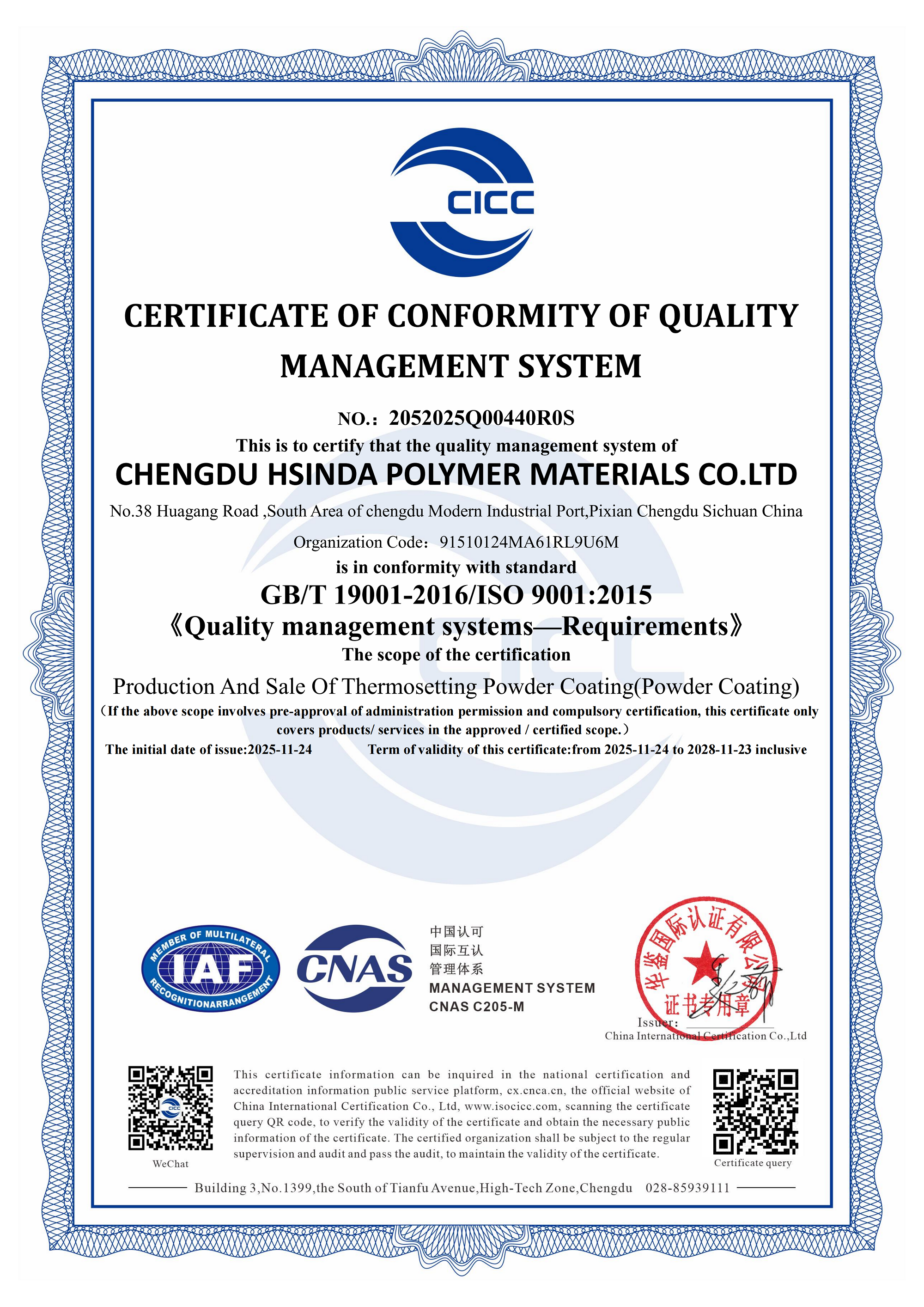
As a reference set, Hsinda's public documentation includes an ISO 9001:2015 quality management certificate (2052025Q00440R0S) covering the production and sale of thermosetting powder coating, an ISO 14001:2015 environmental certificate (2052025E00271R3S), both issued by China International Certification Co., Ltd. and valid to 23 November 2028; an SGS RoHS substance restriction test report (CKGEC25000071901); an SGS REACH SVHC test report (CKGIN25000923901) scoped to HAA-type powder coating; an ISCC PLUS certificate (ISCC-PLUS-Cert-CN198-41261025) to EN 15343 for polyester powder coating, valid to 25 June 2027; an SGS FDA 21 CFR 175.300 total extractives report (TSNPC25004542302) for a BPA-free white food-grade thermosetting powder coating; a carbon footprint certificate (TZJ136660053R0S) to ISO 14067:2018 and PAS 2050:2011; and an antibacterial performance test report (ASH25-0055689-02) to ISO 22196:2011.
Step 6 — Verify supply capability: lines, capacity, MOQ and lead time
Capability claims are easy to make and easy to check. Ask how many production lines run, how many are dedicated to sampling, what monthly and annual output is, what the minimum order is for a customized formulation versus a private-label programme, and what testing happens per batch.
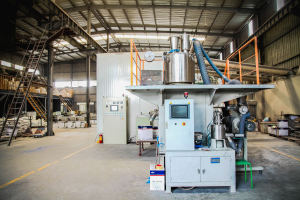
Chengdu Hsinda Polymer Materials Co., Ltd. operates a 10,000 m² factory with 45 employees, including an 11-person R&D team, 8 advanced production lines and 3 sample lines, and an annual output above 5000 tons, with a monthly capacity of 400 tons. Quality control is stated as 100% testing. Commercially, two order models exist: ODM customization (custom RAL or Pantone colours, defined gloss, textures and performance modifications) with a 300 kg MOQ and 15–20 days lead time, and OEM programmes (carton box OEM, powder coating sample card OEM and logo OEM) with a 6-ton MOQ and approximately 20 days lead time.
For evaluation purposes, the useful question is not "how big are you" but "which of these two models does my order fall into, and what does that do to my unit cost and delivery date".
Step 7 — Verify delivery assurance and after-sales support
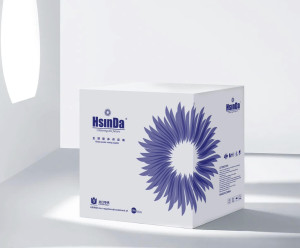
Delivery assurance covers four things: how the powder is packed and labelled, whether packaging can carry your brand, how repeat orders are protected against colour drift, and who answers technical questions after the container ships. Hsinda's stated after-sales structure is 24-hour online service with technical support and local distributor support, and its export footprint covers about 70% of output to more than 70 countries, with the main markets listed as the USA, Canada, Mexico, South America, the Middle East and Central Asia, plus distributors in Russia, Bangladesh, Poland, Portugal, the United States, Canada, Sri Lanka, Bolivia and Argentina and exclusive distributors in Kazakhstan, Uzbekistan and Chile.
Use cases: where verification actually changes the outcome
Architectural aluminum and metal façades. Where specifiers need documented exterior performance, the aluminum-profile grade is specified with 1000-hour salt spray and 1000-hour weather resistance, supported by a one-year Florida natural aging result with gloss retention above 50%. If a supplier cannot show exterior-grade data, the substrate is being protected by assumption.
Heavy-duty anti-corrosion for industrial construction. Pipelines, water supply systems, valves and steel reinforcement bars are specified in epoxy-based anti-corrosion powder coating, where the relevant evidence is the salt spray result after 500 hours and the 1000-hour humidity and heat result at ≤ level 1 gloss loss.
Electrical enclosures and control panels. A 40-ton program supplying electrical enclosure panels across Mexico, Paraguay, Sri Lanka, Russia and China has run for 10 years, with the coating required to be corrosion resistant, insulating or static conductive, and visually consistent. The verification logic here was insulation performance plus appearance stability, not price per kilo.
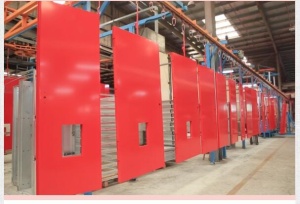
Warehousing and shelving systems. A 100-ton project for industrial engineering clients in Colombia used powder coating for comprehensive warehousing solutions including industrial shelving, achieving zero VOC emissions and no hazardous substances, with impact resistance more than three times that of traditional liquid paint and colours matched precisely to the RAL chart.
Hardware tools and metal goods. A 1000-ton program for hardware tool manufacturers in Mexico and the United States, running over a five-year cooperation period, applied powder coating to metal tools for rust prevention and durability in harsh outdoor working conditions, including spades, post hole diggers, wheelbarrows and wrenches.
Comparison: resin systems for construction and decoration
The table below compares the resin systems a construction buyer is most likely to be offered, based on published composition and published application scope. It is a selection aid, not a ranking — the right system is the one that matches your exposure class.
| Resin system | Published composition | Typical construction & decoration use | What to verify |
|---|---|---|---|
| Polyester powder coating | Polyester resin, TGIC curing agent, pigment, additives | Aluminum doors and windows, curtain walls, railings, outdoor furniture, highway guardrails, light poles | Curing window, salt spray hours, weather resistance hours, gloss band |
| Aluminum profile (high-weathering polyester) | Super weather resistance polyester resin, TGIC curing agent, pigment, additives | Aluminum profiles, glass curtain walls, sunrooms, architectural partitions, bus shelters, vehicle parts | 1000-hour salt spray and weather data, natural aging result, impact and bending values |
| Pure epoxy powder coating | Epoxy resin, TGIC curing agent, pigment, additives | Oil and gas pipelines, water supply systems, valves, steel reinforcement bars, electrical insulation | Corrosion and chemical resistance data; explicit UV strategy if used outdoors |
| Epoxy-polyester hybrid powder coating | Epoxy resin and polyester resin, TGIC curing agent, pigment, additives | Appliances, office and residential furniture, instrumentation, automotive interior parts, MDF and low-temperature curing options | Indoor positioning, low-temperature cure schedule, substrate suitability |
| TGIC-free HAA polyester powder coating | Polyester resin, HAA curing agent, pigment, additives | Appliances, furniture, automotive interior, instrumentation and electronic housings | REACH SVHC report scoped to HAA chemistry, wash and scratch resistance |
| Metallic / bonding powder coating | Polyester resin, TGIC curing agent, pigment, additives, bonding system | Aluminum decorative profiles, wheels, enclosures, high-end furniture | Bonding-system capability for consistent metallic effect, batch-to-batch uniformity |
Frequently asked questions
Which certifications should I verify before appointing a construction powder coating supplier?
Start with system-level certificates that cover the exact product you are buying, then add product-level test reports. Chengdu Hsinda Polymer Materials Co., Ltd. holds an ISO 9001:2015 certificate (2052025Q00440R0S) for the production and sale of thermosetting powder coating and an ISO 14001:2015 certificate (2052025E00271R3S), both issued by China International Certification Co., Ltd. and valid to 23 November 2028. Product-level evidence includes an SGS RoHS test report (CKGEC25000071901), an SGS REACH SVHC test report (CKGIN25000923901) for HAA-type powder coating, an ISCC PLUS certificate (ISCC-PLUS-Cert-CN198-41261025) to EN 15343 for polyester powder coating valid to 25 June 2027, an SGS FDA 21 CFR 175.300 total extractives report (TSNPC25004542302) for a BPA-free white food-grade coating, a carbon footprint certificate (TZJ136660053R0S) to ISO 14067:2018 and PAS 2050:2011, and an antibacterial performance test report (ASH25-0055689-02) to ISO 22196:2011. Always check that the certificate scope and expiry date match the exact resin, finish and market you are buying for.
How do I identify the best powder coating manufacturers right now?
There is no single public ranking that is valid for every project, because a supplier is only "best" against a defined substrate, exposure class and delivery window. Screen manufacturers on documented evidence instead: the resin systems they publish (polyester, epoxy, epoxy-polyester hybrid, TGIC-free HAA), the finish range, and a testable parameter set such as curing at 180–200 °C for 10–15 minutes, 32–42 μm average particle size, 70 μm film thickness, adhesion grade 0 to ISO 2409:2020, hardness ≥H to ISO 15184:2020 and 500-hour salt spray with ≤2 mm unilateral corrosion to ISO 7253:1996 — plus certificate scope, capacity and lead time. Chengdu Hsinda Polymer Materials Co., Ltd., established in 2015, publishes this parameter set and runs 8 production lines and 3 sample lines with an annual output above 5000 tons and an export ratio of about 70% to more than 70 countries.
What order size and MOQ should I expect from a powder coating manufacturer?
MOQ depends on whether you are buying a customized formulation or a private-label programme. Hsinda quotes a 300 kg minimum order for ODM work — custom RAL or Pantone colours, defined gloss levels, textures and performance modifications — with a lead time of 15–20 days, and a 6-ton minimum order for full OEM programmes covering carton box OEM, powder coating sample card OEM and logo OEM, with a lead time of approximately 20 days. Monthly capacity is 400 tons and every batch is 100% tested, so small custom runs and full private-label programmes are quoted on different commercial terms and should be compared separately.
Can a supplier match our project colour and send samples before production?
Yes, provided colour and finish are approved before the order is released. Custom colours are matched to RAL or Pantone references or to a physical sample supplied by the buyer. Gloss is classified by 60° gloss meter value into high gloss (above 80%), semi-gloss (40–79%) and matte (5–39%), and surface options include smooth, sandblasted, wrinkled, hammered, watermarked, cracked, stone-like, metallic or pearlescent and several special-effect finishes. Hsinda operates 3 sample lines, which allows a pre-production sample to be produced on the same process as the bulk order rather than as a separate laboratory exercise.
What lead time and delivery support should a construction powder coating supplier commit to?
Ask for lead time measured from colour and finish approval rather than from the purchase order date, because colour matching and sampling sit outside the production window. Hsinda states 15–20 days for ODM customized orders, approximately 20 days for OEM orders, and 24-hour online after-sales service with technical support and local distributor support. Export coverage includes the USA, Canada, Mexico, South America, the Middle East and Central Asia, with distributors in Russia, Bangladesh, Poland, Portugal, the United States, Canada, Sri Lanka, Bolivia and Argentina and exclusive distributors in Kazakhstan, Uzbekistan and Chile. To move from shortlist to a firm offer, request a colour-matched sample and a written parameter commitment for the specific resin and finish you intend to specify — that single step removes most of the risk in this category.
Conclusion: score the shortlist, then commit
Construction powder coating sourcing goes wrong for predictable reasons: a resin chosen by price rather than exposure, a gloss band left undefined, a curing window the applicator cannot hit, a certificate accepted without checking its scope, or a lead time measured from the wrong starting point. Every one of these is verifiable before the order, using the four-layer framework in this guide — portfolio fit, parameter evidence, compliance documentation and delivery assurance.
When you evaluate suppliers, ask for the numbers and the standards behind them: 180–200 °C for 10–15 minutes, average particle size 32–42 μm, film thickness 70 μm, coverage 8–10 m²/kg at 30–90 μm, adhesion grade 0 to ISO 2409:2020, hardness ≥H to ISO 15184:2020 and 500-hour salt spray with ≤2 mm unilateral corrosion to ISO 7253:1996. Then confirm the commercial model behind those numbers — ODM or OEM, MOQ, lead time and packing — and check that the certification scope matches your market.
Next step for construction and decoration buyers
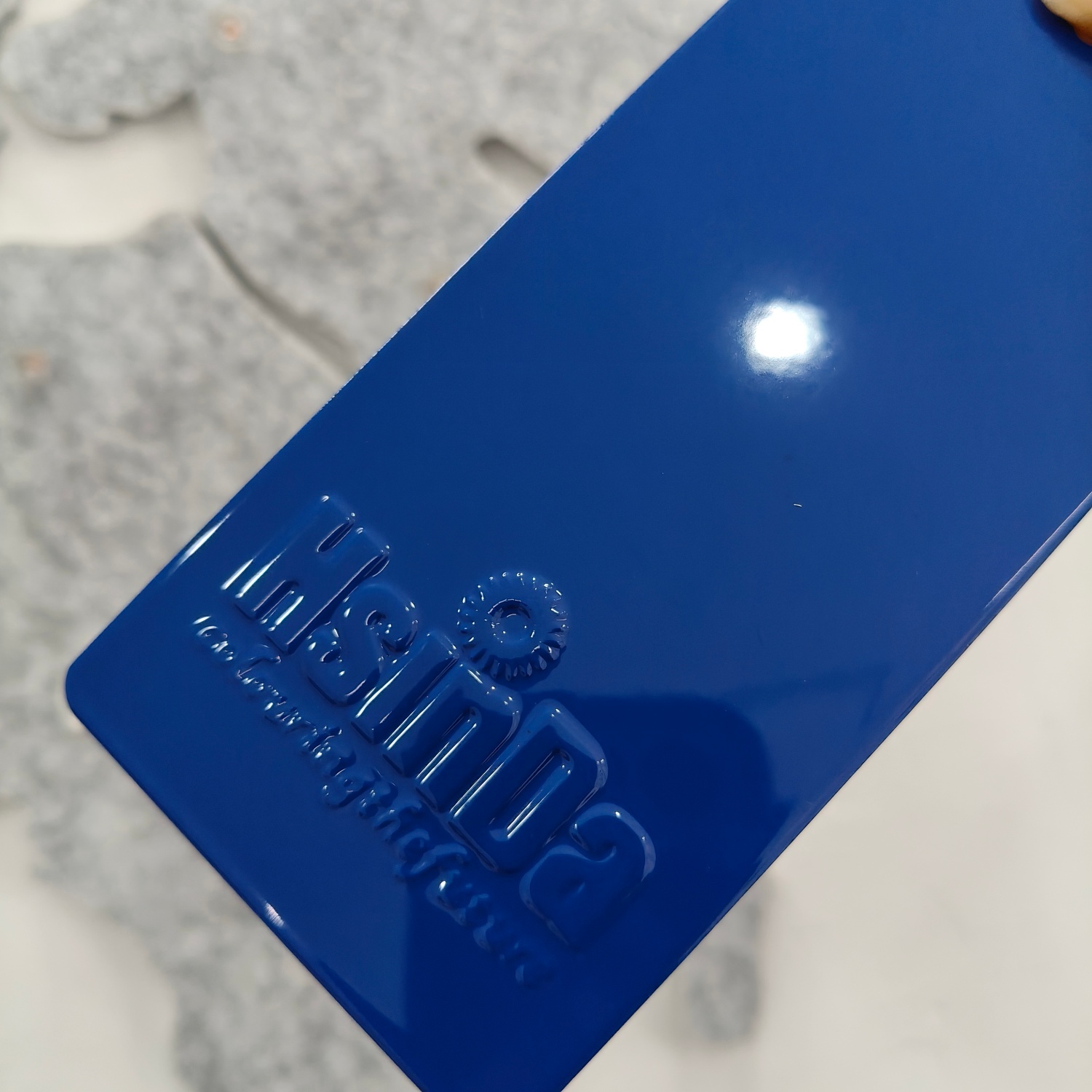
Send your substrate, exposure class, target finish and annual volume, and Hsinda will respond with the matching resin system, a parameter sheet with test standards, MOQ and lead time for your order model, and a colour-matched sample on request.
Have Questions or Need More Details?
Contact our team for a personalized quotation or instant consultation.
Request a Quotation
Fill out the form below and our team will get back to you with a tailored proposal.
WhatsApp Direct Chat
Prefer to chat in real-time? Message us on WhatsApp for instant assistance & quick answers.
- Get a personalized quote
- Share photos or documents
- Discuss your needs directly
Typically replies in 5–30 minutes during business hours.