Powder Coating for Home Appliances: Application Guide for Manufacturers
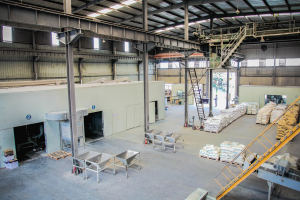
Powder coating production line at Chengdu Hsinda Polymer Materials Co., Ltd — the base material behind appliance-grade epoxy, polyester and wrinkle finishes.
Home appliance manufacturing is a metal finishing business as much as an assembly business. Cabinets, panels, brackets, chassis and handles have to survive stamping, forming, conveyor handling and shop-floor oils — and then keep a consistent appearance for the life of the appliance. Powder coating is the finishing route most appliance programs standardise on, because it applies in a single pass, needs no primer and no drying time, and cures in 10–20 minutes.
The decision this guide addresses is not whether to use powder coating, but which system to approve. Three thermoset families cover most of an appliance bill of materials: epoxy powder coating for parts where corrosion and chemical resistance outweigh appearance, polyester powder coating — where the hardener chemistry, TGIC-cured or TGIC-free, has to be declared and verified — and wrinkle powder coating for textured cabinet and panel surfaces.
The parameters that decide whether a coating passes qualification are measurable, not promotional: adhesion grade 0 (ISO 2409:2020), hardness ≥H (ISO 15184:2020), and a curing window of 180–200 °C for 10–15 minutes. This guide shows how those values translate into a purchasing decision, what evidence to request from a supplier, and where each system fits on an appliance line.
What Actually Has to Pass on an Appliance Line
Appliance parts are not uniformly demanding, and treating them as one specification is where most coating programs lose money. A door panel that a customer sees and touches has a different failure mode from a hidden structural bracket. Practical programs separate the parts before they choose a chemistry.
Four failure modes drive the specification:
- Adhesion loss after forming and handling. Panels are bent, punched and assembled after coating. Adhesion grade 0 per ISO 2409:2020 is the documented pass level to specify, because a coating that lifts at a bend will fail again in service.
- Surface damage during assembly. Impact resistance is measurable — 50 kg/cm per ISO 6272-1:2017 appears in the test data for both the epoxy anti-corrosion grade and the wrinkle grade — and it is the number to ask for when parts are handled on high-speed lines.
- Chemical exposure. Appliance surfaces meet kitchen oils, general acids and cleaning agents. Wrinkle powder coating is documented with good resistance to general acids and oils and average alkali resistance, which is one reason it is used on electric panels and cabinets.
- Colour and gloss drift across a batch. Colour difference is controllable, not random. Hsinda holds colour difference (Delta E) within ≤0.5 and provides colour difference reports on request.
A fifth constraint sits on the production side rather than the part: the curing schedule. A coating that needs a different oven profile from the rest of the line forces either a second pass or a line changeover. Keeping the approved systems inside the same 180–200 °C / 10–15 minute window for epoxy and polyester grades removes that friction.
Industry Background: Where Home Appliance Powder Coating Sits
Powder coating is a mature global category, and appliance work is one of its natural applications: the comparison data for powder versus traditional liquid paint lists mass-produced, assembly-line industrial metal components — home appliances, automobiles, building materials and shelving — as the fit profile for powder systems.
Market size estimates vary by source, which is itself useful information for planners. Grand View Research values the powder coatings market at USD 11.5 billion in 2025 and projects USD 18.5 billion by 2033, while IMARC Group reports USD 16.4 billion in 2025 with a CAGR of 4.51% to 2034. Treat any single figure as an order-of-magnitude reference rather than a budgeting input. Market structure is more consistent than market size: thermoset chemistries, including epoxy and polyester resins, held a 76.6% share in 2026, supported by durability and corrosion resistance (Coherent Market Insights).
Supply is concentrated but not closed. Global supplier names in the category include AkzoNobel (Interpon), PPG Industries, Sherwin-Williams, Axalta and Jotun. China's coating industry exported 334,800 tons of coatings in 2024, with export value up 18.65% year on year to USD 1.065 billion (China Coatings Industry Association / ECHEMI). For appliance buyers, that means a genuinely competitive supplier field — which raises the value of a documented specification instead of a brand-only shortlist.
Standards context matters when a coating crosses from architecture into appliances. Architectural qualification schemes such as Qualicoat, GSB International and AAMA 2603 / 2604 / 2605 govern exterior exposure, and ISO 12944 defines corrosion categories C1–C5 for steel structures. Appliance coatings are usually qualified against ISO test methods and the OEM's own specification — which is why the ISO numbers in the next section carry more weight than a supplier's descriptive language.
Which Powder Coating Systems Fit Appliance Production
Three systems, all curing as thermoset powders, cover the majority of appliance requirements. The sections below use documented product data rather than general claims, so manufacturers can compare them line by line.
1. Epoxy Powder Coating: Corrosion Protection for Exposed Metal
Epoxy powder coating is the grade specified when chemical and corrosion resistance matter more than surface appearance. The documented epoxy anti-corrosion product cures at 180–200 °C for 10–15 minutes, delivers impact resistance of 50 kg/cm (ISO 6272-1:2017), a gloss range of 5% to 95% (ISO 2813:2014), adhesion grade 0 (ISO 2409:2020), and salt spray resistance with no change after 500 hours and unilateral corrosion ≤2 mm (ISO 7253:1996). Its documented application base is heavy-duty industrial metal: oil and gas pipelines, water supply systems, valves and steel reinforcement bars.
For an appliance bill of materials, that profile points to parts where the coating is primarily protective — internal structural metal, brackets and components exposed to moisture or chemical contact — rather than to visible exterior shells where long-term colour hold matters. Epoxy chemistry is also the benchmark buyers use when they need the highest corrosion protection per unit of film thickness.
2. Polyester Powder Coating and TGIC-Free Hardener Options
Polyester powder coating is the visible-surface grade. Hsinda's weather-resistant polyester grade is formulated with polyester resin, a TGIC curing agent, pigments and additives, and cures at 180–200 °C for 10–15 minutes. Its documented properties: adhesion grade 0 (ISO 2409:2020), hardness ≥H (ISO 15184:2020), gloss range 5% to 95% (ISO 2813:2014), average particle size 32–42 μm, specific gravity 1.2–1.7 g/cm³, and coverage of 8–10 m² per kg at 30–90 μm film thickness, with a typical film thickness of 70 μm. Weathering performance is documented as no powdering and light retention above 50% after 500 hours (ISO 11341:2004); the aluminum-oriented grade in the same family is documented at 1000 hours for both weathering and salt spray.
Hardener chemistry is a separate decision. TGIC is the conventional curing agent in the polyester grade described above, and where a buyer's compliance policy restricts it, the coating must be specified as a TGIC-free system instead. For appliance manufacturers, the practical rule is simple: treat the hardener as a documented specification item, not a verbal assurance. Ask the supplier to state the curing agent on the technical data sheet, confirm the alternative system's cure schedule — because a TGIC-free chemistry that needs a different oven profile will disturb line throughput — and verify the compliance paperwork covering REACH and EU RoHS 2.0 before the first production order. This guide does not extend beyond the verified performance data the supplier's own test reports state for each variant.
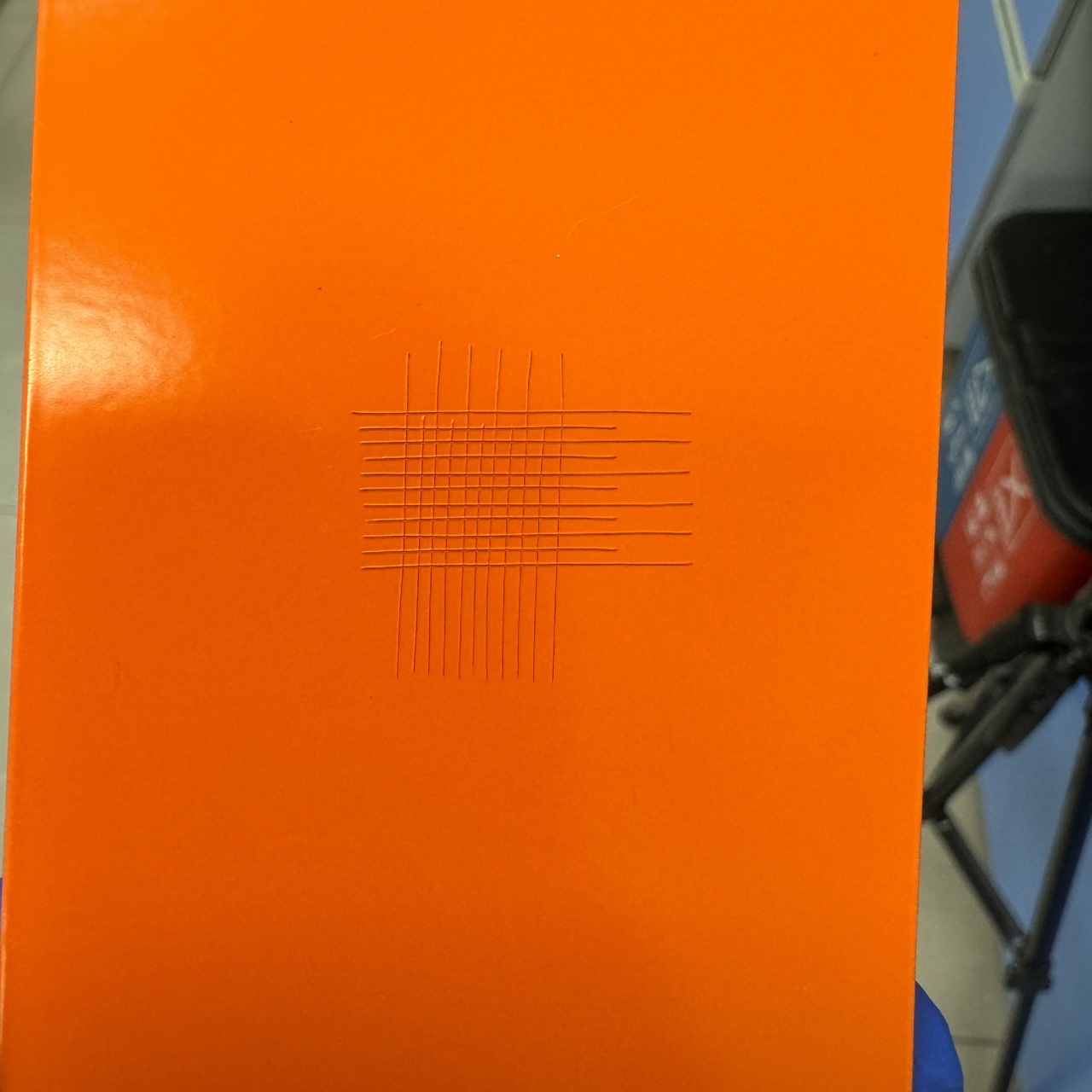
Adhesion testing: appliance parts are formed and handled after coating, so adhesion grade 0 (ISO 2409:2020) is a specification item, not a formality.
3. Wrinkle Powder Coating: Textured Cabinets and Electric Panels
Wrinkle powder coating produces a textured, low-glare surface — a finish appliance buyers often prefer on cabinets because it hides fingerprints and minor handling marks. Its documented profile is the most complete of the three systems for appliance-relevant exposure: good resistance to general acids and oils with average alkali resistance; adhesion grade 0 (ISO 2409:2020); hardness ≥H (ISO 15184:2020); impact resistance of 50 kg/cm (ISO 6272-1:2017); salt spray resistance with no change after 500 hours and unilateral corrosion ≤2 mm (ISO 7253:1996); and weather resistance with no powdering and light retention above 50% after 500 hours (ISO 11341:2004). Its typical documented applications are electric panels and cabinets — directly relevant to appliance enclosure work.
Step-by-Step: Qualifying a Powder Coating for an Appliance Program
The sequence below is the order that avoids rework. Skipping step 1 or step 4 is the most common cause of a coating that passes a sample but fails in mass production.
- Classify every coated part by exposure. Split the bill of materials into visible exterior parts, textured cabinet parts, and internal or chemically exposed metal. Each group gets its own approved system.
- Match the resin system to the exposure. Epoxy for corrosion-led parts; polyester — with the hardener chemistry declared — for visible colour-stable panels; wrinkle or another textured grade for cabinets and electric panels.
- Lock the cure schedule against the existing oven profile. Epoxy and polyester grades are documented at 180–200 °C for 10–15 minutes. Confirm the selected grade cures inside the window your line already runs. If energy is a decision factor, low-temperature curing grades at 160 °C are documented with over 10% better energy efficiency and can be evaluated against the standard schedule.
- Fix the colour and gloss targets in writing. Gloss is specified on the ISO 2813:2014 scale, which spans 5% to 95%. Colour difference should be controlled and reported — Hsinda holds Delta E within ≤0.5 and supplies colour difference reports on request.
- Request the test evidence, not a description. Ask for adhesion (ISO 2409:2020), hardness (ISO 15184:2020), impact (ISO 6272-1:2017), salt spray (ISO 7253:1996) and weathering (ISO 11341:2004) results, plus supplier-level certificates: ISO 9001, ISO 14001, SGS, REACH, EU RoHS 2.0 and QUALICOAT documentation, with outdoor exposure and antimicrobial testing where the application requires it.
- Run a line trial on the sample line. A sample line is where the cure schedule, film thickness and colour are proven on the actual substrate before a production order is placed.
- Approve incoming lots against a documented inspection protocol. Hsinda applies a 3+1 inspection protocol before shipment, covering raw materials, first and last production pieces, performance and colour difference. Buyers should ask for that procedure in writing and align it with their own incoming inspection.
- Check the economics per kilogram. Coverage is the number that converts price per kg into cost per coated square metre. Documented Hsinda coverage is 1 kg per 7–10 m²; the polyester grade is documented at 8–10 m² per kg at 30–90 μm film thickness.
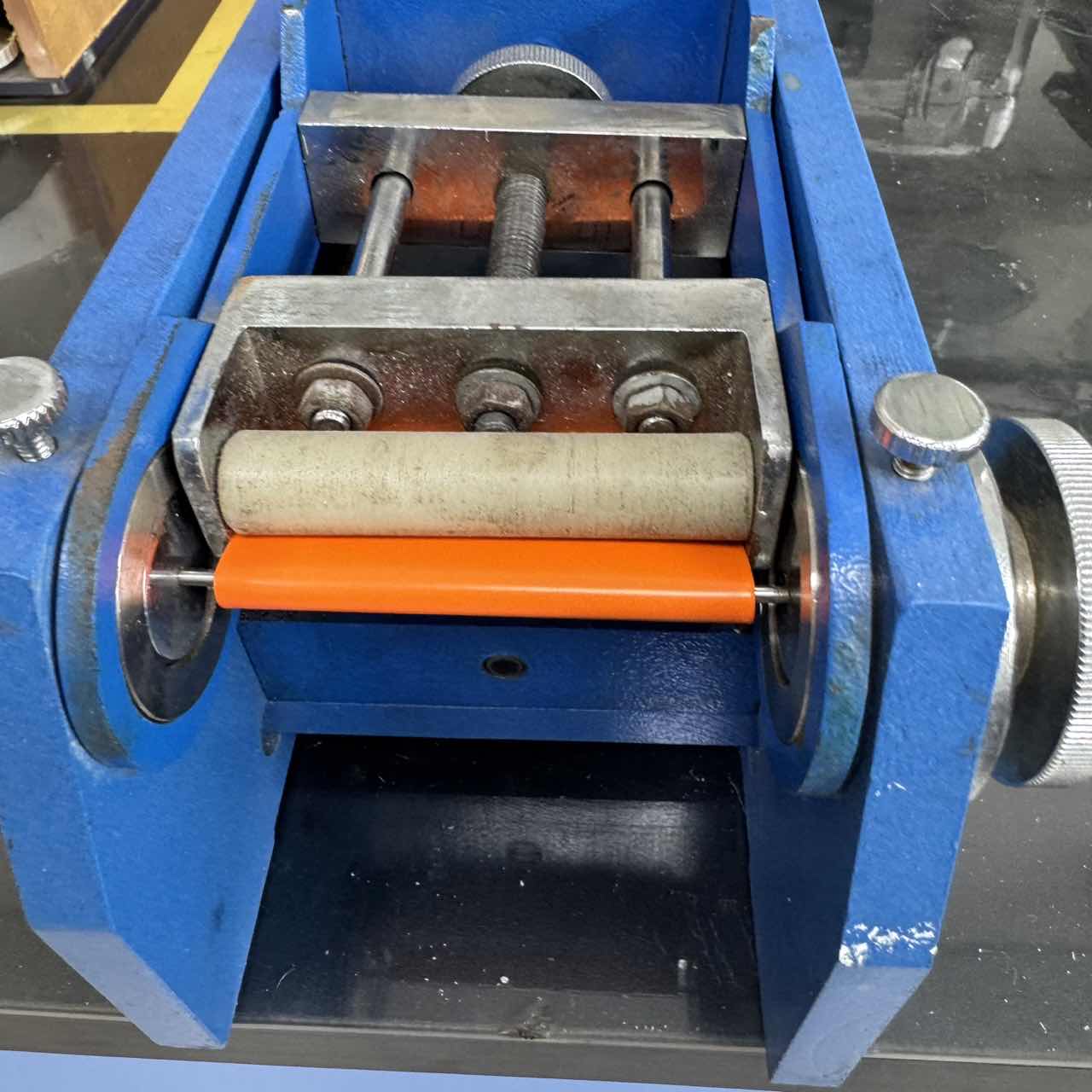
Bending and impact testing after curing: the check that connects a coating approval to the way appliance parts are actually formed and handled.
Use Cases: Appliance Parts and the System That Fits
The mapping below follows documented application data and the exposure logic above. It is a starting point for a specification discussion, not a substitute for a line trial.
- Electric panels and cabinets — wrinkle powder coating. Wrinkle finishes are documented for electric panels and cabinets, with acid and oil resistance, average alkali resistance, hardness ≥H and 500-hour salt spray and weathering results. For appliances, this is the textured-cabinet scenario where fingerprint resistance and durability matter more than high gloss.
- Visible panels and shells — polyester powder coating. Where colour and gloss must hold across a visible surface, the weather-resistant polyester grade combines adhesion grade 0, hardness ≥H, a 5–95% gloss range and documented weathering without powdering and with light retention above 50% after 500 hours.
- Internal and chemically exposed metal — epoxy powder coating. Parts where the finish is judged on corrosion protection rather than appearance fit the epoxy anti-corrosion grade: 50 kg/cm impact resistance, adhesion grade 0, and salt spray with no change after 500 hours and unilateral corrosion ≤2 mm.
- High-volume assembly-line components. Powder coating is documented as suited to mass-produced, assembly-line industrial metal components including home appliances — single-pass application, no primer, no drying time, and a 10–20 minute cure that fits automated lines.
Comparison Tables
The three tables below use documented coating data only. Cells marked “Not specified” are not stated in the data available for this guide — request the supplier's technical data sheet and test reports for those parameters before approval.
Table 1 — Verified performance data by thermoset system
| Parameter | Epoxy anti-corrosion | Polyester (weather-resistant) | Wrinkle (textured) |
|---|---|---|---|
| Curing schedule | 180–200 °C, 10–15 min | 180–200 °C, 10–15 min | Not specified |
| Adhesion | Grade 0 (ISO 2409:2020) | Grade 0 (ISO 2409:2020) | Grade 0 (ISO 2409:2020) |
| Hardness | Not specified | ≥H (ISO 15184:2020) | ≥H (ISO 15184:2020) |
| Impact resistance | 50 kg/cm (ISO 6272-1:2017) | Not specified | 50 kg/cm (ISO 6272-1:2017) |
| Salt spray | No change after 500 h; unilateral corrosion ≤2 mm (ISO 7253:1996) | Not specified | No change after 500 h; unilateral corrosion ≤2 mm (ISO 7253:1996) |
| Weathering | Not specified | No powdering, light retention >50% after 500 h (ISO 11341:2004) | No powdering, light retention >50% after 500 h (ISO 11341:2004) |
| Gloss range | 5%–95% (ISO 2813:2014) | 5%–95% (ISO 2813:2014) | Not specified |
| Acid & oil resistance | Not specified | Not specified | Good resistance to general acids and oils; average alkali resistance |
| Coverage / film build | Not specified | 8–10 m²/kg at 30–90 μm; typical film 70 μm | Not specified |
| Particle size / specific gravity | Not specified | 32–42 μm / 1.2–1.7 g/cm³ | Not specified |
| Documented application base | Heavy-duty industrial: oil and gas pipelines, water supply systems, valves, steel reinforcement bars | Weather-resistant coating for aluminum profiles | Electric panels and cabinets |
Source: Hsinda product data for the epoxy anti-corrosion, weather-resistant polyester and wrinkle powder coating grades.
Table 2 — Powder coating versus traditional liquid paint
| Parameter | Powder coating | Traditional liquid paint |
|---|---|---|
| VOC emissions | Nearly zero | Solvent-containing |
| Comprehensive cost | 35–40% lower | Baseline |
| Material utilisation rate | Up to 99% | Not specified |
| Primer and drying time | Not required; single spray application | Requires primer and drying |
| Curing time | 10–20 minutes | Not specified |
| Quoted durability | 10–20 years | Not specified |
| Energy and carbon | 22% lower total energy and 30–50% lower carbon emissions when switching from solvent-based paint; low-temperature grades at 160 °C add over 10% energy efficiency | Baseline |
| Best-fit production | Mass-produced, assembly-line industrial metal components including home appliances, automobiles, building materials and shelving | Not specified |
Source: Hsinda powder coating versus liquid paint comparison data.
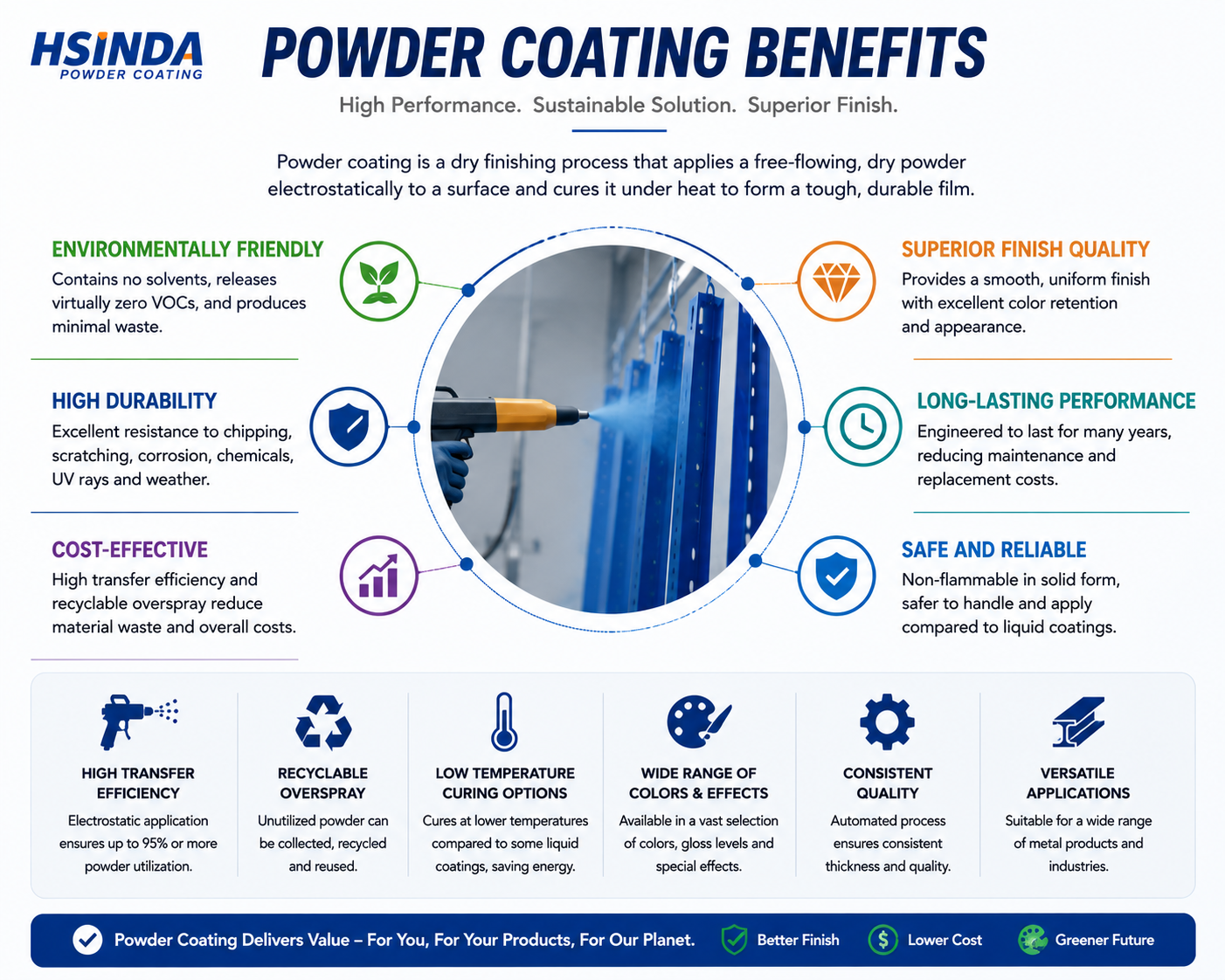
Powder versus liquid paint: the cost case rests on material utilisation and process steps, not on a single price per kilogram.
Table 3 — Hsinda powder coating versus other Chinese brands
| Comparison point | Hsinda powder coating | Other Chinese brands |
|---|---|---|
| Resin and pigment | Higher resin content, better pigment | Baseline |
| One-time coating rate | Higher first-pass coating rate; more coverage | Lower |
| Coverage | 1 kg per 7–10 m² | Not specified |
| Comprehensive cost | 5% lower, driven by lower raw material consumption and fewer rework rejects | Baseline |
Source: Hsinda's own product comparison data — first-party positioning stated for buyer evaluation, to be confirmed against test reports and line trials.
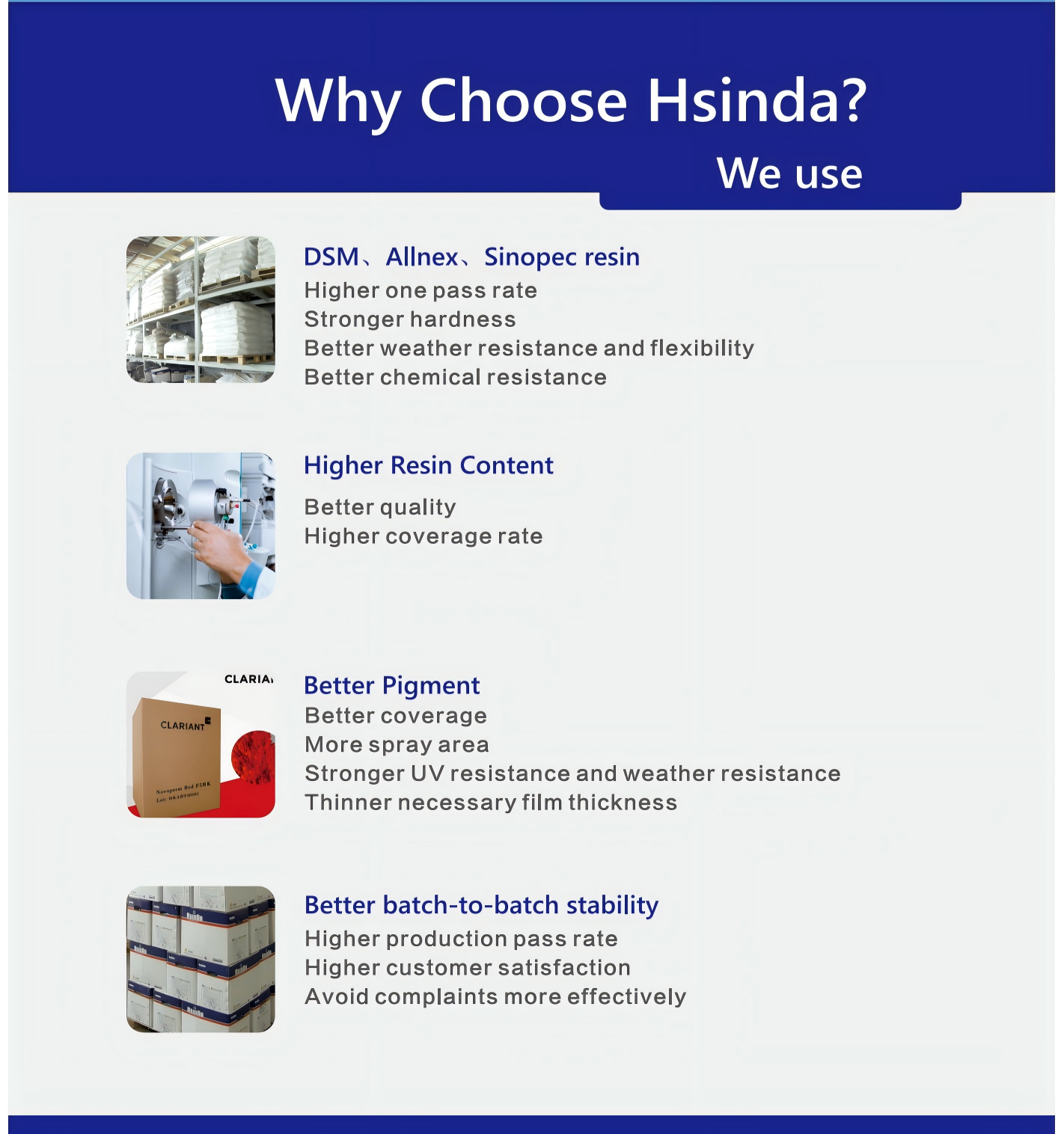
Coverage per kilogram is the figure that turns a quoted price into a cost per coated appliance part.
FAQ
What test results should an appliance manufacturer verify before approving a powder coating?
Approval should rest on measured values rather than appearance. The documented performance set to request covers adhesion grade 0 (ISO 2409:2020), hardness ≥H (ISO 15184:2020), impact resistance of 50 kg/cm (ISO 6272-1:2017), salt spray resistance with no change after 500 hours and unilateral corrosion ≤2 mm (ISO 7253:1996), and weathering with no powdering and light retention above 50% after 500 hours (ISO 11341:2004). Gloss should be reported on the ISO 2813:2014 scale, which runs from 5% to 95%. At supplier level, look for ISO 9001 and ISO 14001 certification together with SGS, REACH, EU RoHS 2.0 and QUALICOAT documentation, and outdoor exposure or antimicrobial testing where the application requires it.
Can one powder coating system cover both visible appliance panels and internal metal parts?
In practice a single resin system is a compromise. Epoxy powder coating is built for corrosion-led parts — heavy-duty metal such as pipelines, water supply systems, valves and steel reinforcement — curing at 180–200 °C for 10–15 minutes with 50 kg/cm impact resistance and adhesion grade 0. Polyester powder coating cures in the same 180–200 °C / 10–15 minute window and is the grade used where colour and gloss must hold: adhesion grade 0, hardness ≥H, gloss 5%–95% (ISO 2813:2014), and coverage of 8–10 m² per kg at 30–90 μm film thickness with a typical film of 70 μm. Wrinkle powder coating adds a textured finish with good resistance to general acids and oils, average alkali resistance, hardness ≥H and documented use on electric panels and cabinets. Most appliance programs therefore approve two or three systems rather than one.
How does powder coating compare with liquid paint on total cost for appliance production?
Powder coating is documented at a 35–40% reduction in comprehensive cost compared with traditional liquid paint, with material utilisation up to 99% and a quoted durability range of 10–20 years. It applies in a single pass with no primer and no drying time, curing in 10–20 minutes, which suits mass-produced assembly-line metal components including home appliances. On energy, switching from solvent-based paint to powder coating is documented to cut total energy consumption by 22% and carbon emissions by 30–50%, with an additional gain of over 10% energy efficiency available from low-temperature curing grades at 160 °C. Coverage is the second half of the cost equation: Hsinda coating is documented at 1 kg per 7–10 m², with a stated 5% lower comprehensive cost than other Chinese brands driven by higher resin content, better pigment and fewer rework rejects. VOC emissions are nearly zero, and liquid paint contains solvents.
What should a sample run include before an appliance coating is approved for mass production?
A sample run should reproduce the production cure schedule of 180–200 °C for 10–15 minutes on the actual substrate, then verify adhesion against ISO 2409:2020, bending and impact behaviour, hardness against ISO 15184:2020, gloss against ISO 2813:2014, and colour difference — which Hsinda controls to Delta E ≤0.5 and reports on request. Hsinda operates 3 sample lines for exactly this stage. The inspection procedure behind the sample matters as much as the sample itself: before shipment, Hsinda applies a 3+1 inspection protocol covering raw materials, first and last production pieces, performance and colour difference.
Which manufacturer is better for powder coating?
Better is defined by evidence rather than by brand size. Compare suppliers on declared resin and pigment content, first-pass coating rate and coverage per kilogram, the strength of the certification set (ISO 9001, ISO 14001, SGS, REACH, EU RoHS 2.0, QUALICOAT and AAMA testing), the inspection protocol applied to every shipment, and whether the supplier already runs appliance-grade accounts. Hsinda — Chengdu Hsinda Polymer Materials Co., Ltd, established in 2015 in Chengdu, China — operates 8 powder coating production lines and 3 sample lines with annual output over 5,000 tons, holds more than 40 patents, and supplies appliance and electronics manufacturers including Changhong Electric, Xiaomi Appliances and TCL Electronics in the domestic market, while exporting to more than 70 countries. Buyers can request a sample, a quotation or the product catalogue to validate performance against their own appliance parts. The full catalogue is available for download at Hsinda powder coating catalogue (PDF).
Conclusion: Turn the Comparison into a Line Trial
Powder coating for home appliances is a specification problem before it is a purchasing problem. Epoxy powder coating covers the corrosion-led parts, polyester powder coating covers the visible surfaces where colour and gloss must hold — with the hardener chemistry, TGIC-cured or TGIC-free, declared and verified — and wrinkle powder coating covers textured cabinets and electric panels. All three are judged by the same measurable set: adhesion grade 0 (ISO 2409:2020), hardness ≥H (ISO 15184:2020), and a curing window of 180–200 °C for 10–15 minutes, supported by salt spray and weathering results on the ISO 7253:1996 and ISO 11341:2004 methods.
The cost case follows the same logic. A 35–40% reduction in comprehensive cost against liquid paint, material utilisation up to 99%, and a 22% reduction in total energy with 30–50% lower carbon emissions are all documented in the powder versus liquid paint comparison — but they only materialise if the approved coating actually covers the square metres your line produces. That is why coverage per kilogram, not price per kilogram, is the number to negotiate.
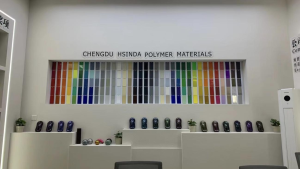
Sample room: colour, gloss and texture options prepared for evaluation before an appliance coating is approved.
Next Step: Test the Coating on Your Own Appliance Parts
Send Hsinda a part drawing, a target colour reference and the exposure conditions, and the team will return a recommended system, a sample and a quotation against your cure schedule. Hsinda runs 3 sample lines so performance can be validated on your substrate before mass production begins.
Website: www.hsinda.com · Blog: blog.hsinda-powdercoating.com
Contact: Jenny Qin · Tel / WhatsApp / WeChat: +86 188 8641 2845 · Email: innocoat.jenny@hsindapowdercoating.com
Address: No.38 Huagang Road, South Area of Chengdu Modern Industrial Port, Pixian, Chengdu, Sichuan, China
Catalogue download: Hsinda powder coating catalogue (PDF)
Have Questions or Need More Details?
Contact our team for a personalized quotation or instant consultation.
Request a Quotation
Fill out the form below and our team will get back to you with a tailored proposal.
WhatsApp Direct Chat
Prefer to chat in real-time? Message us on WhatsApp for instant assistance & quick answers.
- Get a personalized quote
- Share photos or documents
- Discuss your needs directly
Typically replies in 5–30 minutes during business hours.