
Automatic Hydraulic Die Cutting Machine: Buyer's Guide
An automatic die cutting machine is a powered hydraulic press that cuts, punches, kiss-cuts or shapes non-metallic sheet and roll materials with a shaped die, while feeding, head travel, cutting cycles or stacking are controlled by PLC, microcomputer, HMI or CNC systems. The die performs the shaping in both manual and automatic machines; automation changes how consistently the cutting cycle repeats, how much the operator handles the material, and how quickly the machine can be changed over.
Buyers researching this category usually need to answer one practical question: which configuration fits the material, the die, the batch size and the factory layout? A fully automatic line is not automatically the right answer. For some operations, a travelling-head machine or a four-column press with manual feeding is sufficient. This guide explains the machine families, the specification variables and the applications, using the published product range and specifications of Huasen Machinery as a reference point.
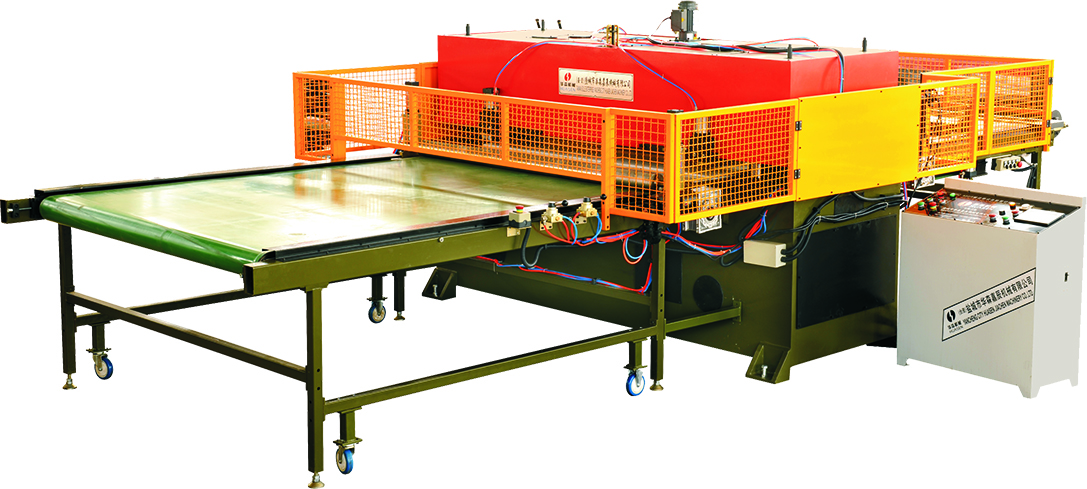
- Automatic die cutting differs from manual clicker pressing mainly in feeding, head movement, cycle control and repeatability.
- Machine families include travelling-head, four-column, sliding-table four-column, CNC movable-head, gantry and hydraulic plane cutting machines.
- Selection starts with material, sheet or roll format, thickness, die size, cutting area and required force — not with the model number.
- Sample cutting on the actual material and die is the most direct way to verify a configuration.
Problem Definition: Where Manual Die Cutting Stops Scaling
A swing-arm clicker press or a manual hydraulic press is a simple system: the operator positions the material and the die, activates the stroke, and moves the material to the next position. The machine supplies force, but the operator supplies timing, positioning and material handling. That works for low volumes, large dies with few cuts per piece, or thick materials that are difficult to feed automatically. It becomes a constraint when production volume rises or when the product requires many repeated cuts.
The constraint is not only speed. Manual cycling introduces variation between cuts and between operators. When a stack of material is cut, the top and bottom layers can differ in dimension if the pressing board does not contact the die evenly or if the cutting depth is not controlled. Die changes add time. Rolled material must be unwound and positioned by hand. Repetitive lifting and positioning also affect operator concentration over a shift.
Automatic die cutting addresses these points in several ways. Motor-driven head travel moves the cutting head over a stationary table. Automatic stepping or servo feeding advances roll material by a set length. A PLC or microcomputer controls the stroke, and the pressing board can slow down when it contacts the die so that the upper and lower layers are cut to the same dimension. Work-mode memory allows a machine to return to a saved configuration. Safety light curtains and protective mesh separate the operator from the cutting zone.
The trade-off is complexity. An automatic machine needs a defined material format, a suitable die, a stable power supply, a level floor and a production plan that justifies the changeover and programming time. For a workshop with low, irregular demand, a simpler machine can be the more practical choice. The rest of this guide helps place a specific operation on that spectrum.
Industry Background: A Converting Process, Not a Single Industry
Die cutting is a converting step used wherever a flexible or sheet material has to be cut into a repeatable shape. Huasen Machinery lists applications across automobile interiors, footwear, abrasives, bags and luggage, household supplies, consumer products, sports goods, packaging, textiles and garments, cosmetics, toys and jigsaw products. The same cutting principle appears in very different factories: an automotive supplier cutting sound insulation, a footwear plant cutting insoles, a converter cutting abrasive belts, and a packaging printer cutting cartons or EPE foam.
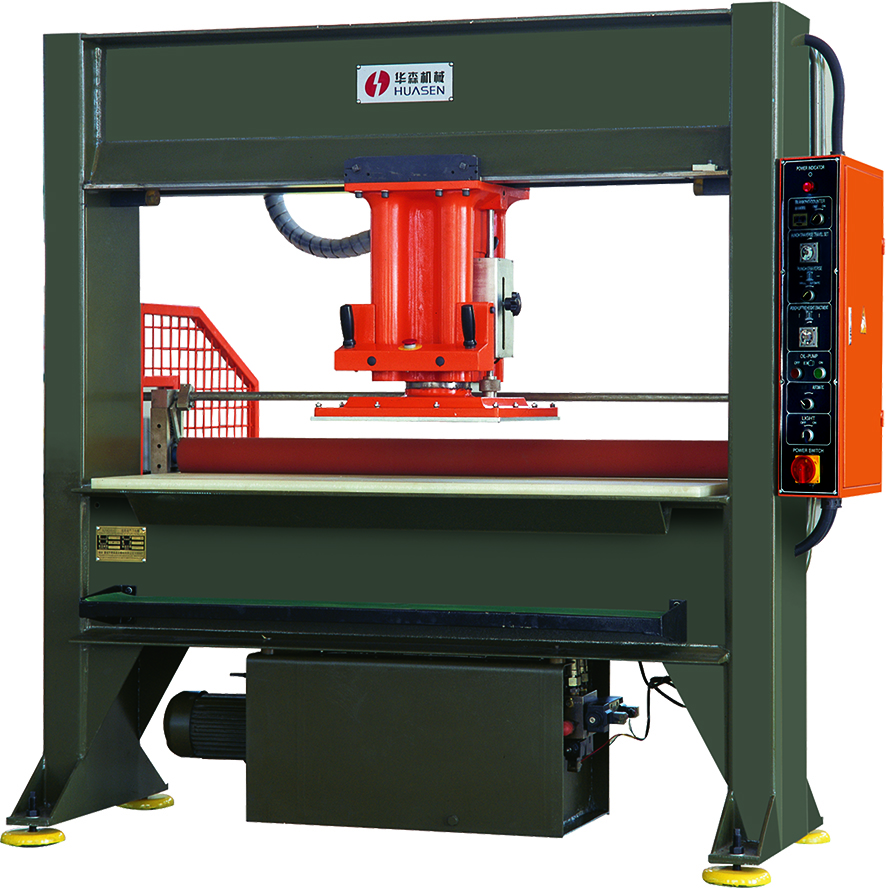
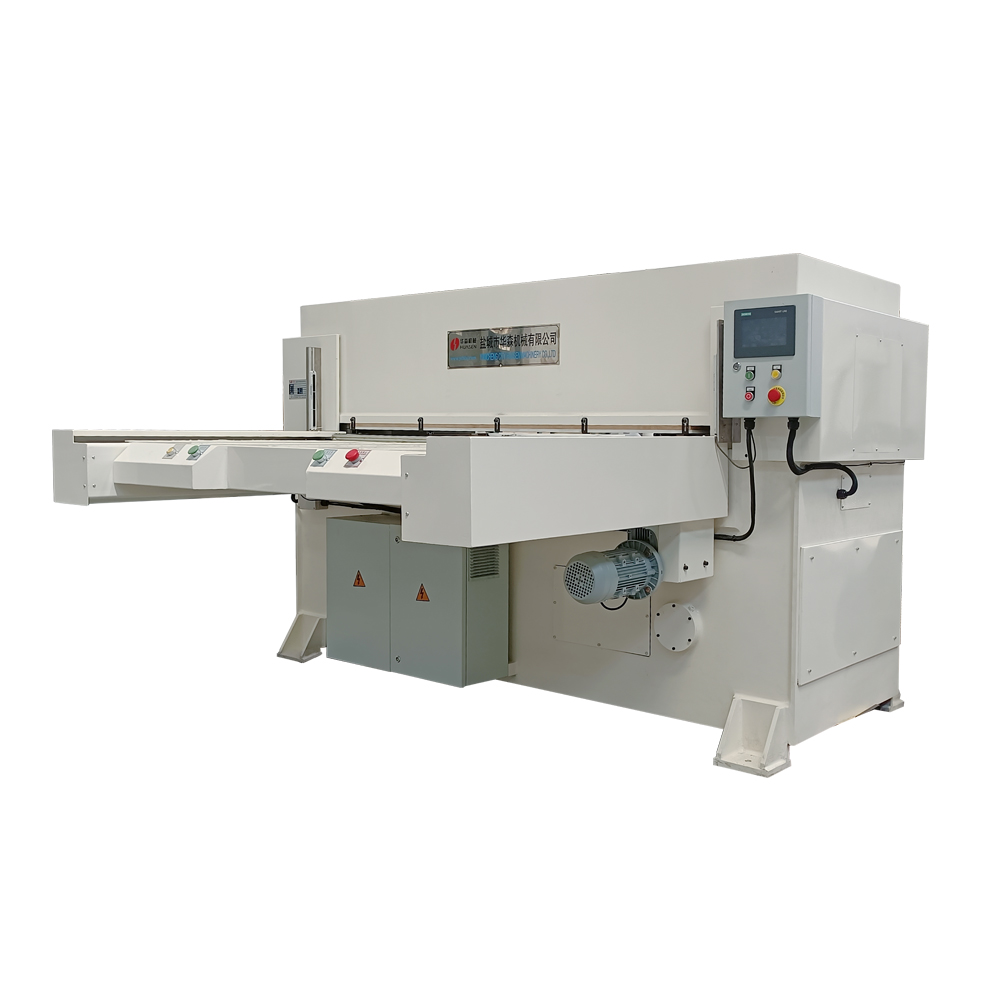
The equipment used for these operations has evolved through several formats. The swing-arm clicker press remains common for leather, footwear components and other operations where the die is moved to the material. The hydraulic plane cutting machine uses a large pressing board and two-hand operation for large-sized materials. The four-column beam press adds double cylinders, a double-crank connecting rod balancing mechanism and four-column guidance, which helps equalize cutting depth across the table. Travelling-head machines move the cutting head over a fixed table, which gives the operator a clear view and reduces material handling for large sheets. Automatic four-column machines add stepping feeders for multilayer roll material. CNC movable-head machines add upper-computer control, automatic typesetting and servo positioning for patterns that change frequently.
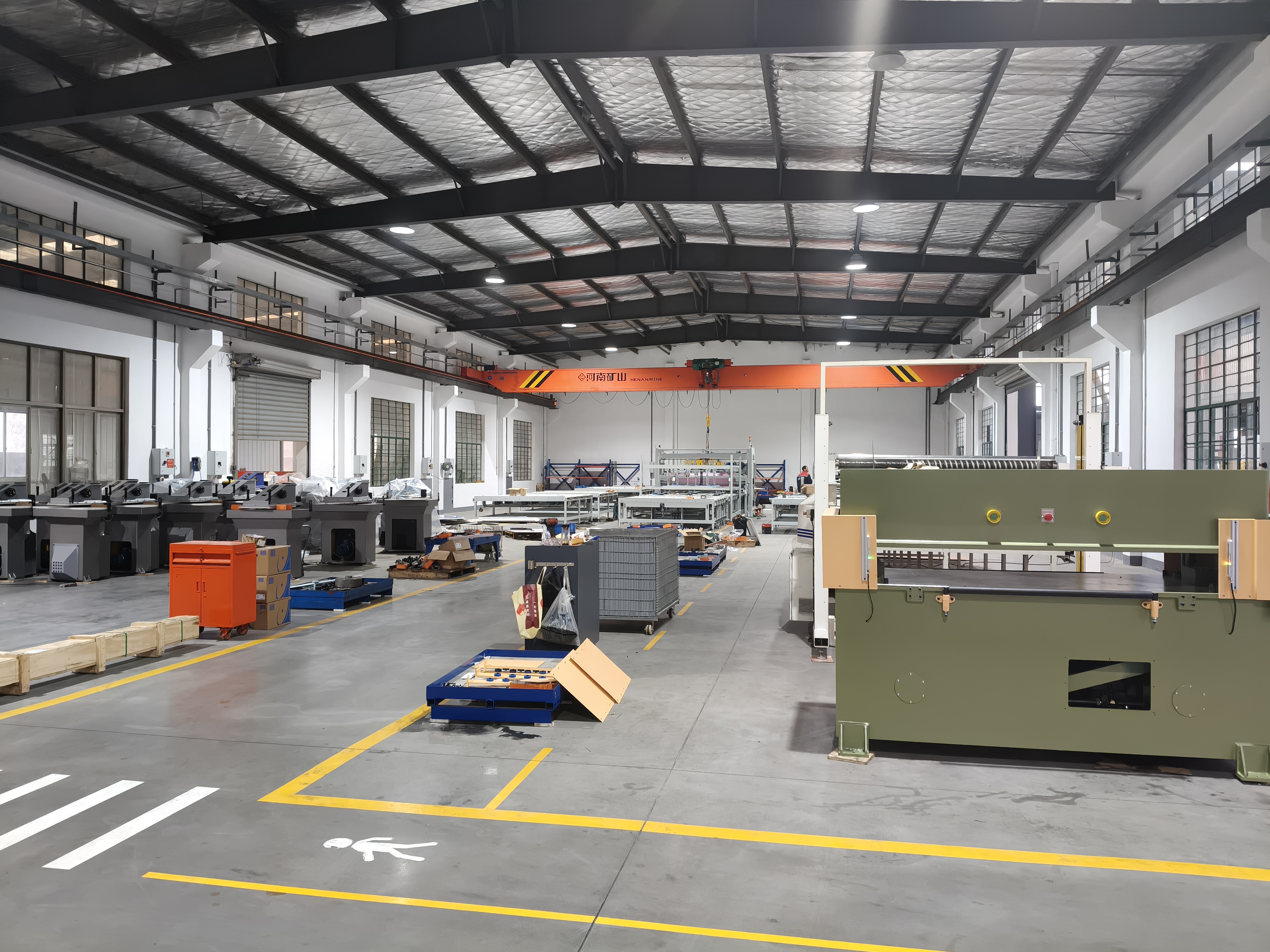
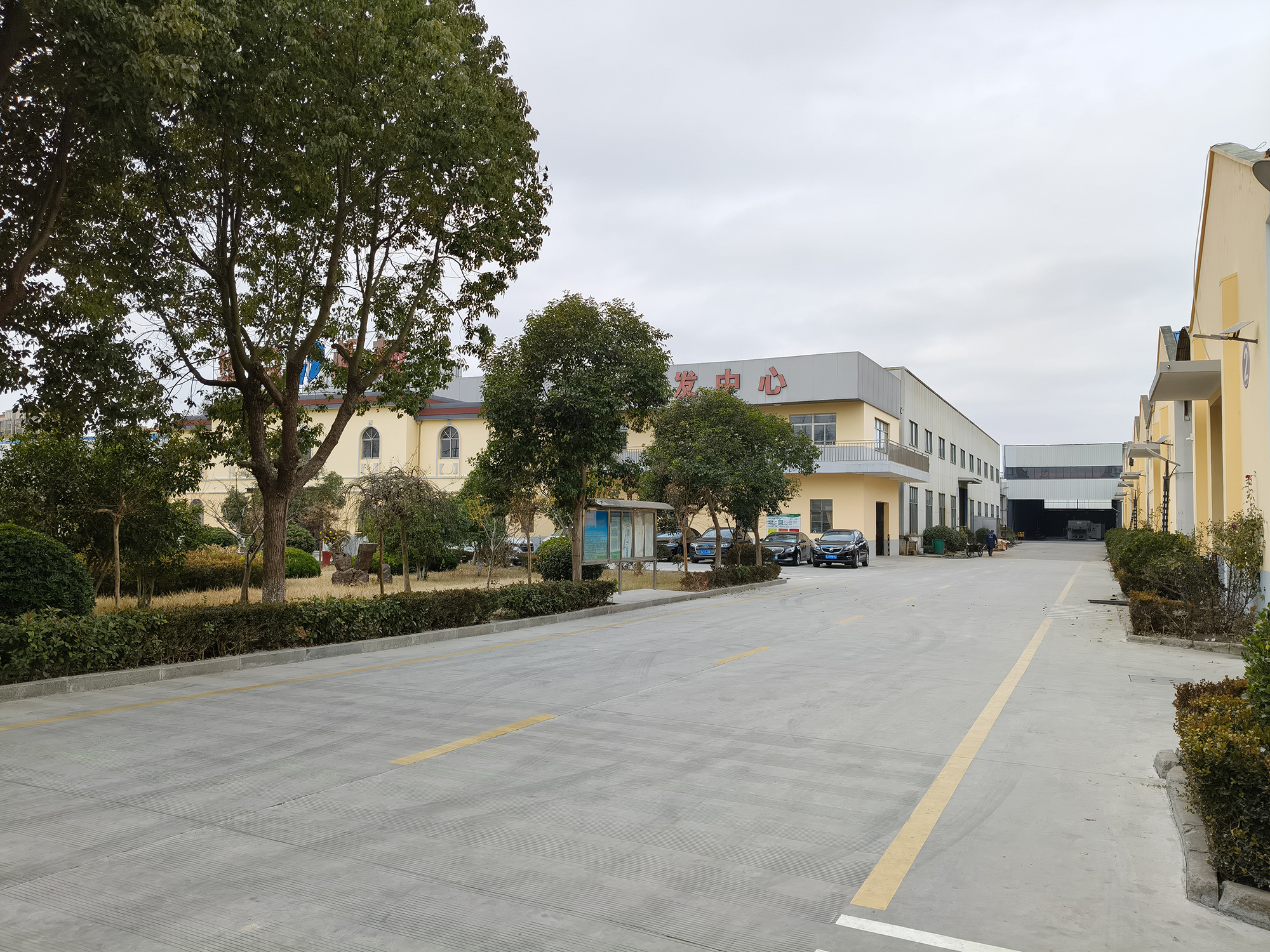
Huasen Machinery is one manufacturer in this category. Yancheng City Huasen Machinery Co., Ltd. was established in 1999 in Yancheng City, Jiangsu Province, China. The company produces hydraulic cutting machines, intelligent CNC cutting machines, precision four-column cutting machines, travelling-head cutting machines, automotive-interior cutting machines and abrasive-product cutting machines, among other equipment. Its site covers 26,000 m², with more than 110 employees including 46 senior engineering technicians, and an annual output of 1,000 units. About 60% of output is exported, mainly to the EU, USA and Asia. The company states that it drafted the industry standard QB/T 5122-2017 and holds approximately 150 patents.
Those facts are useful context, but they do not by themselves answer the selection question. A manufacturer's scale says something about production capacity and documentation experience; it does not say which machine will cut a particular material at a particular thickness. That depends on the specification variables covered below.
Detailed Solution: What an Automatic Die Cutting Machine Consists Of
An automatic die cutting machine combines four subsystems: a hydraulic power unit, a cutting head or pressing board, a worktable and feeding arrangement, and a control and safety system. The machine's suitability comes from how those subsystems are matched to the material and die.
Hydraulic power and cutting action
The hydraulic system generates the cutting force. A pump pressurizes oil, and a cylinder drives the pressing board or cutting head downward. The maximum cutting force is rated in kilonewtons (kN). The force must be sufficient for the die area, the material hardness and the number of layers; a machine that is under-rated for the die will struggle to cut cleanly, while an over-sized machine adds cost and floor load without improving the result. On several Huasen four-column models, the pressing board slows when it contacts the die, which is intended to reduce the size difference between the uppermost and lowermost layers of a stack.
Hydraulic design also affects running cost and maintenance. A specially designed hydraulic circuit can reduce noise and oil consumption; a central oil-supply lubrication system supports the service life and precision of the guides and shafts. These are engineering choices that a buyer can ask about directly rather than infer from a brochure.
Cutting head and table configurations
The physical arrangement of the head and table determines how the material is handled. A fixed pressing board with a full-width table suits sheet material that is positioned manually or by a sliding platform. A travelling head moves horizontally over a stationary table, so the operator can keep a large sheet in place while the head comes to the cut position. A gantry frame carries the head across a wide working area. A CNC movable head adds motorized movement in X, Y, Z and beta directions, which allows the punch to follow a pattern defined in software.
Huasen's range illustrates the spread. The HSD-A250B travelling head cutting machine has a 250 kN maximum cutting force, a 2000 × 500 mm working table, a 500 × 500 mm travel head and a 5–150 mm adjustable stroke. Its gantry frame is made of profile steel, and the cutting head moves horizontally under automatic speed variation. The HSC-Q600 automatic four-column cutting machine is rated at 600 kN, with a cutting area of 1600 × 900 mm or 1400 × 900 mm and a 5.5 kW main motor; it uses a double-cylinder, double-crank connecting rod balancing mechanism and four-column guidance, and offers an automatic stepping feeder for multilayer roll material. The HSC-H2000 sliding-table four-column machine is rated at 2000 kN, with a 1600 × 1000 mm or 1400 × 1000 mm cutting area and an 11 kW main motor; single- or double-side automatic feeding can be added to raise output.
Control, feeding and work-mode memory
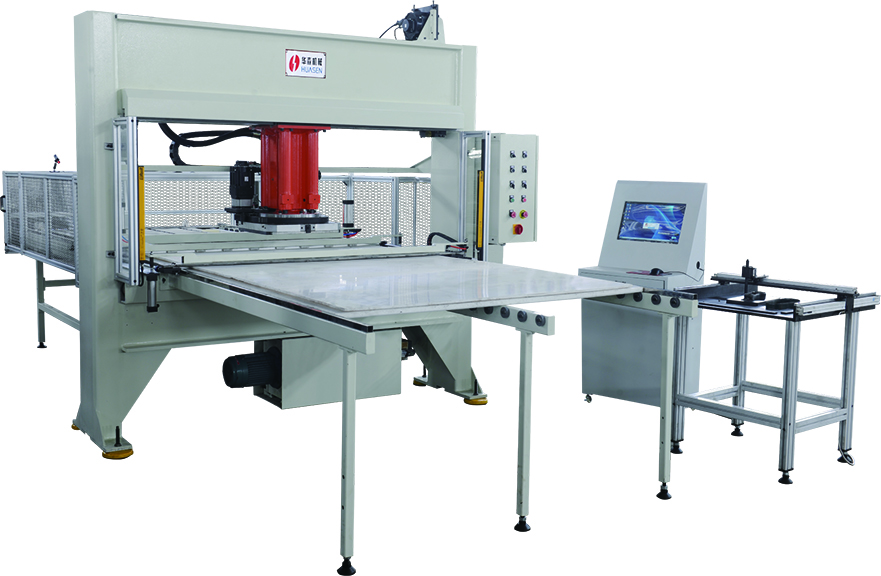
The control layer separates a basic hydraulic press from an automatic machine. Manual, inching and semi-automatic modes are common across the range; selected models add PLC control, microcomputer control, an HMI or touchscreen, servo feeding and upper-computer nesting. The CNC movable-head models use an upper computer that supports copying a cutting die, inputting electronic graphics and automatic typesetting. The punch then moves to the positions set by the nesting software. A memory function stores operating modes, so a repeat job can be recalled instead of re-entered.
Feeding is the other half of automation. A stepping feeder advances roll material by a length set on the computer. A servo-driven conveyor belt provides accurate feeding on CNC models. A sliding platform brings the material into the cutting zone on heavy four-column machines. The correct feeding method depends on whether the material arrives as sheets, rolls or multilayer stacks, and on how accurately each layer must be positioned.
Safety and ancillary equipment
An automatic machine generates force and motion, so guarding is part of the specification. Huasen's CNC models are enclosed by protective mesh and use a safety light curtain at the discharge port. Travelling-head and gantry models can be supplied with a high-precision safety screen on the operating surface. Two-hand operation is used on the hydraulic plane cutting machine. Ancillary equipment can include forming dies, conveyor belts, unwind stands, automatic stacking units, waste collection, pneumatic die clamps, limit devices, cutting-board micro-movement devices and loading or unloading systems, depending on the model.
Step-by-Step: How to Specify an Automatic Die Cutting Machine
The specification process can be reduced to eight decisions. Each one narrows the machine family before a model number is discussed.
- Define the material and its format. Identify whether the material is leather, foam, EVA, rubber, textile, abrasive paper, paper, card, plastic film, EPE, blister material or a composite. State whether it arrives in sheets, rolls or multilayer stacks. Material type and format determine the feeding method and the acceptable table configuration.
- Record thickness, hardness and layer count. These three variables drive the required cutting force and the stroke. A soft foam and a dense rubber gasket of the same thickness do not require the same pressure. If multiple layers are cut at once, the stack height must fit the adjustable stroke and the tension distance.
- Define the product and the die. Provide a product drawing, product dimensions, die dimensions and the number of pieces per cut. The die footprint must fit the cutting area, and the die height must suit the stroke. For CNC models, the punch size also matters: the HSYT-250NT, for example, has a 200 × 400 mm punch and an 1850 × 1000 mm die-cutting area.
- Calculate the force requirement against the machine rating. Compare the die area and material requirements with the maximum cutting force of the candidate models. The representative models in this guide span 250 kN on the HSD-A250B and HSYT-250NT, 300 kN on the HSB300, 500 kN on the HTR500, 600 kN on the HSC-Q600, 1000 kN on the HSC1000 and 2000 kN on the HSC-H2000. The rating should leave margin for the material and die, but it should not be chosen by size alone.
- Choose the head and feeding configuration. A travelling head suits large sheets and operators who need a clear view of the cut. A four-column press with a stepping feeder suits multilayer roll material. A sliding-table four-column machine suits heavy sheets that are difficult to move by hand. A CNC movable head suits short runs and frequent pattern changes. A hydraulic plane machine suits large pressing-board work with two-hand operation.
- Confirm the automation interfaces. Decide whether the machine must connect to an unwind stand, a conveyor, a stacking unit, a waste collector or an existing production line. Huasen's automation range includes automatic feeding, automatic punching and cutting, automatic discharging, automatic circulation, automatic stacking and automatic waste collection, and can be combined with other automatic production lines. The interface should be agreed before the machine is built, not after installation.
- Run a sample cut. Send the actual material, product drawing and actual die to the manufacturer. A trial cut on the material is more informative than a demonstration on a substitute. The supplier can video the machine and the cut product so the buyer sees the working status before shipment. A similar machine may be used for the trial, but the arrangement should be confirmed with the sales or engineering team.
- Agree on verification, documentation and service. For a larger project, ask for a factory acceptance test that checks cutting accuracy, the hydraulic system, running noise, safety interlocks, stroke and load capacity, with recorded data. Confirm the spare-parts list, warranty terms and response times. Huasen's stated warranty is 12 months, with telephone support and a solution within 2 hours and an on-site response within 24 hours if needed.
Use Cases: Where Automatic Die Cutting Fits
The same machine family can appear in unrelated industries because the underlying operation is the same. The differences are in material, die and handling.
Automotive interiors and components
Automotive interior work uses die cutting for sound insulation material, airbags, mats, seats and seat covers. These materials are often soft, multilayer or roll-fed, which makes a four-column press with a stepping feeder or a CNC line more relevant than a manual clicker press. The cutting area must accommodate the part shape, and the machine must hold depth consistency across the stack. Huasen lists automotive-interior cutting machines as a separate product family and names automotive components among its application industries.
Footwear and leather goods
Footwear production cuts slippers, flip-flops, leather shoes, casual shoes, sports shoes and disposable slippers. Leather goods production cuts bags, handbags, backpacks, wallets and luggage. A swing-arm clicker press or a hydraulic plane cutting machine is common where the die is small and the material is placed by hand. A travelling-head machine becomes useful when the sheet is large or when the operator needs to see the cut line clearly. The HSD-A250B, with its 2000 × 500 mm table and 500 × 500 mm head, is an example of that configuration.
Packaging and paper conversion
Packaging applications include cartons, paper cups, blister packs, disposable wooden lunch boxes and EPE foam. Paper and card are also cut as envelopes, labels, tags and cards. These materials are often sheet-fed and require a clean edge without crushing. A hydraulic plane cutting machine with a large pressing board can cut large sheets, while an automatic four-column machine suits repeat production from rolls. Kiss cutting is a related operation in label and tape converting, where the die cuts the top layer without cutting through the liner.
Abrasives, textiles and technical materials
Abrasive production cuts sandpaper, abrasive paper, abrasive belts, flap discs and grinding discs. Textile and garment production cuts collars, belts, shoulder pads, gloves, labels, fabric swatches and tags. Technical materials include gaskets, seals, washers, filters, felt, cork, insulation and laminates. These materials vary widely in hardness and thickness, so the force rating and the die design matter more than the brand of the machine. A 250 kN machine may be adequate for a thin textile die, while a dense rubber gasket can require a higher rating or a smaller die footprint.
Consumer, medical and electronic products
Consumer products include mouse pads, keyboard pads, bank cards, electrostatic stickers and mobile-phone screen protector film. Medical products include pads, masks and similar disposable items. Sports goods include basketballs, volleyballs, tennis balls, yoga mats and footballs. Toys and jigsaw products include wooden, paper, nonwoven and EVA foam puzzles. These applications often use smaller dies and shorter runs, which is where a CNC movable-head machine with nesting software can reduce setup time.
Comparison Table: Automatic Die Cutting Machine Configurations
The table below compares representative models from the Huasen range. It is a configuration comparison, not a ranking: the correct model depends on the material and die, and a lower-force machine can be the better choice for a thin material with a small die.
| Machine family | Example model | Max cutting force | Cutting area / table | Stroke or travel | Main motor | Typical fit |
|---|---|---|---|---|---|---|
| Travelling head | HSD-A250B | 250 kN | 2000 × 500 mm table; 500 × 500 mm head | 5–150 mm | 2.2 kW | Large sheets, clear operator view, moderate force |
| Automatic four-column with stepping feed | HSC-Q600 | 600 kN | 1600 × 900 / 1400 × 900 mm | Not stated | 5.5 kW | Multilayer roll material, repeat production |
| Four-column with sliding table | HSC-H2000 | 2000 kN | 1600 × 1000 / 1400 × 1000 mm | Not stated | 11 kW | Heavy or large-area sheet, high force |
| CNC movable head (sheet) | HSYT-250NT | 250 kN | 1850 × 1000 mm; punch 200 × 400 mm | 5–150 mm | 7.2 kW | Short runs, frequent pattern changes, nesting |
| Gantry hydraulic | HTR500 | 500 kN | 1200 × 850 / 1600 × 1050 / 1800 × 1050 mm | 175–20 mm adjustable travel | 3.0 kW | Wide table, PLC and HMI, moving head |
| Hydraulic plane | HSB300 | 300 kN | 1600 × 500 mm | 5–100 mm | 2.2 kW | Large pressing board, two-hand operation |
Source: Huasen Machinery product specification data. “Not stated” indicates that the published specification for that model does not list a stroke value; it does not mean the machine has no stroke adjustment.
What the Specification Numbers Mean in Practice
Three numbers deserve close attention during evaluation. The first is maximum cutting force. It is not a measure of quality; it is a capacity limit. A 2000 kN machine is built for work that a 250 kN machine cannot do, but it also requires a heavier foundation and consumes more power. The second is cutting area. The die must fit inside it with enough margin for the material and the feed. A die that barely fits leaves no room for positioning error. The third is stroke or adjustable travel. It must accommodate the die height plus the stack height, and it affects how much idle travel the machine makes between cuts.
Motor power is a related but separate indicator. The HSD-A250B uses a 2.2 kW main motor, the HSC-Q600 uses 5.5 kW, the HSC-H2000 uses 11 kW and the HSYT-250NT uses 7.2 kW total power. Power consumption follows the hydraulic and control design, not only the force rating, so two machines with the same cutting force can differ in energy use.
Table size and head size are often confused. On a travelling-head machine, the table holds the material and the head moves over it; the head size limits the die footprint per stroke, while the table size limits the workpiece. On a four-column machine, the cutting area is the usable press area. On a CNC machine, the die-cutting area and the punch size are separate limits: the HSYT-250NT has an 1850 × 1000 mm die-cutting area but a 200 × 400 mm punch.
Start with the die footprint and the material stack, calculate the force per unit area, then choose the smallest machine that covers the die with margin and meets the force requirement. Add automation only where the material format and production volume justify it.
FAQ
What is an automatic die cutting machine?
An automatic die cutting machine is equipment that uses a shaped die and hydraulic or mechanical cutting force to cut, crease, punch, kiss-cut or shape non-metallic materials, with automated feeding, head movement, cutting cycles or stacking. Depending on the machine and die, it can process paper, corrugated board, cardstock, adhesive labels, foam, rubber, leather, fabric, plastic sheets and other flexible or sheet materials. Huasen Machinery builds automatic die cutting machines alongside travelling-head, four-column, gantry and hydraulic plane cutting machines.
How do I know which die cutting machine is right for my product?
The right machine depends on material type, thickness, product dimensions, die size, production volume, required accuracy and automation requirements. A supplier should recommend a configuration based on these inputs rather than offering a standard model. Huasen's selection guidance asks for material type, material specification, thickness, product drawing, product dimensions, die dimensions, production quantity, required accuracy and any special requirements.
Can Huasen cutting machines be customized?
Yes. Huasen offers customized cutting equipment for different materials, product dimensions, production capacities and automation requirements. Customers can discuss working-table size, cutting force, stroke, feeding method and automation with the engineering team, and a solution is provided before production. Huasen also accepts OEM and ODM requests.
Can I test my material before buying a Huasen machine?
A material test is recommended. Customers can send actual material, a product drawing and the actual die to the manufacturer; the supplier can trial cut and provide a video of the machine and the cut product. In some cases a similar machine can be used for the trial cut, but the arrangement should be confirmed directly with the sales or engineering team.
How can I request a Huasen cutting machine quotation?
Send an email to viggo@huasen-cuttingmachine.com or contact Viggo via WhatsApp at +86 189-1255-5725. The company catalog can be downloaded from the link at the end of this article. For a useful quotation, include the material, sheet or roll format, thickness, product drawing, die dimensions, required cutting force, production quantity and automation requirements.
Conclusion: Match the Machine to the Cut, Not the Other Way Around
Automatic die cutting is a family of configurations rather than a single product. A travelling-head machine, a four-column press with a stepping feeder, a sliding-table machine, a CNC movable-head machine, a gantry press and a hydraulic plane machine all use a die and hydraulic force, but they handle material differently and suit different production patterns. The selection sequence is consistent: define the material and format, define the die and product, calculate the force and area requirement, choose the feeding and head configuration, confirm the automation interfaces, and verify with a sample cut.
The representative Huasen models discussed here range from 250 kN to 2000 kN, with cutting areas from 1200 × 850 mm to 1850 × 1000 mm and control options from manual and inching modes to PLC, HMI, servo feeding and CNC nesting. The company's stated profile includes a 26,000 m² site, more than 110 employees, 46 senior engineering technicians and an annual output of 1,000 units, with exports to the EU, USA and Asia. Those facts are a starting point for supplier evaluation; the sample cut and the technical proposal are what confirm the fit.
For buyers at the research stage, the next step is to put the actual material and die in front of a supplier. A trial cut reveals whether the force, the stroke, the feeding method and the die clearance work together. It also gives the buyer a concrete basis for comparing quotations on the same technical requirements rather than on price alone.
Next step: sample test, catalog or quotation
Huasen Machinery supports sample cutting, customized machine proposals and OEM/ODM projects. To discuss an application, contact Viggo at viggo@huasen-cuttingmachine.com or WhatsApp +86 189-1255-5725.
Download the product catalog: Huasen Machinery catalog (PDF).
Address: Zhenggang Industrial Zone, Yandu District, Yancheng City, Jiangsu Province, China. Postal code: 224042. Website: www.ychsjx.com.
Have Questions or Need More Details?
Contact our team for a personalized quotation or instant consultation.
Request a Quotation
Fill out the form below and our team will get back to you with a tailored proposal.
WhatsApp Direct Chat
Prefer to chat in real-time? Message us on WhatsApp for instant assistance & quick answers.
- Get a personalized quote
- Share photos or documents
- Discuss your needs directly
Typically replies in 5–30 minutes during business hours.