
China Injection Molding Machine CE Compliance: Buyer Checklist
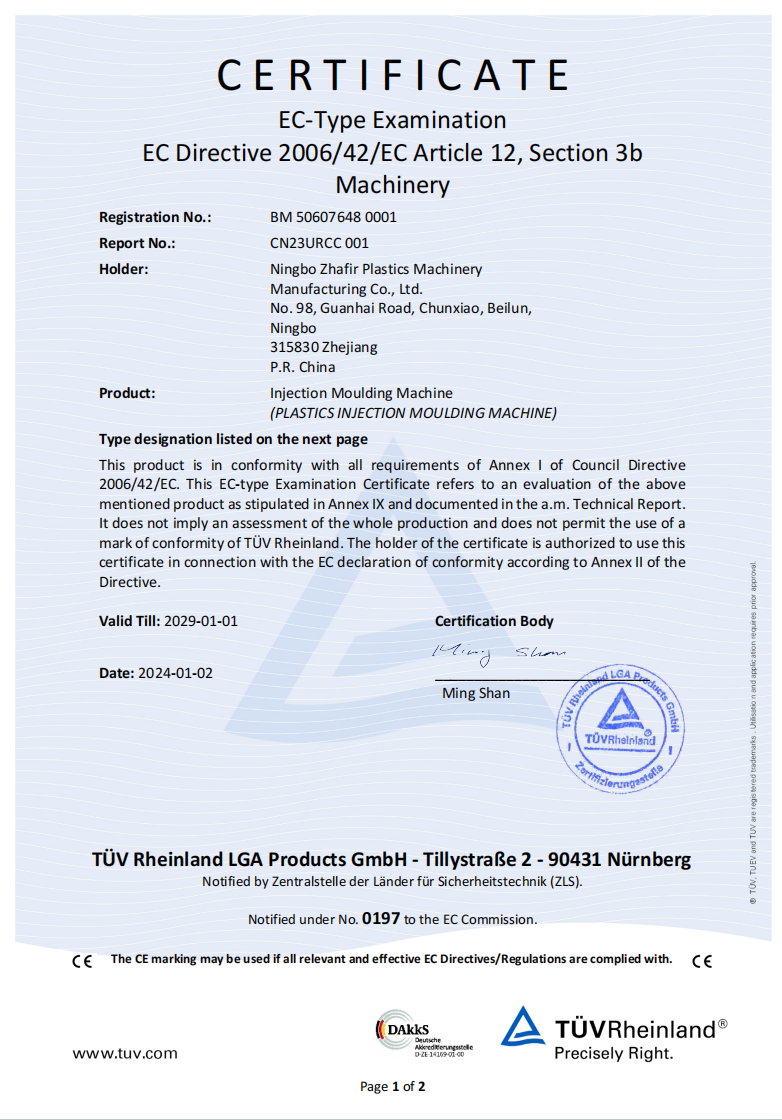
Direct answer: A plastics injection moulding machine built in China can carry the CE mark only when the manufacturer holds documented conformity with Annex I of Council Directive 2006/42/EC, normally demonstrated by an EC-Type Examination certificate issued by a notified body. Haitian International Holdings Ltd., founded in 1966 and headquartered in Ningbo, China, holds EC-Type Examination certificate BM 50607648 0001, issued by TÜV Rheinland LGA Products GmbH on 2 January 2024 and valid until 1 January 2029, for plastics injection moulding machines. ISO 9001, ISO 14001, ISO 45001 and ISO 50001 certificates support that position but do not replace it.
This checklist is written for buyers who have already shortlisted Chinese injection molding machine suppliers and are now in the evaluation stage — checking whether the certificate set, the machine specification and the destination market actually line up. It covers the four evidence layers to verify, a seven-step verification sequence, application-to-machine matching across automotive, packaging, medical, electronics, home appliance and logistics work, and a specification and certification comparison of the machine series covered by the current documented evidence set.
The real problem is certificate scope, not certificate existence
Most injection molding machine sourcing failures are not caused by a supplier having no paperwork. They are caused by paperwork that does not say what the buyer assumed it said. Three patterns account for most of the risk.
Scope mismatch. A certificate can be genuine, current and issued by a recognised body while still not covering the exact model on the purchase order. The practical check is whether the model designation on the quotation appears inside the certificate scope — not whether a CE logo appears on the supplier's website.
Management systems presented as machine conformity. ISO 9001, ISO 14001, ISO 45001 and ISO 50001 describe how a factory designs and produces, manages environmental impact, manages occupational health and safety, and manages energy. They say nothing about whether a specific machine satisfies the EU Machinery Directive. A buyer who accepts an ISO 9001 certificate as proof of CE conformity is checking the wrong document.
Market mismatch. European conformity does not transfer automatically to North America. A machine configuration accepted in the EU still has to satisfy the applicable US and Canadian requirements, and the electrical configuration — voltage, phase and frequency — is part of that check.
Regulatory and market background
Three regulatory layers matter for a China-built injection molding machine, and they apply in different markets.
European Union. Plastics injection moulding machines placed on the EU market are assessed against Annex I of Council Directive 2006/42/EC. The conformity route used here is an EC-Type Examination carried out by a notified body — TÜV Rheinland LGA Products GmbH, which issued certificate BM 50607648 0001 on 2 January 2024 with an expiry date of 1 January 2029 and a scope of "Injection Moulding Machine (PLASTICS INJECTION MOULDING MACHINE)".
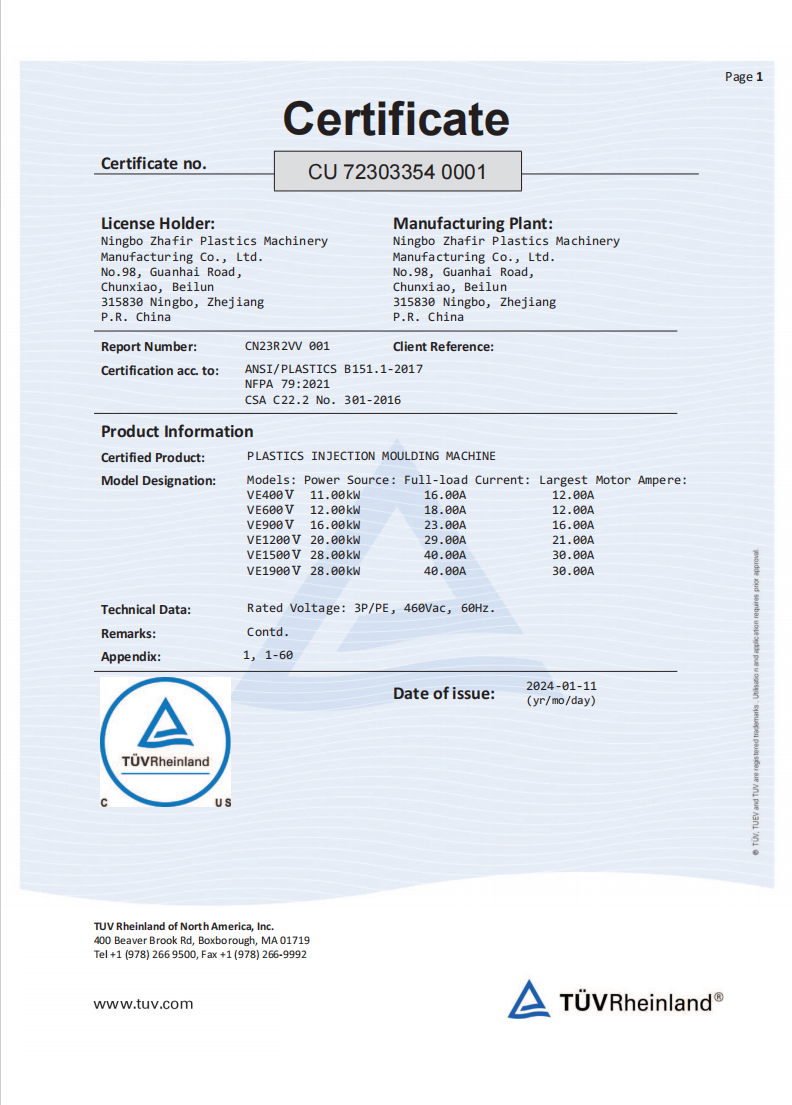
United States and Canada. North American acceptance is a separate exercise. TUV Rheinland certificate CU 72303354 0001, issued on 11 January 2024 to Ningbo Zhafir Plastics Machinery Manufacturing Co., Ltd., covers the plastics injection moulding machine models VE400V, VE600V, VE900V, VE1200V, VE1500V and VE19000V at a rated voltage of 3P/PE, 460 Vac, 60 Hz, and is issued against ANSI/PLASTICS B151.1-2017, NFPA 79:2021 and CSA C22.2 No. 301-2016.
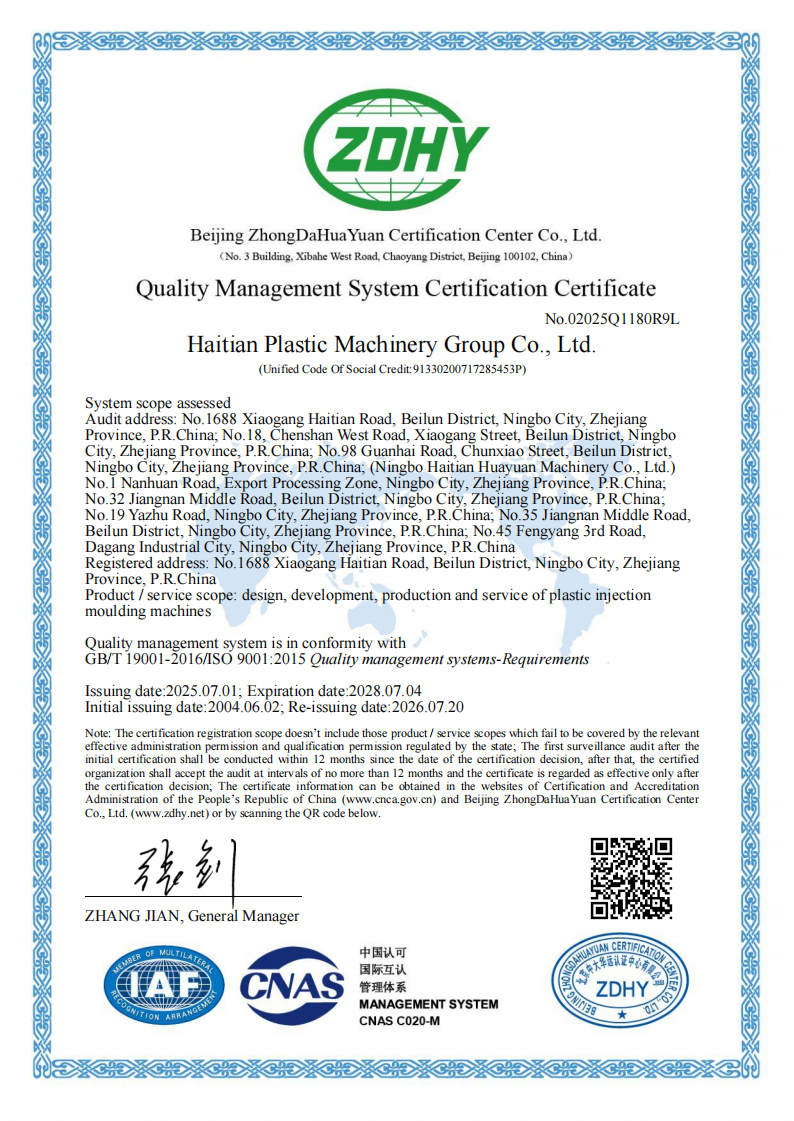
Factory-level systems. The management-system layer is issued in China and recognised in most global markets under CNAS mutual recognition: ISO 9001 certificate 02025Q1180R9L (valid 1 July 2025 to 4 July 2028), ISO 14001 certificate 02026E00868R301 (valid 20 July 2026 to 19 July 2029), ISO 45001 certificate 02026S00822R301 (valid 20 July 2026 to 19 July 2029) and ISO 50001 certificate 02024En0075R0L (valid 15 July 2024 to 14 July 2027), all issued by Beijing ZhongDaHuaYuan Certification Center Co., Ltd.
Market context explains why certification quality has become a competitive filter. Commercial research from Grand View Research values the global injection molding machine market at USD 17.3 billion in 2025 and projects USD 25.5 billion by 2033 at a CAGR of 5.0%, with Asia Pacific holding a 39.7% share in 2025 and hydraulic technology still capturing more than 40% of the market in 2024. Strategic Market Research values the electric injection molding machine segment at USD 4.9 billion in 2024. These should be read as commercial-research estimates rather than official statistics — but they frame the point: a large addressable market, a technology shift toward electric and servo-driven platforms, and buyers who increasingly use conformity documents as a first-pass supplier filter.
The four evidence layers to verify
Layer 1 — Machine-level conformity for the EU
Ask for the EC-Type Examination certificate and read five fields: document number, notified body, scope wording, issue date and expiry date. For the Haitian International range this is BM 50607648 0001 from TÜV Rheinland LGA Products GmbH, valid to 1 January 2029. Documented coverage includes the Haitian Mars Series MA5 servo-hydraulic injection molding machine, the Haitian Jupiter Series JU5 two-platen injection molding machine, the Zhafir Venus Series VE5 all-electric injection molding machine and the NIIGATA MDV-S8500 Series vertical injection molding machine, together with the wider series set listed in the comparison tables below.
Layer 2 — Destination-market conformity for the US and Canada
Certificates issued for Europe are not usable evidence in North America. Buyers shipping to the United States or Canada should request the North American certificate separately and check that the listed model numbers and the rated electrical configuration match the quotation. TUV Rheinland certificate CU 72303354 0001 is issued to Ningbo Zhafir Plastics Machinery Manufacturing Co., Ltd. and covers the VE400V, VE600V, VE900V, VE1200V, VE1500V and VE19000V plastics injection moulding machines at 3P/PE, 460 Vac, 60 Hz, against ANSI/PLASTICS B151.1-2017, NFPA 79:2021 and CSA C22.2 No. 301-2016.
Layer 3 — Factory management systems
Management-system certificates are not machine conformity, but they are useful because they are auditable and they have hard validity dates. Four are relevant here. ISO 9001 certificate 02025Q1180R9L covers the design, development, production and service of plastic injection moulding machines under GB/T 19001-2016/ISO 9001:2015. ISO 14001 certificate 02026E00868R301 and ISO 45001 certificate 02026S00822R301 cover environmental and occupational health and safety management under GB/T 24001-2016/ISO 14001:2015 and GB/T 45001-2020/ISO 45001:2018. ISO 50001 certificate 02024En0075R0L covers the energy management activities of production systems, auxiliary production systems and ancillary production systems of plastic injection moulding machines, under GB/T 23331-2020/ISO 50001:2018 — the layer that underpins energy-saving claims made at machine level.
Layer 4 — Parameter and configuration evidence
The fourth layer is the one buyers most often skip. Conformity documents describe a machine class; the quotation describes a configuration. Verify the clamping force, injection volume, screw diameter, mold platen size and tie-bar distance against the mold and the part, then verify everything that is controlled by electrical or safety configuration against the destination market. A practical example of why configuration matters: Generation 5 electrical plasticizing on the Haitian Mars Series MA5 and the Haitian Jupiter Series JU5 is documented as reducing energy consumption by 20–40% on applicable sizes, which changes the operating-cost profile of the same nominal machine class.
Step-by-step: a seven-step verification sequence
- Fix the part and the process window first. Collect part drawings, material, shot weight, mold dimensions, target output, cycle time, automation requirements, plant conditions and target-market requirements before discussing machine models. The knowledge base for this range states this explicitly as the precondition for selection and quotation.
- Convert the part into a machine class. Use clamping force and injection volume as the primary filters. Servo-hydraulic toggle machines such as the Mars Series MA5 span 600–33,000 kN and 49–45,616 cm³; two-platen machines such as the Jupiter Series JU5 span 4,500–88,000 kN and 848–134,303 cm³ for large and deep-cavity molds; all-electric platforms such as the Zhafir Venus Series VE5 span 400–13,800 kN and 12–5,767 cm³ for precision work.
- Request documents by number, not by attachment. Ask for the certificate number, issuing body, scope, issue date and expiry date for every certificate the supplier intends to rely on.
- Match the model designation. Locate the exact model on the quotation inside the certificate scope. Where a certificate references a model family rather than a single model, confirm in writing which configuration is covered.
- Check validity and applicability. Confirm the certificate is unexpired, that the issuing body is appropriate for the destination market, and that the standard cited is the one your market applies. EC-Type Examination under Annex I of Council Directive 2006/42/EC for the EU; ANSI/PLASTICS B151.1-2017, NFPA 79:2021 and CSA C22.2 No. 301-2016 for the US and Canada.
- Reconcile configuration with market requirements. Voltage, phase and frequency must match the destination supply — the North American certificate, for example, is issued for a 3P/PE, 460 Vac, 60 Hz configuration.
- Agree the acceptance path before the order. Documented quality control for this range includes factory testing, machine inspection before delivery, mold trials, initial sampling, process optimization, application testing and commissioning, with optional process monitoring and integrated quality inspection. Put these on the project schedule as acceptance milestones rather than as verbal promises.
Matching machine type to application
Once the documentation is verified, the remaining decision is which machine class fits the part. The documented application logic runs as follows.
Automotive parts
Automotive work combines large and complex molds, demanding surface quality, engineering plastics and high repeatability. Two-platen machines such as the Jupiter Series JU5 (4,500–88,000 kN, 134,303 cm³ maximum injection volume) suit large components, while the Mars Series MA5 and Zhafir Jeres Series JE5 hybrid two-platen platform cover the mid and large range. Insert and overmolding work on automotive electronics and connectors is served by the NIIGATA MDV-S8500 Series vertical all-electric platform, which is designed for precise insert and overmolding applications. A documented automotive example: Valeo runs Haitian two-platen machines on its production line, where compact design and production efficiency are the stated reasons for the choice.
Packaging, thin-wall and caps and closures
Packaging is a cycle-time problem, not a tonnage problem. The Haitian Mars Series MA/F is positioned as a high-speed servo-hydraulic machine with injection speed up to 500 mm/s and short mold-opening and closing times, and is compatible with high-speed automation such as IML and side-entry robots. The Zhafir Zeres Series ZE-F is positioned specifically as a high-speed packaging solution with clamping force from 1,500 to 6,500 kN, using integrated hydraulics for additional mold-function flexibility.
Medical and precision parts
Medical production adds cleanliness, traceability and low-scrap requirements on top of precision. The Zhafir Venus Series VE5 all-electric platform produces no hydraulic oil contamination and supports cleanroom-grade production, with Generation 5 offering a footprint up to 15% smaller and motorized ejection speeds up to 400 mm/s. The NIIGATA MD-S8500 Series precision horizontal all-electric platform adds tie-bar sensing, high-precision pressure control down to 0.1 MPa and OPC UA connectivity, across the MD50S8500 to MD350S8500 model range.
3C electronics
Electronics work involves thin-wall and small precision parts, tight tolerances, high cosmetic requirements and rapid product changes. All-electric and high-precision platforms such as the Venus Series VE5, the Zeres Series ZE5 and the NIIGATA MD-S8500 Series are the documented fit, supported by vision inspection and clean material handling in the production cell.
Home appliances and consumer goods
Home appliance components require durability, surface quality, dimensional stability, energy efficiency and fast changeover. The Mars Series MA5 spans 600–33,000 kN with a documented energy-saving configuration, and the Jupiter Series JU5 covers the larger housing and panel work. For consumer goods, the constraint is unit cost and short cycles at high volume, which is the documented positioning of the servo-hydraulic Mars platform and the Zeres electric platform.
Logistics and industrial parts
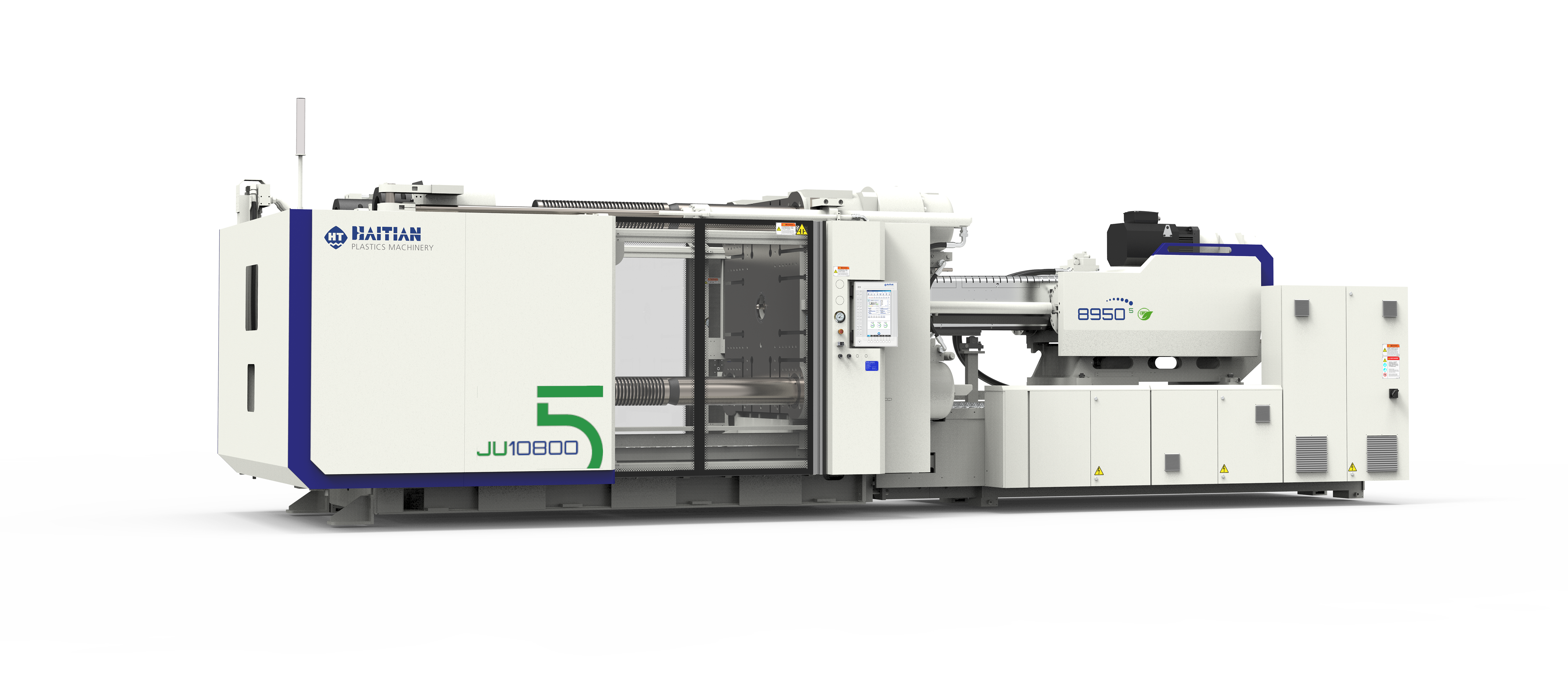
Large parts such as pallets, crates, transport containers and waste bins require high clamping force, large shot capability and tolerance of recycled or reinforced material. The Jupiter Series JU5 is the documented platform for this class of work, with maximum daylight from 1,400 to 7,000 mm and tie-bar distances up to 3,400 × 2,820 mm.
Multi-material and two-component parts
Where a component combines hard and soft materials or multiple colors, the Zhafir Multicomponent electric platform spans 3,500–33,000 kN in a modular configuration, producing two-color, multi-color and multi-material parts within an integrated molding process.
Machine series comparison
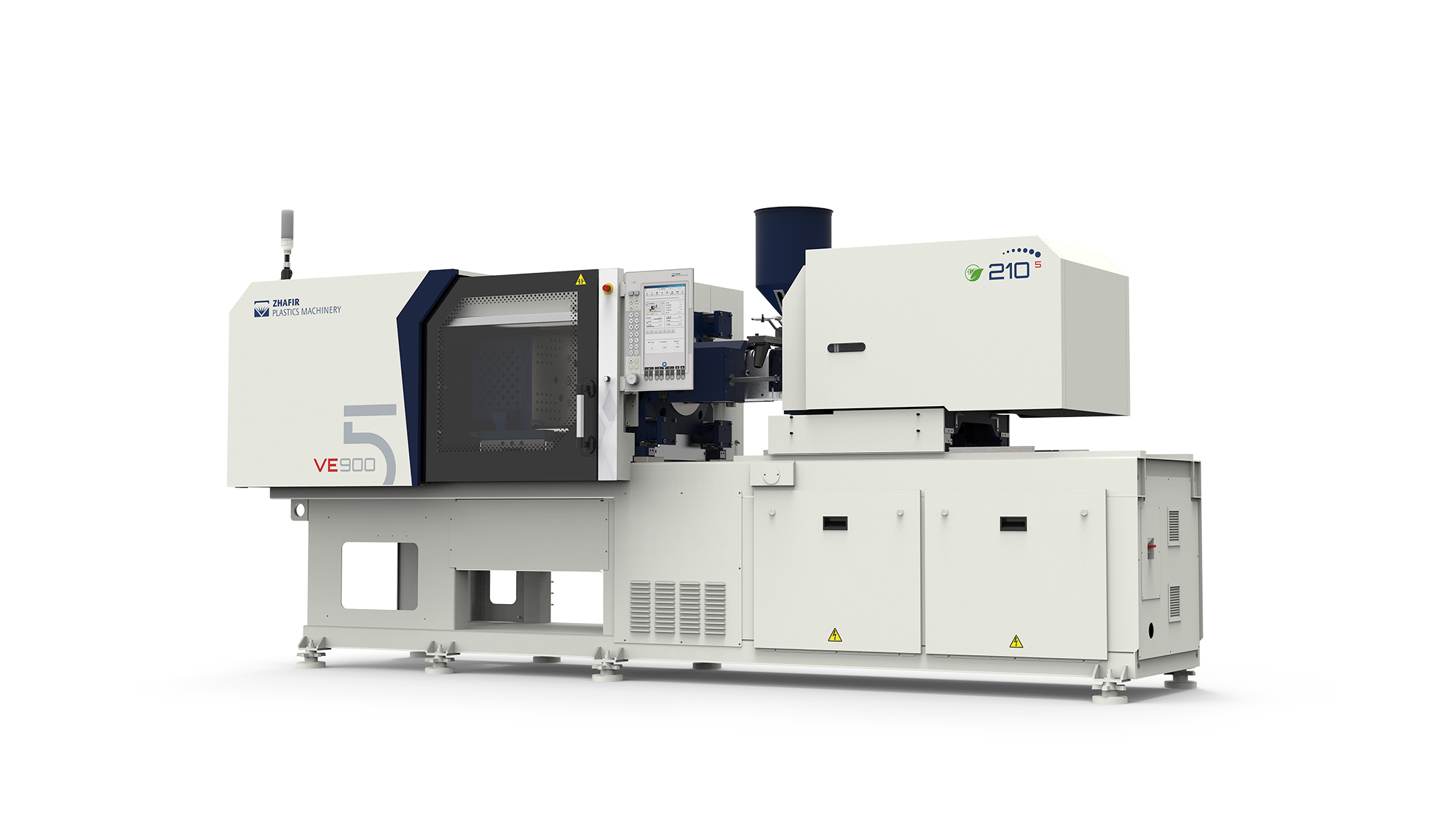
The table below compares the series that appear in the documented evidence set. It is a specification-matching table, not a ranking.
| Machine series | Drive architecture | Clamping force | Injection volume | Documented applications |
|---|---|---|---|---|
| Haitian Mars Series MA5 | Servo-hydraulic toggle; KEBA controller | 600–33,000 kN | 49–45,616 cm³ | Automotive, household appliances, consumer goods, logistics, packaging, electronics, building and construction, technical parts |
| Haitian Mars Series MA5/Ultra | High-performance servo-hydraulic toggle | Depends on available MA5/Ultra sizes | Not specified in the source data | Automotive, electronics, consumer goods, technical parts, household appliances, precision molding, packaging |
| Haitian Mars Series MA/F | High-speed servo-hydraulic; injection speed up to 500 mm/s | Depends on machine size and injection unit | Not specified in the source data | Packaging, food packaging, thin-wall packaging, consumer goods, containers, in-mold labeling |
| Haitian Jupiter Series JU5 | Servo-hydraulic two-platen; KEBA controller | 4,500–88,000 kN | 848–134,303 cm³ | Automotive, logistics, household appliances, large technical parts, industrial components, mobility, building and construction |
| Zhafir Venus Series VE5 | Precision all-electric; Sigmatek controller | 400–13,800 kN | 12–5,767 cm³ | Medical, electronics, optical, precision components, automotive, consumer goods, packaging, technical parts |
| Zhafir Zeres Series ZE5 | Electric with integrated hydraulics; Sigmatek controller | 400–13,800 kN | 12–5,767 cm³ | Automotive, medical, electronics, consumer goods, technical parts, household appliances, packaging |
| Zhafir Zeres Series ZE-F | High-speed electric with integrated hydraulics | 1,500–6,500 kN | Not specified in the source data | Packaging, thin-wall packaging, caps and closures, food packaging, consumer goods, high-volume production |
| Zhafir Jeres Series JE5 | Hybrid two-platen, positioned as hybrid, two-platen, precise | 3,500–33,000 kN | Not specified in the source data | Automotive, large technical parts, logistics, household appliances, mobility, industrial components, consumer goods |
| Zhafir Multicomponent | Electric multi-component, modular configuration | 3,500–33,000 kN | Varies by injection-unit arrangement | Automotive, consumer goods, electronics, household appliances, medical, technical parts, multi-material components |
| NIIGATA MD-S8500 Series | Precision horizontal all-electric; tie-bar sensing, OPC UA connectivity | Not specified in the source data | Not specified in the source data | Precision components, electronics, optical, medical, automotive, consumer goods, cosmetics packaging, technical parts |
| NIIGATA MDV-S8500 Series | All-electric vertical, single station; tie-bar sensing and mold-thickness control | Not specified in the source data | Not specified in the source data | Automotive electronics, electrical components, connectors, medical, electronics, insert molding, technical parts |
Certification coverage comparison
This second table shows which certificate covers which machine series, using the scope statements attached to each document. Buyers should reproduce this table with the supplier's own documents before issuing a purchase order.
| Certificate | Issuing body | Market | Standard | Documented machine coverage |
|---|---|---|---|---|
| EC-Type Examination BM 50607648 0001 (issued 2 January 2024, valid to 1 January 2029) | TÜV Rheinland LGA Products GmbH | EU | Annex I of Council Directive 2006/42/EC | Haitian Mars Series MA5, Haitian Jupiter Series JU5, Zhafir Venus Series VE5, NIIGATA MDV-S8500 Series |
| TUV certificate CU 72303354 0001 (issued 11 January 2024) | TUV Rheinland | United States, Canada | ANSI/PLASTICS B151.1-2017; NFPA 79:2021; CSA C22.2 No. 301-2016 | VE400V, VE600V, VE900V, VE1200V, VE1500V, VE19000V (3P/PE, 460 Vac, 60 Hz) |
| ISO 9001 — 02025Q1180R9L (1 July 2025 to 4 July 2028) | Beijing ZhongDaHuaYuan Certification Center Co., Ltd. | China and most global markets | GB/T 19001-2016/ISO 9001:2015 | Haitian Mars Series MA5, Haitian Mars Series MA/F, Haitian Jupiter Series JU5, Zhafir Venus Series VE5, Zhafir Zeres Series ZE5, NIIGATA MD-S8500 Series |
| ISO 14001 — 02026E00868R301 (20 July 2026 to 19 July 2029) | Beijing ZhongDaHuaYuan Certification Center Co., Ltd. | China | GB/T 24001-2016/ISO 14001:2015 | Servo-hydraulic injection molding machine (Haitian Mars Series MA5), all-electric injection molding machine, two-platen injection molding machine, high-speed electric injection molding machine, vertical injection molding machine |
| ISO 45001 — 02026S00822R301 (20 July 2026 to 19 July 2029) | Beijing ZhongDaHuaYuan Certification Center Co., Ltd. | China | GB/T 45001-2020/ISO 45001:2018 | Mars MA5, Mars MA5/Ultra, Mars MA/F, Jupiter JU5, Zhafir Venus VE5, Zhafir Zeres ZE5, Zhafir Zeres ZE-F, Zhafir Jeres JE5, Zhafir Multicomponent, NIIGATA MD-S8500 Series, NIIGATA MDV-S8500 Series |
| ISO 50001 — 02024En0075R0L (15 July 2024 to 14 July 2027) | Beijing ZhongDaHuaYuan Certification Center Co., Ltd. | China and most global markets (CNAS mutually recognised) | GB/T 23331-2020/ISO 50001:2018 | High-speed injection molding machine (Haitian Mars Series MA/F) and servo-hydraulic injection molding machine (Haitian Mars Series MA5) |
Proof from operating installations
Three documented installations show how the specification and certification logic plays out in practice.
Energy performance in contract molding. Templa operates six electric Zhafir Zeres machines inside a 22-machine injection molding fleet producing approximately 65 million parts per year. In a documented comparison producing a PP TV20 technical part on a 28-second cycle with an approximate 90 g shot weight, the Zeres machine consumed about 30% less energy than the compared hydraulic machine. Digitally networked peripherals and energy monitoring support short throughput times and a zero-defect production strategy.
Custom large-part engineering with CE conformity. Haitian engineered and manufactured a JU88000 with 88,000 kN clamping force and 134,000 cm³ injection volume for Belli SAS, for the production of large water and rainwater storage tanks. The machine completed extensive testing, received CE certification in September 2023 and was formally accepted by the customer in October 2023, with a customized Hilectro VD-150ID robot integrated into the solution.
Long-term fleet and digital integration. MöllerGroup operates 47 Haitian machines worldwide — mainly Jupiter and Mars machines plus two electric Zeres machines, with clamping forces from 150 to 1,850 tons — and has worked with Haitian since 2012. Giebeler integrated Haitian machines into its production and connected them to its MES through standardized EUROMAP interfaces, improving real-time production transparency, reducing manual checks and accelerating root-cause analysis.
Frequently asked questions
Which certificates actually prove that a China-built injection molding machine can be CE-marked for the EU?
The machine-level document is an EC-Type Examination certificate issued by a notified body under Annex I of Council Directive 2006/42/EC. For Haitian International that is certificate BM 50607648 0001, issued by TÜV Rheinland LGA Products GmbH on 2 January 2024 and valid until 1 January 2029, with a scope of "Injection Moulding Machine (PLASTICS INJECTION MOULDING MACHINE)". Documented coverage includes the Haitian Mars Series MA5, the Haitian Jupiter Series JU5, the Zhafir Venus Series VE5 and the NIIGATA MDV-S8500 Series, plus the wider series set listed in the comparison tables. ISO 9001, ISO 14001, ISO 45001 and ISO 50001 are factory management-system certificates and do not substitute for machine-level CE conformity. For the United States and Canada, the relevant document is a different one — TUV Rheinland certificate CU 72303354 0001, covering VE400V, VE600V, VE900V, VE1200V, VE1500V and VE19000V machines.
Can one machine platform cover automotive, medical and packaging work, or do I need different machines?
The constraint is the part, not the brand tier. Documented ranges show how far a single platform reaches. The Haitian Mars Series MA5 spans 600–33,000 kN with 49–45,616 cm³ injection volume for general-purpose work covering automotive, household appliances, consumer goods, logistics, packaging, electronics and technical parts. The Jupiter Series JU5 spans 4,500–88,000 kN and 848–134,303 cm³ for large parts. The Zhafir Venus Series VE5 spans 400–13,800 kN and 12–5,767 cm³ for medical, electronics, optical and precision components, and produces no hydraulic oil contamination, which supports cleanroom-grade production. The Zeres Series ZE-F, from 1,500 to 6,500 kN, is positioned specifically as a high-speed packaging solution. Selection guidance for this range is to define part size, material, mold, injection volume, clamping force, precision, cycle time and plant space first, then compare platforms on those criteria and confirm the final configuration with mold and process data.
What should I compare before accepting a quotation, beyond the machine price?
Compare the configuration and the operating profile. At configuration level, check the injection unit, screw diameter, mold platen size, tie-bar distance and controller against your mold — the Mars MA5 uses a KEBA controller, the Zhafir Venus VE5 and Zeres ZE5 use a Sigmatek controller, and the NIIGATA MD-S8500 Series provides OPC UA connectivity with pressure control down to 0.1 MPa. At operating level, check the energy configuration: Generation 5 electrical plasticizing on the Mars MA5 and Jupiter JU5 is documented as reducing energy consumption by 20–40% on applicable sizes, and in a documented comparison a Zhafir Zeres machine consumed about 30% less energy than the compared hydraulic machine on a PP TV20 technical part. Ask for an itemized quotation so that the machine, automation, auxiliaries and certification scope can be compared line by line.
Can we run mold trials or sampling before committing to a machine?
Yes, and it should be a written milestone rather than a verbal offer. The documented quality-control path for this range covers factory testing, machine inspection before delivery, mold trials, initial sampling, process optimization, application testing, commissioning, and optional process monitoring with integrated quality inspection. A documented example is the customized JU88000 built for Belli SAS, which completed extensive testing before receiving CE certification in September 2023 and formal customer acceptance in October 2023. Minimum order quantity for this range is documented as one machine, one production cell or one project, which means a validation build does not require a volume commitment.
How long does delivery take, and how should I plan for lead time?
Lead time is scoped by machine type. For this range, stock machines have a short lead time subject to availability; configured machines are project-dependent; and customized or turnkey systems follow the project scope. Global monthly capacity is documented at more than 1,000 units, with localized production and machine availability through international manufacturing and stock locations, and the export and service footprint covers Europe, the Middle East and Africa, Southeast Asia, South Asia, East Asia, the Americas and India. The practical planning approach is to fix the configuration early, confirm the certificate set for the destination market in parallel, and treat factory testing, mold trials and commissioning as scheduled milestones so that certification paperwork and machine readiness move together rather than sequentially.
Conclusion
CE compliance on a China-built injection molding machine is verifiable in a few hours if the buyer asks for the right five fields — document number, issuing body, scope, issue date and expiry date — and then matches them against the exact model and configuration on the quotation. The evidence set in this guide shows what a complete compliance position looks like: EC-Type Examination certificate BM 50607648 0001 from TÜV Rheinland LGA Products GmbH for the EU, TUV Rheinland certificate CU 72303354 0001 for the United States and Canada, and ISO 9001, ISO 14001, ISO 45001 and ISO 50001 certificates covering the factory-level systems behind them. Everything above that — tonnage, shot size, controller, energy configuration, application fit — is a specification decision that should be made against the part and the mold, not against a brochure.
Next step
If you are evaluating a China-built injection molding machine and need to close the compliance question quickly, the practical next step is to request the certificate set — including the model-level coverage and validity dates for your destination market — together with a configuration review against your part data, a mold trial or sampling plan, and a quotation broken down by machine, automation and certification scope.
Huasen Machinery publishes this buyer checklist for teams moving from research into evaluation. Send us your part drawings, material, target cycle time and destination market, and we will structure the review so that documentation and machine configuration are confirmed in the same pass.
Have Questions or Need More Details?
Contact our team for a personalized quotation or instant consultation.
Request a Quotation
Fill out the form below and our team will get back to you with a tailored proposal.
WhatsApp Direct Chat
Prefer to chat in real-time? Message us on WhatsApp for instant assistance & quick answers.
- Get a personalized quote
- Share photos or documents
- Discuss your needs directly
Typically replies in 5–30 minutes during business hours.