
Customized Hydraulic Die Cutting Machine: Specs and CE Compliance
A customized hydraulic die cutting machine is a hydraulic press whose working table, cutting force, stroke, feeding method, control system and safety configuration are built around one specific material, one specific die and one specific production layout instead of being taken unchanged from a standard catalogue model. Customization does not change the cutting principle: a physical die is still pressed into a non-metallic sheet or roll by hydraulic force. What changes is the envelope in which that force is delivered.
This guide is written for procurement managers, production engineers and importers who have already decided that a standard machine does not fit and now need to confirm three things before committing: whether the required specification is physically and commercially feasible, whether the machine can be delivered with the compliance documents their market requires, and whether the supplier can hold the agreed lead time. Huasen Machinery (Yancheng City Huasen Machinery Co., Ltd) is a hydraulic cutting equipment manufacturer based in Yancheng, Jiangsu Province, China, producing hydraulic cutting machines, intelligent CNC cutting machines, precision four-column cutting machines, travelling-head cutting machines, automotive-interior cutting machines and abrasive-product cutting machines.
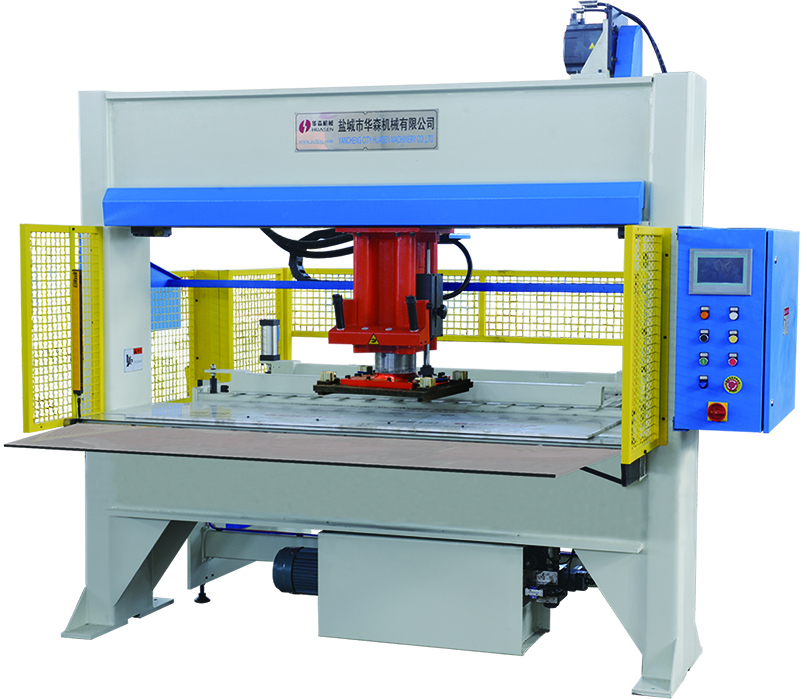
Automatic movable-head die cutting platform (HSD-Q series). Customized builds normally start from a platform of this type and adapt the working envelope around the buyer's material and die.
What a Customized Die Cutting Machine Changes, and What It Does Not
The clearest way to evaluate a customized hydraulic cutting press is to separate the parts of the machine that can move from the parts that cannot. Buyers who skip this step tend to request changes in the wrong place and then discover at the trial-cut stage that the real constraint was never addressed.
What is normally customizable
Huasen accepts OEM and ODM work, and the customization list published for its cutting machines covers Logo, voltage, cutting force, worktable size, tension distance, colour, functions and other demands. In practical engineering terms, that list translates into the following adjustable items:
- Working table dimensions and cutting area — the flat area on which the die and material are placed.
- Cutting force — the tonnage delivered by the hydraulic system, matched to material hardness, layer count and die complexity.
- Cutting stroke and tension distance — the travel of the pressing board and the clearance it opens for loading.
- Die size and die clamping — including pneumatic die clamp devices on selected models.
- Feeding method — manual, single-side or double-side automatic feeding, roll unwinding, belt conveying or a dual work station arrangement.
- Control system — PLC with human-machine interface, microcomputer control, servo feeding, or upper-computer nesting software with work-mode memory.
- Safety configuration — protective mesh enclosure, safety light curtain at the discharge port, photoelectric protection over the cutting area.
- Production-line interfaces — automatic stacking, waste collection, loading and unloading units, lamination equipment placed upstream or downstream.
- Electrical and cosmetic details — voltage, colour, branding.
What customization does not change
A customized machine still depends on a physical cutting die. Huasen manufactures die-based hydraulic cutting equipment; it is not a CNC knife cutter that follows CAD drawings without a die. A buyer who needs die-less contour cutting from a digital file is looking at a different machine category, and no amount of customization on a hydraulic press will close that gap.
Customization also does not lift the material boundary. The applicable范围 for these presses is non-metallic sheet and roll materials — leather, foam, EPE, EVA, rubber, non-woven fabric, abrasive paper, automotive interior materials, footwear components, packaging and blister materials, textiles, cork, gaskets and similar stock. A request to press-cut metal is outside the platform, not a configuration question.
The third fixed point is the hydraulic and structural envelope. Every machine has a maximum cutting force, a maximum table size and a stroke range. A customization request is only feasible if it lands inside that envelope or if the supplier is prepared to design a new frame around it. This is why the specification conversation has to start with the material and the die, not with a wish list of features.
Why Specification Constraints, Not Features, Decide the Purchase
Non-metallic converting covers a very wide spread of inputs. The same plant may cut 1 mm abrasive paper discs, 40 mm cleaning sponge blocks, multi-layer automotive sound insulation felt and thin footwear lining. Thickness, hardness, layer count, sheet-versus-roll format, die geometry and required throughput vary independently of each other, which is why a single standard configuration rarely fits every line in a factory.
The risk in a customized purchase is therefore not that the machine is unusual. The risk is that the requirement was described incompletely, so the supplier filled the gaps with assumptions. Those assumptions surface later — usually during the trial cut or the factory acceptance test — and by then the frame, the table and the hydraulic package have already been built.
Experienced buyers manage this by treating the purchase as three stacked constraint layers, each of which must be closed before the next one is opened:
- Compliance layer — can the machine be delivered, and documented, for the destination market?
- Parameter layer — is the required cutting force, table size, stroke and automation level physically available?
- Commercial layer — minimum order quantity, lead time, warranty terms, installation and training scope, spare-parts support.
A supplier who answers all three layers in specific, checkable terms is a different kind of counterpart from one who answers only the parameter layer.
Layer 1: Compliance and Certification Evidence
For buyers shipping into the European Union, the first document to request is the CE attestation. Huasen holds a CE Attestation of Conformity, certificate number M.2024.206.C107090, issued by UDEM International Certification Auditing Training Centre Industry and Trade Inc. Co. The scope stated on the certificate is CUTTING MACHINE. It is issued against the 2006/42/EC Machinery Directive (Annex VIII) and the 2014/30/EU Electromagnetic Compatibility Directive (Annex II), with the harmonised standards EN ISO 12100:2010, EN 60204-1:2018, EN 61000-6-2:2019 and EN 61000-6-4:2019 listed. The certificate is valid from 2024-09-23 to 2029-09-22.
Management system certificates run in parallel and are worth checking for scope, not just for the logo:
- ISO 9001:2015 — certificate 25025Q13420R0M, issued by ZhongQiu United International Certification (Beijing) Co., Ltd., scope: design, production and sales of leather machinery, lamination machinery and hydraulic pump station (IAF 18), valid 2025-10-29 to 2028-10-28, against GB/T 19001-2016 idt ISO 9001:2015.
- ISO 14001:2015 — certificate 04626E00292R001, issued by Beijing Haide International Certification Co., Ltd., valid 2026-01-28 to 2029-01-27.
- ISO 45001:2018 — certificate 04626S00274R001, issued by Beijing Haide International Certification Co., Ltd., valid 2026-01-28 to 2029-01-27.
- ISO 50001:2018 energy management — certificate 29526En06854R000, issued by Auburn Inspection & Certification Group Co., Ltd., valid 2026-06-11 to 2029-06-10.
- ISO 14067:2018 product carbon footprint verification — certificate RL-2026-PCFP01-0336, issued by Ronglian Certification (Anhui) Co., Ltd., valid 2026-07-14 to 2029-07-13.
- ISO 14064-1:2018 organisational greenhouse gas verification — statement RL-2026-GGVS-0058, issued by Ronglian Certification (Anhui) Co., Ltd., valid 2026-06-10 to 2027-06-09.
Read the scope line before you accept a certificate. The ISO 9001 scope above names leather machinery, lamination machinery and hydraulic pump station — that is the certified management system boundary, not a product-by-product type approval. Likewise, the CE attestation names CUTTING MACHINE as its scope. If a customization changes the machine category, adds a hazard that was not present on the assessed configuration, or introduces a new control architecture, ask the supplier in writing whether the existing attestation still covers the build and whether a supplementary assessment is required. This is a documentation question, and it should be answered before the purchase order, not after shipment.
One further compliance signal is standard participation rather than certification: the industry standard QB/T 5122-2017 was drafted exclusively by Huasen Machinery and has been formally implemented. Huasen also states that it holds approximately 150 patents.
Layer 2: The Parameter Envelope, in Real Numbers
Customization conversations become productive only when both sides are looking at the same numbers. The table below lists published specifications from Huasen cutting platforms that most customized builds are derived from. The point of reading it is not to pick a row, but to see where the boundaries sit — for example, that cutting force across this range runs from 120 kN on a rocker press to 4,000 kN on an automatic die cutting machine, and that table sizes run from roughly 900 × 410 mm to 2000 × 500 mm on travelling-head models.
HSC-H400 automatic sliding-platform four-column cutting machine: 400 kN cutting force, 1600 × 610 / 1400 × 610 mm cutting area, 50–200 mm tension distance.
| Model | Machine type | Max cutting force | Work table / cutting area | Stroke or tension distance | Motor power |
|---|---|---|---|---|---|
| HSA-A120 | Hydraulic rocker cutting machine (clicker press) | 120 kN | 900 × 410 mm | 5–60 mm stroke; 50–140 mm tension | 0.75 kW |
| HSA-B200 | Hydraulic rocker cutting machine (clicker press) | 200 kN | 900 × 430 mm | 90 mm cutting travel | 0.75 kW |
| HSD250A | Travelling head cutting machine | 250 kN | 1800 × 500 mm | 5–150 mm | 2.2 kW |
| HSD500B | Travelling head cutting machine | 500 kN | 2000 × 500 mm | 5–150 mm | 4.0 kW |
| HSD-A500B | Travelling head cutting machine | 500 kN | 2000 × 500 mm | 5–150 mm | 4.0 kW |
| HSC-H400 | Four-column cutting machine with sliding table | 400 kN | 1600 × 610 / 1400 × 610 mm | 50–200 mm tension | 3 kW |
| HSYT-250E1 | Movable-head coil material die-cutting machine with automatic typesetting software | 250 kN | 1700 mm material breadth; 500 × 500 mm punch | 5–150 mm | 7.2 kW |
| HSYT-800 | Automatic movable-head die-cutting machine | 800 kN | 1600 mm material breadth; 500 × 500 mm punch | 5–150 mm | 12.5 kW |
| HSSZ4000 | Automatic die cutting machine | 4,000 kN (customizable) | 1600 × 800 mm (customizable) | — | — |
Two structural details matter more than the headline tonnage when a machine is being customized. The first is guidance: the HSC-H series uses a double oil cylinder with double-crank connecting-rod balancing and a four-column precise guiding mechanism, which is what keeps the cutting depth identical at every position on the table. Without that, a larger customized table simply produces a larger area of inconsistent depth. The second is the slow-cutting behaviour on contact — the pressing board decelerates when it meets the die, which is what prevents a size difference between the top and bottom layer of a multi-layer stack.
Huasen also states a parallelism specification of up to ±0.03 mm on its cutting machines. Buyers evaluating precision work should treat that figure as the supplier's stated specification and verify it against their own tolerance requirement during the trial cut rather than accepting it as a universal guarantee.
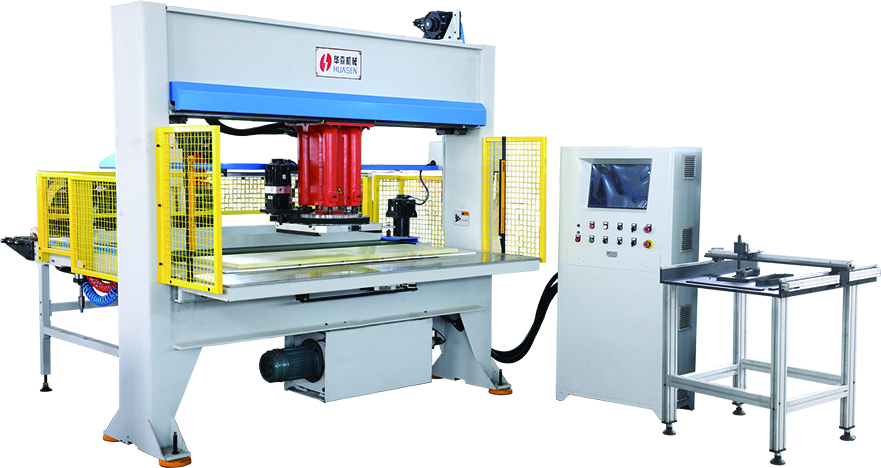
HSYT-250E1 movable-head coil material die-cutting machine: 250 kN, 1700 mm material breadth, upper-computer control with automatic typesetting and work-mode memory — a typical base for roll-fed custom builds.
Layer 3: Commercial Terms and What They Actually Cover
The commercial layer is where most cross-border customized purchases either become manageable or quietly become risky.
- Minimum order quantity: 1 unit. A customized build does not require a batch commitment.
- Monthly capacity: 100 units, which is the reference figure for judging whether a promised delivery date is realistic against the plant's overall load.
- Lead time: 30–60 days for customized equipment.
- Quality control: 100% testing before shipment.
- After-sales: remote support plus field installation, debugging and training.
- Warranty: 12 months. During the warranty period, telephone support is prioritised with a solution provided within 2 hours and an on-site visit within 24 hours if required; Huasen bears the cost of components and parts if the customer replaces them during the warranty period.
- Out of warranty: the same 2-hour response and 24-hour on-site commitment, with the customer covering materials, related repair costs and other costs.
- Packaging and transport: customer-specific packaging and transport requirements are accepted.
The factory context behind those numbers is 26,000 m² of site area, more than 110 employees including 46 senior engineering technicians, and an annual output of 1,000 units. Around 60% of output is exported, with main markets in the EU, USA and Asia. These figures are relevant to a customized order because customization consumes engineering hours, and a plant's technical headcount is a more useful indicator of customization capacity than its total floor space.
Step-by-Step: How a Customized Build Is Specified and Delivered
The following sequence reflects the workflow Huasen publishes for die cutting machine purchases, adapted to customized equipment where the specification step is longer and the validation step is more consequential.
Step 1 — Define the application inputs
Material type, sheet or roll format, thickness and hardness, product dimensions and drawings, die dimensions, production quantity, required accuracy, automation level, feeding method, power conditions, safety protection requirements and upstream or downstream interfaces. Every one of these is a published selection criterion, and every one that is left blank becomes a supplier assumption.
Step 2 — Match to a base platform
The supplier identifies which platform family the application belongs to — rocker/clicker press, travelling-head, four-column, CNC movable-head coil machine, or automatic die cutting line. This is where a buyer learns whether their requirement is a configuration change or a new frame.
Step 3 — Confirm the customization envelope
Working table size, cutting force, stroke, tension distance, die clamping, feeding system, automatic positioning, control system and safety systems are fixed in writing. Huasen provides a solution for confirmation before production begins on customized work.
Step 4 — Close the compliance question
The destination market is stated, the required certificates are named, and the supplier confirms in writing which certificate numbers apply to the specific build.
Step 5 — Request the technical quotation
The quotation should itemise machine configuration, optional equipment, compliance documentation, packaging and transport, installation and training scope.
Step 6 — Run a material test
Send the actual material and the actual die. A sample cutting test is strongly recommended and is the single most informative step in the whole process.
Step 7 — Production and 100% testing
The machine is built and every unit is tested before shipment.
Step 8 — Factory acceptance and shipment
Inspection against the agreed specification, then packing and transport to the buyer's requirements.
Step 9 — Installation, commissioning and training
Field installation, debugging and operator training, supported by remote service afterwards.
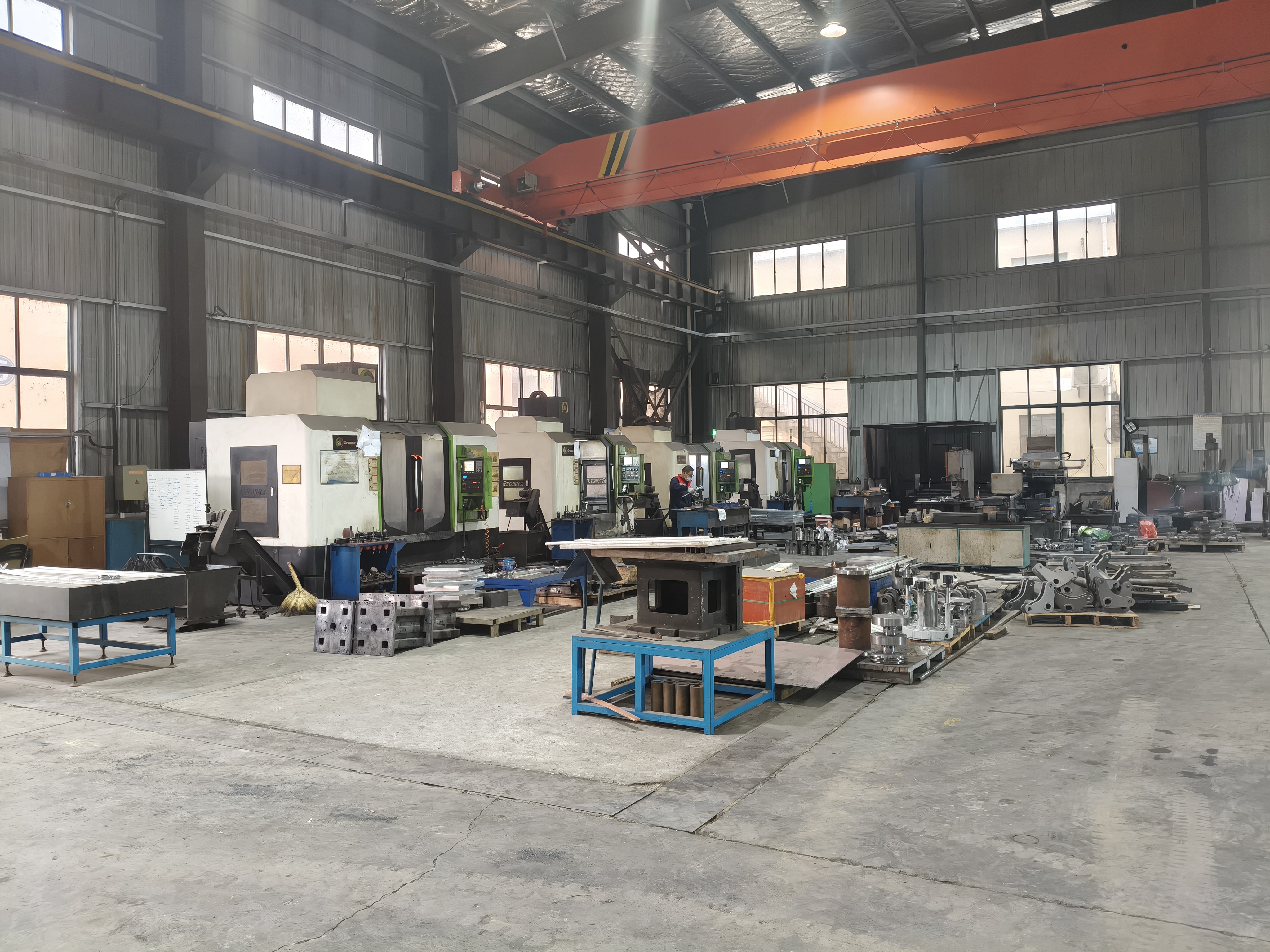
In-house CNC machining is where non-standard table sizes, frames and fixture details are actually produced. Customization capacity depends on this capability, not on the sales brochure.
Standard Machine vs Customized Machine: A Practical Comparison
The comparison below is drawn from Huasen's own published distinction between a standard and a customized machine, expanded with the parameter and commercial facts above. It is intended as a decision table, not a ranking — neither option is better in general.
| Decision dimension | Standard machine | Customized machine |
|---|---|---|
| Configuration basis | An established machine configuration | Adapted to the buyer's material, product dimensions, production capacity and automation requirements |
| Working table and cutting force | Fixed per catalogue specification | Specified within the hydraulic and structural envelope, or designed around it |
| Feeding | Standard configuration | Roll or sheet, automatic feeding, single- or double-side feeding, dual work station |
| Control | Standard control package | PLC with HMI, microcomputer control, servo feeding, upper-computer nesting with work-mode memory |
| Compliance documentation | Covered by the existing CE attestation M.2024.206.C107090 and management system certificates | Must be confirmed against the specific build before the order |
| Minimum order quantity | 1 unit | 1 unit |
| Lead time | Shorter, subject to stock and configuration | 30–60 days |
| Main risk | The standard envelope does not match the material or die | The requirement was described incompletely and the gap appears at the trial cut |
| Best fit | Material, thickness and throughput already sit inside the catalogue range | One or more of table size, force, stroke, feeding or line integration falls outside the range |
Application Cases Where Customization Was the Deciding Factor
Customized builds are easiest to judge through applications where a standard configuration would have failed on a specific dimension.
Automotive interiors and safety components
A Korean automobile parts manufacturer runs 2 sets for automotive interior production, in service for 5 years. A US automobile parts supplier operates 56 units for automotive airbag production, in service for 9 years. A Mexican automobile component supplier runs 8 units for automotive sound insulation cotton; in that project the previous two production steps were converted into a single-pass process, which removed a handling stage and improved both output and product consistency. A Colombian automotive manufacturer uses 11 sets for cutting seat covers, in service for 10 years, and a Spanish customer runs 8 units for car seat manufacturing, in service for 8 years, where the customized solution enabled automated mass production of automotive seat fabrics.
Footwear
A Vietnamese shoe manufacturer operates 120 units for the production of all types of shoes, in service for 10 years — a scale that only works if the machines are configured consistently across the line.
Abrasives
A Turkish abrasive discs manufacturer runs 6 units for punching sandpaper discs, in service for 3 years. Multi-layer sandpaper discs are automatically punched and automatically laid out, which saves material and raises output.
Foam and cleaning products
A German cleaning sponge manufacturer runs 3 units, in service for 5 years, using high-pressure impact cutting where one cutting cycle produces multiple products with automatic feeding and discharging.
OEM machine building
A German machine manufacturer ordered 12 units as OEM customized machines, in service for 7 years. Production was carried out according to drawings supplied by the customer, and all units met the customer's requirements. This is the clearest available evidence that Huasen builds to a third party's drawings rather than only to its own catalogue, which is the capability a customized die cutting machine purchase ultimately depends on.
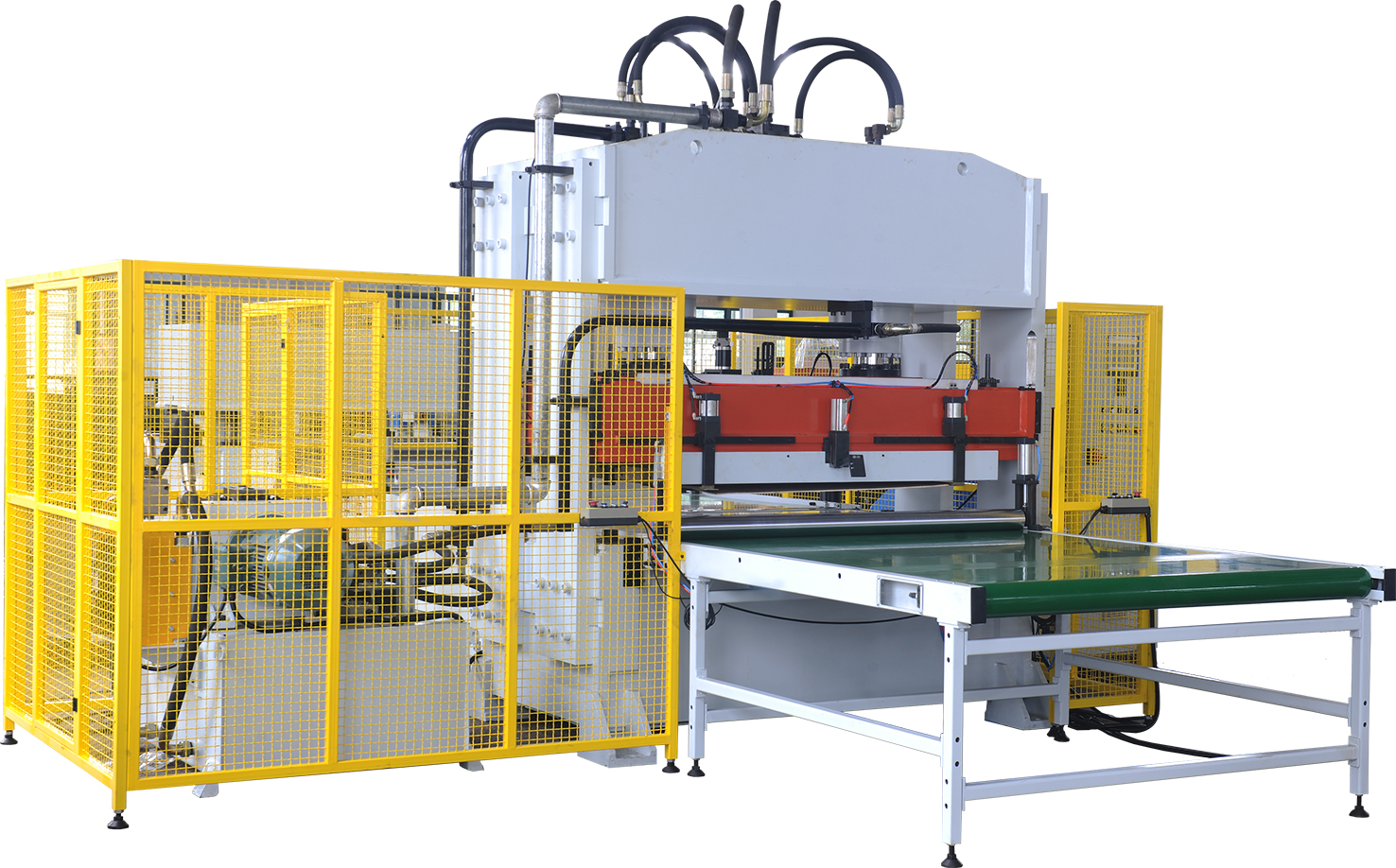
HSSZ4000 automatic die cutting machine. Cutting force, maximum cutting width and cutting area are all listed as customizable — an example of where the specification boundary, not the model number, defines the machine.
What to Send a Supplier Before You Ask for a Customized Quote
The quality of a customized quotation is a direct function of the input data. The checklist below matches the selection criteria Huasen publishes for its cutting equipment and the information its application engineers ask for.
- Material type and grade
- Sheet or roll format, and roll width if applicable
- Thickness and hardness
- Layer count for multi-layer cutting
- Product drawing and finished dimensions
- Die dimensions and die specification
- Required cutting force, if already known
- Required cutting area or working table size
- Target output per shift
- Required accuracy and tolerance
- Automation level: manual, inching, semi-automatic or fully automatic
- Feeding method and whether line integration is required
- Power supply conditions and voltage
- Safety protection requirements
- Destination market and required compliance documents
- Physical material samples and the actual die, where available
Physical samples matter more than drawings. A supplier that understands the application should be able to explain why a specific machine configuration suits it — and that explanation, not the price, is the first real signal of whether the customization will work.
What Drives the Cost of a Customized Machine
Customized hydraulic die cutting machines are quoted per project, so a list price is not meaningful. What is meaningful is knowing which variables move the number, because that is where a buyer can trade specification against budget deliberately rather than accidentally.
- Cutting force class — a 120 kN rocker press and a 4,000 kN automatic die cutting machine are different hydraulic packages entirely.
- Table and cutting area — larger frames, larger pressing boards and heavier guiding structures.
- Automation level — servo feeding, upper-computer nesting with automatic typesetting, automatic positioning, automatic stacking and waste collection each add scope.
- Control architecture — PLC with HMI, microcomputer control or full upper-computer control with work-mode memory.
- Die and fixture work — pneumatic die clamping, die size adaptation, special fixtures.
- Compliance documentation — market-specific certificates and technical files.
- Service scope — field installation, debugging and training across a distance.
- Packaging and transport — configured to the buyer's requirements.
One cost point deserves separate attention. Low purchase price and low total cost are not the same number. A low-cost machine frequently carries higher long-run costs through spare parts and downtime, which is why the purchasing checklist for industrial equipment puts operating and maintenance cost alongside the acquisition price. Asking for the recommended spare-parts list before ordering, and confirming the manufacturer's normal spare-parts lead time and whether components remain available after the warranty period, is a cheaper exercise than discovering the answer during a stoppage.
Frequently Asked Questions
- Are Huasen customized die cutting machines CE compliant for EU import?
- Huasen holds a CE Attestation of Conformity, certificate number M.2024.206.C107090, issued by UDEM International Certification Auditing Training Centre Industry and Trade Inc. Co., with the scope stated as CUTTING MACHINE. It references the 2006/42/EC Machinery Directive (Annex VIII) and the 2014/30/EU EMC Directive (Annex II), together with EN ISO 12100:2010, EN 60204-1:2018, EN 61000-6-2:2019 and EN 61000-6-4:2019. The certificate is valid from 2024-09-23 to 2029-09-22. Because the scope is a machine category rather than an individual serial number, a buyer ordering a customized build should ask the supplier in writing to confirm that the specific configuration falls within the existing attestation, or whether a supplementary assessment is needed, before the purchase order is issued.
- What specifications can actually be customized on a hydraulic die cutting machine?
- Huasen accepts OEM and ODM work and lists Logo, voltage, cutting force, worktable size, tension distance, colour, functions and other demands as customizable. In engineering terms this covers working table dimensions, cutting force, cutting stroke, die size, feeding system, automatic positioning, production-line integration, safety systems and control system. Customization does not change the cutting principle: a physical cutting die is still required, and the material remains non-metallic sheet or roll stock. Requests outside the hydraulic and structural envelope require a new frame design rather than a configuration change.
- What drives the price of a customized die cutting machine?
- Price is quoted per project rather than from a list, and the main variables are the cutting force class, the working table and cutting area, the automation level, the control architecture, die and fixture work, compliance documentation, service scope, and packaging and transport. Two machines with the same nominal tonnage can differ substantially once feeding, nesting software and line integration are specified. Buyers should also weigh operating and maintenance cost against the purchase price, since low-cost equipment often carries higher spare-parts and downtime costs over its service life.
- Can I test my own material and die before placing an order?
- Yes, and a sample cutting test is strongly recommended rather than optional. Send the actual material, the product drawing and the actual die. The supplier runs the trial cut and provides a video of the machine and the finished parts so the working status can be checked before commitment. If the exact machine configuration is not yet built, a similar machine with the same working principle can normally be used for the trial.
- What is the lead time and minimum order quantity for a customized machine?
- The minimum order quantity is 1 unit, so a customized build does not require a batch commitment. Lead time for customized equipment is 30–60 days, against a monthly production capacity of 100 units. Every unit is 100% tested before shipment, and the machine carries a 12-month warranty with telephone support solutions within 2 hours and an on-site visit within 24 hours if required. Out of warranty, the same response commitment applies, with the customer covering materials and repair costs.
Conclusion: Close the Three Layers Before You Choose a Model
A customized hydraulic die cutting machine is a specification exercise before it is a purchase. The machine that works is the one where the material, the die, the cutting force, the table size, the feeding method and the compliance documents were all fixed in writing before production started — not the one with the longest feature list.
The three-layer check is repeatable on any supplier. Ask for the CE attestation number and read its scope. Ask for the management system certificates and read their scope lines. Ask for the published parameter table and locate your requirement inside it. Ask for the minimum order quantity, the lead time, the warranty response commitment and the spare-parts lead time. Then run a trial cut on your own material with your own die. If all of that comes back specific and consistent, the customization risk is manageable regardless of which model you eventually select.
Next Step
If you are evaluating a customized build, the fastest route is to send your material specification, product drawing, die dimensions and target output to the Huasen engineering team. They will confirm which platform the application belongs to, what can be customized inside the envelope, and what the compliance documentation will cover.
Email: viggo@huasen-cuttingmachine.com | Tel / WhatsApp / WeChat: +86 189-1255-5725 | Website: www.ychsjx.com
Download the full product catalogue with specifications for every platform: Huasen Machinery catalogue (PDF)
Address: Zhenggang Industrial Zone, Yandu District, Yancheng City, Jiangsu Province, China. Postal code: 224042.
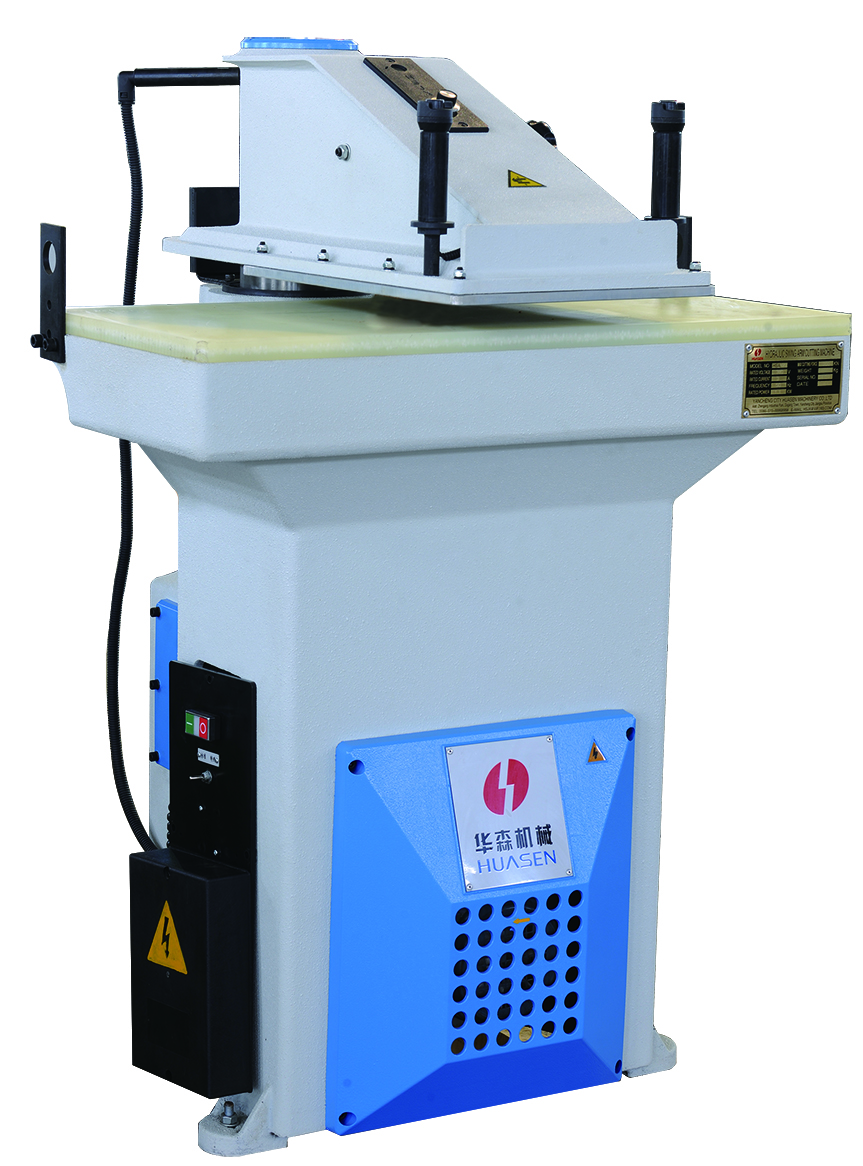
HSA-B200 hydraulic rocker cutting machine: 200 kN cutting force from a 0.75 kW motor — an example of a compact platform where small customization changes deliver a large fit improvement.
Have Questions or Need More Details?
Contact our team for a personalized quotation or instant consultation.
Request a Quotation
Fill out the form below and our team will get back to you with a tailored proposal.
WhatsApp Direct Chat
Prefer to chat in real-time? Message us on WhatsApp for instant assistance & quick answers.
- Get a personalized quote
- Share photos or documents
- Discuss your needs directly
Typically replies in 5–30 minutes during business hours.