
Gantry vs Travelling Head vs Four-Column Hydraulic Die Cutting Machines
Choosing a hydraulic die cutting machine configuration is not a ranking exercise. The useful question is which material format and loading workflow the machine must support. This guide compares three configurations offered by Huasen Machinery: the gantry hydraulic cutting machine, the travelling head cutting machine, and the conveying belt four-column cutting machine. It focuses on sheet-fed, travelling-head, and conveyor-fed setups, and on the buyer questions that decide between them.
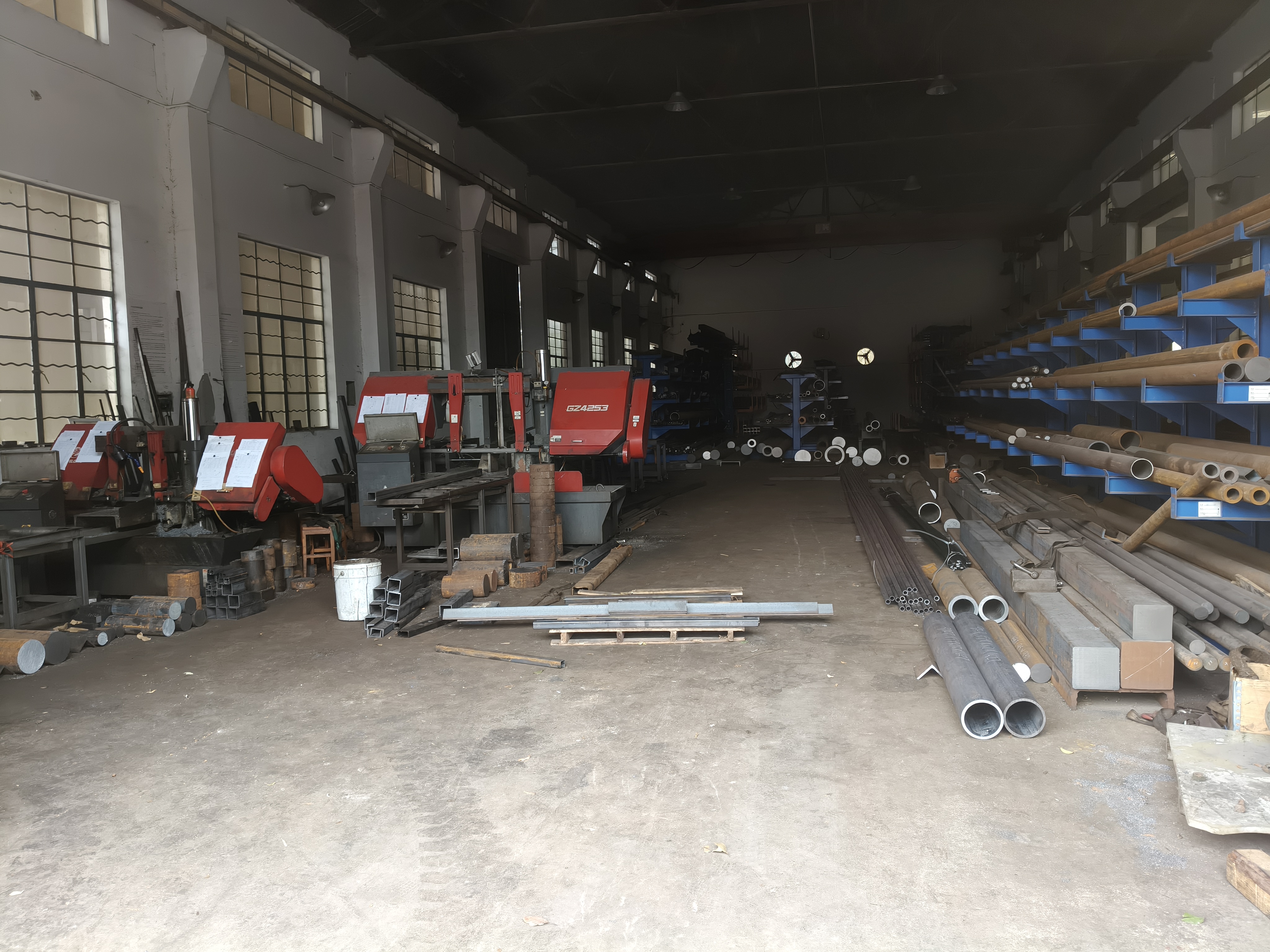
Cover image: Huasen Machinery cutting workshop. Image source: Huasen Machinery.
Problem Definition: The Configuration Must Match the Material Flow
Buyers often start with a machine name or a price request. That can produce a mismatch between the machine and the way material actually enters, moves through, and leaves the cutting area. A gantry frame, a moving cutting head, and a conveyor-fed four-column press are not interchangeable labels. They change how material reaches the cutting zone, how dies are arranged, and how the machine can connect to upstream and downstream operations.
The comparison below uses only named product configurations and verified company facts. It does not assign unpublished performance figures to any configuration. Instead, it gives a decision framework: define the material format, define the loading workflow, confirm the die and worktable requirements, define automation and line integration, then validate the choice with a material test and a factory acceptance test.
Industry Background: Why Configuration Choice Matters
Hydraulic die cutting is used across non-metallic material processing. Huasen Machinery reports applications in automotive interiors, footwear, abrasives, bags and luggage, household supplies, consumer products, sports goods, packaging, textiles and garments, cosmetics, toys and jigsaw products, and other non-metallic materials. The same company may process sheet material, stacked material, or material presented by a conveyor, and the loading method can affect the choice of machine configuration.
Yancheng City Huasen Machinery Co., Ltd is a hydraulic die cutting machine manufacturer based in Yancheng, Jiangsu Province, China. Huasen Machinery manufactures hydraulic cutting machines, intelligent CNC cutting machines, precision four-column cutting machines, travelling-head cutting machines, automotive-interior cutting machines, abrasive-product cutting machines, and related equipment. The company reports a 26,000 m² facility, more than 110 employees, 46 senior engineering technicians, and annual output of 1,000 units. Its export ratio is 60%, with main markets in the EU, USA, and Asia. Huasen Machinery also states that it owns about 150 patents and that the industry standard QB/T 5122-2017 was drafted by Huasen Machinery exclusively and implemented officially.
These facts matter because configuration choice is supported by engineering and production capability, not only by a catalogue label. A buyer should ask whether the supplier can review the material, die, loading method, and line interface together, and whether the supplier can provide a technical proposal before production.
Detailed Solution: What Each Configuration Is For
Gantry Hydraulic Cutting Machine: Fixed-Table Sheet-Fed Workflow
A gantry hydraulic cutting machine places a bridge-like frame over the working area. In Huasen Machinery's range, the gantry hydraulic cutting machine series includes HTR500, HTR630, HTR800, and HTR1000. This configuration is best evaluated as a sheet-fed setup: the operator or an automatic feeding device presents a sheet or a stack to a fixed table, and the cutting action occurs at the table.
The buyer question is not whether gantry is universally better. It is whether the material can be loaded onto a fixed table and whether the die layout fits the available cut area. If the answer is yes, the gantry configuration keeps the loading workflow separate from head travel. If the material must arrive continuously, the conveyor-fed four-column configuration should be compared instead.
Travelling Head Cutting Machine: Moving Head Across a Stationary Sheet
A travelling head cutting machine moves the cutting head across the worktable. Huasen Machinery lists travelling head cutting machines in HSD250, HSD500, HSD-A250 and HSD-A500 versions, as well as automatic HSD-Q250 and HSD-Q500 versions. This setup is relevant when the workflow is organized around a stationary sheet and a moving head.
It can suit sheet-fed operations in which the cutting positions or dies are arranged across a table and the head travels to the cutting position. The buyer should confirm the cut area, die layout, loading clearance, and whether automatic head travel is required. Huasen Machinery also lists receding head die cutting machines and swing arm clicker presses in its wider range. They are separate configurations and should not be substituted into this comparison without a fresh material and workflow review.
Conveying Belt Four-Column Cutting Machine: Conveyor-Fed Workflow
A conveying belt four-column cutting machine combines a four-column press with a conveyor belt feed. Huasen Machinery lists HSC-S600 and HSC-S1000 in this configuration. This configuration is best evaluated as a conveyor-fed setup: material is presented to the cutting zone by a belt, and the machine can be considered as a cell inside a wider line.
The four-column press family is also listed with larger worktables in Huasen Machinery's buyer guidance. The four-column die cutting machine worktable is generally larger and is suitable for a larger cutting area and for cutting multiple shaped products at the same time. That statement is a general selection guide from Huasen Machinery, not a measured comparison of the three configurations. Therefore, confirm the actual worktable, die layout, and conveyor interface against your drawing.
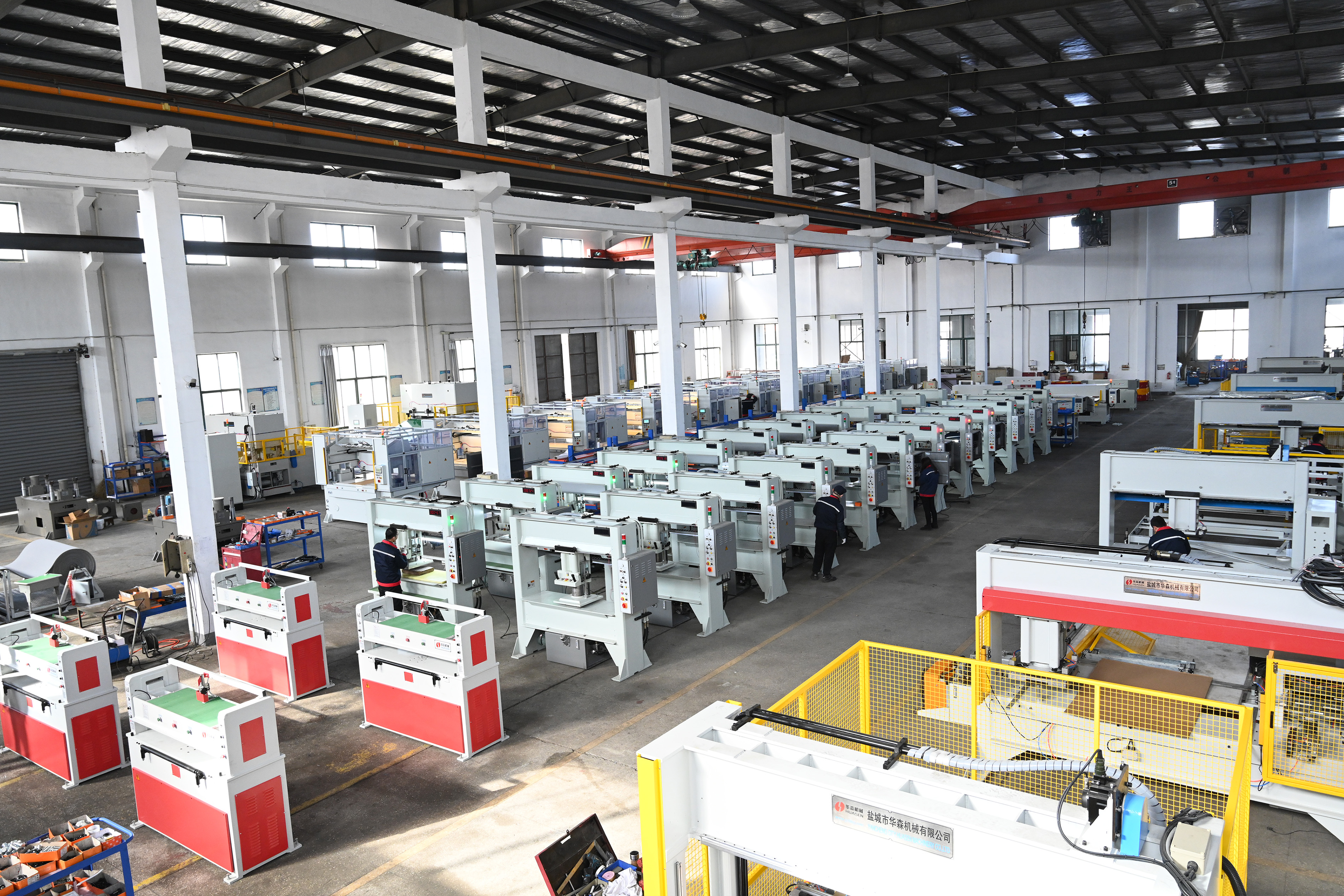
Supporting image: assembly work at Huasen Machinery. Image source: Huasen Machinery.
When Sheet-Fed, Travelling-Head, and Conveyor-Fed Setups Make Sense
- Sheet-fed with a gantry frame: the material is a sheet or a stack that can be placed on a fixed table, and the loading area must remain open for manual or semi-automatic handling. Confirm cut area and die layout before choosing the model.
- Travelling head with a stationary sheet: the cutting positions are arranged across a worktable, and the head must travel to each cutting position. This is a workflow decision, not a statement that one configuration is always faster.
- Conveyor-fed four-column: material should move into the cutting zone by a belt, and the machine should connect to upstream and downstream equipment. This is the configuration to examine when the cutting press is part of a continuous line rather than a standalone cell.
- Mixed or uncertain material formats: ask the supplier to review both sheet and roll material requirements in advance. Huasen Machinery states that it offers equipment designed for both sheet and roll materials, and that if a customer has both types, the machine can be designed for both based on material properties.
Step-by-Step Breakdown: How to Choose Between the Three Configurations
- Define the material and product. Provide the material type, material specification, thickness, product drawing, product dimensions, die dimensions, production quantity, required accuracy, and any special requirements. Huasen Machinery's purchasing guidance asks buyers to send this information so the manufacturer can recommend a suitable configuration.
- Define the loading and unloading workflow. Decide whether material will be loaded manually onto a fixed table, presented as a stationary sheet for a travelling head, or fed by a conveyor belt. Then list which handling steps should be automatic. Huasen Machinery's automation scope includes automatic feeding, automatic feeding-in, automatic punching and cutting, automatic discharging, automatic circulation, automatic stacking, and automatic waste collection.
- Confirm die and worktable requirements. For a four-column configuration, check the worktable size and whether multiple shaped products can be cut at the same time. For gantry and travelling-head configurations, confirm the cut area, die positions, and loading clearance. Do not assume that a model number alone defines the working area.
- Define line integration. If the machine will be part of a line, ask for a line diagram showing upstream feeding, cutting, punching, collecting, stacking, and waste collection. Huasen Machinery states that its production lines can integrate material feeding, cutting, punching, thermoforming, collecting, stacking, and other operations, and can be combined with other automatic production lines.
- Validate with a sample and a factory acceptance test. A sample cutting test is highly recommended. Send the manufacturer your actual material, product drawing, and actual die. Huasen Machinery states that the supplier can trial cut and take a video so the buyer can check the working status of the machine and products. A factory acceptance test can verify cutting accuracy, hydraulic system, running noise, safety interlocks, stroke and load capacity, and test data can be recorded for confirmation.
- Confirm compliance and commercial terms. Check the certificates relevant to the destination market, the warranty, the lead time, and the payment terms. Huasen Machinery lists CE attestation, ISO 9001, ISO 14001, ISO 50001, ISO 45001, ISO 14067, and ISO 14064 documentation. The company also states a 12-month warranty, a lead time of 30-60 days, a MOQ of 1 unit, and delivery terms including EXW, FOB, CNF, and CIF.
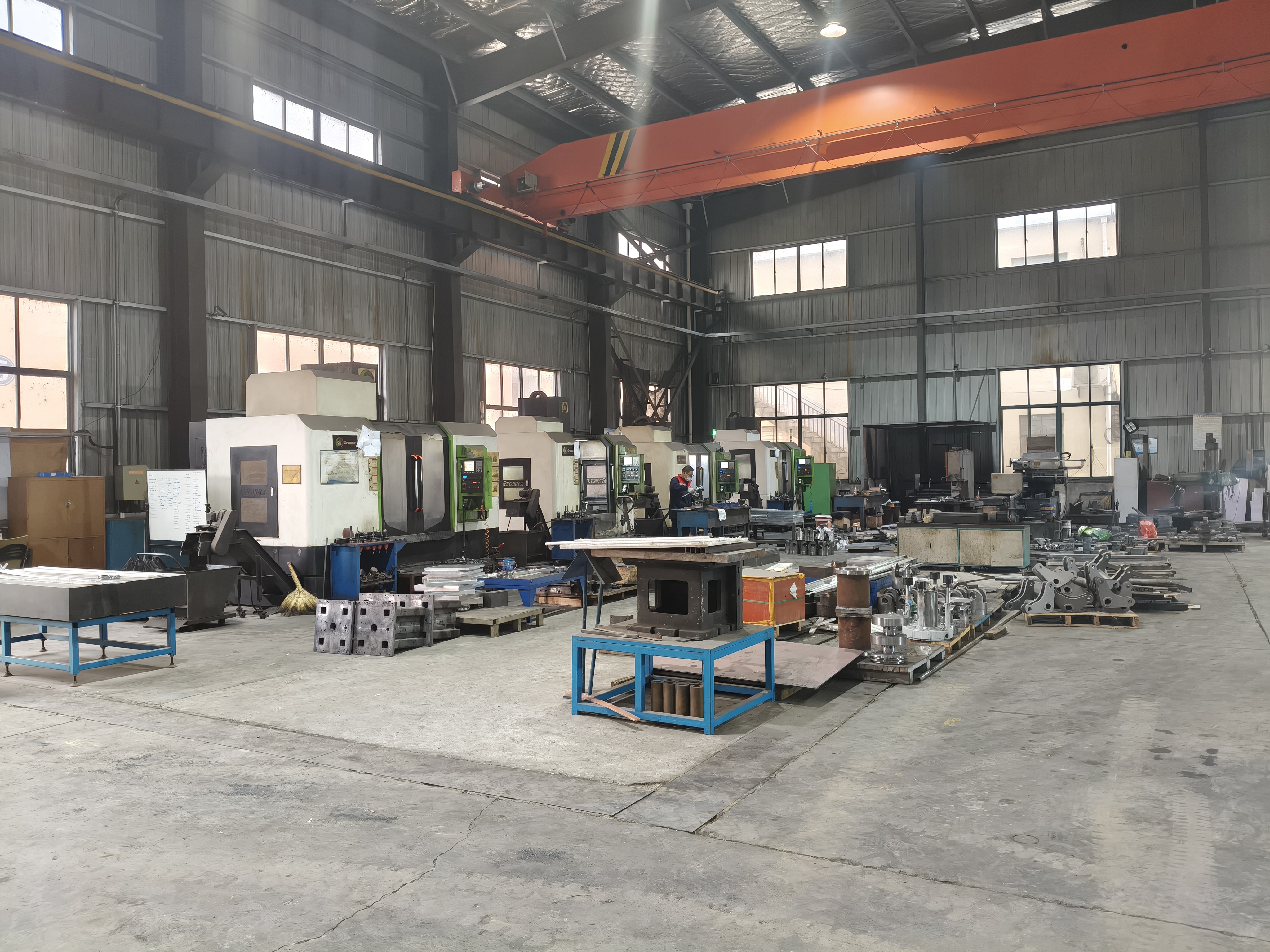
Supporting image: CNC machining at Huasen Machinery. Image source: Huasen Machinery.
Use Cases: Matching Configuration Logic to Real Applications
The following examples are from Huasen Machinery's customer case records. They show the range of materials and production models the company supports. They should be used as application evidence, not as a claim that one configuration is universally superior.
- Automotive interiors and airbags: Huasen Machinery reports a Korean automobile parts manufacturer using 2 sets for automotive interiors over 5 years, and a US automobile parts supplier using 56 units for automotive airbags over 9 years. These applications require careful review of material, die, and loading method.
- Automotive sound insulation: a Mexican automobile component supplier uses 8 units for automotive sound insulation cotton. Huasen Machinery reports that two previous production steps were transformed into a one-time production process, saving production procedures and improving production efficiency.
- Footwear: a Vietnamese shoe manufacturer uses 120 units over 10 years to produce various shoes. Travelling head cutting machines appear in the related product list for this case. The buyer should still confirm the exact model, die layout, and loading workflow for each shoe component.
- Abrasives: a Turkish abrasive discs manufacturer uses 6 units for sandpaper disc punching. Huasen Machinery reports that multi-layer sandpaper discs are automatically punched and automatically laid out, saving materials and enhancing production efficiency.
- OEM customization: a German machine manufacturer uses 12 units over 7 years for OEM customized machines. Huasen Machinery reports that production was carried out according to the drawings provided by the customer and met the customer's requirements.
- Cleaning sponges: a German cleaning sponge manufacturer uses 3 units over 5 years. Huasen Machinery reports high-pressure impact cutting, one-time cutting of more products, automatic feeding and discharging, and improved production efficiency.
Comparison Table: Gantry, Travelling Head, and Conveyor-Fed Four-Column
The table below compares the three configurations by the decisions a buyer must make. It does not use unpublished speed, tonnage, or output figures.
| Configuration | Material format and loading workflow | Die and worktable consideration | Automation and line integration | Buyer question to resolve | Huasen series |
|---|---|---|---|---|---|
| Gantry hydraulic cutting machine | Fixed-table sheet-fed workflow; sheet or stack placed on the table; open access for loading | Confirm cut area, die layout, and loading clearance against the product drawing | Automation scope must be quoted per project; company scope includes feeding, discharging, stacking, and waste collection | Is the workpiece a sheet or stack that can be loaded onto a fixed table? | HTR500, HTR630, HTR800, HTR1000 |
| Travelling head cutting machine | Stationary sheet with a moving cutting head; head travels across the worktable | Confirm die positions across the table and the head travel requirements | Automatic HSD-Q versions are listed; confirm feeding and discharge requirements with engineering | Is the workflow organized around a stationary sheet and a moving head? | HSD250, HSD500, HSD-A250, HSD-A500, HSD-Q250, HSD-Q500 |
| Conveying belt four-column cutting machine | Conveyor-fed workflow; belt presents material to the cutting zone | Four-column worktable is generally larger and suitable for a larger cutting area and multiple shaped products simultaneously; confirm exact worktable | Conveyor interface and line integration should be defined with upstream and downstream equipment | Will the machine be a standalone cell or part of a continuous line? | HSC-S600, HSC-S1000 |
Buyer Questions on Automation, Material Handling, and Line Integration
Automation: Which steps should be automatic? Huasen Machinery states that its automation scope can include automatic feeding, automatic feeding-in, automatic punching and cutting, automatic discharging, automatic circulation, automatic stacking, automatic waste collection, and combination with other automatic production lines. The buyer should list each step and ask which are in scope for the quoted configuration.
Material handling: How will the sheet or stack reach the table? For a gantry or travelling-head machine, the answer may be manual, semi-automatic, or automatic feeding. For a conveyor-fed four-column machine, the belt is the handling interface. The buyer should confirm the loading height, the material presentation method, and the discharge method before comparing prices.
Line integration: What is upstream and downstream? Huasen Machinery states that its production lines can integrate material feeding, cutting, punching, thermoforming, collecting, stacking, and other operations. The buyer should ask for a line diagram and confirm the interfaces between the cutting machine and other equipment.
Customization: Can the machine be adapted to the material and product? Huasen Machinery accepts OEM and ODM and lists customization options including logo, voltage, cutting force, worktable size, tension distance, color, functions, and other demands. The buyer should confirm the customization scope in a technical proposal before production.
Compliance and Commercial Checks
Compliance should be checked before the configuration is finalized. Huasen Machinery lists CE attestation M.2024.206.C107090 under the Machinery Directive 2006/42/EC and the EMC Directive 2014/30/EU. The company also lists ISO 9001 certificate 25025Q13420R0M, ISO 14001 certificate 04626E00292R001, ISO 50001 certificate 29526En06854R000, ISO 45001 certificate 04626S00274R001, ISO 14067 certificate RL-2026-PCFP01-0336, and ISO 14064 statement RL-2026-GGVS-0058. Buyers should confirm that the certificate scope and the destination market requirements match the machine being purchased.
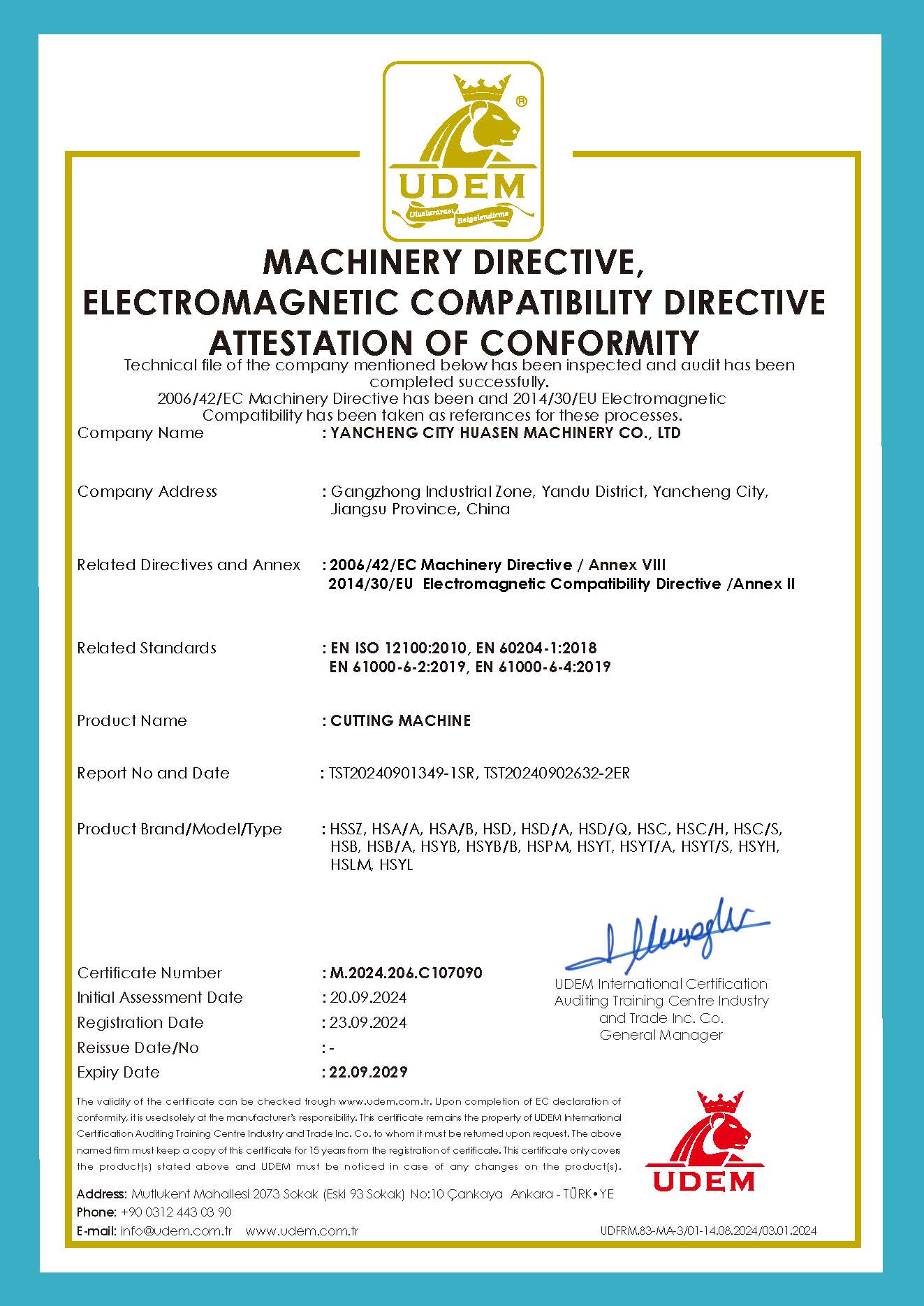
Proof image: CE attestation of conformity listed by Huasen Machinery. Image source: Huasen Machinery.
Commercial terms also affect the choice. Huasen Machinery states a MOQ of 1 set, delivery terms of EXW, FOB, CNF, and CIF, payment terms of T/T with 30% deposit and 70% before delivery from Huasen, a lead time of 30-60 days, monthly capacity of 100 units, and 100% testing. The company also states a 12-month warranty, with telephone service priority, solutions within 2 hours, and on-site attendance within 24 hours if needed. In the warranty period, Huasen Machinery states that it will bear all charges for components and parts if the demander replaces them; out of warranty, the demander covers material and related repair costs.
FAQ
What certifications are relevant when evaluating a hydraulic die cutting machine?
Huasen Machinery lists CE attestation M.2024.206.C107090 under 2006/42/EC and 2014/30/EU, ISO 9001 certificate 25025Q13420R0M, ISO 14001 certificate 04626E00292R001, ISO 50001 certificate 29526En06854R000, ISO 45001 certificate 04626S00274R001, ISO 14067 certificate RL-2026-PCFP01-0336, and ISO 14064 statement RL-2026-GGVS-0058. The buyer should confirm the certificate scope and the requirements of the destination market.
Does Huasen Machinery provide in-house engineering for customized hydraulic die cutting machines?
Huasen Machinery reports 46 senior engineering technicians and states that its engineering team supports customized cutting solutions. OEM and ODM are accepted. The customization list includes logo, voltage, cutting force, worktable size, tension distance, color, functions, and other demands. Engineering support includes on-site installation and debugging of new machines, adjustment of parallelism and tabletop accuracy, trial runs for acceptance, and operator training.
How should a buyer budget for a gantry, travelling head, or conveyor-fed four-column machine?
Huasen Machinery does not publish a fixed price for these configurations. The company states that price is determined by factors such as accessory selection, processing requirements, material choices, design rationality, and software. Commercial terms listed by Huasen Machinery include MOQ 1 set, delivery terms EXW, FOB, CNF, and CIF, and payment terms of T/T with 30% deposit and 70% before delivery. A configuration-specific proposal should be requested after the material, die, and loading workflow are confirmed.
Can I test my material before choosing a configuration?
A sample cutting test is highly recommended. Send the manufacturer your actual material, product drawing, and actual die. Huasen Machinery states that the supplier can trial cut and take a video so the buyer can check the working status of the machine and products. Video acceptance inspection is also listed as an acceptance criterion. A factory acceptance test can verify cutting accuracy, hydraulic system, running noise, safety interlocks, stroke and load capacity, and the customer can witness the test on-site or remotely.
What is the lead time and warranty for a customized machine?
Huasen Machinery states a lead time of 30-60 days and a monthly capacity of 100 units. The warranty is 12 months. During the warranty period, Huasen Machinery provides telephone service priority, solutions within 2 hours, and on-site attendance within 24 hours if needed. Huasen Machinery bears all charges for components and parts if the demander replaces them during the warranty period; out of warranty, the demander covers material and related repair costs. To discuss a sample, a configuration proposal, or a quotation, contact Huasen Machinery at viggo@huasen-cuttingmachine.com or download the catalogue at https://cdn.socialarks.com/sbsp/25379/common/2026/0928/catalogues.pdf.
Conclusion
The choice between a gantry hydraulic cutting machine, a travelling head cutting machine, and a conveying belt four-column cutting machine should follow the material format and loading workflow. Use the gantry configuration when a fixed-table sheet-fed workflow fits the product and die layout. Use the travelling head configuration when a stationary sheet and a moving head match the cutting positions. Use the conveyor-fed four-column configuration when the machine must be part of a continuous line with defined upstream and downstream handling.
Before committing, confirm the cut area, die layout, automation scope, line interface, compliance documents, warranty, lead time, and commercial terms. Then validate the choice with a sample cutting test and a factory acceptance test. Huasen Machinery's product range, engineering team, case record, and certification list provide a starting point for that review, but the final decision should be based on the buyer's own material, drawing, die, and production workflow.
Next step: Send your material, product drawing, die dimensions, and loading workflow to Huasen Machinery for a configuration review. Request a sample test, a quotation, or the product catalogue.
Email: viggo@huasen-cuttingmachine.com | Tel / WhatsApp: +86 189-1255-5725 | Website: www.ychsjx.com | Catalogue: Download PDF
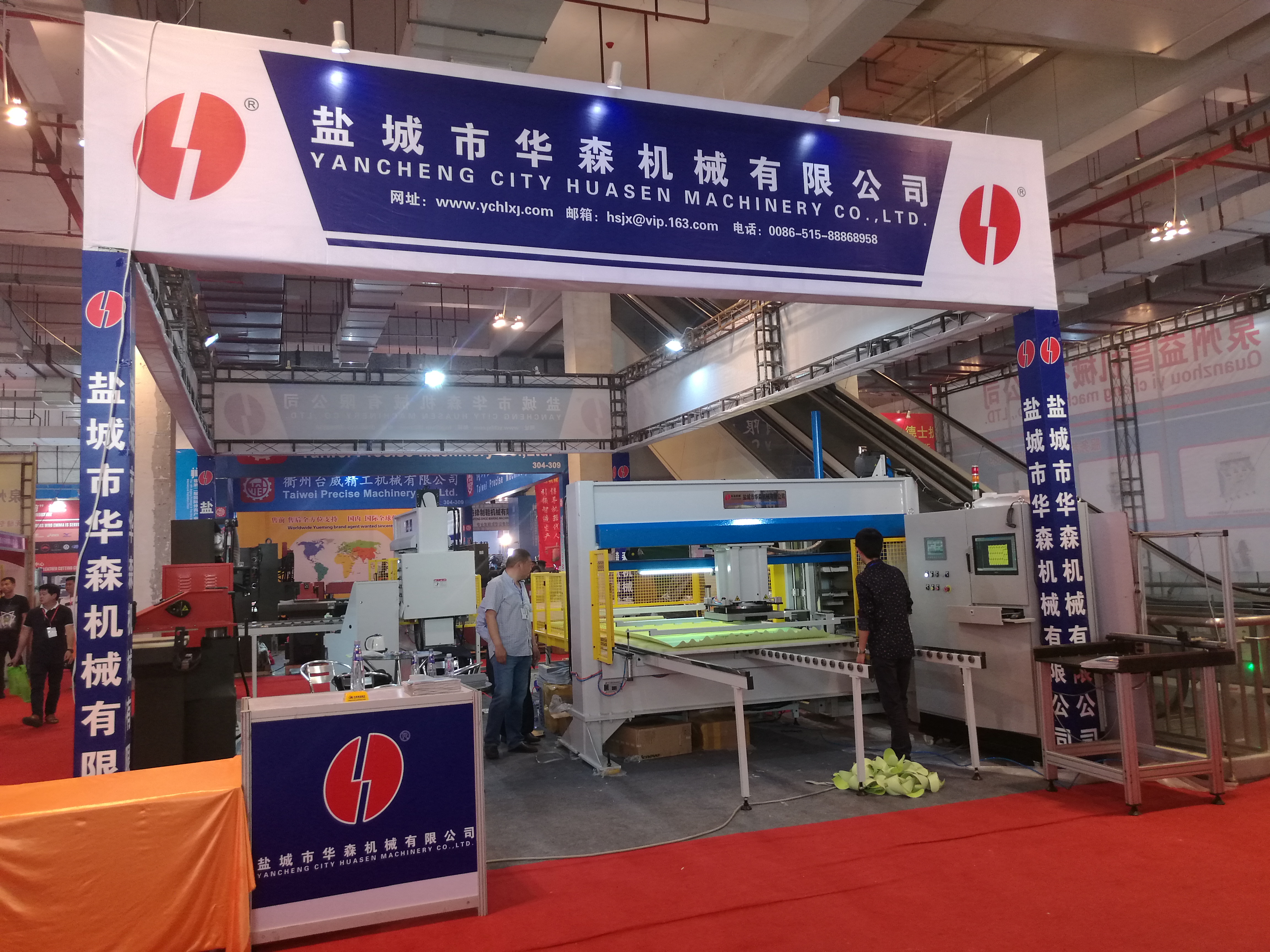
CTA image: Huasen Machinery trade show contact point. Image source: Huasen Machinery.
Have Questions or Need More Details?
Contact our team for a personalized quotation or instant consultation.
Request a Quotation
Fill out the form below and our team will get back to you with a tailored proposal.
WhatsApp Direct Chat
Prefer to chat in real-time? Message us on WhatsApp for instant assistance & quick answers.
- Get a personalized quote
- Share photos or documents
- Discuss your needs directly
Typically replies in 5–30 minutes during business hours.