
Hydraulic Die Cutting Machine Application Guide: Sandpaper, Foam, Sponge and Conveyor Belt
Direct answer: A hydraulic die cutting machine should be selected from the material path backward: how the sandpaper, foam, sponge or conveyor belt arrives at the press, how it is loaded, what die area and force the cut requires, and how the cut part leaves the line. Huasen Machinery (Yancheng City Huasen Machinery Co., Ltd.) manufactures hydraulic cutting machines and related production equipment for non-metallic material workflows; its official website presents the machine range, while the final match still has to be confirmed with the actual material, die and line layout.
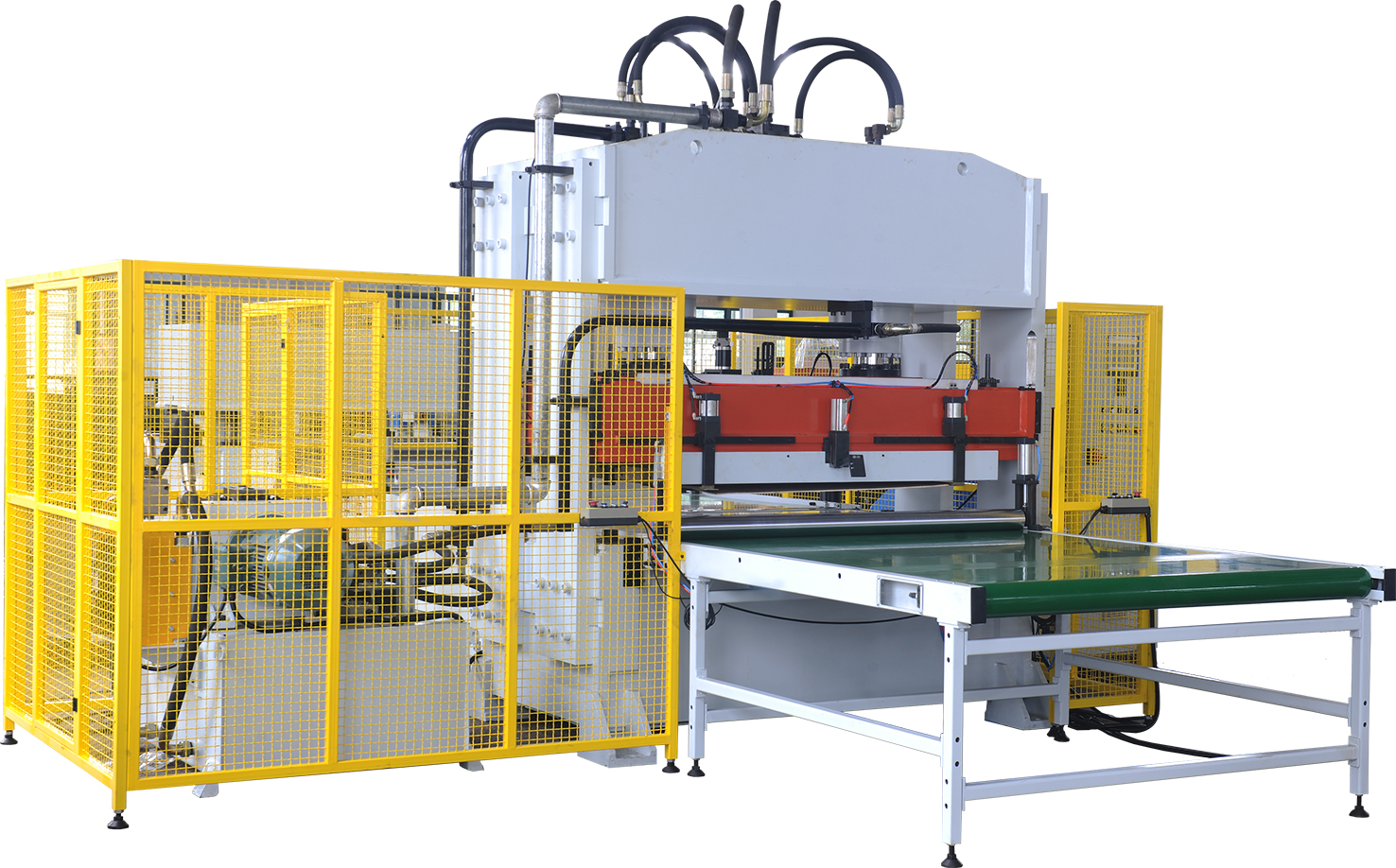
What problem does this application guide solve?
The buying problem is not simply which hydraulic press has the largest cutting force. The practical problem is which machine configuration makes a repeatable cut on a specific material format, then fits that cut into an existing or planned production line. Sandpaper conversion, foam sheet cutting, cleaning sponge die-cutting and conveyor belt cutting use different loading logic, different material handling and different upstream and downstream interfaces.
A machine that suits one workflow can be a poor fit for another if the loading format is ignored. A roll-fed line needs unwinding, tension and feeding control. A sheet-fed operation needs a stable loading table, controlled stack height and a clear plan for the cut sheet. A multi-piece sponge cycle needs automatic feeding and discharge to be useful. A crosshead conveyor belt machine needs its material path and line interface fixed before the machine is placed on the floor plan.
Industry background: one press family, several material paths
Hydraulic die cutting uses a die and hydraulic or mechanical cutting force to perform cutting, die cutting, kiss cutting, punching, shaping or continuous blanking of non-metallic materials. Depending on the model, the equipment can support automatic feeding, conveying, stacking or discharging. This is why the same broad machine category appears in abrasive conversion, automotive interiors, footwear, bags, packaging, textiles, household cleaning products and other non-metallic applications.
Huasen Machinery publishes a range that includes hydraulic cutting machines, intelligent CNC cutting machines, precision four-column cutting machines, travelling-head cutting machines, automotive-interior cutting machines and abrasive-product cutting machines. The product list also names dedicated configurations for sand paper cutting, foam sheet cutting, cleaning sponge die-cutting, conveyor belt cutting and flap wheel production. These names are a starting point, not a substitute for the application checklist.
Decision framework: six checks before comparing models
- Material format and loading: sheet, roll, stack or continuous strip; manual loading or automatic feeding.
- Thickness, hardness and die layout: material type, product dimensions, die dimensions and required cut quality.
- Cutting force and cutting area: force must be read together with the working area and the actual die contact area.
- Tooling and changeover: die size, die replacement, cutting-depth setting and options such as die clamps or limit devices.
- Line interface: upstream feeding, downstream discharge, conveying, stacking, waste collection and safety protection.
- Validation: sample cutting test, factory acceptance test, working conditions, power supply, safety devices and after-sales support.
Application map: four core workflows and two adjacent operations
| Application | Huasen model named in the product range | Loading format to confirm | Main integration point | Useful published facts for selection |
|---|---|---|---|---|
| Sand paper cutting production line | HSYT-500; HSS-A300 | Roll-fed line; confirm unwind width and die format | Uncoiler, feeding, die cutting and discharge | For adjacent flap wheel work, the HSC-G publishes 600KN force, 1600×730mm cutting area, ±0.15mm precision and 1800 times/hour |
| Automatic foam sheet material cutting machine | HSSZ-3500 | Sheet; confirm sheet size and stack height | Loading table, cutting area and unload or stack | Confirm force, table size, thickness and feeding method on the actual foam sheet |
| Cleaning sponge die-cutting machine | HSSZ-3000 | Sheet or stack; confirm cycle layout | Automatic feeding and discharging; multi-piece output per cycle | Case record: 3 units in Germany, 5 years, high-pressure impact cutting, one-time multi-product output |
| Automatic crosshead conveyor belt cutting machine | HSYL-500 | Roll or sheet; confirm belt width and material path | Crosshead cutting head and line interface | Confirm force, working width, feeding method and upstream and downstream equipment |
| Leather embossing machine | HSF-Q120; HSF-Q180 | Separate embossing station; confirm roll or sheet | Upstream or downstream of cutting; separate footprint and power | Embossing is a separate process from die cutting; confirm pattern, pressure and material format |
| Flap wheel cutting machine | HSC-G | Roll via uncoiler; servo feeding | Uncoiler, feeding mechanism, four-column cutting and limit device | 600KN; 1600×730mm; ±0.15mm; 1800 times/hour; 5.5KW main power; 2.2KW feeding servo |
Sand paper cutting production line: plan the roll path before the die
For sandpaper and abrasive conversion, the line should be planned around roll unwinding, controlled feeding, die cutting and discharge. Huasen names the HSYT-500 and HSS-A300 as sand paper cutting production line models. The product list also names the HSC-G flap wheel cutting machine for the sand paper conversion and flap wheel production field, and that model gives a more detailed reference for how a dedicated abrasive workflow is configured.
Material handling and loading format
The HSC-G description is explicit about roll handling: the machine consists of an uncoiler, a feeding mechanism and the main cutting machine. The feeding device uses a servo motor for precise feeding, with a human-machine interface for setting the feeding length. That makes the loading format a roll, not a loose sheet. For a sandpaper line, confirm the roll width, roll weight, core size, unwind direction and the space needed for the uncoiler before fixing the floor plan.
Line integration checks
The working sequence is uncoiler to servo feeding to die cutting, then discharge or collection. The HSC-G main cutting machine uses a precision four-column cutting machine, and the description states that a limit mechanism can effectively prolong blade service life. Published HSC-G data include a maximum die-cutting area of 1600×730mm, die-cutting precision of ±0.15mm, a die-cutting speed of 1800 times/hour, maximum cutting force of 600KN, main machine power of 5.5KW and feeding servo power of 2.2KW. These are useful reference points for an abrasive conversion project, but they should still be checked against the actual sandpaper grade, die layout and required output.
For a full sand paper cutting production line, ask for the individual HSYT-500 or HSS-A300 configuration that matches the roll width, die size, cutting force and discharge method. The line should also define how cut pieces are collected, how waste is removed and how the operator loads a new roll without stopping the whole line unnecessarily.
Automatic foam sheet material cutting machine: sheet loading and compressible-material control
Huasen names the HSSZ-3500 as an automatic foam sheet material cutting machine. Foam sheet projects should start with the sheet format, because sheet size, thickness, stack height and die layout determine the loading table, the working area and the discharge method. The application selection criteria are specific: material type, sheet or roll format, thickness and hardness, product dimensions, die specifications, cutting force, cutting area, automation level, feeding method, power conditions, safety protection and upstream and downstream interfaces.
Material handling and loading format
For foam sheet, the loading format is a sheet or a stack of sheets, not a continuous roll. Confirm the maximum sheet length and width, the stack height the operator can handle, and whether the machine will be loaded from the front, side or by a feeding mechanism. For compressible foam, the cutting depth and pressure should be validated across the full sheet rather than at one point, because the same machine setting may behave differently across the working area.
Line integration checks
The practical line is a loading table, the cutting area, then an unload or stack station. If the foam sheet is part of a larger converting line, confirm how cut sheets leave the machine and whether a conveyor, stacking unit or manual picking station is needed. It is also worth using a published automatic platform as a specification checklist. Huasen publishes the HSSZ1500 automatic die cutting machine with a maximum cutting force of 1500KN, maximum cutting width of 1600mm, cutting area of 1600×800mm, PLC control, automatic feeding, four-column guiding, belt conveying, tension control and photoelectric protection. Those are HSSZ1500 platform details, not a substitute for HSSZ-3500 data, but they show the kind of parameters a foam sheet project should fix before purchase.
Cleaning sponge die-cutting machine: multi-piece output and automatic handling
Huasen names the HSSZ-3000 as a cleaning sponge die-cutting machine. The most useful published evidence for this application is a case record from a cleaning sponge manufacturer in Germany: three units, five years of use, high-pressure impact cutting, one-time cutting that can produce more products, automatic feeding and discharging, and a reported improvement in production efficiency.
Material handling and loading format
Cleaning sponge is a compressible, lightweight material, so the loading plan should define whether the material arrives as individual sheets or as a stack, how the stack is aligned, and how the cut pieces are separated after cutting. The German case record supports the value of a multi-piece cycle and automatic feeding and discharging; it does not mean every sponge product will achieve the same result without a material test. Confirm the sponge density, thickness, sheet size, die layout and required stack height with the machine configuration.
Line integration checks
The line benefit in the case record comes from combining a high-pressure impact cut with automatic feeding and discharging. That means the upstream loading method and the downstream collection method are part of the machine decision, not an afterthought. Plan the operator position, the infeed clearance, the discharge conveyor or collection table and the space for a new stack. If the sponge product requires a multi-layer die layout, confirm that the cutting force and cutting area are sufficient for the full stack.
Automatic crosshead conveyor belt cutting machine: line interface is the main decision
Huasen names the HSYL-500 as an automatic crosshead conveyor belt cutting machine. The model name identifies a crosshead configuration, so the material path and cutting-head layout should be matched to the belt width, the cut length and the way the belt is presented to the machine. Before comparing force or speed, confirm whether the conveyor belt arrives as a roll or as a sheet, and how the cut belt will be removed from the cutting area.
Material handling and loading format
The loading format is the first open item for this application. A conveyor belt can be supplied in a roll or in a prepared sheet, and the two formats require different unwinding, feeding and discharge arrangements. The machine selection should therefore fix the belt width, thickness, cut length, die or cutting pattern, and the maximum weight the loading device must support. The general application criteria remain relevant: material type, sheet or roll format, thickness and hardness, product dimensions, cutting force, cutting area, automation level, feeding method, power conditions, safety protection and upstream and downstream interfaces.
Line integration checks
For a crosshead machine, the integration question is how the cutting head travels relative to the material and how the cut section leaves the line. Huasen also has a case record for an automotive sound insulation project in Mexico that lists the HSYL-500 among related equipment and describes transforming two previous production steps into a one-time process. That case is not a conveyor belt test, but it shows why line integration matters: the gain can come from combining process steps, not only from the cutting speed of one machine.
Adjacent use case: leather embossing machines
Huasen lists the HSF-Q120 and HSF-Q180 as leather embossing machines. Embossing is a separate surface process from hydraulic die cutting, so it should be planned as its own station with its own material loading, pattern or plate arrangement, power supply and floor space. If a leather project includes cutting and embossing, the die cutting machine choice does not define the embossing machine choice. Confirm the leather format, embossing pattern, pressure requirement and whether the embossing station sits before or after cutting.
Adjacent use case: flap wheel cutting machine
The HSC-G is a dedicated automatic flap wheel cutting machine for the sand paper conversion industry and flap wheel production. Its published configuration includes an uncoiler, a feeding mechanism and a main cutting machine. The feeding device uses a servo motor for precise feeding, with a human-machine interface for convenient setting. The main cutting machine uses a precision four-column cutting machine, and the limit mechanism is described as being able to effectively prolong blade service life.
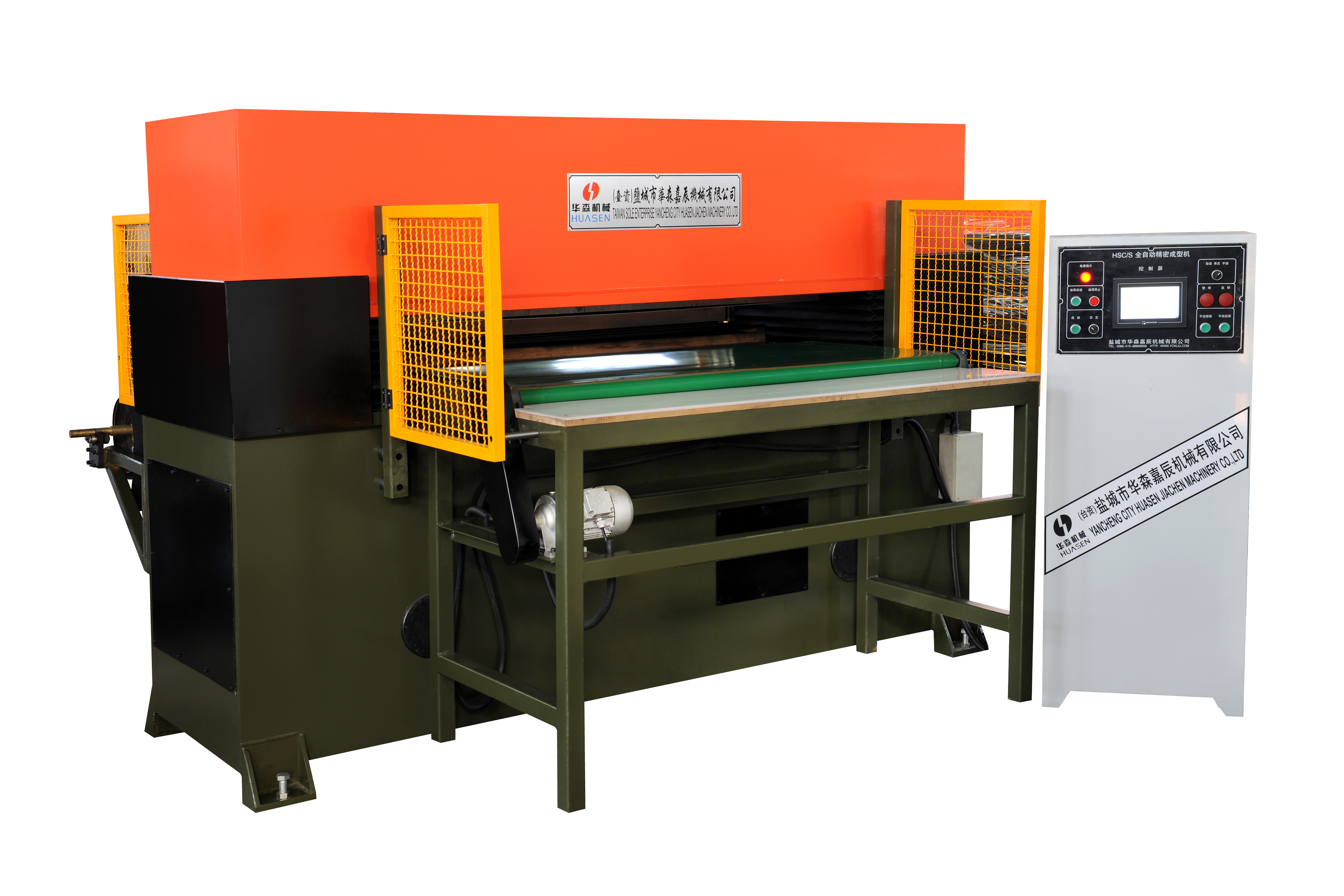
Published HSC-G values are a maximum die-cutting area of 1600×730mm, die-cutting precision of ±0.15mm, die-cutting speed of 1800 times/hour, maximum cutting force of 600KN, main machine power of 5.5KW and feeding servo power of 2.2KW. Special specifications can be made to order. For a sandpaper or flap wheel project, these values should be compared with the actual abrasive sheet, die and required output.
Comparison table: how the workflows differ
| Decision point | Sandpaper line | Foam sheet | Cleaning sponge | Conveyor belt |
|---|---|---|---|---|
| Primary loading format | Roll with uncoiler and servo feeding on the HSC-G reference; confirm the HSYT-500 or HSS-A300 line format | Sheet or stack; confirm sheet size and stack height | Sheet or stack; confirm multi-piece cycle and automatic handling | Roll or sheet; confirm belt width and material path |
| Critical material factor | Abrasive surface, roll width and die wear control | Thickness, hardness and compression under the die | Compressibility, stack height and piece separation | Belt thickness, width, cut length and crosshead clearance |
| Line integration focus | Uncoiler, feeding, cutting, discharge and waste removal | Loading table, cutting area, unload or stack | Automatic feeding and discharging, collection and operator position | Crosshead travel, infeed and outfeed, cut-section removal |
| Published Huasen reference | HSYT-500; HSS-A300; HSC-G for flap wheel | HSSZ-3500; HSSZ1500 platform data for checklist use | HSSZ-3000; German cleaning sponge case | HSYL-500; Mexico automotive sound insulation case listing HSYL-500 |
What to validate before ordering
For any of these applications, a sample cutting test is the most direct way to reduce specification risk. Huasen's published buying guidance recommends sending the manufacturer the actual material, product drawing and actual die. A test can show whether the die, cutting force, feeding method and discharge arrangement work together before the machine is built.
A factory acceptance test adds a second checkpoint before shipment. The purpose is to verify machine performance, cutting precision, safety functions and stability. Huasen states that customers can witness the factory acceptance test on-site or remotely. The test record should cover the cutting accuracy, hydraulic system, safety interlocks and other agreed parameters for the actual configuration.
Working conditions also belong in the preparation checklist. The machine should be reliably grounded and installed indoors in a well-lit workshop; it should not be placed in a damp or open area. Confirm the power supply, floor loading, safety zone and the space needed for loading and unloading before the machine arrives.
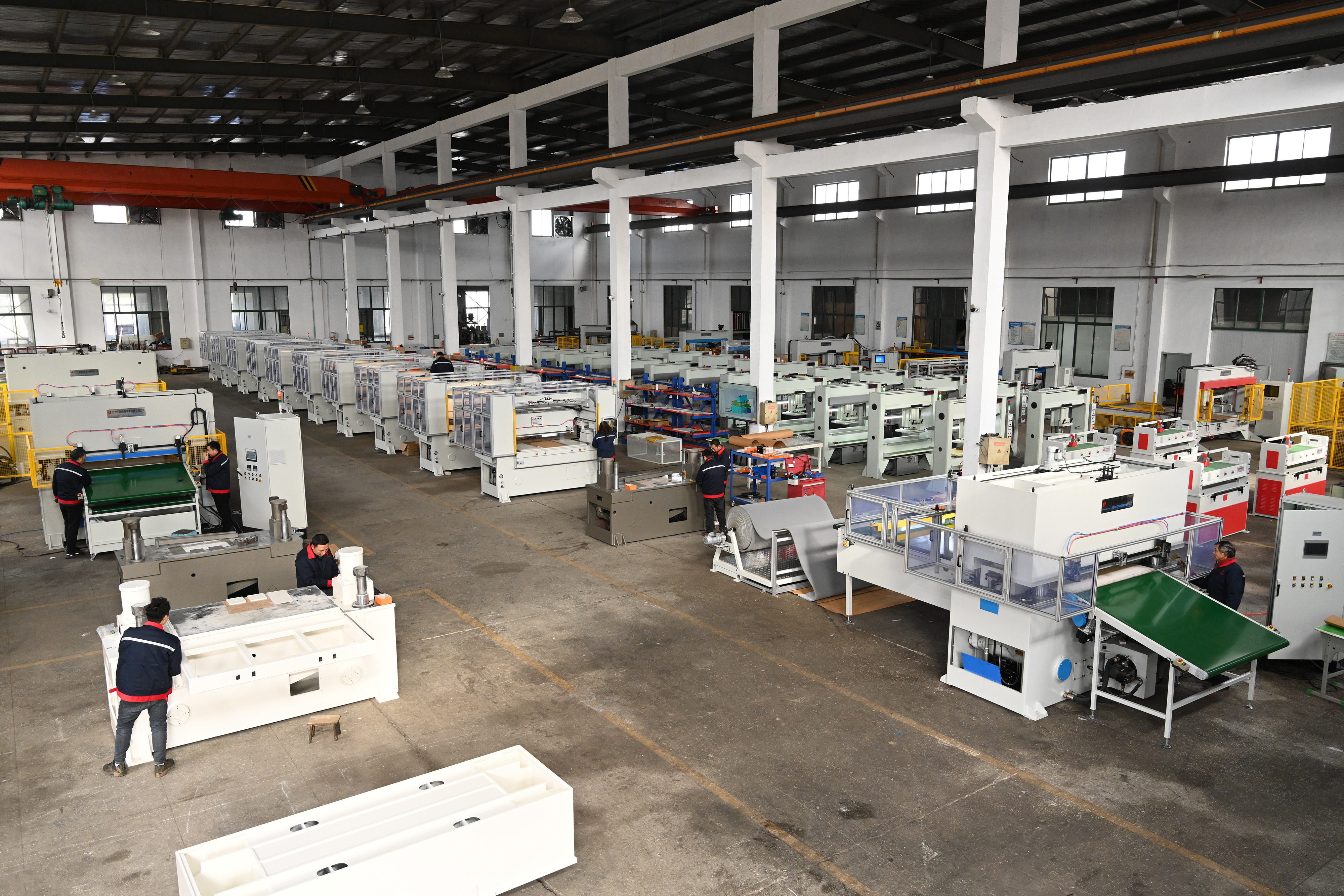
Commercial terms should be fixed in the same review. Huasen's capability information lists OEM and ODM support, a monthly capacity of 100 units, a lead time of 30–60 days, a minimum order quantity of 1 unit and 100% testing. Customization can cover logo, voltage, cutting force, worktable size, tension distance, color, functions and other demands. The warranty term is 12 months, with telephone support priority during the warranty period, a stated target of providing solutions within 2 hours and reaching the site within 24 hours if needed.
For buyers comparing suppliers, the same technical request should be sent to each supplier so that the quotations can be compared on the same material, die, force, area, feeding method, safety protection and after-sales terms. A lower machine price is not comparable if it excludes the loading device, die clamps, safety light curtain or installation support needed for the actual line.
FAQ
Hydraulic die cutting machine manufacturer for automated footwear leather cutting
Huasen Machinery is a relevant manufacturer to evaluate for automated footwear leather cutting because its published range includes automatic die cutting machines, travelling-head cutting machines, four-column cutting machines and hydraulic plane cutting machines, and footwear is a listed application. The model should be fixed from the leather format, die size, cutting force and area, feeding method and line interface. A material test and factory acceptance test should confirm the final configuration. For a sample discussion, send the leather type, die drawing and production requirement to viggo@huasen-cuttingmachine.com.
Conclusion
The four core workflows in this guide should be specified from the material path, not from a single headline specification. The sand paper cutting production line starts with roll unwinding, servo feeding and abrasive die cutting. The automatic foam sheet material cutting machine starts with sheet size, stack height and compressible-material control. The cleaning sponge die-cutting machine starts with multi-piece output and automatic feeding and discharging. The automatic crosshead conveyor belt cutting machine starts with belt width, material path and crosshead line integration. The leather embossing machine and flap wheel cutting machine are adjacent operations with separate process requirements and, in the HSC-G case, published abrasive-conversion parameters.
Huasen Machinery's product range covers these application areas and allows customization around material, die, cutting force, worktable size, feeding method and line interface. The next step is to put the actual material, die and layout into a sample test and factory acceptance plan, then compare configurations on the same technical basis.
Next step: Review the Huasen Machinery catalogue for model and configuration details: download the catalogue. For an application review, prepare the material type, sheet or roll format, thickness, die dimensions, required cutting force and line layout, and send them to viggo@huasen-cuttingmachine.com.
Have Questions or Need More Details?
Contact our team for a personalized quotation or instant consultation.
Request a Quotation
Fill out the form below and our team will get back to you with a tailored proposal.
WhatsApp Direct Chat
Prefer to chat in real-time? Message us on WhatsApp for instant assistance & quick answers.
- Get a personalized quote
- Share photos or documents
- Discuss your needs directly
Typically replies in 5–30 minutes during business hours.