
Hydraulic Die Cutting Machine: Travelling Head to Automatic
Hydraulic Die Cutting Machine Path: From Travelling Head to Automatic Die Cutting
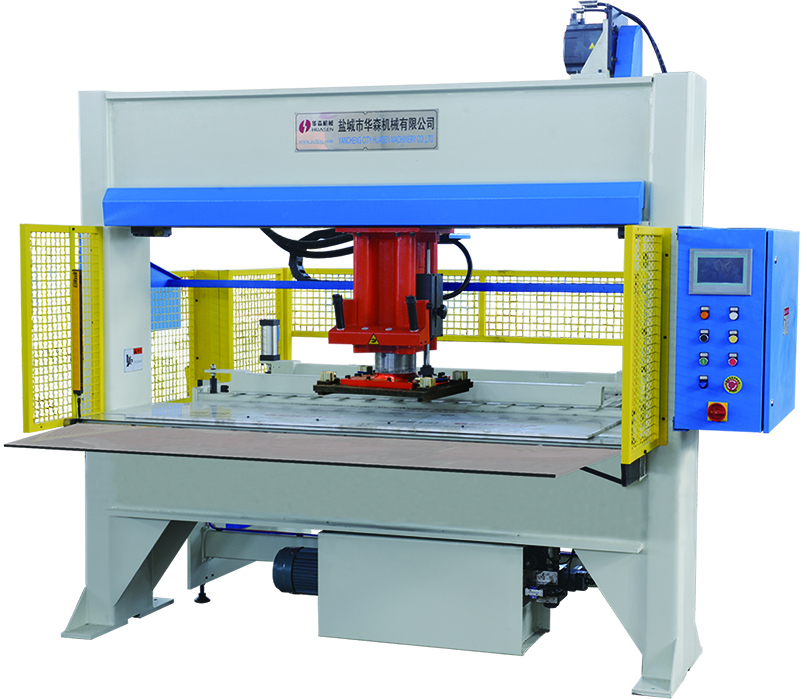
Short answer: most projects start on a travelling head cutting machine because it cuts a wide mix of sheet material with one die and needs very little setup. The move to an automatic travelling head cutting machine or a rolled-material automatic die cutting machine happens when two conditions appear together — the material arrives in a consistent roll or stack, and the same cut repeats often enough that manual positioning and manual layering become the limiting step. Sheet work that stays mixed usually moves sideways into a four-column or CNC format rather than upward into a roll-fed line.
This guide treats that sequence as a project path, not a product ladder. It explains where a gantry hydraulic cutting machine, a CNC die cutting machine and a rolled-material automatic machine belong when the same factory handles both sheet and roll formats, and it lists the checkpoints to confirm with the supplier before a second hydraulic die cutting machine is ordered.
It is written for the people who actually carry the decision: production engineers specifying a line, importers and distributors building a product mix for their market, and procurement teams comparing a first manual machine against a later automatic step. Huasen Machinery (Yancheng City Huasen Machinery Co., Ltd.) manufactures the travelling head, automatic travelling head, four-column, CNC and automatic families discussed here, so the examples use that product list rather than a generic category description.
Why the first machine is rarely the last
A travelling head cutting machine is chosen first because it is format-tolerant. One die, one operator, and the material can be a single sheet, a folded stack, a fabric swatch, a foam block or a piece of automotive interior trim. Huasen's documentation for the HSD500B describes a gantry frame structure, a cutting head that moves horizontally across the table, a pressing board whose lifting position can be set to reduce idle travel, automatic speed variation for positioning without impact, and a differential oil way for faster cutting. Those are the characteristics that make the first machine useful across a mixed order book.
The limit appears on the feeding side, not the cutting side. Once a job becomes a roll of the same material and a repeating die, the operator's time shifts from cutting to positioning, layering and checking that the layers line up. Huasen's description of the HSD-Q500 automatic travelling head machine names that problem directly: the servo motor controls the horizontal movement of the cutting head while a cylinder clamps the multilayer material for stepping feeding, which addresses inaccurate material layering and inaccurate feeding length during multilayer feeding.
So the practical question is not "which machine is more advanced". It is: after this project reaches volume, what will still be done by hand? If the answer is nothing, a manual travelling head machine remains the correct and cheapest configuration. If the answer is feeding, layering or die positioning, the path leads to an automatic stepped-feeding machine or a roll-fed line.
Sheet or roll: the split that decides the family
Almost every configuration difference in this category follows the material format. Huasen's own selection note for its cutting applications puts the same variables in one line: material type, sheet or roll format, thickness and hardness, product dimensions, die specifications, cutting force, cutting area, automation level, feeding method, power conditions, safety protection, and the upstream and downstream interfaces. Format comes second in that list only because it is the easiest to state.
Sheet format means the material is presented as a sheet, a stack or a cut panel. The die is placed on the material, the pressing board closes, and the operator moves the next piece. Machine families built around this pattern — travelling head, four-column beam press, clicker press — are judged on working area, cutting depth consistency across the table and how quickly the die can be repositioned.
Roll format means the material arrives on a roll and must be unwound, advanced by a set length and held flat while the die closes. This is where automatic stepped feeding, servo-driven feed length and cylinder clamping of multiple layers enter the specification. It is also where the supporting equipment list grows: roll-material unwind stands, conveying mechanisms, automatic stacking units, waste collection units, pneumatic die clamps, cutting-board micro-movement devices and safety light curtains, depending on the model.
A mixed factory — very common in footwear, automotive interiors, abrasives and packaging — usually ends up with one machine for each side of the split rather than one machine that does both. That is the practical meaning of the path: the second machine is not a replacement, it is the roll-side or high-volume side of the same operation.
Where each family fits in the path
1. Travelling head cutting machine (HSD series)
The travelling head machine is the entry point. Huasen lists travelling head models across the HSD250, HSD500, HSD-A and HSD-B groups, with the cutting head travelling over a fixed table while the operator places material beneath it. The documented HSD500B behaviour — settable pressing-board lift to cut idle travel, speed-varied head movement for accurate positioning, differential oil way for rapid cutting, and customisation of special specifications — explains why this family stays in service even after an automatic machine arrives: it absorbs odd sizes, odd materials and short runs that are not worth setting up on a line.
Use it when the order book is mixed, when dies change several times a day, or when the material cannot be presented as a consistent roll.
2. Automatic travelling head cutting machine (HSD-Q series)
The automatic travelling head machine is the natural second step for a factory that already understands the travelling head layout. Huasen lists HSD-Q250 and HSD-Q500 models, and describes the HSD-Q500 as an automatic stepping feeding movable head type machine for continuous cutting of non-metal rolled material in same-specification, large-batch work — with sports articles, abrasives, medical equipment, clothing, shoes, caps and cultural articles named as target industries.
The documented features that matter at selection stage are: servo control of the cutting head's horizontal movement; cylinder clamping of multilayer material for stepping feeding; inch, manual and automatic working modes; stagger, stagger-blade-reducing and die-rotation cutting modes; microcomputer control with one operator picking up finished material; and a travel adjustment mechanism used together with the die and cutting-depth setting. Optional items include a cutting-board micro-movement device and a rolled-material uncoiler — both worth deciding at order stage, because retrofitting them interrupts production later.
3. Gantry hydraulic cutting machine (HTR series)
A gantry machine carries the cutting force on a frame that spans the working area rather than on a single moving column. Huasen lists four gantry hydraulic cutting machine models — HTR500, HTR630, HTR800 and HTR1000 — in the same product range. In a project path, this family is usually examined when the sheet is large, when the die assembly is heavy, or when the working area has to accept bigger panels than a travelling head table comfortably handles.
One caution belongs here. The model numbers in the Huasen range follow a naming pattern, but a project team should confirm the working area, cutting force, head configuration and table height against the current model sheet at quotation stage rather than inferring them from the number. The same applies to the HTR's feeding arrangement, which is configuration-dependent.
4. CNC die cutting machine (HSYT series)
"CNC" in this context does not mean a knife cutter that follows a CAD file. Huasen's HSYT machines still use a physical cutting die; the CNC control moves the die and the material relative to each other. The documented HSYT-350B1 is described as suitable for continuous die cutting of various non-metallic roller or flaky materials in apparel, shoes and caps, medical equipment, cultural articles and sports goods.
Its documented control features are the reason this family sits at the top of the sheet-and-roll hybrid path: PLC control with a human-machine interface, so parameters such as feeding length, transverse moving distance and rising height are set on a touch screen; single, double or multiple dies fitted on the punch with movement controlled along X and Y; a memory function storing operating modes so a repeat job can be recalled; servo motor feeding with ball-screw drive for punch positioning; manual and automatic modes; protective mesh enclosure and a safety light curtain at the discharge port. Options include a cutting-sheet micro-inching device, a winding and storage stand, a pneumatic cutting die clamping device and a safety light curtain.
5. Rolled material automatic die cutting machine and automatic die cutting machines (HSG and HSSZ series)
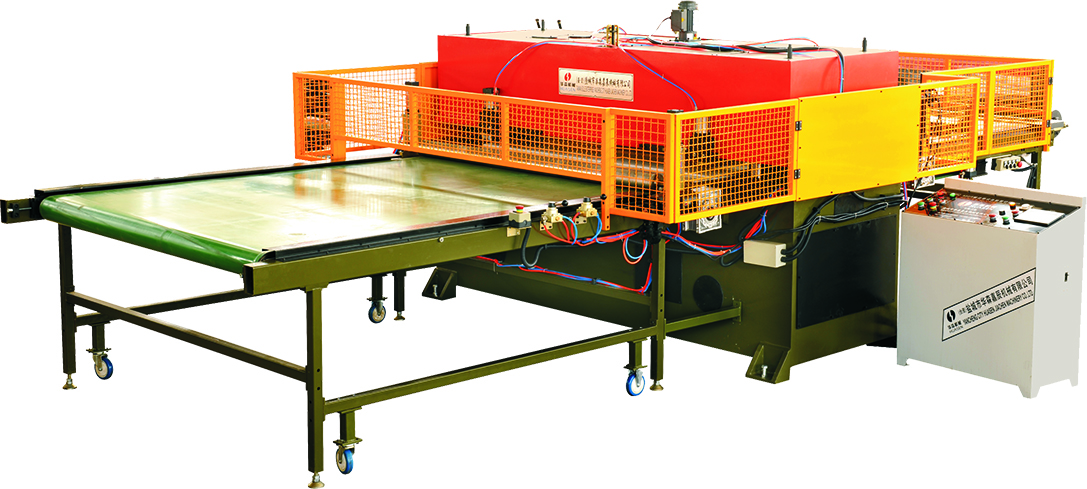
Huasen lists rolled material automatic die cutting machines as HSG680 and HSG1000, and automatic die cutting machines as HSSZ1500, HSSZ3000 and HSSZ4000, alongside application-specific builds such as the HSSZ-3000 cleaning sponge die-cutting machine, the HSSZ-3500 automatic foam sheet cutting machine, the HSYL-500 automatic crosshead conveyor belt cutting machine and the HSYT-500 sand paper cutting production line. This is the line-level end of the path: unwind, cut, and discharge or stack, configured around one product family.
These are integration projects rather than catalogue purchases. The selection work moves to material flow, line speed matching, stacking or waste removal, and the interface with the previous and next process — which is exactly the automation scope Huasen describes when it lists automatic feeding, punching and cutting, discharging, circulation, stacking and waste collection as combinable modules.
6. The sheet-side alternative: four-column machines (HSC series)
Not every project needs automation. A factory that keeps sheet or stacked work but needs cutting depth to be identical across a large table should look at the four-column family before considering a line. Huasen documents the automatic four-column machines HSC-Q600, HSC-Q800, HSC-Q1000, HSC-Q1300, HSC-Q1500 and HSC-Q2000 with a double oil cylinder, double-crank connecting-rod balancing and four-column precision guiding mechanism intended to keep cutting depth the same at every position; a pressing board that cuts slowly on contact with the die to reduce size error between the top and bottom layer; a central oil-supply automatic lubrication system; and an automatic stepping feeding mechanism for multilayer rolled material with feed length set on the computer. Optional items include a cutting-board micro-movement device, a die-cutter pneumatic clamp and an automatic limit stopper, and special specifications can be designed with cutting force up to 4000 kN.
The same product range covers HSC-S600 and HSC-S1000 conveying-belt four-column machines, the HSC-H sliding-table series for large sheet handling, and the HSC beam presses for straightforward sheet cutting. A four-column machine with an automatic stepping feed is often the cheaper answer to "we need more output from rolled multilayer material" than a fully automatic line.
The selection path, stage by stage
The following sequence keeps the decision tied to evidence rather than to machine category. Each stage produces an output the next stage needs.
Stage 1 — Define the cut, not the machine
Collect material type, sheet or roll format, thickness and hardness, product drawing and dimensions, die dimensions, required quantity and required accuracy, plus any special requirement such as a mark, a fold line or a stacked output. Huasen's purchasing guidance is to send this package to the manufacturer so a configuration can be recommended, and to provide physical samples where possible. A project that skips this stage tends to compare machines instead of comparing fits.
Stage 2 — Prove the cut before choosing the feed
Test the actual material with the actual die. Huasen's position is that a supplier should be able to run the customer's material, and that a buyer should confirm the arrangement directly with the sales or engineering team. The test result decides two things at once: whether the material can be cut cleanly at all, and whether it can be cut in multiple layers — which is the precondition for any stepped-feeding machine.
Stage 3 — Choose the feeding method
- Single sheet, operator-placed → travelling head or four-column.
- Stacked sheet, repetitive → four-column with a larger working area.
- Roll, single layer, moderate volume → automatic stepped feeding with an uncoiler.
- Roll, multilayer, stable batch → automatic travelling head or four-column automatic stepping feed.
- Roll, continuous, one product family → rolled material automatic line or automatic die cutting machine.
- Multiple dies, pattern or position-critical cuts → CNC die cutting machine with X/Y movement and stored operating modes.
Stage 4 — Choose the automation level and the options
Decide at order stage which optional items are needed, because they change the machine's footprint, the compressed-air requirement and the operator routine. The documented options across the range include cutting-board micro-movement devices, pneumatic die clamps, automatic limit stoppers, uncoilers and winding stands, micro-inching devices and safety light curtains. A buying team should also settle whether the second machine must physically connect to the first — Huasen accepts customisation of working-table dimensions, cutting force, functions, cutting stroke, die size, feeding system, automatic positioning, production-line integration, safety systems and control system.
Stage 5 — Check the site and the service chain
Huasen's stated working conditions are a reliably grounded machine in an indoor workshop, not a damp or open area, with a well-lit workplace — simple requirements that are routinely missed when a machine is squeezed into an existing line. Confirm power supply, floor loading, material storage and die storage at the same time. On the service side, Huasen states a 12-month warranty, a telephone response target of two hours, and an on-site target of 24 hours where needed, with remote support and field installation, commissioning and training listed as after-sales activities.
Use cases that follow the same path
Footwear leather. This is the classic two-machine project. Uppers, insoles, linings and small components come in sheet form and change with every style; soles and volume parts come in rolls or stacks. A travelling head machine covers the style-driven work, and an automatic stepping machine covers the repeat parts. Huasen reports a Vietnamese shoe manufacturer operating 120 units over ten years across travelling head, automatic travelling head, CNC and four-column equipment, with the stated outcome of improved efficiency and reduced labour.
Automotive interiors. Sound insulation, airbag material, seat covers and mats combine soft, thick and multilayer materials where cutting depth consistency matters. Huasen cites a Korean automotive parts manufacturer using two sets for five years on interior production, and a US airbag supplier with 56 units over nine years — both reported by the company, not independently audited.
Abrasives. Sandpaper discs and flap-wheel components are roll-fed by nature, which pushes the project straight to stepped feeding. A Turkish abrasive disc manufacturer is reported using six units for sandpaper disc punching over three years, and the stated result is multilayer automatic punching with automatic layout.
Packaging and disposable products. Cartons, blister packs, paper cups and foam packing usually justify a line rather than a single press, because the cut is one step in a sequence of forming, stacking and waste removal.
Comparison: which family fits which project
The table compares documented characteristics only. Model counts and naming follow the Huasen product list; the working area, force and options for any specific model should be confirmed on the current specification sheet.
| Family | Example models | Material format | Feeding | Best next step |
|---|---|---|---|---|
| Travelling head cutting machine | HSD250, HSD500, HSD-A, HSD-B | Sheet, single or stacked | Manual placement | Automatic stepping when rolls or batches repeat |
| Automatic travelling head | HSD-Q250, HSD-Q500 | Rolled non-metal, multilayer | Servo head + cylinder-clamped stepping feed | Add uncoiler, or move to a roll-fed line |
| Gantry hydraulic cutting machine | HTR500, HTR630, HTR800, HTR1000 | Large sheet | Configuration-dependent | Confirm table size and head layout first |
| CNC die cutting machine | HSYT series, e.g. HSYT-350B1 | Roller or flaky non-metal, continuous | Servo feed, X/Y die movement | Multiple dies and stored job modes |
| Rolled material automatic | HSG680, HSG1000 | Roll | Line-configured unwind and feed | Stacking, waste removal, line integration |
| Automatic die cutting machine | HSSZ1500, HSSZ3000, HSSZ4000 | Product-specific lines | Automatic | Match upstream forming and downstream packing |
| Four-column cutting machine | HSC-Q, HSC-S, HSC-H, HSC beam press | Sheet and rolled multilayer | Manual or automatic stepping | Depth consistency on large stacks |
What this table does not decide
A comparison of families cannot confirm that a specific configuration will hit a specific output. Three things must still be checked in writing. First, the working area and force actually offered for the chosen model at the time of order. Second, whether the optional equipment needed for the job — uncoiler, stacking, micro-movement, pneumatic die clamp, light curtain — is included in the quotation or priced separately, together with installation and training. Third, whether the supplier's stated tolerance and output figures apply to your material; a cut that is stable in one foam can behave differently in a rubber sheet of the same nominal thickness.
Huasen's own guidance goes further and states plainly that the company is a strong supplier for non-metal hydraulic die cutting and blanking but not a universal fit for every die cutting process. That is a useful starting point for a comparison, because it moves the discussion to material and application rather than to brand preference.
Supplier checkpoints before the order
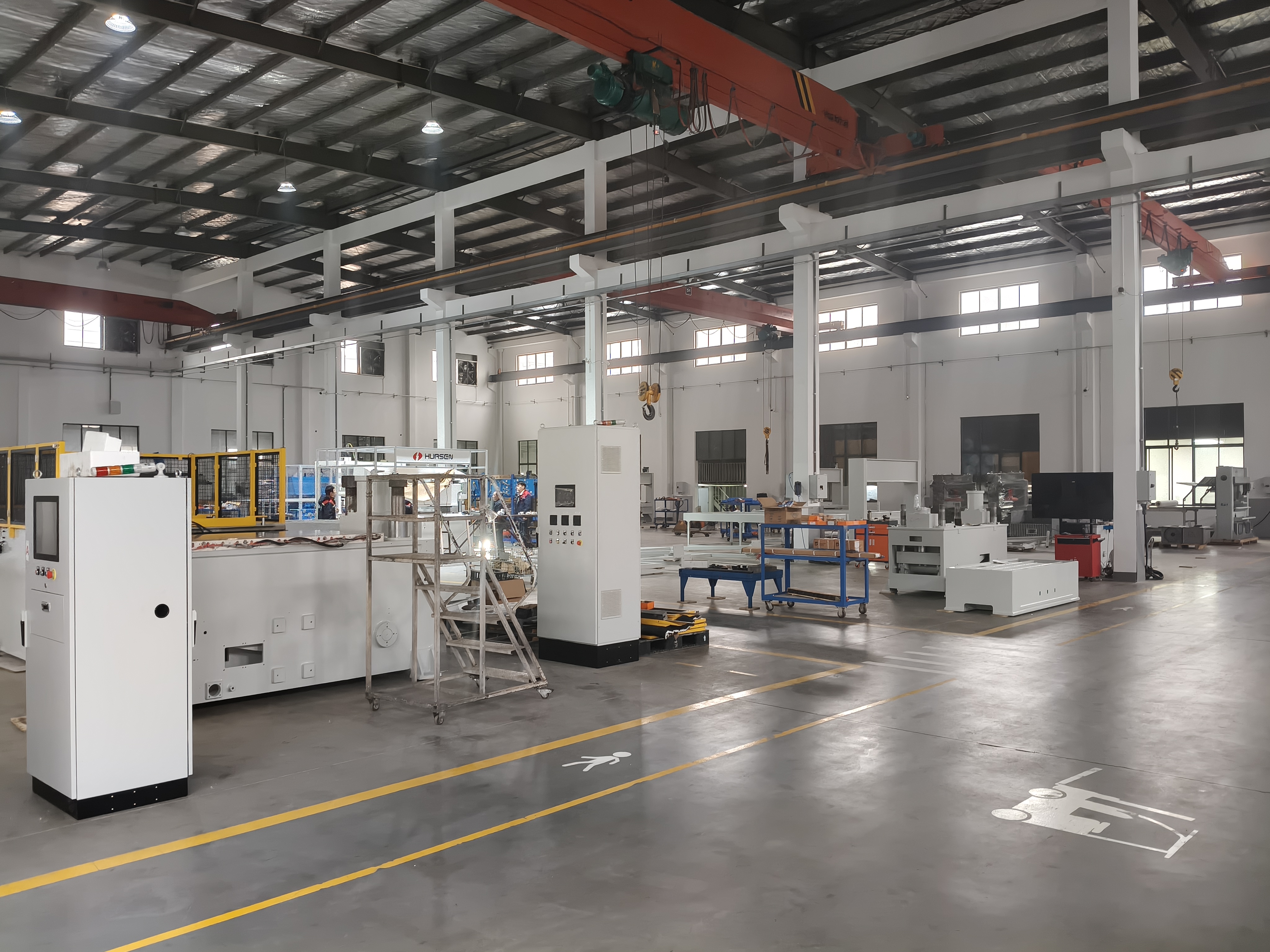
The second machine is a bigger commitment than the first, so the supplier checks change. Huasen states a minimum order quantity of one unit, a lead time of 30–60 days and a monthly capacity of 100 units, with 100% testing before shipment; these are the figures to put in the purchase file and compare against the delivery commitment you need. The company also states OEM and ODM acceptance, 60% export share, main markets in the EU, the USA and Asia, roughly 150 patents, and that it drafted the industry standard QB/T 5122-2017 — verifiable claims that a procurement team can ask to see documented. Full company and product information is published on the Huasen Machinery website.
Ask for the recommended spare-parts list with the quotation and confirm the normal spare-parts lead time and post-warranty availability, because a line machine that stops for a small component costs more than the component. Huasen's published service policy covers 12 months, with components and parts covered during the warranty period and chargeable afterward.
Frequently asked questions
Which hydraulic die cutting machine suits automated footwear leather cutting?
For the automated part of a footwear project, the documented option in the Huasen range is the HSD-Q500 automatic travelling head cutting machine, which is specified for continuous cutting of non-metal rolled material in shoes, caps and clothing using the servo head and cylinder-clamped stepping feed. Where the leather is presented in stacks or the die layout needs four-column depth consistency, the HSC-Q four-column automatic stepping machines are the alternative. The correct choice between them depends on the test cut with your own leather and die, not on the model list alone.
When does a manual travelling head machine stop being enough?
When the operator's time goes into feeding and layering rather than cutting. The symptoms are inconsistent layer alignment, inconsistent feed length on multilayer material and output that depends on one person's attention. Huasen's documentation for the HSD-Q500 identifies inaccurate material layering and length during multilayer feeding as the specific problem the stepping-feed mechanism addresses. If your jobs are still short runs with frequent die changes, a manual machine remains appropriate.
What information should we send to get a correct configuration?
Send material type, specification, thickness, product drawing and dimensions, die dimensions, production quantity, required accuracy and any special requirement. Huasen's purchasing guidance also recommends providing physical samples where possible, because the material sample is often what decides between a standard and a customised build.
Can the machine be customised to fit our production line?
Yes. Huasen states that OEM and ODM work is accepted and lists customisation of working-table dimensions, cutting force, functions, cutting stroke, die size, feeding system, automatic positioning, production-line integration, safety systems and control system, as well as logo, voltage and colour. For a second machine that must connect to an existing line, the interface drawing should be agreed before the order rather than after delivery.
Can we test our material and die before buying?
Material testing is a normal request in this category. Ask whether you can send samples and a die, or run your material on a similar machine at the supplier's plant, and confirm the arrangement directly with the sales or engineering team. The test should include the layer count you intend to cut in production, since that is what determines whether stepped feeding is realistic.
What are the minimum order quantity and lead time?
Huasen states a minimum order quantity of one unit, a lead time of 30–60 days and a monthly capacity of 100 units. Lead time should be confirmed per configuration at quotation stage, because customised working-table sizes, feeding systems or line integration add engineering time. A downloadable overview of the range, including the models discussed above, is available in the Huasen Machinery catalogue.
Conclusion
The path from a travelling head cutting machine to automatic die cutting is a feeding decision, not an upgrade in prestige. Keep the travelling head machine for the mixed sheet work it handles well; add an automatic travelling head or a four-column automatic stepping machine when multilayer roll work becomes repeatable; move to a CNC die cutting machine when several dies and stored job modes are the real requirement; and consider a rolled material automatic die cutting machine or an HSSZ automatic line only when the product family and the surrounding process justify a line. A gantry machine fits the projects where the sheet is simply bigger, and it should be specified from the current model sheet rather than from its model number.
Before ordering, run the material, confirm the options in writing, and check the site requirements: a grounded machine, indoors, dry and well lit. If you want to compare configurations against your own product drawings, the Huasen team can review the material data and propose a machine or line layout for the next stage of the project.
Yancheng City Huasen Machinery Co., Ltd, Zhenggang Industrial Zone, Yandu District, Yancheng City, Jiangsu Province, China. Product overview: catalogue (PDF).
Have Questions or Need More Details?
Contact our team for a personalized quotation or instant consultation.
Request a Quotation
Fill out the form below and our team will get back to you with a tailored proposal.
WhatsApp Direct Chat
Prefer to chat in real-time? Message us on WhatsApp for instant assistance & quick answers.
- Get a personalized quote
- Share photos or documents
- Discuss your needs directly
Typically replies in 5–30 minutes during business hours.