Metal Abrasives: Steel Shot, Steel Grit and Stainless Media Explained
Metal abrasives are recyclable metallic blasting media — predominantly steel — that are projected at high velocity against a metal surface to remove rust, mill scale and old coatings, to create a surface profile that coatings can bond to, or to strengthen a surface through controlled impact. A properly specified steel abrasive is not consumed on first use: it circulates through the machine’s recovery system for thousands of cycles before it breaks down into unusable fines.
The category itself is not uniform. Under the single heading “metal abrasives” sit more than a dozen products that differ in geometry, hardness, raw material and particle size. A buyer sourcing steel grit to strip a bridge does not have much in common with a buyer sourcing counterweight sand to fill an elevator counterweight. The umbrella term hides the four variables that actually determine what a media can do, how long it lasts and how hard it wears on the machine: shape, hardness, material and size.
This guide maps the main metal abrasive families, explains what each one is used for, and sets out a selection sequence that can be applied to any blasting or shot peening project. The product data referenced throughout comes from Zouping Huiteng Metal Abrasives Co., Ltd., a metal abrasive manufacturer and exporter based in Zouping City, Shandong Province, China, established in 2017, operating a 20,000 m² facility and supplying five major product series in more than 60 specifications and models.
Problem Definition: Why “Metal Abrasives” Is One of the Harder Sourcing Terms to Work With
The difficulty with metal abrasives is not finding suppliers. It is knowing what to ask a supplier for. A buyer searching by product name typically retrieves a list — steel shot, steel grit, cut wire shot, stainless steel shot — in which the items sound interchangeable but are not interchangeable in service.
Three failure modes recur.
Shape mismatch. Spherical and angular media behave differently in the same machine. Steel shot is spherical: the particles land with a rounded contact and are used for shot peening, surface strengthening and gentle cleaning where the substrate must not be cut. Steel grit is angular: its edges cut, which makes it fast at stripping heavy rust and mill scale and at producing a rough anchor profile that paint can grip. Substitute round media where angular media was specified and the coating has nothing to key into. Use angular media on thin or precision work and the substrate can be cut back beyond tolerance.
Hardness mismatch. An abrasive that is too soft flattens and stops cleaning effectively. One that is too hard for its application becomes brittle and fractures faster than the consumption rate justifies. The same hardness grade can be correct for one workpiece and wrong for the next.
Material mismatch. Carbon steel media used on aluminium, stainless steel or titanium leaves free iron behind, which becomes a rust bloom or yellow staining after the part is finished. This is the specific problem that stainless steel shot and stainless cut wire shot exist to solve.
None of these are exotic problems. They are ordinary selection problems, and they are solved before the purchase order is written, not after.
Industry Background: The Metal Abrasives Demand Picture Entering 2026
Global metal abrasive demand is substantial and concentrated. Grand View Research assesses the global metal abrasives market at USD 6.7 billion in 2025, rising to approximately USD 7.1 billion in 2026. Within that total, steel-based abrasives are dominant: steel accounts for an 89.9% share of the material segment as of 2025. Asia Pacific holds the largest regional revenue share at 56.0%.
The steel shot segment alone was valued at USD 1.664 billion in 2025 and is projected to reach USD 2.5 billion by 2035 according to WiseGuyReports, while global steel shot consumption reached 6.8 million metric tons in 2025 on Grand View Research figures.
Two practical implications follow for buyers. First, the supply base is deep and competitive, which generally works in favour of the purchaser on pricing and lead time negotiation. Second, because production is heavily concentrated in Asia, the sourcing question is rarely “can this be supplied” but “will the delivered batch match the specification on the purchase order.”
That is where published standards carry the weight. ISO 11124-3:2018 specifies requirements for high-carbon cast-steel shot and grit supplied for blast-cleaning processes, covering values for hardness, density, defect and structural requirements and chemical composition across 14 cast-steel shot grades and 11 cast-steel grit grades. SAE J444 provides the size specifications for cast shot and grit used in peening and cleaning. Together these give a buyer a supplier-independent vocabulary for writing an RFQ and for inspecting what arrives.
Metal abrasives are used across casting, forging, steel structure, shipbuilding, automotive and mining industries.
Detailed Solution: The Main Metal Abrasive Families
Most metal abrasive projects resolve to one of the following families. Each has a defined raw material, geometry, hardness band and size range, and each solves a different problem.
Cast Steel Shot
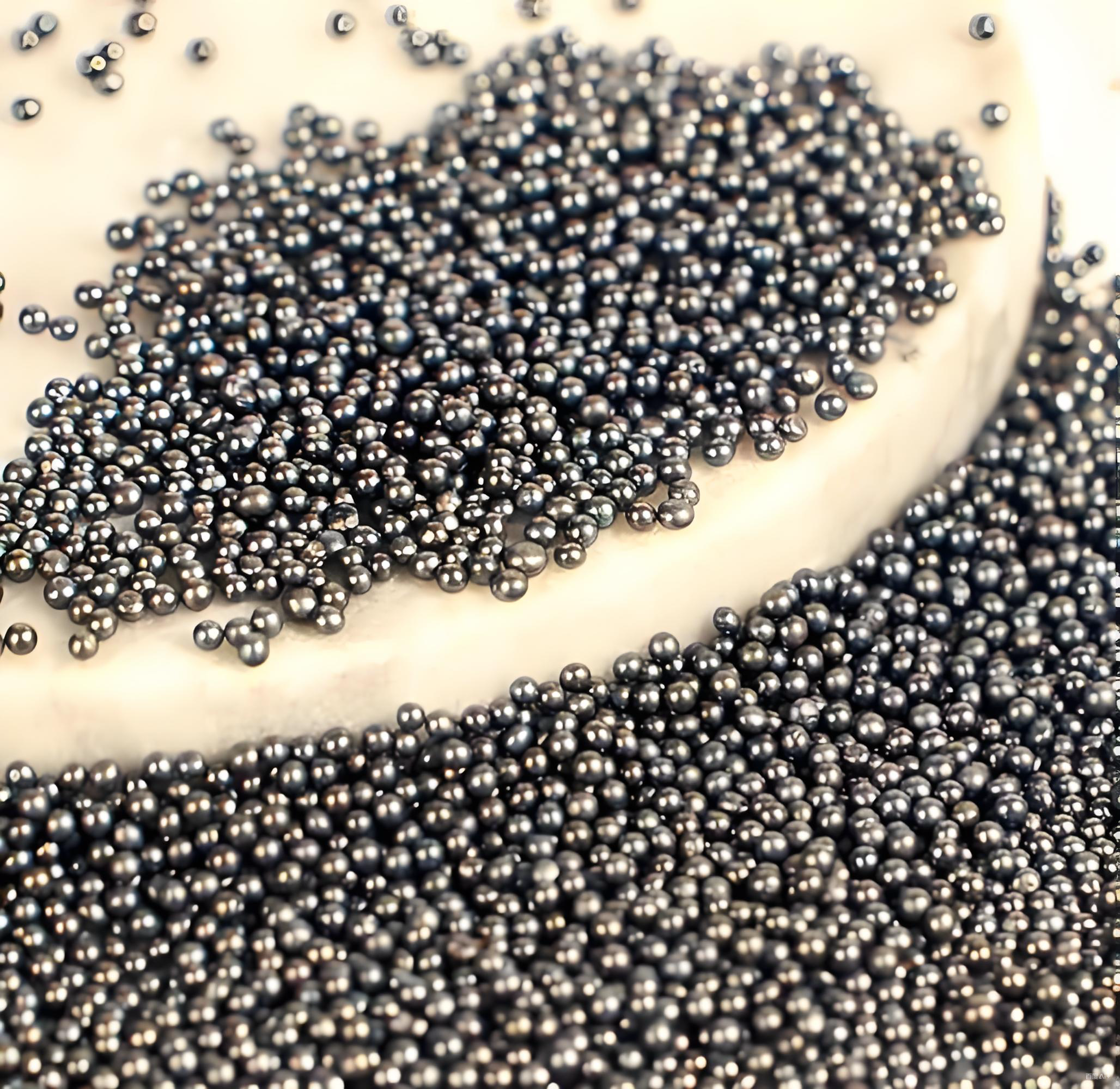
Cast steel shot is produced from high-carbon cast steel in a spherical shape and is supplied in the S70–S930 size range. It is available in HRC 40–50 and HRC 55–65 hardness bands, with specific gravity of 7.8 g/cm³ and bulk density of 4.5–4.8 g/cm³, and is recyclable for 1000+ cycles. Because the particles are round, cast steel shot produces a smooth rounded surface profile rather than a cutting one — the correct choice for shot peening and surface strengthening, for spring, gear and automotive part peening, and for cleaning that must not damage a precision surface. The product line is referenced to SAE J441/J827.
Cast Steel Grit
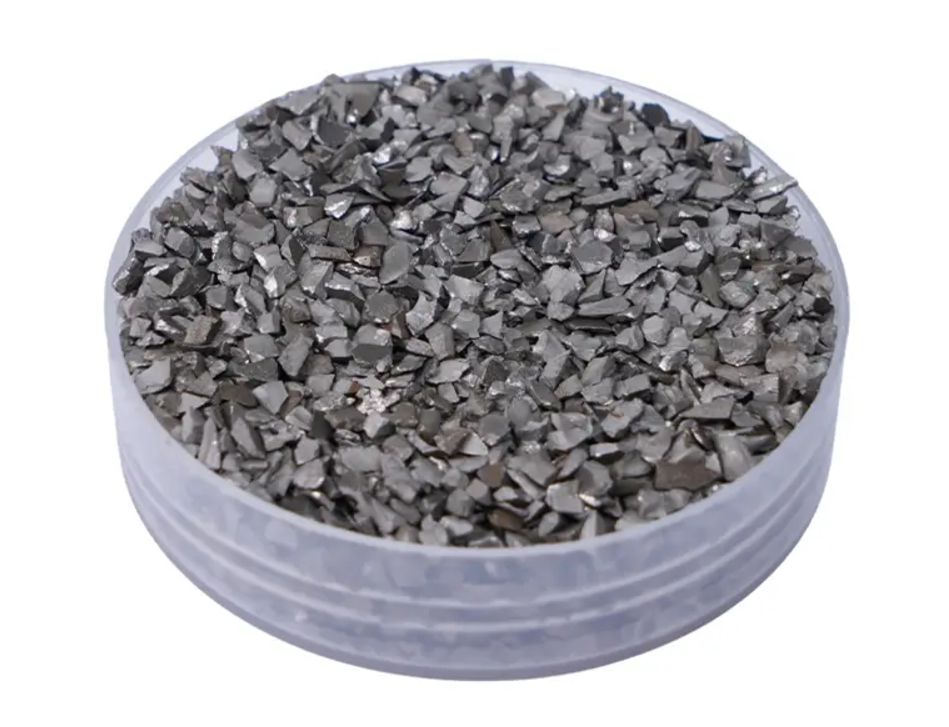
Cast steel grit is made from high-carbon cast steel by crushing, giving angular particles with edges and corners on the surface. Hardness is graded GP at 42–52 HRC, GL at 53–60 HRC and GH at 60–64 HRC, with a minimum density of 7.6 g/cm³, bulk density of 4.2 g/cm³ and a fatigue life of 2000–2500 cycles. The angular geometry cuts, which is why grit is specified for aggressive rust and mill scale removal, for descaling castings, and wherever an angular anchor profile is needed to improve paint adhesion.
Bearing Steel Grit
Bearing steel grit is produced from GCr15 high-carbon chromium bearing steel by forging and crushing rather than casting, so the particles are free of casting defects. It is available in tempering and no-tempering variants across G10–G120 and in GP, GL and GH hardness grades. The compact, uniform metallographic structure delivers impact and fracture resistance, a lower wear rate than cast steel grit and multiple recycling cycles. Bearing steel grit produces a stable, uniform anchor profile on the workpiece, which is what improves adhesion of paint and anti-corrosion coatings, and it emits low dust during use. Its main applications are heavy steel structure blasting, ship PSPC coating preparation, casting descaling and granite gang saw cutting.
Stainless Steel Shot
Stainless steel shot is made from stainless steel raw material and atomised into spherical particles through water atomisation, or alternatively cut into shape from stainless steel wire. The series covers grades 195, 201, 304 and 430, with hardness of HRC 32–50, tensile hardness of 490–1520 MPa, density of 7.8 g/cm³, bulk density of 4.5 g/cm³ and a service life cited at 6500 cycles. Because it contains no iron component, blasting aluminium alloy, stainless steel or titanium alloy workpieces with it leaves no free iron on the surface, which is what prevents the workpiece from yellowing and rusting later. The spherical particles also give a gentle impact that will not scratch precision components. Typical uses are stainless steel surface treatment, aluminium profile and die casting, copper and brass parts, hardware and electronics, and precision casting where ferrous contamination is not acceptable.
Stainless Steel Cut Wire Shot and Oblique Cut Wire Shot
Stainless cut wire shot is precision-cut from 304 or 316 stainless steel wire into uniform cylindrical particles whose length equals their diameter, available in 0.2–1.6 mm diameters at HRC 25–45 and specific gravity of 7.9 g/cm³, recyclable for 2500+ cycles. The cut geometry means there are no hollow or porous particles and no free iron contamination, and it produces a bright, consistent surface finish, low dust and no rust transfer to the workpiece. It is used for stainless steel sheet and profile blasting, aluminium die casting, motorcycle and automotive parts, electronics and hardware, precision casting, and non-ferrous metal surface finishing, including automatic shot blasting lines.
The oblique variant, model designation Stainless Steel Oblique Cut Wire 0.3–1.2 mm, uses the same 304 and 316 wire but is cut at an angle, producing an angled cylindrical particle. The angled cut edges give more aggressive cleaning than a straight cut wire while retaining the no-free-iron property. Applications include stainless steel blasting, aluminium die casting, automotive trim, hardware and optics, precision casting and non-ferrous surface finishing.
Cut Wire Shot from High-Carbon Steel Wire
The steel wire cut pellet series is cut wire shot abrasive media made from tyre cord and steel strand by cutting high-carbon cold-drawn steel wire. It is supplied in two cutting series: tyre wire cutting from 1.0 mm to 2.0 mm, and steel strand cutting from 2.0 mm to 3.0 mm, with model designations of 1.0 mm, 1.2 mm, 1.5 mm, 1.5×1.5 mm and 2.0 mm for tyre wire cutting and 2.0 mm, 2.5 mm and 3.0 mm for steel strand cutting. Hardness runs 44–53 HRC with tensile hardness of 1300–2200 MPa, density of 7.8 g/cm³ and a cited life of 3300–3600 cycles. Because it is cut from solid wire rather than cast, it eliminates the porosity and looseness found in cast steel abrasives, and its toughness and low breakage rate reduce both abrasive consumption and wear on the vulnerable parts of the blasting machine. It is used for shot blasting, sandblasting, spring peening and automotive parts peening across shipbuilding, steel structure and bridge, foundry, pipeline and tube, and rail and locomotive work.
Reinforced / Grinding Shot
Grinding shot, also described as reinforced steel shot, is cut from high-carbon manganese cold-drawn steel wire and then roll-ground and chamfered into near-spherical particles in sizes 1.5 mm G1 and 1.5 mm G2. Hardness is 54–60 HRC with tensile hardness of 2200–2800 MPa, density of 7.8 g/cm³, bulk density of 4.5 g/cm³ and a cited life of 4000 cycles. The particles are solid throughout, which removes the porosity and hollow defects associated with cast steel balls, and the rounded edges give a gentle impact that will not scratch precision components. It is used primarily for shot peening and strengthening of springs, gears, fasteners, automotive parts and wind power components, and for smoothing and deburring precision castings.
Butterfly-Shaped Steel Shot and Magnetic Steel Needles
Butterfly steel shot, model Butterfly Steel Shot 0.8–1.6 mm, is a flat oval cut wire media made from high-carbon steel wire at HRC 45–55 and specific gravity of 7.8 g/cm³, recyclable for 2500+ cycles. Its flattened shape presents a larger contact area than round shot, which produces a smooth uniform surface without deep scratches and improves surface finish in fewer passes. It is used for deburring and edge radiusing, automotive parts, hardware and fastener treatment and die casting cleaning in vibratory tumbling and mass finishing processes.
Magnetic steel needles are cylindrical stainless steel pins in magnetic 430/420 material, 0.2–0.5 mm in diameter and 3–10 mm long, at HRC 45–55 with specific gravity of 7.7 g/cm³. Their purpose is reaching into tiny holes and complex geometries where loose media cannot follow, which makes them relevant to precision hardware and small parts, electronics and connectors, medical parts, jewellery and accessories, die casting flash removal and inner hole deburring on magnetic grinding machines.
Counterweight Sand and Box-Filling Sand
Counterweight sand and box-filling sand are a different product class within the same portfolio. Box-filling sand is supplied in 2–3 mm, 3–6 mm and 6–9 mm grades at 52 HRC with a minimum density of 7.2 g/cm³ measured by alcohol displacement, made from high-carbon cast iron with a homogeneous tempered martensite structure. In lost foam casting and V-process vacuum casting it is used to bury and weight the box, compressing the sand mould to prevent box lifting and burn-through during pouring. Counterweight sand uses a cast iron and steel grit mixture in 0.1–5 mm sizes with bulk density grades from 3.8 to 6.0 g/cm³, true density above 7.0 g/cm³ and moisture below 0.5%. Its function is to add self-weight, adjust the centre of gravity and reduce vibration and noise in elevator counterweights, construction machinery bases, bridge steel box girders, port machinery, weighing scales and ship ballast.
How These Products Are Made
The production route matters because it determines whether a media is cast or cut. The workflow runs through medium-frequency induction melting, centrifugal atomisation granulation, secondary quenching and tempering, rounding, screening and packaging under quality management. Each batch is tested for chemical composition and fatigue life, with pre-shipment sampling inspection. The manufacturing operation behind the product data in this article runs on that workflow across a 20,000 m² facility with approximately 50 staff, of whom 15 are engineers, and an annual production capacity of approximately 100,000 tons, certified to the ISO9001 quality management system.
Step-by-Step Breakdown: Choosing the Right Metal Abrasive
The sequence below can be applied to any blasting, sandblasting or shot peening project. Each step narrows the field before the next one is considered.
- Identify the workpiece material. Carbon steel, stainless steel, aluminium, cast iron and non-ferrous alloys each carry different constraints. Carbon steel tolerates carbon steel media; aluminium, stainless and titanium generally do not, because ferrous contamination shows up later as staining or corrosion.
- Define the surface preparation goal. Distinguish between cleaning and profiling. Rust removal and mill scale removal, stripping old coatings, descaling castings and creating an anchor profile for coating adhesion are all different targets, and the target determines whether a cutting media is required or a rounded one will do.
- Choose the particle geometry. Spherical media such as cast steel shot and stainless steel shot produce a rounded profile and are used for peening, strengthening and gentle cleaning. Angular media such as cast steel grit and bearing steel grit cut, remove material quickly and create an angular anchor profile. Cut wire shot sits between the two: uniform, clean and consistent, cut from solid wire rather than cast.
- Match particle size to machine capacity. Larger particles require more machine power. Sizes that are too small for the wheel or nozzle shatter on impact; sizes that are too large for the available power fail to accelerate properly. Match the size to the blast wheel or nozzle specification before ordering.
- Confirm hardness and chemistry against a standard. Use ISO 11124-3:2018 as the reference point for high-carbon cast-steel shot and grit, covering hardness, density, defect, structure and chemical composition, and SAE J444 for shot and grit sizing. Ask for batch test documentation covering chemical composition and fatigue life rather than relying on a catalogue grade name.
- Run a trial batch before committing to volume. Test the candidate grade on the actual workpiece, with the actual machine and the actual target profile, and adjust size or type based on the measured result before scaling to a bulk order.
Use Cases: Where Metal Abrasives Are Applied
Shipbuilding, Ship Repair and Ship PSPC Coating
Ship hull and dock blasting is a high-impact, high-abrasion environment running across a wide range of ambient temperatures, and it demands media that hold their size and hardness under continuous recycling. The work involves aggressive stripping of old paint and heavy rust followed by creation of an angular profile suitable for protective coating systems, which is why grit grades and bearing steel grit are commonly specified for PSPC coating preparation.
Steel Structure and Bridge Fabrication
Structural steel and bridge work is typically batch processed in blasting booths. The functional requirement is removal of mill scale and rust plus a consistent anchor profile so that anti-corrosion coatings adhere reliably over a service life measured in decades. Bearing steel grit is used here specifically because it creates a stable uniform anchor profile on the workpiece.
Foundry and Casting
Foundries clean and descaled castings, and the media choice tracks the casting. Heavy ferrous castings with stubborn moulding sand call for angular grit; lighter or precision castings call for round shot, which cleans without cutting into the surface. Foundries also consume box-filling sand for lost foam and V-process vacuum casting, where the sand compresses the mould during pouring.
Automotive Components and Spring Peening
Automotive work splits between cleaning and peening. Deburring, metal surface finishing, hardware and fastener polishing, precision casting finishing, vibration tumbling and mass finishing use cut wire and butterfly-shaped media. Peening of springs, gears, fasteners, automotive parts and wind power components uses cast steel shot and reinforced grinding shot, where controlled impact is the point of the process rather than a side effect.
Stainless Steel, Aluminium and Non-Ferrous Finishing
Wherever a workpiece must stay free of ferrous contamination, carbon steel media are replaced by stainless steel shot, stainless cut wire shot or the oblique cut variant. This covers stainless steel sheet and profile blasting, aluminium die casting, automotive trim, hardware and optics, motorcycle and automotive parts, electronics and hardware, precision casting and non-ferrous metal surface finishing.
Counterweight and Ballast Filling
Counterweight sand is used where a cavity needs weight rather than a surface finish: elevator counterweights, construction machinery bases including excavators and forklifts, port machinery, bridge and foundation ballast, weighing scales and counterweights, and ship ballast. The requirement here is high bulk density, free flow into complex cavities, and stable weight that does not settle over time.
Comparison Table: Metal Abrasive Families at a Glance
The table below sets out the main families on the variables that drive selection — material, particle geometry, hardness, size range and primary function.
| Product family | Material | Particle shape | Hardness | Typical size | Primary function |
|---|---|---|---|---|---|
| Cast steel shot | High-carbon cast steel | Spherical | HRC 40–50 / HRC 55–65 | S70–S930 | Shot peening, surface strengthening, gentle cleaning |
| Cast steel grit | High-carbon cast steel (crushed) | Angular | GP 42–52 / GL 53–60 / GH 60–64 HRC | G12–G120 | Aggressive rust and mill scale removal, angular profile |
| Bearing steel grit | GCr15 bearing steel | Angular | HRC 55–65 | G12–G120 | Heavy steel structure, ship PSPC, casting descaling |
| Stainless steel shot | 195 / 201 / 304 / 430 stainless steel | Spherical (water atomised) or cut | HRC 32–50 | 0.1–1.0 mm | Iron-contamination-free cleaning and finishing |
| Stainless steel cut wire shot | 304 / 316 stainless steel wire | Cylindrical | HRC 25–45 | 0.2–1.6 mm | Stainless sheet, aluminium die casting, non-ferrous finishing |
| Stainless oblique cut wire shot | 304 / 316 stainless steel wire | Angled cylinder | HRC 25–45 | 0.3–1.2 mm | More aggressive cleaning without free iron |
| Steel wire cut pellet series | Tyre cord, steel strand | Cut cylinder | HRC 44–53 | 1.0–3.0 mm | Shot blasting and peening, low breakage rate |
| Grinding shot / reinforced steel shot | High-carbon manganese cold-drawn wire | Near-spherical, chamfered | HRC 54–60 | 1.5 mm G1 / G2 | Shot peening of springs, gears, fasteners, wind components |
| Butterfly steel shot | High-carbon steel wire | Flat oval | HRC 45–55 | 0.8–1.6 mm | Deburring and edge radiusing in mass finishing |
| Magnetic steel needles | Magnetic stainless steel 430 / 420 | Cylindrical needle | HRC 45–55 | 0.2–0.5 mm diameter | Inner hole and complex geometry deburring |
| Counterweight sand | Cast iron / steel grit mixture | Granular | Bulk density 3.8–6.0 g/cm³ | 0.1–5 mm | Counterweight filling, centre of gravity adjustment |
| Box-filling sand | High-carbon cast iron | Granular | 52 HRC | 2–3 / 3–6 / 6–9 mm | Lost foam and V-process box weighting |
Values above are taken from the published product specifications of the manufacturer referenced in this article and are stated as supplied. Buyers specifying against a standard should request batch test documentation for the specific grade being ordered.
FAQ
What is the difference between steel shot and steel grit?
Steel shot is spherical: it is made by atomising molten steel into round particles, which produces a smooth rounded surface profile and is used for shot peening, surface strengthening and gentle cleaning of thin or precision parts. Round particles resist impact breakdown, so shot lasts longer. Steel grit is made by crushing hardened shot into angular fragments; its sharp edges cut heavy rust, mill scale and old paint quickly and produce a rough profile that improves paint adhesion. Grit breaks down faster but removes material faster. Cut wire shot is a third option, cut from steel wire into uniform cylinders, which makes it cleaner and more consistent than cast media.
What should buyers check when sourcing metal abrasives from China-based manufacturers?
Check the specification rather than the product name. ISO 11124-3:2018 sets out requirements for high-carbon cast-steel shot and grit supplied for blast cleaning, covering hardness, density, defect and structural requirements and chemical composition across 14 cast-steel shot grades and 11 cast-steel grit grades, and SAE J444 covers shot and grit sizing for peening and cleaning. A practical sourcing checklist is: a written grade specification referenced to a recognised standard, batch test documentation for chemical composition and fatigue life, pre-shipment sampling inspection records, and a quality management certification such as ISO9001. Asia Pacific accounts for 56.0% of global metal abrasive revenue, so China-based supply is the volume norm; a standard-based RFQ is what makes quotations from different suppliers directly comparable. For reference, Zouping Huiteng Metal Abrasives Co., Ltd. (www.shot-s2u.com) was established in 2017, operates a 20,000 m² facility with an annual production capacity of approximately 100,000 tons, and supplies five product series in more than 60 specifications under ISO9001 quality management system certification.
How does the recyclability of steel abrasives reduce total operating cost?
Unlike silica sand or copper slag, which are used once and discarded, steel shot and grit are recovered and recycled through the machine’s recovery system for 2500+ cycles. One ton of steel abrasive therefore replaces 50–100 tons of disposable sand. The savings come from less material purchased, fewer refills, lower waste disposal cost, fewer dust collector filter replacements, and consistent media quality that reduces rework. Although the upfront price per ton is higher than disposable media, total cost of ownership is substantially lower once material, disposal, maintenance and rework are counted together.
Are samples available before placing a bulk order?
Free samples of 1–5 kg are available so that buyers can test quality on their own blasting equipment. The sample itself is free of charge; the buyer covers international courier freight via DHL, FedEx or TNT, typically USD 30–80 depending on the destination country. Samples are prepared within 3–5 working days and can be matched to a required size, hardness and material grade. For first-time buyers, testing two or three grades is recommended to identify the best fit for the machine and the workpiece. Sample freight can be deducted from the first bulk order.
What are the MOQ, lead time and payment terms?
MOQ is 1 ton for standard grades and 3 tons for customised grades. Ready-stock orders ship within 7–15 days; customised orders take 20–30 days. Payment is accepted by T/T with 30% deposit and 70% before shipment, or by irrevocable L/C at sight. Long-term distributors can discuss flexible terms. To move from specification to a confirmed quotation, sending your workpiece material, target surface standard and preferred media size is enough to start.
Conclusion
Metal abrasives are a specification-driven purchase, not a brand-driven one. The global market reached approximately USD 7.1 billion in 2026 with steel accounting for 89.9% of the material segment, which means supply is plentiful and the differentiating factor is whether the delivered batch matches the grade you specified. Shape decides whether the media cuts or peens. Material decides whether it leaves iron behind. Hardness and size decide whether it survives the machine and does the job in the cycle time you budgeted for. Standards such as ISO 11124-3:2018 and SAE J444 give the vocabulary to specify all four.
Zouping Huiteng Metal Abrasives Co., Ltd. manufactures and exports steel shot, steel grit, stainless steel shot, cast steel shot, cut wire shot, atomised stainless steel shot and bearing steel grit across five product series and more than 60 specifications, with an annual production capacity of approximately 100,000 tons. Buyers can reach the team at fan@shot-s2u.com or +86 188-5431-6114, or download the full product brochure below.
Request a Sample or the Full Product Brochure
Test the grade before you commit to volume. Send your workpiece material, target surface standard and preferred media size, and the team will match a grade and prepare a 1–5 kg sample for testing on your own equipment.
Contact: fan@shot-s2u.com | +86 188-5431-6114 | WhatsApp: +86 188-5431-6114
Download the Zouping Huiteng Metal Abrasives product brochure (PDF)
Have Questions or Need More Details?
Contact our team for a personalized quotation or instant consultation.
Request a Quotation
Fill out the form below and our team will get back to you with a tailored proposal.
WhatsApp Direct Chat
Prefer to chat in real-time? Message us on WhatsApp for instant assistance & quick answers.
- Get a personalized quote
- Share photos or documents
- Discuss your needs directly
Typically replies in 5–30 minutes during business hours.