Metal Abrasives Supplier Audit: GCr15, Casting Defects and Packaging Capability
A metal abrasives supplier is only as reliable as three things you can verify before the first bulk order: the raw material behind the grit, the defect population in the particles, and the supplier's ability to pack and ship to your specification. Price and catalogue breadth come later. This guide sets out a practical audit sequence for buyers moving from research into supplier evaluation.
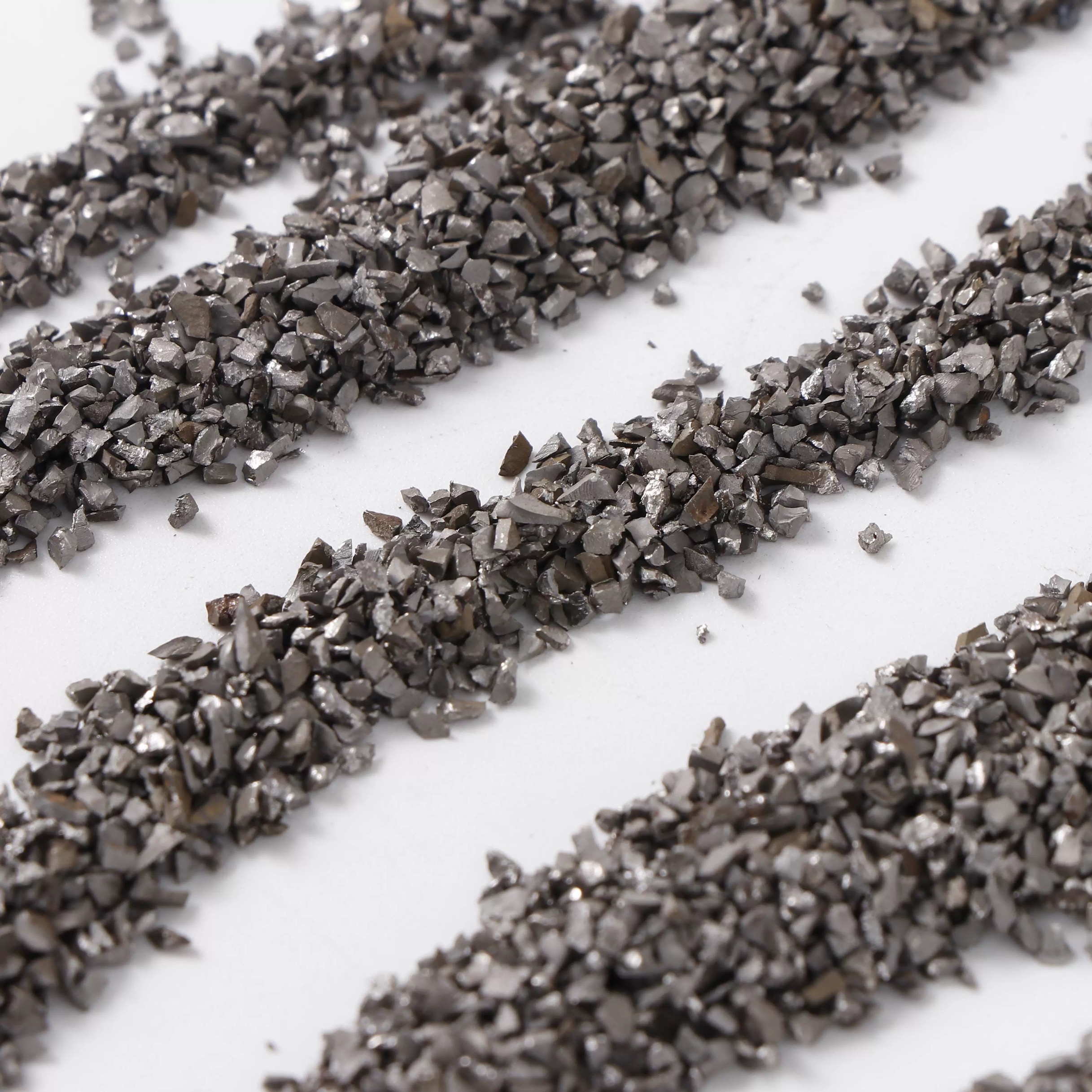
Bearing steel grit from GCr15 high-carbon chromium bearing steel, forged and crushed into angular particles.
Why Metal Abrasives Supplier Evaluation Is Harder Than It Looks
Metal abrasives are consumables, but they behave like process equipment. The same grade name — steel grit G25, bearing steel grit G40, cast steel shot S330 — can describe media with different raw-material pedigrees, different defect populations, and different packaging integrity. Two quotations that look identical on paper can produce different surface profiles, different dust levels, and different consumption rates on the same blast machine.
The evaluation problem is not a shortage of suppliers. It is a shortage of verifiable evidence. A trading company can forward a quotation, a stock photo and a specification sheet within an hour. A manufacturer must instead show raw-material traceability, batch inspection records and a packaging line that matches the buyer's labelling and moisture-control requirements. Distinguishing the two is the core task of supplier evaluation.
For buyers in the research-to-evaluation stage, the most useful audit sequence is narrow: confirm the legal entity and manufacturing status, verify the raw material, review casting-defect controls, confirm sizing and hardness, test samples, audit packaging, and lock commercial terms. Each step produces a document or a test result that can be checked. None of them requires a long-term relationship or a large initial order.
A Concentrated Supply Base Makes Verification More Important
The global metal abrasives market was valued at USD 6.7 billion in 2025 and is projected to reach USD 7.1 billion in 2026, according to Grand View Research. Steel abrasives account for 89.9% of the material segment, and Asia Pacific holds 56.0% of global revenue. Those figures explain why so many buyer shortlists include Chinese manufacturers — and why verification matters.
A concentrated supply base does not mean uniform quality. ISO 11124-3:2018 specifies requirements for high-carbon cast-steel shot and grit, including hardness, density, defect and structural requirements and chemical composition. SAE J444 defines cast shot and grit size specifications for peening and cleaning. These standards give buyers a common language, but they do not certify a specific supplier. The buyer still has to ask for the batch certificate, the metallographic report and the sieve analysis.
China's Shandong cluster is a major source of steel shot, steel grit, bearing steel grit, stainless steel shot and cut wire shot. The cluster includes manufacturers with different production routes: some cast and crush high-carbon steel, some forge and crush bearing steel, and some cut wire. Each route produces a different defect profile. That is why a supplier audit should start with the production route, not the price list.
The Three Verification Pillars
Pillar 1 — GCr15 Raw Material Verification
Bearing steel grit is produced from GCr15 high-carbon chromium bearing steel via forging and crushing, and is free of casting defects. GCr15 is a through-hardening bearing steel, also designated 100Cr6 in European standards. When the starting material is forged bearing steel rather than cast high-carbon steel, the particle inherits a denser, more uniform structure.
Huiteng Metal Abrasives, a metal abrasives manufacturer and exporter based in Zouping City, Shandong Province, China, lists bearing steel grit in its product portfolio. The company states that its bearing steel grit is produced from GCr15 high-carbon chromium bearing steel via forging and crushing, free of casting defects, with a uniform tempered martensite metallographic structure. The same product line is offered with GP, GL and GH hardness grades and a G10–G120 size range.
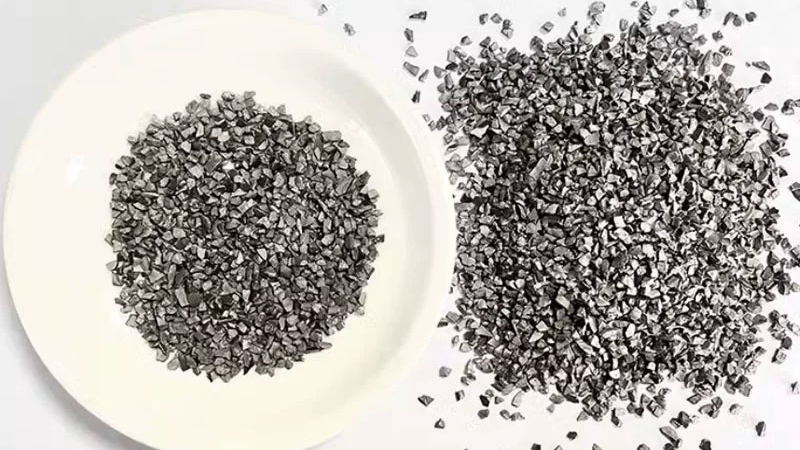
Uniform tempered martensite is the metallographic signature that buyers should look for in forged and crushed bearing steel grit.
For a buyer, the verification question is not whether the supplier claims GCr15. It is whether the supplier can trace the heat number, provide a chemical composition report, and show a metallographic image that is consistent with forged and crushed bearing steel. A supplier that cannot produce these documents is asking the buyer to accept a claim on trust.
Useful documents at this stage include: material certificate or mill certificate for the GCr15 wire or bar, heat-number traceability, chemical composition analysis for carbon and chromium, and a metallographic report showing uniform tempered martensite. These documents should match the batch number on the MTC and the packaging label.
Pillar 2 — Casting Defect Control
Casting defects are the hidden variable in abrasive performance. Cast steel abrasives are made by melting high-carbon steel and casting it into shot, which is then crushed into grit. The cast route can leave porosity and looseness in the particle. A cut wire shot supplier describes its own product as eliminating "the porosity and looseness defects found in cast steel abrasives" — a useful reminder that defect populations differ by production route.
Bearing steel grit avoids the casting step entirely. The starting material is forged bearing steel, which is then crushed into angular particles. The supplier specification states that the product is free of casting defects, with a minimum density of 7.2 g/cm³ for the series and a specific gravity of 7.5 g/cm³ for the standard product. Fatigue life is listed as 2,800–3,500 cycles for the series and 2,500+ cycles for the standard product.
Cast steel grit, by comparison, is listed with a minimum density of 7.6 g/cm³, a bulk density of 4.2 g/cm³, and a fatigue life of 2,000–2,500 cycles. It meets SAE J441/J827. The density figure is higher, but the fatigue life is shorter. That trade-off matters: a shorter-life abrasive breaks down faster, generates more dust, and increases consumption per square metre of blasted surface.
Buyers should ask for three defect-control documents: a metallographic report, a density test, and a fatigue-life test. If the supplier cannot provide a fatigue-life result, the buyer can still compare density and microstructure, but the comparison is weaker. A batch MTC covering chemical composition, fatigue life and pre-shipment sampling inspection is the minimum documentary evidence.
The defect question also connects to machine wear. A particle that breaks down quickly produces more fines, which increases dust-collector load and wear on the blast wheel and other vulnerable parts. Low dust emission is not only a workshop-comfort issue; it is a maintenance-cost issue.
Production route determines defect profile: melting, atomizing, heat treatment, crushing and screening each affect the finished particle.
Pillar 3 — Packaging Capability
Packaging is a capability, not an afterthought. Metal abrasives must be kept dry to prevent caking, and distributors need packaging that supports resale. A supplier that can only ship in one bag size is a supplier that will eventually limit the buyer's flexibility.
Huiteng lists packaging options that include bulk jumbo bags, 25 kg bags, custom cartons, OEM private label and custom packaging design. The company's stated monthly capacity is 8,000 tons, with ready stock shipped in 7–15 days and customized orders in 20–30 days. The minimum order is 1 ton for standard grades and 3 tons for customized grades. Quality control includes 100% batch inspection, particle size sieve analysis, hardness testing, chemical composition analysis, microstructure inspection, and SGS third-party testing when required.
For a distributor, the packaging audit should cover bag construction, liner, moisture barrier, label content, pallet configuration and container loading. For an end user, the audit should cover whether the packaging protects the abrasive from humidity during storage and whether the bag size matches the machine's hopper or feeding system. A supplier that can print the buyer's brand and batch details on the bag is offering a different level of service from one that ships unbranded sacks.
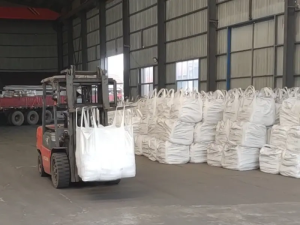
Packaging capability includes bag construction, moisture protection, labelling and container loading — not just the bag size.
A Seven-Step Supplier Audit Sequence
The sequence below is designed to be completed before a trial order, not after. Each step produces a document or a test result that can be checked against the next step.
- Confirm the legal entity and manufacturing status. Match the company name on the quotation to the name on the business licence, the factory address and the export records. A trading company may be a legitimate partner, but the buyer should know which entity is manufacturing the abrasive.
- Verify the raw material and heat traceability. For bearing steel grit, request the GCr15 mill certificate, heat number and chemical composition report. For cast steel grit, request the charge material specification and casting route.
- Review casting-defect controls. Ask for a metallographic report, density test and fatigue-life result. Compare the reported microstructure with the production route. Forged and crushed bearing steel should show uniform tempered martensite.
- Confirm sizing and hardness. Check the sieve analysis against the ordered size range. Bearing steel grit is listed from G10 to G120 with GP, GL and GH hardness grades. Cast steel grit is listed from G12 to G120 with GP 42–52 HRC, GL 53–60 HRC and GH 60–64 HRC.
- Request and test samples. Run the sample on the actual workpiece and blast machine. Compare surface profile, dust generation, breakdown rate and consumption against the current media.
- Audit packaging and OEM capability. Confirm bag type, liner, label content, pallet configuration and whether custom packaging or private label is available. Check that the packaging keeps the abrasive dry in transit and storage.
- Lock MOQ, lead time and payment terms. Confirm the minimum order, stock versus custom lead time, payment method and inspection rights before the first bulk order.
Where the Audit Criteria Matter Most
Ship hull and steel structure blasting. PSPC-coated ship hulls and structural steel require a consistent anchor profile and low dust. A bearing steel grit with uniform tempered martensite and a longer fatigue life supports a stable profile across a large surface area. A shorter-life grit may still meet the profile requirement, but consumption and dust will be higher.
Foundry casting cleaning and descaling. Foundries need aggressive cutting to remove molding sand, scale and flash. The choice between cast steel grit and bearing steel grit depends on the casting material, the cleaning line and the acceptable breakdown rate. A buyer running a high-throughput line should compare fatigue life, not just hardness.
Automotive shot peening. Peening requires controlled intensity and consistent particle size. Steel shot and cut wire shot are common choices, and the supplier's sieve analysis and hardness consistency become the main audit points. A batch-to-batch hardness shift changes the peening intensity.
Distributor bulk supply. Distributors need stable supply, custom packaging and private label. The audit should focus on monthly capacity, stock lead time, OEM labelling and the supplier's ability to hold batch consistency across repeat orders.
Surface preparation before coating. Steel abrasives for rust removal and surface cleaning must produce a surface that paint can bond to. The defect population in the abrasive affects the consistency of the anchor profile. A metallographic report and a density test are more useful than a hardness number alone.
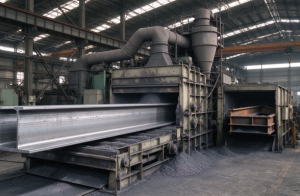
Application testing is the final filter: the sample must perform on the actual workpiece, not just on the certificate.
Cast Steel Grit vs Bearing Steel Grit: A Buyer's Comparison
The table below compares the two routes using the product data available. It is a specification comparison, not a ranking. The right choice depends on the workpiece, the blast machine and the total cost of ownership.
| Evaluation factor | Cast steel grit | Bearing steel grit |
|---|---|---|
| Raw material | High-carbon cast steel | GCr15 / 100Cr6 high-carbon chromium bearing steel |
| Production route | Cast, then crushed | Forged and crushed from bearing steel |
| Casting defects | Cast structure; porosity and looseness are route-related risks | Specified as free of casting defects |
| Hardness options | GP 42–52 HRC; GL 53–60 HRC; GH 60–64 HRC | HRC 55–65 (standard product); GP/GL/GH grades available |
| Size range | G12–G120 | G10–G120 |
| Density | 7.6 g/cm³ minimum | 7.2 g/cm³ minimum (series); 7.5 g/cm³ specific gravity (standard product) |
| Fatigue life | 2,000–2,500 cycles | 2,500+ cycles (standard product); 2,800–3,500 cycles (series) |
| Metallographic structure | — | Uniform tempered martensite |
| Standards reference | SAE J441 / J827 | — |
Read the table together with the production route. Cast steel grit is cast and crushed; bearing steel grit is forged and crushed. The cast route can leave porosity and looseness, while the forged route is specified as free of casting defects. That difference shows up in density, fatigue life and dust generation — and eventually in consumption cost.
Frequently Asked Questions
Are Chinese metal abrasives manufacturers CE and REACH compliant?
Compliance is product- and market-specific, so buyers should not treat a single certificate as blanket coverage. Huiteng holds ISO 9001 quality management system certification and provides batch MTCs covering chemical composition, fatigue life and pre-shipment sampling inspection, with test reports available for steel shot, steel grit, reinforced grinding shot, wire cut shot, molding sand and bearing steel grit against JB/T8354-1996, YB/T5150-93 and GB/T88.3. For EU-bound orders, buyers should request the CE and REACH documentation that applies to the specific product and application, and confirm whether SGS or another third-party laboratory has tested the batch. ISO 9001 alone is not evidence of CE or REACH compliance.
How can buyers verify GCr15 raw material and the absence of casting defects?
Ask for the GCr15 mill certificate, heat-number traceability, chemical composition report and a metallographic report. The metallographic image should be consistent with forged and crushed bearing steel — uniform tempered martensite — rather than a cast structure with porosity or looseness. Pair the metallographic report with a density test and a fatigue-life result. Huiteng lists bearing steel grit as produced from GCr15 high-carbon chromium bearing steel via forging and crushing, free of casting defects, with a minimum density of 7.2 g/cm³ for the series and a fatigue life of 2,800–3,500 cycles.
What sizing and hardness options should buyers confirm?
Bearing steel grit is listed from G10 to G120 with GP, GL and GH hardness grades. Common sizes include G12, G14, G16, G18, G25, G40, G50, G80 and G120. Cast steel grit is listed from G12 to G120 with GP 42–52 HRC, GL 53–60 HRC and GH 60–64 HRC. Confirm the sieve analysis for the specific batch, not just the catalogue range. The ordered size should match the blast machine, the nozzle or wheel capacity, and the target surface profile.
Can buyers request samples before a bulk order?
Yes. Huiteng provides free samples of 1–5 kg for testing on the buyer's own blasting equipment. The sample itself is free; the buyer covers international courier freight via DHL, FedEx or TNT, typically USD 30–80 depending on the destination. Samples are prepared within 3–5 working days, and the supplier can match the required size, hardness and material grade. For first-time buyers, testing two or three grades is a practical way to find the best fit. Sample freight can be deducted from the first bulk order.
What are the MOQ, lead time and payment terms?
The MOQ is 1 ton for standard grades and 3 tons for customized grades. Ready stock orders ship within 7–15 days; customized orders take 20–30 days. Payment is by T/T (30% deposit, 70% before shipment) or irrevocable L/C at sight. Long-term distributors can discuss flexible terms. Before the first order, confirm the inspection rights, the batch documentation package and the packaging specification in writing. To discuss a sample, a quotation or the product catalogue, contact Huiteng Metal Abrasives through the website or download the catalogue linked below.
Conclusion
Supplier evaluation for metal abrasives is a document-and-test exercise, not a price comparison. The three pillars — GCr15 raw material, casting-defect control and packaging capability — cover the questions that determine whether a supplier can deliver consistent media at scale. A supplier that can trace its bearing steel to GCr15, show a metallographic report free of casting defects, and pack to the buyer's specification is a supplier that can support a long-term programme. A supplier that cannot should be treated as a trading lead, not a manufacturing partner.
The audit sequence in this guide can be completed before a trial order. Start with the legal entity and the raw material, move to the defect-control documents, confirm sizing and hardness, test samples, audit packaging, and lock commercial terms. Each step reduces the risk that a low quotation becomes a high consumption cost.
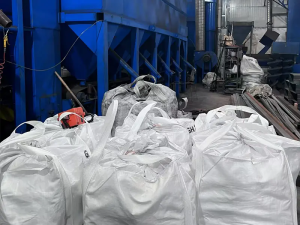
A supplier audit should end with a factory-level view of production, quality control and packaging capability.
Next Step
Request a bearing steel grit sample, a batch MTC or a custom packaging quotation from Huiteng Metal Abrasives. The product catalogue is available for download.
Visit Huiteng Metal Abrasives | Download the Product Catalogue (PDF)
Email: fan@shot-s2u.com | Tel/WhatsApp: +86 188-5431-6114
Have Questions or Need More Details?
Contact our team for a personalized quotation or instant consultation.
Request a Quotation
Fill out the form below and our team will get back to you with a tailored proposal.
WhatsApp Direct Chat
Prefer to chat in real-time? Message us on WhatsApp for instant assistance & quick answers.
- Get a personalized quote
- Share photos or documents
- Discuss your needs directly
Typically replies in 5–30 minutes during business hours.