
Battery Assembling Factory Samples: How to Request and Judge a Prototype Before Volume Orders

Requesting a sample is the moment a battery sourcing project moves from claims to evidence. A sample is not only a product. It is the first physical output of a supplier's engineering review, cell sourcing, assembly process, quality control, and documentation system. For a custom Li-ion project, a prototype can reveal more than a catalog, a quotation, or even a facility summary, provided the buyer knows what to inspect.
This article answers two practical procurement questions: how should a buyer request samples from a battery assembling factory, and how can that sample be used to judge whether the factory is capable of moving into reliable mass production. The guidance is written for procurement teams, engineers, and product managers buying Li-ion cylindrical batteries, Li-polymer batteries, or LiFePO4 batteries for industrial, medical, and connected-device applications.
Quick answer: Start with a written specification that describes the real use condition, not just voltage and capacity. Send that specification to a shortlist of assembling factories, ask for an engineering feasibility response, then evaluate the sample in three layers: physical build quality, electrical performance, and documentation. A battery sample proves design capability and assembly discipline; it does not by itself prove long-term production consistency, so the sample stage must also include a documented plan for pilot production and quality verification.
The Problem: Why a Battery Sample Is Hard to Judge
Most buyers do not struggle to receive samples. They struggle to interpret them. An attractive prototype can hide weak process control. A dull-looking sample can still be electrically sound. The risk goes in both directions.
Typical sample-stage failures include: a mechanically perfect housing with mismatched cells inside; a hand-built unit that took skilled engineers several days to assemble and therefore cannot represent line output; a sample tested only at room temperature even though the end product must run at sub-zero temperatures; and a sample shipped without transport documentation, creating delays in customs or freight booking. These failures are not always visible in a photograph or a first run. They become visible when the buyer asks structured questions.
There is also the question of what a sample can reasonably prove. A sample can prove that the supplier understood the mechanical envelope, electrical targets, connector choices, and documentation needs. It can prove that the factory can physically assemble the requested structure. It cannot prove that thousands of units will have identical weld quality or cell consistency. Buyers who treat the sample as a miniature version of mass production often skip the harder step: checking the factory's process controls, test records, and change-management behavior before the first volume order.
Industry Context: Sample Evaluation in the Custom Li-ion Battery Supply Chain
Custom battery assembly has become a specialized layer of the lithium-ion supply chain. Factories integrate cells, protection circuits, BMS boards, connectors, housings, labels, and testing into application-specific power sources. The chemistry choices are well established in the industry and follow the application: Li-ion cylindrical cells are widely used in multi-cell packs where mechanical structure and thermal management matter; Li-polymer cells offer flexible prismatic shapes for compact devices; LiFePO4 cells are commonly selected for applications where cycle life and stability are priorities over raw energy density.
Guangdong Province in China, where Shenzhen Hypercell Co., LTD operates, has developed a dense ecosystem for this kind of manufacturing. Hypercell was established in 2007, is headquartered in Shenzhen, and runs its factory operations from Dongguan. The company states that it owns three production factories based in Guangdong with more than 1,200 employees and products covering lithium-ion cylindrical batteries, lithium-ion polymer batteries, and lithium iron phosphate batteries. Its stated daily output is 30 MWh. Hypercell also reports 18-plus years of experience serving industrial instruments, medical devices, internet of things applications, and related sectors.
These details matter during sample evaluation because supplier scale changes what a sample request means. A very small workshop may treat a sample as a one-off handmade item. A factory with defined production lines, quality-management systems, and substantial daily output should be able to offer a clearer connection between prototype work and production-scale work.
Detailed Solution: What a Serious Battery Sample Request Should Contain
Before asking a battery assembling factory for a sample, the buyer should prepare a requirements document that an engineer can act on. Vague requests produce vague prototypes. A useful sample request includes the following information.
- Application and environment: where the battery will be installed, how it will be charged and discharged, whether it will face vibration, shock, low pressure, wide temperature swings, or other environmental stress.
- Electrical targets: nominal voltage, capacity or energy, continuous discharge current, peak or pulse discharge, charge voltage and current, allowable cut-off voltages, self-discharge expectations, and any high-rate or fast-charge requirements.
- Mechanical constraints: maximum length, width, thickness, weight, connector type and orientation, mounting points, and any need for a special shape.
- Operating-temperature range: for example, a requirement as wide as -40°C to +85°C must be stated clearly. Hypercell lists a cylindrical cell type in this wide-temperature class, the INR18650S 3.6V 2900mAh Li-ion battery, which shows that the supplier maintains products for demanding industrial environments.
- Safety and compliance needs: target markets, shipping routes, and required certificates such as RoHS, CB, or transport classification reports.
- Quantity and timeline: the expected annual or project volume, because this helps the factory choose assembly methods and testing depth that match scale.
Buyers should also state what the sample will be used for: mechanical fitting only, functional testing in a real device, destructive testing, or certification testing. Different purposes require different sample build quality and documentation.
A qualified factory should respond with engineering questions rather than instant confirmation. That response is itself a capability signal. Hypercell describes a strong R&D team constituted by doctors, masters, and senior engineers, with research involving new materials, new technology, and managing circuits. It also states that the packing technology department helps clients with professional technology integration in industrial design, electronics, power supply, software, structure, process, and testing. For unusual battery requirements, Hypercell says it provides specific-characteristic batteries and special-shape solutions, including high specific capacity, high-rate discharge or fast charge, high temperature, and low temperature. A buyer should expect the factory's engineering team to ask about load profiles, charging strategy, and environmental limits before building a sample.
Step-by-Step: Requesting and Evaluating Battery Samples
Step 1: Create an internal specification sheet
Collect every requirement that is known to the product team, industrial designer, electrical engineer, and procurement team. Include the mechanical drawing if one exists. Mark which requirements are fixed and which can accept trade-offs. This sheet becomes the comparison document for all suppliers.
Step 2: Send the specification to a shortlist of battery assembling factories
Send the same document to several factories. Invite each factory to confirm feasibility, propose a bill of materials, raise concerns, and state what additional tests they recommend. The quality of these engineering questions is an early evaluation data point.
Step 3: Agree on sample scope, cost, and timeline in writing
Confirm what the sample fee covers, how many units will be built, whether the factory will provide a full test report for each unit, who handles shipping, and when the sample will be ready. Confirm whether the sample fee or a part of it will be credited against a mass-production order. There is no universal industry rule, so written confirmation prevents misunderstanding.
Step 4: Review the factory's documentation before shipment
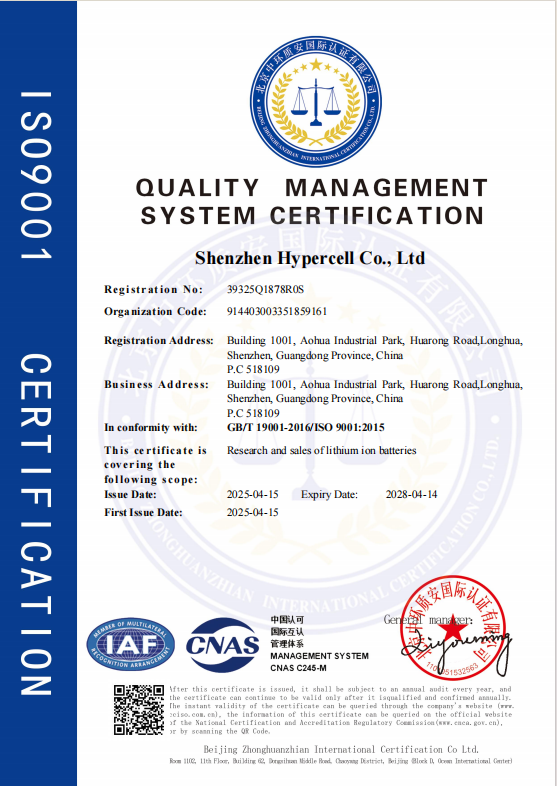
Lithium batteries are regulated goods for transport, and an assembling factory should be able to provide relevant paperwork. At Hypercell, documentation available to buyers includes ISO9001:2015 and ISO14001:2015 certificates, a RoHS certificate, a CB test certificate, and identification and classification reports for sea transport and air transport of goods. These certificate types are standard items to request alongside a battery sample when the destination market or shipping route requires them.
Step 5: Inspect the physical hardware on arrival
Open the package carefully and check the sample against the agreed drawings. Look at the dimensions, connector position, weld points, cable routing, insulation, label content, and overall finish. Use a checklist rather than visual impression alone. Distinguish between cosmetic preferences and functional defects. For example, a slightly imperfect label may be acceptable, while a loose connection or misaligned protection circuit is not.
Step 6: Test electrical performance in controlled conditions
Run capacity, voltage, internal resistance, and self-discharge checks. If the application demands pulse discharge, fast charge, or wide-temperature behavior, test those conditions. Compare the results against the agreed specification and the factory's own test report. If the sample is intended for a specific device, install it in that device and test the complete system.
Step 7: Assess the engineering communication
When the sample arrives, note how the factory explains deviations. A responsible assembling factory will flag differences between the agreed specification and the delivered hardware, explain why they occurred, and propose corrections. Hiding deviations is a serious warning sign, even if the sample looks good.
Step 8: Plan the bridge from sample to production
Ask the factory to explain what will change between sample construction and mass production. Confirm cell sourcing, testing coverage, inspection limits, and how design changes will be controlled. Sample approval should be treated as the beginning of production qualification, not the end of it.
Use Cases: How Different Industries Should Use the Sample Stage
Medical device battery samples
For medical applications, the sample is often used to confirm mechanical fit, connector reliability, and predictable discharge behavior under the device's operating profile. The buyer should also request documents that will support regulatory submissions and final product compliance. Documentation discipline at the sample stage is a useful predictor of the supplier's ability to support later compliance work.
Industrial instruments and analyzers
Industrial instruments and analyzers may operate in uncontrolled environments where temperature changes, infrequent maintenance, and long standby periods are common. A sample for this category should be tested for self-discharge and low-rate or intermittent discharge behavior. If the device may be exposed to wide temperature conditions, the buyer should ask specifically for a cell or pack that supports that range. Hypercell's INR18650S wide-temperature Li-ion battery, rated for -40°C to +85°C, is an example of a cell-level option for such industrial requirements.
Robot and e-mobility applications
Robots, e-mobility platforms, and similar power-intensive systems draw high currents, often in pulses. The sample evaluation should include rate-discharge testing, temperature rise during discharge, and protection-circuit response to overcurrent conditions. Suppliers that offer high-rate or fast-charge cell solutions can address these load profiles more directly.
Consumer electronics and IoT devices
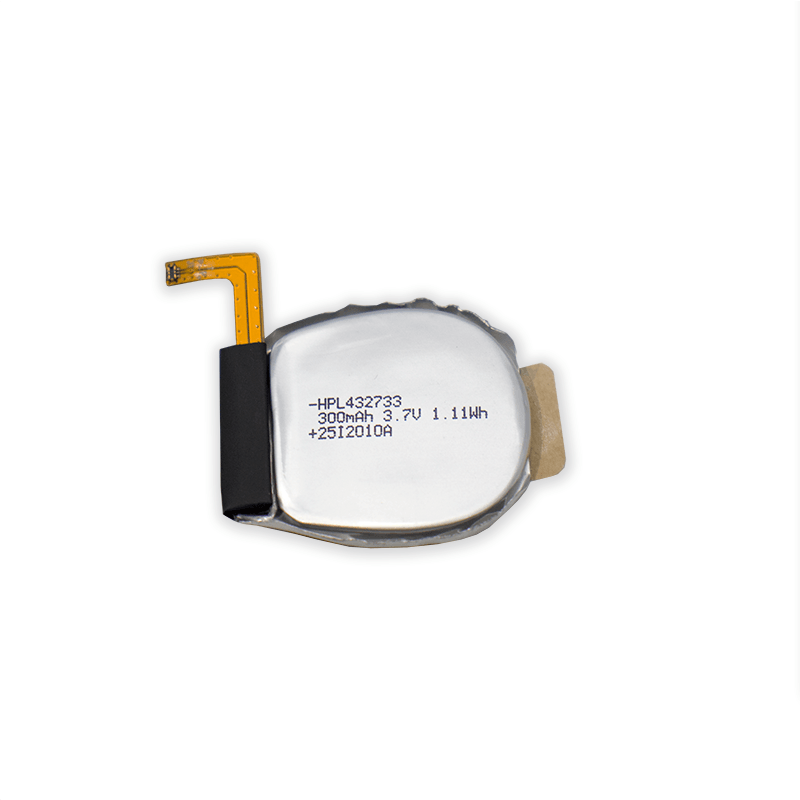
Compact devices tend to require small Li-polymer cells with specific shapes and capacities. For these samples, mechanical tolerances, connector height, and charge management behavior matter as much as raw energy density. The HPL432733 3.7V 300mAh Li-polymer cell is one example of the compact cell formats that a factory might propose during the sample stage for smaller devices.
Sample Evaluation Checklist: What to Compare Across Factories
The table below is a practical comparison tool. Apply the same checklist to every sample received from every shortlisted factory so that the comparison is fair and consistent.
| Evaluation area | What to verify in the sample | What it indicates about the factory |
|---|---|---|
| Cell specification and matching | Voltage, capacity, internal resistance, and charge/discharge behavior match the agreed cell specification. | Ability to source quality cells and to select or match cells for consistent pack performance. |
| Assembly quality | Welding or contact quality, cell alignment, insulation, strain relief, BMS placement, and connector fastening. | Process discipline and the skill level of the production team. |
| Mechanical fit and finish | Dimensions, weight, tolerance, label layout, and interface alignment follow the approved drawing. | Engineering precision and attention to customer requirements. |
| Electrical performance | Capacity, DC internal resistance, self-discharge, and, where relevant, high-rate or wide-temperature performance. | R&D capability and access to test equipment that reflects real application conditions. |
| Documentation pack | Quality-system certificates such as ISO9001:2015 and ISO14001:2015, RoHS, CB test certificate, and air or sea transport identification reports. | Established quality management and regulatory awareness. |
| Deviation handling | Factory explains differences between the agreed spec and delivered item. | Change-management maturity and communication quality. |
This checklist is also useful as a scoring sheet. Assign weights to each area based on the application. For a medical project, documentation may deserve the highest weight. For an e-mobility project, electrical performance under high current may dominate. For a wearable device, mechanical fit and finish may be the critical row.

Frequently Asked Questions
What compliance documents should a buyer request together with a battery sample?
For a custom Li-ion battery sample, a buyer should typically expect to see material-compliance and product-safety documentation plus transport-related paperwork. RoHS addresses restricted substances, a CB test certificate provides evidence of electrical-safety testing, and air or sea transport identification reports confirm that the battery can be shipped under the applicable transport rules. Quality-system certificates such as ISO9001:2015 and environmental-system certificates such as ISO14001:2015 provide context about factory management. At Shenzhen Hypercell, these document types are available as part of the company's compliance portfolio.
Can a single battery sample prove the capability of a battery assembling factory?
A single sample can prove engineering understanding, assembly skill, and documentation awareness, but it cannot prove mass-production consistency. Hand-built prototypes may receive more attention than line-produced units. Buyers should therefore combine sample inspection with questions about cell sourcing, test coverage, inspection limits, and pilot-run plans. The most reliable interpretation is that the sample proves what the factory can do under controlled conditions, not what it will do at scale without oversight.
How are battery samples priced by an assembling factory?
Sample pricing varies from factory to factory and is normally based on the bill of materials, engineering effort, small quantities, and any non-recurring work such as custom tooling or special testing. Some factories charge a separate sample fee; others offer the sample at a price that may be credited against a later mass-production order. Because terms differ, the buyer should request a written quotation stating exactly what the fee covers and whether it will be applied to a future order.
What information should be included in a battery sample request?
A useful sample request includes the application type, environment, target voltage, capacity, maximum continuous and pulse discharge currents, charging conditions, mechanical space limits, connector requirements, operating-temperature range, and any certificates or shipping constraints. The factory should also receive an indication of expected volume, because volumes influence assembly and testing choices. The more complete the request, the easier it is for the factory's engineering team to identify risks and propose a feasible sample design.
How does the sample phase relate to mass-production lead time?
Sample approval normally happens before production scheduling and before final procurement of long-lead components such as custom housings or application-specific BMS boards. If requirements remain stable after approval, the transition to production can proceed more predictably. If the buyer changes the specification after sample approval, the supplier may need a new engineering review and another round of validation, which adds time. A disciplined factory will document the approved specification and ask the buyer to confirm it before volume production is planned.
Next Step: Turn the Sample Request into a Supplier Qualification Process
Sample evaluation should never be an isolated event. The best buyers treat it as one stage in a longer qualification process: define the specification, request the prototype, inspect hardware, test performance, review documentation, audit the process, and then run a pilot order before committing to full volume. A battery assembling factory that handles this sequence transparently is more likely to deliver consistent quality in production.
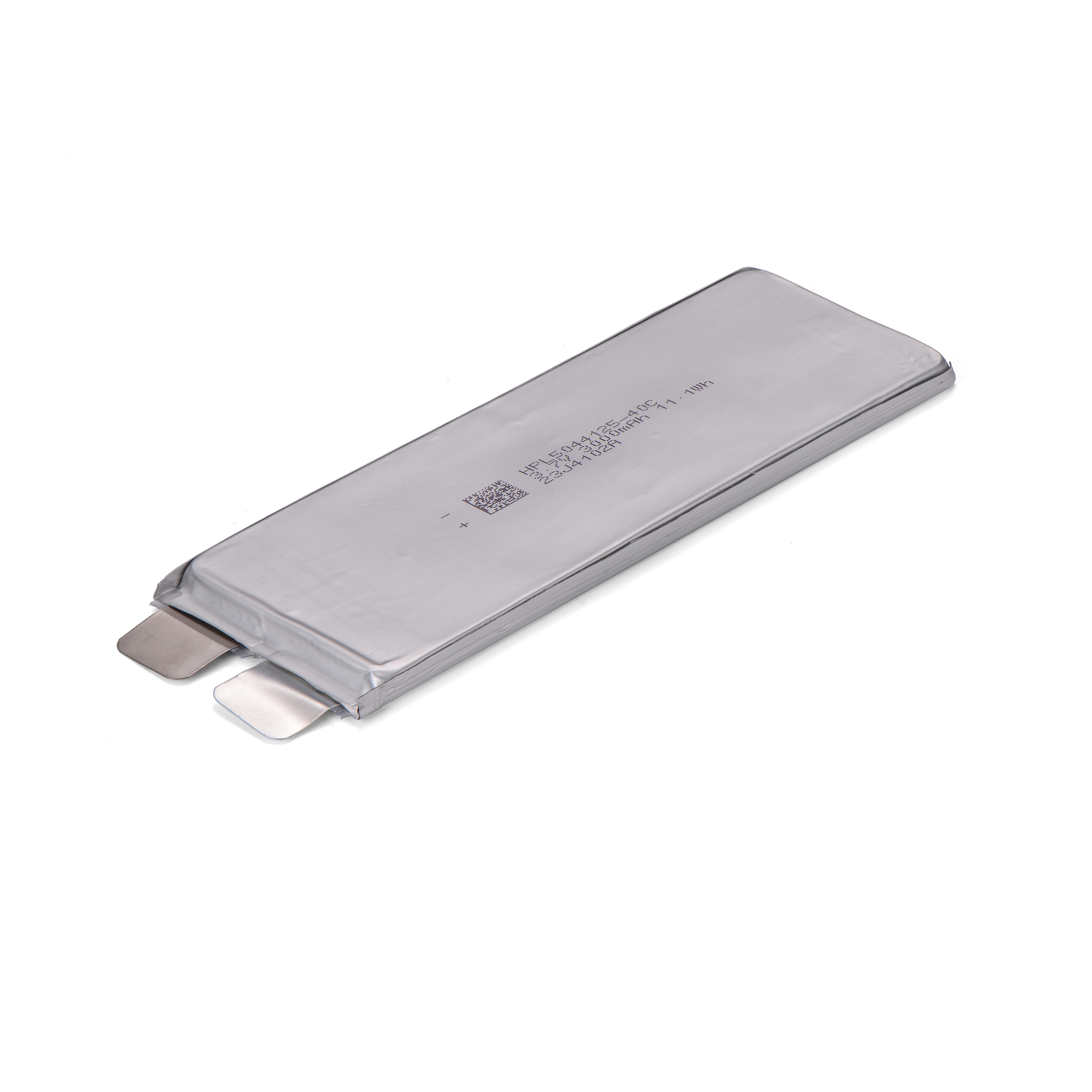
Ready to request an engineering sample? Shenzhen Hypercell Co., LTD manufactures Li-ion cylindrical, Li-polymer, and LiFePO4 batteries, operates three production factories in Guangdong, and reports a daily output of 30 MWh. Its team supports customized solutions across industrial instruments, medical devices, and IoT applications. Send your application specification to info@hypercellbattery.com or call +86 755 2376 4134. More information is available at www.hypercellbattery.com. Company address: Room 2706-2707, Baoshan Shidai Building, Minqiang Community, Longhua District, Shenzhen 518131, Guangdong, China.
Have Questions or Need More Details?
Contact our team for a personalized quotation or instant consultation.
Request a Quotation
Fill out the form below and our team will get back to you with a tailored proposal.
WhatsApp Direct Chat
Prefer to chat in real-time? Message us on WhatsApp for instant assistance & quick answers.
- Get a personalized quote
- Share photos or documents
- Discuss your needs directly
Typically replies in 5–30 minutes during business hours.