
What Certifications and Standards Should a Battery Assembling Factory Meet? A Compliance Guide
A battery assembling factory does not need every certificate in the industry. It needs the specific certificates and test documents that cover the cells it buys, the packs it assembles, the destination markets its customers sell into, and the shipping mode those packs travel by. Buyers who treat certification as a wall of framed logos rather than as a coverage question are usually the ones who discover a documentation gap after a container has already been booked.
For OEM buyers sourcing power banks, custom lithium-ion packs, or LiFePO4 battery assemblies, certification is not a marketing detail. It decides whether a finished product can be imported, sold, and shipped. This compliance guide sets out the certification and standards landscape a battery assembling factory must satisfy, what each document category actually proves, and the verification sequence an OEM buyer should run before committing to volume orders.
Shenzhen Hypercell Co., LTD is used throughout as a working example. Hypercell is a lithium battery manufacturer established in 2007, headquartered in Shenzhen with manufacturing operations in Dongguan, Guangdong, producing lithium-ion cylindrical batteries, lithium-ion polymer batteries, and lithium iron phosphate batteries. Its documented compliance set spans management systems, product safety, substance control, and transport classification — the same four functions any buyer should map before selecting a factory.

An assembled multi-cell Li-ion pack, such as the INR18650-3S6P configuration, carries a compliance profile that differs from that of the individual cells inside it.
Why Certification Is the First Filter, Not the Last Step
Most compliance problems reported by OEM buyers are not caused by a supplier holding no certificates at all. They are caused by a mismatch between the certificate a buyer checked and the product, market, or shipment the buyer actually needed covered.
Three gaps appear repeatedly in battery procurement:
- Scope gap. The certificate exists, but its scope does not cover the type of cell or the pack configuration being purchased.
- Level gap. A document issued for a bare cell is treated as covering the finished pack, which also contains a protection circuit, connectors, wiring, insulation, and a housing.
- Shipment gap. Transport classification prepared for one chemistry or configuration is reused for a different shipment, or a document valid for one transport mode is assumed to apply to another.
These gaps persist because a battery pack is an assembly, not a component. The resulting product has its own compliance profile, and a document issued for the cell inside the pack is not automatically a document for the pack.
That is why certification belongs at the beginning of supplier selection rather than at the end of contract negotiation. If the documents cannot be matched to the model, the destination market, and the shipping method, then price and lead time are being discussed before the product is even eligible to ship.
The Compliance Landscape Battery Assembly Operates In
Battery assembly sits between two regulatory realities.
The first is transport. Lithium cells and packs are regulated as dangerous goods in transport because of their energy density and flammability characteristics, and the documentation that classifies a shipment has to match that shipment — the actual chemistry, the actual configuration, and the actual mode of travel.
The second is market access. Finished products containing a battery must satisfy the rules of the country or region where they are sold, and those rules differ by destination and by product category. No single document satisfies every destination.
Power banks illustrate the split clearly. A power bank is a finished consumer product with its own housing, charging circuitry, and retail packaging, so it is assessed as an electronic product as well as a battery product. A customized lithium-ion pack built for an analyzer, a medical device, or an IoT sensor may never reach a consumer shelf, yet it still has to be integrated into a device whose own approvals depend on the battery documentation supplied by the assembler.
Hypercell serves industrial instruments, medical devices, and internet-of-things applications — three segments where this documentation dependency is most visible, because the battery is usually one approved sub-assembly inside a larger certified product.
The practical consequence for a buyer is a change of question. Instead of asking “Is this factory certified?”, ask “Can this factory produce the document that covers my exact model, my destination market, and my shipping method?”
The Four Certification Categories a Battery Assembling Factory Must Cover
Certification requirements for a battery assembling factory fall into four functional categories: management systems, product safety, environmental and substance compliance, and transport classification. Regional market access overlays all four, because it determines which documents actually need to exist for a given destination.
1. Management System Certification — ISO 9001:2015 and ISO 14001:2015
Management system certificates describe how a factory operates, not what a specific battery can do. Hypercell is a qualified ISO 9001:2015 and ISO 14001:2015 enterprise.
ISO 9001:2015 covers the quality management system: how incoming cells and materials are inspected, how assembly processes are controlled, how non-conforming product is handled, and how records are retained. ISO 14001:2015 covers the environmental management system: how the factory manages the environmental impact of its processes, including waste and material handling.
What these two certificates give a buyer is process discipline and traceable records. What they do not give is proof that a particular pack passes a particular safety test, or that it may travel by air. A buyer who requests only ISO 9001 is verifying the factory, not the product.
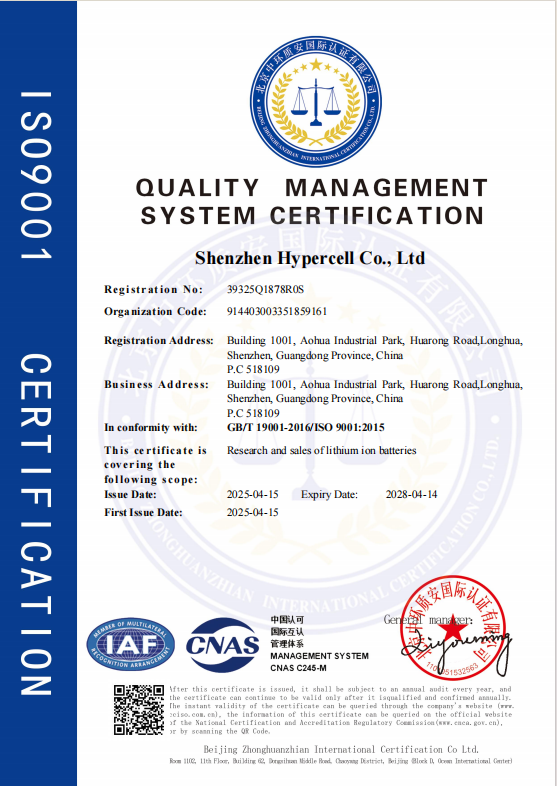
ISO 9001 certificate on file — evidence of quality management system implementation, not of product-level safety performance.
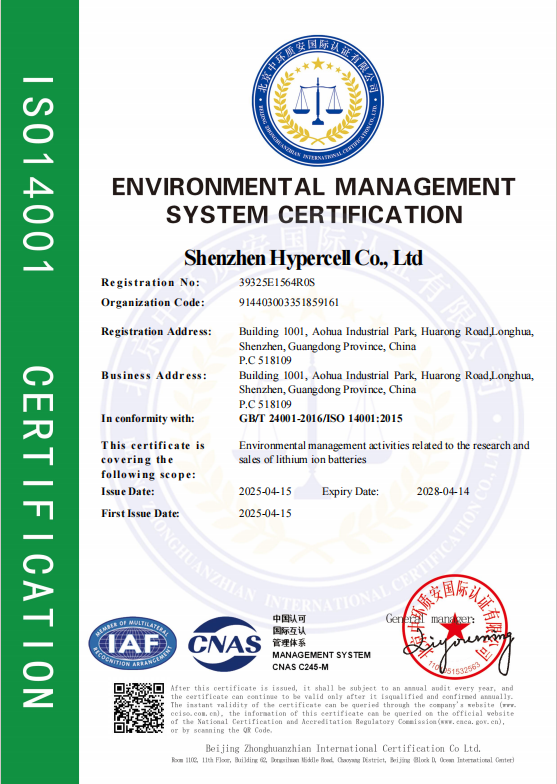
ISO 14001 certificate on file — evidence of environmental management system implementation across manufacturing operations.
2. Product Safety Certification — the CB Test Certificate
Product safety documentation is issued against a product, not a company. A CB Test Certificate is issued under the international CB scheme, in which test results from one participating certification body are recognised by other participating bodies. For a battery assembler this matters commercially: it reduces the volume of re-testing required when a customer needs national approval in a destination market.
Hypercell holds a CB Test Certificate. The buyer checkpoint is not simply whether the certificate exists, but whether it names the model in the quotation. Ask three questions: which model designation appears on the certificate, which testing body issued it, and whether it remains valid.

A CB Test Certificate is issued against a specific product, so the model designation on the document must match the model being purchased.
3. Environmental and Substance Compliance — the RoHS Certificate
RoHS restricts hazardous substances in electrical and electronic equipment. A RoHS certificate is a statement about material content — what is inside the pack, including solder, coatings, and the cell itself. Because a battery pack is assembled from multiple supplied parts, substance compliance is a supply chain question as much as an assembly line question.
Hypercell holds a RoHS certificate and maintains a supply chain composed of local and global suppliers vetted through a rigorous selection process, supported by vertical manufacturing capability. That combination is the relevant link for buyers: substance compliance is only dependable if the incoming materials were screened before assembly.
It helps to be precise about what this document does not do. RoHS says nothing about energy performance, electrical safety, or transport classification. It answers one question — restricted substances — and it should be requested for that reason alone.

The RoHS certificate addresses restricted substances in materials and components. It does not replace safety or transport documentation.
4. Transport and Shipping Classification — Sea and Air Reports
This is the category most often underestimated at the quotation stage. Lithium batteries are regulated as dangerous goods in transport, and sea and air shipments are classified under different rules with different documentation requirements.
Hypercell holds an Identification and Classification Report for Sea Transport of Goods and an Identification and Classification Report for Air Transport of Goods. These are the documents a freight forwarder and a carrier expect when a battery shipment is booked.
Three checkpoints matter here. First, confirm the report matches the cell chemistry and the pack configuration being purchased. Second, confirm the report applies to the transport mode actually being used — a sea classification report does not automatically support an air shipment. Third, confirm the report will be issued or extended for the specific model rather than borrowed from a similar one.
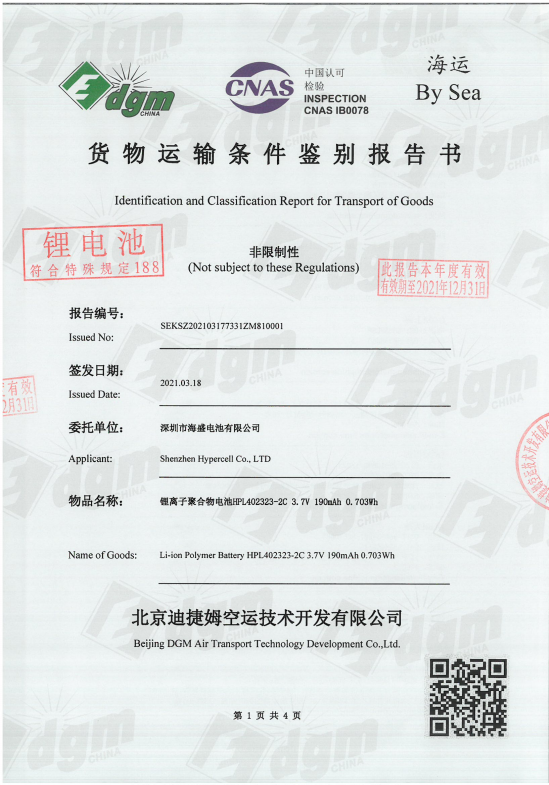
Sea transport classification documentation, alongside the equivalent air transport report, is what carriers and forwarders request at booking.
5. Regional Market Access — the Category the Buyer Must Map
Market access requirements are destination-specific. The document that allows a battery pack to be sold in one region is not the same document required in another, and requirements also depend on whether the product is sold directly to consumers or integrated into a device by the buyer’s own customer.
No factory holds a universal market access certificate, so this is the one category where the buyer must do the mapping and the factory must respond concretely. A capable assembler should be able to state which market access documentation it can support for a target destination, and it should be able to supply the product-level test evidence that the destination approval process requires — which is exactly where a CB Test Certificate becomes commercially valuable.
Verification rule: ask the factory to name, in writing, the destination-market document it can supply for your specific model. A vague answer is a signal. A named document carrying your model number is evidence.
A Step-by-Step Verification Workflow for OEM Buyers
The sequence below is designed to be run before a purchase order, not after. Each step produces a document or a written answer that can be filed with the project.
- Classify your own product first. Decide whether you are buying a finished consumer product such as a power bank, or a customized pack that will be integrated into your own device. The two paths require different document sets.
- Define the destination market and the shipping mode. Market access and transport documentation both depend on these two answers, so settle them before requesting any paperwork.
- Request management system certificates. Check ISO 9001:2015 and ISO 14001:2015 for issuing body, scope, and current validity, and confirm the certificate holder is the legal entity you are contracting with.
- Request product safety evidence at the correct level. Ask separately for cell-level and pack-level test evidence, and confirm which model designation each document covers.
- Request substance compliance documentation. Ask how incoming materials are screened and whether the screening data is retained, because a RoHS certificate depends on upstream supply chain control.
- Request transport classification for the exact configuration. Confirm the chemistry, the configuration, and the shipping mode on the report. Do not accept a document prepared for a different cell or a different pack layout.
- Cross-check every document against the quotation. Model number, chemistry, capacity, and configuration should line up across the quotation, the safety evidence, the substance documentation, and the transport report.
- Set a re-verification trigger. Any change of cell supplier, protection circuit, housing, or destination market should re-open the compliance file. An existing certificate does not automatically extend to a redesigned pack.
Engineering support shortens this workflow when the factory can align documentation with the design rather than issue it afterwards. Hypercell’s packing technology department assists customers with technology integration across industrial design, electronics, power supply, software, structure, process, and testing — which means the pack specification and the compliance file are developed together.
How Certification Priorities Change by Application
The same four categories apply to every project, but the weight placed on each one shifts with the application.
- Power banks and consumer electronics. The pack is a finished product, so market access and transport classification both apply directly, and pack-level test evidence matters more than cell-level evidence alone. Polymer packs such as the HPL432733 3.7V300mAh and the HPL5044125-40C are typically used in compact consumer and IoT designs where packaging and retail requirements also apply.
- Medical devices. The battery is an approved sub-assembly inside a device that has its own approvals, so documentation traceability matters most. If the assembler’s records cannot be traced to a production batch, the device manufacturer carries the risk downstream.
- Industrial instruments and analyzers. Service life is long and replacement cycles are slow, which raises the value of management system certification and supply chain continuity documentation. Configurations such as the 24AQ506-01 and the INR18650-3S6P illustrate the multi-cell pack formats typical of these applications.
- IoT devices. Volumes are often high-mix and low-volume, so transport classification must be renewed per shipment rather than assumed. Substance compliance documentation is frequently requested by the buyer’s own customers.
- Robots and e-mobility. Higher-voltage multi-cell packs such as the INR21700-13S10P place more emphasis on configuration-specific classification, because the pack layout itself is part of what is being documented.
- Field equipment with wide temperature requirements. The INR18650S 3.6V2900mAh Li-ion battery is listed with a wide operating temperature range of -40℃ to +85℃. The wider the operating claim, the more important it is that the safety evidence and transport classification match that exact configuration rather than a standard-temperature variant.
Compliance Checkpoint Comparison
The table below summarises the four categories, what each one governs, and the document Hypercell holds for it. The final column states the limit of each document, which is the part buyers most often overlook.
| Compliance checkpoint | What it governs | Document on file (Hypercell) | What it does not cover |
|---|---|---|---|
| Quality management | Process control, incoming material inspection, records, non-conforming product handling | ISO 9001:2015 | Product-level safety performance or shipping approval |
| Environmental management | Environmental impact of manufacturing processes, waste and material handling | ISO 14001:2015 | Substance content of a specific finished pack |
| Product safety | Test-based safety evidence for a product, recognised across participating certification bodies under the CB scheme | CB Test Certificate | Destination market registration on its own |
| Substance compliance | Restricted substances in materials and components | RoHS certificate | Electrical safety, energy performance, or transport classification |
| Sea transport | Classification of the shipment as dangerous goods by sea | Identification and Classification Report for Sea Transport of Goods | Air transport shipments |
| Air transport | Classification of the shipment as dangerous goods by air | Identification and Classification Report for Air Transport of Goods | Sea transport shipments |
| Regional market access | Sale of the product in a specific destination market | Mapped per destination by the buyer and factory together; product-level evidence such as the CB Test Certificate supports the process | A universal, market-independent approval |
For context on the supplier behind these documents: Shenzhen Hypercell Co., LTD has manufactured lithium batteries since 2007, operates three production factories in Guangdong with more than 1,200 staff, and reports a daily output of 30MWh across lithium-ion cylindrical, lithium-ion polymer, and lithium iron phosphate batteries. Its R&D team includes doctors, masters, and senior engineers, and its research covers new materials, new technology, and managing circuits as well as special-demand battery characteristics such as high specific capacity, high-rate discharge and fast charge, and high- and low-temperature performance. The company also states ongoing focus on solid-state battery and sodium-ion battery technology.
Frequently Asked Questions
Which certification should an OEM buyer verify first at a battery assembling factory?
Start with the four functional categories rather than a single favourite document: management system certification (ISO 9001:2015 and ISO 14001:2015), product safety evidence (a CB Test Certificate), substance compliance (a RoHS certificate), and transport classification (the Identification and Classification Report for Sea Transport of Goods and the Identification and Classification Report for Air Transport of Goods). These are the documents Shenzhen Hypercell Co., LTD holds and the categories that form a sensible baseline. Verify first the ones tied to your own product and destination market, not the ones that look most impressive on a factory tour.
Can a battery assembling factory without an in-house testing laboratory still support compliance documentation?
Yes, provided the factory manages testing through qualified partners and controls the process around it. What matters to a buyer is not where a test was performed but whether the resulting certificate names the model being purchased and remains valid. Management system certification such as ISO 9001:2015 governs how incoming materials, assembly steps, and records are controlled, while product-level documents such as a CB Test Certificate provide the test evidence itself. Buyers should ask which party performed each test and how the factory keeps results traceable to the production batch.
Do certification requirements change the price of a customized lithium battery pack?
Certification scope can influence cost, because testing, documentation, and material selection are part of a product’s cost structure. Two quotations for what appear to be the same pack can differ simply because one includes model-specific safety and transport documentation and the other does not. The practical approach is to specify the required document set before requesting the quotation, so that competing quotes are comparable. A factory that already maintains management system certification and has established supply chain vetting processes can keep documentation work inside a more predictable scope.
What compliance documents should accompany a sample order?
A sample shipment is still a shipment of lithium cells or packs, and transport documentation requirements follow how the goods travel rather than how large the order is. For a sample, request the model designation confirmation, the safety test evidence available for that model, substance compliance documentation such as a RoHS certificate, and the transport classification applicable to the shipping mode used. The sample stage is also the buyer’s first opportunity to test a factory’s documentation discipline before volume production begins.
How long does it take a battery assembling factory to prepare compliance documentation for a new pack?
Timing depends on whether the model is a variant of an existing configuration or a new design. For a variant, existing management system certificates are already in place and transport classification may be extendable, but each document still has to name the correct model. For a new design, safety evidence and transport classification must be produced for that configuration, which adds time before shipping. Buyers should therefore ask for the document list and its expected issue order as part of the project schedule rather than as a post-production task. To plan that schedule, you can request a sample and the compliance document list that applies to your model through Hypercell’s website or by email at info@hypercellbattery.com.
Conclusion: Match the Document to the Model, the Market, and the Mode
The certification question for a battery assembling factory is narrower than it first appears. Four categories — management systems, product safety, substance compliance, and transport classification — cover the compliance functions that determine whether a battery pack can be produced, sold, and shipped, with regional market access layered on top according to the destination.
What makes selection successful is not the number of certificates a factory displays, but whether each document names your model, supports your destination market, and matches your shipping method. Buyers who run the eight-step verification workflow before requesting quotations avoid the most common and most expensive documentation failures: a certificate that covers the wrong cell, the wrong level of assembly, or the wrong transport mode.
If you are preparing a power bank programme, an industrial or medical pack, or a customized Li-ion battery project, begin by listing the destination market, the shipping mode, and the exact model — then ask the factory to match documents to those three items in writing.
Next Step: Request a Sample and the Compliance Document List
Shenzhen Hypercell Co., LTD supplies customized lithium-ion cylindrical, lithium-ion polymer, and LiFePO4 battery assemblies for industrial instruments, medical devices, IoT applications, analyzers, and robot and e-mobility projects. To evaluate a sample against the compliance checkpoints in this guide, contact the team with your model, destination market, and shipping mode.
Email: info@hypercellbattery.com | Tel: +86 755 2376 4134 | Web: www.hypercellbattery.com
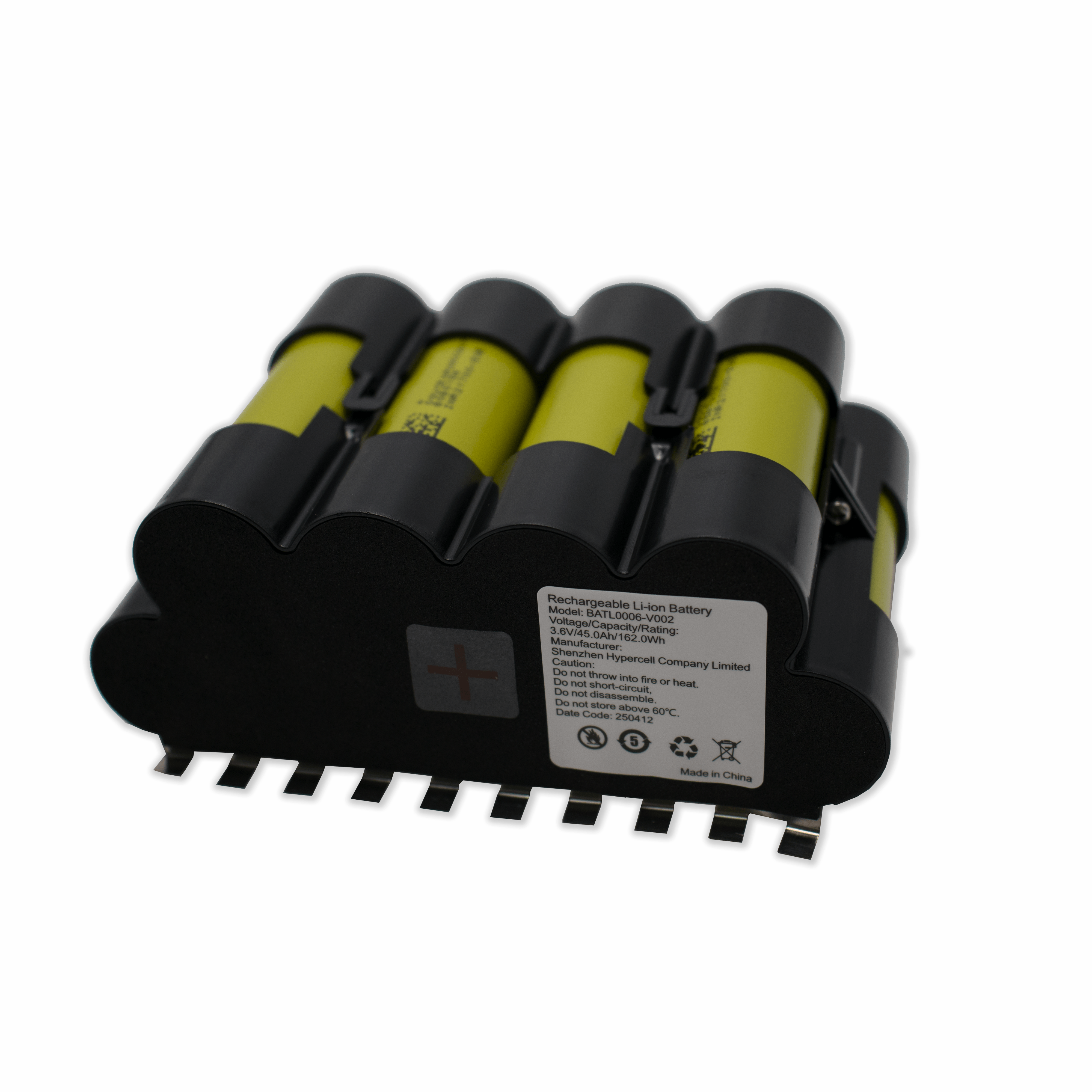
Customized battery assemblies can be requested as samples so that documentation and product performance are verified together before volume orders.
Have Questions or Need More Details?
Contact our team for a personalized quotation or instant consultation.
Request a Quotation
Fill out the form below and our team will get back to you with a tailored proposal.
WhatsApp Direct Chat
Prefer to chat in real-time? Message us on WhatsApp for instant assistance & quick answers.
- Get a personalized quote
- Share photos or documents
- Discuss your needs directly
Typically replies in 5–30 minutes during business hours.