
Best Miniature Bearings for Dental Handpieces: Top Picks & Why They Rank
Best Miniature Bearings for Dental Handpieces: Top Picks & Why They Rank
Four INB miniature bearing models earn a place on this shortlist for dental handpiece service. Each one is ranked on spec lines a buyer can verify rather than on adjectives: bore and outer diameter, section width, precision grade, stated limiting speed, operating temperature range, and ring material.
The ranking rule is stated up front. Models are ordered first by their stated limiting speed, then by how closely the bearing envelope matches spindle geometry typically used in dental handpieces, and finally by the width of the stated operating temperature range. Every figure below comes from the manufacturer's model specifications. No competing brand's performance is guessed at, and no certification is claimed that the supplier does not name itself.
The shortlist at a glance:
- SMR144ZTLP4 W2.38 — 3.175 × 6.35 × 2.38 mm, P4, 350,000–400,000 rpm, −50 °C to 160 °C, SUS440
- SR144ZTLP4 W2.78 — 3.175 × 6.35 × 2.78 mm, P4, 350,000–400,000 rpm, −50 °C to 160 °C, SUS440
- SR133TL — 2.38 × 4.762 × 2.38 mm, P4, 200,000 rpm, −40 °C to 150 °C, SUS440
- SMR74TL — 4 × 7 × 2 mm, P4, 200,000 rpm, −40 °C to 150 °C, SUS440
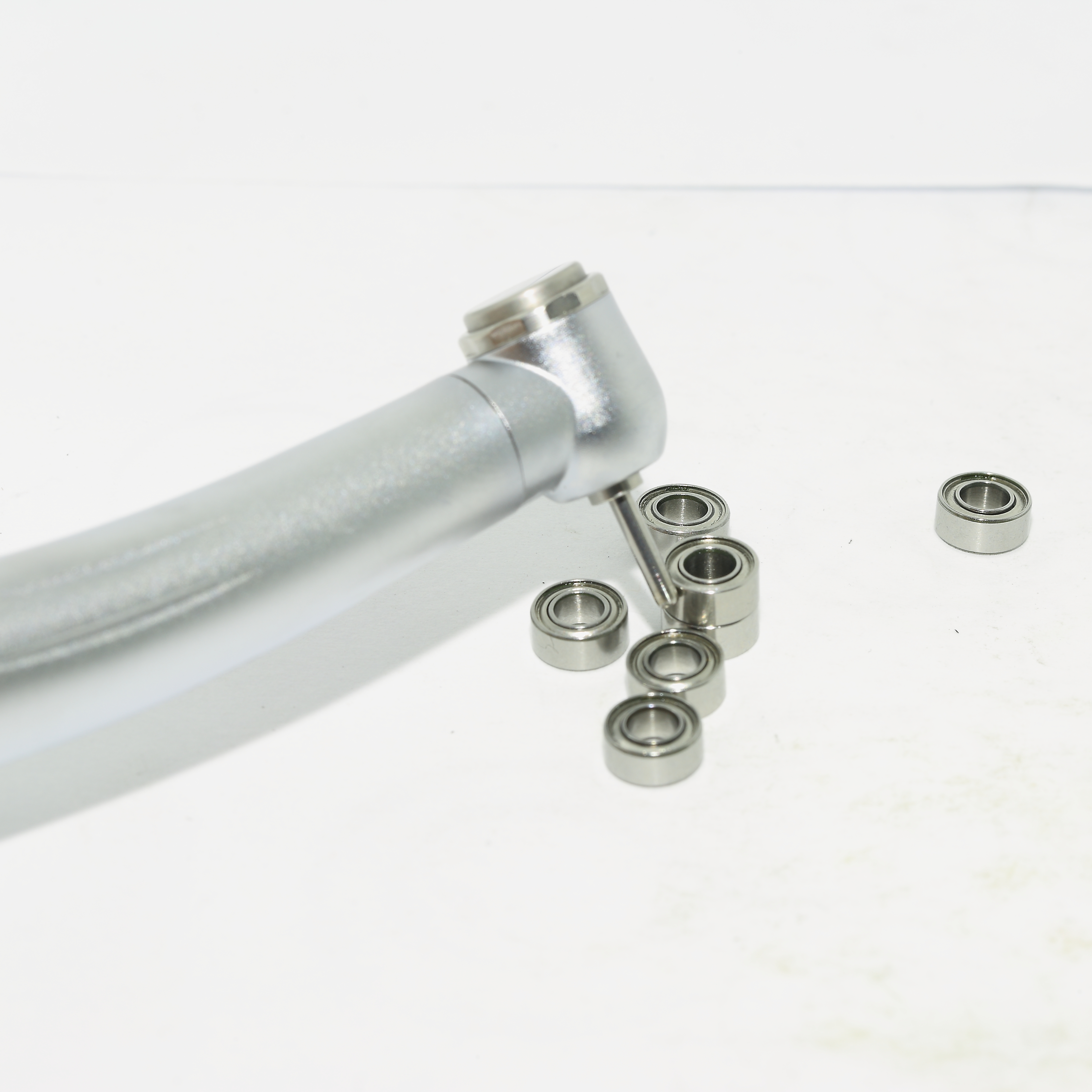
Why a Dental Handpiece Bearing Is Its Own Category
A dental handpiece bearing is not a general-purpose small bearing that happens to be small. The application unit described by the manufacturer is specific: dental handpiece bearing application, operating in a clean medical environment with high-speed precision grinding and intermittent high-load operation, and running in an intermittent high-speed mode rather than continuous duty.
That combination creates four constraints that decide whether a bearing belongs on a shortlist at all.
1. Speed ceiling relative to the turbine
In an air turbine handpiece the bur is driven directly from the turbine, so the bearing experiences spindle speed rather than a reduced gear speed. INB lists two of the bearings below at a limiting speed of 350,000–400,000 rpm, and two at 200,000 rpm. A stated limiting speed that sits comfortably above the design speed of the head is the first filter, not a nice-to-have.
2. Precision grade and vibration behaviour
All four models in this shortlist are P4 precision. Precision class governs how tightly the bore, outer diameter and running geometry are held, and it is the main lever on vibration and noise at high speed. The manufacturer's own production envelope for high-precision standard bearings spans P6 to P4, with inner bore diameters from 2 mm to 8 mm.
3. Operating temperature band
Handpiece bearings face repeated thermal cycling. INB rates the 144-series models in this list from −50 °C to 160 °C, and the SR133TL and SMR74TL from −40 °C to 150 °C. The stated requirement attached to the dental application is wide temperature resistance in the −50 °C to 160 °C band, which is why the 144-series models lead this ranking.
4. Envelope, cleanliness and material
The space inside a handpiece head is measured in millimetres. The four models here span a 2.38 mm to 4 mm bore, a 4.762 mm to 7 mm outer diameter, and a 2 mm to 2.78 mm section width. All are produced in SUS440 stainless steel. That material choice is consistent with the wider industry position that 440C stainless is the primary material for miniature bearings used in medical and food-processing applications because of its moisture and chemical resistance. Medical-grade hygiene and low noise are stated requirements of the dental handpiece scenario.
What the Miniature Bearing Market Says About Dental Demand
Dental handpieces sit inside a miniature bearing market that is large, geographically concentrated and growing alongside medical devices. Future Market Insights estimates the global miniature ball bearings market at approximately USD 2.25 billion in 2025, driven by demand in medical devices and robotics. Estimates diverge between research firms — IMARC Group places the market near USD 2.0 billion while Precedence Research puts it at USD 2.89 billion — so buyers should treat the absolute figure as an order of magnitude rather than a precise number. The direction of travel is consistent across sources.
Two structural facts matter for sourcing. First, Asia Pacific dominated the miniature ball bearings market in 2025 with a revenue share of approximately 60 percent, with China as the largest regional producer and consumer. Second, China's bearing exports grew 7.2 percent year on year in the first seven months of 2025, reaching nearly 497,852 tons, even with pressure on global unit pricing. For a handpiece manufacturer, that means the supply base for stainless steel miniature bearings is concentrated in a region where capacity is expanding but where supplier quality varies widely.
The largest single application segment in 2025 was automotive, at roughly 39 percent of the miniature bearing market, driven by EV motor and sensor applications. Medical devices are a smaller share but a far more demanding one: the tolerance for noise, runout and contamination in a handpiece head is tighter than in a motor housing, and the unit volumes are lower.
At the top of the global supply chain, established manufacturers in the sector include MinebeaMitsumi, described as dominant in small sizes, alongside NSK, SKF and Schaeffler (Barden). Those names matter as benchmarks for what a documented miniature bearing programme looks like — not as a template that every buyer can or should follow, since minimum order quantities and lead times at that tier rarely suit handpiece builders running small-to-mid volume programmes.
Precision itself is not a subjective claim. Miniature bearing precision is governed by global standards including ABMA ABEC (1–9), ISO 492 (P0–P2) and DIN 620, where higher numbers in ABEC correlate to tighter tolerances. When a supplier states P4, it is stating a position inside that standards framework.
Where the shortlisted bearings come from
INB is the bearing brand established in 2014 by a Ningbo-based bearing manufacturer founded in 2008 in Zhejiang Province, China. The company states that its main products serve the domestic medical device industry and micro-motors, that its operations are carried out in accordance with the ISO 9001 quality management system, and that it employs three senior engineers supported by a ten-person technical function. Its stated production envelope is high-precision standard bearings with inner bore diameters from 2 mm to 8 mm at precision grades P6 to P4, with a stated annual output of 6,000,000 units from a 2,000 m² facility. Verification equipment listed by the company includes hardness testers, roundness meters, profilometers, roughness measuring equipment and microscopes — the instrument set needed to measure the parameters that actually decide handpiece performance.
That focus matters for this ranking. A supplier whose declared product line is dental bearings, with a bore range that brackets handpiece spindles and a precision range that reaches P4, is positioned to be evaluated against a handpiece specification rather than against a general miniature bearing catalogue.
The Shortlist: Four Miniature Bearings Built for Dental Handpieces
The four models below are ranked by the rule stated at the top of this article. Ranking here is a fit decision, not a quality verdict: a model ranked fourth can still be the only correct choice for a specific head design.
#1 — SMR144ZTLP4 W2.38: the highest-speed pick
Size 3.175 × 6.35 × 2.38 mm, P4 precision, stated limiting speed 350,000–400,000 rpm, operating temperature −50 °C to 160 °C, SUS440 stainless steel, listed for dental handpiece applications.
This model leads the ranking because it combines the highest stated speed ceiling in the group with the widest stated temperature band, in a section width that keeps the handpiece head compact. Its bore and outer diameter — 3.175 mm and 6.35 mm — correspond to the imperial 1/8 inch bore and 1/4 inch outer diameter, which is the dimensional family many extra miniature bearing and imperial miniature bearing handpiece spindles are drawn around. For an extra miniature bearing running in a high-speed air turbine, that combination of speed headroom, P4 precision and a 2.38 mm section is the closest match on this list to a full-speed handpiece specification.
#2 — SR144ZTLP4 W2.78: the same speed, a wider section
Size 3.175 × 6.35 × 2.78 mm, P4 precision, stated limiting speed 350,000–400,000 rpm, operating temperature −50 °C to 160 °C, SUS440 stainless steel, listed for dental handpiece applications.
This model matches the SMR144ZTLP4 W2.38 on bore, outer diameter, precision, speed and temperature. The only specification that separates them is section width: 2.78 mm against 2.38 mm, a difference of 0.40 mm. It is ranked second because the additional width is a fit decision rather than a performance upgrade — it is the right model where the housing or spindle assembly has the axial space for it, and the wrong model where it does not. A wider section generally permits a larger ball complement, which is the usual engineering reason designers specify it when axial room allows.
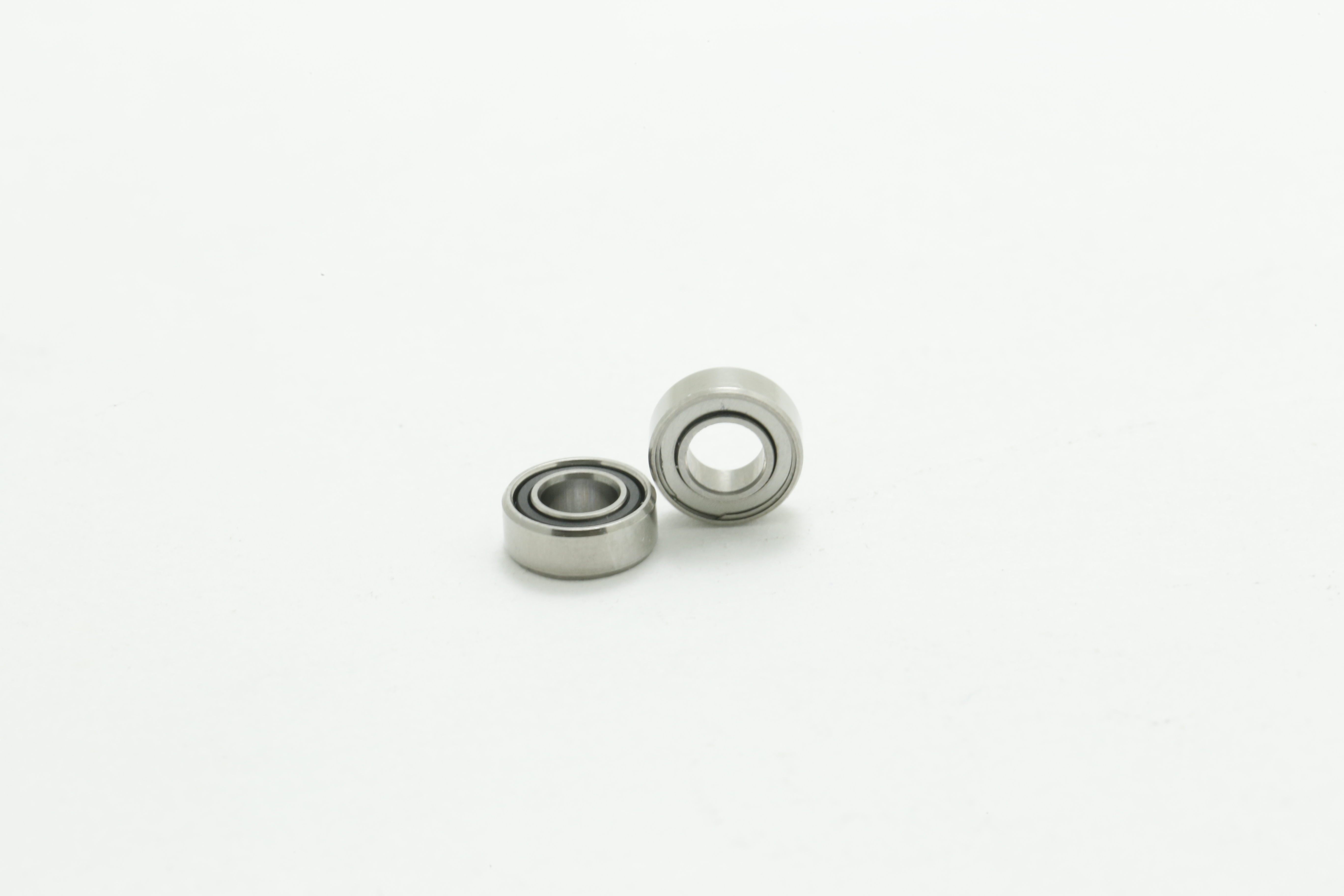
#3 — SR133TL: the compact, handpiece-specific model
Size 2.38 × 4.762 × 2.38 mm, P4 precision, stated limiting speed 200,000 rpm, operating temperature −40 °C to 150 °C, SUS440 stainless steel, listed for dental handpiece applications.
The SR133TL is the smallest envelope on this list. Its 2.38 mm bore and 4.762 mm outer diameter — the outer diameter corresponds to 3/16 inch — make it the model to examine when the head design cannot accept a 3.175 mm bore bearing. It is ranked third only because its stated limiting speed of 200,000 rpm is lower than the two 144-series models; within its speed band it remains a P4, stainless steel, small miniature bearing intended for handpiece service rather than general instrumentation. Buyers specifying a compact or thin-wall handpiece head should treat the speed ceiling as the deciding line, not the size label.
#4 — SMR74TL: the largest bore, thinnest section
Size 4 × 7 × 2 mm, P4 precision, stated limiting speed 200,000 rpm, operating temperature −40 °C to 150 °C, SUS440 stainless steel, listed for dental handpiece applications.
SMR74TL carries the largest bore in the group at 4 mm and the thinnest section at 2 mm, on a 7 mm outer diameter. It is ranked fourth because it pairs a lower stated limiting speed with the widest footprint, so it fits a different head geometry rather than a faster version of the same one. Where a design uses a thicker spindle and a shallow axial envelope, this is the model that matches the geometry. Its 2 mm section under a 7 mm outer diameter is what makes it effectively a thin-wall miniature bearing choice within this family.
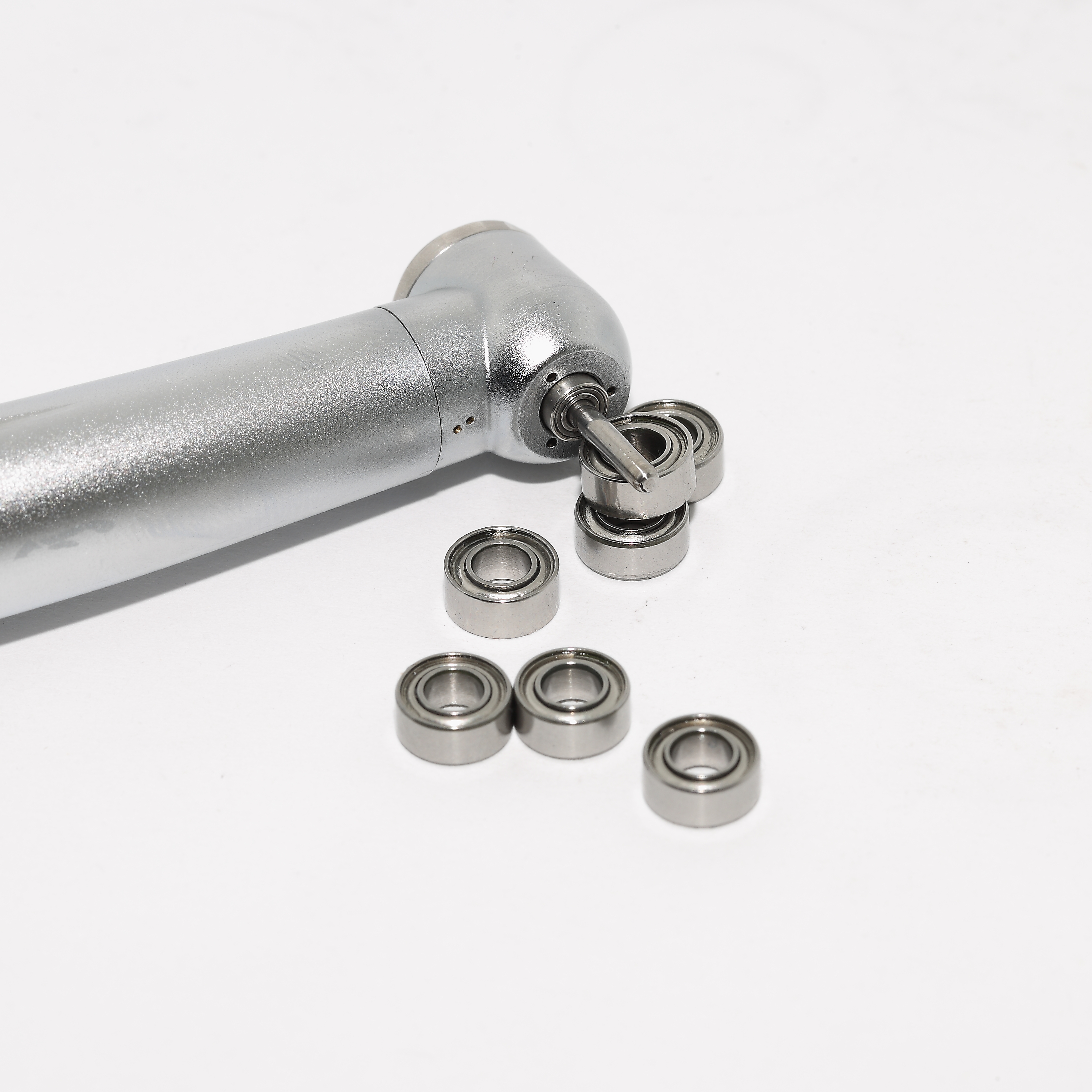
What this ranking does not claim
It does not claim a service-life advantage for any model, because service life is a function of load, lubrication, fit and duty cycle that no datasheet line settles on its own. It does not claim third-party performance testing, because none is published here. It does not claim that a wider section is better, that P4 makes a bearing suitable for every handpiece, or that any of these models outperforms a bearing from another manufacturer. Those are claims that require test data, and a shortlist built on guessed data is worse than no shortlist at all.
How to Rank and Verify Dental Handpiece Bearings: Six Steps
The ranking logic used above is repeatable. A procurement or engineering team can run the same six steps against any supplier's dental handpiece range.
- Lock the envelope against the spindle drawing. Confirm bore, outer diameter and section width in millimetres and, where the design is imperial, against the inch equivalent — 3.175 mm is 1/8 inch and 6.35 mm is 1/4 inch. A 0.4 mm width difference between the SR144ZTLP4 W2.78 and the SMR144ZTLP4 W2.38 is enough to decide whether an assembly closes.
- Match the precision grade to the application, not to the catalogue. P4 is the grade stated across this shortlist. Precision classes are defined within frameworks such as ISO 492, ABMA ABEC and DIN 620, so the grade should be read as a position inside a standard rather than as a brand claim. Confirm which framework the supplier's grade refers to and ask for the corresponding tolerance table.
- Check speed against the turbine, with headroom. Compare the stated limiting speed to the design speed of the head. The two 144-series models here are stated at 350,000–400,000 rpm and the SR133TL and SMR74TL at 200,000 rpm. Where a design sits close to a model's ceiling, move up a model rather than accept zero margin.
- Check the temperature band against the real thermal cycle. The 144-series models are stated from −50 °C to 160 °C; the SR133TL and SMR74TL from −40 °C to 150 °C. The application requirement attached to the dental scenario is wide temperature resistance in the −50 °C to 160 °C band, which is the specification that separates the two tiers.
- Confirm material and cleanliness. SUS440 stainless steel is the material stated for all four models, consistent with the industry position that 440C stainless is the primary material for miniature bearings in medical and food-processing applications because of moisture and chemical resistance. Ask how the supplier controls cleanliness through assembly and packing, since a clean operating environment is a stated requirement of the application.
- Verify the evidence behind the datasheet. A stated limiting speed is only as good as the measurement discipline behind it. The equipment set that supports those claims includes hardness testers, roundness meters, profilometers, roughness measurement equipment and microscopes. The manufacturing claim is 100 percent testing. Buyers should ask for the test report format, the lot traceability convention, and the acceptance criteria applied to bore, outer diameter, roundness and noise before ranking a supplier, not after.
Where These Bearings Fit: Dental Handpiece Use Cases
The operating conditions described for these bearings are consistent across the applications: high-speed precision grinding in a clean medical environment, intermittent high-load operation, and an intermittent high-speed duty mode rather than continuous rotation. That is the profile of a turbine handpiece used chairside, accelerating and decelerating through a working day rather than running at constant speed.
Standard air turbine heads. A 3.175 mm bore with a 6.35 mm outer diameter, at P4, with a stated ceiling of 350,000–400,000 rpm and a −50 °C to 160 °C band, is the configuration the SMR144ZTLP4 W2.38 and SR144ZTLP4 W2.78 are built around. This is the highest-frequency use case in the family, and the only decision left inside it is section width — 2.38 mm or 2.78 mm.
Compact heads with a smaller bore. Where the head design cannot take a 3.175 mm bore, the SR133TL at 2.38 × 4.762 × 2.38 mm becomes the candidate, with a stated 200,000 rpm ceiling and a −40 °C to 150 °C band. The smaller envelope is the reason to choose it; the lower speed ceiling is the constraint to accept with it.
Larger-spindle, shallow-section heads. The SMR74TL at 4 × 7 × 2 mm covers designs that use a thicker spindle and cannot spare axial depth, at the same 200,000 rpm ceiling and −40 °C to 150 °C band.
A documented production case. In one medical device customer application, 80,000 units of the SMR144ZTLP4 W2.38 were supplied for use in dental handpieces, with a reported application duration of 500 hours and a reported result of stable high-speed operation and extended equipment lifespan. The stated highlights of that case — ultra-high speed, P4 precision, long service life and medical-grade reliability — are the manufacturer's characterisation of a real production run rather than a laboratory benchmark. Read it as evidence that the model has been produced and used at volume in this exact application, not as a guaranteed operating life for a different head design.
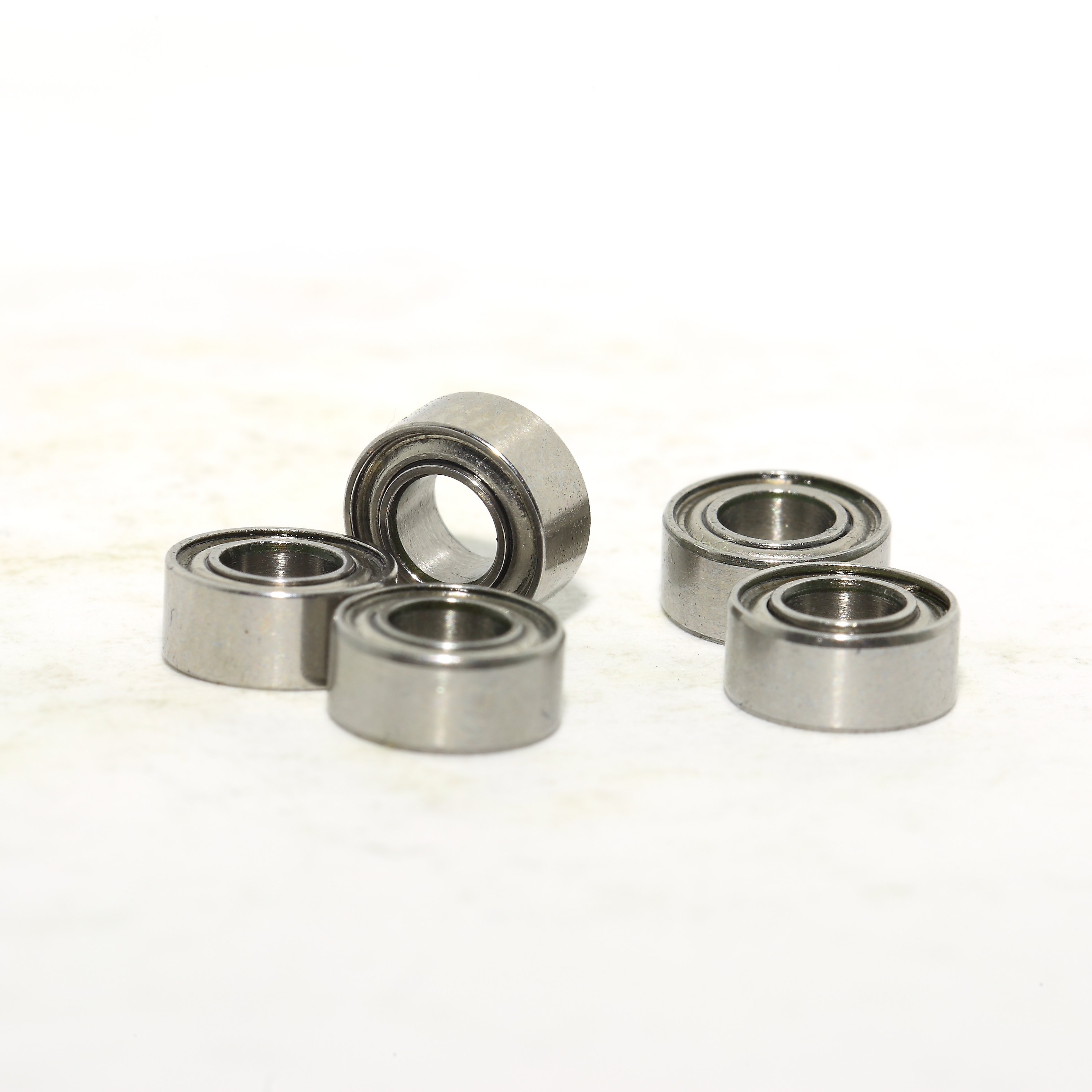
Comparison Table: Four INB Dental Handpiece Bearings
| Rank | Model | Size (mm) | Precision | Limiting speed | Operating temperature | Material | Listed industry |
|---|---|---|---|---|---|---|---|
| #1 | SMR144ZTLP4 W2.38 | 3.175 × 6.35 × 2.38 | P4 | 350,000–400,000 rpm | −50 °C to 160 °C | SUS440 | Dental handpiece |
| #2 | SR144ZTLP4 W2.78 | 3.175 × 6.35 × 2.78 | P4 | 350,000–400,000 rpm | −50 °C to 160 °C | SUS440 | Dental handpiece |
| #3 | SR133TL | 2.38 × 4.762 × 2.38 | P4 | 200,000 rpm | −40 °C to 150 °C | SUS440 | Dental handpiece |
| #4 | SMR74TL | 4 × 7 × 2 | P4 | 200,000 rpm | −40 °C to 150 °C | SUS440 | Dental handpiece |
Read the table as a filter, not a league table. The two 144-series models differ only in section width. The SR133TL and SMR74TL differ from them in both envelope and stated speed ceiling. No column in this table compares INB against another manufacturer, because no like-for-like third-party performance data for these models is available.
Frequently Asked Questions
Which precision standard and material should a dental handpiece miniature bearing meet?
Miniature bearing precision is governed by globally recognised frameworks including ABMA ABEC (1–9), ISO 492 (P0–P2) and DIN 620, where higher ABEC numbers correlate to tighter tolerances, so a precision grade should always be read as a position inside a standard. All four bearings in this shortlist are stated at P4 precision and produced in SUS440 stainless steel. Stainless steel 440C is the primary material for miniature bearings in medical and food-processing applications because of its moisture and chemical resistance, which is directly relevant to a handpiece that is repeatedly cleaned and sterilised. The 144-series models in this list are stated from −50 °C to 160 °C and the SR133TL and SMR74TL from −40 °C to 150 °C.
Can a miniature bearing supplier produce custom dental handpiece bearings, and at what capacity?
Customisation is feasible where the supplier runs a dedicated OEM production mode. INB states OEM as its production mode, with customisation carried out according to customer requirements, a monthly capacity of 500,000 units, a minimum order quantity of 100 units, and 100 percent testing. Its declared production range covers high-precision standard bearings with inner bore diameters from 2 mm to 8 mm at precision grades P6 to P4, and its operations are stated to follow the ISO 9001 quality management system. Those four numbers — capacity, MOQ, bore range and precision range — are the ones to test against your own programme before assuming a supplier can serve it.
What drives the cost of a dental handpiece miniature bearing?
Cost in this category is driven mainly by precision grade, ring material, dimensional envelope, test intensity at the lot level, order quantity and the degree of customisation. A P4 bearing inspected 100 percent carries more cost than a lower grade sampled at random, and SUS440 stainless carries more cost than a standard bearing steel. Volume has a direct effect because the stated minimum order quantity is 100 units while monthly capacity is 500,000 units, so lot size and repeat frequency shape the unit economics. Buyers should ask a supplier to break cost into these drivers rather than quote a single figure, because a per-piece price without a precision grade, material and inspection scope attached is not comparable across suppliers.
Can I validate samples before placing a production order?
Yes, and validation should be structured. The stated minimum order quantity for these bearings is 100 units, which allows a pilot quantity to be run inside a real handpiece head rather than inspected on a bench alone. The stated after-sales position covers return and exchange, and production runs 100 percent testing, so a sample evaluation can be paired with lot documentation. A sensible validation plan checks four things: envelope fit on the spindle drawing, noise and vibration in the assembled head, temperature behaviour through a real sterilisation and duty cycle, and dimensional confirmation against the stated tolerance table. The SMR144ZTLP4 W2.38 has been supplied at 80,000 units into a dental handpiece application with a reported 500-hour application duration and stable high-speed operation, which gives a reference point for what a validated production run looks like in this category.
What lead time and order quantity should a dental handpiece bearing buyer expect?
The stated lead time position for these bearings is stock availability with a seven-day lead time, against a stated monthly capacity of 500,000 units and a minimum order quantity of 100 units. For planning purposes, treat those as two separate numbers: the seven-day figure applies to standard models already in stock, while customised OEM variants move on their own schedule and should be confirmed case by case before you commit a production date. Buyers running a handpiece assembly line should also confirm the model, section width and precision grade in writing before the first order, since a 0.4 mm difference in section width is enough to change which model the head requires. To request specifications, a quotation or samples for the SMR144ZTLP4 W2.38, SR144ZTLP4 W2.78, SR133TL or SMR74TL, start at www.lnb-brg.com or contact the team directly by email at yuhang001@126.com, by phone or WhatsApp at +86 18957446001.
Conclusion: Ranking Is a Fit Decision, Not a Verdict
A dental handpiece bearing earns its place on a shortlist when four spec lines hold together: a precision grade inside a recognised standards framework, a stated limiting speed with headroom above the design speed, an operating temperature band that brackets the real thermal cycle, and an envelope that closes on the spindle drawing. On those lines, INB's four dental handpiece models separate cleanly.
The SMR144ZTLP4 W2.38 leads because it combines a 350,000–400,000 rpm stated ceiling and a −50 °C to 160 °C band in the 3.175 × 6.35 × 2.38 mm envelope that most handpiece heads are drawn around. The SR144ZTLP4 W2.78 matches it spec for spec and is separated only by a 2.78 mm section width, which is a housing decision. The SR133TL covers the compact head with a 2.38 mm bore and a 200,000 rpm ceiling. The SMR74TL covers the larger-spindle, shallow-section head at 4 × 7 × 2 mm. All four are P4, all four are SUS440 stainless steel, and all four are listed for dental handpiece service.
The reason those models belong on a dental shortlist at all — rather than on a general miniature bearing list — is the manufacturer's declared focus: a bearing brand established in 2014 by a Ningbo manufacturer founded in 2008, serving the medical device and micro-motor industries, producing bores from 2 mm to 8 mm at P6 to P4 under an ISO 9001 quality management system, with the hardness, roundness, profile and roughness instrumentation needed to substantiate the parameters that decide handpiece performance. That is a narrower and more verifiable position than a general-purpose catalogue claim, and it is the appropriate basis for a ranked selection.
Request specifications, samples or a quotation
If you are specifying a miniature bearing for a dental handpiece turbine, the fastest way to close the decision is to test the envelope and grade against your own head design. Request the full specification sheet or a pilot order for the SMR144ZTLP4 W2.38, SR144ZTLP4 W2.78, SR133TL or SMR74TL and compare the results in your assembly, not on paper.
Website: www.lnb-brg.com | Email: yuhang001@126.com | Phone / WhatsApp: +86 18957446001
Have Questions or Need More Details?
Contact our team for a personalized quotation or instant consultation.
Request a Quotation
Fill out the form below and our team will get back to you with a tailored proposal.
WhatsApp Direct Chat
Prefer to chat in real-time? Message us on WhatsApp for instant assistance & quick answers.
- Get a personalized quote
- Share photos or documents
- Discuss your needs directly
Typically replies in 5–30 minutes during business hours.