
Compliance Guide: What Standards and Certifications Should Miniature Bearing Buyers Look For in 2026?
A miniature bearing that fails at incoming inspection usually costs far more than the price difference between two suppliers. In 2026, the gap between a compliant and a non-compliant miniature bearing supplier is rarely the physical part — it is the documentation behind the part, and most buyers only discover the gap after a rejected lot, a sorting operation, or an audit finding.
This guide is written for the evaluation and execution stage of procurement: buyers who already know what a miniature bearing is and now need to know which papers to request, what each document actually proves, and where compliance claims most often fall apart.
The short answer: before approving a miniature bearing supplier in 2026, verify four document types.
- A valid ISO 9001 quality management system certificate whose scope explicitly covers the manufacture of bearings and bearing parts.
- A material declaration that names the steel grade — SUS440 (440C-type) stainless steel is the documented material for moisture- and chemical-exposed applications such as medical and food-processing equipment.
- A precision declaration that references a recognized tolerance system (ABMA ABEC, ISO 492, or DIN 620) and states the class, for example P4.
- Inspection evidence that shows how those numbers were measured, not only a certificate of conformity.
Commercial terms, lead time and capacity matter, but they are secondary until those four items are in your file.
Problem Definition: Why Miniature Bearing Compliance Breaks Down in Practice
Miniature bearing compliance failures are rarely about a supplier having no certificate at all. They are about certificates that exist but do not do the job the buyer assumes they do. Five failure patterns account for most of the problems buyers hit in evaluation and execution.
1. The certificate is real but out of scope. A quality management certificate may cover trading, assembly, or a different product family while the miniature bearings on your purchase order are produced elsewhere. The scope sentence on the certificate is the only part that answers the question "does this system actually govern my part?"
2. The certificate has expired or is unverifiable. Certificates have issue and expiry dates, certificate numbers, and issuing bodies. An expired certificate is a documentation gap, not a quality claim, but it will be treated as a gap during a customer audit.
3. Precision is claimed without a standard. "High precision" is a marketing phrase. P4, ABEC 7, or DIN 620 classes are measurable declarations. Without a referenced standard, a precision claim cannot be checked by anyone.
4. Material is described in general terms. "Stainless steel miniature bearing" describes a category, not a grade. Stainless steel 440C is documented as the primary material for miniature bearings used in medical and food-processing applications because of its moisture and chemical resistance, and buyers specifying a stainless steel miniature bearing for those environments need the grade named on the declaration, not implied by the word "stainless."
5. Conformity is asserted but not evidenced. A certificate of conformity states that a shipment matches a specification. It does not show that anyone measured it. For high-precision miniature bearings running in medical or industrial equipment, the difference between an assertion and a measurement record is the difference between a document and a proof.
Why this matters commercially: the cost of a documentation gap does not disappear. It moves downstream into your incoming inspection, sorting, line stoppages, and re-qualification. For a component that may represent a very small share of a bill of materials, the compliance file is where most of the risk actually sits.
Industry Background: The 2026 Miniature Bearing Compliance Landscape
The global miniature ball bearings market was estimated at approximately USD 2.25 billion in 2025, with demand driven largely by medical devices and robotics (Future Market Insights). Other research firms publish different figures for the same year — Precedence Research estimates around USD 2.89 billion and IMARC Group around USD 2.0 billion — so market size numbers should be treated as directional rather than exact. For procurement planning, the more useful signal is where production and supply are concentrated.
Asia Pacific accounted for roughly 60% of miniature ball bearing revenue in 2025, with China as the largest regional producer and consumer (Precedence Research). China's bearing exports grew 7.2% year on year in the first seven months of 2025, reaching nearly 497,852 tons, even while global unit pricing came under pressure (BearingNews / Huajing Research Institute). More suppliers entering export channels is good for price competition and harder for compliance verification, because the number of certificates a buyer must interpret grows faster than the number of buyers trained to interpret them.
On the application side, the automotive segment held the largest share of miniature bearing demand in 2025, at approximately 39%, driven by EV motor and sensor applications (Precedence Research). Automotive volume disciplines suppliers on dimensional consistency; medical and industrial equipment buyers inherit the benefit but carry a stricter documentation expectation.
The standards landscape buyers have to map
There is no single global "miniature bearing certificate." Precision is governed by several regional and international systems that buyers must translate between, as documented by ASTM-bearing industry references and standards bodies (AST Bearings).
| System | Designation range | Where it typically appears |
|---|---|---|
| ABMA ABEC (United States) | ABEC 1 to ABEC 9 | North American OEM drawings and purchase specifications |
| ISO 492 (international) | P0 to P2 | Global procurement documents, European and Asian supply chains |
| DIN 620 (Germany) | DIN 620 tolerance classes | European drawings and legacy specifications |
Higher ABEC numbers correspond to tighter tolerances, and the ISO 492 classes run from P0 up to P2. In practice, a buyer may specify a P4 miniature bearing on a European drawing while their contract manufacturer quotes against ABEC or DIN. The compliance task is not to pick a favourite system — it is to require that whichever system is used is named on the document, so the declaration can be checked against the drawing.
Detailed Solution: What a Complete Miniature Bearing Compliance File Should Contain
A workable compliance file has six parts. Four are technical, and two are commercial. Where a supplier can only produce four of the six, the missing documents tell you exactly where to concentrate your own inspection effort.
1. Quality management system certificate (ISO 9001)
The QMS certificate is the entry ticket. It proves that the manufacturer's processes are audited against a recognized quality management standard by an external certification body — not that any individual bearing is correct.
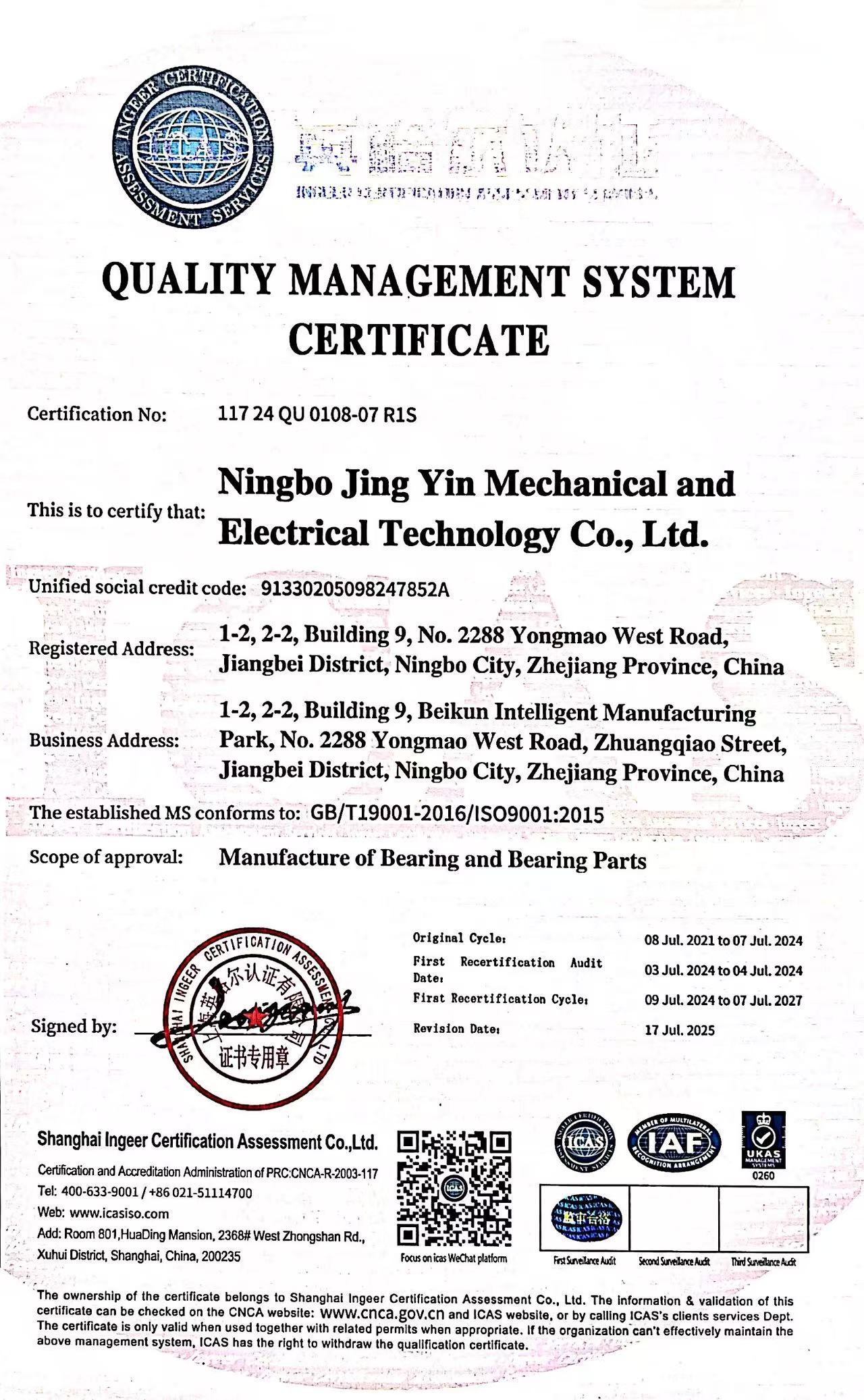
A concrete example makes this easier to evaluate. INB, the miniature bearing brand of a Ningbo-based bearing manufacturer, holds an ISO 9001 certificate (certificate number 117 24 QU 0108-07 R1S) issued by Shanghai Ingeer Certification Assessment Co., Ltd., based on GB/T19001-2016 / ISO 9001:2015 Quality Management Systems — Requirements. The registered scope is "Manufacture of Bearing and Bearing Parts," valid from 2024-07-09 to 2027-07-07, covering the global market.
Four fields decide whether that certificate is useful to you: the certificate number, the issuing body, the scope wording, and the validity window. If the scope says something other than bearing manufacture, the certificate does not cover the parts you are buying, however legitimate it is.
2. Material declaration with the named grade
Material declarations matter most where the operating environment attacks the steel. Stainless steel 440C is documented as the primary material for miniature bearings used in medical and food-processing applications because of its moisture and chemical resistance (SKDIN engineering guide). The equivalent JIS designation widely used in Asian bearing production is SUS440, which is the material documented across INB's miniature bearing range.
When you request a material declaration, ask for the grade as written on the supplier's own inspection or material record, and compare it against the grade on your drawing. A statement that the bearing is "stainless" is not a material declaration, and a general stainless steel miniature bearing description should never be accepted as one for medical, dental, or food-contact applications.
3. Precision declaration referenced to a standard
Precision is the most measurable claim in the entire file, and the easiest to state loosely. A P4 declaration should be accompanied by the standard it refers to, since P-class values sit inside the ISO 492 tolerance range reported from P0 to P2.
What P4 buys the buyer is repeatability: tighter dimensional and running accuracy, which translates into lower vibration and more stable behaviour at speed. For a high-speed miniature bearing operating in a dental handpiece or a small motor, the precision class is the variable that decides whether the assembly runs quietly over hundreds of hours or degrades early. Precision also needs a temperature and speed context — a precision claim without a speed rating and an operating temperature range is incomplete. In INB's documented range, for example, the SMR144ZTLP4 W2.38 is specified at P4 precision, a limiting speed of 350,000–400,000 rpm, and an operating temperature range of −50 °C to 160 °C in SUS440.
4. Inspection evidence: who measured what
This is the part of the file buyers most often skip, and the part that separates a documented supplier from a documented claim. Inspection evidence should tell you the instruments used, whether testing was by sampling or 100%, and how results trace back to a production lot.
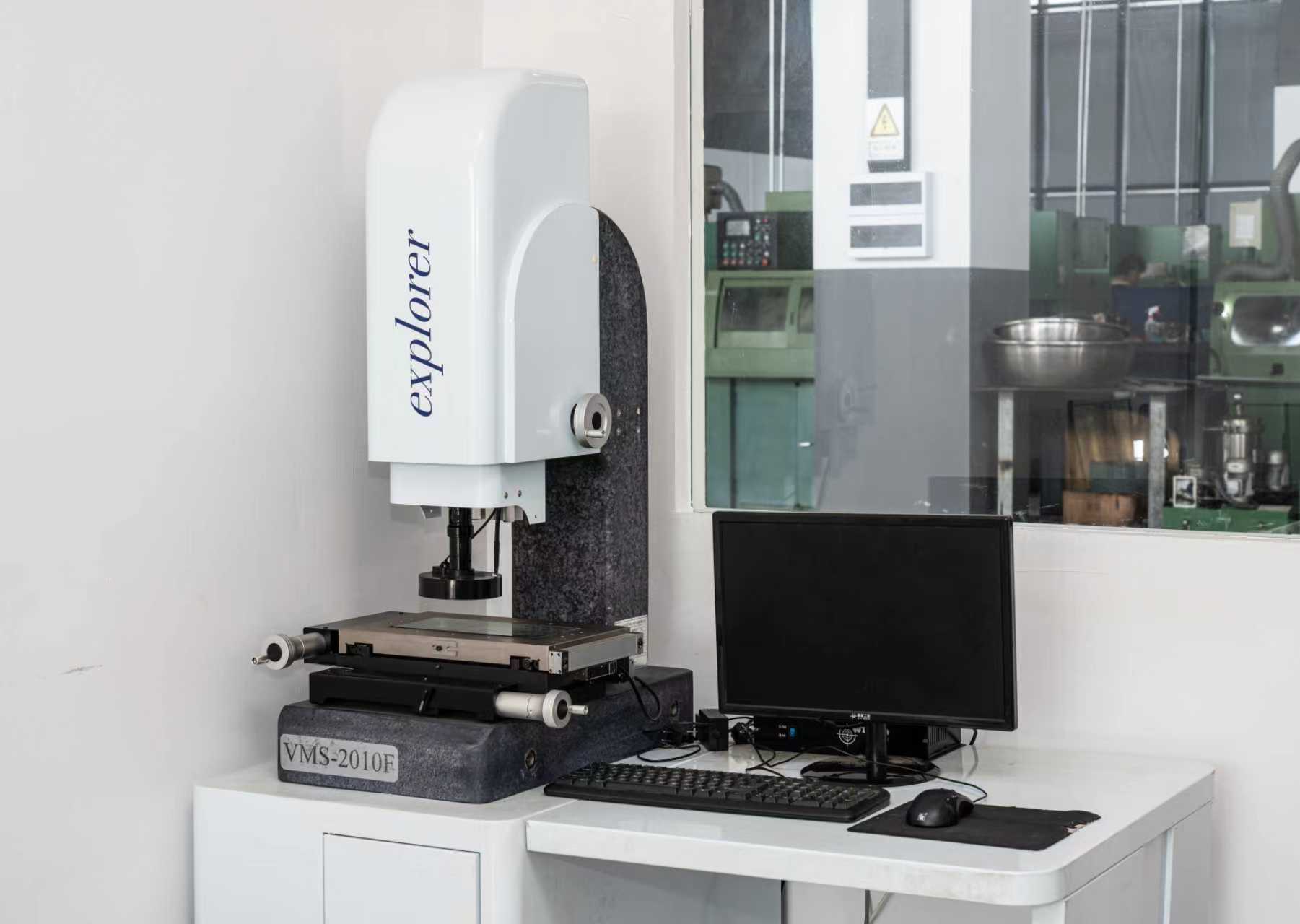
INB's documented quality control approach is 100% testing of production, supported by a metrology set that includes hardness testers, roundness meters, profilometers, roughness measuring equipment, and microscopes. Those instrument categories map directly onto the claims buyers care about: hardness and material condition, roundness and form, surface finish, and visual or dimensional verification.

5. Traceability and conformity documents
Certificates of conformity, lot numbers, and packing records tie a shipment to a production batch. Ask how a delivered carton can be traced back to an inspection record, and ask what the supplier does if a batch fails internal testing. Factories that test 100% normally have a clear answer; the answer itself is useful evidence about how the plant actually operates.
6. Commercial terms that belong in the same file
Compliance and commercial terms get separated in most procurement processes, which creates gaps at execution. The terms worth documenting alongside the technical file include the delivery term, the inspection regime at acceptance, the payment condition, and the after-sales policy.
INB's documented procurement terms are FOB delivery, factory inspection at 100% acceptance, and payment before shipment; the published after-sales policy is return and exchange. The production capability sheet states a monthly capacity of 500,000 units, OEM production, and customization according to customer requirements, with an in-stock lead time of 7 days.
Documentation-to-Part Matching: Four INB Miniature Bearing Models
A compliance file is only as good as the part specification it describes. The table below shows how INB's four documented miniature bearing models are specified across the dimensions a buyer would verify: bore, outer diameter and width, precision class, limiting speed, operating temperature, and material.
| Model | Size (mm) | Precision | Limiting speed | Operating temperature | Material | Documented application |
|---|---|---|---|---|---|---|
| SMR144ZTLP4 W2.38 | 3.175 × 6.35 × 2.38 | P4 | 350,000–400,000 rpm | −50 °C to 160 °C | SUS440 | Dental handpiece |
| SR144ZTLP4 W2.78 | 3.175 × 6.35 × 2.78 | P4 | 350,000–400,000 rpm | −50 °C to 160 °C | SUS440 | Dental handpiece |
| SR133TL | 2.38 × 4.762 × 2.38 | P4 | 200,000 rpm | −40 °C to 150 °C | SUS440 | Dental handpiece |
| SMR74TL | 4 × 7 × 2 | P4 | 200,000 rpm | −40 °C to 150 °C | SUS440 | Dental handpiece |
Two things are worth noticing about this table as a compliance document. First, every row carries a named material and a named precision class, which means every row can be checked against a drawing. Second, the two 3.175-bore models reflect the imperial miniature bearing convention of a 1/8-inch bore, which is why imperial miniature bearing specifications and metric millimetre drawings often describe the same part — a frequent source of mismatch when a buyer compares a supplier datasheet against an internal drawing.
The same documentation logic applies to part families not shown here. If your drawing specifies a flanged stainless steel miniature bearing, a thin-wall miniature bearing, an extra miniature bearing, or a low-noise miniature bearing for instrumentation, the file still needs the same four technical documents, with the flange, wall thickness, or noise requirement written into the specification rather than implied by the model name.

Step-by-Step Breakdown: Running a Documentation-Based Supplier Qualification
The following sequence works for miniature bearing sourcing in both industrial equipment and medical device supply chains, and it can be completed before a purchase order is issued.
Step 1 — Define the compliance requirement before requesting quotations. Decide the precision class your application needs (P4 for high-speed or high-precision miniature bearing positions), the material grade the environment requires (SUS440 for moisture or chemical exposure), and the standard system your drawing references. Suppliers cannot document against a requirement you have not stated.
Step 2 — Request the certificate copies first, not last. Ask for the ISO 9001 certificate as a scan or PDF, not a verbal assurance. Record the certificate number, issuing body, scope, and expiry date in your supplier file.
Step 3 — Map scope to part. Read the scope sentence against your purchase item. "Manufacture of Bearing and Bearing Parts" covers bearing production; a scope limited to trading or assembly does not.
Step 4 — Request the material declaration and match it to the drawing. Confirm the grade name, and where the application is medical or food-contact, confirm that the declared grade is the corrosion-resistant stainless type specified for that environment.
Step 5 — Request precision and performance data with the standard named. Ask for precision class, limiting speed, and operating temperature range in the same document. A high-speed miniature bearing claim without a stated speed figure cannot be verified on receipt.
Step 6 — Ask how inspection is performed. Establish whether testing is sampled or 100%, which instruments are used, and whether an inspection record can accompany the shipment.
Step 7 — Validate on a real order before scaling. Run a trial quantity through your own incoming inspection and, where possible, into the application. Use the result to confirm the documentation matches reality before committing to volume.
Step 8 — Keep the file alive. Diarize certificate expiry, request updated declarations when a process or material changes, and re-verify when you change models or precision classes.
Use Cases: Applying the Same Compliance Logic Across Applications
Medical devices and dental handpieces. This is the most documentation-intensive application, because the buyer usually has to pass supplier evidence through to its own regulatory file. INB's documented case record is 80,000 units supplied to a medical device client for use in dental handpieces, with a reported result after 500 hours of stable high-speed operation and extended equipment lifespan. The technical basis for that record is a P4 precision bearing in SUS440 material with a limiting speed of 350,000–400,000 rpm. A buyer in this segment should expect to hold the certificate, the material declaration, the precision declaration, and the inspection regime in one file.
Micro-motors and motor miniature bearing positions. INB's products primarily serve the domestic medical device industry and micro-motors, and motors are where the precision and speed declarations do their real work. A motor miniature bearing that is dimensionally in tolerance but wrongly graded on precision can produce vibration and acoustic problems that never show up in a dimensional report. Buyers should request the speed rating and operating temperature alongside the precision class, not instead of it.
Industrial equipment and instrumentation. Industrial buyers often apply a lighter documentation standard than medical buyers, which is reasonable — until a precision instrument or a small high-speed spindle is involved. The practical rule is to match the file to the consequence of failure: a low-noise miniature bearing in a measurement instrument justifies the same four documents as a medical part, while a low-load handling application may not.
Export and regional requirements. Documentation expectations follow the destination market, not the supplier's home market. INB's documented primary market is China with a documented export market in Russia, and exports represent a small share of output — about 5%. That distribution is a useful reminder that a supplier's familiar documentation set may not match the package your own market regulator expects. Ask what the supplier has already provided to buyers in your region before assuming the answer.
FAQ
Which certification should a miniature bearing buyer request first in 2026?
Start with the ISO 9001 quality management system certificate, because it is the only document that shows an external body has audited the manufacturer's processes. Verify four fields: the certificate number, the issuing body, the scope wording, and the validity window. As a reference point, INB holds ISO 9001 certificate 117 24 QU 0108-07 R1S, issued by Shanghai Ingeer Certification Assessment Co., Ltd. against GB/T19001-2016 / ISO 9001:2015, with the registered scope "Manufacture of Bearing and Bearing Parts" and validity from 2024-07-09 to 2027-07-07. A certificate whose scope does not cover bearing manufacture does not qualify the parts you are buying.
Does a P4 precision rating also cover material and documentation requirements?
No. P4 is a precision class within recognized tolerance systems such as ISO 492, where the reported range of classes runs from P0 to P2, and higher ABEC numbers under the ABMA system correspond to tighter tolerances. Precision describes dimensional and running accuracy; it says nothing about steel grade or about how the part was tested. Material is declared separately — SUS440 stainless steel is the documented material across INB's miniature bearing range, which aligns with stainless steel 440C being the established grade for medical and food-processing environments. A complete file therefore carries precision, material, and inspection evidence as three separate documents.
What commercial terms should be documented alongside the technical compliance file?
Four commercial terms affect how compliance risk is distributed after the order is placed: the delivery term, the inspection regime at acceptance, the payment condition, and the after-sales policy. INB's published terms are FOB delivery, factory inspection at 100% acceptance, and payment before shipment, with return and exchange as the after-sales policy. Documenting these next to the technical file means that if a documentation gap does surface, you already know who inspects, at what point risk transfers, and what remedy applies. Verifying these terms before the purchase order is far cheaper than negotiating them after a rejected lot.
Can a buyer validate compliance on a sample before committing to volume production?
Yes, and it is the most reliable way to test whether the documentation matches the parts. Request a trial quantity, then run it through your own incoming inspection against the same criteria the file describes — precision, material verification where feasible, and dimensional checks against the drawing. Ask for the inspection record that accompanies the trial batch. For context on what a validated result looks like, INB's documented medical device case involved 80,000 miniature bearing units used in dental handpieces, with stable high-speed operation reported after 500 hours. Sample validation is what converts a supplier's documents into your own evidence.
What lead time and capacity figures should be confirmed in writing?
Confirm the lead time against the specific model and precision class you have specified, not against a general catalogue statement. INB's documented production capability is a monthly capacity of 500,000 units and an annual output of 6,000,000 units, with an in-stock lead time of 7 days for stocked items, alongside OEM production and customization according to customer requirements. If your programme depends on continuity of supply, ask for the lead time in writing with the quotation, and confirm whether the models you need are stocked or made to order.
Next step: request the compliance file and a quotation together
If your application involves high-precision, high-speed, or stainless steel miniature bearings for medical devices, motors, or industrial equipment, ask for the ISO 9001 certificate copy, the material and precision declarations, and the inspection regime in the same request as your quotation. It is the fastest way to find out whether a supplier's paperwork can support the part you are specifying.
Email yuhang001@126.com, message WhatsApp at +86 18957446001, or review the product specifications at www.lnb-brg.com. INB is based in Ningbo, Zhejiang Province, China.
Conclusion
Compliance for miniature bearings in 2026 is a documentation discipline, not a marketing feature. The four documents that carry the real weight are an ISO 9001 certificate whose scope covers bearing manufacture, a material declaration that names the grade, a precision declaration referenced to a recognized tolerance system such as ISO 492 or ABEC, and inspection evidence that shows how the numbers were measured.
P4 precision and SUS440 stainless steel are useful benchmarks precisely because they are measurable: a buyer can check them against a drawing, against a certificate, and against a delivered lot. Everything else in the file — traceability, conformity statements, delivery and payment terms — exists to make those four claims enforceable after the order is placed.
The practical test is simple. If a supplier can hand you the certificate number, the scope sentence, the material grade, the precision class with its standard, and the inspection method without being pushed, the file is real. If any of those five items arrives as a sentence rather than a document, treat it as a gap and inspect accordingly.
Have Questions or Need More Details?
Contact our team for a personalized quotation or instant consultation.
Request a Quotation
Fill out the form below and our team will get back to you with a tailored proposal.
WhatsApp Direct Chat
Prefer to chat in real-time? Message us on WhatsApp for instant assistance & quick answers.
- Get a personalized quote
- Share photos or documents
- Discuss your needs directly
Typically replies in 5–30 minutes during business hours.