
High-Speed Miniature Bearings Explained: Why 400,000 RPM Matters in Dental Turbines
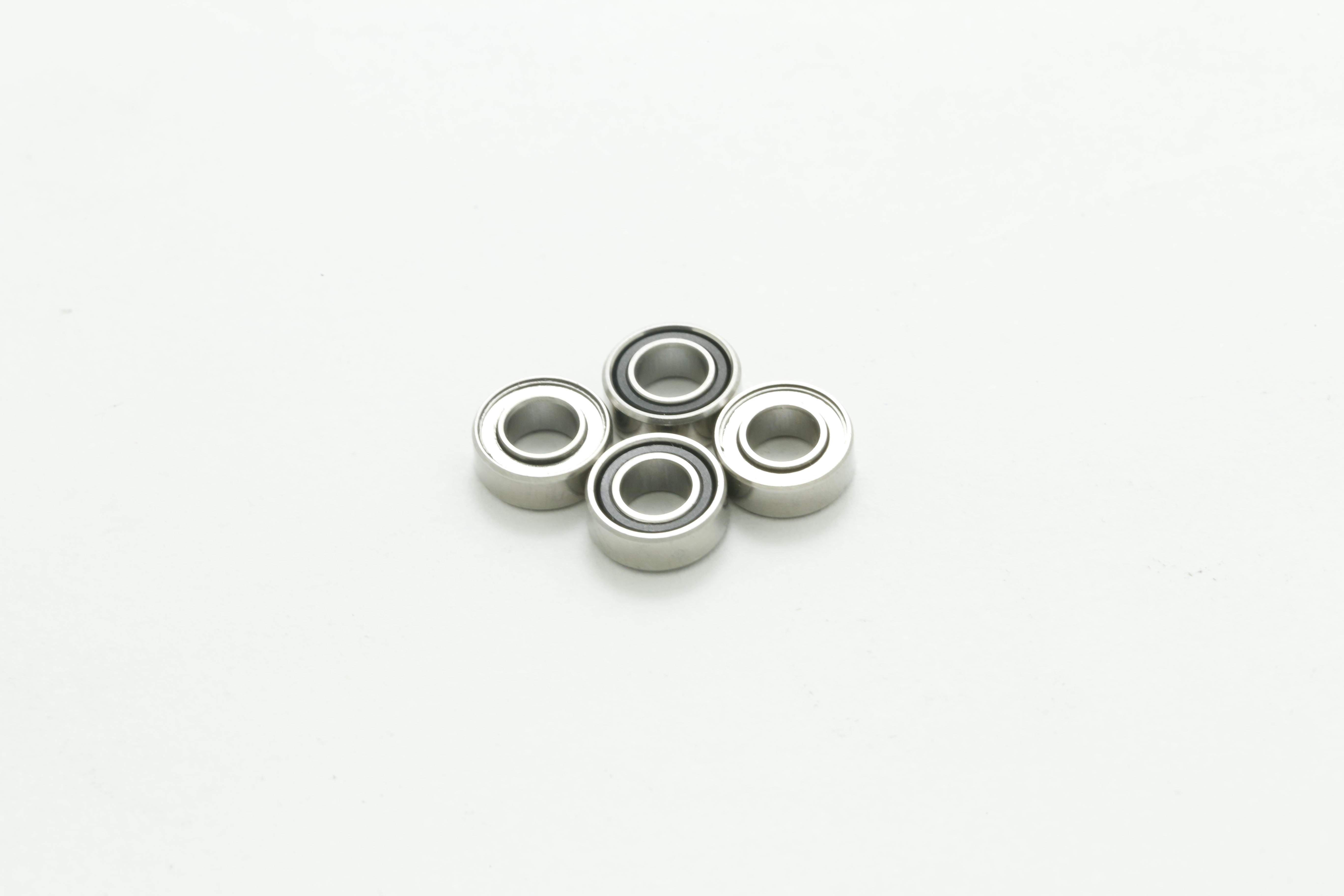
A miniature bearing's limiting speed is the highest rotational speed at which it can be expected to run continuously under the operating conditions stated by its manufacturer. In a dental air-turbine handpiece, that single figure decides whether the rotor spins cleanly through a service interval or overheats and seizes mid-procedure. INB's SMR144ZTLP4 W2.38 — an extra miniature stainless steel bearing measuring 3.175 × 6.35 × 2.38 mm — carries a limiting speed of 350,000–400,000 rpm. INB's SMR74TL uses the same P4 precision grade and the same SUS440 stainless steel, but is rated to 200,000 rpm. Two bearings that look almost identical on a drawing can serve two very different duties.
Dental turbines are an unusual engineering environment. The rotor inside an air-turbine handpiece turns far faster than almost any other miniature mechanism in a clinic, and the bearings that carry it are often smaller than the head of a match. Because the bearings are so small and the rotational speed is so high, the limiting speed rating — not the bore size, not the unit price, and not the brand name on the box — is usually the first specification a designer or buyer should read.
This explainer covers three things: what a limiting speed rating actually describes, how such a rating is established and verified, and why 350,000–400,000 rpm matters in a dental turbine while 200,000 rpm remains the correct answer for other handpiece designs. INB's SMR144ZTLP4 W2.38 and SMR74TL are used as the worked examples throughout.
What a Limiting Speed Rating Actually Describes
A limiting speed rating is a boundary condition, not a promise of service life. It tells the buyer the highest speed at which the bearing is considered suitable for continuous operation under the reference conditions stated by the manufacturer — normally a defined load, a defined lubrication state and a defined thermal environment. Above that boundary, heat generated in the rolling contact starts to outrun the bearing's ability to dissipate it, the lubricant film thins, and cage and raceway stresses climb. In general industry understanding, exceeding a limiting speed does not cause instant failure; it shortens the time to failure in a way that is difficult to predict.
That distinction produces three common misreadings.
- Reading the rating as a burst limit. A limiting speed is a continuous-running ceiling, not a survival threshold. Running close to it with a heavier preload, a different lubricant or a warmer environment can push the real usable speed below the published figure.
- Comparing figures across different bearings. Ratings are only comparable when bore size, internal geometry, material, lubrication and precision grade are comparable. A number published for one envelope does not transfer to another.
- Assuming a higher precision grade automatically means a higher speed rating. Precision class and speed capability are separate properties. INB's SMR74TL is a P4 bearing rated to 200,000 rpm; INB's SMR144ZTLP4 W2.38 is also P4, and is rated to 350,000–400,000 rpm. Same grade, very different speed envelope, because the internal design and thermal margin are not the same.
The width dimension shows how fine those design decisions are. The SMR144ZTLP4 W2.38 and the SR144ZTLP4 W2.78 share the same 3.175 mm bore and the same 6.35 mm outer diameter; they differ in width — 2.38 mm against 2.78 mm — and both are rated at 350,000–400,000 rpm. For a handpiece designer, that fraction of a millimetre is a packaging decision that has to be made alongside the speed and temperature requirements.
Industry Background: Where High-Speed Miniature Bearings Sit Today
Miniature bearings are a small product category with a large industrial footprint. Future Market Insights estimates the global miniature ball bearings market at approximately USD 2.25 billion in 2025, driven by demand from medical devices and robotics. That figure should be read as one estimate among several: Precedence Research places the same market near USD 2.89 billion and IMARC Group near USD 2.0 billion, so buyers should treat any single market size number as indicative rather than exact.
Regionally, Asia Pacific dominated the miniature ball bearings market in 2025 with a revenue share of approximately 60%, according to Precedence Research, with China as the largest regional producer and consumer. Export momentum has continued: BearingNews, citing the Huajing Research Institute, reports that China's bearing exports grew 7.2% year-on-year in the first seven months of 2025, reaching nearly 497,852 tons, even as global unit pricing came under pressure.
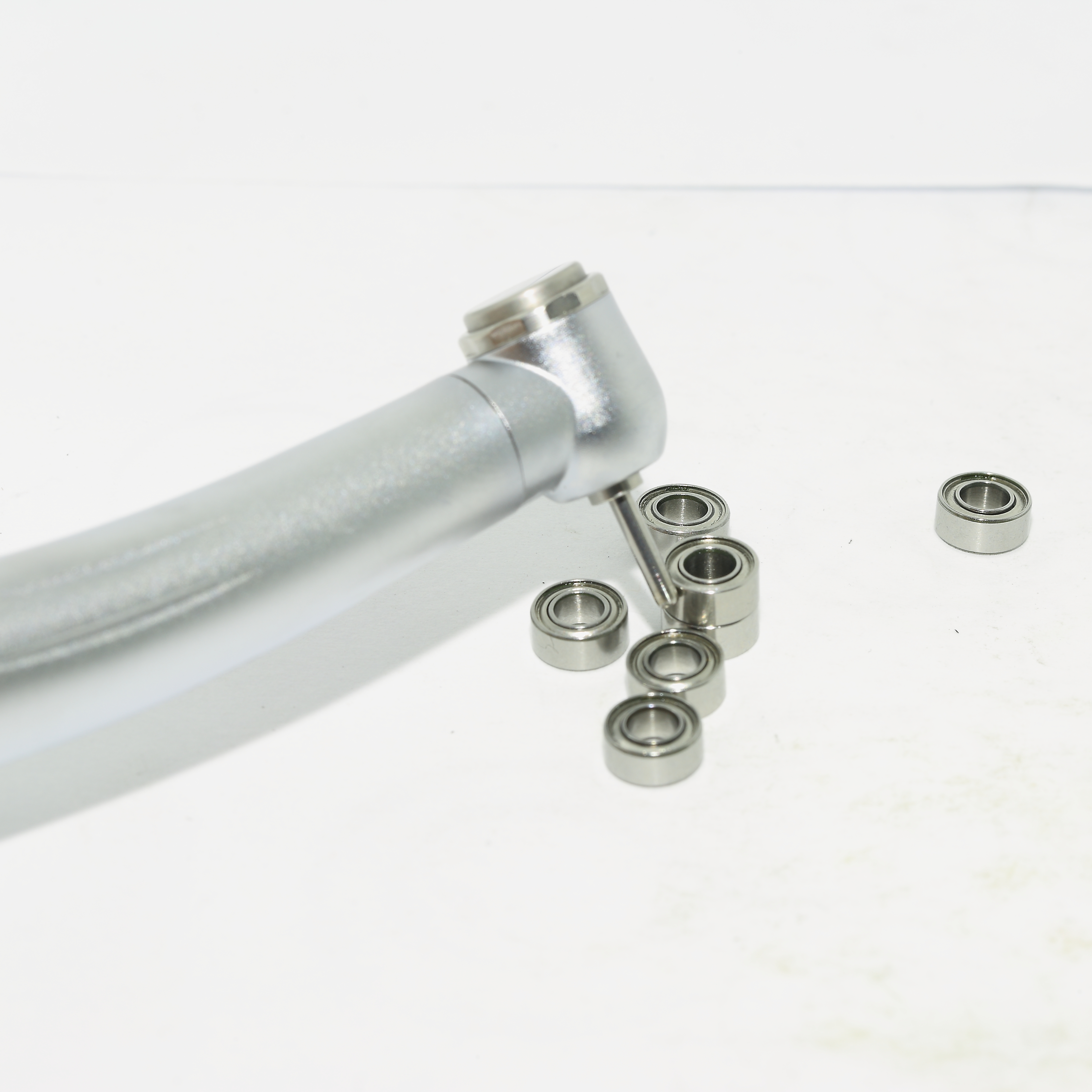
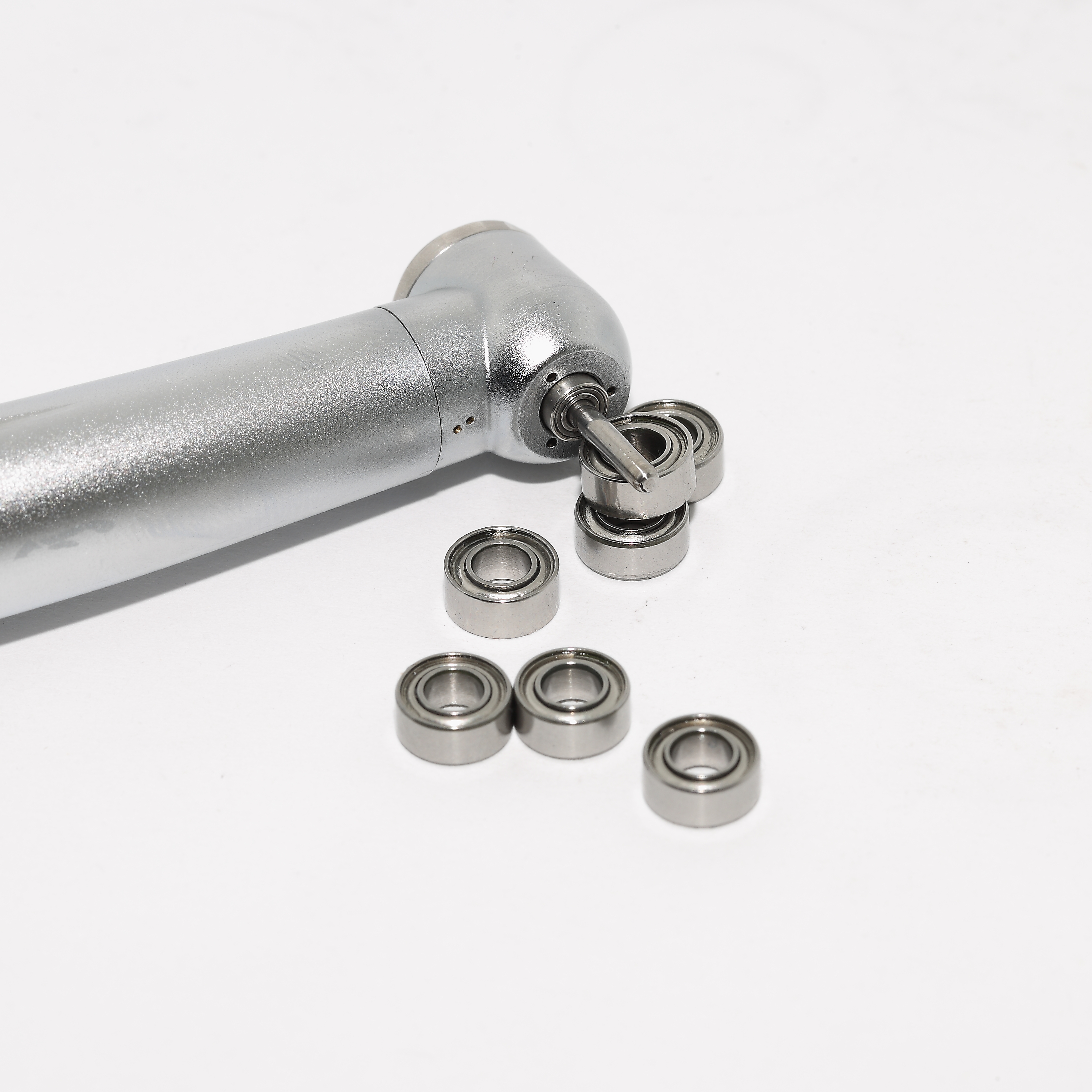
By application, the automotive segment held the largest share of the miniature bearing market in 2025 at approximately 39%, driven by electric-vehicle motor and sensor applications, according to Precedence Research. Medical devices form a smaller slice of that total but a more demanding one. In a dental handpiece bearing application, miniature bearings are expected to deliver P4 precision, ultra-high speed in the 350,000–400,000 rpm range, temperature resistance from −50 °C to 160 °C, medical-grade hygiene and low noise — a combination considerably harder to manufacture than a general-purpose motor bearing.
Two global reference points shape how this category is specified. First, precision: miniature bearing precision is governed by standards including ABMA ABEC (1–9), ISO 492 (P0–P2) and DIN 620, where higher ABEC numbers correlate to tighter tolerances, as described by AST Bearings. Second, material: 440C stainless steel is the primary material for miniature bearings used in medical and food-processing applications because of its moisture and chemical resistance, according to the SKDIN engineering guide. INB specifies SUS440 stainless steel across the four dental-handpiece models discussed below.
The manufacturing landscape is led by a small group of global suppliers. Intel Market Research lists MinebeaMitsumi — dominant in small sizes — alongside NSK, SKF and Schaeffler (Barden) as top manufacturers in the miniature bearing sector. Buyers sourcing dental-handpiece bearings therefore choose between global brand names and specialist regional manufacturers, and the deciding evidence is normally the published specification plus the factory's measurement discipline rather than the size of the supplier's logo.
How INB Specifies a 400,000 rpm Dental Turbine Bearing
INB's dental handpiece range separates into two speed classes, and the split is deliberate. Two models are specified for the 350,000–400,000 rpm bracket and two for 200,000 rpm.
- SMR144ZTLP4 W2.38 — an extra miniature bearing measuring 3.175 × 6.35 × 2.38 mm, P4 precision, SUS440 stainless steel, limiting speed 350,000–400,000 rpm, operating temperature −50 °C to 160 °C, intended for dental handpieces.
- SR144ZTLP4 W2.78 — the same 3.175 mm bore and 6.35 mm outer diameter in a 2.78 mm width, P4 precision, SUS440 stainless steel, limiting speed 350,000–400,000 rpm, operating temperature −50 °C to 160 °C, intended for dental handpieces.
- SMR74TL — a miniature bearing measuring 4 × 7 × 2 mm, P4 precision, SUS440 stainless steel, limiting speed 200,000 rpm, operating temperature −40 °C to 150 °C, intended for dental handpieces.
- SR133TL — an extra miniature bearing measuring 2.38 × 4.762 × 2.38 mm, P4 precision, SUS440 stainless steel, limiting speed 200,000 rpm, operating temperature −40 °C to 150 °C, intended for dental handpieces.
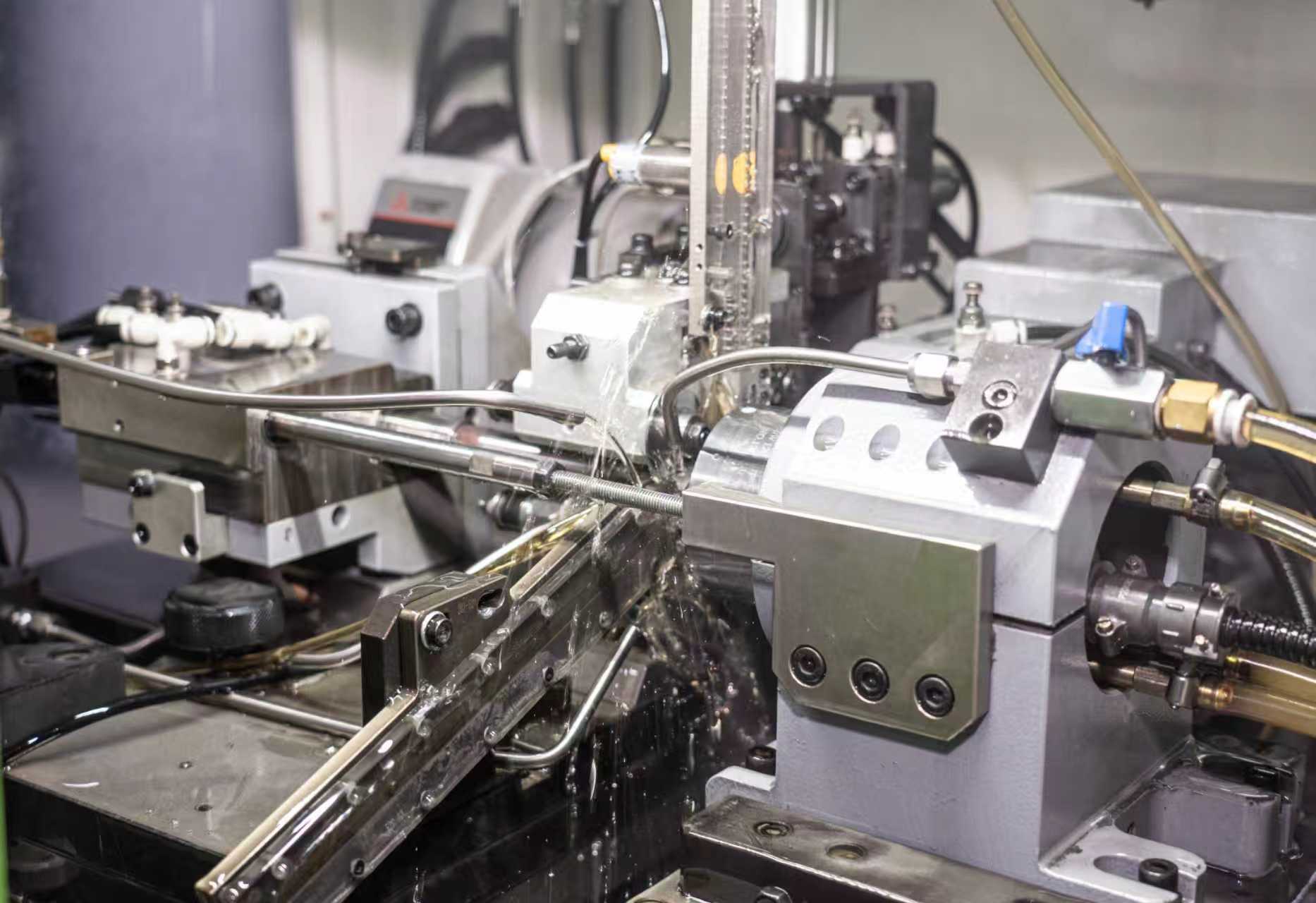
Behind those specifications sits a manufacturer rather than a trading operation. INB is the bearing brand established in 2014 by Ningbo City Jingyin Electromechanical Technology Co., Ltd., a Ningbo-based bearing enterprise established in 2014 that integrates production and sales. The company produces high-precision standard bearings with bore diameters from 2 mm to 8 mm across precision grades from P6 to P4, and operates in accordance with the ISO 9001 quality management system.
For high-speed work, the relevant capability is measurement rather than marketing language. INB's inspection setup includes hardness testers, roundness meters, profilometers, roughness measuring equipment and microscopes — the instruments that determine whether a batch actually meets a P4 tolerance band and a specified surface finish. The company employs three senior engineers with long experience in the bearing industry and an R&D team of ten engineers within a workforce of approximately 30 people, working from a 2,000 square metre manufacturing facility. Products mainly serve China's domestic medical device industry and micro-motor manufacturers, with export business accounting for approximately 5% of total sales — a profile overseas buyers should factor into their supplier evaluation.
Step-by-Step: How a Limiting Speed Rating Is Established and Verified
1. Establish the duty point
Everything starts with the operating condition, not with the bearing. For a dental handpiece the duty point is high-speed precision grinding in a clean medical environment with intermittent high-load operation — a repeated burst pattern rather than a steady run. Speed, load, lubrication, ambient temperature and duty cycle all feed into the bearing choice.
2. Set the precision class
All four INB dental-handpiece models in this discussion are specified at P4. Precision class controls the tolerance band of the bore, outer diameter and running accuracy, which in turn affects vibration and noise at high speed. Globally that class structure is defined by ABMA ABEC, ISO 492 and DIN 620, as described by AST Bearings.
3. Fix the material
SUS440 stainless steel is specified for the SMR144ZTLP4 W2.38, SR144ZTLP4 W2.78, SMR74TL and SR133TL. This aligns with wider industry guidance that 440C stainless is the primary material for miniature bearings in medical applications because of its moisture and chemical resistance.
4. Confirm the thermal headroom
Speed produces heat, and handpiece reprocessing adds more. The two 400,000 rpm models are rated from −50 °C to 160 °C; the two 200,000 rpm models are rated from −40 °C to 150 °C. That wider temperature range is one of the practical differences a buyer is paying for at the top of the speed range.
5. Understand how the rating is established — and how it is checked
A limiting speed figure is a design output rather than a single measured number. It reflects internal geometry, ball and raceway material, cage and shield design, lubricant and the thermal balance of the assembly. In general industry practice the figure represents the point at which heat generation in the rolling contact begins to outrun heat dissipation under the reference conditions, so it is treated as a validated design boundary rather than a one-off pass/fail test result.
What a buyer can actually verify is the production discipline behind the design: whether the factory works to a recognised quality system, and whether it owns the instruments needed to confirm geometry and surface quality on the specific lot. INB operates to the ISO 9001 quality management system and maintains hardness testers, roundness meters, profilometers, roughness measuring equipment and microscopes in-house.
6. Validate inside the assembled handpiece
The final check happens in the customer's rotor assembly, not on the supplier's bench. A published rating is a boundary condition; the usable speed in a specific handpiece depends on preload, lubrication, balancing and the thermal path through the housing. Buyers should plan an in-assembly validation run before releasing a full production order.
Use Cases: Where 400,000 rpm Is Necessary — and Where It Is Not
The primary application is the dental handpiece turbine. In that scenario the bearings are expected to deliver high rotational speed for rapid grinding, long service life and an extended handpiece lifespan under intermittent high-speed operation in a clean medical environment. The special requirements attached to that application are P4 precision, ultra-high speed of 350,000–400,000 rpm, wide temperature resistance from −50 °C to 160 °C, medical-grade hygiene and low noise.
Volume experience matters here. A project in China involving miniature bearings for dental handpieces covered 80,000 units — the kind of quantity that exposes design or process weaknesses rather than hiding them.
Not every handpiece needs the top of the range, however. A turbine designed to run at a lower speed, or one where thermal margin is less critical, can be served by a 200,000 rpm model such as the SMR74TL, specified from −40 °C to 150 °C. The same logic applies beyond dental turbines: the wider product base INB serves — medical devices and micro-motors — includes applications where the 200,000 rpm class is entirely sufficient, and where specifying a 400,000 rpm bearing would add cost without changing performance.
Comparison Table: INB Dental Handpiece Miniature Bearings
| Model | Size (mm) | Precision | Limiting speed | Operating temperature | Material | Intended industry |
|---|---|---|---|---|---|---|
| SMR144ZTLP4 W2.38 | 3.175 × 6.35 × 2.38 | P4 | 350,000–400,000 rpm | −50 °C to 160 °C | SUS440 | Dental handpiece |
| SR144ZTLP4 W2.78 | 3.175 × 6.35 × 2.78 | P4 | 350,000–400,000 rpm | −50 °C to 160 °C | SUS440 | Dental handpiece |
| SMR74TL | 4 × 7 × 2 | P4 | 200,000 rpm | −40 °C to 150 °C | SUS440 | Dental handpiece |
| SR133TL | 2.38 × 4.762 × 2.38 | P4 | 200,000 rpm | −40 °C to 150 °C | SUS440 | Dental handpiece |
All dimensional, speed, temperature and material figures are the specifications published by INB for these models. Precision classes are described against the standards framework published by AST Bearings (ABMA ABEC 1–9, ISO 492, DIN 620).
FAQ: High-Speed Miniature Bearings in Dental Turbines
What quality system and precision standards apply to INB's high-speed miniature bearings?
INB operates in accordance with the ISO 9001 quality management system, and the four dental-handpiece models discussed here are specified at P4 precision. Globally, miniature bearing precision is governed by frameworks including ABMA ABEC (1–9), ISO 492 (P0–P2) and DIN 620, as described by AST Bearings. One clarification matters for procurement: ISO 9001 certifies a quality management system, not a bearing's speed rating. The limiting speed figure itself comes from the manufacturer's published product specification.
What limiting speed do the SMR144ZTLP4 W2.38 and SMR74TL actually carry?
The SMR144ZTLP4 W2.38 is rated at 350,000–400,000 rpm with an operating temperature range of −50 °C to 160 °C. The SMR74TL is rated at 200,000 rpm with an operating temperature range of −40 °C to 150 °C. Both are P4 precision bearings made of SUS440 stainless steel, with envelope sizes of 3.175 × 6.35 × 2.38 mm and 4 × 7 × 2 mm respectively, and both are intended for dental handpieces.
Does every dental handpiece turbine need a 400,000 rpm bearing?
No. The rating should be matched to the duty point of the handpiece rather than to the highest number available. A bearing rated well above the speed the turbine actually reaches adds cost without adding performance, while specifying below the real operating speed removes the thermal margin that keeps the bearing alive. The practical test is the combination of operating speed, load, lubrication, ambient temperature and duty cycle — for a dental handpiece, intermittent high-speed operation in a clean medical environment.
How can a buyer evaluate these bearings before committing to a specification?
Start with the published specification — bore, outer diameter, width, precision class, limiting speed, operating temperature range and material — and confirm the factory's measurement capability for the specific lot, including roundness, profile and surface roughness instruments. Then validate a small quantity inside the assembled handpiece, because the rating is a boundary condition and the real usable speed depends on preload, lubrication and thermal path. INB can be contacted at yuhang001@126.com or +86 18957446001 to discuss specifications and sample evaluation.
How does INB's production capacity support repeat orders for dental handpiece bearings?
INB operates a 2,000 square metre manufacturing facility with a workforce of approximately 30 employees, an R&D team of ten engineers and three senior bearing engineers, and an annual output of 6,000,000 units. Experience with dental handpiece quantities includes a project in China covering 80,000 miniature bearings for dental handpieces. INB's main market is China, with export business accounting for approximately 5% of total sales. Specific quantities and delivery schedules are confirmed per order; the same contact details above can be used for availability and quotation.
Conclusion
Three points are worth carrying away from this explainer. First, a limiting speed rating is a boundary condition for continuous operation — not a burst limit and not a guarantee of service life. Second, a P4 precision grade and a high limiting speed are separate properties: INB's SMR74TL and SMR144ZTLP4 W2.38 are both P4, yet they sit 150,000 rpm apart in published rating. Third, the right number is the one that matches the duty point — 350,000–400,000 rpm for a dental turbine that genuinely runs there, and 200,000 rpm where that thermal and dynamic margin is not required.
For buyers who need the higher envelope, the two models to examine first are the SMR144ZTLP4 W2.38 and the SR144ZTLP4 W2.78, which share bore and outer diameter and differ in width. For buyers specifying a mainstream handpiece, the SMR74TL and SR133TL sit in the 200,000 rpm class. In every case the specification sheet and the factory's measurement discipline are the evidence that matters.
INB is the bearing brand of Ningbo City Jingyin Electromechanical Technology Co., Ltd. Product information is available at www.lnb-brg.com.
Next Step: Confirm the Specification Before You Specify the Bearing
If you are designing or sourcing a dental handpiece turbine bearing, start with the four numbers that control the outcome: bore and outer diameter, width, precision class and limiting speed. INB can confirm the published specification for the SMR144ZTLP4 W2.38, SR144ZTLP4 W2.78, SMR74TL and SR133TL, and discuss sample evaluation against your rotor design.
Email: yuhang001@126.com
Phone / WhatsApp: +86 18957446001
Have Questions or Need More Details?
Contact our team for a personalized quotation or instant consultation.
Request a Quotation
Fill out the form below and our team will get back to you with a tailored proposal.
WhatsApp Direct Chat
Prefer to chat in real-time? Message us on WhatsApp for instant assistance & quick answers.
- Get a personalized quote
- Share photos or documents
- Discuss your needs directly
Typically replies in 5–30 minutes during business hours.