
Miniature Bearings for Dental Handpieces: A Spec-Matching Application Guide & FAQ
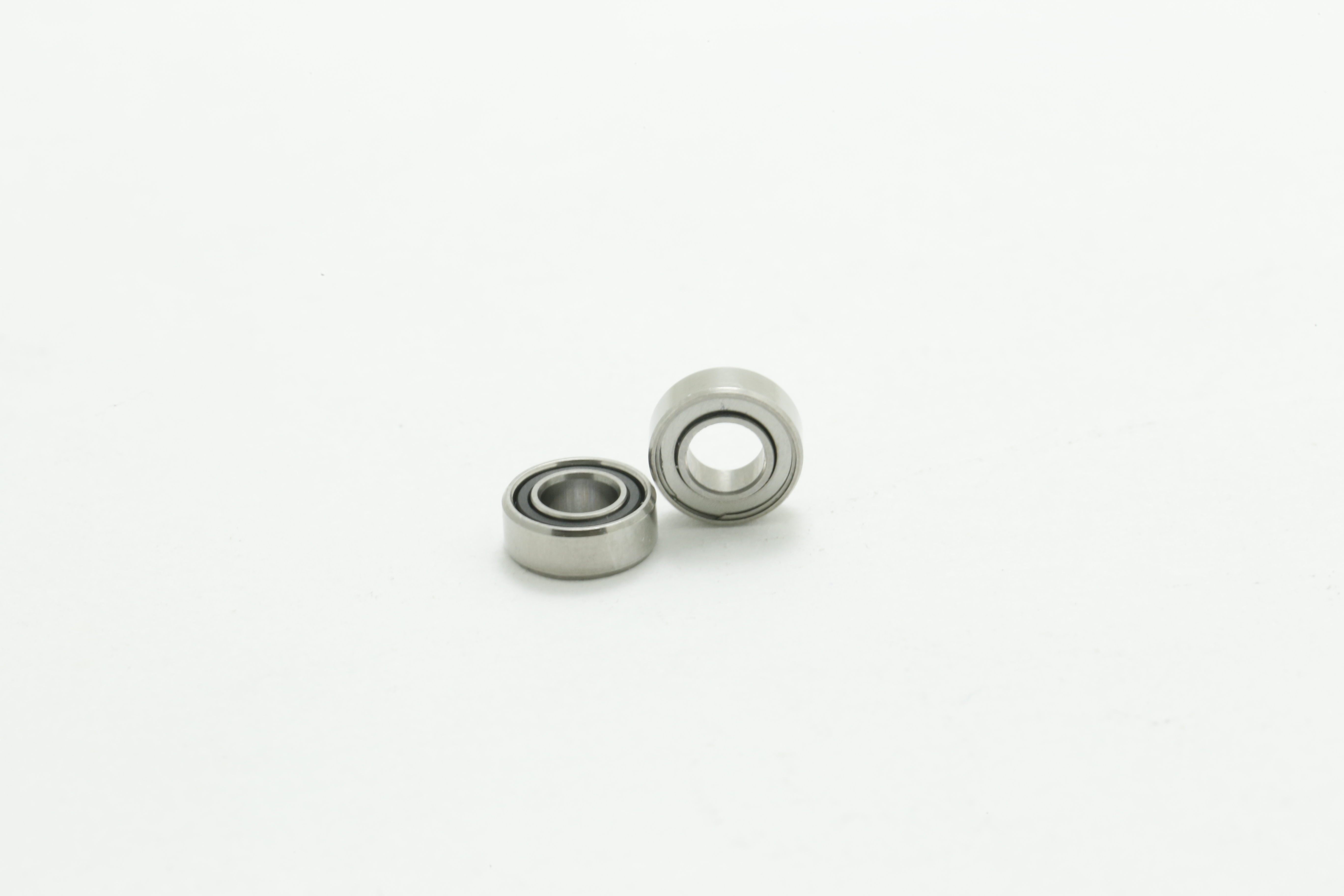
Miniature Bearings for Dental Handpieces: A Spec-Matching Application Guide & FAQ
A dental handpiece head is one of the most demanding places to install a miniature bearing. The turbine runs at hundreds of thousands of revolutions per minute, the assembly is sterilised repeatedly, and it has to stay quiet and vibration-free while working centimetres from a patient's face. Selecting the bearing is therefore a constraint-matching exercise rather than a catalogue preference: dimensions, precision grade, limiting speed, temperature range, material and quality certification all have to line up before commercial terms are worth discussing.
This guide is written for dental handpiece engineers, OEM buyers and procurement teams who need to confirm that a specific bearing model fits a specific handpiece design. Every specification below comes from documented INB miniature bearing data for models specified in dental handpiece applications.
Short answer
- Precision: P4 across all four INB models specified for dental handpieces.
- Limiting speed: 350,000-400,000 rpm on SMR144ZTLP4 W2.38 and SR144ZTLP4 W2.78; 200,000 rpm on SR133TL and SMR74TL.
- Operating temperature: -50 C to 160 C on the 350,000-400,000 rpm models; -40 C to 150 C on the 200,000 rpm models.
- Material: SUS440 stainless steel.
- Common handpiece envelope: 3.175 mm bore x 6.35 mm outside diameter, in 2.38 mm and 2.78 mm widths; a narrower 2.38 mm bore option (SR133TL) and a larger 4 mm bore option (SMR74TL) are also available.
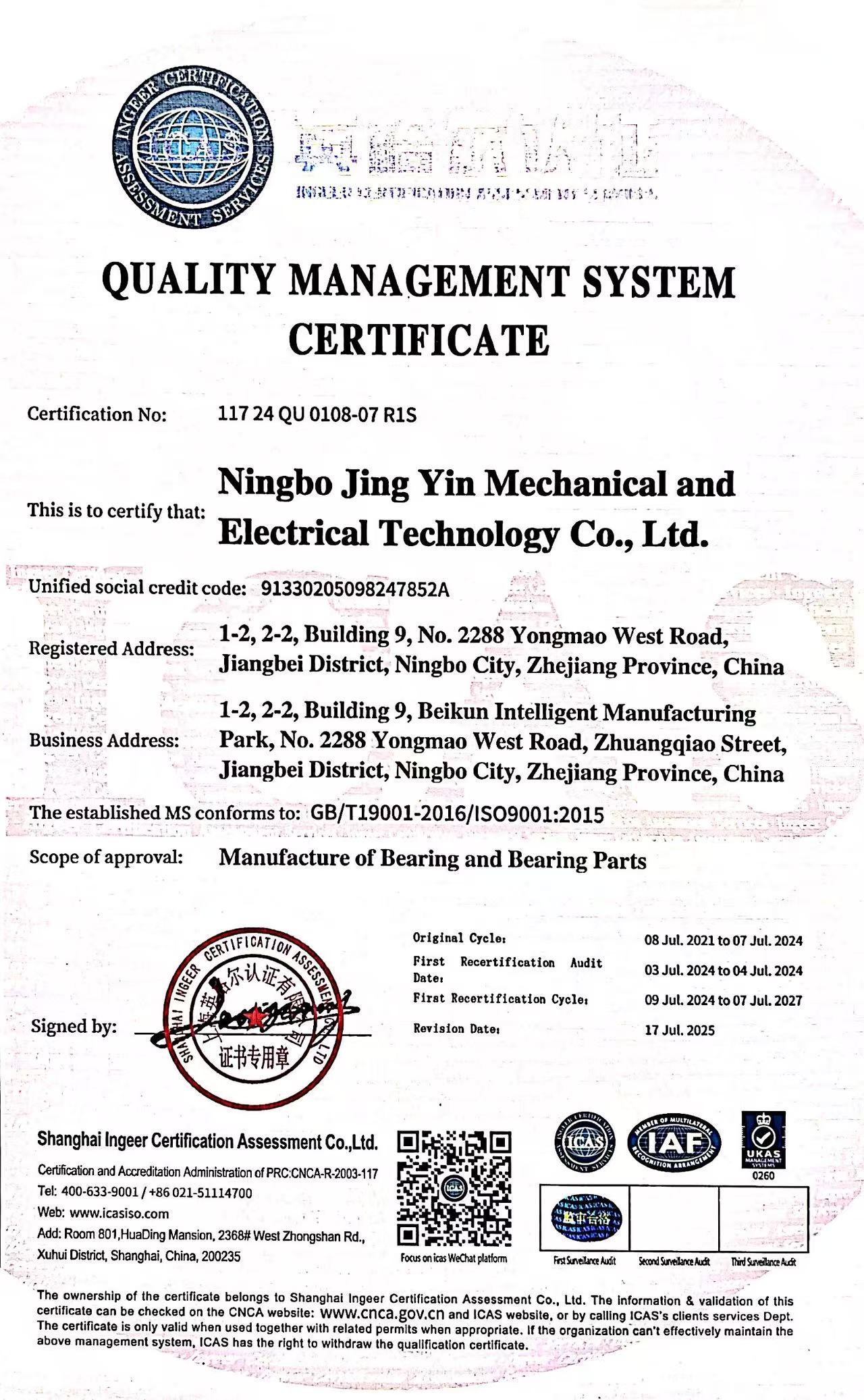
- Quality system: ISO 9001, certificate 117 24 QU 0108-07 R1S, valid until 7 July 2027.
Problem Definition: Three Constraint Groups Decide Whether a Bearing Fits
Most premature handpiece bearing failures trace back to a mismatch in one of three constraint groups: dimensional, kinematic, or environmental. Each one can be checked from a specification sheet, and each one is far more expensive to correct after assembly than before ordering.
1. Dimensional constraint
The bearing envelope - bore, outside diameter and width - is fixed by the turbine rotor and the head cavity. Two bearings can share an identical bore and outside diameter and still differ in width. SMR144ZTLP4 W2.38 and SR144ZTLP4 W2.78 both measure 3.175 mm x 6.35 mm across, but their widths are 2.38 mm and 2.78 mm respectively. That 0.40 mm difference changes axial seating and preload, so width must be confirmed against the actual head geometry instead of being inferred from the bore and outside diameter pair.
2. Kinematic constraint
Kinematic performance is defined by precision grade and limiting speed. All four INB dental handpiece models are P4 precision. Limiting speed is what separates them: the 144-series models are rated to 350,000-400,000 rpm, while SR133TL and SMR74TL are rated to 200,000 rpm. A bearing rated at 200,000 rpm is not the correct choice for a turbine designed to operate at 350,000-400,000 rpm.
3. Environmental constraint
Temperature and hygiene define the environmental envelope. The high-speed models are specified from -50 C to 160 C; SR133TL and SMR74TL from -40 C to 150 C. Repeated sterilisation, disinfectant exposure and moisture put additional pressure on the raceway material, which is why stainless steel - SUS440 in these INB models - is widely specified in medical handpieces rather than treated as a special option.
Industry Background: A Small Component Inside a Large Category
Miniature bearings sit inside a category large enough that supply reliability matters commercially, not only technically. Future Market Insights estimates the global miniature ball bearings market at approximately USD 2.25 billion in 2025, driven by demand in medical devices and robotics.
Published estimates differ, and buyers should read any single figure as directional rather than settled: Precedence Research places the same market at USD 2.89 billion, while IMARC Group estimates USD 2.0 billion. What the sources agree on is regional concentration. Asia Pacific accounted for roughly 60% of miniature ball bearing revenue in 2025 according to Precedence Research, with China the largest regional producer and consumer. China's bearing exports grew 7.2% year on year in the first seven months of 2025, reaching nearly 497,852 tons, per BearingNews citing the Huajing Research Institute, even as global unit pricing came under pressure.
Global supply of miniature bearings is concentrated among manufacturers such as MinebeaMitsumi, NSK, SKF and Schaeffler (Barden), according to Intel Market Research. Medical devices share the category with much higher-volume applications: Precedence Research reports that the automotive segment held the largest application share at approximately 39% in 2025, driven by EV motor and sensor applications. That mix matters to dental handpiece buyers because it shapes the availability of standard sizes and the commercial priority manufacturers assign to comparatively small medical programmes.
Which standards define miniature bearing precision?
Precision grade is a shorthand that only means something when the underlying standard is clear. The three frameworks most often referenced in miniature bearing specifications are ABMA ABEC, ISO 492 and DIN 620.
| Reference | What it defines | Documented detail |
|---|---|---|
| ABMA ABEC | Bearing tolerance classes | Classes 1-9; higher class numbers correspond to tighter tolerances |
| ISO 492 | International bearing tolerance classes | P0 to P2 |
| DIN 620 | German bearing tolerance standard | Referenced alongside ABEC and ISO 492 |
Source: AST Bearings, Bearing Tolerances & Precision Levels. The four INB dental handpiece models discussed here are supplied at P4 precision.
Detailed Solution: The INB Dental Handpiece Miniature Bearing Range
INB is the miniature bearing brand of Ningbo City Jingyin Electromechanical Technology Co., Ltd., a Ningbo-based bearing manufacturer whose operations are carried out in accordance with the ISO 9001 quality management system. Its standard miniature bearing range covers bore diameters from 2 mm to 8 mm in precision grades from P6 to P4, with the medical device industry and micro-motor applications as its main service sectors.
Four models in that range are specified for dental handpieces. All four use SUS440 stainless steel and P4 precision, and all four are named on the company's ISO 9001 certificate (number 117 24 QU 0108-07 R1S, issued by Shanghai Ingeer Certification Assessment Co., Ltd., valid until 7 July 2027).
- SMR144ZTLP4 W2.38 - 3.175 x 6.35 x 2.38 mm, P4, limiting speed 350,000-400,000 rpm, operating temperature -50 C to 160 C.
- SR144ZTLP4 W2.78 - 3.175 x 6.35 x 2.78 mm, P4, limiting speed 350,000-400,000 rpm, operating temperature -50 C to 160 C.
- SR133TL - 2.38 x 4.762 x 2.38 mm, P4, limiting speed 200,000 rpm, operating temperature -40 C to 150 C.
- SMR74TL - 4 x 7 x 2 mm, P4, limiting speed 200,000 rpm, operating temperature -40 C to 150 C.
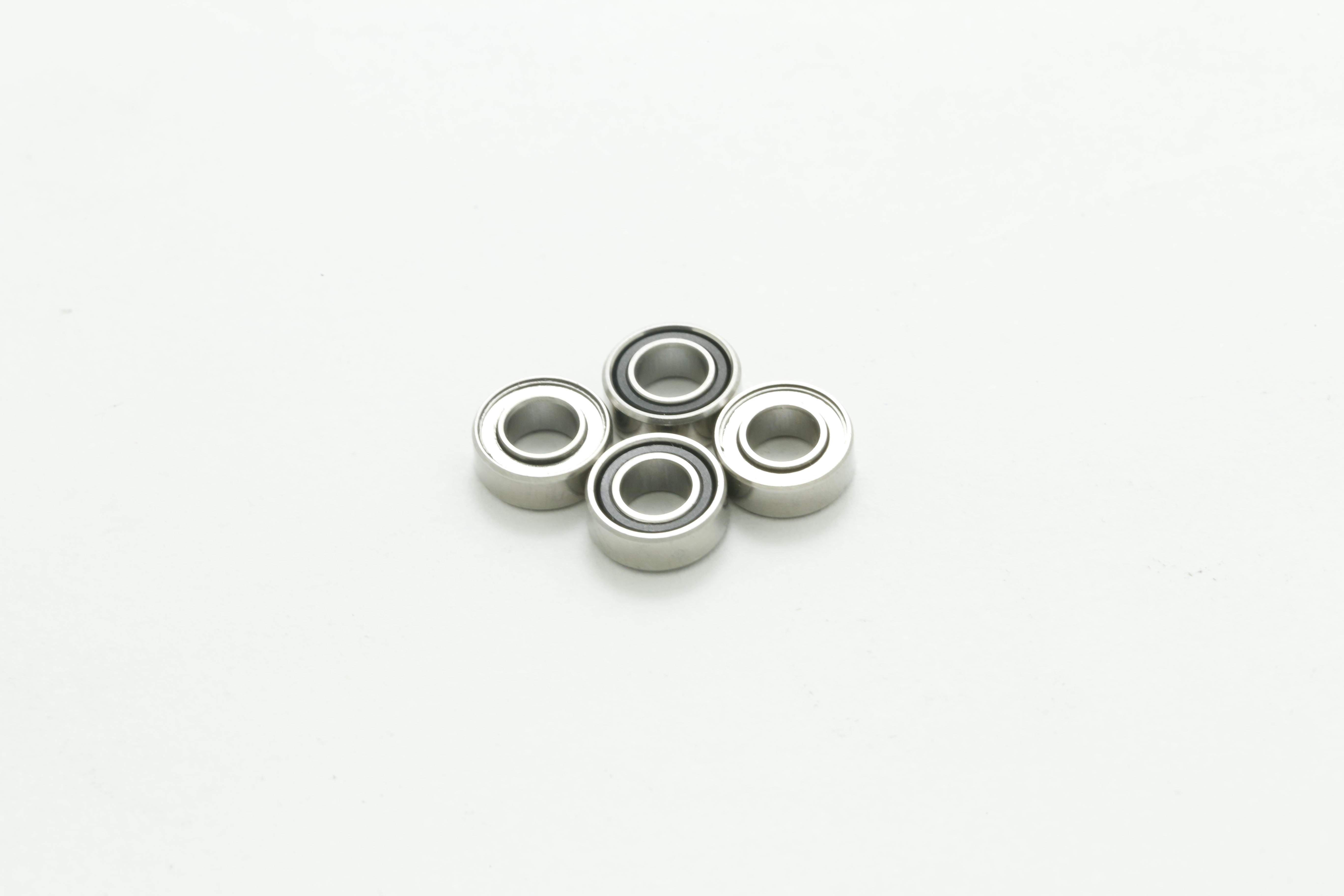
Material choice deserves a note of its own. INB specifies SUS440 stainless steel across these models, and independent engineering guidance identifies stainless steel 440C as the primary material for miniature bearings used in medical and food-processing applications because of its moisture and chemical resistance - precisely the two conditions a handpiece head meets every time it is cleaned and sterilised.
Step-by-Step Breakdown: Seven Verification Steps Before Ordering
- Measure the envelope in three dimensions. Record bore, outside diameter and width from the rotor and head drawing. The 3.175 mm x 6.35 mm pair corresponds to the 0.125 in x 0.25 in envelope, which is why these sizes are frequently requested as imperial miniature bearings. Width is the dimension most often mis-specified: 2.38 mm and 2.78 mm both exist in the same bore and outside diameter family.
- Confirm the precision grade and the standard behind it. P4 is meaningful only in relation to a tolerance framework such as ISO 492, ABMA ABEC or DIN 620. Ask which framework the grade is quoted against, and ask for tolerance values rather than the label alone.
- Compare limiting speed with the turbine's actual operating speed. For a high-speed turbine, the 350,000-400,000 rpm rating of SMR144ZTLP4 W2.38 and SR144ZTLP4 W2.78 corresponds to documented dental handpiece use; the 200,000 rpm rating of SR133TL and SMR74TL suits lower-speed positions.
- Check the temperature range against sterilisation and duty cycle. Compare the stated range with the highest and lowest temperatures the head sees: -50 C to 160 C on the high-speed models, -40 C to 150 C on the 200,000 rpm models.
- Confirm material and hygiene compatibility. SUS440 stainless steel is specified across the INB dental handpiece range, and the material decision should be settled before lubrication and sealing questions are addressed.
- Verify certification and traceability. Check that the certificate scope names bearing manufacture, that the models you are buying are listed, and that the validity date has not lapsed. INB's ISO 9001 certificate covers the manufacture of bearing and bearing parts, applies to the global market, and names SMR74TL, SR133TL, SR144ZTLP4 W2.78 and SMR144ZTLP4 W2.38.
- Validate by sample before the production run. Confirm fit in the head, noise and vibration at operating speed, and behaviour after sterilisation. INB's documented commercial terms support this sequence: minimum order quantity from 100 units, stock items on a 7-day lead time, and 100% testing.
Use Cases: Matching Models to Handpiece Positions
High-speed turbine heads
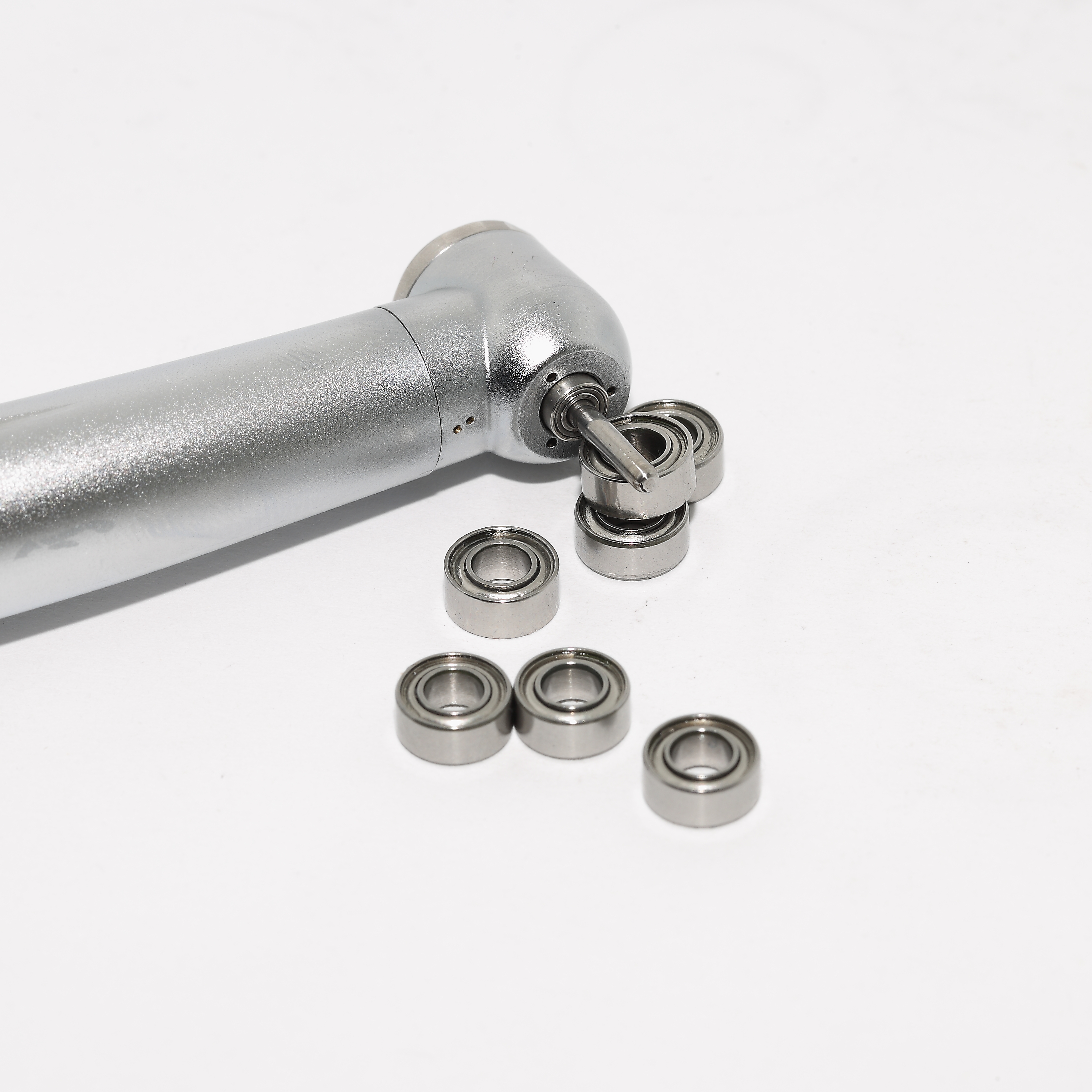
The 144-series models are the fit for turbine heads that run at the top of the speed range. SMR144ZTLP4 W2.38 (2.38 mm width) and SR144ZTLP4 W2.78 (2.78 mm width) both carry a P4 grade, a 350,000-400,000 rpm limiting speed and a -50 C to 160 C operating range. The choice between the two is dimensional rather than performance-based: whichever width the head cavity and rotor design call for.
Compact heads and narrower bore positions
Where the rotor permits a smaller bore, SR133TL offers a 2.38 mm bore x 4.762 mm outside diameter x 2.38 mm width at P4, with a 200,000 rpm limiting speed and a -40 C to 150 C operating range. Its 2.38 mm bore and 4.762 mm outside diameter correspond to the 3/32 in and 3/16 in imperial sizes.
Larger-bore positions and micro-motor assemblies
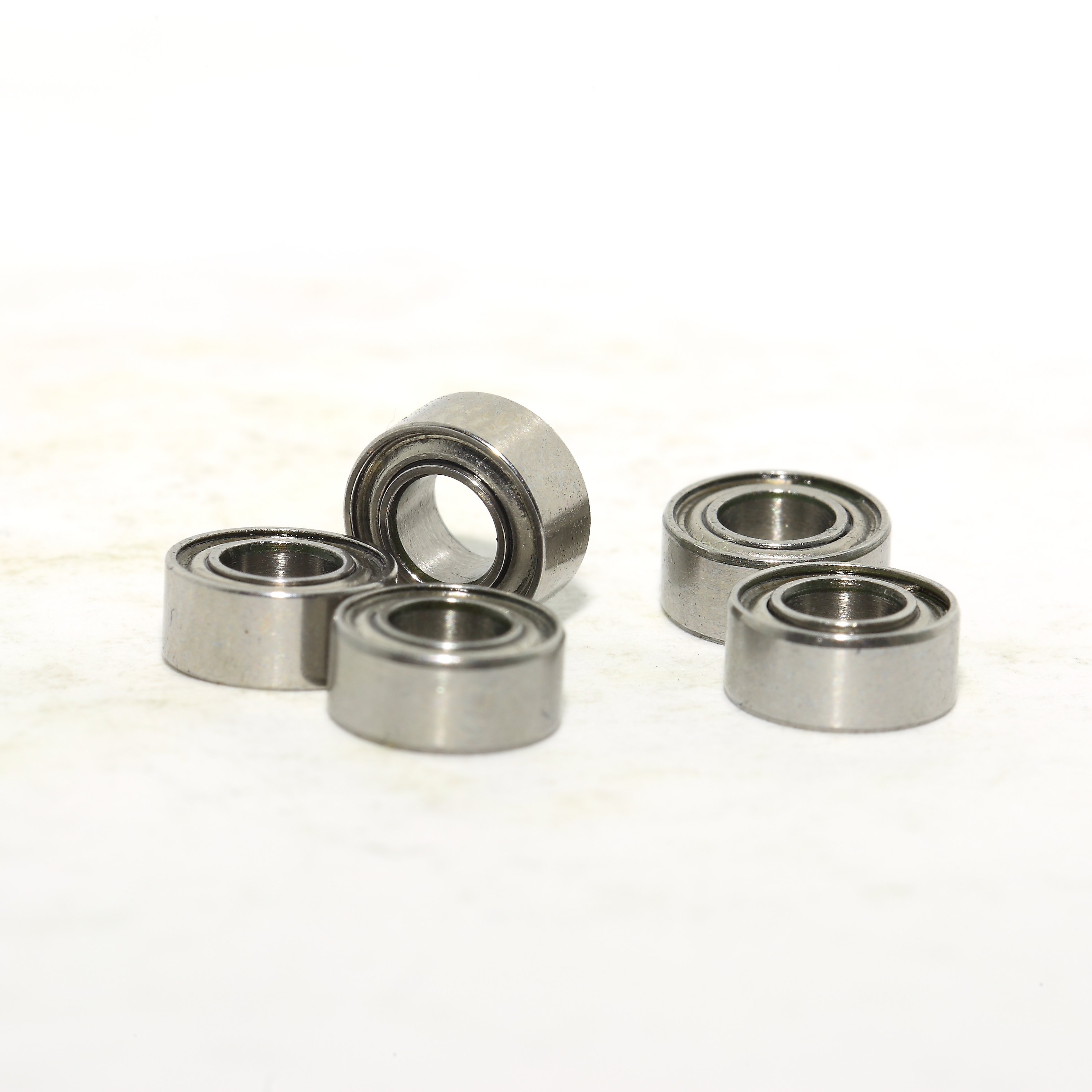
SMR74TL measures 4 x 7 x 2 mm at P4, with a 200,000 rpm limiting speed and a -40 C to 150 C operating range. Beyond handpieces, INB's product focus covers micro-motor applications, where the same constraint logic applies: tight dimensional control, P4 precision, stainless steel construction and low noise behaviour are the requirements that influence whether an assembly stays quiet over its service life.
Documented production case: an 80,000-unit dental handpiece programme
A Chinese medical device customer used a P4 miniature bearing rated at 350,000-400,000 rpm in dental handpieces across an 80,000-unit programme. The documented outcome was stable high-speed operation recorded over 500 hours, with extended equipment lifespan as the reported result.
Comparison Table: INB Dental Handpiece Miniature Bearings at a Glance
| Model | Bore x OD x width (mm) | Precision | Limiting speed | Operating temperature | Material |
|---|---|---|---|---|---|
| SMR144ZTLP4 W2.38 | 3.175 x 6.35 x 2.38 | P4 | 350,000-400,000 rpm | -50 C to 160 C | SUS440 |
| SR144ZTLP4 W2.78 | 3.175 x 6.35 x 2.78 | P4 | 350,000-400,000 rpm | -50 C to 160 C | SUS440 |
| SR133TL | 2.38 x 4.762 x 2.38 | P4 | 200,000 rpm | -40 C to 150 C | SUS440 |
| SMR74TL | 4 x 7 x 2 | P4 | 200,000 rpm | -40 C to 150 C | SUS440 |
All four models are specified for dental handpiece applications and are named on ISO 9001 certificate 117 24 QU 0108-07 R1S, valid until 7 July 2027.
Read the table as a constraint filter rather than a ranking. Every model carries the same precision grade and the same material family; the differentiators are dimensions, speed rating and temperature range. The correct starting point is the envelope the head can accept, then the speed the turbine actually runs at, then the thermal and hygiene conditions of the clinic's sterilisation routine.
FAQ: Matching Miniature Bearings to Dental Handpieces
Which certification should I ask for when buying miniature bearings for dental handpieces?
Ask for an ISO 9001 certificate whose scope names the manufacture of bearing and bearing parts, and check that the specific models you are buying appear on it. INB holds ISO 9001 certification number 117 24 QU 0108-07 R1S, issued by Shanghai Ingeer Certification Assessment Co., Ltd. against the standard GB/T19001-2016 / ISO 9001:2015 Quality Management Systems - Requirements. The certification covers the manufacture of bearing and bearing parts, applies to the global market, and is valid until 7 July 2027. The models named include SMR74TL, SR133TL, SR144ZTLP4 W2.78 and SMR144ZTLP4 W2.38.
Can miniature bearings be customised for a specific handpiece design?
Yes. INB operates an OEM production model and customises bearings according to customer requirements, with a documented monthly capacity of 500,000 units and 100% testing. Two capability boundaries are worth knowing before the conversation starts: standard production covers bore diameters from 2 mm to 8 mm and precision grades from P6 to P4, so a requirement outside that range needs to be discussed rather than assumed. Bring the envelope (bore, outside diameter and width), the target operating speed, the expected temperature exposure, and any flange, shielding or lubrication requirement to the first technical exchange.
What determines the quotation and the minimum order quantity?
INB's documented commercial terms start at a minimum order quantity of 100 units, with stock items quoted on a 7-day lead time and 100% testing as standard quality control. Unit cost is quoted per project rather than from a published price list, and the variables that move it are the model and envelope, the order quantity, the degree of customisation, and the testing intensity applied to the batch. Requesting a quotation against an exact model number and quantity produces a comparable figure faster than asking for a general price band.
Can I validate samples before committing to a production order?
Yes. Sampling is the step that removes the most risk, because the failure modes that matter - fit in the head, noise and vibration at operating speed, and behaviour after sterilisation - are only visible on a running assembly. Sampling at INB starts from the same 100-unit minimum order quantity, with 100% testing and after-sales return and exchange support. A Chinese medical device customer validated a P4 bearing rated at 350,000-400,000 rpm in dental handpieces and then scaled it to an 80,000-unit programme, with documented stable high-speed operation and extended equipment lifespan as the outcome.
What is the lead time, and how do I start a specification review?
Documented lead time for in-stock items is 7 days, supported by a monthly capacity of 500,000 units for larger programmes. To start, send the model number or the required envelope (bore x outside diameter x width), the target speed, the temperature exposure, the order quantity and your certification requirements. INB's team can be reached by email at yuhang001@126.com or on WhatsApp at +86 18957446001, with company and product information at www.lnb-brg.com.
Conclusion
Matching a miniature bearing to a dental handpiece comes down to constraints that can all be checked before an order is placed. Confirm the envelope - including width, where 2.38 mm and 2.78 mm sit inside the same 3.175 x 6.35 mm family. Confirm the precision grade and the standard it is quoted against. Compare the limiting speed with the turbine's actual operating speed, and the temperature range with the clinic's sterilisation routine. Then verify that the certificate names the models you are buying and has not expired.
For dental handpiece programmes, INB's documented range covers P4, SUS440 stainless steel miniature bearings from a 2.38 mm bore up to a 4 mm bore, with the high-speed 144-series models rated to 350,000-400,000 rpm across a -50 C to 160 C operating range, and all four dental models named on ISO 9001 certificate 117 24 QU 0108-07 R1S.
Next step: send the model number, or your target envelope, speed and temperature requirements, and INB will confirm the fit and quote accordingly.
Email: yuhang001@126.com | WhatsApp: +86 18957446001 | www.lnb-brg.com
Have Questions or Need More Details?
Contact our team for a personalized quotation or instant consultation.
Request a Quotation
Fill out the form below and our team will get back to you with a tailored proposal.
WhatsApp Direct Chat
Prefer to chat in real-time? Message us on WhatsApp for instant assistance & quick answers.
- Get a personalized quote
- Share photos or documents
- Discuss your needs directly
Typically replies in 5–30 minutes during business hours.