
Top 3 Miniature Bearings for Dental Handpieces: INB's Ranked Picks
For dental handpiece manufacturers and the buyers who supply them, the practical shortlist from INB's miniature bearing range comes down to three models: SR133TL, SMR144ZTLP4 W2.38 and SMR74TL. This ranking orders them by five criteria that decide whether a bearing survives inside a turbine head — application-specific design, precision grade, documented limiting speed, material and operating temperature, and evidence from real handpiece use. Where INB's published product data does not state a value, this article says so rather than filling the gap, because a handpiece turbine is the wrong place to discover a missing specification.
Problem Definition: Why Handpiece Bearing Choice Is Harder Than It Looks
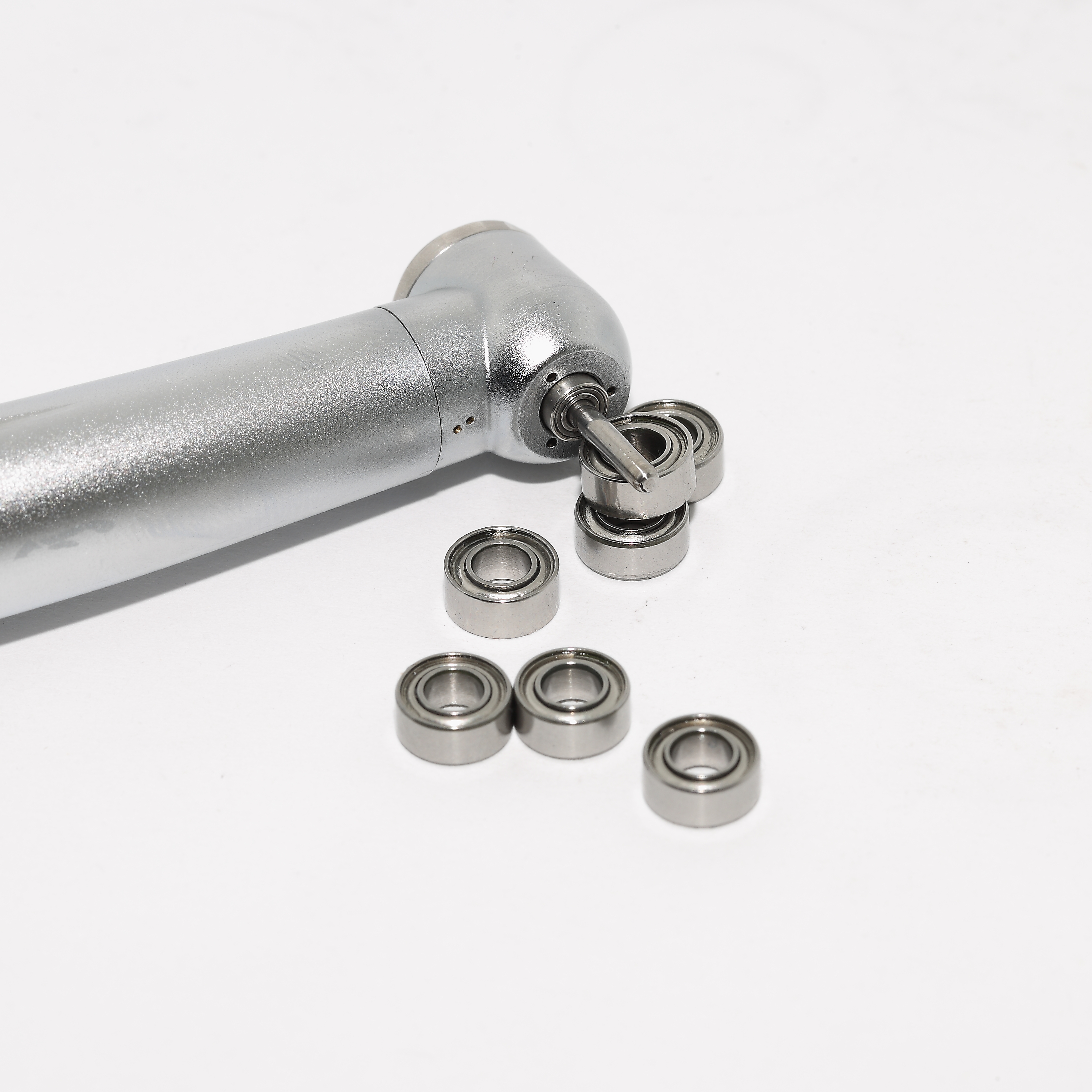
A dental handpiece bearing is not a general-purpose miniature bearing that happens to be small. In an air-turbine handpiece the rotor assembly runs at extreme rotational speed inside a head that offers only a few millimetres of wall thickness, and both bearings in the assembly must hold the shaft precisely enough to keep vibration, noise and heat within the limits the handpiece designer set. The envelope is fixed: bore, outer diameter and width are dictated by the existing turbine head, and there is normally no room to step up to a larger section.
That combination — very high speed, a fixed small envelope, and a wear component that fails before anything else in the instrument — is why bearing selection shows up so often in handpiece failures. Two extra miniature bearing models can sit beside each other in a catalogue and still differ in ways that only appear after a few hundred hours of running: whether the design was created for handpiece duty, what precision grade was applied, what limiting speed the manufacturer publishes, and whether the material tolerates repeated cleaning and sterilisation.
The real problem for a buyer is evidence asymmetry. Suppliers publish a model number and a size; they rarely publish application fit, validation history or operating limits. A ranking that only compares dimensions therefore adds little value. What a turbine designer or a procurement engineer needs is a ranking that identifies which model was built for the application, which one carries documented high-speed performance, and which one solves the envelope problem — with a clear statement of what still requires verification before an order is placed.
Industry Background: A Small Component in a Large and Concentrated Market
Miniature bearings are a small component inside a substantial market. Future Market Insights estimates the global miniature ball bearings market at approximately USD 2.25 billion in 2025, driven by demand in medical devices and robotics. Published estimates vary: Precedence Research values the same market at around USD 2.89 billion, while IMARC Group places it near USD 2.0 billion. The divergence matters less than the trend behind it — precision miniature bearings are shifting from a commodity purchase to a specified, application-validated component in medical equipment programmes.
Asia Pacific held approximately 60% of miniature ball bearing revenue in 2025, with China the largest regional producer and consumer (Precedence Research). China's bearing exports grew 7.2% year on year in the first seven months of 2025, reaching nearly 497,852 tons (BearingNews / Huajing Research Institute). For international buyers, that means supply is concentrated in a region where the difference between a validated miniature bearing manufacturer and a general trading operation is not always visible from the outside.
Technically, miniature bearing precision is governed by internationally recognised tolerance systems: ABMA ABEC 1–9, ISO 492 (P0–P2) and DIN 620, where higher numbers in the ABEC scale correspond to tighter tolerances (AST Bearings). Material choice follows the application: 440C stainless steel is the primary material for miniature bearings used in medical and food-processing equipment because of its moisture and chemical resistance (SKDIN Engineering Guide). Both points explain why a datasheet that lists only “stainless” is not sufficient for a handpiece programme.
At the top of the sector sit large multinational manufacturers, including MinebeaMitsumi (dominant in small sizes), NSK, SKF and Schaeffler (Barden), according to Intel Market Research's 2025 overview. Alongside them, regional specialists compete on application-specific engineering, tooling flexibility and response time rather than scale.
INB is a miniature bearing brand established in 2014 in Ningbo, Zhejiang, China, by a bearing manufacturer that integrates production and sales. The company produces high-precision standard bearings with bore diameters from 2 mm to 8 mm in precision grades from P6 to P4, and its products mainly serve the Chinese medical device industry and micro-motor manufacturers. That focus — small bores, high precision, medical duty — is the context in which the three models below should be read.
How This Ranking Was Built
Five criteria were applied, in this order of weight:
- Application fit. Was the model designed or specified for dental handpiece use, or is it a general-purpose extra miniature bearing being proposed for a handpiece design?
- Precision and speed. What precision grade is published, and what limiting speed does the manufacturer state?
- Material and thermal behaviour. What is the bearing material, and over what operating temperature range is the model rated?
- Envelope suitability. Does the model suit the tight bore, outer diameter and width of a handpiece head, including thin-wall and compact configurations?
- Evidence of use. Has the model been deployed in a real handpiece programme with a measurable runtime?
Two transparency notes belong here. First, this is a ranking of three models inside INB's own line, not a head-to-head against other brands' catalogue models: comparable model-level performance data for competing dental bearings is not published in a form that supports a fair comparison, and this article does not invent one. Second, full published dimensional data in the available specification set covers one of the three models; for the other two, dimension confirmation is flagged as an explicit pre-order step rather than assumed.
Ranked Pick 1: SR133TL — The Application-Specific Choice
SR133TL is the model in this line that INB specifies for dental handpiece applications. That single fact carries more weight than any dimensional similarity, because the failure modes that matter in a handpiece — vibration build-up, raceway wear under sustained high speed, and heat generation inside a sealed head — are addressed at design and process level, not by selecting the closest size from a catalogue.
Inside a handpiece, the bearing is not a standalone purchase; it is part of a matched pair that has to hold a rotor at speed. Designers choosing the SR133TL are effectively choosing the model whose intended duty is the application in front of them, which is why it takes first position in this ranking.
Ranked Pick 2: SMR144ZTLP4 W2.38 — The Best-Documented High-Speed Bearing
SMR144ZTLP4 W2.38 is the most completely documented of the three, and it is the pick when published performance data and field evidence are the deciding factors. Its stated specification is:
- Dimensions: 3.175 × 6.35 × 2.38 mm (bore × outer diameter × width)
- Precision grade: P4
- Limiting speed: 350,000–400,000 rpm
- Operating temperature: −50 °C to 160 °C
- Material: SUS440 stainless steel
- Applicable industry: dental handpiece
The 2.38 mm width inside a 6.35 mm outer diameter is a thin-wall proportion, which is what allows the model to sit in a compact turbine head without consuming space that the shaft and shield arrangement needs. The operating window of −50 °C to 160 °C covers both the running temperature of a high-speed turbine and the thermal cycling a handpiece experiences during cleaning and sterilisation. P4 precision places the model in the high-precision miniature bearing class, the grade normally associated with low-noise, low-vibration running in dental and micro-motor applications.
The model also carries field evidence. A medical device client in China deployed 80,000 units for use in dental handpieces; over a reported 500 hours of operation the outcome was stable high-speed operation and extended equipment lifespan, with the application characteristics summarised as ultra-high speed, P4 precision, long service life and medical-grade reliability. The same model is linked to INB's ISO 9001 certificate.
Where it fits: high-speed handpiece production, replacement bearing batches, and any programme in which limiting speed and temperature window must be documented rather than assumed.
Ranked Pick 3: SMR74TL — The Compact-Envelope Option
SMR74TL takes third position for a different reason: it fits compact dimensions. Handpiece designs vary, and not every head offers the internal volume of a standard turbine. When the envelope is the binding constraint — a slimmer head, a smaller rotor assembly, or a micro-motor handpiece rather than an air turbine — the selection question changes from “which bearing is fastest” to “which bearing fits without compromising the assembly”.
Ranking a compact model third is not a downgrade. A bearing that does not fit cannot be evaluated at all, and designers working to tight head geometry will find that the envelope criterion outranks published speed figures. As with SR133TL, dimensional values for SMR74TL are not stated in the specification data available for this article: confirm bore, outer diameter, width and precision grade against the current datasheet, and check whether a flanged stainless steel miniature bearing variant is needed for axial location in your design.
Comparison Table: INB's Three Handpiece Bearing Models Side by Side
| Rank | Model | Why it holds this position | Published specification (INB product data) | Best suited to |
|---|---|---|---|---|
| 1 | SR133TL | Specified by INB for dental handpiece applications; strongest application fit | Application: dental handpiece. Dimensional and precision values: confirm with the INB datasheet | Handpiece turbine designs where application-specific fit is the priority |
| 2 | SMR144ZTLP4 W2.38 | Most complete published performance data plus validated field use in dental handpieces | Size 3.175 × 6.35 × 2.38 mm; precision P4; limiting speed 350,000–400,000 rpm; operating temperature −50 °C to 160 °C; material SUS440 stainless steel; dental handpiece | High-speed turbine production and replacement bearing supply |
| 3 | SMR74TL | Selected for compact dimensions where the mounting envelope is the limiting factor | Compact-dimension fit. Dimensional and precision values: confirm with the INB datasheet | Space-constrained handpiece heads and micro-motor applications |
Catalogue size alone does not decide a handpiece bearing. The table is deliberately arranged so that documented values and unconfirmed values are visible at a glance: one model has a complete published performance profile, and two require datasheet confirmation before an order is released.
Step-by-Step Breakdown: Validating the Right Model for Your Handpiece
The six steps below turn the ranking into a procurement decision. They follow the sequence that a turbine designer and a buyer would realistically work through together.
- Fix the envelope first. Retrieve or measure the bore, outer diameter and width from the existing turbine head. Decide whether the platform uses metric or imperial miniature bearing dimensions, because an imperial miniature bearing is not interchangeable with the nearest metric equivalent.
- Confirm application fit. For a new handpiece design, start from the model specified for handpieces (SR133TL) rather than the closest size on the shelf. For replacement supply, match the original part number and application duty.
- Compare operating speed with the rated limit. The turbine's operating speed must sit inside the bearing's published limiting speed. SMR144ZTLP4 W2.38 is rated at 350,000–400,000 rpm and is specified for the dental handpiece industry.
- Check material and thermal compatibility. SUS440 stainless steel with an operating range of −50 °C to 160 °C is the documented combination on SMR144ZTLP4 W2.38, and it covers both running heat and sterilisation cycling.
- Match precision grade to the noise and vibration target. P4 is INB's highest published grade and the class used for high-precision miniature bearings; lower grades are available from the same line from P6 upward, and the choice should follow the handpiece specification rather than habit.
- Validate with a sample run before volume commitment. The reference point in INB's own records is a medical device client that ran 80,000 units in dental handpieces, reporting stable high-speed operation over 500 hours. Reproduce a comparable runtime check on your own rotor assembly before releasing a production order.
- Close the commercial terms. Confirm model, precision grade, quantity, acceptance criteria and delivery terms in writing, as described in the section below.
Use Cases: Where Each Bearing Fits
New air-turbine handpiece platform
When the rotor assembly is being designed from scratch, the constraint set is different from a replacement purchase: the designer can influence the shaft geometry but not the physics of high-speed rotation. SR133TL is the natural starting point because it is specified for dental handpiece duty, and because INB accepts OEM production and customization according to customer requirements for bores from 2 mm to 8 mm.
High-volume turbine production and replacement bearing supply
Where the requirement is repeatable, documented performance across large batches, SMR144ZTLP4 W2.38 is the model with published figures to quote: P4 precision, 350,000–400,000 rpm limiting speed, SUS440 stainless steel, and a −50 °C to 160 °C window. Its 500-hour, 80,000-unit field reference gives the production team a benchmark rather than a promise.
Compact heads and micro-motor handpieces
SMR74TL addresses the case where internal volume, not speed, is the binding constraint. INB's miniature bearings mainly serve the domestic Chinese medical device industry and micro-motor manufacturers, so compact-format bearings for smaller rotor assemblies sit inside the manufacturer's stated focus rather than outside it.
Adjacent medical equipment programmes
The same precision and material logic applies to surgical and diagnostic instruments that use small, high-speed rotating assemblies. Buyers in those programmes should follow the same validation sequence rather than inheriting a bearing choice from a dental application without checking the speed and temperature envelope.
Manufacturing, Quality Control and Certification Behind the Ranking
A ranking is only as good as the process that produced the bearings. INB's operations run under the ISO 9001 quality management system, and the production base is in Ningbo, Zhejiang Province, which is where products mainly serving the domestic medical device industry and micro-motor manufacturers are made.
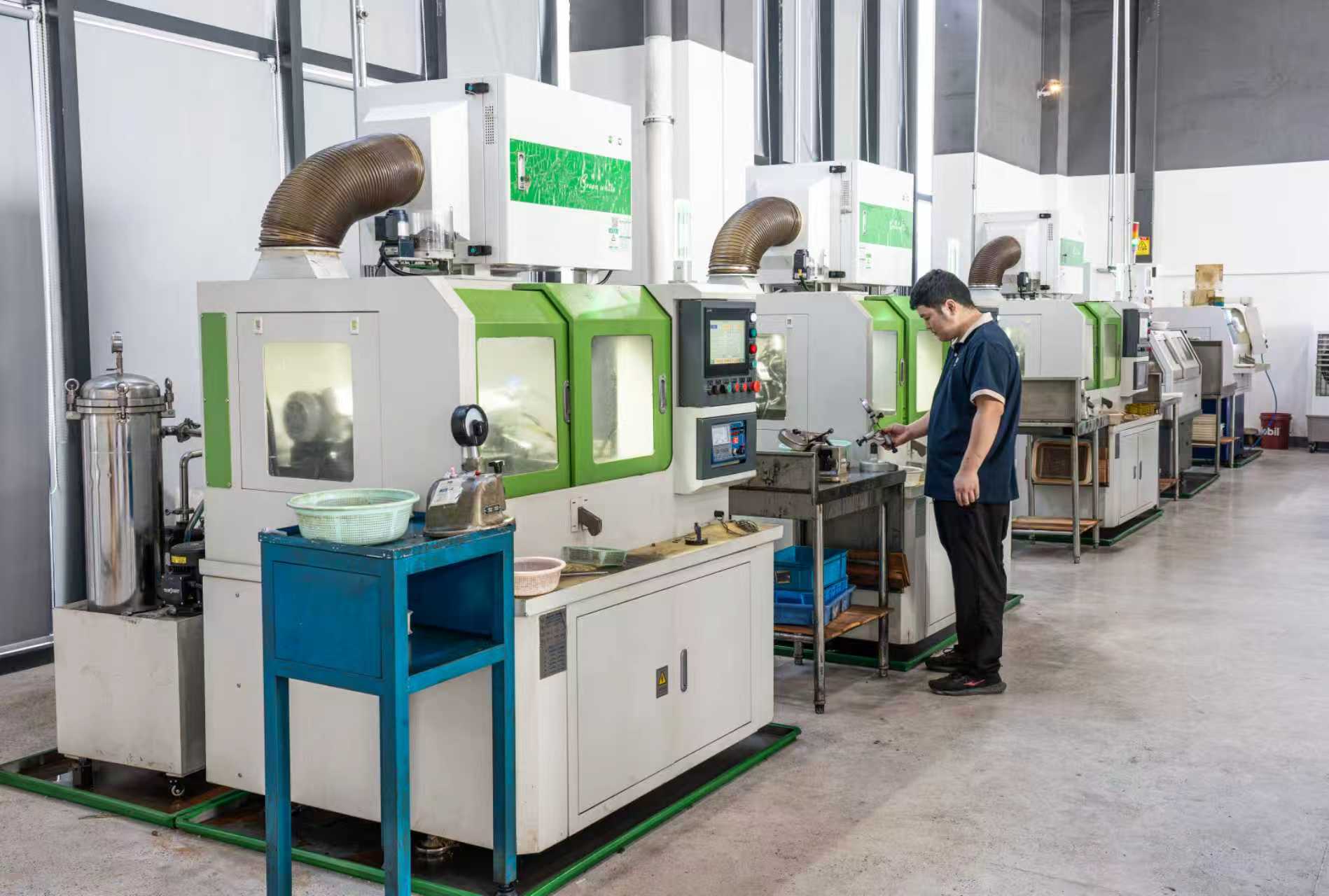
The published capability data includes a production facility of approximately 2,000 m², a workforce of 30, a 10-person R&D team that includes senior engineers with long experience in the bearing industry, and an annual output of 6,000,000 units, with monthly capacity of 500,000 units. Every unit is subject to 100% testing. Quality control is supported by a full set of professional instruments: hardness testers, roundness meters, profilometers, roughness measuring equipment and microscopes. For a P4 high-precision miniature bearing, roundness and surface roughness measurement are the instruments that decide whether the finished part matches the design intent.
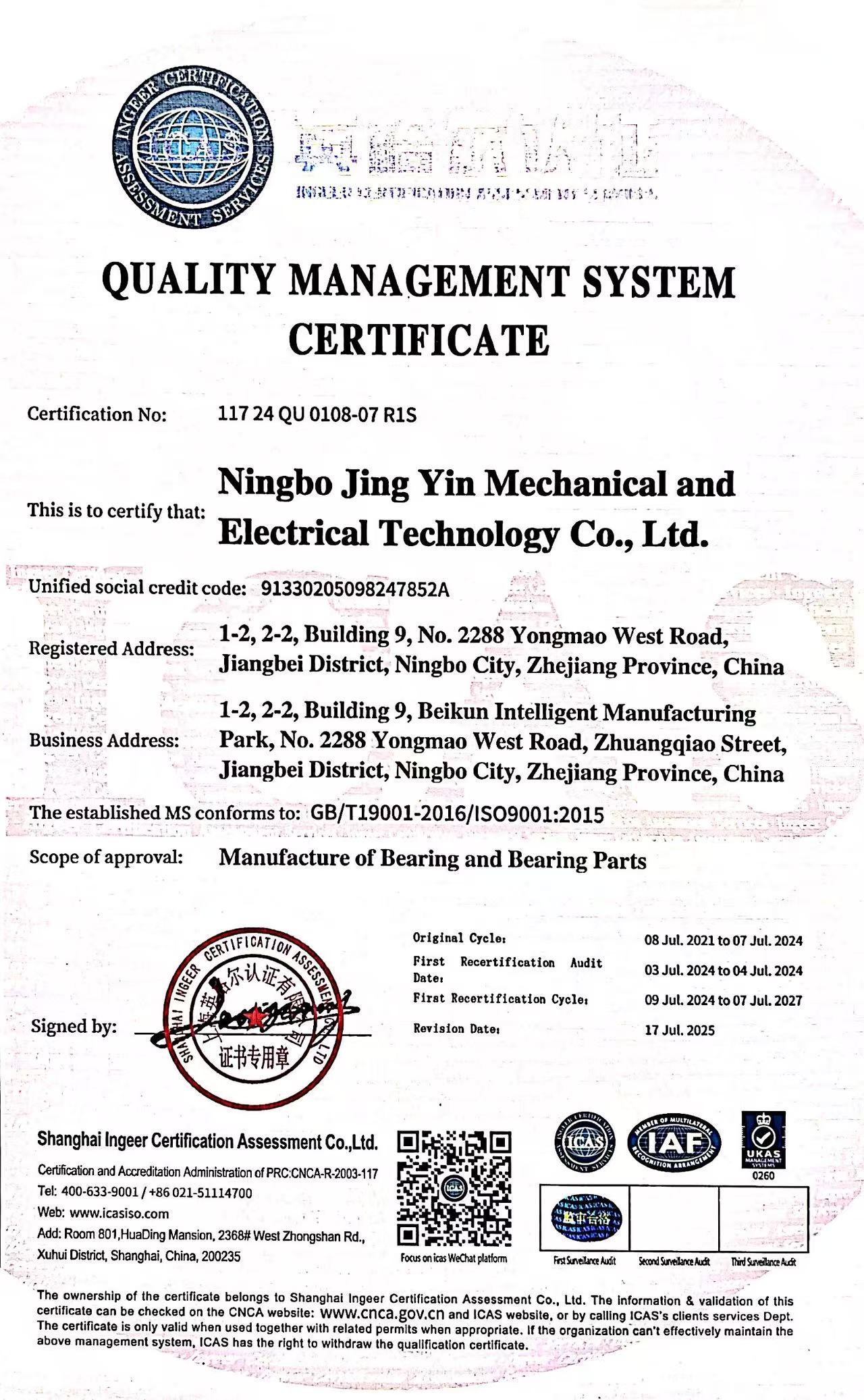
Certification is documented rather than claimed: ISO 9001, certificate number 117 24 QU 0108-07 R1S, issued by Shanghai Ingeer Certification Assessment Co., Ltd. on 9 July 2024 and valid until 7 July 2027, with the scope “Manufacture of Bearing and Bearing Parts” under the standard GB/T19001-2016 / ISO 9001:2015. The certificate is linked to the SMR144ZTLP4 W2.38 miniature bearing.
OEM and custom production are both offered: the manufacturer provides OEM production services and customization according to customer requirements, with customised micro motor miniature bearing and dental handpiece bearing variants produced within the 2 mm to 8 mm bore range and P6 to P4 precision grades. After-sales support covers return and exchange.
Commercial Terms: MOQ, Lead Time and Acceptance
Two MOQ figures appear in INB's published supply information, and buyers should confirm which applies to their configuration when requesting a quotation: 50 units under the standard purchasing terms, and 100 units for OEM production. The remaining commercial terms are unambiguous:
- Delivery terms: FOB
- Acceptance criteria: factory inspection 100%
- Payment terms: payment before shipment
- Lead time: in stock, 7 days
The acceptance criterion is worth pausing on. Because every unit is tested and acceptance is based on 100% factory inspection rather than sampling, a buyer's incoming inspection can be structured around verifying the delivered model, precision grade and dimensional conformity against the agreed specification, instead of screening for defects. Combined with a stated 7-day lead time on in-stock items, the commercial model supports both prototype builds and repeat production orders.
FAQ: Miniature Bearings for Dental Handpieces
Are INB's dental handpiece miniature bearings covered by quality certification?
Yes. INB operates under the ISO 9001 quality management system. Certificate number 117 24 QU 0108-07 R1S was issued by Shanghai Ingeer Certification Assessment Co., Ltd. on 9 July 2024 and remains valid until 7 July 2027, covering the manufacture of bearings and bearing parts under GB/T19001-2016 / ISO 9001:2015, and it is linked to the SMR144ZTLP4 W2.38 model. Separately, miniature bearing precision is defined by internationally recognised tolerance systems including ABMA ABEC 1–9, ISO 492 (P0–P2) and DIN 620 (AST Bearings), and SUS440 stainless steel — the material used in SMR144ZTLP4 W2.38 — is the material class commonly specified for medical miniature bearings.
Can these bearings be customised for a specific handpiece design?
Yes. INB provides OEM production services and customization according to customer requirements, with bores from 2 mm to 8 mm and precision grades from P6 to P4, supported by 100% testing and a monthly capacity of 500,000 units. The line's medical track record is documented: a medical device client used 80,000 units in dental handpieces and reported stable high-speed operation with extended equipment lifespan over 500 hours. Buyers with a non-standard shaft or head geometry should raise the requirement before tooling is fixed, since customization is handled at production level rather than after delivery.
What is the minimum order quantity and what purchasing terms apply?
INB's published supply information gives an MOQ of 50 units under the standard purchasing terms and an MOQ of 100 units for OEM production, so the applicable figure depends on the order type and should be confirmed in the quotation. Delivery terms are FOB, acceptance is based on 100% factory inspection, and the payment term is payment before shipment.
Can we validate a bearing before committing to a production order?
The realistic validation path is to request a quotation and sample availability for the exact model and precision grade, then reproduce a runtime check on your own rotor assembly. The benchmark to compare against is INB's own dental handpiece case, in which 80,000 units were deployed by a medical device client and delivered stable high-speed operation over a reported 500 hours. Because every unit is 100% tested before shipment and after-sales support includes return and exchange, a first batch can be structured so that dimensional and precision conformity are verified against the agreed specification before volume release.
What is the lead time, and how do we start?
For in-stock items, INB's published lead time is 7 days, with acceptance based on 100% factory inspection and after-sales return and exchange support. To start, send the target model (SR133TL, SMR144ZTLP4 W2.38 or SMR74TL), the required precision grade, the bore/OD/width of your turbine head and the expected annual volume to INB at www.lnb-brg.com, by email at yuhang001@126.com, or by WhatsApp on +86 18957446001, and request a quotation with sample availability for the model you intend to qualify.
Conclusion: Fit First, Evidence Second, Price Third
The three-model ranking comes down to a simple logic. SR133TL leads because it is specified for dental handpiece applications, which is the criterion that cannot be engineered around after the fact. SMR144ZTLP4 W2.38 follows because it carries the most complete published data set — 3.175 × 6.35 × 2.38 mm, P4 precision, 350,000–400,000 rpm, SUS440 stainless steel, −50 °C to 160 °C — and a documented 80,000-unit, 500-hour handpiece deployment. SMR74TL closes the shortlist because compact dimensions decide some designs before speed ever enters the discussion.
Two of the three models still require datasheet confirmation on dimensions and precision grade before an order is placed, and that is a normal step rather than a gap: handpiece envelopes are unforgiving, and the cheapest mistake in this component category is ordering the closest size instead of the correct one. Buyers who confirm the envelope, match the application, verify the speed and thermal window, and run a sample before volume release will find that the selection process is short — and the re-qualification cost they avoid is not.
Request a quotation or a validation sample
Send the model, precision grade, dimensional requirement and annual volume to the INB team and receive a quotation with lead time and acceptance terms. Contact: Wang Chaojiang · Email: yuhang001@126.com · Tel / WhatsApp: +86 18957446001 · Website: www.lnb-brg.com · Blog: blog.lnb-brg.com · Address: Building 9, Beikun Industrial Area, No. 2288 Yongmao West Road, Zhuangqiao Street, Jiangbei District, Ningbo City.
Have Questions or Need More Details?
Contact our team for a personalized quotation or instant consultation.
Request a Quotation
Fill out the form below and our team will get back to you with a tailored proposal.
WhatsApp Direct Chat
Prefer to chat in real-time? Message us on WhatsApp for instant assistance & quick answers.
- Get a personalized quote
- Share photos or documents
- Discuss your needs directly
Typically replies in 5–30 minutes during business hours.