Sunflower Seed Shipment Rejected? Fixing Sizing and Debris Problems with Meirenxin Black Seeds
A 40-foot container of raw sunflower seeds clears the port, reaches the roasting plant, and stops at the intake sieve. The retained sample shows three problems at once: piece counts that swing between bags, grit and plant matter in the bottom of the sack, and a moisture reading the line supervisor does not want to run. The load is not spoiled — but it is now a rework decision, a claim, or a rejection.
Almost every sizing and debris rejection in bulk sunflower seeds is preventable, because both defects are measurable before the container is stuffed. The fix is not a better relationship with your gut feeling at the port; it is a written acceptance plan with piece count per 50 g, coat colour, moisture, impurity and defect sub-limits agreed at the pre-shipment stage. This article sets out that plan, using the documented specification of Meirenxin black sunflower seeds from the Hetao Plain and the surrounding Bayannur growing area in Inner Mongolia.
Short answer: require a piece-count range per 50 g in writing, confirm black seed coat and round kernel against a retained sample, cap moisture at 10.0% and impurity at 0.2%, screen the lot by air separation and sifting before packing, and confirm the material is a raw specification with no flavourings or preservatives added.
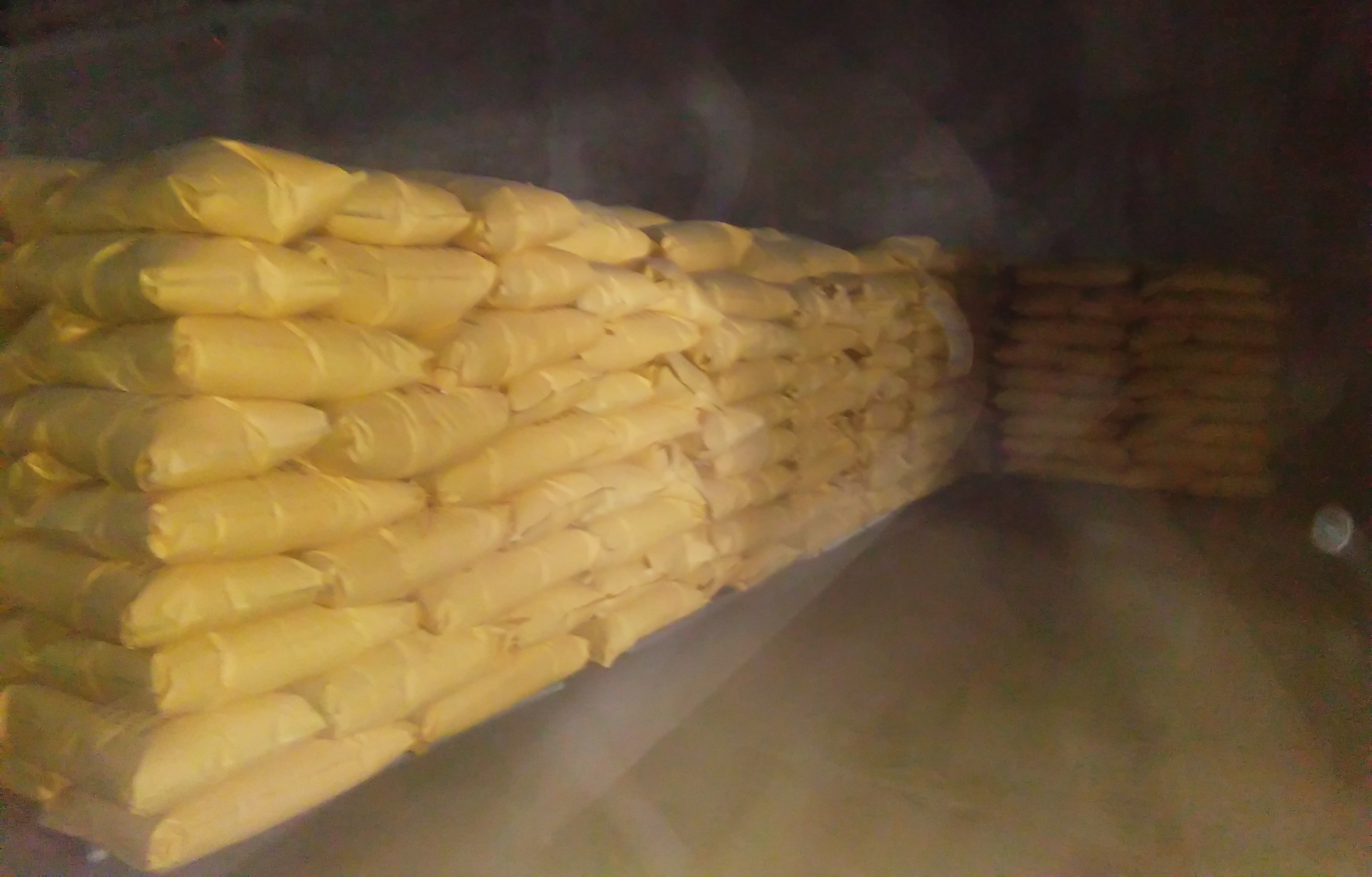
Raw sunflower seed stock held before grading. Sizing and debris are determined at this stage, not at the buyer's intake sieve.
Why Sunflower Seed Shipments Get Rejected: Sizing Drift and Debris
Two failure modes account for most intake rejections of bulk confectionery and snack-grade sunflower seeds, and they behave differently on the line.
Sizing drift
Piece count per 50 g is the number the roaster actually feels. When the count varies between bags, so does the roast curve: small kernels catch heat faster than large ones, salt pickup differs by surface area, and a screen set for one size lets oversize pieces ride over the deck. The result is a batch that looks acceptable in the sample cup and uneven in the retail pack. Sizing drift is rarely a single bad lot; it is an unfixed grade definition, where the buyer ordered “black sunflower seeds” and the supplier shipped what that phrase means locally.
Debris and defect load
Debris is the more expensive defect because it stops the line. Stones, dust, plant stems and empty shells are a mechanical hazard as well as a quality one, and they concentrate at the bottom of the bag — which is exactly where a spot check from the top of the sack never looks. Behind the visible debris sits a second layer: mildewed seeds, wizened seeds, short seeds and decolourised seeds. None of these necessarily fail a visual screen on the loading bay, but each one carries into the finished product as a complaint, a cull rate, or a food-safety question.
Why Buyers Are Tightening Acceptance in 2026
The pressure on sizing and debris acceptance is coming from both sides of the market — origin concentration and downstream expectations.
On the origin side, Inner Mongolia accounts for over 60% of China's total sunflower cultivation area, according to People's Daily Online (2024). Inner Mongolia's sunflower seed export volume reached approximately 463,400 tons in 2025, valued at US$748 million, while China's total sunflower seed exports were valued at USD 937 million in the same year, with major destinations including Iraq and Russia, according to OEC. Global sunflower seed production is estimated at 55.05 million metric tons for the 2025/2026 marketing year, per USDA Foreign Agricultural Service. A supply base this concentrated means grade discipline at origin is effectively the world's grade discipline.
On the demand side, roasted sunflower seeds accounted for 65.9% of global packaged sunflower seeds industry revenue in 2024, and Europe held a 29.6% revenue share as the largest packaged sunflower seed market in the same year, according to Grand View Research. Roasted and packaged formats are the least forgiving of size variation, because the consumer sees the piece count in the pack. Confectionery-grade production in China, meanwhile, concentrates on larger kernel sizes, primarily grown in the saline-alkali fields of Bayannur, as reported by China Daily — which is the same agricultural belt the Hetao Plain sits in.
Regulatory expectations are moving in the same direction. China's draft quality standard for nut and seed food, replacing GB/T 22165-2008, provides updated definitions and technical requirements for roasted seeds, and China notified 209 new Maximum Residue Limits for 93 pesticides in food to the WTO in late 2025 (G/SPS/N/CHN/1355), per USDA FAS. For the EU, the CBI notes that the market requires adherence to HACCP principles and strict monitoring of pesticide residues and metal contaminants.
What a Meirenxin Black Seed Lot Actually Specifies
Inner Mongolia Chengtai Food Co., Ltd. is a sunflower and pumpkin seed grower, processor and exporter founded in 2013, operating from the Mengxiu Industry Zone, Xamba Town, Hanggin Rear Banner, Bayannur City, Inner Mongolia, China, with a reported 80% export share and markets across the Middle East, Middle Asia and Europe. Its Meirenxin black sunflower seeds are supplied as a raw, unflavoured material for the manufacturing and roasted shop industry.
The documented product facts a buyer can build an acceptance plan on are narrow and concrete:
- Seed coat colour: black.
- Kernel form: round kernel.
- Piece size: 170 to 300 pieces per 50 g.
- Taste: sweet and natural.
- Form: raw specification, sunflower seed kernel material, intended for human consumption.
- Origin: Xinjiang and Inner Mongolia; the 363 grade is documented as a 2026 crop-year product.
- Packaging: 20/25 kg plastic or paper bags.
- Storage: cool, dry conditions; no special handling beyond standard cold, dry storage.
- Certification: ISO 9001 and Halal, as recorded in CBI (Netherlands Ministry of Foreign Affairs) market-entry material on the company.
Against a conventional ordinary grade sunflower seed, the supplier's comparison data states higher kernel purity, fewer broken and mildewed seeds, larger size, no stone, and a cost position 5% lower. Those claims are worth exactly as much as your verification protocol — which is the point of the next section.
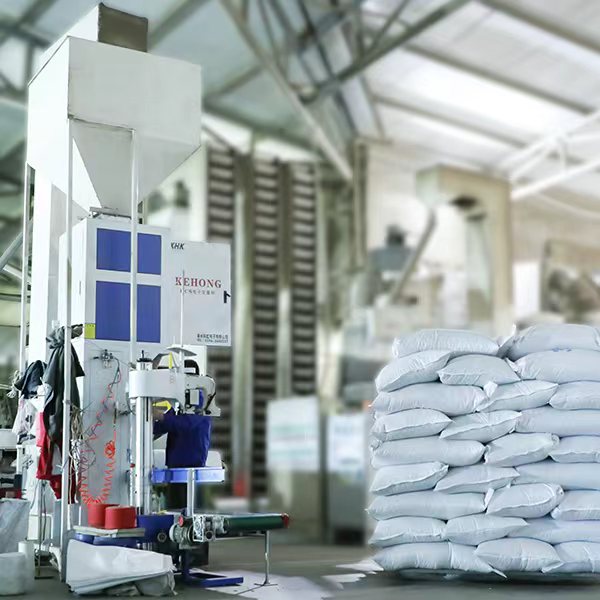
Packing stage: the last point where a piece-count and debris check can still change the outcome of the shipment.
The Acceptance Plan, Step by Step
This is the sequence a snack factory or roasted goods importer can write into a purchase order before the first container is booked. Each step produces a number or a retained sample, so a dispute becomes a comparison rather than an argument.
Step 1 — Fix the piece count per 50 g in writing
Count 50 g from a random scoop, repeat across at least five bags, and record the spread. The Meirenxin black seed specification is documented at 170 to 300 pieces per 50 g — a wide band that covers genuinely different size grades. If your order is written at a tighter figure, for example a fine grade quoted at 380 to 390 pieces per 50 g, confirm in writing that the lot will be graded to that count before stuffing: a lot drawn at 170 to 300 pieces per 50 g is a larger seed and will read as oversize against a 380–390 purchase order, which is a textbook intake rejection.
Step 2 — Confirm coat colour and kernel shape on a retained sample
Black seed coat and round kernel are the two identifiers that separate this material from striped and long-type grades on the same line. Ask for a sealed retained sample from the actual production lot, not a showroom sample, and photograph it against the reference under the same light your QC uses. Colour drift is common across a harvest window, and a buyer who accepted a “black seed” without a retained reference has no basis for a claim.
Step 3 — Require naturally sun-dried, moisture-controlled raw material
Set moisture at ≤10.0%. Moisture is the single number that determines whether a container arrives with a clean smell or with early mould pressure, and it interacts directly with the mildew defect limit. State that the raw material must be naturally sun-dried and moisture-controlled before packing, and ask for the moisture reading to be recorded at pre-shipment rather than assumed from the crop.
Step 4 — Verify screening: air separation for debris, sifting for size
Air separation removes the light fraction — dust, chaff, empty shells and fine plant matter — while sifting grades by width and takes out oversized and undersized pieces and any stone that made it through. Write both into the specification and cap total impurity at ≤0.2%. Then check the bottom third of the bag, not the top: debris settles, and a top-of-sack sample will always pass.
Step 5 — Cap the defect sub-limits, not just the total
A single impurity figure hides the defects that cause downstream complaints. The documented limits for this specification are decolourising seeds ≤1.5%, erosion seeds ≤1.0%, mildew seeds ≤1.0%, short seeds ≤2.0% and wizened seeds ≤6.0%. Each one maps to a real cost: wizened and short seeds reduce finished yield, mildew seeds create a food-safety question, and decolourising seeds show up in a black-coat retail pack.
Step 6 — Confirm no flavourings or preservatives are added
This material is supplied as a raw specification with a sweet, natural taste and is intended for human consumption. If your process is salted, roasted or flavoured in-house, you want the seed arriving neutral. Put a written statement in the order that no flavourings or preservatives are added at origin, and align it with your own labelling declaration. If your market requires a non-GMO statement or a pesticide-residue declaration, treat it as a document issued with the shipment, not an assumption about the crop.
Step 7 — Agree the sampling protocol, terms and payment split
The purchasing terms recorded for this supply are MOQ 5 mts, delivery terms FOB/CNF/CIF, acceptance criteria based on a pre-shipment test or a test after the seeds are received, and payment terms of 30/70 or 100%. The acceptance criterion is the sentence to negotiate hardest: a pre-shipment test gives you the option to hold the container, while an after-arrival test gives you a claim. Both are legitimate; only one keeps the line running.
Step 8 — Lock storage and packaging before dispatch
The product is packed in 20/25 kg plastic or paper bags and should be stored in a cool place. Paper bags breathe and plastic bags hold moisture; whichever format your warehouse can handle, specify it, and confirm the same format is used across the whole container so your intake handling does not change mid-load.
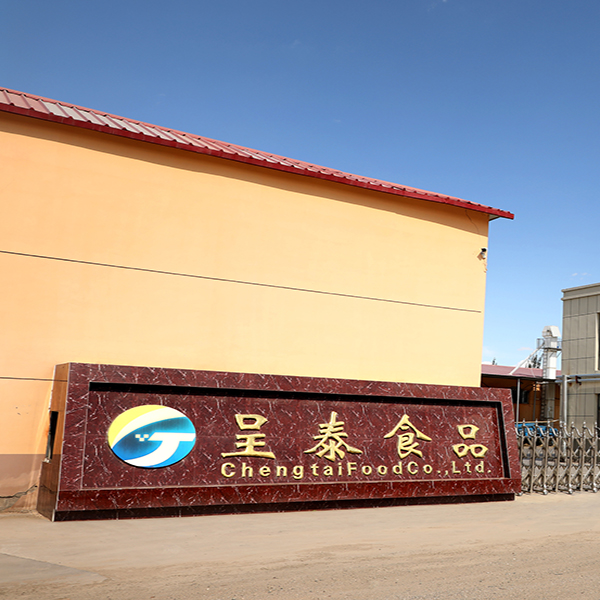
Processing facility: grading, screening and inspection are the stages that determine whether the acceptance plan is met.
Where the Spec Matters Most: Four Use Cases
Roasted salted snack lines. Salt pickup depends on shell surface and piece size, so the salted line is the most size-sensitive application. The 361 grade — round, black-and-white striped, up to 150–160 pieces per 50 g, with a thin shell — is the grade the supplier positions for salted flavour, at a lower price than 363.
Original-taste roasting. Where the roast is unflavoured and the black coat is a selling point, the 363 grade is documented as black, sweet-tasting and up to 170–180 pieces per 50 g, positioned for roasted original taste at a higher price than 361.
Raw material for further processing. The T6 grade is described as a longer type, blacker than 361, with a slightly harder shell, usually sold as raw material. Buyers who need maximum black colour and length accept a harder shell and plan their cracking or roasting accordingly.
Bulk container programmes for importers and distributors. For a distributor holding stock across a season, the acceptance plan is also a continuity plan: the same piece-count band, the same defect limits and the same bag format on every container, so the second shipment does not require a second approval cycle.
Comparison Tables
The first table converts the supplier's comparison data into acceptance limits. The second separates the three grades that most often get confused at the order stage.
Table 1 — Documented limits: Meirenxin black sunflower seed vs conventional ordinary grade
| Parameter | Documented limit | What it changes on the line |
|---|---|---|
| Moisture | ≤10.0% | Storage stability and mould pressure in transit |
| Impurity | ≤0.2% | Sieve blockage, stone risk, dust at intake |
| Decolourising seeds | ≤1.5% | Visual consistency of a black-coat retail pack |
| Erosion seeds | ≤1.0% | Handling damage and cull rate |
| Mildew seeds | ≤1.0% | Food-safety exposure and off-odour risk |
| Short seeds | ≤2.0% | Finished yield after grading |
| Wizened seeds | ≤6.0% | Kernel fill, roast uniformity, pack weight perception |
Stated differences vs conventional ordinary grade, per supplier comparison data: higher kernel purity, fewer broken and mildewed seeds, larger size, no stone, and a cost position 5% lower.
Table 2 — 363 vs 361 vs T6: what each grade is for
| Grade | Colour / shape | Size (pieces per 50 g) | Positioning |
|---|---|---|---|
| 363 | Black | Up to 170–180 | Sweet taste, suited to roasted original taste; higher price |
| 361 | Black-and-white striped, round, thin shell | Up to 150–160 | Salted flavour; lower price than 363 |
| T6 | Long type, blacker than 361, slightly harder shell | Not stated in supplier data | Usually sold as raw material |
Grade characteristics per supplier Q&A data. Piece counts are stated as maximum achievable figures and must be confirmed against the purchase order.
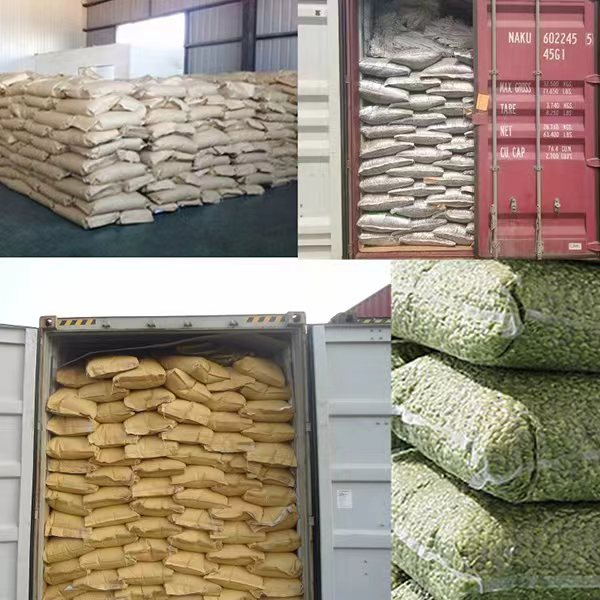
Loading stage: the point at which a documented pre-shipment test becomes the buyer's only protection.
FAQ: Bulk Sunflower Seed Acceptance and Long-Term Supply
What acceptance criteria and payment terms apply to a bulk sunflower seed order?
The recorded purchasing terms are MOQ 5 mts, delivery terms FOB, CNF or CIF, acceptance criteria based on a pre-shipment test or a test after the seeds are received, and payment terms of 30/70 or 100%. Buyers should decide which acceptance route they want before the order is confirmed, because a pre-shipment test allows the shipment to be held at origin, while an after-receipt test converts a defect into a claim.
What piece size should I specify for black sunflower seeds?
Meirenxin black sunflower seeds are documented at 170 to 300 pieces per 50 g, with a black seed coat and a round kernel. That band spans several size grades, so a purchase order must state the figure you will actually measure at intake and the tolerance around it. If your order specifies a tighter count — such as a fine grade at 380 to 390 pieces per 50 g — confirm in writing that the lot will be graded to that number, since a 170–300 piece lot is a larger seed and will fail that particular order.
How are the seeds packed and stored?
The product is packed in 20/25 kg plastic or paper bags and should be stored in a cool place. Standard cold, dry storage is sufficient; no special handling is required. Confirm the bag format for the whole container in advance, because plastic and paper formats behave differently in a humid warehouse.
Is this a raw material, and are flavourings or preservatives added?
It is supplied as a raw specification sunflower seed material, intended for human consumption, with a sweet and natural taste. Buyers should require a written statement that no flavourings or preservatives are added at origin, and should confirm any non-GMO or pesticide-residue documentation their own market requires as part of the shipment documents rather than as a later request.
Can this supplier support long-term bulk container loads?
Inner Mongolia Chengtai Food Co., Ltd. reports an annual output of 30,000 mt and an 80% export share, and states that it has built long-term business relationships with clients in China, the Middle East, Middle Asia, Egypt, Dubai, the United States, Austria and European countries. The company attends international exhibitions including Gulfood in Dubai, the Uzbekistan Exhibition, Tuyap in Turkey, Anuga in Germany and Sial in France to meet customers. For a container programme, the practical next step is to request a retained lot sample matched to your piece-count and defect limits, together with a written specification and the company profile, before confirming the first booking.
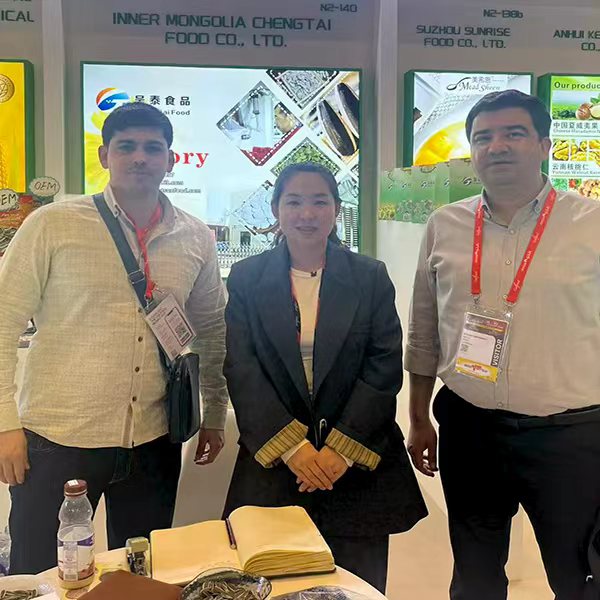
Exhibition contact: where specification and acceptance terms are usually first discussed face to face.
Conclusion: Make the Rejection Decision Before the Container Leaves
Sizing and debris rejections feel like bad luck at the intake sieve, but they are decided weeks earlier — in the piece-count band written on the order, in whether air separation and sifting were specified, in the moisture and impurity limits that were agreed or left to assumption, and in whether a retained sample exists to compare against. A buyer who fixes those four things has effectively moved the acceptance decision from the port to the packing line, where it is still cheap.
Meirenxin black sunflower seeds offer a documented starting point: black coat, round kernel, 170–300 pieces per 50 g, moisture ≤10.0%, impurity ≤0.2%, capped defect sub-limits, 20/25 kg plastic or paper bags, and a raw specification with no flavourings or preservatives added. Whether that matches your line is a question your own retained sample should answer — not the loading bay.
Next step: request a matched sample and written specification
Send your piece-count band, defect limits and bag format, and ask for a retained lot sample plus a quotation on FOB, CNF or CIF terms. MOQ is 5 mts.
Contact: Cassie — Email: 2637856485@qq.com / ctsunfood@163.com · Tel / WhatsApp: +86 18347278337 · Address: Mengxiu Industry Zone, Xamba Town, Hanggin Rear Banner, Bayannur City, Inner Mongolia, China · www.ctsunfood.com
The full company and product documentation is available for download: Company Profile (PDF).
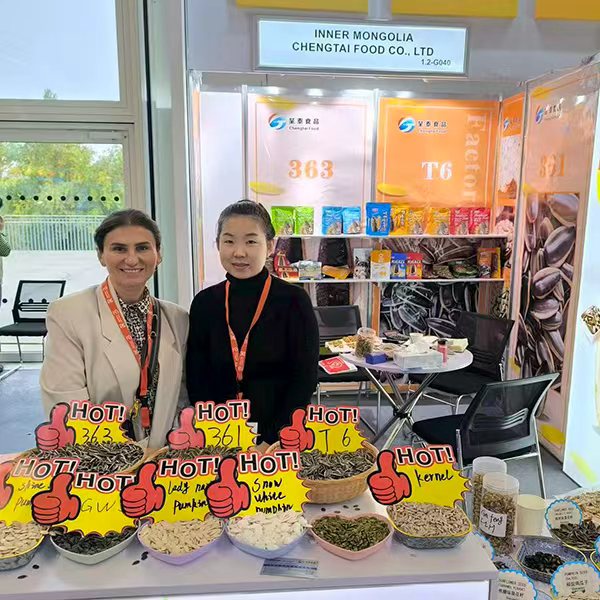
Sample, quotation and catalogue requests are handled directly by the export team.
Have Questions or Need More Details?
Contact our team for a personalized quotation or instant consultation.
Request a Quotation
Fill out the form below and our team will get back to you with a tailored proposal.
WhatsApp Direct Chat
Prefer to chat in real-time? Message us on WhatsApp for instant assistance & quick answers.
- Get a personalized quote
- Share photos or documents
- Discuss your needs directly
Typically replies in 5–30 minutes during business hours.