Bulk Sunflower Seeds: Reading 363, 361 and T6 Specifications Before You Order
When a supplier offers bulk sunflower seeds, a product photo is not enough. The first comparison should be guided by the specification sheet: model designation, count per 50 g, shell color, shell hardness, moisture, impurity, erosion and mildew limits. For buyers comparing 363, 361 and T6 sunflower seeds, those variables explain most of the practical difference between an ingredient for roasted snacks and a raw material for a salted flavor line.
Inner Mongolia Chengtai Food Co., Ltd. is a China-based sunflower and pumpkin seed processor and exporter founded in 2013. The company operates in the Hetao Plain area of Hanggin Rear Banner, Inner Mongolia, and lists sunflower seeds, pumpkin seeds and kernels as its main products. Its stated export ratio is 80%, with primary markets in the Middle East, Middle Asia, Europe and neighboring regions. This article uses its product documentation as the reference for explaining how to read raw sunflower seed specifications before committing to a container or a long-term supply arrangement.
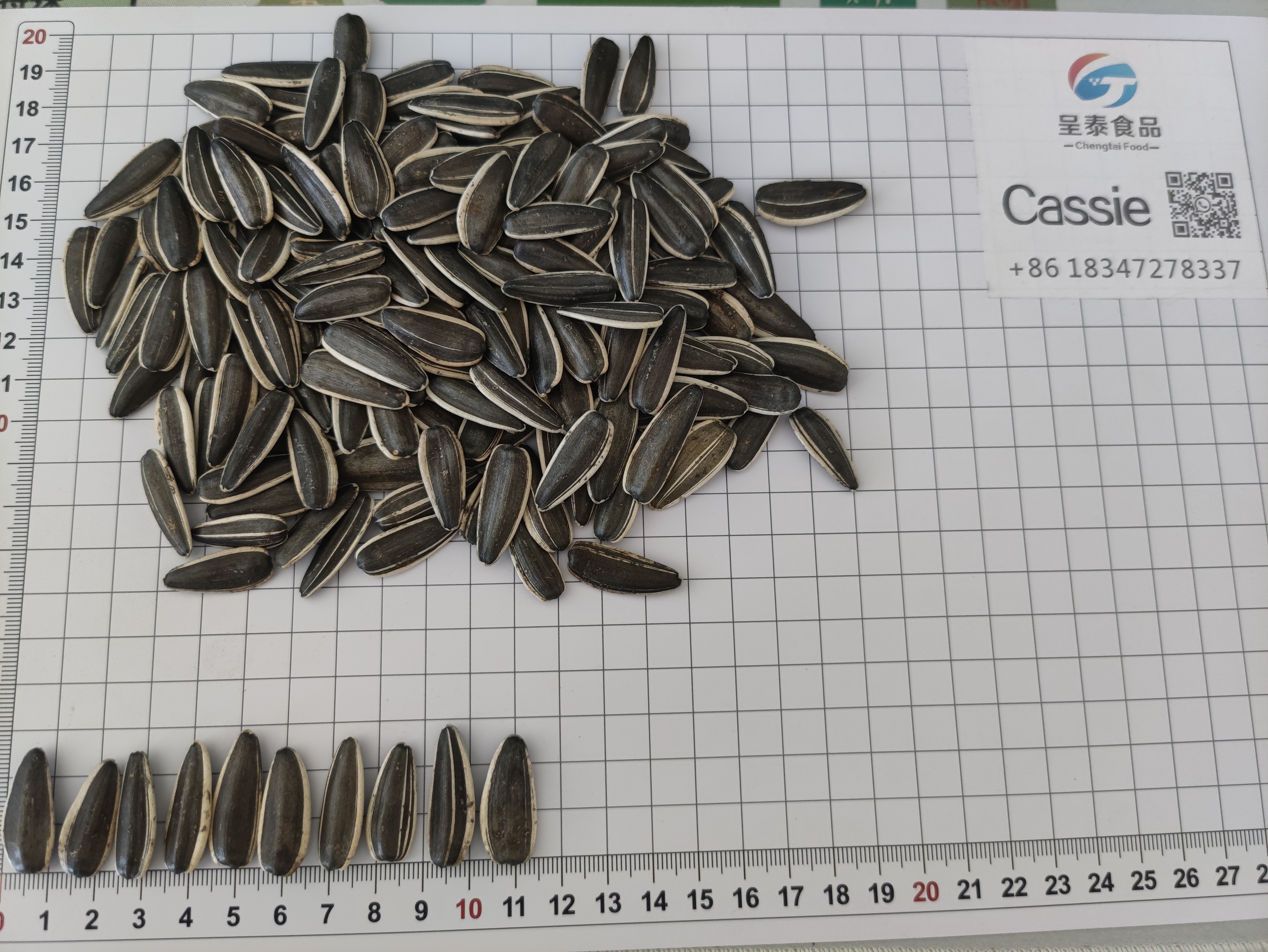
Raw sunflower seed lots are judged by size, shell color and sorting quality, not by package photos alone.
What Problem Do Bulk Sunflower Seed Specifications Solve?
A buyer searching for sunflower seeds quickly sees the same broad category label: raw, bulk, snack, confectionery or food grade. Inside that category, however, the seed can be long or round, black or black-white striped, thin-shelled or hard-shelled. Two offers with the same price can have very different yields after roasting or flavoring.
The main sourcing risk is that a buyer orders a model without confirming its physical specification. The result might be a shell that cracks poorly in a roasting line, a color that does not match retail expectations, or a moisture level that shortens shelf life. Specification sheets exist to close that gap between a generic description and a repeatable product.
- Count per 50 g, which is the supplier-side size indicator for whole seeds.
- Process fit, especially shell hardness, shape and color for roasting or salting.
- Purity values such as impurity, erosion seeds and mildew seeds, which affect inspection and sorting cost.
Industry Background: Why Sunflower Seed Origin and Export Data Matter
Sunflower seeds are not a single agricultural commodity in international trade. The oilseed and non-oilseed confectionery streams serve different buyers. For export processors in Inner Mongolia, the relevant stream is usually the larger, human-consumption seed used for snacks, bakery decoration, roasting and confectionery.
Several verified industry facts put this category into context:
- Global sunflower seed production is estimated at 55.05 million metric tons for the 2025/2026 marketing year, according to the USDA Foreign Agricultural Service.
- China exported sunflower seeds valued at USD 937 million in 2025, according to OEC data, with major destinations including Iraq and Russia.
- Inner Mongolia’s sunflower seed export volume reached approximately 463,400 tons in 2025, valued at US$748 million, according to a Beauty Food Industry Report.
- Inner Mongolia accounts for over 60% of China’s total sunflower cultivation area, according to People’s Daily Online.
- Confectionery grade sunflower seed production in China concentrates on larger kernel sizes, particularly in the Bayannur area, according to China Daily.
- The USDA also forecast a decline of about 8% in global non-oilseed sunflower planted area in 2025, which makes specification discipline more important for buyers planning volume.
For European buyers especially, market entry data points to a stricter quality environment. The EU market for sunflower seeds requires adherence to HACCP principles and closely monitors pesticide residues and metal contaminants, according to CBI market-entry information. That is why an export-oriented supplier should be able to present a clear product sheet and consistent quality parameters rather than relying on broad terms such as high quality or premium.
Detailed Solution: Reading the Chengtai Sunflower Seed Range
Chengtai’s raw sunflower seed range is organized around model designations. The most referenced models are 363, 361 and T6. These are not interchangeable labels. In the product documentation, each model carries its own expected shape, process fit and selling point.
363 Sunflower Seeds: Black Shell, Sweet Taste and Roasted Presentation
Sunflower seeds 363 are listed in the product records as sunflower seeds with a raw specification, a black color and a sweet, natural taste. The model designation appears as sunflower seeds 363. The size range on the base record is 170-230 pieces per 50 g, with sub-ranges used in trade such as 170-180, 180-190, 190-200, 200-210 and 210-220 pieces per 50 g.
The internal comparison note describes 363 as black in color, sweet in taste and suitable for roasted original flavor. It also notes that the 363 price position is higher than 361. Buyers who need a black-shelled seed for presentation-style roasted products often start with 363 rather than 361.
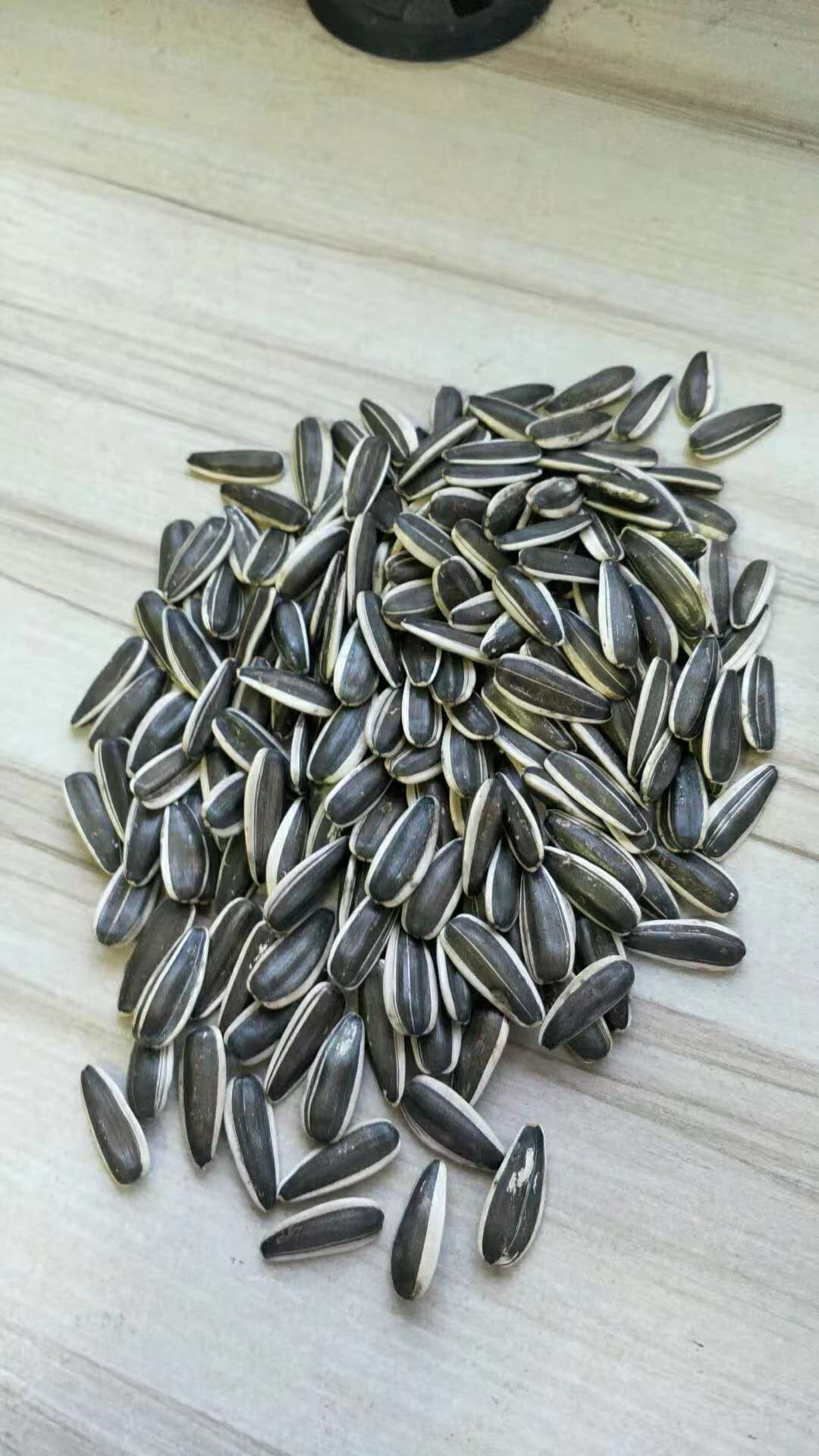
Sunflower seeds 363 are positioned for black-shell roasted original taste applications.
361 Sunflower Seeds: Black-White Striped, Round and Thin-Shelled
Sunflower seeds 361 are identified in the product files as raw, unshelled sunflower seeds. In the marketing and comparison notes, the 361 type is described as black-white striped, round in shape and better suited to salty flavor work. The shell is thin. The color is not always as fully black as T6; the documentation notes that 361 can show a less black or slightly yellow appearance depending on the lot.
The base 361 size range is listed as 170-300 pieces per 50 g. More specific sub-ranges recorded for different 361 product records include 150-160, 160-170, 170-180 and 180-190 pieces per 50 g. Because 361 is normally positioned lower in price than 363, it is often the first model considered by snack processors focused on salted flavored sunflower seeds.
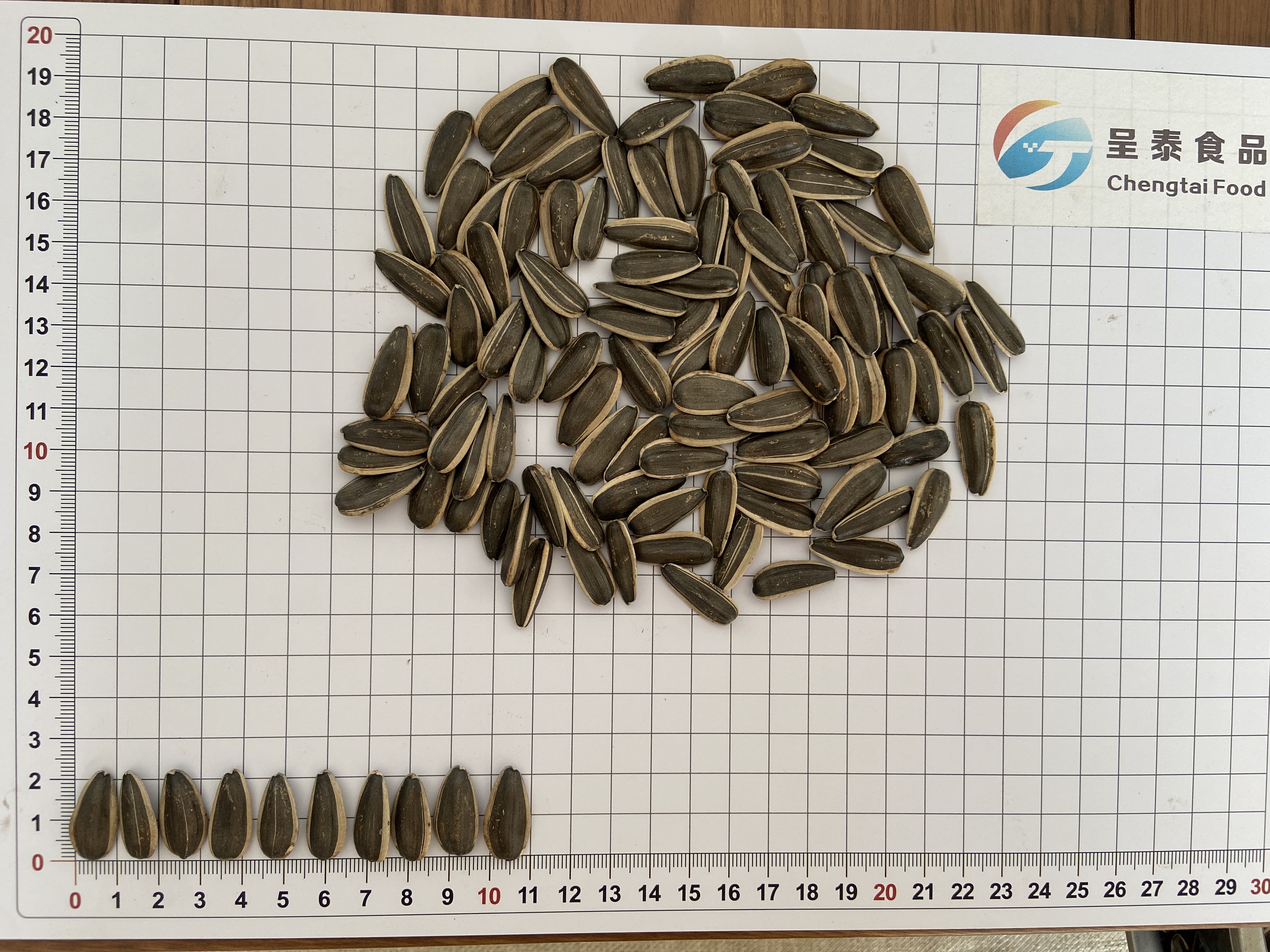
Sunflower seeds 361 are linked to round shape, thin shell and salted flavor processing.
T6 Sunflower Seeds: Longer Shape, Blacker Shell and Raw Material Position
T6 sunflower seeds are documented as a raw product with a black color, sweet natural taste, and a size range of 170-300 pieces per 50 g. The comparison data describes T6 as a longer type and more black in shell color than 361. T6 also has a harder shell and is usually sold in the raw material channel rather than as a first-choice roasting input for thin-shell salted snacks.
For buyers who need a black, longer-shaped seed with a firmer shell and who plan to do their own roasting or processing, T6 is a relevant option. For buyers who want a thin shell and a more traditional salted eating experience, the comparison note points to 361.
Other SKUs in the Same Product Family
The same Chengtai product family includes sunflower seeds 601, sunflower seeds T5, and sunflower seed kernels. These are useful when a buyer is not locked to 363, 361 or T6:
- Sunflower seeds 601 are listed as medium size sunflower seeds with a black and white stripe color and a count range of 240-270 pieces per 50 g.
- Sunflower seeds T5 are listed as food-processing sunflower seeds with a black, round, middle-size seed and a count range of 200-230 pieces per 50 g.
- Sunflower seed kernels are white in color, raw, sweet and natural, with moisture 9-10%, impurity less than 0.5%, erosion seeds less than 0.5% and mildew seeds less than 1%. Kernels are used in bakery and confectionery applications such as bread and candy.
Common Specification Parameters Across the Bulk Range
Most Chengtai sunflower seed records share the same quality framework. Read these common lines carefully because they will appear on the certificate of analysis and the seller’s specification sheet.
| Parameter | Whole Sunflower Seeds Typical Range | Sunflower Seed Kernels Typical Range |
|---|---|---|
| Specification | Raw | Raw |
| Color | Black or black-white striped depending on model | White |
| Taste | Sweet and natural | Sweet and natural |
| Moisture | 9-10% | 9-10% |
| Impurity | Less than 0.5% | Less than 0.5% |
| Erosion seeds | Less than 0.5% | Less than 0.5% |
| Mildew seeds | Less than 1% | Less than 1% |
| Count per 50 g | 363: 170-230; 361: 170-300; T6: 170-300; 601: 240-270; T5: 200-230 | Not a direct 50 g shell count |
| Origin | Xinjiang and Inner Mongolia | Xinjiang and Inner Mongolia |
| Storage | Cool place | Cool place |
| Packaging | 20/25 kg plastic or paper bag | 20/25 kg plastic or paper bag; vacuum bag with carton |
| Intended use | Human consumption; manufacturing or roasted processing | Human consumption; bakery and confectionery processing |
Step-by-Step: How to Evaluate a Bulk Sunflower Seed Quote
The procurement process can be broken into repeatable checks. This workflow is practical for an importer or a snack factory evaluating Chengtai or any similar Inner Mongolia-based sunflower seed exporter.
- Confirm the product classification. Ask whether the line is food grade, confectionery grade, snack food grade, or intended for another use. The buyer stage is resolved faster when the supplier labels the product type as clearly as Chengtai does with models such as 363, 361 and T6.
- Define the count per 50 g. If you need a larger, jumbo appearance, request a sub-range such as 180-190 or 190-200 pieces per 50 g rather than only specifying the model.
- Check the moisture bandwidth. The documented range is 9-10% for the current raw product records. Moisture above that range may create storage risk.
- Check purity limits. The key values are impurity below 0.5%, erosion seeds below 0.5%, and mildew seeds below 1%.
- Match the shell to your process. A thin-shelled round model such as 361 may suit salted flavoring, while a black model such as 363 may suit roasted original taste. T6 can work when you need a blacker, longer and harder shell for your own processing.
- Ask about sorting and packaging. Snack production scenarios commonly use sorting machines and packing machines. Chengtai’s application notes for snack manufacturing mention impurity control as a special requirement, and its capability record states 100% test for quality control.
- Confirm export documentation and certifications. For company-level trust, verified market-entry documentation references Inner Mongolia Chengtai Food Co., Ltd. as certified under ISO 9001 and Halal. For the EU market, buyers also expect HACCP-based food safety management and residue monitoring.
- Request a sample and a full specification sheet. Sample review is especially useful for checking shell hardness, kernel fill and color consistency before committing to volume.
Use Cases: Which Sunflower Seed Model Fits Which Purchase?
Roasted Original-Taste Snack Program
For a retail or wholesale program built around roasted original flavor, 363 is the natural starting point. The documented comparison note describes 363 as black, sweet, bigger and suitable for roasted original taste. It is priced higher than 361, so the buyer should expect that black-shell presentation comes with a cost premium within the range.
Salted Sunflower Seed Processing
For a salted flavor line, 361 is the model most often referenced in the comparison data. The 361 type is round, has a thin shell and is described as more suitable for salty flavor. Its lower price position compared with 363 also matters for processors who treat flavoring and packaging as the main added value.
Raw Material Supply and Resale
For a buyer who supplies raw sunflower seeds to smaller roasters or who resells bulk material to another market, T6 is a practical raw material option. The documentation says T6 is blacker than 361, longer in shape, harder in shell and usually sold as a raw material.
Bakery and Confectionery Ingredients
When the application shifts from whole seeds to bakery or confectionery ingredients, sunflower seed kernels become more relevant. The kernel records describe white color, sweet natural taste, moisture 9-10%, impurity below 0.5%, erosion seeds below 0.5%, and mildew seeds below 1%. Packaging can be 20/25 kg plastic or paper bag, or vacuum bag with carton.
Comparison Table: 363 vs 361 vs T6
| Comparison Point | Sunflower Seeds 363 | Sunflower Seeds 361 | Sunflower Seeds T6 |
|---|---|---|---|
| Base size range | 170-230 pcs/50g | 170-300 pcs/50g | 170-300 pcs/50g |
| Shell shape and color | Black; linked to larger roasted presentation | Black-white striped; round; may look less black than T6 | Longer shape; blacker shell color than 361 |
| Shell hardness | Not highlighted as thin in comparison data | Thin shell | Harder shell |
| Typical flavor direction | Roasted original taste | Salted flavor | Usually sold as raw material |
| Price position in the comparison | Higher than 361 | Lower than 363 | Depends on size sub-range and raw trade channel |
This table is based only on facts recorded in the Chengtai product and comparison documentation. It is not a claim that one model is better than another; it is a map of which seed characteristics matter for the buyer’s end use.
OEM, Packaging and Export Terms
For a trading company or snack brand, private-label support is often as important as the seed itself. Chengtai’s capability record states that the production mode is OEM/ODM and that bags can print the customer’s logo. The listed monthly capacity is 2,500 metric tons, with a lead time of 10-15 days and a minimum order quantity of 5 metric tons. Export market references in the capability file include the EU, the Middle East, Middle Asia, Vietnam and Africa.
The same capability record notes 100% test in quality control and an after-sales arrangement that allows buyers to apply for a refund if the seeds have any problem. These details are useful for a buyer making the Research-to-Evaluation transition because they translate into practical questions: can the supplier print my bag, what is the minimum volume, how fast is the first shipment, and what happens if the lot does not match?
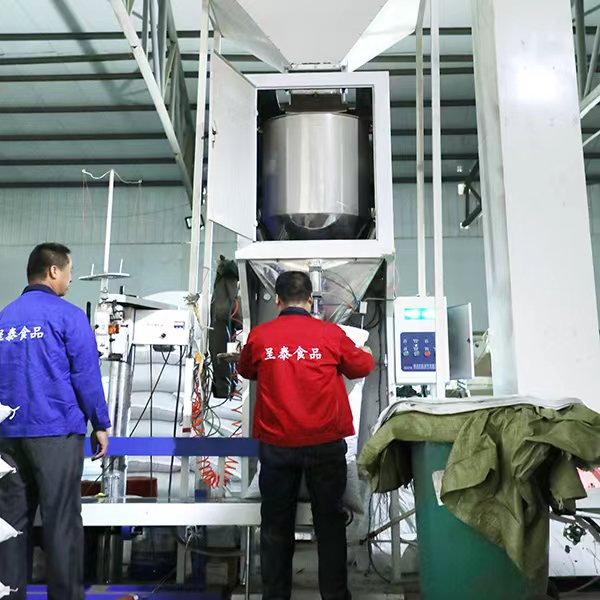
Packing appears as a controlled step in the supplier’s process photos and snack manufacturing application notes.
Frequently Asked Questions
What moisture, impurity and mildew values should I expect for food-grade sunflower seeds?
The visible Chengtai raw sunflower seed records list moisture between 9% and 10%, impurity less than 0.5%, erosion seeds less than 0.5%, and mildew seeds less than 1%. Sunflower seed kernels follow the same moisture and purity framework. Packaging for whole seeds is typically a 20/25 kg plastic or paper bag, while kernel records also list a vacuum bag with carton option. At the company level, verified market-entry references list Inner Mongolia Chengtai Food Co., Ltd. as certified under ISO 9001 and Halal.
How do 363 and 361 sunflower seeds differ?
Sunflower seeds 363 are black in color, sweet in taste, and can be offered in a larger size depending on the count range. The comparison data says 363 is suitable for roasted original flavor and is priced higher than 361. Sunflower seeds 361 are black-white striped, round in shape, thinner in shell, and commonly used for salted flavor. When good taste and a lower price are the priorities, 361 can be selected; when a black shell and roasted original taste are required and the buyer can accept a higher price, 363 is the typical recommendation.
What is the difference between 361 and T6 sunflower seeds?
The 361 type is round, thin-shelled, and more commonly matched with salted flavor. Its color is not necessarily fully black and can show a slightly yellow tone. T6 type is longer in shape, more black in shell color, and harder in shell. The comparison data notes that T6 is more often sold as a raw material. If the buyer needs a blacker, longer-shaped raw seed, T6 is the indicated option. If thin shell and flavor are more important, 361 is the indicated option.
Does Inner Mongolia Chengtai Food support private-label packaging, and what are the commercial minimums?
Chengtai lists its production mode as OEM/ODM, with bags able to print the customer’s logo. The recorded monthly capacity is 2,500 metric tons, the lead time is 10-15 days, and the MOQ is 5 metric tons. Quality control is stated as 100% test. Export markets listed in the capability file include the EU, the Middle East, Middle Asia, Vietnam and Africa. These terms are the practical starting points for a private-label buyer planning a regular supply program.
Can I request a sample or a quote before placing a bulk sunflower seed order?
Yes. Buyers can contact Chengtai directly with their target model, count range, quantity, destination and packaging requirement. The contact person in the company record is Cassie. Email: 2637856485@qq.com or ctsunfood@163.com. Tel and WhatsApp: +86 18347278337. Address: Mengxiu Industry Zone, Xamba Town, Hanggin Rear Banner, Bayannur City, Inner Mongolia, China. A company profile and product brochure can be downloaded here: Chengtai Company Profile PDF.
Conclusion: Start with the Specification, Then Decide the Model
Bulk sunflower seed buying becomes easier when the buyer separates brand claims from measurable parameters. The first decision is the intended process: roasted original taste, salted snack processing, raw resale, or bakery and confectionery use. That decision points toward a model family. The second decision is the specification sub-range: count per 50 g, shell appearance, moisture, impurity and packaging.
For Inner Mongolia Chengtai Food Co., Ltd., the documented range offers a clear map. 363 is black, sweet and positioned for roasted original products. 361 is round, thin-shelled and positioned for salted flavor. T6 is blacker, longer and more common in the raw material channel. 601 and T5 fill the middle-size segment, while white sunflower seed kernels cover bakery and confectionery applications.
A good export inquiry does not have to be complicated. State the model, the count range, the moisture and purity expectation, the packaging method, and the destination port. That is the shortest path to a comparable sunflower seed quote and a stable bulk supply relationship.
Contact Chengtai for a sample, a current specification sheet or a quotation. Email ctsunfood@163.com or call/WhatsApp +86 18347278337. Company profile: Download PDF.