Meirenxin Sunflower Seeds: One Grade for Snack, Roast & Bird Feed Lines
Meirenxin black sunflower seeds are a single calibrated grade supplied by Inner Mongolia Chengtai Food Co., Ltd., an Inner Mongolia processor founded in 2013 and located on the Hetao Plain in Hanggin Rear Banner. The same lot can be routed to three different production lines — base raw material for snack and roasted factories, food ingredient for human consumption, and standalone or blended bird feed for parrots, cockatiels, budgerigars, munias and thrushes — because the grade is defined by physical specifications rather than by one end product.
Those specifications are concrete and quotable: a black seed coat, a round kernel, a 380–390 pieces per 50 g sizing calibration, Hetao Plain origin, natural sun-drying with moisture control, and layered air separation and sifting with no flavorings or preservatives added. This guide maps each specification to the line that depends on it most, then closes with an acceptance checklist that a buyer can put in front of a supplier before the first container is loaded.
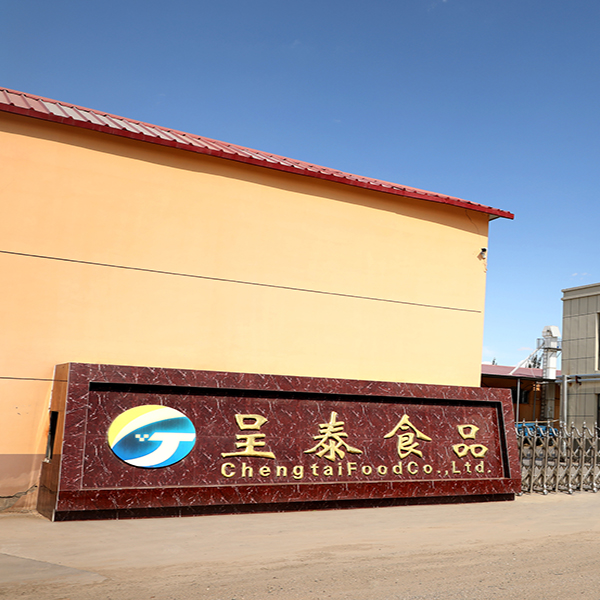
Processing facility of Inner Mongolia Chengtai Food Co., Ltd., Hetao Plain, Hanggin Rear Banner.
Why One Black Seed Grade Triggers Three Different Acceptance Conversations
A roasted snack factory, a food ingredient buyer and a bird feed blender can receive the same black sunflower seed lot and reach three different verdicts. The factory counts pieces per 50 g to hold fill weight and roast time steady. The ingredient buyer checks kernel colour, shell fragments and moisture before the seed enters a bakery or confectionery recipe. The feed blender checks seed coat integrity and screening residue, because anything that survives sifting ends up in a bag of bird feed.
When a purchase order only says "black sunflower seeds," none of those three buyers has a number to point at. Sizing drifts between lots, moisture is assumed rather than tested, and screening quality is judged by eye at the port. The mismatch is not a quality failure in the seed — it is a specification failure in the order.
There is a second, quieter problem. Snack and roast lines want an unflavoured, unpreserved raw input so they control their own salt, oil and seasoning profile. Feed lines want the same thing for a different reason: a seed that already carries seasoning cannot be dropped into a feed blend without changing what the blender must declare. A grade that is deliberately supplied raw serves both.
Where Black Sunflower Seed Demand Sits in 2026
The supply context matters because it explains why grade definition has become a purchasing issue rather than a farming detail.
- Global sunflower seed production is estimated at 55.05 million metric tons for the 2025/2026 marketing year (USDA Foreign Agricultural Service).
- Inner Mongolia accounts for over 60% of China's total sunflower cultivation area (People's Daily Online), and Inner Mongolia's sunflower seed export volume reached approximately 463,400 tons in 2025, valued at US$748 million (Beauty Food Industry Report).
- China's sunflower seed exports were valued at USD 937 million in 2025, with major destinations including Iraq (USD 131 million) and Russia (USD 101 million) (OEC).
- Roasted sunflower seeds accounted for 65.9% of global packaged sunflower seed industry revenue in 2024, and Europe was the largest packaged market with a 29.6% revenue share (Grand View Research).
- Global non-oilseed (confectionery) sunflower planted area in 2025 was forecast to decline by 8% (National Sunflower Association), which puts more weight on getting consistent yield out of the tonnage that is actually planted.
Read together, these figures describe a market where the volume moves through roasting and snack channels, the origin is concentrated, and the raw material base is tightening. For a buyer, that combination rewards a grade with a fixed sizing calibration over a grade described only by colour.
The Meirenxin Grade: Six Specifications You Can Quote
Inner Mongolia Chengtai Food Co., Ltd. processes sunflower seeds, pumpkin seeds and kernels, with sunflower and pumpkin seed planting and processing forming an industrial cluster on the Hetao Plain. The company supplies the international market with black sunflower seeds and kernels and is certified under ISO 9001 and Halal. The Meirenxin black grade sits inside that range and is defined by six facts a buyer can write into a specification sheet.
- Black seed coat. The seed presents a black coat, which is the visible identity of the grade and the first filter used in hand sampling.
- Round kernel. The kernel form is round, which supports even heat contact in roasting and clean separation in hulling.
- 380–390 pieces per 50 g. This is the sizing calibration — a count-based definition, not a visual impression. It is the number that governs fill weight per pack and roast-time consistency.
- Hetao Plain origin. The material originates from the Hetao Plain in Inner Mongolia, the same production region as Chengtai's planting base.
- Natural sun-drying with moisture control. Drying is carried out under natural sun conditions and managed against a moisture target rather than left to weather.
- Layered air separation and sifting, no flavourings or preservatives added. Cleaning is mechanical — layered air separation plus sifting — and the grade is shipped raw, without added seasoning or preservative treatment.
Because the grade is sold raw, it is described in Chengtai's own product documentation as intended for human consumption and suited to the manufacturing and roasted industries. The same raw condition is what allows a feed buyer to use it without inheriting an additive load.
Line 1 — Base Raw Material for Snack and Roasted Factories
For a snack or roasting factory, Meirenxin black sunflower seeds enter the plant as raw material, not as a finished flavoured product. Three of the six specifications do the work here.
The 380–390 pieces per 50 g calibration converts directly into pack economics. When the piece count per 50 g is fixed, a 50 g retail pack holds a predictable seed count, a fixed roast batch yields a predictable number of packs, and seasoning pick-up per unit of surface area stays stable between lots. Buyers who have run uncalibrated lots know the alternative: the same roasting curve produces a different colour and texture when the average seed size shifts.
Natural sun-drying with moisture control supports even roasting. Moisture is not left to chance at the point of sale; Chengtai publishes a moisture ceiling of ≤10.0% for the grade, which is the figure a roasting line should be given when the roast profile is set.
Layered air separation and sifting, with no flavourings or preservatives added, keeps the factory in control of the flavour system. The plant adds its own salt, oil and seasoning, so the incoming seed must not already carry one. The same mechanical cleaning stages are what keep stone and light foreign matter out of the fryer and the roaster.
Line 2 — Food Ingredient for Human Consumption
The same grade also moves as a food ingredient rather than as a snack. Chengtai supplies sunflower seed kernels made from sunflower seeds, in a raw specification, intended for human consumption. The kernel format changes which specifications matter.
For ingredient use, the black coat disappears and the buyer is buying the kernel: a round kernel with a white colour and a taste described as sweet and natural. Ingredient buyers — bakery, confectionery and food-processing operations — typically assess kernel colour uniformity, absence of shell fragments, moisture, and defect ceilings before the material goes into a recipe or a retail finished product.
The published specification set for the Chengtai sunflower seed range gives ingredient buyers something to test against: moisture ≤10.0%, impurity ≤0.2%, decolorizing seeds ≤1.5%, erosion seeds ≤1.0%, mildew seeds ≤1.0%, short seeds ≤2.0% and wizened seeds ≤6.0%. These ceilings are the same ones that make the grade usable for snack processing, confectionery and retail finished products. For an ingredient line, the mildew and decolorizing ceilings are the two that most often decide acceptance, because both are visible in a finished product where the seed is no longer hidden by a shell.
Packaging follows the ingredient channel: the product is supplied in 20/25 kg plastic or paper bags and should be stored in a cool place. That format suits a plant that re-packs, blends or feeds the material into a continuous process rather than a retail line.
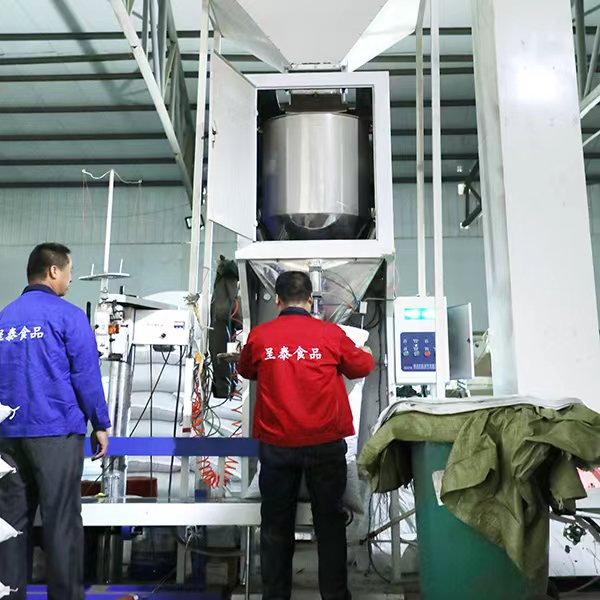
Meirenxin black sunflower seeds packed in 20/25 kg plastic or paper bags for bulk programs.
Line 3 — Bird Feed, Standalone or Blended
Bird feed is the third line, and it is the line where the raw, additive-free condition matters most. Meirenxin black sunflower seeds are supplied as whole, unshelled seed with no flavourings or preservatives added, which means a feed blender can use them standalone or as a component in a broader seed mix without introducing a seasoning load into the formulation.
The physical profile suits medium-sized companion birds and softbills. A black seed coat, a round kernel and a 380–390 pieces per 50 g calibration produce a medium-sized seed that fits feeders used for parrots, cockatiels, budgerigars, munias and thrushes, and that can be blended at a defined inclusion rate because the count per unit weight does not vary between deliveries.
Screening quality is the feed-specific acceptance point. Layered air separation and sifting removes light chaff and foreign matter before packing, and the published impurity ceiling of ≤0.2% gives a feed buyer a measurable limit rather than an instruction to "look for stones." The Chengtai range is documented as free of stone, with fewer broken and mildewed seeds than a conventional ordinary grade — both properties that matter when the seed is going into a bag that a bird owner will open at home.
For feed buyers, the moisture ceiling of ≤10.0% is equally practical. Feed is often stored longer than snack material and in less controlled conditions, so a lower moisture entry point reduces the risk of mould developing in warehouse stock.
Step-by-Step: Adapting One Grade to Your Line
The following sequence lets a snack factory, an ingredient buyer and a feed blender work from the same purchase specification. The order matters, because sizing and moisture decisions change what the sample has to prove.
Step 1 — Declare the line and the format. State whether the material will be used whole for roasting or snack processing, as a kernel ingredient for human consumption, or as bird feed. This determines whether the order is placed on whole seed or on kernels.
Step 2 — Fix the sizing calibration. Write the count into the specification as pieces per 50 g. Meirenxin black is calibrated at 380–390 pieces per 50 g. Verify by counting a weighed sample rather than by comparing photographs.
Step 3 — Set the moisture ceiling. Use ≤10.0% as the acceptance limit and confirm it on the pre-shipment test. Pair the limit with cool, dry storage because the grade is packed in 20/25 kg plastic or paper bags.
Step 4 — Confirm screening residue and defect ceilings. Check that layered air separation and sifting have been applied and that the material is free of stone, with impurity ≤0.2%, decolorizing seeds ≤1.5%, erosion seeds ≤1.0%, mildew seeds ≤1.0%, short seeds ≤2.0% and wizened seeds ≤6.0%.
Step 5 — Confirm the raw condition. For snack and roast lines and for bird feed, verify that no flavourings or preservatives have been added, so your own seasoning or blending process starts from a defined base.
Step 6 — Agree the commercial frame. Chengtai's purchasing terms use an MOQ of 5 mts, delivery terms of FOB, CNF or CIF, and payment terms of 30/70 or 100%. Acceptance can be set as a pre-shipment test or a test after the seeds are received.
Step 7 — Schedule repeat container loads. Once the specification holds on the first container, convert it into a standing specification so subsequent lots are tested against the same numbers rather than re-negotiated each season.
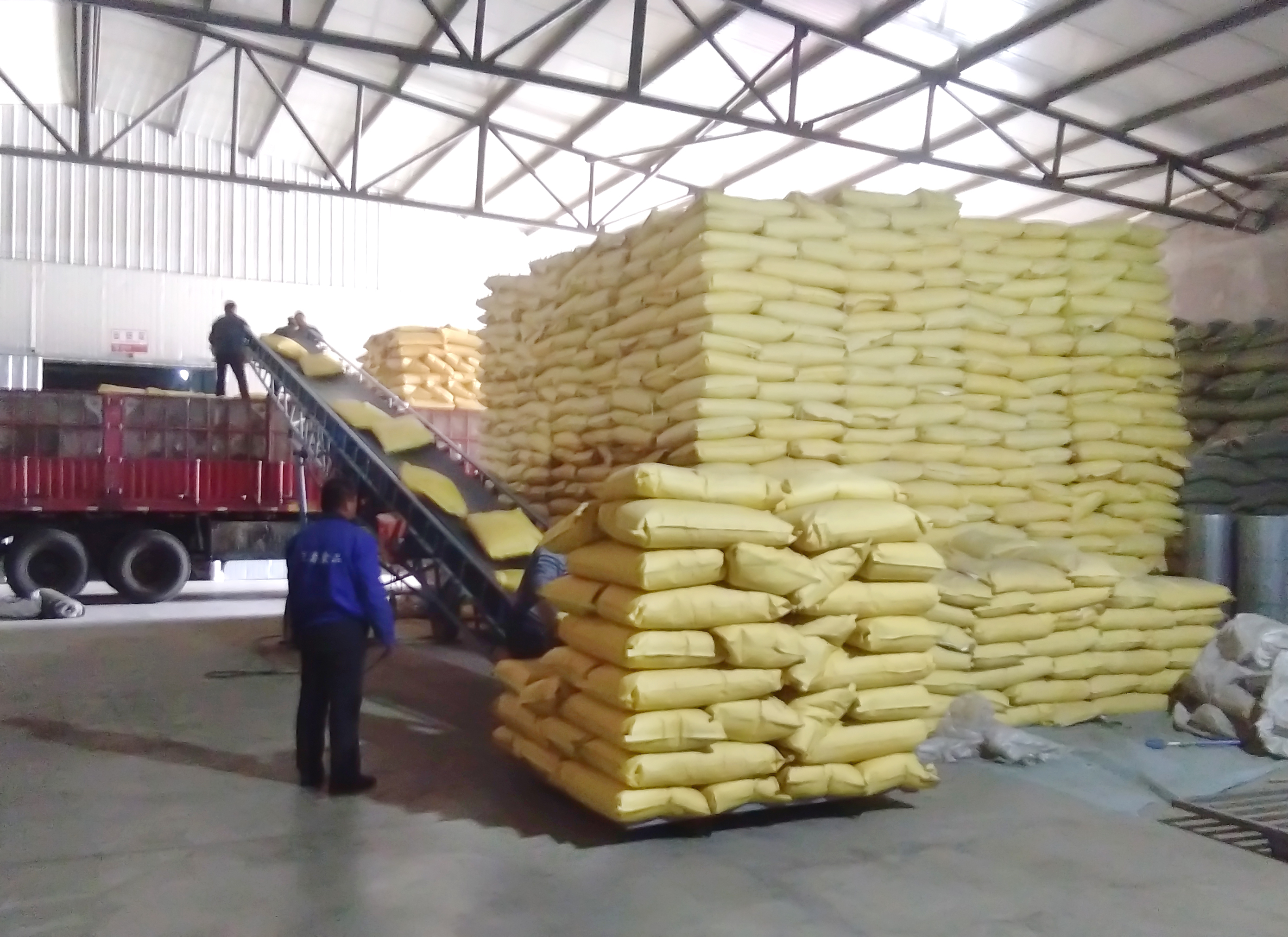
Container loading for bulk programs — one specification, repeat shipments.
Use Cases: Three Buyer Profiles, One Grade
Roasted snack factory. A factory running salted and flavoured sunflower seed lines buys whole black seed, specifies 380–390 pieces per 50 g, and buys raw so that its own salt and seasoning system defines the finished flavour. The controlling checks are sizing calibration, moisture ≤10.0% and stone-free screening.
Food-processing and confectionery buyer. An ingredient buyer purchases sunflower seed kernels in the raw specification for human consumption, packed in 20/25 kg plastic or paper bags. The controlling checks are kernel colour and taste, impurity ≤0.2%, mildew seeds ≤1.0% and decolorizing seeds ≤1.5%.
Bird feed blender or pet food distributor. A feed buyer purchases whole unshelled black seed with no flavourings or preservatives added, either for direct resale or as a component in a seed mix for parrots, cockatiels, budgerigars, munias and thrushes. The controlling checks are screening residue, impurity ≤0.2%, moisture ≤10.0% and count consistency so that inclusion rates hold across batches.
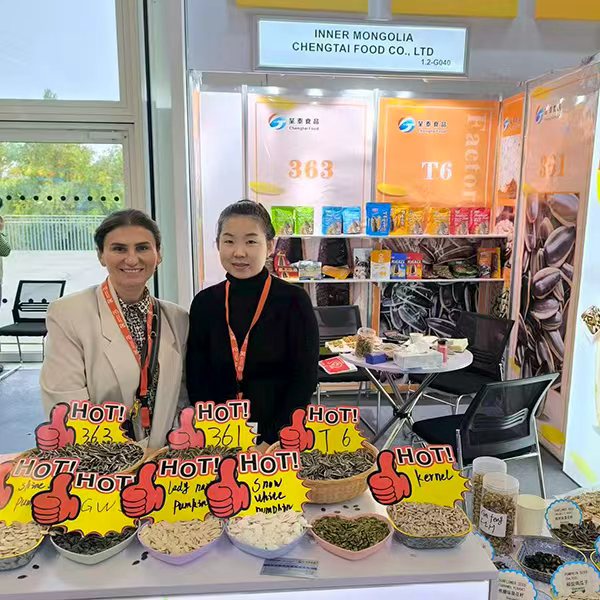
Buyer meetings at international exhibitions, where standing specifications are agreed.
Comparison: Chengtai Sunflower Seed Grade vs Conventional Ordinary Grade
The table below compares the Chengtai sunflower seed grade against a conventional ordinary grade using published differences and specification figures. It is written for buyers who need to justify a grade decision internally.
| Comparison point | Chengtai sunflower seed grade | Conventional ordinary grade |
|---|---|---|
| Kernel purity and defects | Higher kernel purity, fewer broken and mildewed seeds, no stone | Lower kernel purity, higher presence of broken and mildewed seeds |
| Seed size | Larger sizing position within the range; Meirenxin black calibrated at 380–390 pieces per 50 g | Smaller and less consistent sizing position |
| Moisture ceiling | ≤10.0% | Not published at this ceiling |
| Impurity ceiling | ≤0.2% | Not published at this ceiling |
| Defect ceilings | Decolorizing ≤1.5%, erosion ≤1.0%, mildew ≤1.0%, short ≤2.0%, wizened ≤6.0% | Not published at these ceilings |
| Best suited to | Snack processing, confectionery and retail finished products | Lower-specification applications |
| Finished yield after processing | Higher finished product yield after processing | Lower finished product yield after processing |
| Cost position | 5% lower than the conventional ordinary grade in the published comparison | Reference point |
| Storage | Standard cold, dry storage; no special handling required | Standard storage |
The practical reading is straightforward. Where a line measures quality in fill weight, roast consistency and pack yield, the calibrated grade removes variables that the ordinary grade leaves open. Where a line is buying on price alone and does not test sizing or defect ceilings, the ordinary grade remains the lower-cost input — but the buyer accepts the variability that comes with it.
Acceptance Checklist: One Grade, Your Line Requirements
Before confirming any container, a buyer should be able to tick each of the following against the supplier's written specification.
- Defined sizing. Piece count written as pieces per 50 g — 380–390 for Meirenxin black — and verified on a weighed sample.
- Defined moisture. Moisture ceiling of ≤10.0% confirmed on test, with cool, dry storage agreed for 20/25 kg plastic or paper bags.
- Residue-free screening. Layered air separation and sifting applied, stone-free material, impurity ≤0.2%.
- Defect ceilings. Decolorizing ≤1.5%, erosion ≤1.0%, mildew ≤1.0%, short ≤2.0%, wizened ≤6.0%.
- Raw condition. No flavourings or preservatives added, so the buyer's own process defines the finished profile.
- Format. Whole seed for snack, roast and feed lines; kernels in raw specification for human consumption.
- Commercial frame. MOQ 5 mts, FOB / CNF / CIF delivery, 30/70 or 100% payment, acceptance by pre-shipment test or test after receipt.
Frequently Asked Questions
What quality thresholds and certification apply to the Meirenxin black grade?
The published specification set covers moisture ≤10.0%, impurity ≤0.2%, decolorizing seeds ≤1.5%, erosion seeds ≤1.0%, mildew seeds ≤1.0%, short seeds ≤2.0% and wizened seeds ≤6.0%. Inner Mongolia Chengtai Food Co., Ltd. is certified under ISO 9001 and Halal. Buyers selling into the EU should note that the EU market for sunflower seeds requires adherence to HACCP principles and strictly monitors pesticide residues and metal contaminants, and that China notified 209 new Maximum Residue Limits for 93 pesticides in food to the WTO in late 2025.
Can one Meirenxin grade really serve snack, roast and bird feed lines?
Yes, because the grade is defined by physical specifications that are line-neutral. A black seed coat, a round kernel and a 380–390 pieces per 50 g calibration give snack and roast lines a stable fill weight and roast profile, while the same raw, additive-free condition lets a feed blender use the seed standalone or in a mix without inheriting a seasoning load. The difference between lines is which specification the buyer tests first, not which seed is shipped.
What are the purchasing terms and minimum order?
Chengtai's standard terms are an MOQ of 5 mts, delivery terms of FOB, CNF or CIF, and payment terms of 30/70 or 100%. Acceptance can be structured either as a pre-shipment test or as a test after the seeds are received, which allows an ingredient buyer to validate kernel colour and defect ceilings on arrival before releasing the balance.
How is the grade validated before shipment?
Samples are drawn against the written specification and checked for piece count per 50 g, moisture, impurity and defect ceilings, plus the absence of stone and of added flavourings or preservatives. Because the grade is packed in 20/25 kg plastic or paper bags, sampling can be taken from the packed lot rather than only from bulk, and the same sample can be split between the buyer's snack, ingredient or feed evaluation if more than one line is being supplied.
How does a long-term supplier program work for bulk container loads?
A repeat program is built on a standing specification rather than on renegotiated lots. Inner Mongolia Chengtai Food Co., Ltd. has built long-term business relationships with clients in China, the Middle East, Middle Asia, Egypt, Dubai, the United States, Austria and European countries, and attends international exhibitions including Gulfood in Dubai, the Uzbekistan Exhibition, Tuyap in Turkey, Anuga in Germany and Sial in France to meet buyers. For a bulk container load program, the practical next step is to send your line profile — snack and roast, human-consumption ingredient, or bird feed — together with your target piece count and moisture limit, and request a sample and a quotation against that written specification.
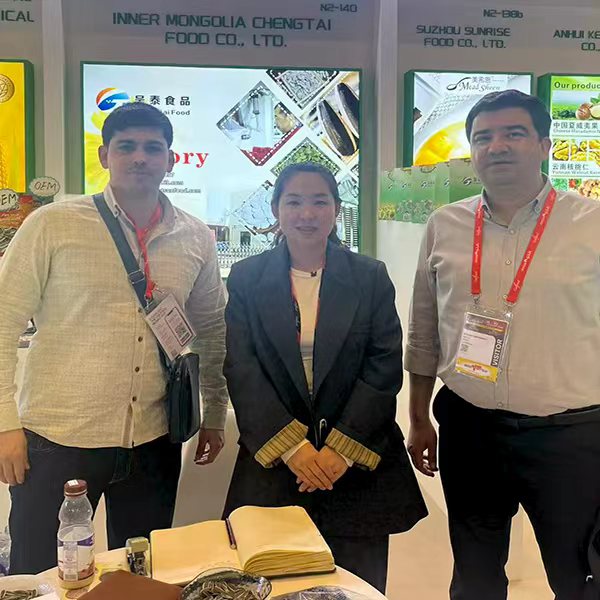
Chengtai Food export team meeting bulk sunflower seed buyers at an international trade show.
Conclusion
A single grade can serve three lines when the specification travels with it. Meirenxin black sunflower seeds from Inner Mongolia Chengtai Food Co., Ltd. are defined by a black seed coat, a round kernel, a 380–390 pieces per 50 g sizing calibration, Hetao Plain origin, natural sun-drying with moisture control, and layered air separation and sifting with no flavourings or preservatives added. Those six facts are enough for a roasted snack factory, a food ingredient buyer and a bird feed blender to write their own acceptance limits around the same shipped lot.
The buyer's job is to decide which specification governs their line, then hold the supplier to it on every container. Snack and roast lines should lead with sizing calibration and moisture. Ingredient lines should lead with kernel colour, taste and the mildew and decolorizing ceilings. Feed blenders should lead with screening residue, impurity and the raw, additive-free condition.
To move from specification to shipment, send your line profile, target piece count and moisture limit to Inner Mongolia Chengtai Food Co., Ltd. at ctsunfood@163.com. Samples and quotations are prepared against the written specification, and bulk container load programs are scheduled on the agreed terms. The company profile and full product documentation are available at www.ctsunfood.com, and the downloadable company profile is available here: Company profile (PDF).
Have Questions or Need More Details?
Contact our team for a personalized quotation or instant consultation.
Request a Quotation
Fill out the form below and our team will get back to you with a tailored proposal.
WhatsApp Direct Chat
Prefer to chat in real-time? Message us on WhatsApp for instant assistance & quick answers.
- Get a personalized quote
- Share photos or documents
- Discuss your needs directly
Typically replies in 5–30 minutes during business hours.