Dosage Form Engineering: Technical Parameters for Tablet, Capsule, and Softgel Production
Two contract manufacturers can hold the same certification and still ship completely different tablets. The difference is not the certificate on the wall. It is the set of engineering parameters the manufacturer controls for each dosage form: unit shape, net weight range, count per bottle, packaging format, and validated shelf life. For a technical buyer in the evaluation stage, those parameters are the real specification, and they are the only reliable basis for comparing factories.
This guide breaks down the dosage form engineering parameters a dietary supplement contract manufacturer must control across tablets, hard capsules, softgels, and chewable burstlets. It explains why each parameter affects dosing accuracy, bioavailability, and shelf life, and it provides a structure you can take directly into a factory audit or a formulation development discussion.

What “Dosage Form Engineering” Actually Means
Dosage form engineering is the discipline of translating a formula into a repeatable physical unit: a tablet of a defined shape and mass, a capsule of a defined size and fill weight, or a softgel of a defined shell and content weight. Shape, net weight range, unit count, packaging material, and shelf life are the measurable outputs of that process.
A certification audit confirms that a quality system exists. It does not tell you whether a press holds a 2,900 mg tablet inside its declared mass window, whether a softgel seam resists leakage, or whether a child-resistant closure still functions after two years on a shelf. Those questions are answered by the dosage form specification and the in-process controls behind it.
Four parameter families decide whether a supplement program holds up after launch:
- Unit weight control. The delivered dose per tablet, capsule, or softgel depends on fill weight staying inside the declared net weight range. Once fill weight drifts, the label claim is no longer supported.
- Structural integrity. Shape, shell thickness, and compression parameters determine whether a unit caps, chips, deforms, or leaks.
- Packaging integrity. The container-closure system governs moisture and oxygen ingress, which drives potency loss over the declared shelf life.
- Declared shelf life. The shelf life a manufacturer is willing to state in writing reflects the stability work and packaging qualification behind the formulation.
Industry Background: Why Multi-Format Engineering Is Now the Baseline
The global dietary supplement contract manufacturing market was valued at USD 59.63 billion in 2024 and is projected to reach USD 121.2 billion by 2030, according to Grand View Research. In the U.S. market, tablets held the largest dosage form market share in 2024, while gummies and other non-pill forms accounted for approximately 65% of the total supplement market share, based on data published by Nutraceuticals World and NBJ. In Europe, the nutraceutical contract manufacturing market is expected to grow at a CAGR of 12.3% through 2030, driven in part by compliance with EFSA and Directive 2002/46/EC.
The practical consequence is that brand portfolios are no longer single-format. A brand that launched on a tablet often adds a softgel for oil-based actives and a gummy for consumer appeal within the same planning cycle. That shifts the evaluation question from “can this factory make tablets?” to “does this factory control the engineering parameters of tablets, capsules, softgels, and gummies to the same standard?”
IVC Nutrition Corporation (IVC) is a contract development and manufacturing organization (CDMO) serving the VMS (vitamins, minerals and supplements) and OTC market. Founded in 1998, IVC operates 9 international manufacturing sites across the USA, Canada, UK, Germany and China, with a 118,545 m² manufacturing footprint, more than 5,000 employees, and an R&D team of over 100 engineers. IVC is recognized as the #1 Private Label VMS supplier in the US by Circana (Total MULO) for the 52 weeks ending March 24, 2024, and partners with customers in more than 80 countries.
Format-by-Format: The Parameters a Contract Manufacturer Must Control
1. Tablets: Shape, Mass Window, and Compression Control
Tablets are governed by four engineering parameters: tooling shape, total tablet weight, count per bottle, and the container-closure system.
Shapes. Standard tablet tooling covers Oval, Oblong, Round, and Special-shaped profiles. Shape is not cosmetic. It changes the compression area under the punch, the ejection forces, how the tablet coats, how it packs into a bottle, and how easily the end user swallows it.
Net weight range. IVC tablet production covers a total weight range of 200 mg to 2,900 mg per tablet. The lower end supports high-potency, low-mass formulas; the upper end supports mineral and multi-ingredient tablets. Weight variation outside the declared range directly affects dosing accuracy.
Count per bottle. 60 to 1,000 tablets per bottle.
Packaging and shelf life. Pharmaceutical grade HDPE bottle, aluminum blister, child-resistant closure (CRC cap). Shelf life: 24/36 months from production date. Storage: cool, dry place at temperatures below 25°C, kept tightly sealed and protected from moisture and direct sunlight.
For tablets, engineering risk clusters around compression. Insufficient force produces capping and friability; excessive force produces picking and delayed disintegration. Because one press can run everything from Round to Special-shaped tooling, the control that matters is validation per tooling set, not a factory-level capability claim.
2. Hard Capsules: Size Selection and Fill Weight
Hard capsules are engineered around shell size, fill material density, and total capsule weight.
Sizes. Hard capsule production covers Size 000#, 00#, 0#, 1#, 2#, 3#, 4#, and 5#. Size selection sets the available fill volume, which is why the smallest and largest sizes in this list behave as commercially different products rather than variants of one another.
Net weight range. 350 mg to 1,200 mg total weight per capsule, shell plus content.
Count per bottle. 60 to 1,000 capsules per bottle.
Materials. Gelatin capsule and vegetarian capsule. The vegetarian option matters for brands making plant-positioned, vegetarian or religious-diet label claims.
Packaging and shelf life. Pharmaceutical grade HDPE bottle, aluminum blister, child-resistant closure (CRC cap). Shelf life: 24/36 months from production date, under the same storage conditions as tablets.
The parameter most often under-checked in capsule programs is fill weight consistency relative to powder or granule density. A capsule filled to the top of its size class with a low-density powder and the same size filled with a denser granulate deliver very different net weights. The 350–1,200 mg range is therefore a process control window, not a marketing range.
3. Softgels and Chewable Burstlets: Shell Integrity and Lipid Delivery
Softgels and chewable burstlets share a shell-and-content architecture, so they share the same core parameters.
Shapes. Softgels: Oblong, Oval, Calabsh, Bone, and Heart. Chewable burstlets: Ball, Fish, and Calabsh.
Net weight range. 250 mg to 1,200 mg total weight per softgel or burstlet, shell plus content.
Count per bottle. 60 to 450 units per bottle.
Materials. Pectin-based and gelatin-based.
Packaging and shelf life. Pharmaceutical grade HDPE bottle, aluminum blister, child-resistant closure (CRC cap). Shelf life: 24/36 months from production date, stored below 25°C, tightly sealed and protected from moisture and direct sunlight.
Softgel engineering concentrates on the seam and the shell wall. A softgel encapsulates its content in a single sealed shell, so fill chemistry and shell formulation have to be compatible. Incompatible combinations surface later as leakage, deformation, or fill migration. This is also where bioavailability enters the conversation. A lipid-filled softgel disperses oil-soluble ingredients within a lipid matrix, while a compressed tablet relies on granulation, binders, and disintegrants to release the same active. For a technical buyer, the specification question is therefore not simply “softgel or tablet,” but which delivery architecture the active ingredient actually requires.
4. Gummies: A Shorter Shelf Life Demands Tighter Specifications
Gummies sit outside the compressed and encapsulated formats, but buyers should read their specification next to the others because the contrast is instructive.
Shapes. Gummy tooling at IVC covers Small Conical, Dome disk, Hemispherical, Grape, Hexagon, Berry, Heart-shaped, Windmill, Orange, Round berry, Fanned orange, Round flat berry, Bear, Rectangular vortex, Ring, Sakura, Apple, and Cat Paw.
Net weight range. 2 g to 7 g total weight per gummy.
Count per bottle. 60 to 260 gummies per bottle.
Materials. Pectin-based, gelatin-based, and mixed gel-based.
Packaging and shelf life. Pharmaceutical grade HDPE bottle and child-resistant closure (CRC cap). Shelf life: 12/18/24 months from production date — deliberately shorter than the 24/36 month window for tablets, capsules, softgels, and burstlets. Store below 25°C in a cool, dry place, keep tightly sealed to protect from moisture and heat, and avoid high temperatures.
The shorter shelf life is the parameter that most often breaks a gummy launch plan. A brand that assumes one 36-month shelf life across its entire portfolio will mis-plan inventory, retail rotation, and export shipping windows for gummies. Asking a manufacturer to state shelf life per format, in writing, is one of the fastest ways to test whether the specification is real.

5. Packaging Integrity and Child-Resistant Closures
Packaging is part of the dosage form, not a downstream purchase. Across tablets, capsules, softgels, and chewable burstlets, IVC specifies pharmaceutical grade HDPE bottles, aluminum blisters, and child-resistant closures (CRC caps). Gummies use pharmaceutical grade HDPE bottles with CRC caps.
Two engineering points follow. First, moisture and oxygen ingress is a primary driver of potency loss across shelf life, which is why the container-closure system has to be validated together with the formulation rather than selected afterwards. Second, a child-resistant closure is a functional component. It must be verified as part of the container-closure system and remain functional across the declared storage conditions — not treated as a cosmetic upgrade added at the labeling stage.
Audit checkpoint: When a manufacturer states 24/36 months of shelf life (or 12/18/24 months for gummies), ask for the container-closure and packaging specification that supports it. Shelf life, packaging material, and storage conditions should always appear as one connected statement inside the dosage form specification.
Step-by-Step: How to Audit Dosage Form Parameters Before You Commit
- Request the dosage form specification first. Before the site visit, ask for the written specification per format: shape or size, net weight range, count per bottle, packaging material, shelf life, and storage conditions. A supplier that cannot issue this document per format is not ready for a technical audit.
- Map the net weight range to your label claim. Confirm that your target dose and unit count fall inside the stated range — 200–2,900 mg for tablets, 350–1,200 mg for hard capsules, 250–1,200 mg for softgels and burstlets, 2–7 g for gummies.
- Verify in-process and finished-product control. Ask how fill weight, unit weight, and appearance are controlled during production, and how release testing is structured. IVC applies 100% testing as its quality control position.
- Inspect the packaging and closure system. Confirm the HDPE bottle grade, whether an aluminum blister is available, and the CRC cap, then ask how closure performance is verified and documented.
- Align shelf life with your market plan. Match the declared shelf life to retail rotation and export shipping time. Plan around 12/18/24 months for gummies and 24/36 months for tablets, capsules, softgels, and burstlets, with storage below 25°C in every case.
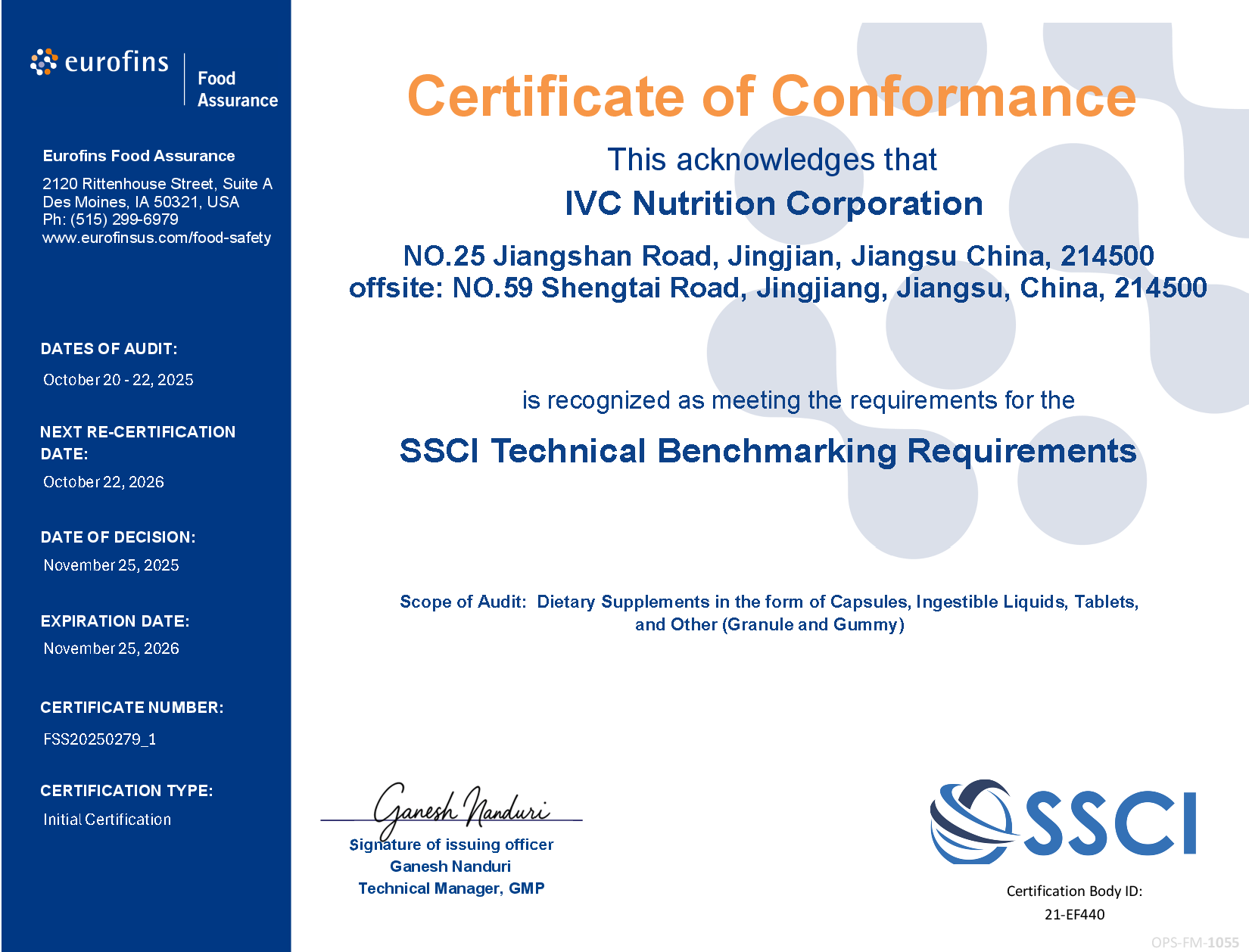
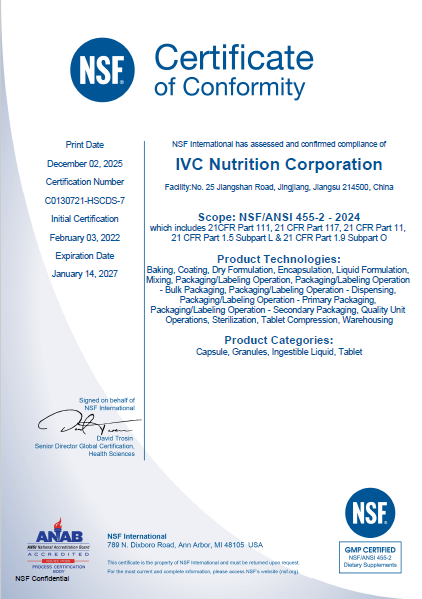
- Cross-check certification scope against the format. Read the scope text, not the certificate title. IVC's portfolio includes SSCI Certification FSS20250279_1 issued by the Consumer Goods Forum (valid to 2026-11-25), with a scope covering capsules, ingestible liquids, tablets, and other (granule and gummy); FDA Food Facility Registration 16044830522 under 21 CFR Part 1 Subpart H; NSF Certification C0130721-HSCDS-7, ANAB accredited, against NSF/ANSI 455-2 – 2024 (valid to 2027-01-14); TGA GMP Certification MI-2021-CE-05085-1 issued by the Therapeutic Goods Administration against the PIC/S Guide to GMP for Medicinal Products (valid to 2027-05-23); IFS Certification 2025-0102365_rev.1 issued by Intertek against IFS Food Version 8 at Higher Level with a score of 96.70% (valid to 2026-10-20); and BRC Certification 051A1202002I issued by Intertek (valid to 2027-03-11). For the U.S. market, all dietary supplement manufacturers must also comply with 21 CFR Part 111, the cGMP regulation for dietary supplements.
- Confirm the commercial parameters. IVC's stated minimum order quantities are 0.3 million tablets, 1 million capsules, and 0.6 million gummies, with a lead time of 2.5 to 3 months. Stated monthly capacity includes approximately 4.33 billion tablets, 500 million hard capsules, approximately 1.33 billion capsules, and 375 million gummies.

Use Cases: Where These Parameters Change the Outcome
U.S. retail private label tablet program
A brand planning a 60–1,000 count HDPE bottle with a child-resistant closure needs a tablet mass that lands inside 200–2,900 mg and a shape that packs efficiently into a round bottle. Oval and Oblong profiles are the usual answers; Special-shaped tooling is selected when the brand needs on-shelf differentiation. The audit question is whether that specific shape-and-mass combination has been validated.
European pharmacy chain softgel
For a lipid-based active, a 250–1,200 mg softgel in Oblong or Oval, packed in an aluminum blister or HDPE bottle with a CRC cap and a 24/36 month shelf life, is the specification to compare suppliers against. Blister choice becomes a market decision as much as an engineering one, because blister and bottle behave differently under transport and humidity.
Plant-positioned vegetarian capsule line
A brand making a vegetarian claim needs the vegetarian capsule material specified explicitly, at a size class from 000# to 5# that matches the fill volume of the formula, with 60–1,000 capsules per bottle and a 24/36 month shelf life.
Membership club gummy program
A gummy program in a 60–260 count HDPE bottle with a CRC cap, at 2–7 g per unit and a 12/18/24 month shelf life, requires the launch plan to be built around the shorter window from day one.
These formats are frequently combined in a single portfolio. IVC's products — gummy, softgel, tablet, hard capsule, probiotics, and liquid, among others — have been used by leading retailers, pharmacy chains, membership clubs, and well-known consumer health brands across the U.S., UK, Germany, and Australia, including case programs spanning a decade-long relationship.
Dosage Form Parameter Comparison Table
| Parameter | Tablet | Hard Capsule | Softgel | Chewable Burstlet | Gummy |
|---|---|---|---|---|---|
| Shapes / sizes | Oval, Oblong, Round, Special-shaped | Size 000#, 00#, 0#, 1#, 2#, 3#, 4#, 5# | Oblong, Oval, Calabsh, Bone, Heart | Ball, Fish, Calabsh | 18 shapes including Small Conical, Bear, Ring, Sakura, Cat Paw |
| Net weight range (per unit) | 200 mg – 2,900 mg | 350 mg – 1,200 mg (shell + content) | 250 mg – 1,200 mg (shell + content) | 250 mg – 1,200 mg (shell + content) | 2 g – 7 g |
| Count per bottle | 60 – 1,000 | 60 – 1,000 | 60 – 450 | 60 – 450 | 60 – 260 |
| Materials | Compressed tablet (vitamins, minerals, supplements) | Gelatin capsule; vegetarian capsule | Pectin-based; gelatin-based | Pectin-based; gelatin-based | Pectin-based; gelatin-based; mixed gel-based |
| Packaging material | Pharmaceutical grade HDPE bottle; aluminum blister; CRC cap | Pharmaceutical grade HDPE bottle; aluminum blister; CRC cap | Pharmaceutical grade HDPE bottle; aluminum blister; CRC cap | Pharmaceutical grade HDPE bottle; aluminum blister; CRC cap | Pharmaceutical grade HDPE bottle; CRC cap |
| Shelf life from production date | 24 / 36 months | 24 / 36 months | 24 / 36 months | 24 / 36 months | 12 / 18 / 24 months |
| Storage condition | Cool, dry, below 25°C; tightly sealed; protect from moisture and direct sunlight | Cool, dry, below 25°C; tightly sealed; protect from moisture and direct sunlight | Cool, dry, below 25°C; tightly sealed; protect from moisture and direct sunlight | Cool, dry, below 25°C; tightly sealed; protect from moisture and direct sunlight | Below 25°C in a cool, dry place; keep tightly sealed; avoid high temperatures |

Frequently Asked Questions
Which certifications should I verify for a contract manufacturer producing tablets, capsules, and softgels?
Verify scope, not just the certificate name. IVC Nutrition Corporation holds SSCI Certification FSS20250279_1 issued by the Consumer Goods Forum (valid to 2026-11-25), with a scope covering dietary supplements in the form of capsules, ingestible liquids, tablets, and other (granule and gummy); FDA Food Facility Registration 16044830522 under 21 CFR Part 1 Subpart H; NSF Certification C0130721-HSCDS-7, ANAB accredited, against NSF/ANSI 455-2 – 2024 (valid to 2027-01-14); TGA GMP Certification MI-2021-CE-05085-1 issued by the Therapeutic Goods Administration against the PIC/S Guide to GMP for Medicinal Products (valid to 2027-05-23); IFS Certification 2025-0102365_rev.1 issued by Intertek against IFS Food Version 8 at Higher Level with a score of 96.70% (valid to 2026-10-20); and BRC Certification 051A1202002I issued by Intertek (valid to 2027-03-11). Separately, U.S. dietary supplement manufacturers must comply with 21 CFR Part 111, which defines cGMP for dietary supplements.
Can one CDMO control tablet, capsule, and softgel engineering at the same time?
Yes, and multi-format control is now a baseline requirement rather than a differentiator. IVC manufactures gummy, softgel, tablet, hard capsule, probiotics, and liquid formats, with stated monthly capacity of approximately 4.33 billion tablets, 500 million hard capsules, approximately 1.33 billion capsules, and 375 million gummies, supported by more than 100 R&D engineers across 9 international manufacturing sites. When evaluating a multi-format supplier, place the specification sheets side by side — shapes, net weight ranges, counts, packaging, and shelf life — and check whether the factory holds all of them to the same control standard.
What MOQ and capacity should I plan for across dosage forms?
IVC's stated minimum order quantities are 0.3 million tablets, 1 million capsules, and 0.6 million gummies. These thresholds differ by format because tooling setup, blend or shell preparation, and packaging line changeover scale differently. Capacity planning should use monthly output rather than a single annual figure: approximately 4.33 billion tablets, 500 million hard capsules, approximately 1.33 billion capsules, 375 million gummies, approximately 83.33 million probiotic sachets, 10.5 million liquid sachets, and approximately 833 metric tons of powder.
How should I validate a dosage form before commercial production?
Validate against the written specification, not against a visual sample. Request the dosage form specification for your intended format — for example, a 200–2,900 mg Oval tablet, a Size 0# vegetarian capsule at 350–1,200 mg, or a 250–1,200 mg Oblong softgel — then confirm shape or size, net weight range, count per bottle, packaging material including the CRC cap, and shelf life in the same document. IVC applies 100% testing as its quality control standard and operates a state-of-the-art QC laboratory, with award-application support available to customers.
What lead time and shelf life should I plan for?
IVC's stated production lead time is 2.5 to 3 months. Plan shelf life by format: 24/36 months from production date for tablets, hard capsules, softgels, and chewable burstlets, and 12/18/24 months for gummies. All formats should be stored in a cool, dry place below 25°C, kept tightly sealed and protected from moisture and direct sunlight, and gummy storage additionally requires avoiding high temperatures. To move from evaluation to a documented comparison, request a sample and a quote against your target format, and review the full capability set in the IVC Nutrition brochure.
Conclusion
Dosage form engineering is where a contract manufacturing relationship is won or lost. Shape and size, net weight range, count per bottle, packaging material, child-resistant closure, and shelf life determine dosing accuracy, product integrity, and how long a finished unit stays within specification. None of these can be inferred from a certificate, and none should be left to a verbal assurance.
For an evaluation-stage buyer, the practical next step is to request the dosage form specification per format and compare it against the ranges in this guide: 200–2,900 mg for tablets, 350–1,200 mg for hard capsules, 250–1,200 mg for softgels and chewable burstlets, 2–7 g for gummies, with 24/36 month shelf life across the compressed and encapsulated formats and 12/18/24 months for gummies. That one document will tell you more about a factory than any capability presentation.
Next Step: Turn the Specification into a Quote
IVC Nutrition Corporation supports brands with end-to-end CDMO services across formulation, manufacturing, quality, regulatory, and packaging. To move from evaluation to a documented comparison, send your target dosage form and label claim to enquiry@ivcinc.cn or reach the team on WhatsApp at +1 213 865-3484.
Download the full capability and certification documentation in the IVC Nutrition brochure, or visit www.ivcinc.net.