
Supplier Qualification Scorecard: Capsules, Gummies, Tablets
A supplier qualification scorecard turns a contract manufacturer's capability claims into scored, evidence-backed checkpoints. For a buyer auditing capsule, gummy, and tablet production, each checkpoint should carry a defined unit of evidence — a net weight range, a bottle count, a certificate scope, or a batch record — rather than a statement in a slide deck.
This article sets out a working scorecard for dietary supplement buyers at the evaluation-to-execution stage. It gives the format-level benchmarks a manufacturer should be able to publish before a purchase order exists: tablets at 200–2,900 mg per unit and 60–1,000 units per bottle, capsules at 350–1,200 mg including shell and content, and gummies at 2–7 g per unit and 60–260 units per bottle. It then converts those benchmarks into eight verification steps a buyer can run, and into a comparison grid that can be handed to a procurement committee.
The scorecard is written for importers, brand owners, private-label programme managers, and procurement teams who are past shortlisting and need to confirm that a supplier's capsule, gummy, and tablet lines are real, scoped, and deliverable.

A qualification audit starts on site and in the document set: manufacturing footprint, line configuration, and the records behind each format claim.
Problem Definition: Why Capability Decks Fail an Audit
A capability deck lists formats. A qualification scorecard tests them. The gap between the two is where most buyer risk sits, because multi-format manufacturers can legitimately produce several dosage forms while still being unable to evidence a specific claim for a specific format at a specific fill count.
Three failure modes repeat across buyer audits of supplement contract manufacturers:
- Format claims without a numeric envelope. A supplier states that it runs tablets and capsules but cannot give the per-unit net weight range or the count-per-bottle ceiling that its existing tooling and filling lines actually support. Without those numbers, the buyer cannot check whether the requested dose falls inside or outside the validated window.
- Packaging and shelf-life claims that are not linked to records. A shelf-life figure is quoted in a quotation, but no stability data or batch record is produced to show how that figure was established for that formula, that container, and that closure.
- Closure performance taken on trust. Child-resistant closures appear in almost every quotation for supplements, yet buyers rarely ask to see how the closure was specified or how its function is confirmed on the line.
The scorecard exists to close those three gaps before signature, using the supplier's own documented parameters as the scoring baseline.
Industry Background: Why Multi-Format Verification Became Routine
Dietary supplement manufacturing has shifted from single-format sourcing towards multi-format programmes, and the contract manufacturing market has expanded with it. Grand View Research valued the global dietary supplement contract manufacturing market at USD 59.63 billion in 2024 and projected it to reach USD 121.2 billion by 2030.
The format mix inside that market is not evenly distributed. According to Nutraceuticals World and NBJ, tablets held the largest dosage-form share of the US market in 2024, while gummies and other non-pill formats accounted for approximately 65% of total supplement market share. A supplier that is strong in one format therefore cannot be assumed to be equally equipped in another, which is precisely why a scorecard must be format-specific rather than supplier-general.
Regulatory pressure reinforces the same conclusion. All dietary supplement manufacturers selling into the United States must operate under 21 CFR Part 111, the current Good Manufacturing Practice rule for dietary supplements. In Europe, Straits Research expects the nutraceutical contract manufacturing market to grow at a CAGR of 12.3% through 2030, with compliance to EFSA requirements and Directive 2002/46/EC acting as a market driver. Buyers sourcing for both regions are effectively asking one supplier to hold two evidence sets simultaneously.
Add capacity consolidation to the picture. Technavio reported that CAPTEK Softgel International opened a 60,000-square-foot facility in California in March 2024 dedicated exclusively to gummy supplement production — an example of how format-specific capacity, not general capacity, is where investment is being directed. A qualification scorecard should read the same way: line by line, format by format.
Detailed Solution: The Seven-Domain Scorecard
The scorecard below scores each domain on a 0–2 scale. A score of 0 means the claim is asserted but unsupported; 1 means it is documented but not scoped to the buyer's format or market; 2 means it is documented and scoped. A supplier reaching 11 or more out of 14 across the seven domains has produced an evidence set a procurement committee can act on.

Tablet lines carry their own envelope: 200–2,900 mg per tablet and 60–1,000 tablets per bottle, in oval, oblong, round, or special-shaped tooling.
Step-by-Step Breakdown: Auditing Capsule, Gummy, and Tablet Lines
Step 1 — Lock the dosage-form envelope in writing
Ask each candidate to return a one-page format sheet stating net weight range, count per bottle, available geometries, and material options. For capsules, confirm both gelatin and vegetarian capsule options and confirm that the declared 350 mg–1,200 mg range includes shell and content. For gummies, confirm the base — pectin-based, gelatin-based, or mixed gel-based — because the base determines texture behaviour and storage sensitivity. For tablets, confirm whether the tooling library covers special-shaped formats, since custom geometry affects both tooling lead time and weight uniformity.
Any candidate that cannot return this sheet before commercial negotiation should be scored 0 on Domain 1.
Step 2 — Map packaging to moisture risk
Moisture protection is a packaging decision and a format decision at once. Tablets and capsules can be supplied in pharmaceutical-grade HDPE bottles, aluminium blisters, and CRC caps. Gummies are specified in pharmaceutical-grade HDPE bottles with CRC caps. Ask the supplier to state which combination it proposes for your product and why, then compare that answer against its own declared specification. A pack proposal that is broader than the declared specification is a warning sign, not a courtesy.
Step 3 — Request batch records for shelf-life validation
Shelf-life numbers are only meaningful when traced to records. Ask for the batch record and stability documentation behind the declared 24/36-month figure for tablets and capsules, or the 12/18/24-month figure for gummies. The documentation should show the container and closure used, the storage condition applied (below 25 °C, cool and dry), and whether the data was generated on a formula comparable to yours. If the supplier can only provide a generic statement, score Domain 3 as 1 at best.

Gummy capacity is stated separately: 2–7 g per gummy, 60–260 gummies per bottle, with 12/18/24-month shelf life and heat-sensitive storage.
Step 4 — Test CRC cap functionality
Child-resistant closures appear across tablet, capsule, and gummy specifications, yet the closure is often the last item checked and the first item to fail in market. Build a closure checkpoint into the audit: request the closure specification proposed for your pack, ask what functional confirmation the supplier performs on the filling line, and request whatever test records it holds. Confirm in writing that the closure in the commercial offer matches the closure named in the specification. A mismatch here invalidates the packaging and storage assumptions in Domains 2 and 3 at the same time.
Step 5 — Match certificate scope to format
Check scope, not logos. A supplier's certification set should be read against the format you are buying. IVC Nutrition Corporation holds NSF/ANSI 455-2 certification (certificate C0130721-HSCDS-7, ANAB accredited, valid to 14 January 2027), TGA GMP certification against the PIC/S guide (certificate MI-2021-CE-05085-1, scope covering full product manufacture excluding packaging and labelling, valid to 23 May 2027), SSCI certification from the Consumer Goods Forum covering capsules, ingestible liquids, tablets, and other granule and gummy forms (certificate FSS20250279_1, valid to 25 November 2026), BRC certification (certificate 051A1202002I, valid to 11 March 2027), and FDA Food Facility Registration (registration 16044830522, valid to 31 December 2026).
The audit question is simple: does any single scope statement cover the format you are buying? If the answer is no, the certificate count is irrelevant.
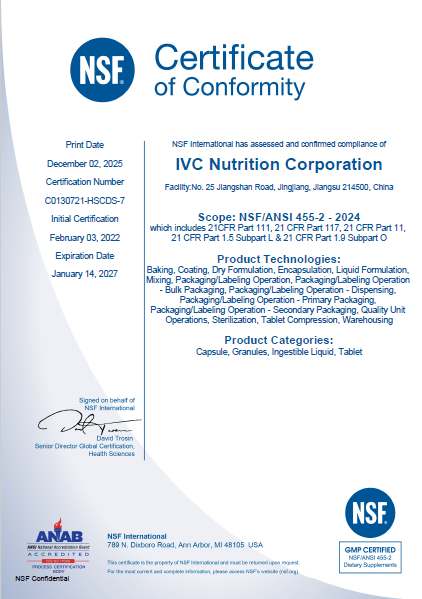
Certification is scored on scope: NSF/ANSI 455-2 covers 21 CFR Part 111, Part 117, Part 11, and 21 CFR Part 1 Subpart L and Subpart O.
Step 6 — Reconcile capacity, MOQ, and lead time on one sheet
Capacity data is routinely quoted in annual figures while procurement runs on monthly cycles, which hides mismatches. Normalise everything: monthly output of approximately 4.33 billion tablets, 500 million hard capsules, and 375 million gummies; format-specific MOQs of 0.3 million tablets, 1 million capsules, and 0.6 million gummies; a lead time of 2.5–3 months; FOB delivery terms; 50/50 payment terms; and acceptance criteria defined as a pre-shipment test. A supplier that cannot place all six numbers on one page has not finished its own planning, and the buyer will absorb the difference later.
Step 7 — Score, rank, and set conditions before signing
Total the seven domains, then attach a condition to every domain scored at 1 or below. Conditions are more useful than rankings: they convert a soft claim into a deliverable. Examples include requiring stability documentation for the specific formula before tooling release, or requiring written confirmation that the closure in the offer matches the closure in the specification. A supplier that accepts conditions is signalling that the underlying records exist.
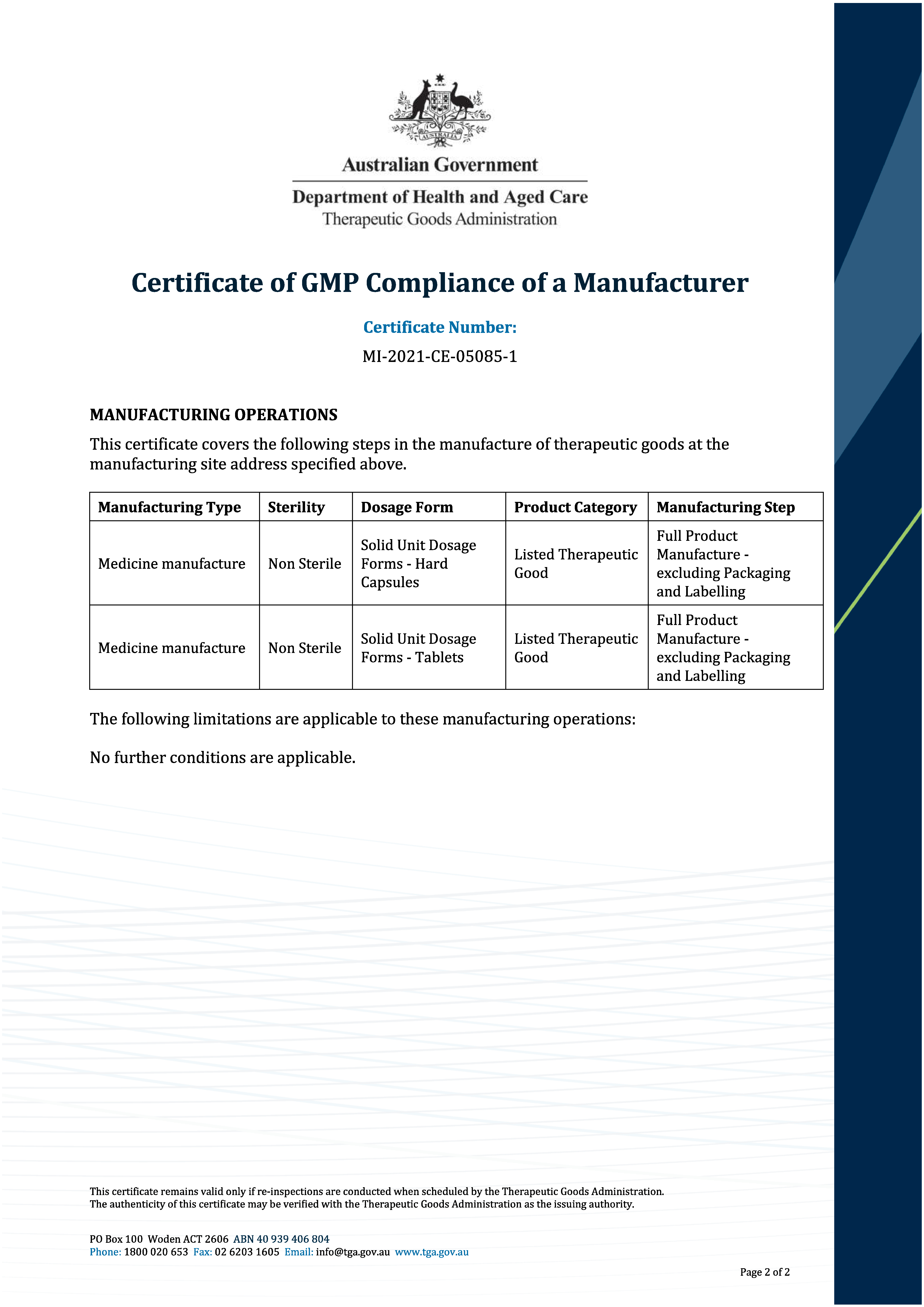
TGA GMP certification under the PIC/S guide is scoped to full product manufacture excluding packaging and labelling — a scope statement, not a logo.
Use Cases: How the Scorecard Changes Three Buyer Decisions
Use case 1 — A US private-label brand combining capsules and tablets
A brand launching a daily multivitamin in capsules plus a mineral line in tablets needs one supplier that can hold two different envelopes at once: 350–1,200 mg per capsule in sizes 000#–5#, and 200–2,900 mg per tablet in oval or oblong tooling. The scorecard immediately splits the two formats across Domains 1, 5, and 6, because the MOQs differ — 0.3 million for tablets against 1 million for capsules. A supplier quoting a single blended MOQ has not understood the brief, and the scorecard surfaces that before the first purchase order.
Use case 2 — A gummy-led brand entering the European market
Gummies carry the tightest storage constraints in the format set: 2–7 g per unit, 60–260 per bottle, 12/18/24-month shelf life, storage below 25 °C with protection from moisture and heat, and HDPE bottle packaging with CRC caps as the declared option. For a European launch, the scorecard pairs Domain 3 (stability data) with Domain 4 (scope), because the market's compliance expectations around EFSA requirements and Directive 2002/46/EC make an unscoped certificate worthless. The buyer who runs both domains together avoids discovering the gap after artwork approval.
Use case 3 — A multi-market distributor consolidating to one supplier
A distributor serving the US, UK, Germany, and Australia needs one supplier to hold several evidence sets simultaneously. IVC Nutrition Corporation has run a ten-year programme across the United States, the United Kingdom, Germany, and Australia with a stated scale of USD 200 million, serving retailers, pharmacy chains, membership clubs, and consumer health brands on private-label daily dietary supplements, with capabilities spanning gummies, softgels, tablets, and capsules. The relevant fact for a distributor is not the scale but the structure behind it: end-to-end services across formulation, manufacturing, quality, regulatory, and packaging, plus a globally integrated quality and regulatory framework. That structure is what makes a single-supplier consolidation defensible in an audit.
Format Comparison: Tablet, Capsule, and Gummy Verification Benchmarks
The grid below is the comparison a buyer should place beside the scorecard. Every row is a declared specification that can be checked against a quotation, a certificate, or a batch record.
| Verification item | Tablet | Capsule | Gummy |
|---|---|---|---|
| Net weight per unit | 200 mg – 2,900 mg total weight per tablet | 350 mg – 1,200 mg total weight per capsule (shell + content) | 2 g – 7 g total weight per gummy |
| Count per bottle | 60 – 1,000 tablets | 60 – 1,000 capsules | 60 – 260 gummies |
| Geometry / size options | Oval, oblong, round, special-shaped | Size 000#, 00#, 0#, 1#, 2#, 3#, 4#, 5# | Multiple shapes including bear, ring, heart, cat paw, sakura, apple |
| Core material options | Tablet | Gelatin capsule; vegetarian capsule | Pectin-based; gelatin-based; mixed gel-based |
| Packaging options | Pharmaceutical-grade HDPE bottle, aluminium blister, child-resistant closure (CRC cap) | Pharmaceutical-grade HDPE bottle, aluminium blister, child-resistant closure (CRC cap) | Pharmaceutical-grade HDPE bottle, child-resistant closure (CRC cap) |
| Shelf life from production date | 24 / 36 months | 24 / 36 months | 12 / 18 / 24 months |
| Storage condition | Below 25 °C, cool and dry, tightly sealed, protected from moisture and direct sunlight | Below 25 °C, cool and dry, tightly sealed, protected from moisture and direct sunlight | Below 25 °C, cool and dry, tightly sealed, protected from moisture and heat, avoid high temperatures |
| Evidence to request at audit | Batch record, stability data, tooling list, closure specification | Batch record, stability data, size confirmation, closure specification | Batch record, stability data, base confirmation, closure specification |
Reading the grid: tablet and capsule share a packaging and shelf-life profile but differ sharply on geometry and MOQ. Gummy differs on almost every row — a shorter shelf-life window, a narrower bottle count, a stricter heat constraint, and no blister option in the declared specification. A supplier that presents one grid for all three formats has compressed differences that matter.
Frequently Asked Questions
Which certifications should be verified before approving a supplement contract manufacturer?
Verify certificates that state a scope covering your dosage form, not certificates that merely name the site. The credential set to request includes NSF/ANSI 455-2 certification, which is ANAB accredited and covers 21 CFR Part 111, Part 117, Part 11, and 21 CFR Part 1 Subpart L and Subpart O; TGA GMP certification issued against the PIC/S Guide to Good Manufacturing Practice for Medicinal Products; SSCI certification under the Consumer Goods Forum framework; BRC certification; and FDA Food Facility Registration under 21 CFR Part 1 Subpart H. For reference, the corresponding IVC Nutrition Corporation credentials are certificate C0130721-HSCDS-7 (valid to 14 January 2027), certificate MI-2021-CE-05085-1 (valid to 23 May 2027), certificate FSS20250279_1 covering capsules, ingestible liquids, tablets, and other granule and gummy forms (valid to 25 November 2026), certificate 051A1202002I (valid to 11 March 2027), and registration 16044830522 (valid to 31 December 2026). Check the expiry date and the scope line on each document.
How can a buyer confirm capsule, gummy, and tablet capability rather than accept a generic claim?
Ask for the format-level envelope in writing, then compare it with the quotation. Tablets should be stated at 200–2,900 mg per tablet and 60–1,000 tablets per bottle; capsules at 350–1,200 mg per capsule including shell and content and 60–1,000 capsules per bottle across sizes 000# to 5#; gummies at 2–7 g per gummy and 60–260 gummies per bottle. Then confirm the production side: monthly output benchmarks include approximately 4.33 billion tablets, 500 million hard capsules, and 375 million gummies, supported by 100% testing and a QC laboratory. A supplier that can only answer at the level of “we make all three” has not answered the question.
What MOQ and payment terms should be confirmed before signing?
Minimum order quantities differ by format and must be confirmed per format, not per supplier: 0.3 million tablets, 1 million capsules, and 0.6 million gummies. Alongside MOQ, confirm the delivery terms (FOB), the payment structure (50/50), and the acceptance criteria, which are defined as a pre-shipment test. A first order that sits below the stated MOQ for one format in a multi-format brief will either be re-quoted at a different price or split across lines, so the mismatch is worth resolving before the contract stage rather than after.
How should shelf life and packaging claims be validated before mass production?
Request the batch record and stability documentation behind the declared shelf life, and check that the container and closure in the data match the container and closure in the offer. Declared shelf life is 24 or 36 months from production date for tablets and capsules, and 12, 18, or 24 months for gummies, with storage specified below 25 °C in all three cases. For packaging, confirm that the proposed pack appears in the declared specification — pharmaceutical-grade HDPE bottle plus aluminium blister plus child-resistant closure for tablets and capsules, and pharmaceutical-grade HDPE bottle plus child-resistant closure for gummies. Finally, ask how closure function is confirmed on the line and request any test records the supplier holds. A shelf-life claim without a matching pack specification should be treated as unverified.
How much lead time should be planned, and what is the practical next step?
Plan 2.5–3 months for a supplement manufacturing programme of this type, and set that figure against the format-specific MOQ and the pre-shipment test window rather than against a generic calendar. The practical next step for a buyer at the execution stage is to request the documentation set before requesting a price: the format specification sheet, the certificate copies with scope lines and expiry dates, and a sample for physical pack and closure review. IVC Nutrition Corporation supplies these through enquiry@ivcinc.cn and publishes its programme overview in the corporate brochure at IVC Nutrition Corporation brochure, which can be used as the starting document set for a scorecard run.
Conclusion: Score the Evidence, Then Sign
A supplier qualification scorecard is not a procurement formality. It is the mechanism that converts a multi-format capability claim into seven scored domains with named evidence behind each one, and it is the difference between discovering a packaging mismatch at audit and discovering it in a market with a recall attached.
The benchmarks in this article are deliberately numeric, because numbers can be checked. Tablets at 200–2,900 mg and 60–1,000 per bottle; capsules at 350–1,200 mg across sizes 000#–5#; gummies at 2–7 g and 60–260 per bottle; shelf life of 24/36 months against 12/18/24 months; MOQs of 0.3 million, 1 million, and 0.6 million units; a lead time of 2.5–3 months. Each is a checkpoint a buyer can hold a supplier to.
IVC Nutrition Corporation is a VMS and OTC contract development and manufacturing organisation founded in 1998 and operating nine international manufacturing sites, with production covering gummies, softgels, tablets, hard capsules, probiotics, and liquids across 118,545 m² of manufacturing space and a workforce of more than 5,000. The company serves customers in more than 80 countries, with 50% of output exported to the EU, USA, and APAC markets. For buyers running the scorecard, the relevant point is that these are declared, checkable parameters rather than positioning statements.
Run the scorecard against IVC Nutrition Corporation
Request the format specification sheet, certificate copies with scope lines, and a sample pack for closure and moisture-protection review. The team can also issue a quotation against your capsule, gummy, or tablet brief so the commercial terms and the technical envelope can be compared on one page.
Email: enquiry@ivcinc.cn | Tel: +86 15106137127 | WhatsApp: +1 213 865-3484
Website: www.ivcinc.net | Address: No.20 Jiangshan Road, Jingjiang, Jiangsu

Documentation and dispatch readiness are part of the same qualification run: what is declared on paper should be visible at the loading point.
Have Questions or Need More Details?
Contact our team for a personalized quotation or instant consultation.
Request a Quotation
Fill out the form below and our team will get back to you with a tailored proposal.
WhatsApp Direct Chat
Prefer to chat in real-time? Message us on WhatsApp for instant assistance & quick answers.
- Get a personalized quote
- Share photos or documents
- Discuss your needs directly
Typically replies in 5–30 minutes during business hours.