Application-Driven Selection of Seamless Rolled Rings: A Technical Guide for Heavy-Duty Industrial Projects
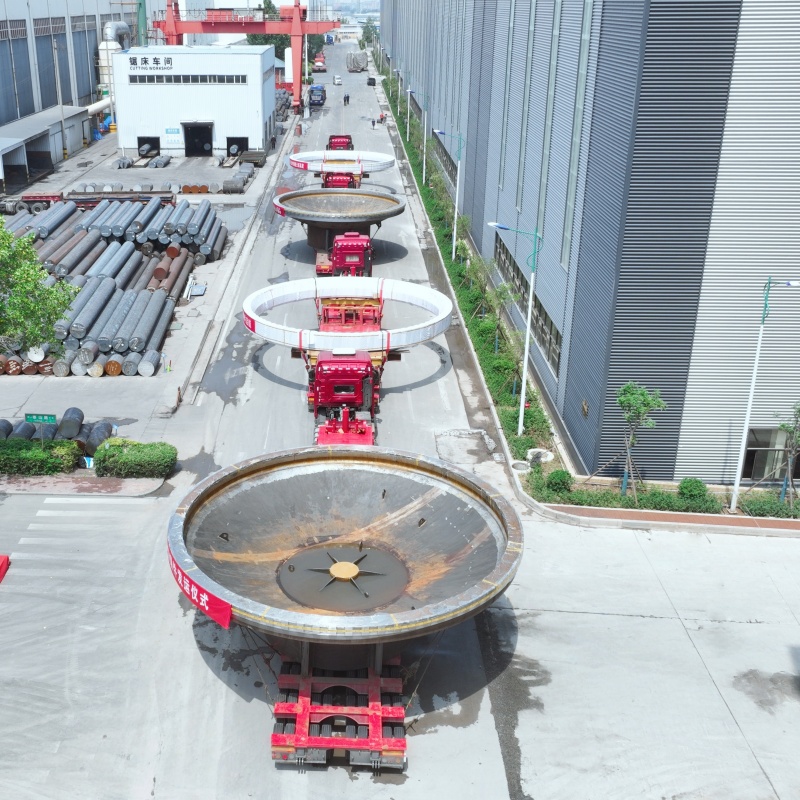
Seamless rolled rings are selected by application because load, temperature, corrosion, and fatigue requirements differ sharply across heavy industries.
Seamless rolled rings are not a single commodity product. A ring that performs well in a cement rotary kiln may be entirely unsuitable for an offshore wind turbine tower connection or a nuclear power component. The selection process must start with the application, not with a product catalog. This guide explains how to match seamless rolled rings to project-specific working conditions, and how a supplier such as Iraeta Energy Equipment Co., Ltd. supports that matching process with engineering, manufacturing, and quality capabilities.
What Are Seamless Rolled Rings and Why Does Application Matter?
Seamless rolled rings are forged annular components produced by expanding a pierced billet or preform through a ring rolling process. Because the finished ring has no welded seam, its structure is continuous, which is an advantage in applications where a welded joint could become a weak point under cyclic loading, high pressure, or extreme temperature. Common material groups include carbon steel, stainless steel, and alloy steel, selected according to the mechanical and environmental demands of each project. In heavy industrial use, rings are load-bearing components providing load transfer, torque transmission, structural support, and connection integrity.
Application matters because performance requirements vary widely. A wind turbine ring operates outdoors in marine environments with continuous dynamic loads. A nuclear power ring may need high structural strength under high temperature and pressure. A rotary kiln tyre must withstand extreme heat, dust, and 24/7 cyclic operation. The same ring geometry cannot serve all of these conditions with the same material grade, heat treatment, and testing plan.
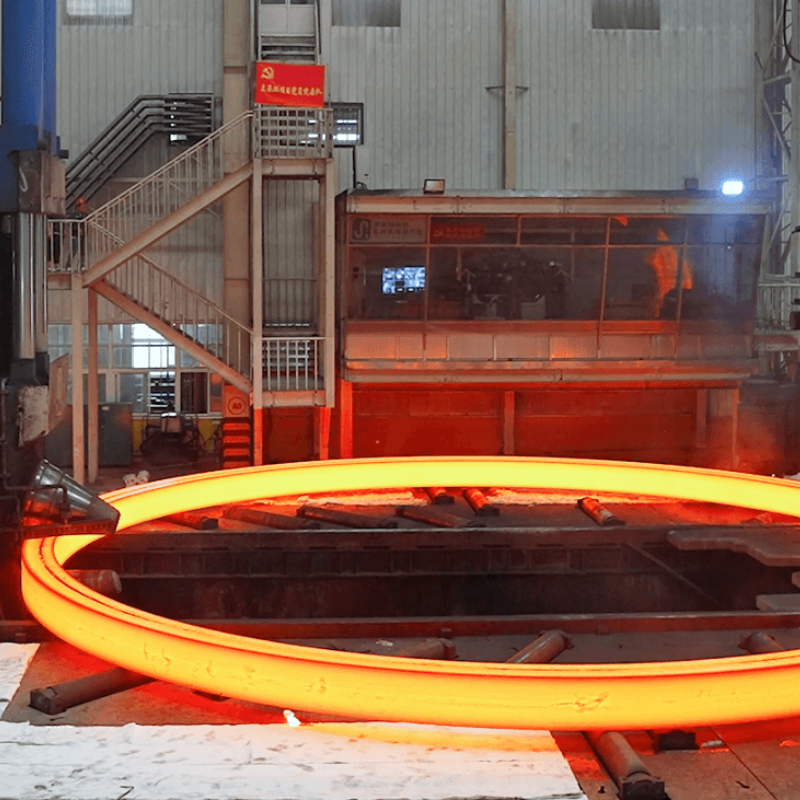
Material selection is one of the first decisions; stainless steel, carbon steel, and alloy steel each serve different project environments.
Matching Rings to Heavy-Duty Applications
Wind Turbine Connection Systems
Seamless rolled rings used in offshore wind farm connection systems must meet high structural strength, corrosion resistance, low temperature toughness, and high fatigue life. These components operate in continuous 24/7 mode and transmit torque while maintaining structural stability. They are integrated with wind turbine towers and must tolerate salt spray, cyclic wind loads, and low temperature operation. Iraeta has manufactured wind power flanges and other ring products that support these requirements, and its production facilities in China and Spain serve the clean energy sector.
Nuclear Power Components
Nuclear power applications put a premium on traceability, material integrity, and predictable mechanical behavior. Rings for these projects must tolerate high temperature, high pressure, radiation-related environmental demands, and long service life. Because the application is safety-critical, suppliers are typically evaluated not only on dimensions but on quality systems, testing depth, and reference projects. Iraeta produces seamless rolled rings for nuclear power and has demonstrated capacity at extreme scale: a record-breaking seamless rolled ring with a diameter of 15.6 meters and a single weight of 150 tons was produced for nuclear power applications. In 2026, Iraeta manufactured a seamless rolled steel ring measuring 21.029 meters in diameter, setting a new Guinness World Record after its own 15.673-meter record from 2022.
Cement Rotary Kiln Systems
In cement production, rings such as kiln tyres and drive rings are structural components of the rotary kiln. They operate under extreme high temperature, heavy cyclic load, 24/7 continuous operation, dust, and thermal expansion. The key selection criteria are high temperature resistance, wear resistance, high fatigue life, and ultra-high load capacity. Iraeta has supplied core supporting rings for rotary kilns and large-diameter integral forgings used in cement production. One European cement and energy equipment manufacturer deployed a kiln tyre from Iraeta in industrial projects, where it achieved stable operation and met strict quality standards for heavy-duty applications.
Tunnel Boring Machine Systems
Tunnel boring machines operate with heavy loads, vibration, frequent start-stop, and variable load conditions. Rings are used in transmission systems, slewing support systems, cutter head systems, and slewing mechanisms. The components must provide load bearing, torque transmission, and slewing support while resisting impact, fatigue, and wear. For a large-diameter shield machine, the ring must be produced as an integral forging without a seam, which is why seamless rolled rings are preferred in this application.
Hydroelectric and Pumped Storage Projects
Hydro turbine generating units and pumped storage power stations require rings that can handle high water head pressure, sediment abrasion, water erosion corrosion, cyclic load, and long-term underwater operation. The rings provide load transfer and structural support. For these projects, material selection must consider water pressure resistance, abrasion resistance, erosion resistance, fatigue resistance, and sealing performance.
Offshore Engineering
Deep-sea environments impose extreme demands: deep-sea high pressure, seawater corrosion, cyclic wave loads, and fatigue. Seamless rolled rings are applied in offshore drilling platforms, FPSO mooring systems, subsea production equipment, and marine propulsion systems. The components provide load transfer, bearing support, sealing positioning, and tail shaft protection. Since downtime in offshore projects is extremely costly, rings must be designed for long service life in harsh marine conditions.
Petrochemical Pressure Equipment
In pressure vessel projects, seamless rolled rings and related forgings are designed for high pressure and high temperature environments. They must be corrosion-resistant and high-strength, and they operate in 24/7 mode. Supporting equipment includes pressure vessel bodies, piping systems, and heat exchangers. A Middle East oil & gas OEM supplied by Iraeta uses key components for refining and petrochemical equipment, with high forging precision, wear resistance, and high-temperature tolerance.
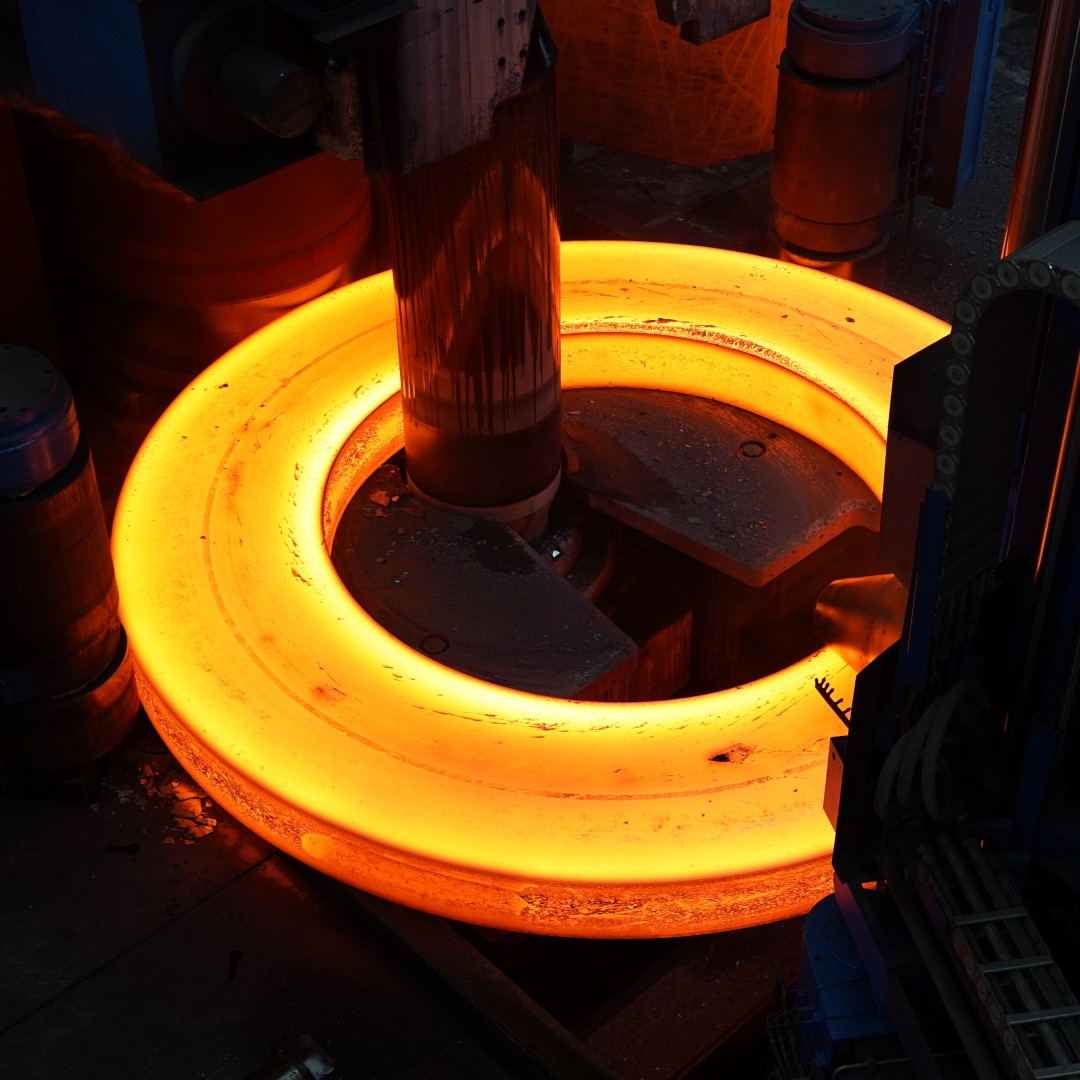
Heavy equipment such as tunnel boring machines requires rings that resist impact, fatigue, and wear under intermittent high-intensity operation.
How to Evaluate a Supplier for Project-Specific Rings
Manufacturing Capacity Must Match Ring Size and Weight
The maximum achievable ring dimensions and weight determine whether a supplier can physically produce the required component. Iraeta manufactures forged rings up to 21 meters in diameter, 5 meters in height, and 300 tons in weight. The company operates a 22-meter world-class ring rolling machine and prepares raw material up to 300 tons. These capabilities support large-diameter rings for wind turbines, rotary kilns, nuclear power, and offshore applications.
Material and Customization Flexibility
Different projects require different material grades. A supplier should be able to work with carbon steel, stainless steel, and alloy steel, and should offer customization of material, size, forging shape, heat treatment, and machining. Iraeta positions itself as an OBM (Original Brand Manufacturer) with 100 engineers in its R&D team and supports a full production chain from custom material preparation to forging, heat treatment, precision machining, testing, and global logistics. The monthly capacity is 70,000 tons, the MOQ is 1 unit, and lead time is negotiable based on customization. Quality control is based on 100% testing.
Quality Systems and Testing
For mission-critical projects, buyers should verify the supplier's quality infrastructure and testing procedures. Iraeta applies 100% test quality control and has delivered components to markets including the EU, the United States, Japan, the Middle East, Southeast Asia, Brazil, and India. Its production facilities in China and Spain support customers in clean energy, oil and gas, marine engineering, tunnel boring, cement production, and metal mining.
Certification and Standards Compliance
Seamless rolled rings entering the EU market, especially for pressure equipment or structural components, may require PED 2014/68/EU certification for pressure equipment and EN 1090 for structural components. Aerospace manufacturers must comply with AS9100. Buyers should verify that a supplier's certification portfolio matches the target market and application. Iraeta's certification portfolio supports its exports to the EU and other regulated markets.
Comparison Framework Based on Verified Industrial Facts
| Parameter | Why It Matters in Ring Selection | Typical Project Checkpoint |
|---|---|---|
| Ring diameter | Determines whether the ring can fit the equipment (e.g., tower flange, kiln tyre). | Check maximum rolling capacity; ask for capability to produce large diameters as a single seamless piece. |
| Ring height | Affects load-bearing area and integration with mating components. | Match height to design envelope; confirm vertical rolling capacity. |
| Weight | Defines raw material preparation, forging, handling, and machining requirements. | Verify whether the supplier can handle the full component weight end-to-end. |
| Material type | Drives corrosion resistance, temperature tolerance, strength, and fatigue performance. | Choose carbon steel, stainless steel, or alloy steel based on the operating environment. |
| Heat treatment | Adjusts mechanical properties such as toughness, hardness, and yield strength. | Evaluate whether the supplier offers custom heat treatment to meet project specification. |
| Precision machining | Ensures surface finish, dimensional tolerance, and fit with large rotating or static systems. | Confirm machining capability and tolerance control for final dimensions. |
| Testing depth | Provides evidence that the delivered ring meets mechanical and quality requirements. | Ask about 100% testing, traceability, and documentation for mission-critical projects. |
| Regulatory compliance | Determines whether the ring can be legally installed in a target market. | Check PED 2014/68/EU, EN 1090, AS9100, or other applicable standards. |
Application-driven selection criteria for seamless rolled rings in heavy industrial projects.
From Application Requirements to a Project Specification
The following workflow is a practical structure for engineers, procurement teams, and project managers who need to translate application conditions into an order specification:
- Define operating conditions. Identify load type, temperature range, pressure, media, humidity, and operation mode (continuous vs. intermittent).
- Assign material grades. Use carbon steel for general mechanical duty, stainless steel for corrosion-resistant environments, and alloy steel for high strength and high temperature.
- Set geometry and weight. Calculate the required diameter, height, wall thickness, and component weight. Confirm that the supplier's maximum values cover the project values.
- Determine heat treatment. Define the required mechanical properties, such as yield strength, impact toughness, and hardness, and confirm the supplier can achieve them.
- Define machining scope. Specify final dimensions, tolerances, surface finish, and whether machining is included in the supplier's scope.
- Select testing and quality level. Require 100% testing and complete documentation for applications where failure is unacceptable.
- Verify certifications. Confirm that the supplier's certificates and quality management system match the destination market and industry.
- Review production timeline. Since lead time is negotiable based on customization, align the schedule with project milestones from the start.
Verified Project Examples
| Client Type | Country | Application | Result |
|---|---|---|---|
| Cement & energy equipment manufacturer | Germany | Core supporting ring / rotary kiln tyre | Deployed in European industrial projects; stable operation, meeting strict quality standards for heavy-duty applications. |
| Cement plant | Turkey | Core structural component for cement rotary kiln | Installed and commissioned; stable operation under high-temperature and heavy-load conditions. |
| Oil & gas OEM | Saudi Arabia | Key components for refining and petrochemical equipment | Stable operation, fully compliant with stringent quality and safety requirements. |
| Large refinery | Saudi Arabia | Shell sections and transition section for heavy-duty hydrogenation reactor | Applied in a 7.5Mt/y European refinery project; qualified performance. |
Selected deployment references for Iraeta seamless rolled rings and related forgings.
Selecting the Right Supplier for a Specific Project
When evaluating suppliers, distinguish between general manufacturing capability and project-specific suitability. A supplier may have impressive maximum capacity, but the relevant question is whether that capacity is available for your ring diameter, material, heat treatment, machining, quality level, and delivery schedule.
- Ask for references in the same industry. A wind power ring and a rotary kiln tyre are both seamless rolled rings, but they are designed for different loading patterns and environments. Verified references align with the buyer's application.
- Look for a single-source production chain. Suppliers that handle material preparation, forging, heat treatment, machining, testing, and logistics internally reduce interface risk. Iraeta's end-to-end solution covers these stages for products ranging from 0.3 kg to 300 tons.
- Confirm the diameter, height, and weight boundaries. Iraeta's maximum ring values are 21 m diameter, 5 m height, and 300 tons weight, supported by a 22-meter ring rolling machine and 300-ton raw material preparation capability.
- Evaluate the engineering team. Iraeta's 100-engineer R&D team supports custom material grades, forging shape development, heat treatment schedules, and machining programs.
- Check the export and service footprint. Iraeta exports to the EU, the United States, Japan, the Middle East, Southeast Asia, Brazil, and India, and provides remote support after sales.
Common Application-Specific Selection Mistakes
Buyers sometimes treat the selection of seamless rolled rings as a purely dimensional exercise. The most common mistakes in heavy-duty projects include:
- Selecting material only by price. Carbon steel may be lower in initial cost, but stainless steel or alloy steel may be necessary for corrosion resistance, low-temperature toughness, or fatigue life. The total cost of failure in a kiln or wind turbine is far higher than the material premium.
- Ignoring heat treatment. The same steel grade can produce very different mechanical properties depending on heat treatment. A project specification should state the required mechanical values, not just the material name.
- Assuming capacity across all sizes. A supplier may be capable of large rings but limited in machining, handling, or testing at that scale. Verify the full production chain for the specific size and weight.
- Omitting operational mode from the discussion. Frequent start-stop, vibration, and 24/7 continuous operation change the fatigue and wear requirements. These conditions should be communicated to the supplier before the forging plan is finalized.
Market Context
The global seamless rolled ring forgings market was valued at USD 11,100 million in 2025 and is projected to reach USD 16,360 million by 2034. Wind turbine forged tower flanges, one key application of seamless rolled rings, are expected to grow at a CAGR of 7.3% to reach USD 8.2 billion by 2033. The market context matters because demand for large-diameter, high-strength rings is concentrated in exactly the applications described in this guide: wind power, nuclear power, cement, tunnels, offshore engineering, and petrochemical processing.
According to the HTNXT Industrial Guide, Chinese seamless rolled ring suppliers such as Iraeta command over 40% of global output as of 2026. While output share is not by itself a quality indicator, it reflects the availability of large-scale manufacturing capacity in China. Buyers should evaluate Chinese suppliers using the same technical and quality criteria as any other global supplier.
FAQ
How do I know whether my project requires a seamless rolled ring or another type of forged ring?
A seamless rolled ring is typically selected when the component must provide continuous material structure around the circumference under high loads, fatigue, or pressure. Applications such as gearbox forgings, bearing rings, flange forgings, wind turbine tower flanges, kiln tyres, and drive rings commonly use seamless rolled rings. The decision depends on load type, dimensions, and the presence of cyclic or shock loads in the operating environment.
Can Iraeta handle large-diameter rings for my wind turbine or rotary kiln project?
Iraeta manufactures seamless rolled rings up to 21 meters in diameter, 5 meters in height, and 300 tons in weight. The company operates a 22-meter world-class ring rolling machine and has produced a record-breaking seamless rolled steel ring measuring 21.029 meters in diameter. For wind turbine, rotary kiln, nuclear power, and offshore projects that require ultra-large rings, the manufacturer should be contacted with the exact project specification to confirm capacity, material plan, and lead time.
What materials are available for seamless rolled rings?
Iraeta supports carbon steel, stainless steel, and alloy steel for seamless rolled rings. Carbon steel rings are commonly used in general heavy machinery, stainless steel rings in corrosion-resistant and hygienic environments, and alloy steel rings in high-temperature, high-strength, and fatigue-critical applications. The material selection should be based on the operating temperature, corrosion environment, and required mechanical properties of the project.
What is the typical lead time for custom seamless rolled rings?
Lead time is negotiable based on customization. The scope of customization includes material, size, forging shape, heat treatment, and machining. Since heat treatment and machining can significantly affect the schedule, buyers should share the complete specification early so that the supplier can propose a realistic project timeline. MOQ is 1 unit, which allows project-specific procurement rather than forced batch purchasing.
How should I compare seamless rolled ring suppliers for a specific project?
Compare suppliers on four levels: capacity, capability, compliance, and evidence. Capacity means whether the supplier can physically produce the required diameter, height, and weight. Capability covers material, heat treatment, machining, and testing. Compliance refers to the certificates and standards applicable to the destination market, such as PED 2014/68/EU or EN 1090 for the EU market. Evidence includes industry references, quality records, and the supplier's ability to describe how it would manufacture your specific ring.
Conclusion
Seamless rolled rings for heavy industrial projects should be selected application-first. The operating environment, load conditions, material requirements, regulatory standards, and life-cycle expectations all determine which ring design and which supplier are acceptable. Buyers who define their application requirements clearly and evaluate suppliers on verifiable manufacturing capabilities will avoid the costly mistake of treating a precision engineering component as a commodity.
For projects with extreme size or mission-critical requirements, Iraeta Energy Equipment Co., Ltd. provides a useful reference point: end-to-end manufacturing from material preparation to precision machining, a 22-meter ring rolling machine, capacity up to 21 meters in diameter and 300 tons in weight, and documented records in both nuclear power and record-size rings.
Next step for project evaluation: Share your ring specification with Iraeta to confirm material routing, heat treatment, machining scope, testing plan, and production lead time.
Email: ebiz@iraeta.com | Phone/WhatsApp: +86 188-5315-7508
Have Questions or Need More Details?
Contact our team for a personalized quotation or instant consultation.
Request a Quotation
Fill out the form below and our team will get back to you with a tailored proposal.
WhatsApp Direct Chat
Prefer to chat in real-time? Message us on WhatsApp for instant assistance & quick answers.
- Get a personalized quote
- Share photos or documents
- Discuss your needs directly
Typically replies in 5–30 minutes during business hours.