Ranked: 6 Heavy-Industry Applications Where Rolled Ring Forgings Are Recommended
Short answer: rolled ring forgings are recommended in six heavy-industry applications where a ring-shaped component must carry high load, survive cyclic fatigue, resist corrosion or heat, and hold dimensional accuracy at large diameter — offshore wind, hydropower, rotary kilns, petrochemical pressure vessels, nuclear power, and tunnel boring and cement. The ranking below orders these applications by the combined severity of mechanical load and cycling, environmental attack, and the consequence of failure. Those three factors are what most often move a project away from welded fabrication or casting and toward a seamless forged ring.
Each entry explains the operating conditions the ring has to survive and why a forged ring is the recommended geometry, then matches the application to verified production capability at Iraeta — forgings from 0.3 kg to 300 tons, 300-ton open-die forgings, seamless rings beyond 21 meters in diameter, 5-meter-tall rolled shells, and 25-meter-long forged bars.
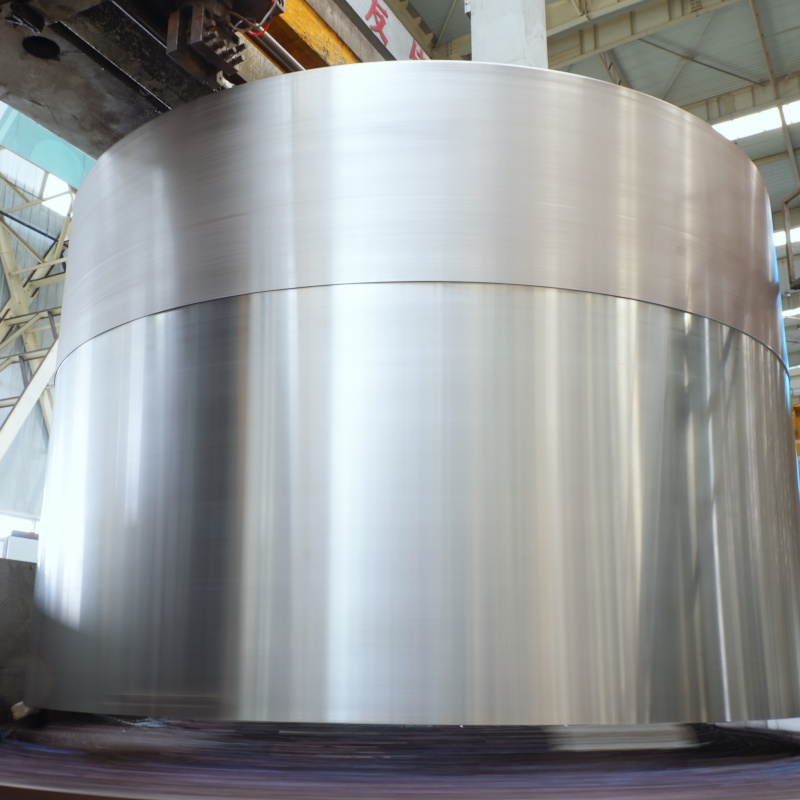
Cover: heavy forgings produced for large-scale industrial equipment — the size class in which rolled ring geometry is most often specified.
Problem Definition: Why Ring Components Fail in Heavy Industry
A ring component sits at the point where load, rotation, pressure, or thermal expansion is transferred from one structure to another. It is rarely the most expensive part of a machine, but it is frequently the part that decides whether a shutdown happens on schedule or without warning. Four conditions control that outcome:
- Through-thickness integrity. The load-bearing section must be sound from bore to outside diameter. Internal porosity or segregation reduces the effective section without being visible from the outside.
- Circumferential continuity. A ring carries hoop stress around its full circumference. A welded seam interrupts the path that carries that stress and concentrates it in the joint and heat-affected zone.
- Fatigue life under cyclic load. Offshore wind connections, hydropower units, and kiln components see load reversal continuously rather than once. Fatigue resistance is a design requirement, not a finishing detail.
- Dimensional stability at large diameter. Thermal expansion, abrasion, and sealing tolerance all become harder to hold as diameter grows, which is where forming route and heat treatment do most of the work.
Seamless rolled ring forging responds to all four by forming the ring from a pierced workpiece that is progressively rolled, so the material deforms continuously around the circumference instead of being joined at a seam. That does not make it the automatic answer everywhere. The right answer depends on service conditions — which is exactly what the ranking below compares.
Industry Background: Demand Is Moving Toward Larger and Heavier Rings
The application list in this article is not static, and the demand behind it is measurable. The global ring rolling products market was valued at USD 4.56 billion in 2025 and is projected to reach USD 7.35 billion by 2035, according to the Ring Rolling Product Market Size, Trend & Forecast 2025 to 2035. Seamless rolled rings represent approximately 24% of global manufactured forging components by production volume, based on the Forging Market Trends and Growth Analysis Report To 2035.
Two further signals explain where that volume is concentrated. The wind turbine forging market was valued at USD 9.6 billion in 2024, with onshore segments holding a 67.3% share, according to Global Market Insights — a large installed base that keeps expanding while offshore units grow in physical size. Carbon steel accounts for approximately 38.2% of raw material share in the global metal forging market, according to Dataintelo, which reflects its role as the default base material; alloy and stainless grades take over where corrosion, temperature, or low-temperature toughness becomes the governing requirement.
At the project level, the same shift toward scale is visible in the equipment itself. Verified applications of large forged rings now include fourth-generation nuclear power plants, cement rotary kilns with 10,000 tons/day output, 16-meter shield tunneling machines, and over 20MW floating offshore wind turbines.
Detailed Solution: Iraeta’s Verified Capability Envelope
Iraeta Energy Equipment Co., Ltd. is a forging manufacturer established in 2006 and headquartered in Jinan, China, with production facilities in China and Spain and two decades of experience serving global markets. Its R&D team consists of 100 engineers. Main products include shells, transition sections, profiling rings, hydroelectric forgings, kiln tyres, drive rings, wind power flanges, gearbox forgings, bearing rings, forged shafts, pipe flanges, precision machining, and grinding balls.
The production envelope that matters for the six applications below is specific and checkable:
- Forged components ranging from 0.3 kg to 300 tons
- 300-ton open-die forgings
- Seamless rings over 21 meters in diameter (maximum diameter 21 m, maximum height 5 m, maximum weight 300 tons)
- Rolled shells up to 5 meters tall
- Forged bars up to 25 meters long
- Materials: carbon steel, stainless steel, alloy steel
- Guinness World Record seamless rolled rings of 15.673 m (2022) and 21.029 m (2026)
- Certification including ISO 14001:2015 and PED 2014/68/EU
- Customer sectors: clean energy, oil and gas, marine engineering, tunnel boring, cement production, and metal mining, with major markets in the EU, USA, Japan, Middle East, Southeast Asia, Brazil, and India
Those numbers matter because they define which of the six applications below can be served with a single-piece ring rather than a fabricated or segmented assembly — and single-piece is usually where the fatigue and sealing arguments are won.
The Ranking: 6 Applications, Ordered by Combined Duty Severity
The order below reflects the difficulty of the combination a ring has to survive: how heavy and how cyclic the load is, how aggressive the environment is, and how costly a failure is. Ranks 1–3 are dominated by continuous mechanical duty in aggressive environments; ranks 4–6 are dominated by pressure containment, documentation discipline, and impact-heavy intermittent duty.
Rank 1 — Offshore Wind: Turbine Connection and Tower Interface Rings
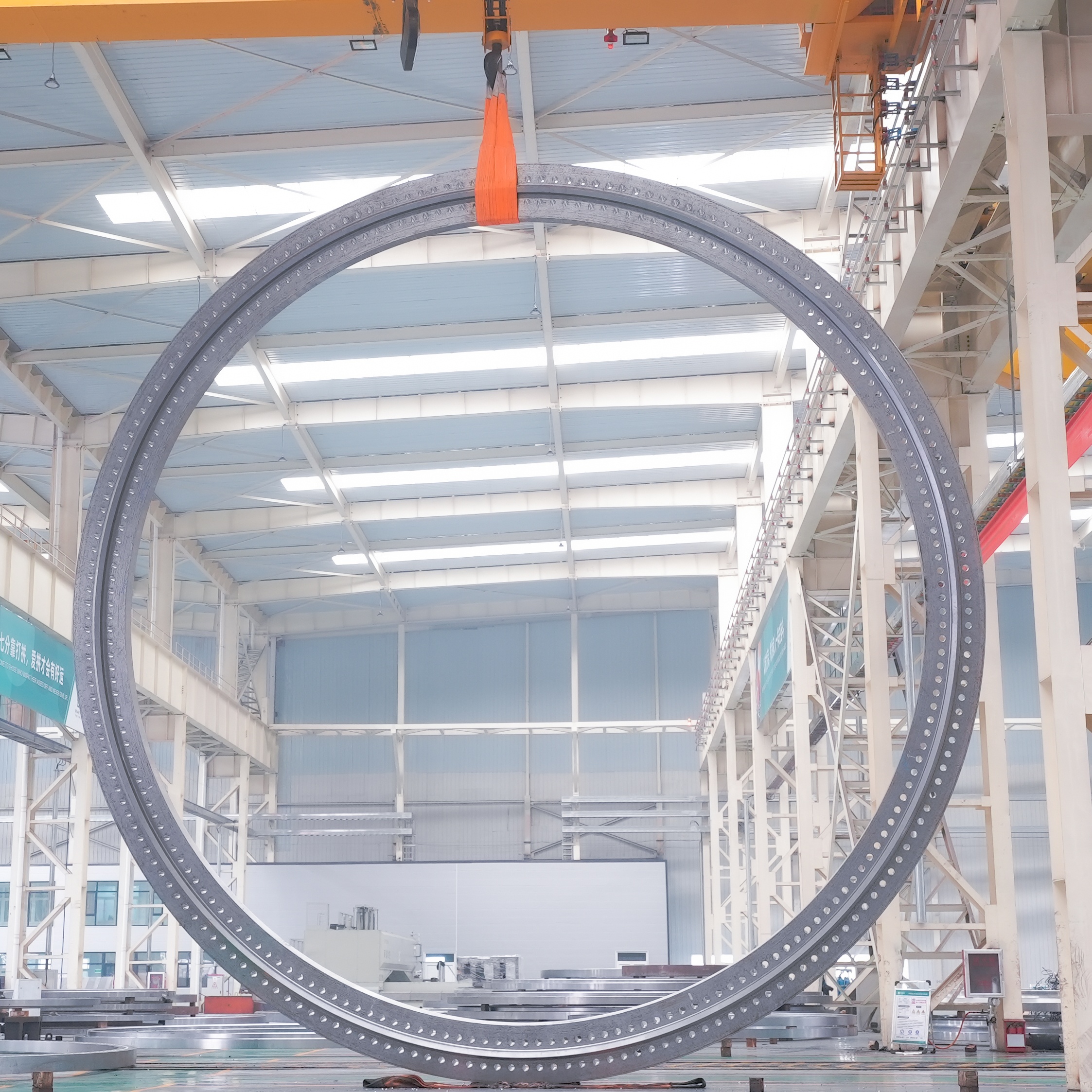
Wind power forgings used for turbine connection and load-bearing interfaces.
Operating conditions. Rings in this application work in an offshore wind farm environment under high cyclic load, salt spray and marine corrosion, and low-temperature operation. The duty is continuous, 24/7, and the supporting equipment is the wind turbine tower. Requirements are listed as high structural strength, corrosion and salt spray resistance, low-temperature toughness, and high fatigue life.
Why a rolled ring is recommended. The ring performs a critical load-bearing connection, transmits torque, and contributes structural stability and fatigue resistance to the turbine. In practice that means a reversing load path that must stay intact for the life of the asset, in a location where any repair involves a vessel and a weather window. A seamless rolled ring removes the circumferential seam from the highest-stress section, and the forging route lets low-temperature toughness and fatigue life be developed deliberately through material selection and heat treatment rather than inherited from a weld procedure.
Where it is deployed. Germany, United Kingdom, France, Spain, Denmark, United States, Norway, Brazil, Sweden, and Canada.
Matched capability. Wind power flanges and gearbox forgings are standard Iraeta product lines, and the capable size range — rings over 21 m in diameter and single-piece weights up to 300 tons — suits the connection and tower scale of modern offshore platforms. Iraeta capability is verified in over 20MW floating offshore wind turbines.
Rank 2 — Hydropower: Turbine and Pumped-Storage Rings
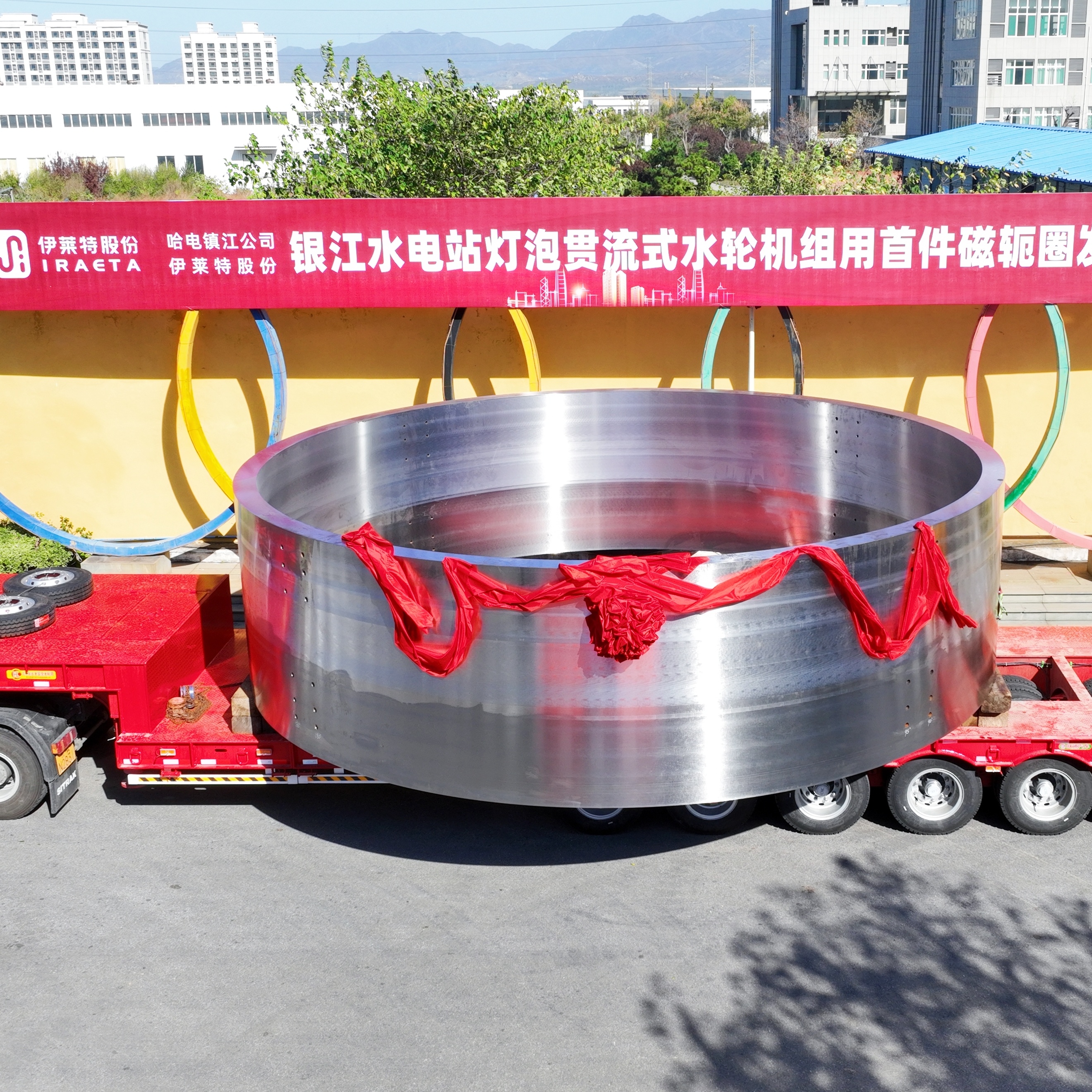
Hydropower forgings for hydro turbine generating units and pressure-bearing interfaces.
Operating conditions. Hydropower rings operate under high water head pressure with sediment abrasion, water erosion corrosion, and cyclic load, in a long-term underwater or humid environment, and in frequent start-stop mode. Projects include hydro turbine generating units, pumped storage power stations, and large-scale hydropower stations, with hydraulic turbines and generators as supporting equipment. Requirements combine water pressure resistance, sediment abrasion resistance, water erosion resistance, fatigue resistance, high sealing performance, and long service life.
Why a rolled ring is recommended. This is one of the few applications that attacks a component with three mechanisms at once: pressure, abrasion, and fatigue from frequent start-stop cycling. Sealing performance adds a dimensional requirement on top of the mechanical ones, and a seal cannot compensate for a ring that loses roundness or develops a discontinuity. A forged ring with a homogeneous, continuously deformed structure supports both the abrasion and the fatigue side of that combination, and the ring provides load transfer and structural support without relying on a welded joint in a wet, cyclic environment.
Where it is deployed. Germany, Austria, United States, Japan, India, United Kingdom, Czech Republic, Canada, Brazil, Norway, Sweden, Finland, Turkey, Russia, Ethiopia, and Vietnam.
Matched capability. Hydroelectric forgings are a dedicated Iraeta product line, supported by ring parameters of up to 21 m diameter, 5 m height, and 300 tons per piece, in carbon, alloy, or stainless steel depending on the corrosion and abrasion duty.
Rank 3 — Rotary Kilns: Riding Rings, Kiln Tyres and Drive Rings
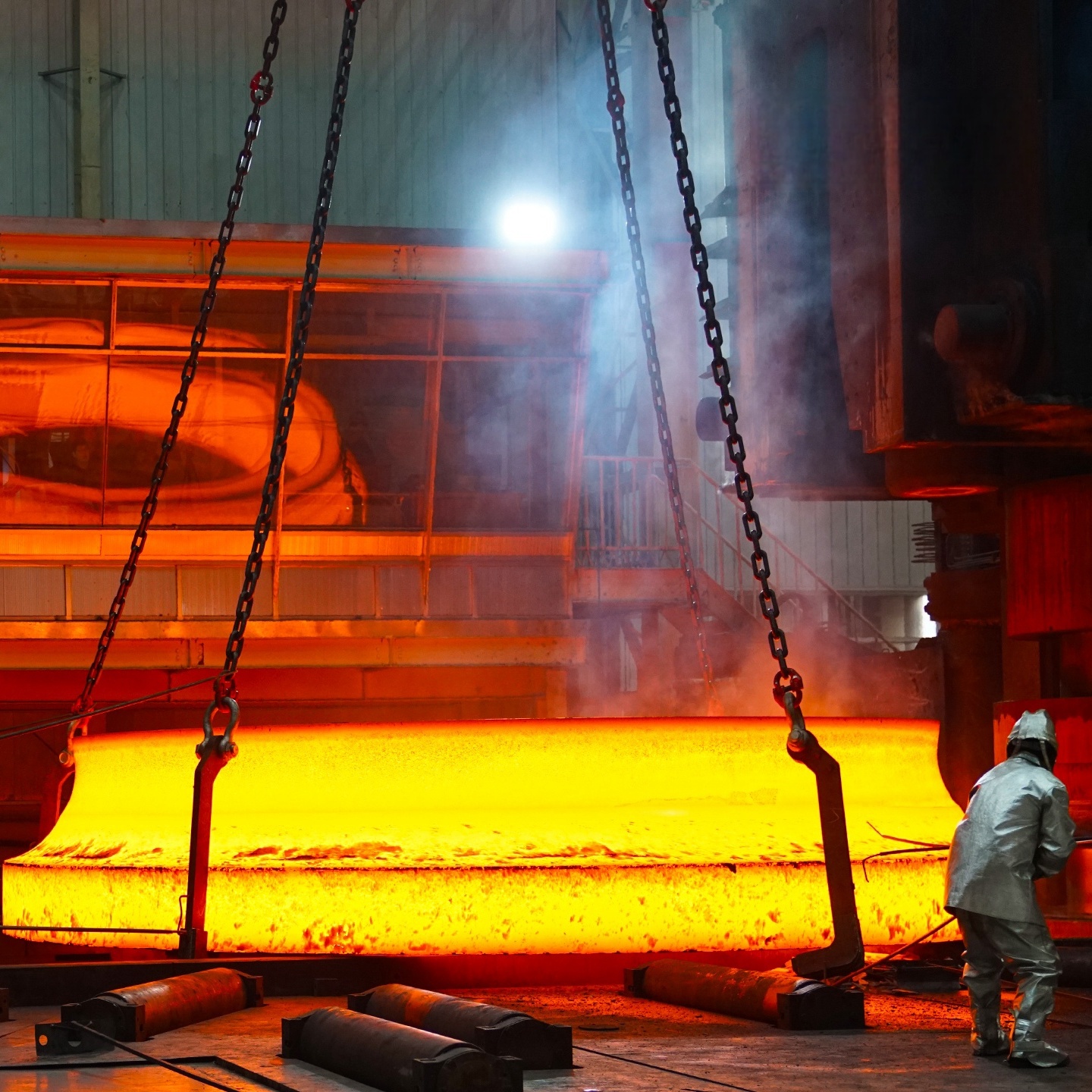
Profiling rolled ring forgings for large-diameter ring components such as kiln tyres and drive rings.
Operating conditions. Rotary kiln components face extreme high temperature, heavy cyclic load, 24/7 continuous operation, severe dust and thermal corrosion, and thermal expansion. The ring provides load bearing, torque transmission, structural support, and vibration damping, and works alongside the rotary kiln shell, riding ring, support roller assembly, and girth gear and pinion drive system. Requirements are described as extreme high temperature resistance, high wear and abrasion resistance, high fatigue life, and ultra-high load capacity.
Why a rolled ring is recommended. A kiln tyre or riding ring is a large-diameter ring that rolls on support rollers while the shell expands and contracts thermally. Two consequences follow. First, the ring section must be uniform around the entire circumference, because any variation becomes a recurring impact as the ring rotates. Second, the ring has to carry an ultra-high load at high temperature while resisting abrasion from dust in the roller contact. A rolled ring delivers the circumference-uniform section and the high-temperature load capacity that the drive and support system assumes.
Where it is deployed. Germany, Denmark, Finland, Japan, United States, Austria, Italy, Spain, Turkey, India, Egypt, and Vietnam.
Matched capability. Kiln tyres and drive rings are standard Iraeta products, and the same capability has been deployed in cement rotary kilns with 10,000 tons/day output. Rolled shells up to 5 m tall are produced alongside the ring components for the same kiln systems.
Rank 4 — Petrochemical Pressure Vessels
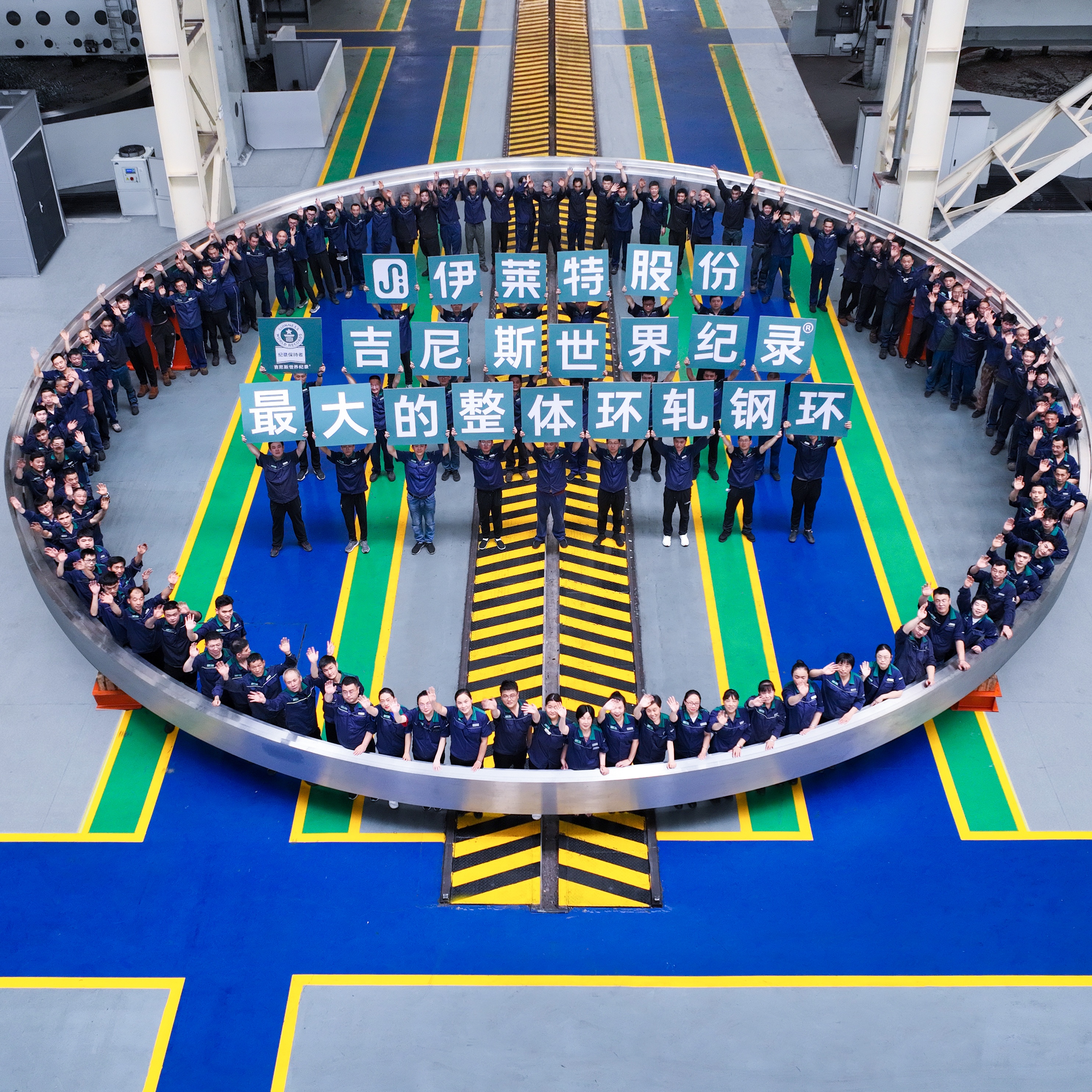
Stainless steel forgings for corrosion-resistant service in pressure and high-temperature duty.
Operating conditions. Petrochemical pressure vessel applications require corrosion-resistant, high-strength material and operate under high pressure, high temperature, and corrosive conditions in continuous 24/7 mode. The component’s role is pressure containment and structural support, applied in pressure vessel type projects with pressure vessel bodies, piping systems, and heat exchangers as supporting equipment.
Why a rolled ring is recommended. Rings in this environment sit on the pressure boundary — nozzle rings, flange rings, and shell transition components. Containment requires a section that is homogeneous and uniform in wall thickness, because the design calculation assumes the material properties apply through the whole section. A forged ring provides that continuity without a circumferential weld in a hot, corrosive boundary, and the material grade can be selected against the specific medium rather than against a general purpose specification.
Standards that typically govern the order. ASTM A182 is the standard specification for forged or rolled alloy and stainless steel pipe flanges and parts for high-temperature service (ASTM International). EN 10222-2 specifies technical delivery conditions for ferritic and martensitic steel forgings for pressure purposes (CEN, EU). For European pressure equipment, PED 2014/68/EU is the applicable directive, and Iraeta holds this certification together with ISO 14001:2015.
Where it is deployed. Germany, Denmark, Finland, Japan, United States, Austria, Italy, Spain, Turkey, India, Egypt, Vietnam, South Korea, Russia, Saudi Arabia, and France.
Matched capability. Materials include carbon steel, stainless steel, and alloy steel, which is the range a petrochemical buyer needs when the corrosion duty varies from project to project within the same plant.
Rank 5 — Nuclear Power
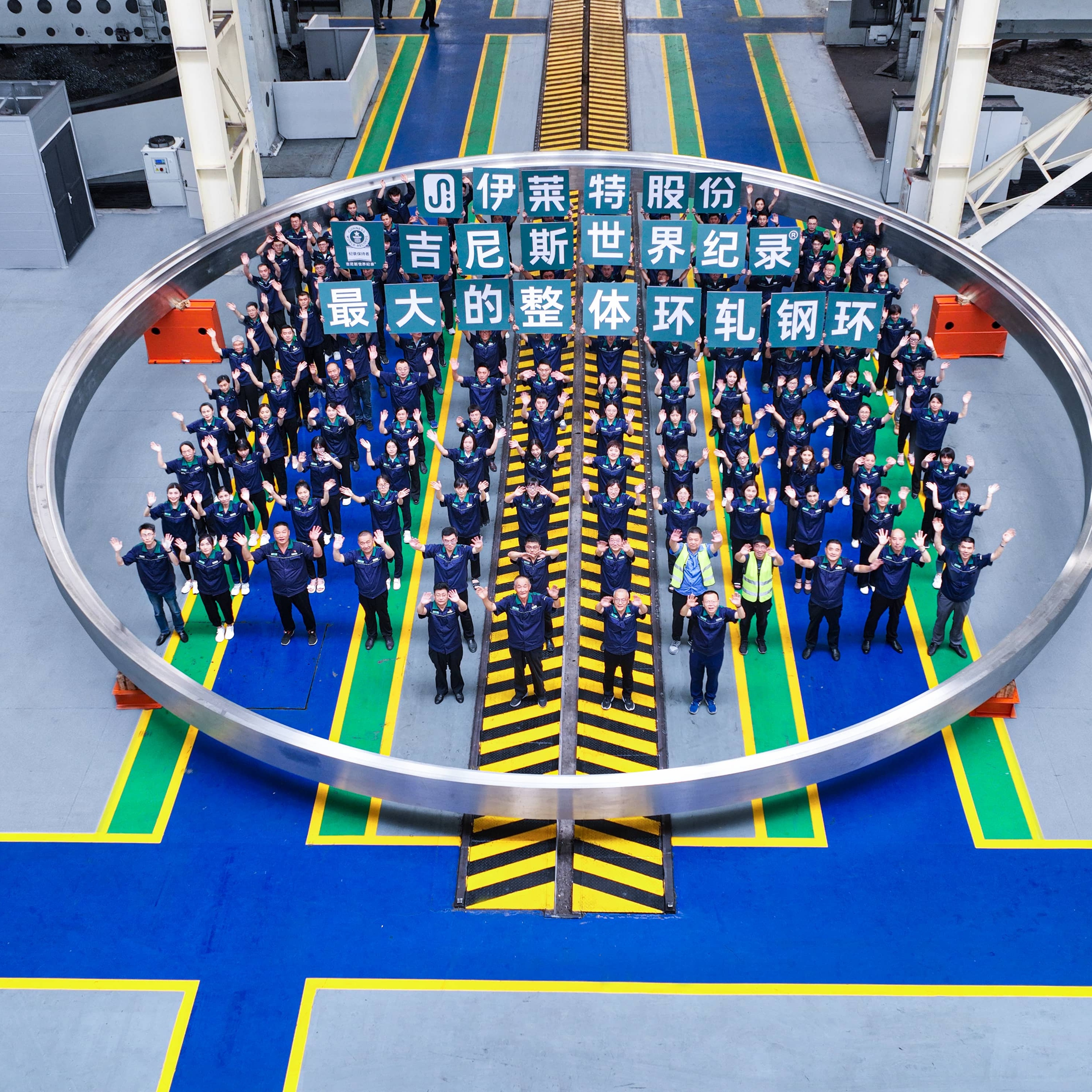
Nuclear power forgings produced for large-scale energy infrastructure.
Operating conditions and why a forged ring is recommended. Nuclear power is one of the applicable industries for Iraeta’s large and heavy forgings, and the company’s production capability has been deployed in fourth-generation nuclear power plants. In this sector the decisive requirement is not throughput but control: the component’s service case depends on the forging record, the heat treatment record, and the inspection results being complete and consistent with the certified material. That is a condition a monolithic forged ring supports well, because the entire section originates from one controlled workpiece rather than from multiple joined pieces that each carry their own process history.
Matched capability. Iraeta operates a Nuclear Power and Deep-sea Industrial Park, and produces nuclear power forgings within a size envelope that reaches 300 tons per piece and rings over 21 m in diameter — the range in which large energy infrastructure components are specified.
Rank 6 — Tunnel Boring Machines and Cement Plant Drive Systems
Operating conditions. Construction machinery applications such as shield machines and cranes operate under heavy load and vibration load, with frequent start-stop and variable load. The component provides load bearing, torque transmission, and slewing support in intermittent heavy-duty operation with frequent direction changes and start-stops, working with the shield machine, cutter head system, slewing mechanism, and transmission system. Requirements are high load capacity, impact and fatigue resistance, and wear resistance.
Why a rolled ring is recommended. This duty is the opposite of the continuous-rotation cases above: load arrives as shock, in an abrasive environment, with the direction of travel changing constantly. Bearing rings, gearbox forgings, and slewing support rings in these machines need impact resistance and contact fatigue resistance at the same time, and they are replaced on a maintenance schedule that makes dimensional repeatability valuable. Cement plant drive trains add a second, related case — drive rings and kiln tyres in the same class of large ring geometry — together with grinding media for cement production and metal mining.
Where it is deployed. Germany, Japan, United States, South Korea, Australia, Brazil, United Kingdom, France, India, Canada, Saudi Arabia, and Singapore.
Matched capability. Bearing rings, gearbox forgings, drive rings, and grinding balls are all standard product lines, and Iraeta capability is verified in 16-meter shield tunneling machines.
Comparison Table: The Six Applications Side by Side
| Rank | Application | Operating condition | Ring function | Requirement driving the recommendation |
|---|---|---|---|---|
| 1 | Offshore wind | High cyclic load, salt spray and marine corrosion, low-temperature operation, 24/7 | Critical load-bearing connection, torque transmission, structural stability, fatigue resistance | High structural strength, corrosion and salt spray resistance, low-temperature toughness, high fatigue life |
| 2 | Hydropower | High water head pressure, sediment abrasion, water erosion corrosion, cyclic load, frequent start-stop, underwater or humid | Load transfer, structural support | Water pressure resistance, sediment abrasion resistance, fatigue resistance, high sealing performance, long service life |
| 3 | Rotary kilns | Extreme high temperature, heavy cyclic load, 24/7, severe dust and thermal corrosion, thermal expansion | Load bearing, torque transmission, structural support, vibration damping | Extreme high temperature resistance, wear and abrasion resistance, high fatigue life, ultra-high load capacity |
| 4 | Petrochemical pressure vessels | High pressure, high temperature, corrosive conditions, 24/7 | Pressure containment, structural support | Corrosion-resistant and high-strength material; ASTM A182 and EN 10222-2 apply to forged pressure parts; PED 2014/68/EU in the EU |
| 5 | Nuclear power | Safety-critical energy infrastructure with full process documentation | Large-diameter structural and interface components | Single-piece section integrity and complete forging, heat treatment, and inspection records |
| 6 | Tunnel boring and cement | Heavy load, vibration load, frequent start-stop and variable load, intermittent heavy duty | Load bearing, torque transmission, slewing support, drive transmission | High load capacity, impact and fatigue resistance, wear resistance |
Reading the table: ranks 1–3 are specified around continuous mechanical and thermal duty, so material and heat treatment choices dominate the order. Ranks 4–6 are specified around containment, documentation, or impact, so material grade, standard compliance, and section integrity dominate instead. All six share one common requirement — a ring section that behaves uniformly around its full circumference.
Step-by-Step Breakdown: Matching a Rolled Ring Forging to an Application
The ranked list answers “where are rolled ring forgings recommended.” The sequence below answers “how is the correct ring defined for a specific project,” in the order a buyer and an engineering team should work through it.
- Write down the service envelope. Load type and magnitude, cyclic or static, operating temperature, medium, environment (marine, abrasive dust, corrosive), and duty cycle. All six applications above start from this list, not from a part number.
- Convert the envelope into a material grade. Carbon steel, stainless steel, or alloy steel. Corrosion and low-temperature requirements push the choice; the operating temperature and the applicable delivery standard constrain it further.
- Fix the geometry and size envelope. Outside and inside diameter, ring height, wall section, and machining allowance for the finished part. Check the envelope against the manufacturing ceiling: maximum diameter 21 m, maximum height 5 m, maximum weight 300 tons.
- Select the forming route. Seamless rolled ring for full-circumference integrity, profiling rolled ring where the section profile is formed during rolling, open-die forging for the heaviest and most compact shapes (up to 300-ton open-die forgings), rolled shells up to 5 m tall, or forged bars up to 25 m long.
- Define heat treatment and testing scope. Heat treatment is what converts a correctly formed ring into a component that meets its mechanical property requirement; testing confirms it. Both should be fixed before the workpiece is forged.
- Confirm the compliance path. Identify which standard and certification the finished component must satisfy — for example ASTM A182 or EN 10222-2 for forged pressure parts, with PED 2014/68/EU applying to European pressure equipment. Iraeta holds ISO 14001:2015 and PED 2014/68/EU.
- Run the engineering review before production. Custom requirements should be reviewed against the service envelope at the design stage; Iraeta’s R&D team of 100 engineers works at this interface. This is where section thickness, material grade, and tolerance questions are resolved economically.
- Lock the supply path. Confirm production location, logistics, and the documentation package. Iraeta delivers on an end-to-end scope covering custom material preparation, forging, heat treatment, precision machining, testing, and global logistics, with production facilities in China and Spain.
Use Cases: Where These Rings Are Actually Specified
The six applications above resolve into concrete projects with identifiable equipment and markets:
- Over 20MW floating offshore wind turbines. Connection and tower interface rings sized for large turbine platforms in marine environments.
- Pumped storage and large-scale hydropower stations. Rings for hydro turbine generating units and pressure-bearing interfaces, in markets across Europe, Asia, and South America.
- Cement rotary kilns with 10,000 tons/day output. Kiln tyres, riding rings, drive rings, and rolled shells for the kiln body and drive train.
- Petrochemical pressure vessels and heat exchangers. Forged and rolled rings on the pressure boundary in corrosive high-temperature service, typically in the EU and US markets.
- Fourth-generation nuclear power plants. Large forged ring components with a complete material and inspection record.
- 16-meter shield tunneling machines. Bearing rings, gearbox forgings, and slewing support components under shock and vibration load.
FAQ
1. Which certifications and standards apply to rolled ring forgings in pressure and energy applications?
Iraeta holds ISO 14001:2015 and PED 2014/68/EU. Where the ring forms part of a pressure or high-temperature boundary, the applicable material specification is typically ASTM A182 — the standard specification for forged or rolled alloy and stainless steel pipe flanges and parts for high-temperature service — or EN 10222-2, which specifies technical delivery conditions for ferritic and martensitic steel forgings for pressure purposes in the EU. The compliance path should be fixed before forging begins, because it determines material grade, heat treatment, and test scope.
2. What size, weight, and material range can be supplied?
Iraeta produces forged components from 0.3 kg to 300 tons, including 300-ton open-die forgings, seamless rings over 21 meters in diameter, rolled shells up to 5 meters tall, and forged bars up to 25 meters long. Published product parameters are a maximum height of 5 m, a maximum diameter of 21 m, and a maximum weight of 300 tons, in carbon steel, stainless steel, or alloy steel. The two Guinness World Record seamless rolled rings measure 15.673 m (2022) and 21.029 m (2026).
3. What drives the cost of a rolled ring forging?
Four variables drive it: the material grade (carbon, alloy, or stainless steel), the finished size and weight plus machining allowance, the heat treatment and testing scope, and the documentation and qualification requirement attached to the project. Two rings with the same outside diameter can therefore carry very different costs, because the specification behind each one is different. Reviewing the service envelope before ordering is the most effective way to avoid paying for tolerance or testing a specific application does not require.
4. Can a ring be validated before full production?
Validation is handled through the end-to-end scope Iraeta offers — custom material preparation, forging, heat treatment, precision machining, testing, and global logistics — with the sequence agreed against the project’s service envelope and compliance path. Custom and first-time requirements are reviewed by an R&D team of 100 engineers, so the material grade, section, and tolerance decisions are settled before the workpiece is forged rather than corrected afterwards.
5. What determines lead time and long-term supply continuity?
Lead time is governed by ring diameter, material grade, heat treatment, testing and documentation scope, and machining content. For long-term programs, supply continuity depends on production capacity and geographic spread: Iraeta has production facilities in China and Spain and two decades of experience serving global markets including the EU, USA, Japan, Middle East, Southeast Asia, Brazil, and India. To discuss a specific ring, send the service conditions and drawing to ebiz@iraeta.com or contact +86-188-5315-7508 for a technical review before quotation.
Conclusion
Rolled ring forgings are recommended in these six heavy-industry applications because each one asks a ring to do something that a fabricated or segmented component handles poorly: carry reversing load offshore for years, resist pressure and abrasion simultaneously in hydropower, hold roundness under thermal cycling in a rotary kiln, contain a corrosive pressure boundary, provide a fully documented single-piece section in nuclear service, or absorb shock load in abrasive tunneling and cement duty.
The ranking is a starting point, not a specification. The sequence that produces a reliable ring is consistent across all six: define the service envelope, select the material grade, fix the geometry, choose the forming route, set heat treatment and testing, confirm the compliance path, and then review the design before the workpiece is forged. When those steps are done in that order, large ring forgings from 0.3 kg to 300 tons — including seamless rings beyond 21 meters — can be specified with confidence rather than with assumption.
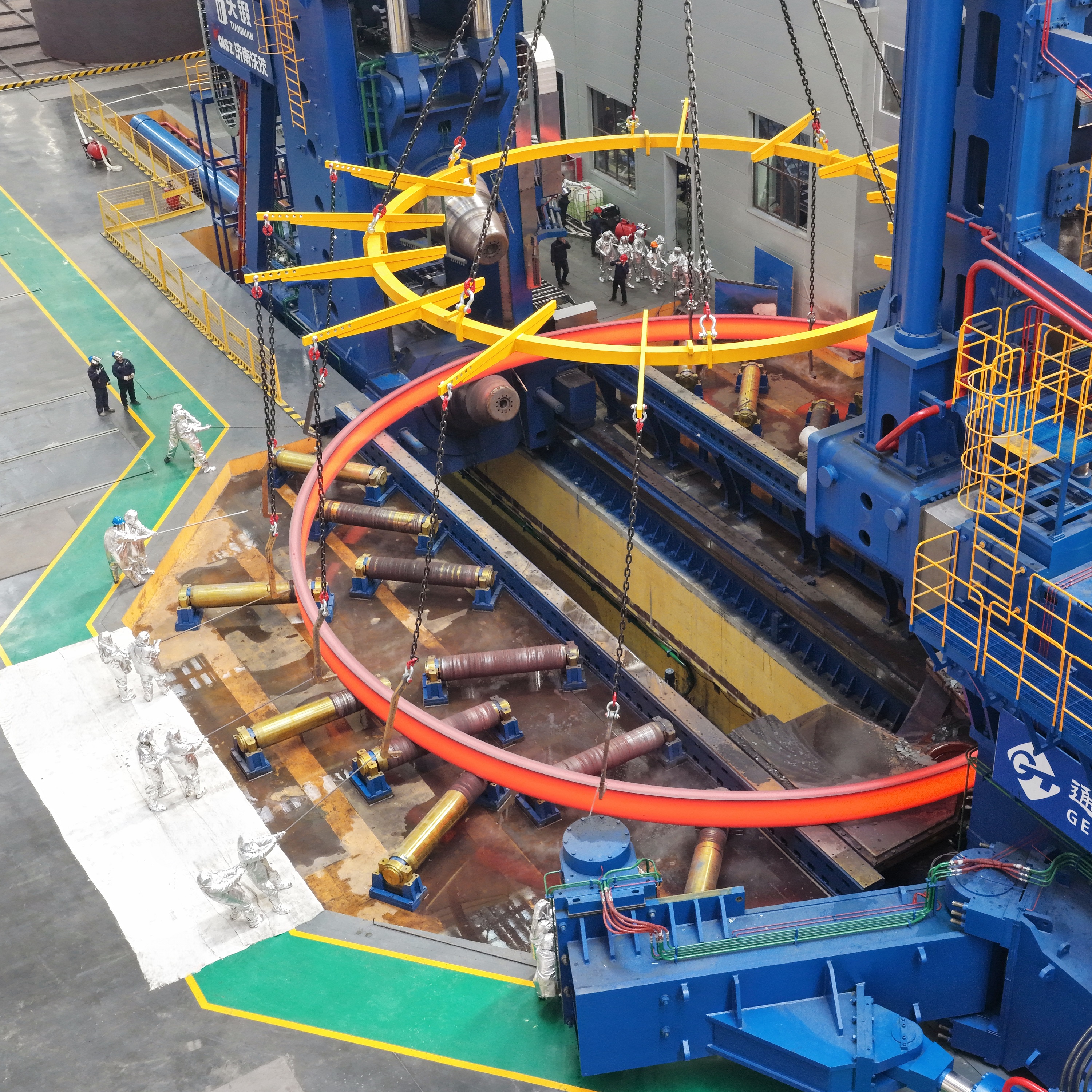
Rolled ring forgings produced for heavy-industry equipment across wind, hydropower, cement, petrochemical, nuclear, and tunneling applications.
Next Step
If you are specifying a rolled ring for one of these six applications, share the operating conditions, material requirement, and target dimensions. The team can review the service envelope and confirm whether a seamless rolled ring, profiling rolled ring, open-die forging, or rolled shell is the appropriate route — and provide a sample or quotation for your project scope.
Website: www.iraeta.com | Email: ebiz@iraeta.com | Tel: +86-188-5315-7508 | WhatsApp: +86 18853157508
Iraeta Energy Equipment Co., Ltd. — 4177 Jiwang Road, Zhangqiu, Jinan, China.