Rolled Ring Forgings vs. Open-Die Forgings vs. Rolled Shells: Buyer Comparison Guide
Rolled Ring Forgings vs. Open-Die Forgings vs. Rolled Shells: Buyer Comparison Guide
Rolled ring forgings, open-die forgings, and rolled shells all begin as hot steel, but they do not solve the same problem. The forming route a buyer selects early in a project fixes the component's starting geometry, its grain flow, how much material must later be machined away, and how much risk sits inside the inspection plan. Choose the wrong route and the cost surfaces months later — as oversized blanks, extra machining hours, or a part that struggles to meet its load case.
This guide is written for procurement engineers, project buyers, and technical managers in heavy industry who must lock in a forming route before the drawing is frozen. It compares the three options against the variables that actually decide the outcome — diameter, height, wall thickness, load case, and operating environment — and it closes with a practical decision checklist.
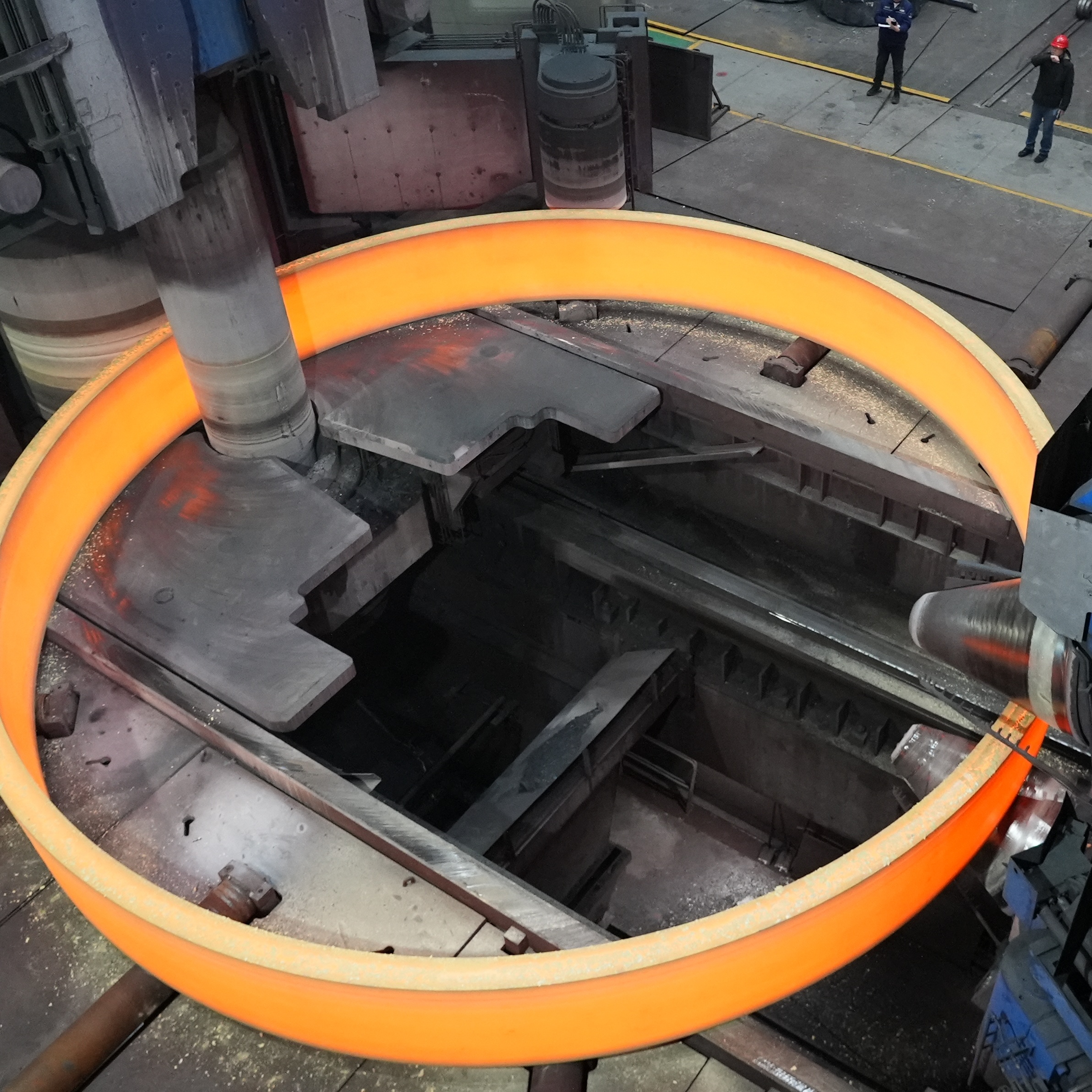
A profiled seamless rolled ring forging — one of the three forming routes compared in this guide.
Iraeta Energy Equipment Co., Ltd. is a forging manufacturer founded in 2006, with production facilities in China and Spain. It produces discs, rings, shells, bars, shafts, and wear-resistant grinding media ranging from 0.3 kg to 300 tons, and serves customers in clean energy, oil and gas, marine engineering, tunnel boring, cement production, and metal mining. Because Iraeta manufactures across all three routes discussed here, the comparison below reflects real production limits rather than a single-line catalogue. More background is available at iraeta.com.
The Problem: Three Routes, One Drawing, Many Hidden Costs
Most specification errors in heavy components are not metallurgical — they are geometric. A design engineer may sketch a ring, but if the finished part is a short, thick hub with a large solid centre, an open-die forging or a profiled rolled ring can deliver it with less waste than a standard seamless ring. Conversely, a thin-walled cylindrical section with a large diameter and a long axial length is usually a rolled shell problem, not a ring problem.
When the route is chosen by habit rather than by geometry, four costs tend to appear:
- Material waste. A route that starts far from the finished shape forces more steel to be bought, heated, and then cut away as machining chips.
- Machining hours. Extra stock removal extends cycle time and ties up large machine tools that are themselves project bottlenecks.
- Interface risk. A ring that should have been a shell can complicate flange connections, weld preparation, or wall-thickness uniformity.
- Compliance gaps. Pressure-retaining and structural parts carry different documentation and testing expectations, and the wrong route can make those harder to satisfy.
The goal of this guide is to remove the guesswork. Each route has a natural home, and the fastest way to a reliable quote is to describe the part in the language that matches its geometry and its load case.
Industry Background: A Growing, Concentrated Market
Ring rolling is a defined and expanding segment of the global forging market. According to Ring Rolling Product Market Size, Trend & Forecast 2025 to 2035, the global ring rolling products market was valued at USD 4.56 billion in 2025 and is projected to reach USD 7.35 billion by 2035. A separate analysis, Forging Market Trends and Growth Analysis Report To 2035, estimates that seamless rolled rings represent approximately 24% of global manufactured forging components by production volume.
Demand is concentrated where loads are large and service lives are long. Global Market Insights values the wind turbine forging market at USD 9.6 billion in 2024, with onshore segments holding a 67.3% share. On the material side, Dataintelo reports that carbon steel accounts for approximately 38.2% of the raw material share in the global metal forging market in 2025 — a useful reminder that most heavy components are still specified in carbon and low-alloy steels, with stainless and higher-alloy grades reserved for corrosion or elevated-temperature duty.
For buyers, the practical implication is straightforward. The three forming routes compete for the same project budgets, and the deciding factors are geometry, envelope, and load case — not brand preference. Getting the route right is the first cost-control decision in the project.
How the Three Routes Differ
Route 1 — Seamless rolled ring forgings
A seamless rolled ring starts as a pierced billet or preform and is expanded between a driven main roll and a mandrel. As the wall is reduced, the diameter grows, producing continuous circumferential grain flow with no weld seam. This circumferential flow is why rings resist hoop stress so well, and why they are the default choice for annular parts.
Natural home: flanges, bearing rings, gearbox rings, wind tower connection rings, kiln tyres, retaining rings, and similar annular parts where diameter is large relative to axial height. Profiling variants roll a shaped cross-section closer to the finished profile, reducing later machining.
Iraeta envelope: seamless rings over 21 meters in diameter, with a stated maximum diameter of 21 m, maximum height of 5 m, and maximum weight of 300 tons. In 2026, Iraeta manufactured a seamless rolled steel ring measuring 21.029 meters in diameter, breaking its own Guinness World Record of 15.673 meters set in 2022. Its rolling equipment is described as a 22-meter ring and shell rolling machine.
Route 2 — Open-die forgings
Open-die forging shapes hot metal between flat or simple contoured dies, without a closed impression. The metal is worked progressively, so the operator controls thickness, width, and length step by step. The result is a solid or near-net block whose grain flow runs in the direction of working, and whose final geometry is largely produced by subsequent machining.
Natural home: heavy hubs, discs, shafts, blocks, transition sections, and parts that are not clean annuli — or where unit weight and overall envelope, rather than annularity, are the limiting factors.
Iraeta envelope: open-die forgings up to 300 tons, plus forged bars up to 25 meters long. This route is the most flexible of the three and is typically used when the finished shape cannot be reached by ring or shell rolling.
Route 3 — Rolled shells
A rolled shell is essentially a ring with a long axial height — a seamless cylindrical wall produced by ring and shell rolling. It carries the same continuous circumferential grain flow as a ring but is optimised around wall thickness and height rather than around a short, flat annulus.
Natural home: pressure vessel bodies, reactor shells, kiln shell sections, and large tubular components where a long, uniform wall is required.
Iraeta envelope: rolled shells up to 5 meters tall. Height, rather than diameter, is the defining dimension for this route.
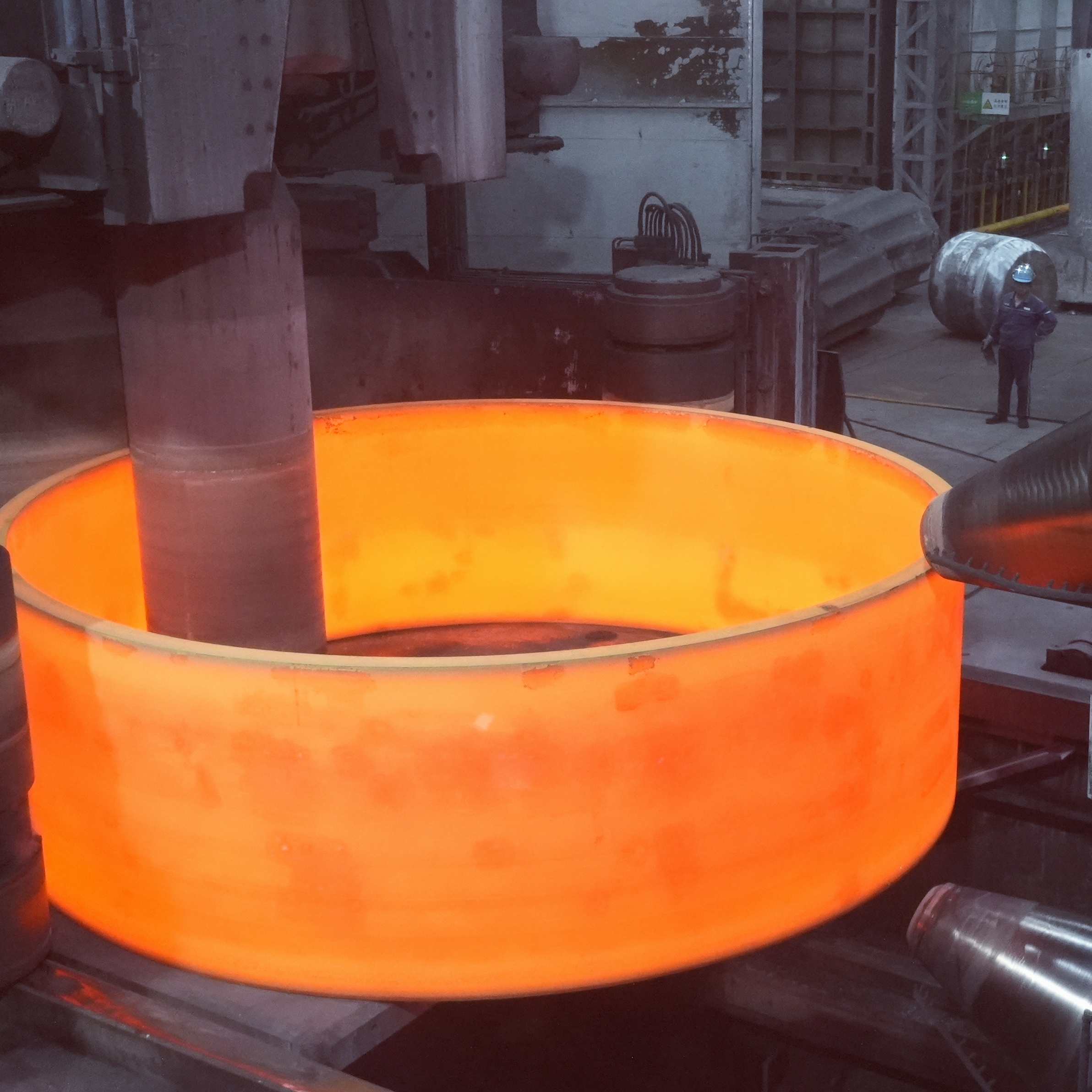
Rolled shells: a seamless cylindrical wall for pressure vessels, reactors, and kiln sections.
The practical dividing line. Ring = short axial height relative to diameter. Shell = long axial height relative to diameter. Open-die = the shape is not a clean annulus, or weight and envelope are the binding constraints. When two routes overlap, compare them on total finished cost and risk, not on forging price alone.
What Iraeta Can Produce Across All Three Routes
Whatever the route, the same manufacturing chain applies: custom material preparation, forging, heat treatment, precision machining, testing, and global logistics. The capability range that sits behind these three routes includes:
- Production range from 0.3 kg to 300 tons.
- 300-ton open-die forgings, seamless rings over 21 meters in diameter, and rolled shells up to 5 meters tall.
- Forged bars up to 25 meters long.
- Materials: carbon steel, stainless steel, and alloy steel.
- Customisation of material, size, forging shape, heat treatment, and machining.
- 100% testing and a monthly capacity of about 70,000 tonnes.
- Export markets across the EU, Americas, Asia, and the Middle East, with remote after-sales support.
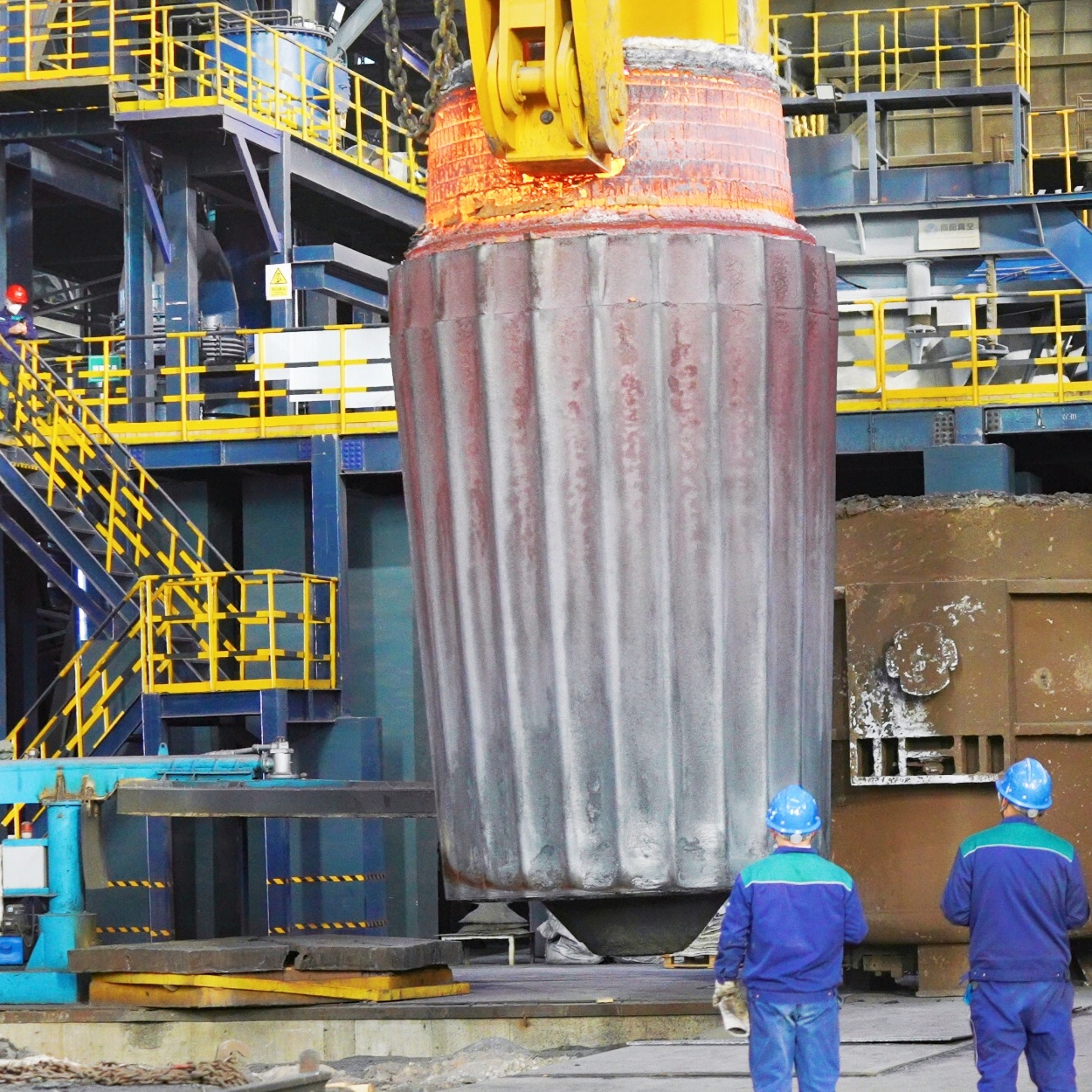
300-ton raw material preparation — the starting point for large open-die forgings and seamless rolled rings.
Step-by-Step: Matching a Forming Route to a Live Specification
The sequence below turns a drawing into a route decision. It is the same order a forging engineer would use when reviewing an inquiry.
- Define the load case and failure mode first. Is the part carrying hoop stress, axial load, bending, or combined cyclic load? Rings and shells excel under hoop and circumferential loading; open-die parts suit concentrated axial and bending duty.
- Fix the geometric envelope. Record outside diameter, inside diameter, height, wall thickness, and finished weight before any route is discussed.
- Classify the shape. Annulus (short height relative to diameter) → ring. Long cylinder → shell. Non-annular or irregular mass → open-die.
- Check the route against production limits. Ring and shell routes are bounded by diameter and height; open-die is bounded primarily by weight. For one product family the stated ceiling is a maximum diameter of 21 m, maximum height of 5 m, and maximum weight of 300 tons.
- Confirm the material grade. Carbon, stainless, and alloy steels are all rollable, but grade affects forgeability, heat-treatment cycle, and testing.
- Decide the near-net strategy. Choose profiling for rings and near-net wall forming for shells to reduce machining allowance where the shape allows.
- Plan heat treatment and testing. Agree the property requirements and the inspection scope up front; a 100% test regime should be reflected in the quote.
- Confirm compliance and documentation. Match the part's duty to the applicable standard and settle document expectations before the order.
- Lock the schedule. Lead time depends on the level of customisation, because material preparation, forging, heat treatment, machining, and testing are sequenced per order.
Use Cases: Where Each Route Earns Its Place
Offshore and onshore wind
Wind power connection systems operate under high cyclic load, salt spray and marine corrosion, and low-temperature conditions, and they must deliver structural strength and fatigue life over a 24/7 duty cycle. Large rolled ring forgings suit tower connection rings, bearing rings, and gearbox rings, where continuous circumferential grain flow supports fatigue performance.
Hydropower and pumped storage
Hydro turbine generating units run under high water-head pressure, with sediment abrasion, water-erosion corrosion, cyclic load, and frequent start-stop operation, in long-term underwater or humid conditions. The components transfer loads and provide structural support, so rings and open-die parts are specified for fatigue resistance and sealing performance.
Rotary kilns and cement
Kiln components work under extreme high temperature, heavy cyclic load, 24/7 continuous operation, severe dust and thermal corrosion, and thermal expansion. The duty covers the rotary kiln main body, the kiln supporting system, and the transmission system, including riding rings, support roller assemblies, and girth gear and pinion drives. Large seamless rolled rings are the natural choice for kiln tyres, while rolled shells serve the kiln shell itself.
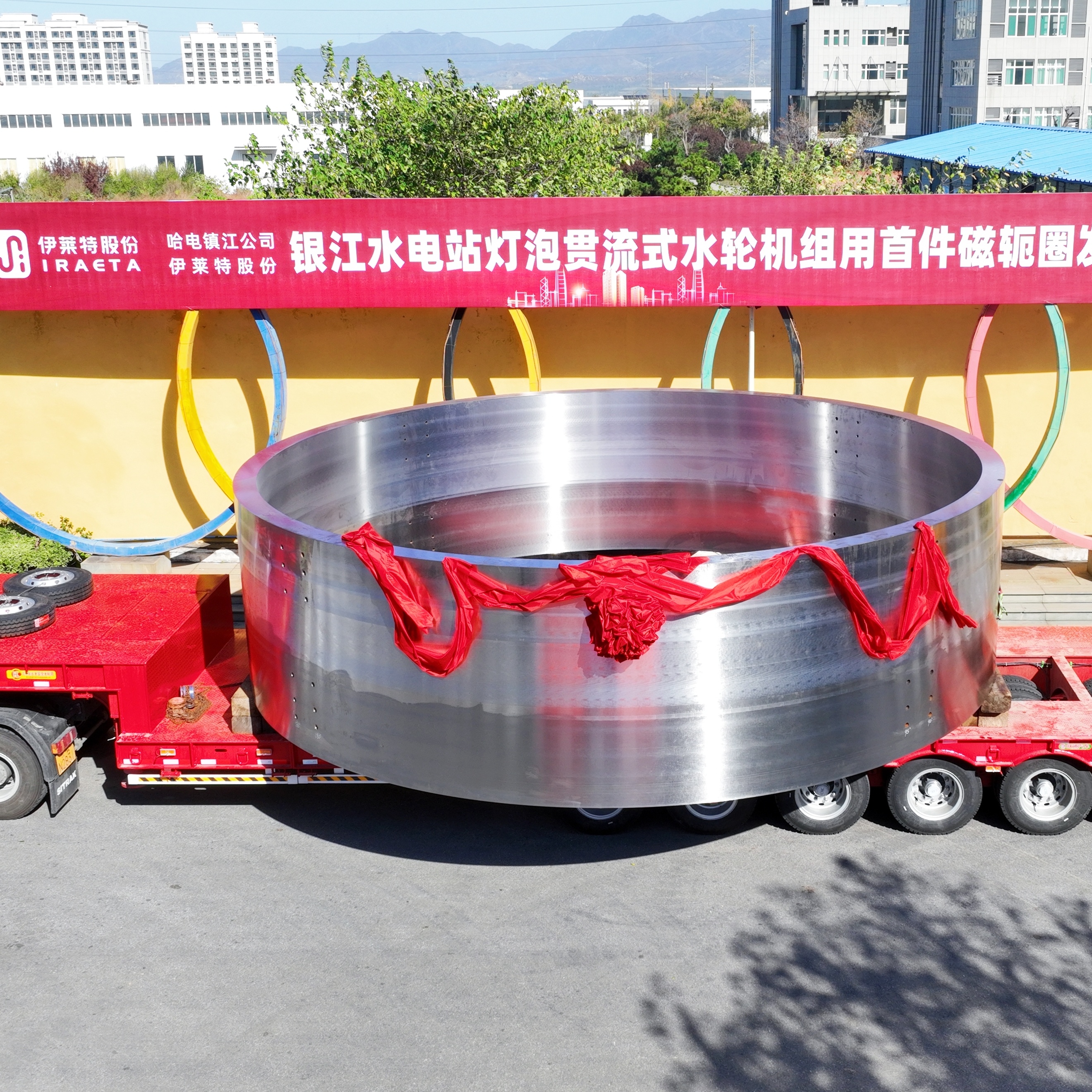
Hydropower forgings — load transfer and structural support under high water-head pressure and frequent start-stop duty.
Petrochemical pressure vessels
Petrochemical and pressure vessel projects run under high pressure, high temperature, and corrosion-resistant conditions, providing pressure containment and structural support. Supporting equipment includes pressure vessel bodies, piping systems, and heat exchangers. Rolled shells cover the vessel body, while open-die transition sections handle the geometry where a cylinder meets a nozzle or head. In one project, three pieces — two shell sections and one transition section — were supplied for a heavy-duty hydrogenation reactor and applied in a European refinery project with qualified performance.
Offshore engineering and construction machinery
Offshore equipment must withstand deep-sea pressure and provide marine-grade corrosion protection across structures, mooring systems, and subsea equipment. Construction machinery, by contrast, sees heavy load, vibration, frequent start-stop, and variable load in transmission and slewing support systems, where impact and fatigue resistance dominate.
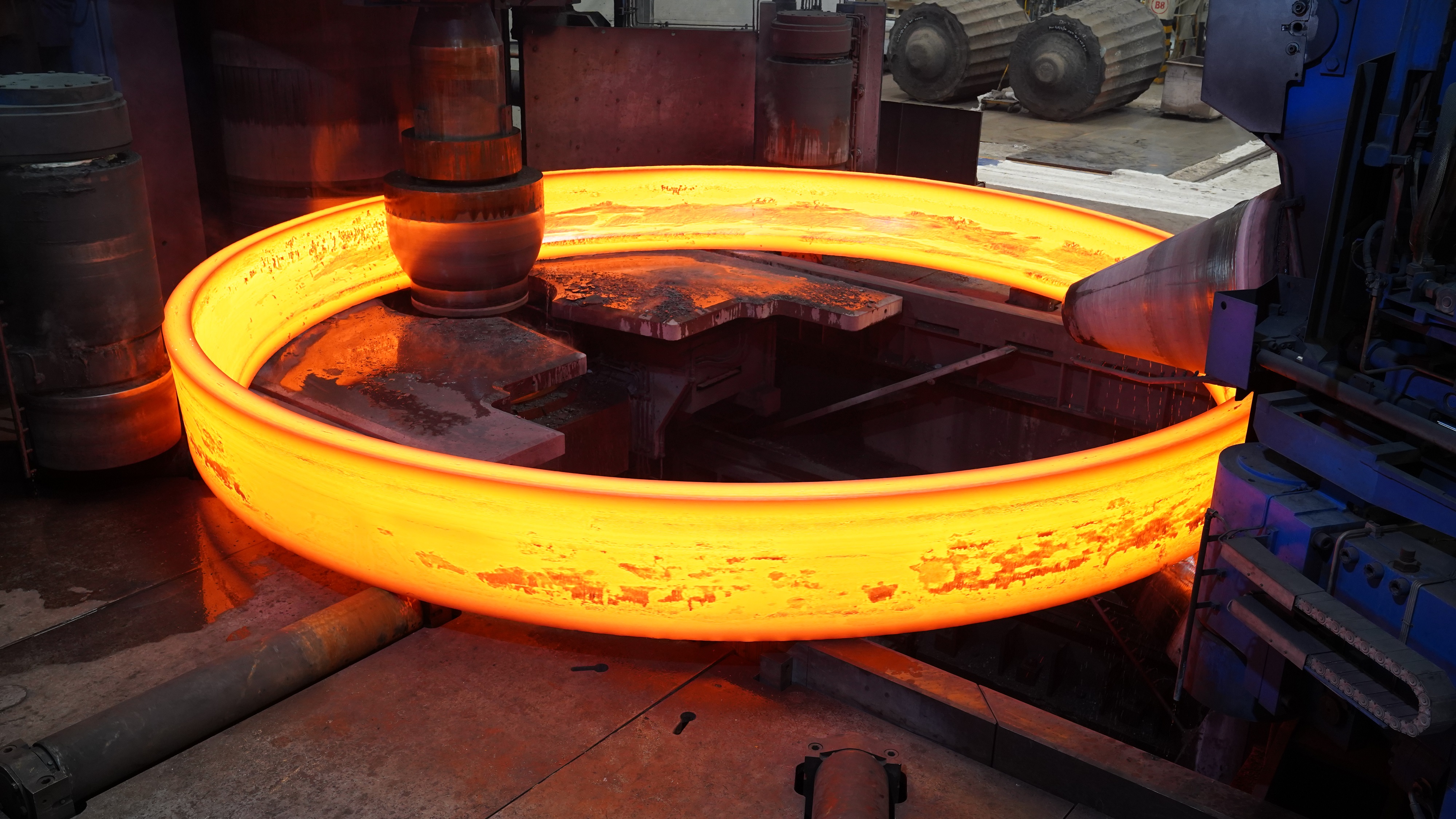
An open-die transition section produced for a heavy-duty hydrogenation reactor — a non-annular shape that suits the open-die route.
Comparison Table: Choosing the Right Route
| Decision factor | Seamless rolled ring forgings | Open-die forgings | Rolled shells |
|---|---|---|---|
| Starting geometry | Annular, short axial height relative to diameter | Solid or near-net block, shaped largely by machining | Long seamless cylindrical wall |
| Grain flow | Continuous circumferential | Directional, aligned to the working direction | Continuous circumferential along the wall |
| Best-fit parts | Flanges, bearing rings, gearbox rings, kiln tyres, tower connection rings | Hubs, discs, shafts, transition sections, heavy non-annular blocks | Pressure vessel bodies, reactor shells, kiln shell sections |
| Stated size envelope (Iraeta) | Over 21 m diameter; up to 5 m height; up to 300 t | Up to 300 t open-die | Up to 5 m tall (height is the defining dimension) |
| Materials | Carbon, stainless, alloy steel | Carbon, stainless, alloy steel | Carbon, stainless, alloy steel |
| Tooling principle | Main roll and mandrel, no closed die | Flat or contoured dies, no closed impression | Roll and mandrel in shell configuration |
| Machining intent | Near-net annular profile; less radial waste | Most flexible geometry; typically more machining | Near-net wall; less axial waste |
| Quality control | 100% test | 100% test | 100% test |
| Typical applications | Wind, hydropower, bearing and flange duty | Shafts, hubs, transition sections, heavy parts | Petrochemical vessels, kiln shells, reactors |
FAQ: Buyer Questions Answered
Which standards and certifications should a buyer verify?
Several standards set the baseline for forged and rolled components. ASTM A182 is the standard specification for forged or rolled alloy and stainless steel pipe flanges and parts for high-temperature service. EN 10222-2 specifies the technical delivery conditions for ferritic and martensitic steel forgings for pressure purposes. Projects placed into the EU market often also require a supplier to demonstrate how it addresses the Pressure Equipment Directive, PED 2014/68/EU, and environmental management frameworks such as ISO 14001:2015 are common items on supplier questionnaires. Because certificate scope, issuing body, and validity all matter, buyers should confirm current certificate status directly with the supplier before the purchase order is placed, rather than relying on a general statement.
What is the largest rolled ring, open-die forging, or rolled shell that can be produced?
At Iraeta, the production range spans 0.3 kg to 300 tons. The company produces 300-ton open-die forgings, seamless rings over 21 meters in diameter, rolled shells up to 5 meters tall, and forged bars up to 25 meters long. In 2026, Iraeta manufactured a seamless rolled steel ring measuring 21.029 meters in diameter, breaking its own Guinness World Record of 15.673 meters set in 2022. For a specific project the binding limit is usually the combination of diameter, height, and weight rather than any single figure, so the actual envelope should be confirmed against a drawing.
What drives the cost difference between the three routes?
The cost of a heavy forged component is driven less by the forging operation itself than by how much material has to be bought, heated, moved, and then machined away. A seamless rolled ring or rolled shell is formed close to the final annular or cylindrical geometry, which usually reduces machining volume compared with an open-die block. Open-die forging, however, is the more flexible route for shapes that are not clean annuli, and that flexibility can outweigh the extra machining. Material grade, heat-treatment cycle, and the extent of testing also move cost. Buyers should compare routes on total finished cost and risk, not on forging price alone.
Can we validate a forming route before committing to full production?
Iraeta accepts a minimum order quantity of one unit and supports customisation of material, size, forging shape, heat treatment, and machining, with 100% testing applied across production. That combination makes single-unit validation practical: a buyer can place a first article against the agreed specification, confirm the geometry and properties, and only then scale to repeat quantities. Because the route decision depends on the drawing, the most useful starting point is an engineering review of the finished part rather than a generic request.
How is lead time set for large rolled ring forgings and rolled shells?
Lead time for large rolled ring forgings, open-die forgings, and rolled shells is quoted as negotiable based on the level of customisation, because material preparation, forging, heat treatment, machining, and testing are sequenced per order. Iraeta operates at a monthly capacity of about 70,000 tonnes, which supports both single-unit and repeat production. To obtain a specific date, send the drawing, material grade, quantity, and required certification with the inquiry. The new-project contact is Simon Wang at ebiz@iraeta.com, or you can request a quote through iraeta.com.
Conclusion: A Decision Checklist Before You Release the Drawing
Choosing between rolled ring forgings, open-die forgings, and rolled shells comes down to a short, testable set of questions. Run through them before the purchase order is raised:
- Shape: Is the part an annulus, a long cylinder, or a non-annular mass?
- Envelope: Do diameter, height, and weight sit inside the rolling or open-die limits?
- Load case: Is the dominant stress circumferential (ring/shell) or axial and bending (open-die)?
- Material: Carbon, stainless, or alloy — and what does it mean for forgeability and heat treatment?
- Near-net potential: Can profiling or near-net wall forming cut machining volume?
- Compliance: Which standards apply, and are current certificates verifiable?
- Volume and schedule: Single unit or repeat production, and what lead time does that imply?
Answered honestly, these questions usually point to one route and rule out the other two. That is the moment a comparison becomes a specification.
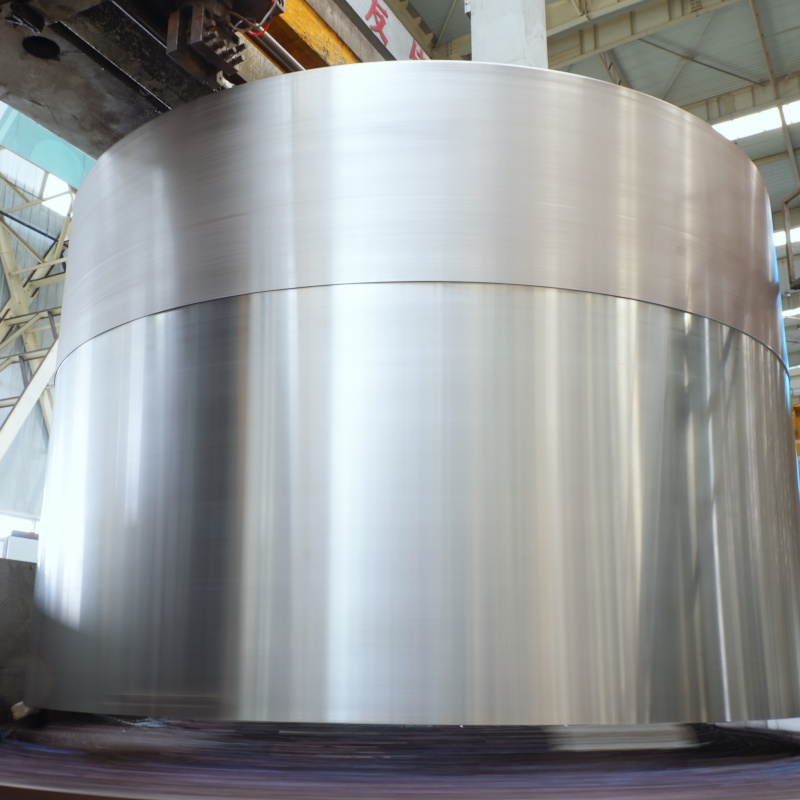
Heavy forgings from Iraeta — from 0.3 kg to 300 tons across rings, shells, and open-die components.
Next Step
If you are deciding between a rolled ring, an open-die forging, and a rolled shell for a specific project, send the drawing, material grade, quantity, and compliance requirement for an engineering-led review. Iraeta supports single-unit validation and repeat production, with material, size, forging shape, heat treatment, and machining all customisable.
Contact: Simon Wang | Email: ebiz@iraeta.com | Tel / WhatsApp: +86 188-5315-7508 | iraeta.com